Ask ChatGPT


 EUVC
19 Nov 2026 · 25m · 14 chapters
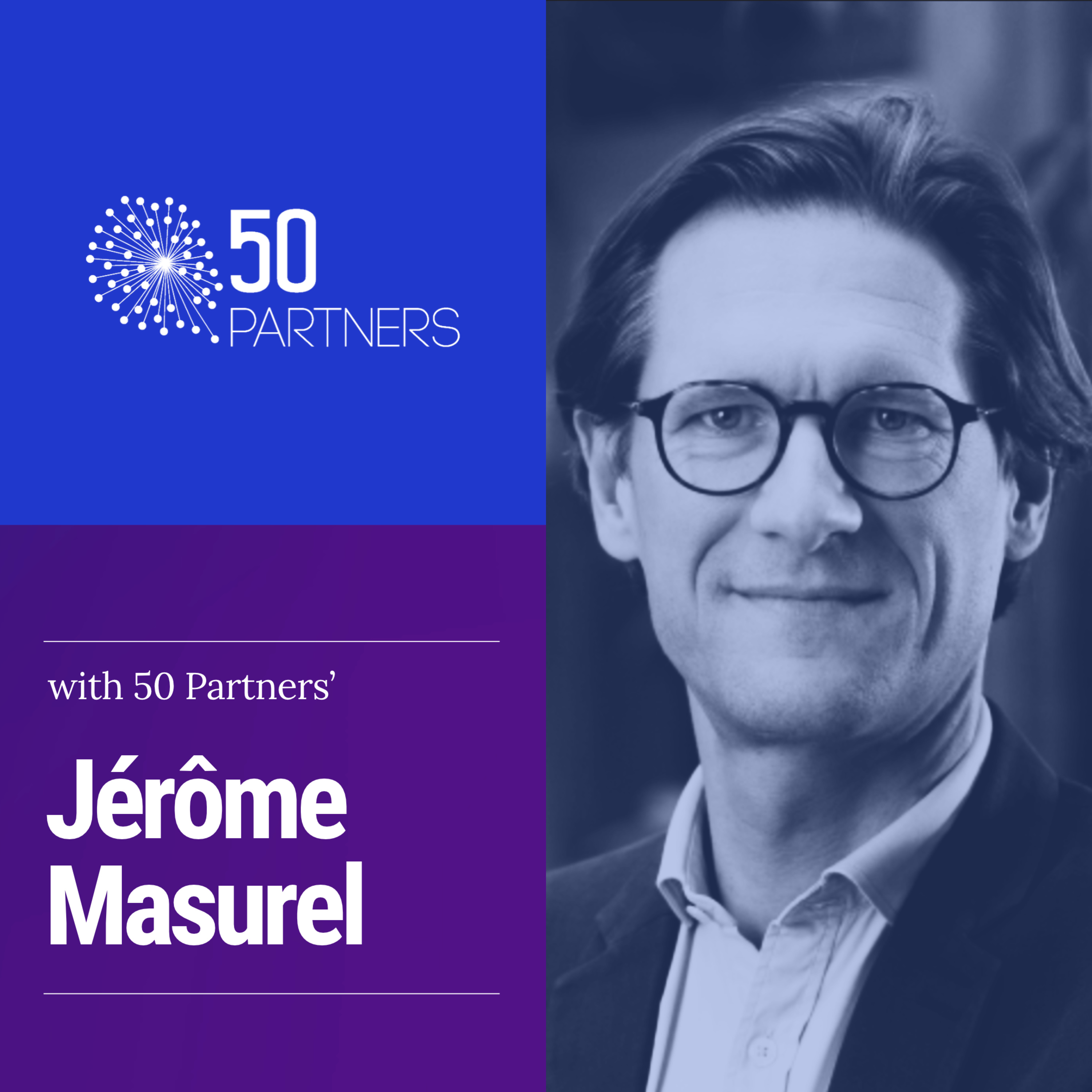
Jérôme Masurel (50 Partners) argues venture shouldn’t rely on a power-law bet that 2% of portfolio companies will cover most failures; instead, build an ecosystem that actively helps startups grow, aiming to reduce early-company death rates while still enabling “moonshots.”
Jérôme Masurel is founder of 50 Partners (started 2012). He previously worked in incubator/venture in London (1999), Next Stage Venture in New York (2000), and Rothschild’s venture arm (2002; later spun into Kinsight Capital). He also created an “aggregator” equity-swap/community model (2004–2010).
venture can’t be “praying for unicorns”; 50 Partners targets 80%+ success/active companies after 5 years (vs ~80% dying before 5 years). They take ~7% service-for-equity and co-invest 10–20%.
exits with ~30X; a company aiming for ~50X; thematic vertical funds: Digital (start), Impact (2018), Healthcare (2021), Blockchain (2023).
Written by AI. May contain mistakes.
Jérôme discusses the limitations of traditional venture capital models.
“Today, I am live from Luxembourg Venture Days in the studio with Jerome Massarel from 50 Partners.”
A look into Jérôme's background and his experiences in various ventures.
“And we can see that with LPs and with everything in the industry, not happy with having those fail rates, I would say.”
Jérôme elaborates on the aggregator model and its community focus.
“And yeah, and I started the aggregator model in 2004.”
The importance of creating a network of supportive entrepreneurs for startups.
“And I think that this power could be very useful for new entrepreneurs or new founders for startups.”
Exploring the foundational idea and goals of 50 Partners in venture capital.
“I think everybody sees that even in the venture capital area with operating partners coming in those funds.”
Discussion on the different thematic funds and their regional focus.
“I mean, building an ecosystem able to support the companies and change statistics in venture capital was something that was the main idea of 50 Partners, I would say.”
Jérôme discusses how satisfaction and performance are measured at 50 Partners.
“Yeah, because we are really close to our funders and the teams and we need to be next to them.”
Explanation of the service-for-equity model and its implications for startups.
“Because it's one thing to build a portfolio that doesn't die, it's another thing to build the one that actually delivers returns.”
Learn about the service-for-equity model and its implications for startups.
“And if everybody is happy, it shows that we are able to bring a lot of value on the table.”
Discover how the investment strategy leads to high success rates among startups.
“The good news is that today we are considering great performance out of those both acceleration companies and VC funds.”
Understand the importance of maintaining a healthy portfolio while pursuing high-reward investments.
“For example, we are dealing with a company that is able to do a 50X in the next year or so.”
Explore the complexities of managing a diverse group of entrepreneurs and the operational toll it takes.
“And it's not to say that it's not as important or as potentially profitable route.”
Learn how to effectively engage and utilize a large group of partners and shareholders.
“helping funders find solutions to keep on growing as fast as possible.”
Discuss the integration of AI in business models and the evolving nature of networking and introductions.
“That's 50 active partners because of the acceleration program plus LPs of the fund.”

Get the gist, explore an idea or ask about something said.
 Claude
On EUVC, what are the key points of this episode?
Searching your listeningAutomatic transcript. May contain errors.
0:00And when you are an investor, you cannot keep on investing in those companies and praying for having a unicorn or one or two success stories in the portfolio to pay for all those fails, I would say. It's not satisfying to work like that. You can gather great people, put them on the wall or on a website and say, hey, those guys are with us and that's fine. But having the ability to involve them really in supporting the company and having an organization dedicated to find the right people at the right time for the right company, considering their own problematics, that's something really different.
0:33but that does not prevent you from having moonshots. And I mean, we also have great companies that we already have done exits with 30X on some company, very recently, but we are not chasing that. I mean, our goal is not to make money. Again, the consequences that we will make money, but what we're building is building value to help innovation happen. We are live. We are live. In five. We are live. Four.
1:04Jérôme Masurel: We are live. Three. We are live. Two. We are live. One.
1:18Jérôme Masurel: Welcome to the European VC Podcast. Today, I am live from Luxembourg Venture Days in the studio with Jerome Massarel from 50 Partners. You were just at the main stage talking to the audience and now we're having a follow-up conversation here. I've been looking forward to it because 50 Partners is a quite different model and take on venture than the usual one. Before we dive into it though, I think we should just lay out your story because your story takes us perfectly into why did you think that the world needed 50 Partners? Yeah, we're trying to do things a bit differently, I think. yeah I started the sorry and now you said a bit differently like you're flying head first into or against the belief that venture is a power law driven industry and you cannot and you just have to accept that 2 % of your companies or 2 % of your companies in your portfolio are going to drive all the positive outcomes you're saying I don't believe it has to be like that, that's what you feel we believe we can fight that I changed that and it's not satisfying to keep on having those statistics in the venture capital.
2:32And we can see that with LPs and with everything in the industry, not happy with having those fail rates, I would say.
2:40Jérôme Masurel: And I wanted that upfront in our conversation here because I'm sure that a lot of the VC nerds that are listening into this episode will have a strong view either pro or against what you're saying. So with that said, now let's go through your story. You started in 1998 in venture? Yeah, in 1999 in the incubator industry at that time in London. A lot of organization was dedicated to support web, internet companies at that time. So that was funny to be at that time. I then joined Next Stage Venture, which started in New York at that time in 2000. So I spent a year in New York starting a fund from scratch at a time where things were really exciting.
3:30So that was really interesting too. I also joined the Rothschild Bank private equity arm or venture capital arm, I would say, in 2002. And yeah, that was really interesting to see that. how venture capital investments were done at that time, especially in a bank like Rothschild. Well, the company actually, well, the fund spun off and became Kinsight Capital. That's probably, you know. And yeah, and I started the aggregator model in 2004.
4:08Jérôme Masurel: Which is already a very interesting take on venture. So let's just expand a little bit on the aggregator model because that is a very different model from anything that's in the market. I've seen one other play. One of the founding partners, or one of the first investors in Auto One out of Germany, have founded something now called Accumulator, which I think is very interesting. We've done an episode with that, or with him in the past. That model was an equity swap for founders from very successful companies, Decacorn companies typically to be able to swap their equity for slicing the funds so that they automatically would have more widespread investment exposure than just from their own company.
4:53Jérôme Masurel: You did something similar can you just expand on that? Yeah that was back in 2004 until 2010 actually and the idea was to exchange equity between the founders who would like to build a network of entrepreneurs able to support themselves and create a link between those founders. So there was mainly an idea of linking all the members of these networks instead of financial consideration I would say. But yeah every founder were promising actually we're not giving it was a real swap of equity but promising part of their own equity in their company in exchange for part of the whole fund that was having all those shares so every time a company was sold there was some distribution to all other other founders so that was a really interesting model and the main output was this link between the founders and the network of entrepreneurs that was really powerful I would say.
6:04So yeah that was an interesting model and I'm sure there's some similar model around Europe that are working pretty well.
6:12Jérôme Masurel: And that was of course because that the founder of Aggregator decided to focus more on the community side and use that. I think there's a really interesting iteration on this that you can take forward where it's still equity and investment focused, but also with a very strong focus on community and bringing founders together, which is, of course, then 50 partners. Yeah, I think I experienced the power of a network of experienced entrepreneurs between themselves, I would say. And I think that this power could be very useful for new entrepreneurs or new founders for startups. And that's why when I came with the idea of 50 partners, because I thought that venture capital was not done the right way.
7:05Because when you see the statistics in terms of performance or failure rate and success rate on early stage companies, at least 50 % of those companies that you are investing in that are going down at some point. I think that's 80 % in nature. it's 80 % of the companies that are going down before five years. So that's a huge amount of fails. And when you are an investor, you cannot keep on investing in those companies and praying for having a unicorn or one or two success stories in the portfolio to pay for all those fails, I would say. It's not satisfying to work like that. That's what you were mentioning as a power law.
7:46With the experience I had with entrepreneurs, I saw that there was another way to consider our portfolio companies and to make sure that those companies could go further and have more success if we were able to gather the best resources and build an ecosystem of resources to help those companies grow. I think everybody sees that even in the venture capital area with operating partners coming in those funds.
8:19Jérôme Masurel: Yeah, or even LPs, that you have a strong LP base that's actually exited founders and that type of thing. Yeah, so I really feel that. I think we went a bit further, building an organization dedicated to support those companies and make sure those companies grow. I think it's kind of going back to basics in venture capital because when you're investing in those companies, You're not just investing money and trying to do IRR out of those investments. You are financing companies and you're trying to build value out of those companies. So the first thing is to see how we are able to build value and to help those companies grow.
8:56And if you do that, the output, the consequence of that is IRR and performance on the funds. But that's especially true in venture capital compared to regular private equity, I would say. So I really wanted to start with that. I mean, building an ecosystem able to support the companies and change statistics in venture capital was something that was the main idea of 50 Partners, I would say. So the main resources that I thought was important to gather was successful entrepreneurs who went through the same journey and would be able to help us select and support those companies the right way. And if we were able to build a model where those founders were really involved in supporting the startups, because that's the main point.
9:45You can gather great people, put them on a wall or on a website and say, hey, those guys are with us and that's fine. But having the ability to involve them really in supporting the company and having an organization dedicated to find the right people at the right time for the right company, considering their own problematics. That's something really different and that takes time. I started 50 partners in 2012, so that's roughly 15 years.
10:12Jérôme Masurel: And we're still building out of that, and there's a lot. And you've done three thematic funds since. You've done a health-focused fund. You've got a blockchain-focused fund. Yeah. And an impact-focused fund, am I correct? We actually started with what we call digital, which is tech industry today. So we started with that. and because those ecosystem were going pretty well we were able to build three other vertical which were Impact in 2018 Healthcare in 2021 and Blockchain in 2023 and those areas those industries are specific enough to require gathering experts and successful entrepreneurs in those specific areas When you gather 50 successful entrepreneurs in the healthcare, it changes everything in terms of ability to select the right companies and to support those companies.
11:10Jérôme Masurel: And you're, of course, geographically focused on friends. Yeah, because we are really close to our funders and the teams and we need to be next to them. at some point we could consider going global and but we would have to to start a specific 50 partners in the UK or in the US or that's kind of a local but you still think that it has to have this local feel to it yeah to be yeah it's a lot about about human relations I would say because we spend a lot of time with the founders to better understand their needs if you build a platform of resource and you gather startups in those programs and say, help yourself, there are a lot of people, you can ask for advice, et cetera, you're missing something important, which is finding the right problematic for those companies.
12:08If you ask a founder what their needs are, they will ask for introduction for customers, introduction for visits because they want to raise money, et cetera. But they maybe are missing the point that they have the wrong go-to-market strategy, problematic of pricing, problematic with the human resources management, or a lot of different things that we are able from the outside to see and to try to find people who went through the same journey and say, hey, here is how I build my company culture. Here are some tips about when to go global, how to raise funds, etc. etc. And so this is important to have an external organization dedicated to organize a thing all that.
12:55Jérôme Masurel: We opened with the grand ambition being to not have the 80 % death rate, so to say, of companies. Can you tell us all about your progress on that? And then at the same time, and this question will come from everyone, of course, where are you performance-wise? Because it's one thing to build a portfolio that doesn't die, it's another thing to build the one that actually delivers returns. Yeah. Yeah, I think we first see the performance as a consequence of what we're doing. Recently, an entrepreneur asked me what is the main KPI for 50 partners, what is the key success rate for what you're doing, etc.
13:36And I answered that the level of satisfaction from the founders and from the partners are the main thing. because actually when the funders are happy is that because you are able to bring value on the table on the long run because we become a shareholder in exchange for the services we provide. So it's a 7 % share we take in those companies. So the funders are really waiting for something to happen in front of those 7%. And if everybody is happy, it shows that we are able to bring a lot of value on the table. And if you're doing that, You also are bringing the best company, applying for the program.
14:17Jérôme Masurel: So you're taking 7%, you're offering value-added services from your founder community, but you're also putting in money. So we have an acceleration model, which is a SWEED equity. It's a service for equity model. We exchange mentoring and expertise and networks and everything we can put on the table in exchange for a few shares in those companies. that is diluted in the long run and we become a shareholder, one or two percent, and we pretty much don't care about that. It's just we need to have a glue in the middle of that to be able to involve those partners and have the founders, the startup founders involved too, which is a thing really important.
15:02So that's the first model. And then the next model is the regular fund. We are a regulated management company with FPCI funds. that are investing in the best company from those portfolios.
15:17Jérôme Masurel: The equity investment side, because you mentioned the 7 % more that you get. It was important to also state very clearly that, yes, that's part of it, but you're investing so that everyone has the VC model in mind as well. Exactly. So success rate is really important. Satisfaction of the partners is really important. and then the consequence of all that, it should be performance. So I say should because that was the idea I had 15 years ago. The good news is that today we are considering great performance out of those both acceleration companies and VC funds. And we are above market. Yeah, we have really great success in those funds and that allows us to continue to grow those funds a little bit.
16:09We don't want to become a regular VC, I would say, because we are co-investors. We put a 10 % to 20 % investment in the rounds.
16:22Jérôme Masurel: And the death rate, Jerome, where are you there? Yeah, so we are the exact opposite of what we mentioned in the fail rate. We are more than 80 % success rate. We are even like 90 % of the overall portfolio. But if you're considering all the companies that have more than five years, because that's what's interesting. It's normal that a company that joined the program six months ago is not dying. But out of all the companies that have more than five years, we are more than 80 % of success or active company, I would say. and then all the vehicles we have are between 2x to 8x from the beginning. I was about to ask you exactly that question because the typical argument for the very power law driven portfolio is of course, well, if you do moonshots, it's a very binary outcome.
17:23Jérôme Masurel: Either you succeed and it goes massive or you don't. And then the model is inherently unsustainable. And that's just how venture must be played. And you're saying, no, we can do it in a different way. My counter to you is then, well, do you have any of those outlier companies in your portfolio? Or is your performance that's still good? Is that driven by having more companies with smaller outcomes, but still having all of them alive? No, I think the idea is to make sure that most of the portfolio is doing good or great and to make sure that there are not those outstanding failure rates that you don't want to have in your portfolio.
18:08But that does not prevent you from having moonshots. And I mean, we also have great companies that we already have done exits with a 30X on some company very recently this summer. For example, we are dealing with a company that is able to do a 50X in the next year or so. so we will have and maybe we'll fall on this power law because some companies will make great returns and make our fund and make most of the returns but the thing is that we are not chasing that chasing that it's part of the chance you can have as an investor to do the 100x but we don't want to expect that to make our returns.
19:04We want to make sure that we are able to make returns out of a portfolio because we bring value and we have them grow and we build value out of that and it's a bonus if we have those super returns.
19:19Jérôme Masurel: Jerome, the final question I want to ask you is, and I think a lot of people have been thinking this, oh my god managing 50 entrepreneurs that all need to add value that must be both very interesting but also had a headache and an operational toll yeah can you shed a bit of light on how you do that and what you've learned and what you definitely shouldn't do if you're pursuing a model where you're engaging entrepreneurs like this yeah that's the main thing about our model that's probably also the reason why nobody's doing 50 partners model I was always asked is there other 50 partners around Europe or around the world and the reason why nobody tried to do that I think is that it's a lot of work a lot of it's pretty expensive to build this solution and it's not as interesting in terms of management field I would say compared to other funds or other model but it's something that I strongly believe in in on the long run I mean building this ecosystem being able to help those companies will allow was to grow on the long run and to be a real solution in terms of, I would say, in virtual capital.
20:33Jérôme Masurel: Well, and to be fair, I think we also all get to a point in our life where we might realize that, okay, there's one way where I can get massively wealthy and I can go that route or I can do something that I believe in more myself and will enjoy more in the day-to-day. And it's not to say that it's not as important or as potentially profitable route. It's just not the cookie cutter route that you know will work and everyone will accept. I think the best example is we all know that we could make more money in normal private equity. Still, we are in venture. It's typically because it's a more rewarding job in the day to day.
21:11Yeah, it's true. And yeah, I think that's part of what we want to do. I mean, we are 25 people in the team at 50 Partners and we are all passionate about what we're doing and what we're doing is not making money. I mean, our goal is not to make money. Again, the consequence is that we will make money. But what we're building is building value to help innovation happen, helping funders find solutions to keep on growing as fast as possible. So it's more about human relations. And so, yeah, it's a lot of work. I mean, we're not 50 partners. There's actually 500 shareholders at 50 partners because we have 50 partners multiplied by the four verticals, which has 200 partners.
21:54And there are different vehicles. So that's 300 partners. And on the funds we are running, there are also regular LPs, I would say, that want to be part of venture capital without part of the risk, I would say. And so we are now family offices or institutions, corporates that are joining our LPs. So that's 500 shareholders. And that's 500 persons and organizations that we are able to evolve in supporting those. How do you do that? What's the operational method
22:26Jérôme Masurel: that allows you to utilize these 500? So actually, there's one team per vertical. So each team is in charge of one ecosystem. That's 50 active partners because of the acceleration program plus LPs of the fund. So they're roughly dealing with 100 people. So that's an amount of people that you can deal with and you are able to know everyone and know the expertise everyone can bring on the table. But when I named the company 50 Partners, I was dealing with not small is beautiful, but a limited amount of people that you want to work really closely, close to bring this value. So we all know that AI, of course, is very interesting because it's permitting business models that were never really possible before.
23:18Jérôme Masurel: I personally have always that I'm never going to do an introducer business because it's just too heavy. Like the operational toll of doing an introduction based business is very, very intensive and is not my skill set. It's not how I work, that kind of thing. I am now very much in the introducer business with the UBC because I can see that, wait a second, And now that I have a perfect transcript of every single conversation, that allows me to have a much more in-depth CRM system. And I all of a sudden very easily can poll, this person is a perfect match for these 20 people. I've never wanted to do that before, but now I'm very much wanting to do that.
23:59We are definitely using those tools. I mean, we're dealing with a lot of large amount of information from the startups and from the partners. and we're able to help the teams find the right connection, but doesn't prevent you from doing the connection, having this person on the phone after the meetings to get the feedbacks, etc. So we are definitely more powerful with those tools, but doesn't change the heart of what we build.
24:30Jérôme Masurel: No, it absolutely still is a human business. It's just the fact that that plucking in between is completely on a different level today. RepoFool, yeah. Yeah.
What if venture returns did not have to depend on a tiny number of breakout companies?
Jérôme Masurel, Founder and CEO of 50 Partners, argues that investors should focus more on helping a larger share of their portfolio companies succeed, rather than accepting high failure rates as inevitable.
Recorded live at Luxembourg Venture Days, the conversation explores the model 50 Partners has built around experienced entrepreneurs actively supporting startups and why that support needs to go far beyond simply having impressive names in a network.
Jérôme also explains how the firm combines acceleration and investment, why reducing failure does not mean giving up moonshots and why 50 Partners does not want its returns to depend on finding a single 100x company.
The conversation also touches on how AI can help manage a large, relationship-driven ecosystem without replacing the human work at its core.
Highlights
Why Jérôme challenges the traditional venture power law
Building a portfolio around more companies succeeding
Why founder networks need active orchestration
How 50 Partners combines acceleration and investment
Why lower failure rates do not rule out moonshots
Building value first and treating returns as the consequence
How AI can strengthen a relationship-driven venture model