In short
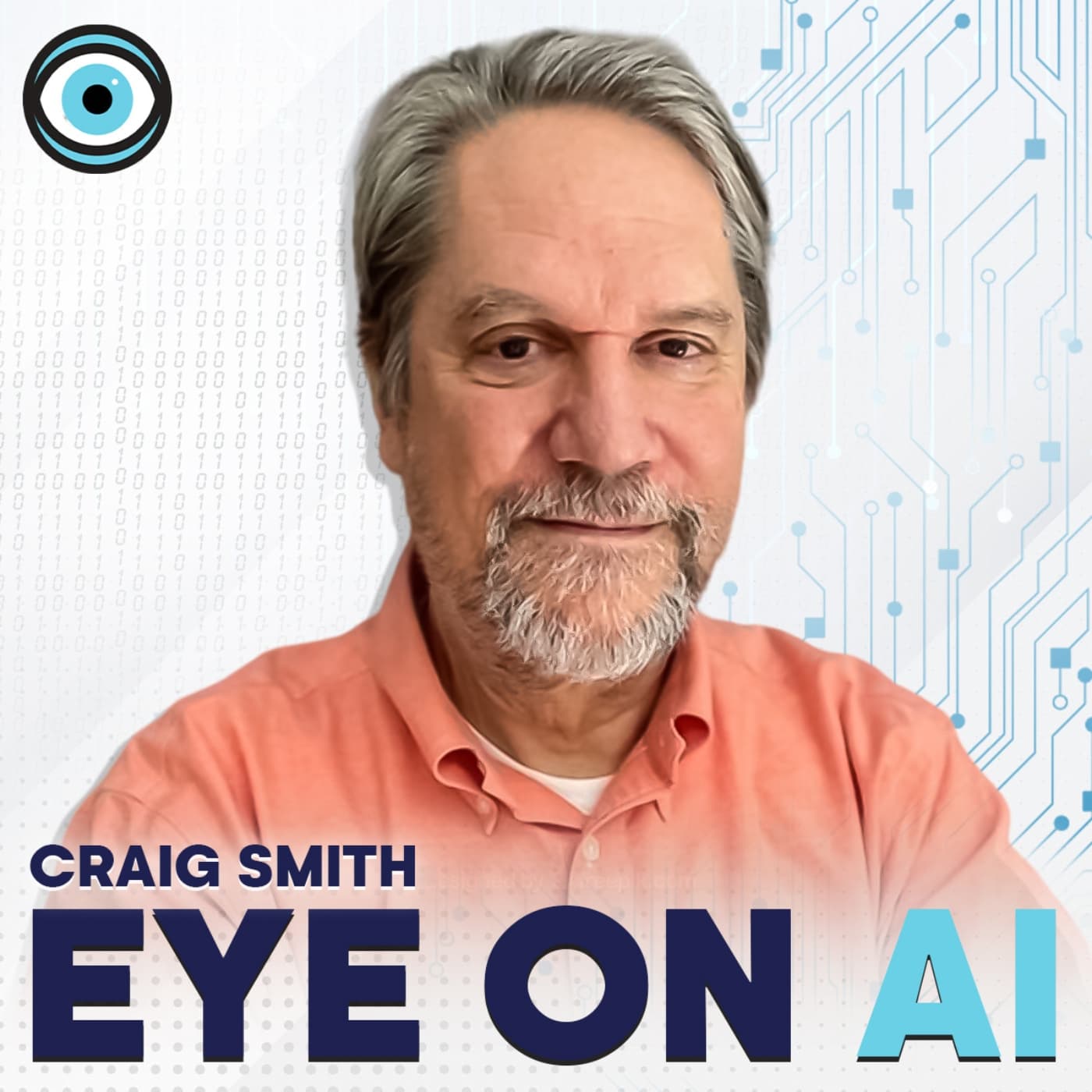
Eye On A.I. - Episode #139: Dmitry Shapiro: Breaking Barriers with No Code AI
Podcast Overview Host: Craig S. Smith Guest: Dmitry Shapiro, Founder of YouAi and CEO of GoMeta Duration: Approximately 1 hour and 1 minute Sponsorship: Supported by Shopify
---
Episode Summary In this episode of Eye On A.I., Craig Smith interviews Dmitry Shapiro, who discusses his latest venture, YouAi, which aims to democratize artificial intelligence by allowing users to create AI applications without any coding experience. The conversation covers various aspects of artificial intelligence, particularly its transformative potential in education, content generation, and personal assistance.
Key Topics Discussed
- Dmitry Shapiro's Background
- Former roles at Google and MySpace, and experience with venture-backed startups.
- Transition to leading YouAi, focusing on building accessible AI tools.
- YouAi's Mission
- Designed to enable users to create AI models easily through a no-code interface.
- Aims to make generative AI accessible to everyone, not just developers.
- Mind Studio
- A tool within YouAi for creating and deploying AI applications quickly and intuitively.
- Users can develop AI-driven apps that cater to various needs, such as content generation, parenting assistance, and more.
Key Concepts
- Personalized Education through AI
- AI can assist in bridging knowledge gaps by providing personalized learning experiences.
- The potential for AI to act as a “mind reader” that recognizes an individual’s learning needs.
- Mind Indexing
- A concept where users can input personal data to enhance AI interactions, allowing for customized contextual assistance.
- The importance of understanding ambiguity in user needs and how AI can fill knowledge gaps.
- Generative AI in Everyday Applications
- Examples of AI applications such as parenting assistants, personalized story generators for children, and summarization tools for Reddit.
- Emphasis on creating intuitive experiences that cater to individual user preferences.
Discussions and Insights
- AI's Role in Content Creation
- Discussion on how generative AI tools can streamline content production and enhance creativity.
- Potential to replace cumbersome prompt engineering with more natural user interactions.
- Need for Contextual AI
- Current AI lacks the ability to deeply understand the user’s context, which can lead to inefficiencies.
- Future AI should leverage user data to provide better recommendations and insights.
- Business Model of YouAi
- Currently funded through venture capital, with future plans to monetize through subscription models for AI applications created by users.
- A commission model for revenue-sharing when users monetize their applications.
Future Directions
- Expansion of Mind Studio
- Plans to enhance the features of Mind Studio allowing for more complex interactions and third-party integrations.
- Introduction of a pro tier for users seeking advanced capabilities and analytics.
- Long-Term Vision
- The goal is to create a more profound human-AI interface by indexing users’ minds and leveraging that data for better AI responses.
- Exploration of how digitizing personal preferences and experiences can improve human communication and collaboration.
---
Conclusion The episode wraps up with Dmitry sharing insights on the transformative impact of AI technologies in personal and professional domains. The overarching theme is that while the singularity may not be near, the rapid evolution of AI is set to redefine human interaction with technology.
---
Additional Notes
- Links & Resources
- [YouAi](https://youai.ai)
- [Shopify Trial Offer](http://shopify.com/eyeonai)
- [Craig Smith on Twitter](https://twitter.com/craigss)
- [Eye on A.I. on Twitter](https://twitter.com/EyeOn_AI)
---
This episode serves as an insightful exploration into the future of AI and its applications, making it a must-listen for those interested in the intersection of technology and daily living.
Written by AI. May contain mistakes. Listen to the episode to check what was said.
Transcript
Automatic transcript. May contain errors.0:00If you ask ChatGPT to summarize a document, it will instantly summarize it. But who is it summarizing it for? Like let's say the document's about astrophysics. And so is it summarizing it for an eighth grader that doesn't even know what astrophysics necessarily really means? Or is it summarizing for an astrophysicist? Well, if it knows, it will summarize differently. So that's just one data point in the sense that you could pass to it in the exercise of summarization. Human salesperson can do a better job because they can see what the other party is grokking, not grokking, paraphrase, do all of that.
0:32That's how websites should be. They shouldn't be sort of pre-created. They should be these interactive things that a human shows up, says, this is me, this is my mental model, this is the digitized me. I think I'm interested in your product. Explain to me why I need it. Hi, I'm Craig Smith, and this is Eye on AI. This week I speak to Dimitri Shapiro, CEO of UAI, a platform that allows users to create their own generative AI apps without needing any coding, and a platform for distributing those apps, either for free or for profit. Dimitri also talks about Mind Indexing, a system whereby users feed personal data to a large model to enable customized contextual interactions Shapiro predicts that digitally capturing the nuances of personal context and preferences will lead to exponential leaps and AI's benefits across education communication teamwork and more I hope you find the conversation as interesting as I did.
1:52Hi. Good tech solves problems you know about. Great tech solves problems you haven't even thought about. What can the commerce platform trusted by millions of merchants do for you? It's time for Shopify, the commerce platform revolutionizing millions of businesses worldwide. Whether you're a garage entrepreneur or IPO ready, Shopify is the only tool you need to start, run, and grow your business without the struggle. Shopify puts you in control of every sales channel, so whether you're selling satin sheets from Shopify's in-person point of sales system or offering organic olive oil on Shopify's all-in-one e-commerce platform, you're covered.
2:40Shopify powers 10 % of all e-commerce in the United States, and Shopify's truly a global force, powering Allbirds, Rothy's, and Brooklyn, and millions of other entrepreneurs of every size across over 170 countries. Plus, Shopify's award-winning help is there to support your success every step of the way. Sign up for a$1 a month trial period at shopify.com slash IONAI. That's Shopify, S-H-O-P-I-F-Y dot com slash Ionai, that's E-Y-E-O-N-A-I, all lowercase, all run together. Go to Shopify.com slash Ionai to take your business to the next level today. Excuse me, sir. I couldn't help but overhear. Did you say Shopify?
3:42Oh, shopify.com slash I on AI. Oh, carry on. Yeah, so my name is Dimitri Shapiro. I am the CEO of UAI. Prior to this, I was at Google for four years from 2012 to 2016. For the first two and a half years of that, I was running product on three machine learning teams that were taking all of this implicitly collected data that Google has about people and trying to make sense of it. Prior to that, I was the chief technology officer of MySpace Music, for those folks that remember MySpace. Before that, I built two other venture-backed companies. One was a competitor to YouTube called VEOH Networks. It was a major competitor.
4:32I raised$70 million for that. Prior to that, I built a venture-backed cybersecurity company called Aconex Systems. So enterprise software, cybersecurity raised$34 million for that. And from 95 to 99, I built the web team at Fujitsu, a giant Japanese company. I started writing code in 1984 when I was in high school. I was 14 years old. I saw the movie War Games in the theater and came home and started in my school hacking around on a computer. I have a degree in electrical engineering from Georgia tech i've never done a day of electrical engineering uh i've always done uh software i'm a nerd i'm just an old nerd georgia tech i i you know i actually wanted to do their online masters in computer science and they said i needed more uh computer science courses on my on my transcript, which is 40 years, 50 years old or something.
5:33So yeah, I've never, I've never taken a computer science class or even one day of any computer science class. I'm completely self-taught as my co-founder here, Sean Thielen, who just started writing code when he was like eight years old and is infinitely better than I am actually at it. Yeah. Well, last time we spoke, you were telling me about there are kind of two sides to UAI. There's the AI marketplace side and toolkit that people can use to build conversational AI chatbots and then deploy them in the marketplace for free or for if they're paid to generate. rate revenue. And then there's the other side, which you guys are calling indexing the mind.
6:34So can you talk about those two sides, how UAI came to be and what those two sides are about? Definitely. So when I was at Google, as I said, from 2012 to 2016, I was on the main campus there and working with all of this data that Google had in order to be able to understand people and create better services for them. It became clear to me then that even though Google has an insane amount of data, being able to use that data and sort of creating real applications from it has a number of challenges. One of the major challenges that are there is that all of that data is quite ambiguous. And so it can be used for doing things like, you know, ranking ads and recommending YouTube videos.
7:32But it's really hard for you to use all that ambiguous data in creating Google Assistant, for example. And I believe this is the fundamental reason why Google Assistant at this time is still so weak is because Google doesn't have that sort of explicit disambiguated data to really be able to drive, you know, train and drive that assistant. And so I had this insight again in sort of late 2012. And now we thought was the right time to start to do some work on ideas like that. And so we've created what we call a mind indexer. Think of it. It feels like TikTok. It's a never ending feed of full viewport experiences that basically ask you for input.
8:14So it prompts you with various things, things like multiple choice questions, open answer questions, a big grid of images, and it says tap all the ones that seem yummy. So explicit signals coming out of humans voluntarily about all kinds of things, because you can sort of create prompts about all kinds of things. And so we launched that in May and invited some alpha testers to come and play. Over 5 ,000 people showed up and started indexing their minds. We've now collected over a million data points of, again, people's preferences and biases and beliefs and given sort of any scenario, how they would respond.
8:54And so that's that part of it, which is this mind indexing part of that. And sort of our belief is long term, that the right way to leverage all of the power of modern AIs, let's say these generative AIs, they're all neural networks. And neural networks are great at what? They're taking a bunch of data, and in today's world, a bunch of data that's quite unstructured, so like a data dump, and then being able to tease out statistically meaningful features and start to make predictions and all of that. And so we believe that if humans could sort of digitize their own minds and have a data set that we could then present to AI and say, this is me.
9:37You figure out what you should help me with and how you could help me. Instead of me trying to figure out how to type prompts in with my thumbs, maybe the AI could simply figure out what I need. I think one of our biggest problems as humans is we don't know what we don't know. And so how am I supposed to ask AI to help me with things that I don't even know exist? And I don't know that. I don't know it. But the AI could figure out that I don't know it. Like if you index your mind very quickly, this thing can start to figure out where you have gaps in knowledge, for example. Right. And then fill those in and then help you sort of think about things.
10:15So that's sort of that part. Yeah. In a related part. Well, actually, can we stop and talk about that for a minute? because does that alpha test or is that publicly facing, it's not on your website, is it? It is, yeah. Okay, I'll go back. At this moment, it's a bit, I think, hidden because we're promoting the Mind Studio part of the thing. Right. But it is still there, and I'll share a link with you so you'll be able to see it, and your audience can come play with it and do that. So we'll make sure the link is included. Okay. But once you've done this, say you've done it for a year and your UAI has this profile built up who I am, how then can I use that?
11:09Or how do you use that? Is there a function that's built on top of that? Yeah. So think near term and then long term. In the near term, what we can do with it, meaning what we can allow you to do with it, because you're in control of all this data. It's obviously encrypted. None of our employees have access to it, nor will ever have access to it. That data is simply used by you to be able to, in the near term, take that and pass it in as context into large language models or image diffusion models or any other models that will accept that could benefit from knowing a bit more about the user that is engaging with them.
11:52I'll give you an example. If you ask ChatGPT to summarize a document, it will instantly start summarizing it. But who is it summarizing it for? Let's say the document's about astrophysics. And so is it summarizing it for an eighth grader that doesn't even know what astrophysics necessarily really means, or is it summarizing for an astrophysicist? Well, if it knows, it will summarize differently. So that's just one data point in the sense that you could pass to it in the exercise of summarization or in the exercise of writing something for you. Write me a blog post, write me a response to an email.
12:29The more it knows about sort of you, the more it can take these things into account in its generation of content. And so in the near term, you get to sort of personalize your interactions with chat GPT, Anthropic Cloud, Llama, whatever, like any of these things. Longer term, sort of our plans with it is again, we're in a sense compiling this data set of individual people and also of many people. And we can take that data set and then we can start to either find two existing models or train new models on sort of these parameters that are represented in the output of humans, which is what these models have been trained on.
13:16All that stuff that we've written as humans that's on the internet, that's what these large language models have parsed and been trained on. But they don't have sort of any way of teasing out what created that because the data isn't there. But we think if we can take that data and merge it, we can do that. Again, that's sort of longer term vision for that. And we think long term, that's really powerful and important. And again, our sort of vision is that, again, we believe that the right way for humans to really leverage all of the innovation and information technology, because these things are going to start to accelerate.
13:56Ray Kurzweil points out information technology innovation accelerates exponentially because each new generation is built on the prior. Well, wow, what a massive step forward we've now taken to have these new models and to have transformers and to have new GPUs. All of this stuff is doing exponential. There is no way that humans can keep up with that and truly be able to leverage those things by typing words into a text prompt. That just does not make any sense to us. And so we think that, again, long term, the right interface, the right human to digital interface is of a digitized human, not of a human with fast fingers.
14:38Yeah. And I'm interested in that. The reason I'm sort of stopping you on it is I am very familiar with a company called Reed in Korea. I think I mentioned it to you last time that has a system that with knowledge tracing algorithms and recommendation engines and, you know, a collection of algorithms that as a student interface, interacts with, uh, it knows what the student is weak on and it can feed it content to, to, uh, improve on that. And, and through the knowledge tracing and the, these prediction algorithms, it can tell the student what its end score, if it's a test prep or a class is going to be in the student, the more it follows the instructions, the closer it gets to, uh, to its desired, to the student's desired score, it can see its predictive score going up.
15:45And what you're talking about sounds like it would have a tremendous, uh, human, I mean, uh, tremendous applications in education where a student, and this is the sort of thing that kids like, you know, swiping through and that it would gradually learn, you know, the student at a deeper level. So then when the student is interacting with it, it would, you know, be more efficient. It would know what kind of content recommend. Have you guys talked to anybody about using this for education? Yes. In our Discord, again, these early alpha testers, I think it's been clear to all of us that education is smack dab in the middle of all of this.
16:39That's one of the biggest things. As I said, we don't know what we don't know. All of, you know, a vast majority of things that we search for are, in a sense, could be considered as education, whether you're searching for a product or you're searching for, you know, whatever, other than like planning things that like executing on things. Um, and, and, and, you know, the education as it's always been, obviously it's evolved and it's, it's different now than it was, you know, a hundred years ago, but, but generally it's been the same where you have some curriculum that's been created and that curriculum has been created for a large group of people and, and sort of personalized learning is something we talk about, but personalized in, in sort of modern day means that it's a bit more finely tuned to a more limited set of people, but it's still generic.
17:23It's not personalized. Curriculum isn't created on demand for each individual based upon the things they know or don't know. But that's what a good tutor does. A good tutor understands by spending time with you what you know and what you don't know, and then can fill in the gaps. And those gaps are different for each one of us. And they're also obviously a function of time. And so the number one thing that we believe that, you know, our mind indexer will need to do is to, in a sense, be a mind reader that is trying to figure out, given this situation, what might you choose, right? Another way of putting it, if LLMs can be described as prediction machines predicting, you know, the next token, the next word or so, given some prior tokens, you could describe the TikTok algorithm in a similar way that it tries to predict what video it should show you next that you will engage with.
18:27You'll spend more time on, you will like, you'll comment on. Then what we need to do is, meaning our algorithm, means to predict, given any situation, what might your response be? And in learning, that's basically testing and nuancing and disambiguating and then discovering, okay, you know, Craig is weak on this. Great. Now I need to spend my time helping him understand this. But because I know that he knows this and this and this, I can use these three things, sort of as analogies, for example, to be able to then get him to see this dimension that he's missing. So education, we think, is at the heart of this.
19:09And again, if we're successful and other companies are successful in doing this, researchers, et cetera, is we'll have this incredible world where all of us are going to learn, again, exponentially faster than we've been sort of getting better at learning, because we're not going to get sort of repetitive stuff shown to us in various ways, but simply have all of those things filled in for us. Like, again, I like to think of it as like a jigsaw puzzle. And each one of us have different shapes of jigsaw pieces missing. Well, this thing should be able to figure out what the pieces should look like and simply fill them in for us.
19:45Yeah. Yeah. And by the way, that also then goes to, you know, to, you know, if you extrapolate from there, you could start to imagine that like websites are the same thing. Websites are created for the purpose of educating people. Like, buy my product. How do I get you to buy my product? I educate you on the value proposition of my product. And today they're all made for, you know, at best, you have different landing pages for different personas, right? But those are still generic. And again, this is why a human salesperson can do a better job because they can see what the other party is grokking, not grokking, paraphrase, do all of that.
20:20That's how websites should be. They shouldn't be sort of pre-created. They should be these interactive things. that a human shows up, says, this is me. This is my mental model. This is the digitized me. I think I'm interested in your product. Explain to me why I need it. I mean, that all goes unsaid. That's the expected relationship. And then the thing simply creates the content on the fly for me. And that's different than the content they would create for this person or that person. Still be about the same product, but using different words, different analogies, different level of communication, less sophistication, more sophistication, you know, regional constraints.
21:00There's all kinds of things that could be marvelous once the thing can figure out who is it talking to, like who's the user. I think that's the number one missing set of variables, who's the user. And then MindStudio, when did that project develop? It's from what I can see, the tools that allow people to build apps are leveraging generative AI. It's mostly chatbots. Is that right? No, I wouldn't say that. Uh, it's actually mostly things that are like, I think it was like AI driven apps where the logic of the app is AI, but the app itself might be like, there's a bunch of content generators or things that help you figure out how to name your YouTube video.
21:55You know, the output of them is text and sometimes images. And some of them allow you to have a chat window to continue chatting with it and disambiguate, for example, or get it to do other things. Other ones that are built with Mind Studio don't even have that. They just sort of end and you can start a new activity, like new document. And so and certainly you can obviously build chatbots with it as well. We now have over a thousand, as of this weekend, AIs that have been created in the last month and a half since we launched it. And if you just go to uai.ai, Y-O-U-A-I.ai, you can just browse through, you know, over a thousand of these AIs in categories in many different purposes.
22:39Yeah. So how we got to that is, again, once we got these alpha testers in to start to digitize their minds and started talking to them, again, people were excited about the long term vision that we've been discussing, but also super excited about like, what could we do with this kind of stuff right now? And again, one of the things that was clear is like, you know, ChatGPT, Claude, et cetera, can take contextual guidance, right? This is sort of part of the prompt or the system message to put them in the right frame of mind to be able to respond to us and get us what we want. And that consumers shouldn't have to be the ones typing this in.
23:20Meaning if I want to use ChatGPT to generate blog post content for me today, I would need to show up and start typing, you are, again, you can paraphrase this, but some people get extremely verbose. You are a professional blog post creator with 40 years of experience, blah, blah, blah, blah, blah. I'm going to give you titles and you will give me back a blog post. I will need it to be formatted, backspace, backspace, backspace, structured. This doesn't make sense for consumers to do. And so it became very clear that it would be awesome to simply build a system that would allow people that do want to do prompt engineering to do that and package that as a simple interface for consumers to show up and just create a blog post or just get help on naming YouTube videos or just get a parenting co-pilot or get a personalized storybook generator for their kids or get diagnosed with various ailments that they have.
24:16We have a thing called AI Medic or get their pet diagnosed with various ailments because We have an AI vet or figure out when to plant their tomatoes in Southern California versus Northern California because we've got AIs for gardening, right? And so all of those things have been created by, let's call them prompt engineers, motivated people that showed up, created a new project, very quickly created the preamble, the parameters, played around and chose the model. Again, we're model agnostic. We support today GPT-3, 3, 5, 4, CLOD 1 and 2. and we'll support many more models, create multi-step automations.
24:52And so we've created this Mind Studio. It's an integrated development environment that lets anyone, you don't have to have any real tech skills. You can watch a couple of YouTube tutorials and 15 minutes later, you're a professional AI creator. And you can sit down and create these things. Many of them are created in less than five minutes. Some of them may take an hour if you really putz around with them. And then you can publish them. And when you publish them, they're just a URL. So you can share them anywhere, you can embed them anywhere, you can offer them for free, or you can turn on monthly subscriptions, and people get a free tier.
25:27And then they're asked to, you know, to subscribe to this thing. Yeah. And on the back end, you know, I've browsed through and I've got a couple sort of permanently open on my computer that I find useful. if they seem i'm trying to think there was they seem to be uh fine-tuned for particular domains at least some of them like the medical one you mentioned uh how does a user of uai fine-tune a model for a specific domain do you guys have uh data on your side that that you can fine-tune these models on? We do not. So there are a couple of ways that we've seen people doing it. One way is really not fine-tuning at all, simply setting the right context for the model, for the interaction, for the AI to be able to respond to and explaining to it that it is a, you know, sort of a virtual physician and that it should use its knowledge of medicine to engage with the user in conversation and to ask the user about, you know, their various symptoms in other states and then sort of disambiguate for them what might be causing their ailments, sort of not providing any new data to fine tune the model and doing it in that way.
27:07And obviously, like many people may have seen videos on YouTube already where there are physicians that are playing around with, you know, ChatGPT and are quite impressed, as many of us have been on other fields, you know, like its ability to write code. It's actually quite good already at being able to diagnose and create treatment plans and things like that without any additional fine tuning. But creating it from a context standpoint, this thing is not a blog post generator. This thing is not something else. it's in the mind again of a physician. The interaction, the relationship becomes such.
27:42And so it stays in that lane in doing that. There's another one that's a vet. Really powerful.
27:50Some of my family members have been experiencing problems with their pet and been using that for that. And it's been extraordinarily valuable in being able to point them even better than two vets that they've seen, where now they found things that they felt were like more reasonable is what might be elements there. So we think that's valuable. Another way you can do it is, of course, you can inject additional data into these interactions via the prompts, the preamble system messages, etc. And when you deal with models like Claude, for example, that have extremely large context windows, like 100 ,000 tokens, what's quite a bit of data that you could add if you had it to your AI and get these models to take that into account and utilize that as well.
28:40Yeah. Well, and that was what I was heading toward. You know, I've talked to a lot of people about, obviously, about LLMs in the last six months and particularly about the hallucination problem and reinforcement learning with human feedback and fine tuning. And in particular for something like a medical advice where you really want to avoid hallucinations, the solution has been to build a vector database full of trusted source material. Is there any way with UAI to do that? I mean, as, as, you know, a dabbler, so I have a project and I've talked to Pinecone and some other people and they're like, yeah, it's easy.
29:35Build a vector database. But, you know, yeah, you know, I'm not. But if I had a no-code interface and it's like, you know, drag these websites or these or upload the text and the backend will vectorize it and put it in a database or in a partition database where I could have access to it, that would be fantastic. So that's my question. Not yet, but certainly in the near future, yes. We believe that's absolutely in scope. Again, you can think of MindStudio as being, even though we call it an IDE, an integrated development environment, which is typically a technical term, right? So for things like Visual Studio Code and Sublime and all the other things people have used before.
30:35Because, again, sort of AI has now made it much simpler to be able to just speak English and explain to it what you need done. That's making things much more accessible for everyone to be able to build things, whether it's using Mind Studio or it's using GitHub Copilot, right, as you're a junior developer developing something, etc. But we were really excited about enabling many more people to be able to create things, whatever they are. And so anything that falls into sort of the scope of doing that, including allowing them to basically sort of get access to vector databases and not have to understand tokenization and any of that stuff, it certainly falls in the realm of that.
31:21That's not there now. Yeah. Today, we're a month and a half into this. again with over a thousand AIs already, but as we move forward, there'll be lots of innovation. Same thing with like these automations that we have today. So we have like in this middle section of Mind Studio, there's a tab for a preamble, there's a tab for sort of model settings where you can control various parameters like temperature or what happens if you overflow the
Read the full transcript
31:54the token limit. So we built a summarizer. It'll take that and summarize and then pass that back in. So there's a lot of those parameters. And also there's a section called automations that allow you to basically, again, sort of create workflows. Today, there's only two different types of things you can do in that automation section. Collect some user input and sort of craft a message to send. There's a thing there that says more coming. We really mean it. There'll be a lot of things there that you'll be able to do. By the way, today you can already hit third party services. So you can go to URLs and ingest that content and use that in your interactions with LLMs.
32:30You can get users, ask users to give you entire documents. It's basically just a blob of things. So we have things that are analyzers. You can literally sort of copy and paste from your Excel spreadsheet, not even export a CSV, just like highlight the cells, copy and paste the blob into this thing. you know give it a minute because it's got a crunch a bunch of data and comes back says hey i understand what this thing is you've given me i found some you know clusters and some anomalies and i've got some insights for you and do you want me to do anything else with it right uh and so like that capability is there already um but that coming more coming soon is is an important part of it yeah uh well this is fascinating i i'm i i don't quite understand uai's uh business model though because uh i can build apps for free i can deploy them on your site i can you know earn revenue off your site i can index my mind on your site what's what's how is uai getting its revenue?
33:38Well, first of all, we're very fortunate that we have amazing venture capitalists that are allowing us to give all of this stuff for free to people at this stage. And so the company has raised$36 million, and so we're quite well capitalized. We do have a business model already implemented and more coming soon. One is if you choose to monetize, if you choose to charge consumers for enterprises or whomever, you know, your customers for the AIs that you've created, you specify the amount per month. Today, it's subscription only. We'll have other payment terms coming in your term as well, but today's subscription.
34:25We take a cut of that. So we take 30%. And so you take 70%. We make it super easy for you to do. You don't have to have your own sort of API keys to open AI, et cetera. We sort of take care of all of that. And we take 30%. The other thing that will be coming soon is what we're calling a pro tier that will give you a bunch more sort of customizations of what your AI can look like and feel like, custom domain names, analytics, and all these other things. Like if you're doing it as a business or if you really care about it, then we think you should join that pro tier. That pro tier is going to cost money monthly.
35:06So you as a developer of that, it's a business thing like Shopify, will be able to sort of buy premium services from us. And we'll take that cut obviously as well. And those are two big obvious ones. In the future, depends on how we proceed with taking advantage of this, again, data that is being collected here for users and training models and such. There might be lots of value there as well. Yeah. You mentioned the API key to OpenAI. the do you do you have a choice of which llm you want uh to work with or or do you have like an orchestration layer that that decides based on the use case which llm is is the best i mean for example the the token window you you mentioned with quad uh you know if if if you need a very big window, then you'd want to use Cloud as opposed to GPT-4.
36:13So yeah, how does that work? Yeah, you as the prompt engineer using MindStudio, when you're creating this AI in the model settings tab, get to choose. There's a default model, and then you get to choose which model you want to use. And again, today we support GPT-3, 3, 5, and 4, and CLOD 1 and 2. And you actually nailed it. A primary reason you might switch it to CLOD would be that you're dealing with larger documents that the consumer is bringing to you, like all of these big summarizers or analyzers or things like that that require the consumer, the person engaging with the AI, to provide a lot of content that you're then going to pass to the model.
36:59you don't want to exceed the window, the token window. By the way, eventually, you also nailed the other part of it. Eventually, this thing can be intelligent. And depending on what the interaction is, and perhaps even with whom, that it can sort of choose which model to use. And also, obviously, it could use multiple models and sort of take it and fragment the use case and say, well, this model is going to be great for doing this first step. and these two models will take the next couple of steps. And then the third model, once all of this has been formatted, I'm going to give it to this model because it does the best job of being able to create the final output.
37:37And so all of that totally makes sense and obviously things that we will do. Yeah. So you have a thousand of these AIs built and deployed and presumably you're adding a lot more every week. Like, is there an upvoting system or something? I mean, otherwise, you know, who's ever going to find the model that you build? Yeah, coming soon. Not now and already experiencing, obviously, this challenge. Right now, we have an editorial function in the company. So we have a human sitting there and looking through these things and saying, oh, this one is good and we should put it in this category. And so we have categories and we have that.
38:20We also in the community tab have a popularity score just by usage. And so you can see which things are popular and that can give you a signal that they might be interesting. Ratings is coming. And then, you know, get more intelligent, like recommendations. And so you should be able to. This is a discovery problem, as you point out. And lots of things can be done to get the right AIs in front of the right people at the right time. Yeah. From your point of view, are there any that you use on a regular basis or that friends and family have found particularly useful? You mentioned the vet AI. Yes.
39:08So I am a parent. I have five kids, nine-year-old, seven-year-old, five-year-old, and one-year-old twins. And so in my spare time, I parent. And even though I've tried to read a couple of parenting books, I have no time to read any parenting books. And I can't recall anything I read in those parenting books anyway. So I always feel like I'm sort of struggling to be the best parent. There's an AI called Parenting Copilot. Parenting Copilot uses behind the scenes GPT-4. And again, because GPT-4 has been trained on all of those parenting books that I would read anyway. Yeah. And parenting studies and all those other things.
39:51When you set it up, it asks you, these things can collect personal information to personalize themselves to you. Think of these as like onboarding wizard that like regular apps have. These AIs can have that too. This one has just one prompt that says, put in the first names of your kids and the year they were born because it needs to know how old they are. And then from then on, you can simply, it asks you what's happening and you can just type in, you know, Diego's upset that Una doesn't want to go to bed and Noah's upset that Diego's making Una upset. What should I do? And this thing comes back and tells me exactly words to say to Diego and say to Una and how to think about it and how to educate them.
40:35And I've just found that to be absolutely mind-blowingly, like I feel like super parent, like I feel like a bionic parent, Like I've tapped into, you know, the ether of parenting and on demand in my pocket, I always have this parenting assistant. That's amazing. So that's one that I use all the time. Another one is, I mentioned it earlier, there's a personalized children's bedtime story generator. And in its onboarding, it asks you for your kids' names. It asks you for things that they might be into. It asks you for first names of their friends. And then from then on, it simply asks you, what do you want the story to be about?
41:19You can even skip that. It'll choose its own story. How many words do you want the story to be? Are there any other keywords you want to include in this story? Three little things. Then you push a button and it spits out for you every time custom stories that my kids are just enthralled by. Because it's about them and it's about their friends and it's about things we're doing Like we're going back to Burning Man this year. We're a big family of burners. And so I've been generating stories about Burning Man. It's amazing on that. They're actually, I mean, summarizers. We have a Reddit summarizer.
41:54I have no time to read subreddits. You literally paste in a subreddit link. It goes off, grabs it, parses it, and summarizes the subreddit for it. It's the only way I can consume Reddit now. I don't have time to do it. or one last one. So again, with five kids, they see, especially my nine-year-old, seven-year-old, they see things on the news and other things. And periodically we like get questions of like, what is this? What is that? And, you know, my wife and I sort of look at each other and I'm like, oh, now we've got to sort of be creative and figure out how to like get them to understand that.
42:28Where there are things, you know, there are multiple AIs now on UAI that do that, where you literally give it the age of, you know, the child you're trying to explain it to and give it the link to the new story and it takes it and then parses it and it summarizes it for this child for a seven-year-old like try summarizing news of trump's indictment for a seven-year-old it's fascinating when it comes back it does a radically better job than i would do yeah and doing that and again there's over a thousand of them so those are just some of the ones that i tend to use because i'm deep in parenting you know Right.
43:04You mentioned images. Does it allow you to output images? It supports markdown in its output and input. And so using that, you can call APIs that will return images as markdown and be able to embed those. So we do have some AIs that do that. It doesn't support natively right now calling out to like a diffusion model and getting results back. But again, that is in the near term coming. So you'll absolutely be able to do that. And so, yeah. But today people are hacking around, basically, is what I'm saying. Yeah. How big is the team? 16 and a half people. part-time part-timer yeah yeah yeah yeah and how do you see i mean i ask everybody these days this uh and how do you see this developing i mean the the proliferation of of ai apps and services interfaces uh you know in i mean it's really remarkable in the last six eight months how so many people are using this stuff even if they don't realize they're using it and i would guess every appliance every you know piece of technology cars certainly
44:48urban infrastructure is going to be imbued with conversational interfaces. I think we are in a profoundly impactful new phase of humans being able to interface with information technology. We've seen these things before. Those of us old enough to remember, Like I remember going to the library and struggling with the Dewey Decimal System. And then we got the first generation search engines and then we got Google and that was insane. Like all the world's knowledge in our pocket. And then, you know, Steve Jobs gave it to us. You know, it was on our desktop. Steve Jobs put it in our pocket. Andy Rubin showed up, fragmented it and put it in many more people's pockets, you know, with Android, etc.
45:33And so computing has had amazing giant leaps in our lifetimes. I believe this one is larger. I mean, those are all been massive, like having the ability to use information technology in your hand or in your pocket. That's incredible. You need that. But I think that these new interfaces to information technology are going to be even greater sort of leaps, step functions. And because they are specifically good at being able to learn and then build upon themselves, So not only learn now, but learn and code. And so leverage code to make new things that can learn. All of that is just going to accelerate.
46:18Again, if people haven't seen Transcendent Man or Ray Kurzweil, that guy's been saying this for decades now. And it's clear now we are in the exponential part of the curve. And of course, the issue with that is I believe we have already quite a bit back past the point where we can leverage information technology. Meaning, forget AI. There's countless mobile apps or desktop apps I could be using right now to make my life better, to be faster, smarter, happier, more productive, etc. I don't have any more room in my head or time in my day to be able to learn to use those or implement them and use them.
46:58So I, human, am the bottleneck of that. More innovation does not help me. It only fragments me more. And this is why I think, you know, that first part of the conversation that we were having, that it's crucial if we are truly to leverage all of this technology for us to sort of unblock that bottleneck or at least expand it and transform ourselves into data, into data sets that can be given to these models and basically change the interface between human and all of information technology. And that, that is the bottleneck. And, and so I think that's, and by the way, as we do that, as we open that up, the, the leaps in capabilities that we will see are again, profound, like education, one-on-one human communication.
47:53You know, one example I can give you that I've been recently telling people about, It's like, you know, I've been married to my wife 10 years now. We've been together for 15 years. I know a tremendous amount of things about her. But still, I'm certain that of all the things she is, I know just the veneer. There are countless things that come up over years of decades of knowing friends. And they say something and we say, how did I never know this about you? It's because we know each other very superficially. Once we digitize our minds, we can again voluntarily choose to say, let's overlap. lap.
48:26Let's take a look at the data and see the things that we have in common or things that we thought we had in common, but where we actually differ because we never had the time to actually go and examine them and do that one-on-one. So that transforms one-on-one human communication. Do that in teams, like the amount of overhead required to run a company and get everybody aligned and keep them aligned or projects is insane. The teamwork is extraordinarily inefficient. Yeah. And looking at it like that, shockingly inefficient, we can make that more efficient. Yeah. And this idea of indexing your mind, I'm fascinated by because, you know, you have alpha testers that have been using it, I don't know, a number of months, maybe a year.
49:14Three months. three months but if if there were a system uh that i mean we talked about this last time you know like like the police body cams the axon body cams if you had a device that you know when you're three years old you just start wearing and it records all the conversations around you and all the activity and it it builds up uh you know in addition to this swiping or or answering over the course of uh 10 years or so uh you would have this avatar in effect that that is really like you or at least much more like you than anything else. Yeah, so there are companies out there. One that has been in the news a bit is a company called Rewind, where you can install this thing on your computer and it basically sort of watches your screen and takes snapshots of it and then uses OCR to be able to digitize it and vectorize it.
50:28And you can search through it and do all that. And that's amazing. And so you basically get sort of infinite memory or ability to recall things, right? That's the first thing. It's like, you can ask it, when did I see this word in the screen? And it'll show you all the instances when you saw it. Okay, great. The next phase of that is that, again, if you give this thing permission, I'm not sure if that's where they're going, but I assume it is, you can start to say, well, let this thing proactively sort of like look at the stuff that's crossing my periphery and then start to make sense of that and give me insights on that I might not even recognize.
50:59but that's there because it knows I'm interested in it. So that becomes really powerful. You get basically recommendations of things. Where all of that though breaks down, one, I believe, and two, I've experienced with it at Google. Where all of that breaks down is in that thing we were talking about of ambiguity. It's okay to make recommendations to me for things and help me frame things. But if we ever want to build an assistant that can make decisions, That assistant, meaning imagine if you were you, Craig, but a special kind of Craig, you've been with me since I'm three years old. You've been on my shoulder.
51:37You've seen everything I've seen, heard everything I've heard. You've got the mind of an AI, meaning you can remember anything. You can, you know, find meaning in things, you know, statistical significance in things. What you would be able to do is understand what I have seen and said, but many things would still be ambiguous, including the fact that I'm constantly changing. I'm constantly changing my mind. My perspective is constantly changing. And the things that I do or see or search for are only a tiny subset of what's bouncing around in my mind. And so I think what you would do before you could make any real meaningful, you could do real meaningful work for me as an assistant is you'd have to ask me a lot of questions about the things that you saw me see or engage with and say, well, what about this?
52:34Should I then do this? Not say no, even though I was doing that, that's not what I mean. And one example I give people is like, all of a sudden you start searching for, you know, appendicitis and watching videos. Does that mean you're just like curious about how the appendix works? Does it mean you might want to be a physician? Does it mean your tummy aches? Like, what is it? Everything we do is ambiguous. And so if we were to understand how people think, we have to understand how they think. And that's different than watching what they do. That can be a guide to help you guide the questioning and disambiguation.
53:12But that by itself does not do it, I believe. No matter how many years you watch me. Yeah. Okay, so what's the next step? You're going to be developing a mind studio. You're going to be adding features and functions. And you're going to continue with the mind indexing? Is that or is that project sort of an experiment that's coming to a close? Yeah, great questions. The next steps that we're taking now is we are expanding the capabilities of MindStudio. I was mentioning these like automation blocks. Today we have two, collect user info, send message. Although they have sort of multiple modes to them so you can get URLs and get data and all that stuff.
54:04There'll be more of those. So you'll be able to access third-party services, ability to be able to do multi-step workflows, hit different models, or not necessarily even models, other APIs, and sort of bring back stuff and then synthesize it. So just much more capability of being able to create things that do even more and more sophisticated things. So that's one area. Another area is, again, we're working on fleshing out this pro tier that I was mentioning that would allow you as a prompt engineer AI creator to make it easier for consumers or enterprises, your customers, to engage with different types of UI interfaces, different types of packaging, embeddability, better analytics, things like that, some performance improvements, those kinds of things.
54:51The mind indexing stuff is happening as part of all of this now. The only thing we've really sort of hidden is that sort of never-ending feed of these prompts that we might bring back. We probably will. I just don't know when it's not scheduled now to bring back. It is compelling. People love doing it. People would get to the end of it because we had a limited number of prompts. We initially had like 240 something, then we had like 1200 prompts and people would get to the end of it. Like they'd finish all of them. Be like, okay, now we need to either need to programmatically create these or create more manually.
55:25And so we sort of stepped away from that. But it's still available. And again, And I'll send links to that. But with each one of these AIs, when it asks you for that personalization training thing, in this case, the names of my kids and the years they were born or my writing style to create blog post content or whatever, all of that is driving. I mean, all of that is long-term data encrypted, associated with my profile and other AIs can ask for that data. And so I don't have to be repetitive. And so we are collecting all of that data. And so you are indexing your mind by doing that. When we give you additional interfaces to leverage that beyond engaging with these AIs created with MindStudio is a question mark.
56:14But certainly we'll come to that as well. And before you go, give Shopify a try. It's only a dollar a month for their trial period, and you can sign up at shopify.com slash I on AI. That's shopify.com slash I on AI, E-Y-E-O-N-A-I, all run together, all lowercase. Go to shopify.com slash I on AI to take your business to the next level today. Shopify.com slash E-Y-E-O-N-A-I. That's it for this week. I want to thank Dimitri for his time. If you want to read a transcript of this conversation, you can find one, as always, on our website, IonAI. That's E-Y-E hyphen O-N dot A-I. Check out UAI at Y-O-U-A-I dot A-I.
57:22You can create an app and put it up on the marketplace and develop an audience or even make money. In the meantime, remember, the singularity may not be near, but AI is about to change your world, so pay attention.
From the publisher
This episode is sponsored by Shopify. Shopify is a commerce platform that allows anyone to set up an online store and sell their products. It's the leading commerce platform designed for a business of any size. Whether you're selling online, on social media, or in person, Shopify has you covered on every base. With Shopify you can sell physical and digital products. You can sell services, memberships, ticketed events, rentals and even classes and lessons.
Sign up for a $1 per month trial period at http://shopify.com/eyeonai
On episode #139 of Eye on AI , Craig Smith sits down with Dmitry Shapiro, Founder of YouAi and CEO of GoMeta. Dmitry Shapiro is no stranger to the tech industry. With an impressive track record, he has made significant contributions to companies like Google, MySpace, and now, he's leading the charge at YouAi.
We start by exploring the groundbreaking concept behind YouAi, a company poised to revolutionize how we interact with artificial intelligence.
Education and content generation are domains where AI's potential can be unleashed in a transformative way. Dmitri reveals how AI could serve as a personal 'mind reader', bridging knowledge gaps and personalizing education like never before.
The spotlight then turns to Mind Studio, YouAi's ingenious tool that empowers users to create AI models without coding. Dmitry also unveils AI tools that simplify parenting.
As we near the end of our conversation, we revisit the concept of mind indexing and explore AI assistants, recommendation systems, and the power of asking questions to decode ambiguity.
Dmitry Shapiro LinkedIn: https://www.linkedin.com/in/dmitry-shapiro-a2b1
Craig Smith Twitter: https://twitter.com/craigss
Eye on A.I. Twitter: https://twitter.com/EyeOn_AI
(00:00) Preview and Introduction
(02:00) Shopify
(04:11) Dmitry Shapiro's Early Career
(11:29) AI in Education?
(18:20) AI's Role in Content Creation
(25:24) Customizing AI Applications
(36:26) Leveraging The Right LLMs
(44:54) AI Assistants Explained
(53:22) What is Mind Indexing?
(56:19) Shopify


