In short
Eye On A.I. Podcast Episode Summary
Episode Title
#309 Jamie Metzl: Why Gene Editing Needs Governance Or We Lose Control
Host
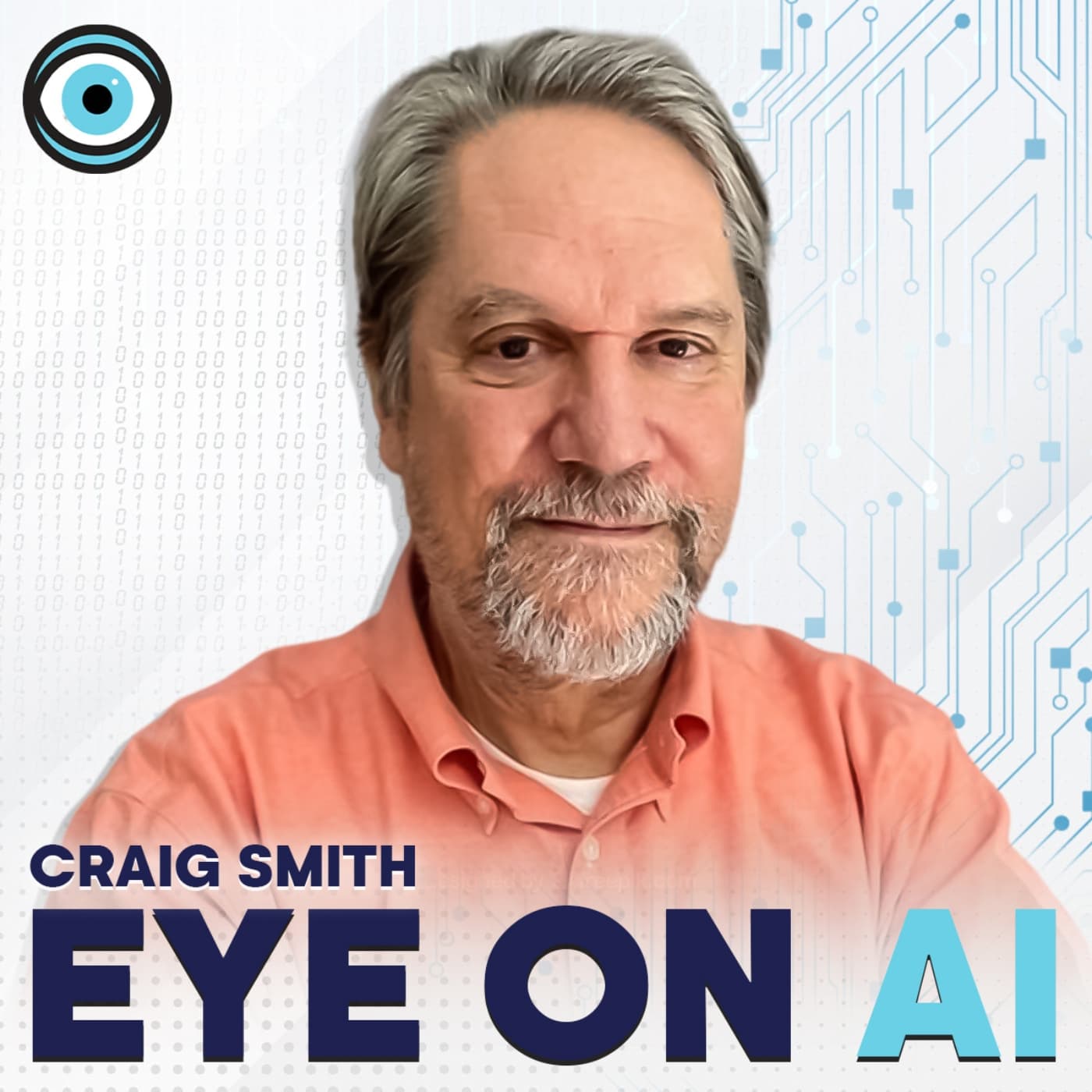
Craig S. Smith
Guest
Jamie Metzl (Futurist and Author)
---
Episode Overview The podcast discusses the convergence of artificial intelligence (AI), biotechnology, and gene editing, focusing on the implications for humanity. Jamie Metzl argues the need for governance in gene editing to ensure ethical practices and prevent abuses similar to past human experimentation.
Key Themes and Topics
- Superconvergence of Technologies
- Metzl introduces the concept of superconvergence, where AI, genomics, and other exponential technologies intersect.
- This convergence has profound implications for healthcare, agriculture, energy, and more.
- Gene Editing and CRISPR Controversy
- Discussion on the ethical complexities surrounding human genome editing, particularly with CRISPR.
- Metzl condemns the actions of He Jiankui, who created the "CRISPR babies," labeling it as unethical and driven by selfish motives without regard for human safety.
- Need for Regulatory Governance
- Emphasizes the importance of establishing legal, regulatory, and social structures to govern gene editing responsibly.
- The scientific community is not yet prepared for widespread human embryo editing; foundational governance must be developed first.
- Human Health and Longevity
- Differentiates between health span (healthy years of life) and longevity (total lifespan).
- Raised concerns about how increased longevity without education or community support could lead to societal issues.
- Education and Inequality
- Metzl highlights the interdependence of technology, education, and social norms.
- The conversation touches upon economic disparities and how they can exacerbate societal challenges as technological advances occur.
- The Role of AI in Decision-Making
- Speculation on AI's potential to provide insights and assist in complex decision-making processes, but emphasizes human agency and ethical considerations are paramount.
- Discussion on whether AI could help solve geopolitical issues, like the Russia-Ukraine conflict—Metzl suggests the answer lies in collaborative human effort.
Key Arguments
- Hubris in Technological Advancement: Metzl warns against the overconfidence of tech developers who treat complex biological systems as easily manipulable.
- Integration of Ethics: Calls for a robust ethical framework intertwined with technological advancement to prevent disastrous outcomes.
- Diversity and Community: Stresses the need for societal structures that foster community, social bonds, and shared purpose to combat isolation and meaninglessness in modern life.
Quotes
- "The future of humans will include the genome editing of pre-implanted human embryos that will be taken to term."
- "We need to invest energy in governance alongside scientific advancement."
- "Humans are inherently social animals. If we don't have community structures, we'll face negative societal outcomes."
---
Conclusion Jamie Metzl presents a compelling case for the need to govern emerging biotechnologies responsibly. He emphasizes that while we stand on the brink of transformative advancements, the choices made today regarding ethics, education, and governance will significantly impact future generations. The episode invites listeners to consider the broader implications of these technologies on human life and societal structures.
Written by AI. May contain mistakes. Listen to the episode to check what was said.
Transcript
Automatic transcript. May contain errors.0:00I absolutely believe that the future of humans will include the genome editing of preimplanted human embryos that will be taken to term. So now what we need to be doing is laying the foundation, not just of the science, which isn't quite there yet, but also the legal, regulatory, governance, social norms, all the other pieces of societal infrastructure that are required to do this responsibly and not have it just turn into some kind of Nuremberg style human experimentation. even if the people who are getting these procedures aren't prisoners, but they're just kind of rich people trying to give their kids a leg up.
0:47Build the future of multi-agent software with Agency. That's A-G-N-T-C-Y. Now an open source Linux Foundation project, Agency is building the Internet of Agents, a collaborative layer where AI agents can discover, connect, and work across any framework. All the pieces engineers need to deploy multi-agent systems now belong to everyone who builds on agency, including robust identity and access management that ensures every agent is authenticated and trusted before interacting. Agency also provides opens standardized tools for agent discovery, seamless protocols for agent-to-agent communication, and modular components for scalable workflows.
1:44Collaborate with developers from Cisco, Dell Technologies, Google Cloud, Oracle, Red Hat, and more than 75 other supporting companies to build next generation AI infrastructure together. Agency is dropping code, specs and services, no strings attached. Visit agency.org to contribute. That's A-G-N-T-C-Y dot O-R-G. How did you get to writing about the future? Well, thanks so much, Craig. Greg, really a pleasure to be with you. My story in this stuff starts about 30 years ago. I was working on the National Security Council for then President Bill Clinton. And my boss at the time and current friend was Richard Clark, who at that time was obscure, later became very well known after 9-11 as kind of the Cassandra who had warned about everything but not been able to change the course of events.
2:53And Dick always used to say that if everyone in Washington is focusing on one thing, you can be sure there's something much more important that's being missed. And the key to efficacy in Washington and in life is to try to solve problems that other people don't see. And for him at the time, it was terrorism and cyber. And for me, 30 years ago, looking around the world, this convergence, what I now call superconvergence, of these incredible computer tools of machine learning, now we call AI, the tools of biotechnology, at that time the nascent genetics revolution, were all going to come together with profound implications for a whole lot of things.
3:34So I became very obsessive in my just self-learning about all of these issues. And when I was ready, I started writing articles about this issue and what it meant and what America could do to prepare. And then those articles got a lot of attention. And a member of Congress, Brad Sherman, called me up and said that he'd read them and he thought it was really important. He wanted to hold hearings based on what I'd written and asked if I'd be the lead witness and help him organize the hearings, which I did. And so I was doing a lot of speaking and writing on this topic, but I felt like I wasn't breaking through with the message to the broader audience I was trying to reach.
4:20And so earlier in my life, I had done my PhD on why the world failed to respond to the Cambodian genocide. And that was published as my first book. And then my first novel was exploring those same issues, but as stories so that people could absorb this history and in a more personal, intimate way. And so then that was when, with this other issue of these converging technology revolutions, I decided that I wanted to write sci-fi novels exploring all of these issues, but doing it in the context of stories. And that was the genesis of my two near-term sci-fi novels, Genesis Code and Eternal Sonata.
5:03And when I was at Genesis Code, it deals with human genetic engineering and Eternal Sonata, the science of hacking aging. And when I was on my book tours for those books, and I would explain the science to people in my way as someone who taught it all to myself, I could just see in people's eyes that they were suddenly getting that there was a very meaningful story that would have big implications for their lives. And suddenly they saw it. They saw themselves inside of those stories. And that was what made me feel I had to write a popular nonfiction book about the past, present, and future of humanity and certainly genetic modification and biotechnology and what that would mean for humans.
5:46And that led to Hacking Darwin, Genetic Engineering and the Future of Humanity. And that became a pretty big international bestseller. And when I was on my book tours for that book, I'd give a lot of talks and I never use notes. And I always just, so for that reason, my talks just change. Every time I give a talk, I'll incorporate new things. And I found my talks about human genetic engineering were just shifting because I would say, well, here's the story of human genetic engineering, but that's just a little piece of this much bigger story at the confluence of these exponential technological revolutions.
6:26And here's the even bigger story. And so that was what led me to start developing the thesis for what became my latest book, Superconvergence. And along the way, after Hack and Darwin was written, where I had predicted that the first CRISPR babies would be born in China, I'd predicted I had a list of five genes that would most likely be mutated. And one of the genes on my list was the one that the Chinese biophysicist Hu Zhongkui altered in 2018. After that, I was invited by Dr. Tedros, the director general of the WHO, to be a member of the World Health Organization Expert Advisory Committee on Human Genome Editing.
7:09And now after super convergence, now I've become a commissioner of the Lancet Commission on Precision Medicine, which is going to be working over the next three years to come up with a kind of a blueprint as much as possible for the future of health care at the intersection of these technologies. Precision medicine is kind of a shorthand, but it's really how do we think differently about the application of technology into health care. So basically my view is that there's so much happening and to understand it in a deep way, we really have to come at it from different angles. And certainly for me, kind of thinking like a science fiction writer is really important because increasingly we're living in a world that is moving at a pace of science fiction and feels to most of us like it has significant elements of science fiction.
8:04Yeah. And you focus on, within biotech, on gene editing, on genomics. But the super convergence is much broader than that. I mean, it's affecting everything from material science to fusion, you know, energy production and quantum mechanics. I mean, how wide and why did you decide to focus on genomics? So my net is pretty broad. I mean, my basic thesis is that the big story of this moment of life on Earth, not just human life, the life on Earth is this is the moment when one species suddenly developed the increasing ability to engineer novel intelligence and re-engineer life. And so that's going to have profound implications really across the board of everything.
9:07My particular focus was on the story of reengineering life. And so that has implications beyond just the life sciences, but it's obviously transformative for human health and healthcare, obviously transformative for agriculture, for energy now with the new age of biofuels, for advanced materials where we have new ways of developing the industrial products that we need for data storage. People think that there's this big division between computing and genetics, but DNA, of course, is the greatest information storage mechanism in history. It's much, much, better and more efficient in really every way than any kind of computing infrastructure that we have today.
10:01And so you could keep going broader and broader because even issues like quantum, which may feel to some people like they're totally dissociated from the life sciences, aren't dissociated at all. The quantum computers will be another tool to help us understand the world around us, including the living systems around us more deeply. That's what Richard and Feynman said that essentially the world isn't binary, the world is quantum. And so we need quantum analytics to better understand quantum systems. So I really see it as all of one piece. But when writing a book, I couldn't call the book the everything book.
10:41And so I tried to bind it as the intersection AI genetics and biotech. And I mean, there are so many ways we could go in this conversation. But let's focus on the CRISPR babies. Yeah. And because that seems to have come back. I mean, MIT had He Jiankui, you know, hosted him for a while and wrote a lot about those interactions. and then his supposed wife, it's a little unclear, Cathy Thier, as a startup now that's focused on gene editing to prevent hereditary diseases or genetic diseases. Why do you think it's coming? Well, you mentioned in the book that there was a long debate about IVF in vitro fertilization, and it took a long time for people to accept that as ethical and normal.
12:01Do you think there will be that same trajectory with gene editing of embryos? I absolutely do, but that doesn't mean that anything goes or should go right now. The reason why I've called He Jung Kuei every bad name in the book, a rogue, a lout, a scoundrel, is because I think that what he did was so phenomenally unethical. And not only that, by racing to be first without any regard to the basic underlying ethics or what's good for humanity or science solely for financial and nationalist reasons, as far as I can tell, he just basically undermined this entire field. So I absolutely believe that the future of humans will include the genome editing of pre-implanted human embryos that will be taken to TURP.
13:06And that will happen. I believe it will happen in the future. But I'm also, as I mentioned, I was a member of the WHO Expert Advisory Committee on Human Genome Editing, and I 100 % stand by our position that we humans aren't ready for doing that now. And so now what we need to be doing is laying the foundation, not just of the science, which isn't quite there yet, but also the legal, regulatory, governance, social norms, all the other pieces of societal infrastructure that are required to do this responsibly and not have it just turn into some kind of Nuremberg-style human experimentation. even if the people who are getting these procedures aren't prisoners, but they're just kind of rich people trying to give their kids a leg up.
14:03Yeah. But again, on the IVF debate, it was a little different because the outcome wasn't debated or the future wasn't debated as much as just the fact that there are religious and societal norms that were being broken. In gene editing, there's a real question once you have heritable mutations in the dean or edits in the gene, in the genome, what that could mean further down the line. Or as we all know, genes are not as discreet as you would like to think. So editing a gene may have one positive effect, but you don't see what negative effects it may have. Yeah, that's exactly right. We understand such a tiny percentage of the full complexity of human biology.
15:15And that's why when we're thinking about making one very specific change, changing a single mutated nucleotide from abnormal to more normal, especially if the abnormal mutation has the potential to be highly deadly. You know, at least that's a little clearer because if you know that somebody has a mutation that's going to cause Huntington's disease or some other deadly disorder, and you can change that. And of all the ways of addressing that, one option is wait till a child is born and treat it somatically. And another option is fetal surgery. And a third option in very limited cases may be editing the pre-implanted embryo.
16:02So in that third option, if we're saying we're going to make this single change that we're pretty confident is going to change a painful five-year life to a relatively normal 90 or 100-year life, then the cost-benefit analysis may be justified. What He Jiankui was doing had nothing to do with treating some kind of disease. What he was trying to do was to give these future children enhanced resistance to HIV at some point later in life. And it was totally unnecessary and unethical. And the risk clearly wasn't worth the reward. I thought in Ho's case, the intent was to develop a therapy for the children of HIV positive parents.
16:58No, it wasn't a therapy. So it was for children who had one parent who was already infected with HIV. But there's very, very simple things to do, for example, when it's the father called sperm washing. And so it's very easy to make sure that a father with HIV won't pass it to their children. So if it had been, if that first case had been carried out very openly, very transparently, very collaboratively, and it was addressing something, a single gene mutation disorder that otherwise would have been deadly to the child and there were no other alternatives, that would have been a great use case. This was very different for them.
17:53yeah although you know in this kind of stuff there's always a maverick that yeah that that upsets a lot of people but he they do kind of a break open a pathway that then others follow yeah so but this was the opposite because i think that maverick needs if the first step is a responsible, collaborative, constructive step, then that opens the door. So this Chinese effort, I think, actually did more harm than good to the idea of that at some point we would be able to edit the pre-implanted embryos of potential future humans. And so I think this was an anti - Maverick, even though I'm a big believer in Mavericks.
18:46But I should say Hu himself, his big heroes were Steptoe and Edwards, the guys who had innovated for IVF itself. And that's what he was saying is, I'm going to bring glory to China and win the Nobel Prize just like these guys. So I'm a big believer in Mavericks, but that doesn't mean every Maverick and everyone doing something calling themselves a maverick is is doing the right thing and i very much think that ho was not doing the right thing could i imagine a different kind of maverick doing this at some point in the future i can yeah why do you think it's come back uh i mean with uh kathy tia uh and i've forgotten that manhattan yeah she has a sort of a nod to the manhattan project in there um and there's um but there's some other startups i've seen i mean suddenly it's it's in the wind again why do you think that is yeah you're exactly right it's in the wind again there's this is i think his name is brian armstrong and he has a thing called the gattaca stack which is it just highlights what's so i don't know we can swear on this podcast so fucked up about all of this so this is we're talking about life and i think that you know humans were naturally hubristic species coming up with all this crazy stuff.
20:15I mean, squirrels haven't come up with space travel. They haven't come up with all. I mean, humans are nuts by definition. That's why we're here, because we have this diversity and we have all these risk takers. And when you see, I don't know if you saw the, I can't remember what it's called, Free Solo film about Alex Honhold, the guy who climbed El Capitan without any ropes. And they did this brain scan and it turned out that he just didn't have like his brain didn't light up for fear. And so this, you know, clinging to the side of a cliff, whatever, 600 feet in the air was just like you and I being here on this podcast.
20:57So we have a lot of diversity in humans And it's great that we have these kinds of risk takers. But there's a reason why we have societies and cultures to try to say, well, here are the risks that we want and here are the risks that we don't want. We don't want some individual person saying, you know, I'm going to start a war with some adversary just on my own or I'm going to do experiments in my basement that have the potential to cause a global pandemic killing billions of people. So it's always a balance, but I definitely think that we're in this hubristic moment. Definitely the message to the tech community has been that this is a no-holes-barred moment, which is a real shift between what was happening with the Biden administration here in the United States and what's happening with the Trump administration.
21:47And it's an exciting moment. And I get and I frankly share the optimism that all of these technologies can and will be applied beneficially to to humans. but I just think that a lot of people who are involved in this don't appreciate the full complexity of biology that it just seems to a lot of people who have been socialized in AI and computer tech that biology is just a system like that maybe in some ultimate cosmic way it is but biology is just much more it's a system of systems and so it's not just genetics humans aren't just genetics on stilts. We have many different dynamic interactive systems.
22:34We understand them very, very poorly. I'd say if understanding the full complexity of human biology is 100 and understanding nothing is zero, we're at three or four, meaning three or four percent understanding of all of biology, even including our own. And so it just seems like, change this, change that, and you'll get this outcome. Change this one gene and maybe you'll have a smarter kid. We have no clue how many genes say something about intelligence or, as you said before, a vigistic complexity. It's not one gene, one task. This is a very, very complex system, which doesn't mean we can't manipulate it.
23:12We've been manipulating complex systems for the last million years, at least. It just means that we need to balance our hubris with some element of humility and some sense of societal interests. Yeah, and that's interesting when you say people who have been socialized with AI, and even though it's not deterministic and are comfortable with it, and don't understand the complexities of biology. I see that a lot in the discussions of AI becoming conscious. Yep. Whether AI could become conscious. I mean, consciousness. I had Stuart Hamroff. He's the guy that wrote the book with Roger Penrose about the potential for quantum effects to be the link between biology and consciousness.
24:20which he sees in this kind of panpsychic view as a property of the universe. But I mean, he points out, and a lot of people don't understand, he calls the AI view cartoon neurons, you know, these neurons that are either on or off. but consciousness there's all kinds of other things happening there are different brain structures there's hormones there's yeah yeah everything else that contributes so yeah because ai has has made people look at complex systems in in a different way And that's normal. In a lot of our technological history, certainly since the dawn of industrialization, with every technology innovation, we always think, oh, humans are just like that.
25:26Humans are whatever. Whatever. And so now this HBO, I'm sorry, Netflix film, Frankenstein is that it reminds me it was like the early days of the industrialization and humans are electricity. And if you plug the electricity and you channel lightning, you can make a human. And with every one of these, we have a metaphor. Humans are locomotives or humans are whatever. And that's why, for me, it's why I write both fiction and nonfiction, because I think fiction forces you to stay plugged in to a recognition of the full and unknown complexity of humans and of life. Yeah. But when you say that gene editing, for example, is something to look forward to, but there have to be all of these regulatory and ethical structures built up before we get to that point.
26:30But that's not how the world works. I don't think it needs to be built up before, but I think that basically the science isn't ready. The science isn't at a level of efficacy to do this responsibly enough that we could feel justified taking a risk with another human, having it not be, as I said before, a Nuremberg-level human experimentation. I think we'll get there. And now we have new base editing and prime editing and less aggressive and more focused ways of doing this. So there's a lot of progress that's being made. So I don't think it's I'm not saying that we have to have everything in place and then move forward because that's obviously never going to happen.
27:22But while we're waiting for the science to advance, we really need to be investing similar amounts of energy, not just in regulation, but in governance. And governance is what happens at all levels of society, not just at the level of governance. Yeah. Where do you think the, I mean, I haven't looked at this as closely. Where do you think the progress is being made? Is it at university research labs or do startups like Kathy Tiaz and these others play a role in pushing the field forward? Well, certainly both do. And what I would differentiate, so certainly university research labs across the board.
28:08And then there are the gene editing companies that aren't doing pre-implanted human embryos. I mean, that's a tiny, tiny, tiny fraction. But there's a lot of companies that are doing great work on gene therapies. I mean, we're at the beginning of really of a new age of gene therapy. So you look at the mRNA vaccines, which were thinking differently about how to deliver instructions to the cell using the mRNA carried to our cells through lipid nanoparticles. There's huge progress that's being made in those areas. In the field of editing the pre-implanted human embryos, there are a lot of gonzo startups, certainly the ones who are doing the editing.
28:55There's other fields. I mean, I'm on the scientific advisory board for a company called Genomic Prediction, which is doing polygenic risk scoring for pre-implanted embryos. And that's a little bit different. That's saying, well, you have 10 different pre-implanted embryos and you want to pick which one to implant in the mother. the way that it's done traditionally meaning most of the time now is you have an embryologist who looks under a microscope and says that that one looks good that one looks whatever whatever it is fluffy healthy and and there's no there's no really way of testing those other nine so it's all just well i have an embryologist who seems like a nice person and they have a lot of experience and and maybe that's a good way i mean i think i'm you know i was the keynote speaker for their International Embryologist Association.
29:42And I've had a lot of conversations. And I actually do think it's meaningful to have an experienced embryologist who's just looking under a microscope and says, you know, I just feel based on 30 years of doing this, that this embryo looks like it's pretty healthy. And I think that's not nothing, as we say in Missouri, where I'm originally from. But being able to extract a few cells from an early stage pre-implanted embryo, after about five or six days. And then to sequence those cells for the 10 different embryos, you can actually get a lot of potentially highly relevant information. And so that's one thing.
30:23I'm much more optimistic in the nearer term about screening embryos smartly during IVF than I am about editing those embryos. Even though I do think that in the future, we will both screen, we'll screen, and then we'll do relatively small numbers of edits. There are people who I respect, like George Church, who are saying we can really scale up editing. But again, we run into the complexity problem. But if we did screening and we had one or two embryos that seem optimal based on that, and there were one or two very discrete changes, like changing a likely disease state to a likely non-disease state, I think that is probably where we're going.
31:08Yeah. You know, I've spoken to a number of people on this podcast about longevity studies and longevity strategies. And one thing I always ask, and it applies to this too, if we optimize human life so that we all live much longer as collectively, not only individually. Isn't that kind of, I mean, how does the world feed and clothe and provide power to that increased population? I mean, it's a little, we're sort of, you're younger than me, but I'm sure you remember Lester Brown, who was predicting, this is in the 70s, 60s, 70s, predicting that the population growth, we were going to run out of food and there were going to be wars over water and all this stuff.
32:16And in fact, you know, yeah. We may get our wars over over water, but it's a great question. And, you know, I write about this topic extensively and I give tons of keynotes to whether it's the health medicine associations or even to the biohackers, although I don't consider myself a biohacker. And what I will say is you framed it right because the right answer is how do we increase average lifespan? and we don't need any science, any new science in order to do that. I think that's the ethical question because we know the people in Japan are living on average to about 85. Here in the United States, we're living to on average 80.
33:06And there are people in places in Africa and elsewhere who are living until their mid-40s. And there are people in our societies, we're both in greater New York area. I mean, there are people who in our community who have much shorter expected lifespans than either you or I. So everybody should be saying, how do we increase average lifespan? And if we do that, we will just unlock tremendous potential everywhere. I mean, that right now, if we had a health in the United States, if everybody was healthier, if everybody was living a life geared towards living until they're 80 and 85, which means they're eating healthy diets and they're exercising and they aren't exposed to all kinds of environmental toxins.
33:53I think that would be fantastic. And there are a lot of people and a lot of people who have their own podcasts who are deeply involved with the issue of the science of aging, who have very high level credentials for well-established institutions. And a lot of these people are total bullshitters selling snake oil because the things that they are selling are these interventions that may work in mice and roundworms and fruit flies, but we have no idea whether they would work in humans or not, or could even cause harm. And so there's this whole feel that influencers like Brian Johnson with, I like Brian, but this don't die movement is preposterous idiocy.
34:50Everybody is going to die. It's just part of the natural order of things, and suggesting otherwise is just lying. And I can't imagine anybody believes that humans are are not going to die. If you want to live forever, order a bunch of plastic wear from Amazon and just keep throwing it out the window. That can be your legacy. Or maybe write a book or have kids and have them have kids down the line. And so I do think, though, that there'll be huge benefits for humans extending our health space. We'll save a lot of money. Humans, it's not like there's some limited amount of innovation that's possible to us.
Read the full transcript
35:32We have unlimited amounts of innovation, but we're throwing away human capital. Whether we're throwing it away because some otherwise previously healthy person in the 1960s who has 20 years more of ideas and love and babysitting, whatever it is, to contribute can't because they don't have health or because we have billions of what we're functionally calling throwaway people around the world who are just living lives of total depravity. And we see because when people from the places that Donald Trump calls shithole countries come here and have the tiniest bit of opportunity, they become more successful in many cases than those of us who were just born into this opportunity.
36:17I mean, you look at the recent immigrants from Africa. I mean, they are killing it. I mean, they're incredibly successful, incredibly hardworking, incredibly educated. So I'm not worried at all about overpopulation. But I do think that if we have, right now we have 8 billion people, apparently we're moving towards 10, and then there's some debate about whether that's going to happen and whether we're going to drop off after that. But even so, to feed and clothe everybody, and especially if people are becoming wealthier and more people want to live lives like ours. We just can't do things the way that we're doing them now.
36:57And that's one of the main pieces of super convergence is that for healthcare, we need to distribute healthcare and empower individuals so that we're not overloading our healthcare system. For agriculture, we need to continue to enhance agricultural productivity with fewer inputs of the raw materials of land and fertilizer and water. We need to find ways of storing data and possibly using the lessons learned from DNA where we don't have to build data centers that will cover the entire surface of the earth. So I'm not worried about that, but I think we have the potential to unlock human capacities that can decrease the footprint and allow us to have a greater productivity and efficiency in how we're using natural resources.
37:47Build the future of multi-agent software with Agency. That's A-G-N-T-C-Y. Now an open source Linux Foundation project, Agency is building the Internet of Agents, a collaborative layer where AI agents can discover, connect, and work across any framework. All the pieces engineers need to deploy multi-agent systems now belong to everyone who builds on agency, including robust identity and access management that ensures every agent is authenticated and trusted before interacting. Agency also provides open, standardized tools for agent discovery, seamless protocols for agent-to-agent communication, and modular components for scalable workflows.
38:45collaborate with developers from cisco dell technologies google cloud oracle red hat and more than 75 other supporting companies to build next generation ai infrastructure together agency is dropping code specs and services no strings attached visit agency.org to contribute that's a-g-n-t-c-y dot o-r-g yeah you know intuitively that's that sounds right but when I think you know I had Nick Bostrom also on the program yeah and he's he has a book out called Deep Utopia yeah I read it yeah yeah it's a hard book to read I have to say I write books to make it easy on the reader. This was, he was not making things easy on the reader.
39:50Yeah. Yeah. And I'm not sure the novelistic elements work, but, you know, it's about humans in a solved, technologically solved world. and where does meaning lie and all of that. But in his book and in a lot of this talk about longevity and making this available so that it's not just the wealthy that benefit, The fact is that largely due to education, poorly distributed education, human nature, which doesn't, for most people, resist work, resist effort. and in your example of recent immigrants, it's still a fraction of people who become really productive. Actually, that may not be right. Maybe it's not a fraction, but there is a large fraction that are not really productive.
41:24And as technology solves all the survival problems that people face, you end up with bored teenagers doing bad things. And, you know, so I'm not I'm not sure that increasing longevity, the average lifespan or health span necessarily leads to a better world if it's evenly distributed. No, I completely agree. I just think that it doesn't necessarily lead to a resource crunch. I mean, my basic point with everything is the future is not set. I'm not some kind of Marxist who believes that everything is inevitable. What I think, and the focus of my work, is that there are different possible futures available to us.
42:24Some are better and some are worse. And if we want those better futures, we need to be talking about them and saying, well, what are the things that we need to do? What are the values that we need to weave into our decisions now to increase the odds of that kind of outcome? And that's why, for me, I keep coming back to this issue of governance, which, again, is broader than government regulation. Governance. How do we think about managing our societies, about managing our technologies, about what incentives do we want to create for things that we want and disincentives for things that we don't want?
42:59So for sure, and that's why I'm very critical of these technology utopianists who act as if these are believed maybe that these technologies are going to, on their own, unleash this better world. I remember Bill Clinton, as everybody else does, saying the internet, you can't control the internet. It's like nailing Jell-O to the wall. Well, there's a lot of Jell-O nailed to the wall these days. It turns out Jell-O is primarily suited by this metaphor for being nailed to the wall. and based on a bunch of decisions that we've collectively made. So for me, that's why it's really all about values. It's all about what are we trying to achieve?
43:43And then I give a lot of talks to big tech conferences and corporate conferences, and I always tell people, if the first question you're asking is, how do we use these technologies? You're going to be screwed from the start. It's the wrong question. The right question is, who are we and what do we stand for and what are we trying to achieve? And what's the right mix of humans and technologies to help us get there in the smartest and most efficient and productive manner possible? Yeah. I mean, the first time we spoke, you know, talking about managing society and governance, you know, we're developing these artificial intelligence systems that are able to hold larger and larger pools of data in their context.
44:46their memory, that you would think at some point there would be an AI system that could provide optimal solutions to very difficult problems. And I think we talked about the Russia-Ukraine war as an example. To me, that's exciting. that possibility. There are a lot of people who think it can't happen because a little bit like what you're saying with genomics, that the systems are so complex and there's so many interactions within them that you can't see that it's hopeless to expect to come up with a solution that won't have adverse implications somewhere down the line. But what do you think about that?
45:55I do not believe that there's going to be some AI that's going to, and I'll give some variations on this after I answer the question the first time, but there's some AI that's going to be, maybe you could get a system that could articulate, hey, here's an optimal thing to do. But I can tell you right now what's the optimal thing to do for Russia-Ukraine, which is Russia should leave Ukraine completely. And then we should say, well, how do we build the kind of regional and global infrastructure that is more collaborative and less hostile? That's the right answer. So then you say, if you had our AI system, make it happen.
46:44Well, then you have to give AI the ability to have all the levers that we humans have. Like, oh, maybe we're going to bomb this, or we're going to give long range weapons to the Ukrainians. And so when you get there, I mean, human societies are just so messy and so complex. Could you have today, if we went on GPT-5 or whatever. And we said, give me, write a 10-page memo providing an optimal outcome for the Russia and Ukraine war that prioritizes mutual respect and where you could get something and it would be great. But to do that, it would be very, very difficult to do. And so I think that, yes, AI systems can provide insights.
47:35As I mentioned to you in our prep call, I have a book that's coming out in April called The AI Ten Commandments No Really. And in it, I describe my process of working with GPT-5 to articulate an alternate and frankly, much better Ten Commandments than the deeply flawed Ten Commandments that Moses purportedly received at the top of Mount Sinai. And in the book, I talk about then my dialogue with GPT-5 about, well, how can we make it happen? There's some great ideas. But I've been involved in these kinds of ideas for my entire life. I was founder of the global interdependence movement, One Shared World.
48:20So it's hard to do stuff within the messy complexity of our real lives. Do I think that AI systems have the ability to help us see different possibilities for ourselves? Absolutely. Do I think that AI systems can help usher in a period of greater abundance? Yes. Do I think that these systems can allow, facilitate the greater distribution of that abundance. So it's not winner take all. And you have a few people, but I just use the example of Uber. Like Uber isn't responsible for 99.9 % of the innovations that made Uber possible. And yet there's the 0.1 % of what they did in setting up their app.
49:10And then we societally have said, well, they are the people who've created this wealth, not society or human cultural history or all of all of these things. So we set up winner take all systems. We're going to we're going to have this vast inequality that frankly is going to undermine the and everything that we're we're talking about. And so I think that I wish we could say, oh, AI is going to do this. It's not. It's The future doesn't belong to AIs alone, doesn't belong to humans alone, but it's humans and our technologies finding optimal ways to work together toward our best possible outcomes because our human perceptions of those best outcomes are varied.
49:55It's just going to be messy for the entire foreseeable future. If you increase on average everyone's health, everyone's, uh, which presumably would increase their, their lifespan. Uh, if those people are not educated, you're, you're still, you're only going to increase many of the problems that society already faces because of the lack of education. To me, education is the prior before all this other stuff because, you know, when I look at, I was in India for a month recently talking to AI people. And when you're in the research institutions and you're talking about all the great things that this technology can do for society, and then you go out on the street and you've got this chaotic environment with a very large population that's undereducated.
51:04But, you know, all of the ease and everything, it only increases some of the bad effects. If people are no longer worried about feeding and clothing themselves, but they don't have any education, they're going to be easily manipulated by populists. or they're going to be attracted to drugs or other things that make the misery of a meaningless life palatable. So, yeah, what are your thoughts about that? Yeah, I know. So I completely agree. All these issues go hand in hand. If you just do one and not the others, and that's why it's human flourishing is the broad category, and it has different pieces.
51:57Traditionally, the places that have developed and the communities that have developed greater lifespans and health spans have tended to be more educated anyway to have stronger communal bonds. So I absolutely think that it's not the case either for education or for extending health or for healthspan. It can't be serial. Like we're going to pick one and then two and then three. It's going to be that in every society, in every community, there are ways of expanding human flourishing and that people will need to be more educated in order to benefit from these things. It's not like you're going to get one shot.
52:36There are a lot of lifestyle. I mean, there's much bigger wins to be had in extending healthspan by smarter lifestyle decisions than anything that can be delivered by AI or medical systems. So these things certainly have to go hand in hand. Yeah. Yeah. And in your book, you talk about humanity is kind of on the brink of this new world because of the super convergence. The effects of that convergence are going to be sort of, they'll multiply each other, whatever domain. So there will be this exponential progress, one would presume. and again thinking of Nick Bostrom's work and all of the negative effects that came from besides the positive effects but the negative effects that came from the internet and particularly social media are you optimistic that we'll be able to guide society through this new future uh in in a predominantly positive way or do you worry that it could go very bad i guess that's what why you talk and then my answer of course is yes i mean i'm an optimist i certainly think excuse me i'm i certainly think that we have tremendous opportunities to do very positive things with these technologies.
54:23And we have tremendous opportunities to do terrible things with these technologies. And that's why I keep saying the technologies themselves don't come with a... Excuse me. That's why I keep saying the technologies themselves don't come with a built-in value system, but it's up to us to infuse our best values into our processes of developing these almost godlike capabilities. So I am optimistic because I think we have these great tools that can allow us to do all of the things that we've discussed, expand human flourishing, education, healthcare, adequate food supplies, solve a lot of difficult problems.
55:06And we have the opportunities to do much greater mischief at a much greater scale. And that's the same with every technology that we've ever had. Agriculture, the stirrup, any technology that you come up with, you could say, well, here's some really positive things. And then here are some really horrible things that happened as a result of those capabilities. And that's certainly the case here. There will be terrible things. Do I believe that humans are the new Neanderthals and AIs are going to take us over and kill us all? I don't think that's a very likely scenario at all. Do I believe that humans will continue to use these capabilities to do harm to each other?
55:51It's a certainty. I mean, you look at what's happening in Ukraine. The only reason that both sides aren't deploying fully autonomous killer robots is that the partly autonomous killer robots are more effective at killing than fully autonomous. The second the fully autonomous become better killers is the second that everybody in Ukraine is going to flip that switch. You look at societies around the world. I mean, you mentioned social media a moment ago. I certainly share your concern that social media is a cesspit. And you look at how it's just pitting. These companies and the algorithms they've created are just pitting people against each other.
56:36And here in the United States, we have the crazy right and the crazy left who are mirror images of each other, each using the exact same strategies, the exact same dynamics in our attention economy. But again, even these terrible social medias, I mean, the issue is that they aren't governed. We as a society decided, well, let's just let these things go on their own. And now these companies and them and crypto have become so powerful that they're able to flood our political class with money. And so they become unregulatable. And that's why I just think that societies have a role. And it's very difficult in our democracies because not everybody is thinking about long-term risks and benefits.
57:31And most people are just thinking, you know, here's a new tool and this is great. And that's why we have governments in the first place. But I worry, certainly, like everybody else should, that these wonderful technologies certainly have the possibility to do very, very significant harms. but everything then leads back to what are our values now what are the things that we're doing now to realize our values and weave our values into our systems yeah what how do you see i mean you say you're an optimist uh what do you see in your science fiction writer at times where do you So what kind of, I mean, can you, in a few sentences, sort of paint a picture of the world at some indeterminate point in the future when the super convergence takes hold?
58:31And then I'll counter with what I see. Yeah, well, there's no one world. I mean, that's what I've been saying. There's no one inevitable world. There are many, many different worlds. And so certainly with these capabilities, we will have the potential to have radically improved health and health care, radically improved and more productive agriculture, radically decentralized education so that people even in poor places can have access to world class capabilities, will have greater levels of abundance. and as I said before, we're going to have all these capabilities that will allow us to do some really horrible things like the ones that we've described.
59:22And so you want to know kind of what is superconvergence look like? Just think of what our pre-industrial ancestors would think if they just visited us today. This would feel like superconvergence to them with such a big jump from how they lived and how we live. We're going to have similar, I think, even bigger jobs, and they're going to happen in a faster period of time. But again, there's no one inevitable future, but it is inevitable that our godlike capabilities are going to become even more godlike if we think of the word god as how our ancestors perceived these deities that could negotiate life and death and change the world around them.
1:00:13Yeah, my primary concern, the older I get, is that humans search for meaning. And in a universe where personally I think there is no meaning, I mean, there's meaning in interpersonal relationships, but beyond that, there's no sort of greater meaning or greater purpose. And so you have, I mean, Richard Dawkins, you know, in his book, The Selfish Gene, talks about how we're just these dumb hosts for genes that want to, you know, propagate. And so we're stumbling around. Well, we're symbionts. We are symbionts with our own biology, with all the microbiomes that are getting a lift on us. So we're part of a complex ecosystem.
1:01:21Right. But we've developed consciousness in these brains and we're trying to figure out what is our purpose? Where is the meaning? And there isn't any. And that creates a lot of human misery and a lot of, you know, anger and frustration. And I don't see any of these technologies addressing that. And so I imagine, yeah. Yeah. No, we do have a technology that can address it. It's called Buddhism. I mean, we have these brains that have evolved in collaboration with our technologies like controlling fire and even agriculture. And we have different human systems to try to think these wonderful. So that's why when people think about technology as this total other, and it's either going to give us a sense of meaning or not give us a sense of meaning, I think it's just preposterous.
1:02:22We humans have been struggling with this exact question for certainly all of our recorded history, but obviously much longer than that. And I'm not saying we have any complete answers, but Buddhism is an answer to that. For people who believe in their various gods, that's an answer. I'm an atheist. But there are humanist traditions where just caring for other people in this life and living an ethical life, that's enough. So I don't think neither technology or anything else is going to give us an absolute answer. But there's nothing new in that question that really changes as a result of our relationship with these technologies.
1:03:09Except, that's right, except, and this is what fascinated me about Fosthum's Deep Utopia. Once, you know, since the dawn of man, there's been this steady technological improvement, which is designed to make life easier, more comfortable, longer. And, uh, but, but this fundamental problem, uh, the question about the meaning of life is, has always been there. But earlier when you were, when people were occupied with, uh, feeding themselves and clothing themselves and creating shelters and getting warm, you know, as that gets taken care of then this question becomes larger and that leads to a lot of criminality a lot of yeah uh yeah it can drug use it yeah it certainly can but those are societal choices i mean i always it's funny i mean so many of our ancestors lived in these these little shitty villages somewhere but it seems like a great life like living in a little village and being a hunter-gatherer and and kind of you have these strong communal bonds and there's the life cycle and the ups and the downs like that seems pretty great to me and certainly our societies have become so big and we've become so atomized um that but i do think that humans can recreate that i mean you know we live in in new york there are lots of people who have these wonderful urban herds there are There are different, as I said, I'm an atheist, but I do stuff with Central Synagogue here in New York.
1:05:02And it's a wonderful community of people who are coming together and finding meaning, not just through community, but through good acts of repair, tikkun olam, repairing the world. I just think that there are many different possible answers. There are some countries, when you look at the happiness index, countries like Estonia or Israel or many of the Scandinavian countries where there's a sense of purpose, a sense of community, a sense of belonging. I don't think any of this stuff is inevitable, but I absolutely feel that in places like the United States where we've under-invested in community, it's the bowling alone pieces.
1:05:46I think there's a real cost for that because humans are inherently social animals. And if we don't have those kinds of structures and infrastructures and even stories, absolutely, we'll get these kinds of outcomes. And if the technology story is an us versus them story of a small number of people who are the big beneficiaries, who are controlling the stories and even manipulating everybody else, which is the case of Elon Musk and Twitter, then I think it's going to be very toxic and dangerous. So none of this is inevitable. The question is just how are we going to do our best to try to make the best possible story?
1:06:27The way I see the world trending and the way it's been actually for a long time is that power and resources are becoming increasingly concentrated. And technology is allowing the people that control it to keep the masses more or less occupied. I mean, I imagine a future where there is this educated elite that lives a wonderful life, and then the rest of the population is basically drugged. You know, the governments legalize certain drugs. There'll be clinics where you go in and get your fix. And then these people lay around with their VR headsets off or whatever and pass the time. It could be.
1:07:35I mean, it's not inevitable, but that's certainly one possible future. And if you look at what's happening now, where in the United States, the Trump administration is engaged in wholesale looting of the generational assets of the country through this crypto scam. And just like in your case, it's drugs, but in our case, and then feeding this story of nationalism and nativism. And so these people who are getting looted, who their country is taking on debt that is being transferred to the Trump family, they're fully on board and they're excited about this, not recognizing that they are the ones who are going to actually have to pay this debt.
1:08:21And whether it's through higher taxes or bad schools or bad roads or bad health care or no Social Security. And so the world that you're describing is a world that partly already exists. What I'm saying is if that's not the world that we want, we've got to fight for the world that we do want. And certainly it's hard. And certainly these inequalities seem to be growing. But that's, I mean, for me, that's why I do the work that I do. That's why in my communications, whether my books or interviews like this or whatever, what I'm trying to say is this is a transformational story for humanity. and it needs to feel intimate and personal to every single person.
1:09:04And every single person needs to say, here's a future that I'd like to see and then here's what I'm going to do. It may be on the smallest level, my own family or community or government or internationally, whatever it is, to try to move toward that future. But the best scenarios are possible and the worst scenarios are possible and everything in between is possible. Thank you.
1:10:00Thank you.
From the publisher
This episode is sponsored by AGNTCY. Unlock agents at scale with an open Internet of Agents.
Visit https://agntcy.org/ and add your support.
Why are AI, biotechnology, and gene editing converging right now, and what does that mean for the future of humanity?
In this episode of Eye on AI, host Craig Smith sits down with futurist and author Jamie Metzl to explore the superconvergence of artificial intelligence, genomics, and exponential technologies that are reshaping life on Earth.
We examine the ethical and scientific realities behind human genome editing, the controversy around CRISPR babies, and why society is not yet ready to edit human embryos at scale. The conversation unpacks the complexity of biology, the risks of tech driven hubris, and why governance, values, and social norms must evolve alongside scientific breakthroughs.
You will also hear a wide ranging discussion on health span versus longevity, AI and human decision making, education and inequality, and how these technologies could either unlock massive human flourishing or deepen existing global challenges depending on the choices we make today.
Stay Updated:
Craig Smith on X: https://x.com/craigss
Eye on A.I. on X: https://x.com/EyeOn_AI


