
In short
Synthesia’s CEO Victor Riparbelli argues AI video is shifting from one-way broadcasts to interactive, two-way “avatar” experiences—especially for K-12 and enterprise training—where students/employees practice with agents, get scored, and engage more than with text or static PDFs.
Guest backgrounds
Victor Riparbelli is co-founder and CEO of Synthesia. Grew up in Copenhagen, studied computer science and business, worked in Denmark’s startup ecosystem, then moved to London. He founded Synthesia after reading Matthias Nister’s “Face to Face” paper on neural networks generating photorealistic video.
Key claims
AI drives content marginal cost/time toward zero; education and corporate training are first real markets; Hollywood won’t lead—AI entertainment will be short-form social; Synthesia focuses on consistent, high-quality talking avatars for B2B.
Notable examples
K-12 personalized lessons using avatars tied to students’ interests/celebrity-like figures; sales training simulations where an avatar “customer” roleplays objections; scoring comprehension via engagement/attention signals; “PowerPoint 2.0” workflow for creating videos.
Written by AI. May contain mistakes. Listen to the episode to check what was said.
Chapters
Tap a time to open that second in VOThe Future of AI in Entertainment
0:00 to 0:44
Learn about the potential shift of AI in educational content versus traditional entertainment.
“I think Hollywood is going to be the last industry to adopt any of these things.”
Victor's Early Interests and Career
1:19 to 2:10
Discover Victor's early passions and how they led him to create Synthesia.
“And I think my path to what founded a company started in my early childhood years.”
The Genesis of Synthesia
2:10 to 3:22
Hear about the inception of Synthesia and the vision behind it.
“And he'd done a research paper called Face to Face, which is the first research paper demonstrating a neural network producing, you know, very photorealistic video.”
Exploring AI's Impact on Video Creation
3:22 to 4:58
Understand how AI will revolutionize content creation and video production.
“And that's going to change the equation around how we create content, right?”
Mark Cuban's Involvement and Investment
4:58 to 7:15
Learn how Victor secured investment from Mark Cuban and what made it unique.
“like meeting researchers, meeting companies.”
Synthesia's Journey and Product Development
7:15 to 10:04
Explore Synthesia's product evolution and its focus on education and training.
“So we started the company in 2017, but there was a lead up to that of, you know, trying to build a prototype and, you know, get the thesis down.”
Next-Gen Interactive Video Technology
10:04 to 13:13
Discover the innovations in video technology that enable two-way interactions.
“And now your valuation is like$4 billion.”
The Future of AI in Customer Interaction
13:13 to 14:00
Discuss how AI will transform customer interactions and training scenarios.
“And the reason this is very powerful is because we learn so much better by practicing and saying things out loud.”
Future of Video Interaction
14:00 to 18:48
Learn how avatars will change customer interactions and training.
“The avatar can pull up content, share their screen, and you basically go through it more like a demo with a real salesperson than go to a website and click your own way around it.”
Personalized Education with Avatars
18:48 to 21:08
Explore the potential of using celebrity avatars in education.
“If you had, you know, I'm old, so I think Tom Cruise is, I don't even know who a young sixth grader would be excited by.”
Show all 18 chapters
Synthesia's Corporate Training Application
21:08 to 22:34
Discover how Synthesia transforms corporate training with video tools.
“Now, what happened back then was that the quality of the drum machines and the synthesizer was not very good.”
The Competitive Landscape of Video Generation
22:34 to 24:36
Understand Synthesia's position in the evolving video generation market.
“On the interactivity, do you have any way of reading the attention of the person on the other side?”
The Future of AI in Entertainment
24:36 to 28:00
Examine the implications of AI in the entertainment industry and short-form content.
“of like talking to celebrities or, you know, almost like game show kind of thing.”
The Rise of Short-Form Content
28:00 to 30:08
Explore the growing trend of short-form content and its implications for filmmaking.
“It's going to be a film student with no money, but a laptop who's going to make something amazing, a short film that's 17 minutes long and posted on Instagram.”
AI's Impact on Visual Effects and Filmmaking
30:08 to 33:19
Discuss how AI is transforming visual effects and the future of filmmaking.
“So I think we will see a lot of this stuff just being picked up as just a faster, easier way to produce visual effects.”
Integrating AI into Business Operations
33:19 to 35:34
Learn about the integration of AI in business workflows and its potential.
“And you're using, you switched to Claude recently.”
Future of Communication with Interactive AI
35:34 to 38:23
Discover Synthesia's vision for interactive, two-way communication through AI.
“So what we're trying right now is invent a new media format that is proprietary to us, and it's going to be all about interacting with agents in a visual manner.”
Potential Collaborations in Education
38:23 to 39:23
Discuss future opportunities for AI in education and ongoing projects.
“I'm actually going to ASU GSV, which is a conference in San Diego.”
Transcript
Automatic transcript. May contain errors.0:00I think Hollywood is going to be the last industry to adopt any of these things. The idea of doing full-length films, has that gone by the wayside as you found your market niche? Or do you still imagine going that? I think what you will see AI-generated entertainment is not in the cinemas, it's not on Netflix. And I kept asking, why don't you put an avatar on this that would engage students more? And this is for K through 12, because students are bored by text on a screen. They kept telling us the same thing. I know I'm creating all this content and no one is reading it. And even if they do read it, they don't remember anything else.
0:36I'm wasting my time. I need to create video and audio content. I think for kids, if you could go, you could personalize their education in two ways. Interest-based and with a celebrity or a person that they know. It would be amazing, right? Hey, Victor, it's great to meet you. As I mentioned a moment ago, I was an early synthesizer. I have trouble pronouncing the company name and have used it for years. But I'd like you to start by introducing yourself to listeners, give your background so far as it's relevant, and the story of how you came to start the company. Yeah, sure. So, yeah, so I'm Victor and I'm one of the co-founders and the CEO of Synthesia today.
1:25And I grew up in Copenhagen in Denmark. And I think my path to what founded a company started in my early childhood years. I love reading. I love computers. In my late teenage years, figured out I could make some money off my interesting computers. So I began making websites for local businesses, e-commerce stores, kind of small projects like that where I could make, you know, pretty good money for like a 17-year-old. I was pretty good at it started running the marketing and you know kind of did it for some years but eventually kind of capped out in how intellectually interesting it could be to help my local tennis store sell more tennis rackets so I went to the Danish startup ecosystem I was there for three years found myself in like product and growth roles I have a bachelor in computer science and business but honestly I was never really there I was more interested in building companies after having worked the danish ecosystem for some years i knew i wanted to build my own company i also knew that i wasn't super interested in building accounting tools and bookkeeping tools and like usual normal business process stuff i've always loved science fiction i love fringe ideas i love the weird wonderful corners of um of the internet and and what's happening in the world and i wanted to combine my interest in building products with that so i moved to london and i spent a year figuring out what company i wanted to build met a guy called matthias nister who was an associate professor at Stanford at the time.
2:47And he'd done a research paper called Face to Face, which is the first research paper demonstrating a neural network producing, you know, very photorealistic video. When we look back at it today, it's less impressive. The world has moved on quite a lot. But I saw this and I felt like there's something very magical about it. And as someone who loves creative things in my spare time, you know, I make music, dabbled in like Photoshop and a bit of video editing, 3D rendering. I saw the technology. I was like, this is going to change everything we know about how we create video and media in general and also how we consume it eventually so i decided to start a company around it which took a while to convince matthias i was 25 years old at the time and i think he thought i was uh you know um he wasn't very interested in the beginning but with enough persistence we kind of got there in the end and we ended up founding a company based on basically two big ideas the first one being that ai is increasingly going to to be able to generate content, not just analyze patterns and data.
3:47And that's going to change the equation around how we create content, right? It's going to drive the marginal cost of creating content to zero. So the cost in dollars of creating content is going to be very low. The cost in time is going to be very low. And the time and skill required to create video is going to be very low. And I think that's the bits up until now. I think that's the market win right now where anyone can go on the internet, they can prompt something in a few minutes, that they can produce something that's very, very high quality. That changes the nature of video production. When you reached out to him, first of all, how did you happen to read the paper?
4:21Because this is an experience I think anyone who follows Archive, the repository of preprint papers, has experienced. You see these great ideas. You think, wow, you could build a company around that. a lot of times that research just fades into the woodwork uh did you how did you happen to read the paper and how did you reach out to him so when i moved to london in uh in 2016 vr and ar was like the hype cycle at the time the oculus headset that just came out and i was very frail by all this tech and i actually thought i was going to start a vr company so i spent a lot of time just like meeting researchers, meeting companies.
5:05I worked as kind of like a freelance consultant to some big companies and what they should do with VR and AR. And I kind of pretty quickly came to the conclusion that outside of the headset being very clunky as a barrier for VR adoption, the other thing that was a big problem was that creating content for VR is very expensive, you know, because basically what you're doing is you're building a computer game. And that comes at a very high cost even compared to video production. So I kind of started to have this interest in how can we make content creation easier. That took me down a path of things like volumetric capture, which is you have a lot of cameras in an array around you.
5:40You go in and you do a performance and you get a 3D asset out of that. You could port into VR. That was interesting. I was part of setting up a studio for this in London and a whole bunch of other interesting ideas of how content creation could be made easier. So I was following that space and Matthias Leesner had a lot of papers in this space around VR, but he also had this paper coming out called Face to Face. And when I saw that, I think I had this eureka moment where, you know, instead of trying to do this with VR, where we're both trying to bring a new type of media to market, which is hard and a clunky headset, and we're trying to make it easier to create content.
6:15That's kind of a double whammy of very hard problems. If this works with video, that's interesting, right? Because video, the infrastructure of video is already in place. We're all spending time on YouTube. Like video is, you know, you could just take an AI video and replace it with a normal video. and so the distribution problem wasn't really there and i think that's where i kind of started to feel like this is actually like a very interesting business idea because if we can solve this for video we and you know we can we can distribute it to the world pretty quickly so you started the company then and that's very funny i was about the vr stuff i was uh running the New York Times operations in China at the time.
6:54And when VR first came out, uh, and there was a company, I'm sure they've long disappeared that came through town and they, they were showing us their cameras. Uh, we, I got very excited and I ended up, uh, partnering with, uh, Chinese media to do a big conference on VR. I thought, boy, that's the future. But as it turns out, it wasn't. So when did you start Synthesia? And tell me about the name. I always want to say Anesthesia. So we started the company in 2017, but there was a lead up to that of, you know, trying to build a prototype and, you know, get the thesis down. and all that trying to raise money, which was very, very, very difficult because this was a very non-consensus bet at the time.
7:51We were basically telling people, in 10 years, you can make a Hollywood film with nothing else but your imagination. And at that point in time, that was certainly like a sci-fi dream more than it was something that was tangible to investors. And every investor just wanted to invest in fintech at the time. But in 2017, end of October 2017, raised the first funding round, got a million dollars from Mark Cuban. who was a big believer and has been since day one. That process. So how did you get to Mark Cuban? Just a cold outreach? Yeah, so we had a long list of investors that we tried to speak to, and we weren't very lucky.
8:29And we had a list over business angels, wealthy people that fit well in their kind of media and technology, Venn diagram, and Mark was one of them. So we found his email online, actually, by downloading a hack. Sony got hacked a few years prior, and there was a lot of emails in that hack. We found his email, we sent him a cold email and he responded back within four minutes saying, I think this is really interesting. Came back with some more questions and then we had a 14 hour email conversation with him. Mark doesn't do any video calls or normal calls. He only does email. And so 14 hours later, he'd asked a lot of great questions and he said, I'll do a million dollars if the diligence checks out.
9:06And I think one thing that was very interesting about this process was Mark was aware of the research paper. he had implemented it himself at home and he 100 % believed in the vision around you're going to be able to make a Hollywood film from your laptop in 10. We didn't have to discuss that. He was just interested in how are you going to build a company around it and what are you going to do until the technology actually works which is a very different conversation than every other investor we spoke to where we had to start at like hey this thing is going to be possible in 10 years and they just if they didn't you know Mark shared the same belief around us so he was evaluating us as a team Whereas everyone else, we had to try and convince them about this worldview.
9:45And that's very hard. So we got turned down by, I think, almost 100 investors before Mark actually invested. And that became the start of the company. Yeah. So you started with a million after your angels. That was a seed investment. You just completed Series E, I think, 200 million. And now your valuation is like$4 billion. Yeah, that's incredible. I mean, that's I mean, all of the companies are growing extremely fast. So the the initial product was was around avatars for advertising or different use cases. I'm particularly interested, you know, I was involved early on sort of as a media advisor with a company, an AI education company.
10:47And I kept asking, why don't you put an avatar on this that would engage students more? because, and this is for K through 12, because students are bored by text on screen. And you've moved into education or you've been in education, corporate training primarily. Is that right? Yeah, that's right. So what we discovered was that the first use case where this kind of technology was actually valuable and not just a cool demo or cool pr stunt was in in in explanatory or educational video and especially the enterprise which is what we've been focused mostly on up until now right because we first started to try and create you know technology for hollywood studios video production agencies the most obvious people to use this kind of technology but what we bumped into was that the quality requirements was extremely high for these people and the willingness to experiment was pretty low because they're already creating lots of great content you know they don't really need an ai solution they're already making fantastic videos but then we discovered there was this other group of people and this group of people were people who were desperate to make video content because they're educating someone on something and the only way they could do it was to send them long pages of text or maybe a slide deck and they kept telling us the same thing i know i'm creating all this content and no one is reading it and even if they do read it they don't remember anything of it.
12:18I'm wasting my time. I need to create video and audio content. That's how everybody, especially the younger generation, wants to consume their content, right? But I don't have a way of doing it. And when we then came up with the first iteration of our technology and our product, what we discovered was that for these people, when they evaluated the quality of the AI video, they would hold it up against a 10-page PDF document. Whereas in Hollywood, right, they would hold it up against a real Hollywood film that say the quality is terrible. So that was when we figured out that here's a really interesting first use case and then we've evolved the company since then to still focus on like educational explanatory video and enterprise we haven't gone we work with a bunch of universities and schools and so on who also use the product for educational purposes and i think we're gonna evolve into doing more and more that over the years we're just now launching our second big product which is evolving video from being a one one-way broadcast which is what a video is today right like you make one video and then everybody watches the same thing with this it's a two-way conversation so you can talk to the video you can talk to the avatar in a training or educational context um you know if you're training your sales team for example then today what people do is that they create a video the sales team sits down and watches the video and that's better than text what you can do now is you can insert agents into the video because that could for example be to watch the video and then the agent pretends to be a customer for 15 minutes and you have to answer questions, overcome objections, build empathy, set up next steps, and basically practice like you would with a real customer, but you're doing it in a setting with an AI agent, right?
13:52And the reason this is very powerful is because we learn so much better by practicing and saying things out loud. And we can also, through technology, we can actually score your eyes. We can actually give whoever created the video a signal that you've actually understood the content you haven't just like passively sat through it has anyone taken that further and instead of just training used it as a sales person on a zoom call i think all that stuff's going to happen the next 12 months where people are going to be using these things like do more things with them i think that i think the um um the consideration that's important is in the different scenarios that you use it is that the quality really matters a lot right so if you want to put it in front of a customer it has to be very very high quality with the latency it has to feel like talking to a real person whereas you can get away with a bit more for internal use cases where it's like the stakes are a little bit different but i absolutely think that in the future the way you're going to interact with a company is going to be probably less like a website which is basically a brochure and more like you go in and you open up a kind of a zoom call with an avatar.
15:02The avatar can pull up content, share their screen, and you basically go through it more like a demo with a real salesperson than go to a website and click your own way around it. Training that you're talking about, the avatar is the text or the content that they're speaking is all written. It's not live, right? Do you have, have you looked at doing, I mean, you were talking about having a salesperson trained. Can you do live interaction? So this is live. Yeah. So this is a live avatar you're talking to. Right. So how do you, what's the, is it just a large language model that you plug in on the back that's producing the text that the avatar is speaking.
15:51Yeah. So, I mean, for most use cases, it's going to be an LLM that's like driving the avatar. It can be whatever you want it to be. If you want it to be an API that feeds it information without an LLM, you can also do that. Basically what the system does, right, is it takes a string of text and then it like generates in real time the avatar kind of saying whatever you want it to say. Right. And is that built into the product or does someone have to do some engineering on the back end? So we're offering it for the first use case is what we call skills, which is training. It's an intern product that you could go in and we can create, you know, you can set up your own scoring system for how you evaluate the people who talk to it.
16:32You can change the prompt to be whatever it is you want it to be. We're also going to enable you to use a low-level API if you just want the avatar in real time and you don't want the rest of our product around it. So both things are going to be possible. And in the future, we're going to launch more than just the skills, like the training use case. Maybe we'll launch the sales use case at one point. Recruiting is another one that's obvious. And we'll kind of go solution by solution. Yeah, but the live interaction, that's already available in the product? Not yet. It's in beta right now with a bunch of customers, but it's launched within the next couple of months.
17:07Okay. The other thing that I'm curious about, I have a son who's an actor who's very much against all of this. And I've been telling him, hey, license your likeness. I mean, you guys do license actors' likenesses for avatars. I don't think you license celebrity likenesses. Yeah. Have you thought about doing that? Yeah, it's an idea that comes up, like, pretty often. and I think there's a bunch of companies that have tried to do it. I think the best proxy is something like Cameo, if you remember that app. I think the company doesn't really exist anymore, but basically you would go in, right, and you could buy these like clips and a real celebrity would take up their phone and they would do some of that.
17:54I think there is probably a business to be built around that. It's not really our focus because we're much more like a corporate B2B platform. But I think something like that probably can work and I think where it's interesting is probably the scale you can get. so if you have an e-commerce store and you want every customer to receive a personalized video from a celebrity for example you could do that and maybe you pay the celebrity one dollar for every video right um so i think it's going to happen but my sense with this stuff is always that until the technology is truly so good that you cannot tell the difference it's not good enough because it's gonna be it's not gonna feel the way that you you want it to right right oh is that But I think we're approaching that now.
18:38Because, again, on the education, the idea of having an avatar is the interface between the system and the student. If you had, you know, I'm old, so I think Tom Cruise is, I don't even know who a young sixth grader would be excited by. But if you had the avatar of a celebrity that they were attracted to, that would be a wonderful way to deliver content. So you think that's coming, that's possible. Is the uncanny valley, you know, between what you can produce now and what you think would be necessary, how wide is that or how deep is that currently? because when I look at your avatars, they seem very realistic to me.
19:39Yeah. No, I think it's almost there now. And I think some of this stuff probably will happen in the next six to 12 months because the technologies by this point is like so mature that they really are of very high quality, right? And I totally agree. I think for kids, if you could go, if you could personalize their education in two ways, interest-based and with a celebrity or a person that they know be amazing right if you just really love soccer or music or like whatever ninja turtles and you could have all your math problems be framed as ninja turtle problems and delivered by your favorite celebrity that's amazing right and i think we are getting pretty close to that being a reality where if you want david beckham to teach your kids about mathematics, you probably can do that very soon.
20:25Yeah. And how does Synthesia, am I pronouncing it right? Well, first of all, where did you get the name? I know Synthesis and Asia. I don't know where they are. Yeah. So it's actually, it's a code name for like that started off and we just never changed it, but it comes from, I love music. and when I'm in my free time, I make music, especially electronic music is my big passion. And electronic music is kind of interesting because it's a product of, you know, way back in the 70s and 80s, people were trying to create digital instruments like drum machines and synthesizers. And a synthesizer's job is basically to imitate a piano or guitars.
21:07That's why they were created in the first place. Now, what happened back then was that the quality of the drum machines and the synthesizer was not very good. It didn't at all sound like a piano or guitar. So it wasn't used for what people thought it was going to be used for. But then there was a lot of people who took it and created new genres of music with it, where you wanted to sound otherworldly and digital, right? And so if you look at music with sampling and synthesizers, you can basically make anything you want. And so that's kind of like where the name comes from, because basically that's what we're doing, right?
21:36We're building synthesizers for video. Yeah. So how do you work with companies, say a corporate training company? Do you have an API that they plug into their system or do they come in and collaborate in a studio? How does that work? Yeah, so it's a web app. And I think the best way of thinking about the product is PowerPoint 2.0. It's used generally by people who use PowerPoint at Enterprise. So it's not video experts that use it. It's like your average office worker. And they log into the platform. And making a video is kind of like making a slide deck. Go in, you create an avatar of yourself.
22:16You choose from the library. You type the scripts that you want. You put the visuals together. We have agents that can help you with all this stuff as well. And then you start to make videos. So it is really like a content creation tool, you know, like making slide decks using Canva, Photoshop, those kind of products. On the interactivity, do you have any way of reading the attention of the person on the other side? so not not yet but we are building that because what you want is that if you do one of these like simulation calls for example you want the avatar to be able to show that it's bored or that it's unengaged so that it's very excited or something like that right as a signal to like how you're doing yourself um it's a harder research problem uh of course but i think it's something we should you know we will be able to do within the like foreseeable future yeah yeah uh and who there's competition out there, obviously, where do you see this industry growing and where do you put yourselves in the competitive landscape?
23:30So I think in terms of, you know, kind of head-on competitors, our play, our space is very much for the enterprise. You know, we have customers of all sizes. You can sign up with your credit card. We have a freemium version of the product. We'll be very much building for businesses, you know, bigger businesses. They have specific requirements that a TikTok creator doesn't need. And that's the ones that we are focusing on. Some of the other companies are more targeting that like down market TikTok creator style of content. So I think that's one dynamic. I think a lot of the very consumer level creation, I think it's going to end up happening inside of like Meta's apps, for example, inside of TikTok.
24:09I think they're going of launch all these AI creator tools inside the apps themselves. And then I think the big other push, right, is this like moving away from just video and to video that's interactive, two-way dynamic. As soon as you move into that space, the universe becomes a lot bigger, right? Like we'll probably focus more again on like business use cases, training use cases, HR use cases, which is more like kind of the world that Synthesia generally sits in. And there'll probably be other companies who go and make amazing consumer level experiences of like talking to celebrities or, you know, almost like game show kind of thing.
24:44There'll be a lot of like new experiences that's brought to life. So I think we're about to see the industry, up until now it's been everyone operating pretty close to what each one does. But I just think the next couple of years we'll see a much bigger diversity in what the companies are doing and what they choose to focus on. Yeah, I mean, there's also a kind of a convergence between voice cloning and image cloning. Yeah, for sure. Do you do the voice cloning yourselves or do you have a third party? Yeah, so we train voice models ourselves. We train video models ourselves and real-time video models ourselves.
25:24We also use third-party providers for language coverage. And I'm not like, you know, extremely beholden to the fact that we need to do everything in-house. But what we've seen is that across some of these modalities like voice, for example, our customers have some needs which are not available in the market. They really want to preserve their accent, for example. A lot of the existing solutions are not very good at that, so we built those ourselves. This idea, you started out with this vision of producing a Hollywood movie, and then, I mean, Sora has been retired, but there have been all these video generation platforms that have come up.
26:02how different do you consider yourself from the video generation platforms? I think there is going to be a foundation model layer, and then there's going to be an application layer, and then it's going to be some mix in between, right? And I think what we're very clearly seeing now is that the players that have the most compute and the most talent, like Google, but VO3 can produce amazing models. Frankly, a world model like that is very hard for me to compete on, even though I've raised a lot of money and we're a pretty big company. I don't want to compete on like very general models that can do anything you want, which is basically what these companies do, right?
26:40The models we train is very specifically for avatars, people talking to the camera. They need to be able to produce clips of arbitrary length, not just eight minutes. We need to be able to have consistent identity. The avatars can't like change looks every time you make a new one with it and so on and so forth. So we partner with these big companies. They're a big part of our product. You know, we offer many models inside their platform, both just as a standalone, but also if you want to have your avatar driving a car, for example, we can tap into these models and build a workflow around it. So I don't see them as competition.
27:11I see them more as partners. And my guess is that that's going to continue and they're going to be essentially like one of the primes that we use to build our product. Yeah. The idea of doing full-length films, has that gone by the wayside as you've found your market niche? or do you still imagine? No, I think someone else is going to do that better than we are. It's not the company we are. It's not the DNA. On a personal level, I love this stuff, but I don't think we're the right ones to do that. I also don't think it's going to be 90-minute feature films that's going to be made with AI. I think Hollywood is going to be the last industry to adopt any of these things.
27:51And I think what you will see AI-generated entertainment is not in the cinemas. It's not on Netflix. it's going to be on TikTok and Instagram. It's going to be a film student with no money, but a laptop who's going to make something amazing, a short film that's 17 minutes long and posted on Instagram. It's going to be very different. So in general, my confidence on someone saying, I'm going to go and make technology for Hollywood to make Hollywood films. I'm very skeptical that that's going to happen anytime soon. Yeah. I mean, that's interesting. I spent a lot of my life in China. And in China, it's starting here.
28:27They have these mini series of like a minute per episode and they become very popular. People consume them on the subway. I actually watched a documentary about this phenomena like literally two days ago. Yeah. And I think exactly that's the kind of stuff that's going to happen, right? Because these are basically like factories where they create these like short clips that are 20 hour sets. And then you have like one full fledged content piece. And I think we're going to see the same thing with AIs. Maybe it's this kind of content that will create, people will build, especially in that part of the world, things like live streaming is incredibly popular.
29:04You'll probably see the news there. I think going back to the idea of synthesizing in music, that creates a new genre of music more than anything. And we still today use pianos and guitars. And I also think we're still going to be recording things with cameras. AI content has just got to be its own genre that's going to look fundamentally different. Yeah. And you see AI content being mixed with live content, or I don't know what you call non-synthetic content these days. for sure i think i mean a lot of this stuff ultimately is visual effects right the visual effects have been around for a very long time the change is just that now it's you know it's it's very very realistic and it's very very easy to use whereas you know even just five years ago if you wanted to create a scene with visual effects of like you floating in space that would have been very expensive take a lot of people you had to be in a green screen somewhere it'd be like a very involved project and now you can go in and you can in literally five minutes you can create a clip of you floating in space with them.
30:09So I think we will see a lot of this stuff just being picked up as just a faster, easier way to produce visual effects. And I also think when I say Hollywood isn't going to be the last ones to adopt this, I mean in like fully adopting it, I'm sure that the way Hollywood's going to be doing in the next couple of years is instead of using old school green screen technology, they'll begin to dabble in these things. Instead of a lot of these like traditional workflows will probably slowly be replaced, but it will still predominantly be like real video. with added visual effects as opposed to the 100 % AI-generated content, which we see a lot of on socials right now.
30:45Yeah. Are you still following research? Is that feeding into the product at all? Because there is a lot of research going on with agentic AI and things like that. For sure. We spend a lot of money on training models. We have a big R &D team that does the video of voice and audio models. And I mean, I wish I had more time to like really closely following everything that's going on. But I think the explosion of things you have to keep up with, it's 2026 around AI, means that I have a great team that, you know, that is mostly concerned with like the specifics of the models. I want to ask where you guys are going next.
Read the full transcript
31:32But before I do that, I've been asking people with the agentic ecosystem developing, there's been a lot of talk of having more precisely trained CEO co-pilots. so that a founder or the leader of a company can talk to an AI chatbot or LLM or something to think through how the company should develop, where the opportunities are, what the economics of various opportunities are. Do you do any of that? Yeah, I mean, I spend a lot of time on feeding the models that I use. I just switched to Claude to understand like how I think and I think I'm trying to figure out like what the best way of implementing that is I think having something that people can ask for like my opinion is probably interesting but I'm also want to make sure that it responds in the right way right so I think everyone it feels like everyone's like trying to figure out like what do you do with all these models that are very smart that can understand how you think how do you operationalize it in the best way I don't think I have the answer yet but I definitely like every strategic question I try and answer I use LLMs right they're really good for like you know playing devil's advocate to your thinking they're really good for instead of me having to sit down for half an hour and write a long memo I can just like voice note it and it'll understand have a lot of context around how I think generally so yeah I think it's going to be it's going to play a big role in how we operate companies in the future.
33:21Yeah. And you're using, you switched to Claude recently. Is that Claude co-work or? Right now it's just a vanilla Claude, the co-work. But yeah. Yeah. I mean, it's a fascinating idea that as a founder, you know, you generally, hopefully you surround yourself with some very smart, like-minded people. But as a corporation gets larger, there's a problem of yes-men sort of reinforcing your own biases. And to have an extremely intelligent AI that you can bounce ideas off or brainstorm with, or For example, are you guys looking into acquisitions? You have all this money now. How are you expecting to grow from here?
34:17Is that going into research, product development, acquisitions, or what? I think it's all of them, right? We evaluate all those things on a consistent basis. I think this year we're going to grow headcount by 70%. We're opening new offices. where, yeah, I think there's a part of this which is just scaling our core business. And then there's like bringing new products to market. Those are two very different disciplines, right? And they require like different things. We haven't made any acquisitions yet, but I mean, who knows what the future will bring. Yeah, and then within the workforce, are you implementing agentic workflows or agentic systems to take up a lot of the work.
35:06Yeah, everywhere. Yeah, everywhere. Like, I mean, you're very gifted with a very AI native workforce and people are finding all sorts of amazing ways to use these tools from the smallest, like minuscule problems, all the way to dealing with things like content moderation, for example, for us, right, which is an important piece of the product. So I love seeing how people are just picking up these tools and automating business processes that just save them time so they can be more productive and other things. So where is Synthesia going? I mean, what's next on the roadmap?
35:44So what we're trying right now is invent a new media format that is proprietary to us, and it's going to be all about interacting with agents in a visual manner. So it's got to be an avatar that you talk to. It's got to be graphics that's drawn on the screen in real time. It's going to be agents that can take action for you, that can help you do work better. And that's an audacious task. There's lots of things to do. We're doing it from the position of having a lot of amazing customers. We work with more than 90 % of the Fortune 100. And we're working a bunch of deployments for them. And I'd love to see that in two or three years, we've really managed to transform how companies communicate.
36:23and that the percentage of like one-way broadcast communication with two-way interactive communication, it will have taken a big swing towards the two-way interactive communication, which I think for like a majority of use cases is a better way of communicating with people. Yeah. Describe that in a little more detail. I mean, I was asking about, you know, having live interactions with an LLM, with an avatar as the interface. what's the architecture that you're looking at? Is it as simple as that? We were talking about the avatar being able to read the emotions on the person it's interacting with.
37:10Is that one of the directions? What are the things you're working on? That certainly is an important part. There's a lot of things that goes into this, right? And I think it's also why, for me, building a great company, in our case, it's about combining a lot of different technology and a lot of different models into great workflows, ultimately. More than it's about the individual technology. That is a very important part of it. Real-time avatars is important. Being able to draw motion graphics on the screen in real-time is very important. We have an editor today where you put together your video or your experience.
37:43and that's evolving into becoming, instead of you just creating a scripted video, it's evolving into how do you want to structure this conversation with someone, right? So if it's the sales example you used yourself earlier, if I go on a website and I want a demo of the product, how do you want that demo to be conducted? You know, instead of just showing people a video of what the product looks like, they can be like, hey, what would you like to see? What are you interested in? Let's have that conversation. And then maybe sometimes the agent will fetch a video from over here that shows this in detail, a scripted video other times it may just like draw a graph on the screen to explain how the pricing works all this is around like visual communication right and that's both the avatar and it's like all the stuff that happens on the canvas and how far are you from from having that uh general release for for that so general it's live with a bunch of like big customers today who are using it and it's going to hit ga probably in the next like couple of of of months you'll be able to have like the real-time avatar specifically for the training product to begin with yeah uh okay well i'm i'm running out of questions is there something that uh that i haven't talked about that's top of mind i think we got pretty pretty fine right yeah are you talking to any education companies uh we have we do work with like universities and primary schools and that kind of i think But no one building what I envision an AI.
39:12No, not yet. Not yet. Not yet. I think it's going to happen soon. I'm actually going to ASU GSV, which is a conference in San Diego. Yeah, so I'm going there next week and hopefully meet a bunch of interesting guys. Okay.
From the publisher
Every company is creating content that nobody reads, nobody watches, and nobody remembers, and the CEO of the AI platform that 90% of Fortune 100 companies use to fix that just explained what comes next.
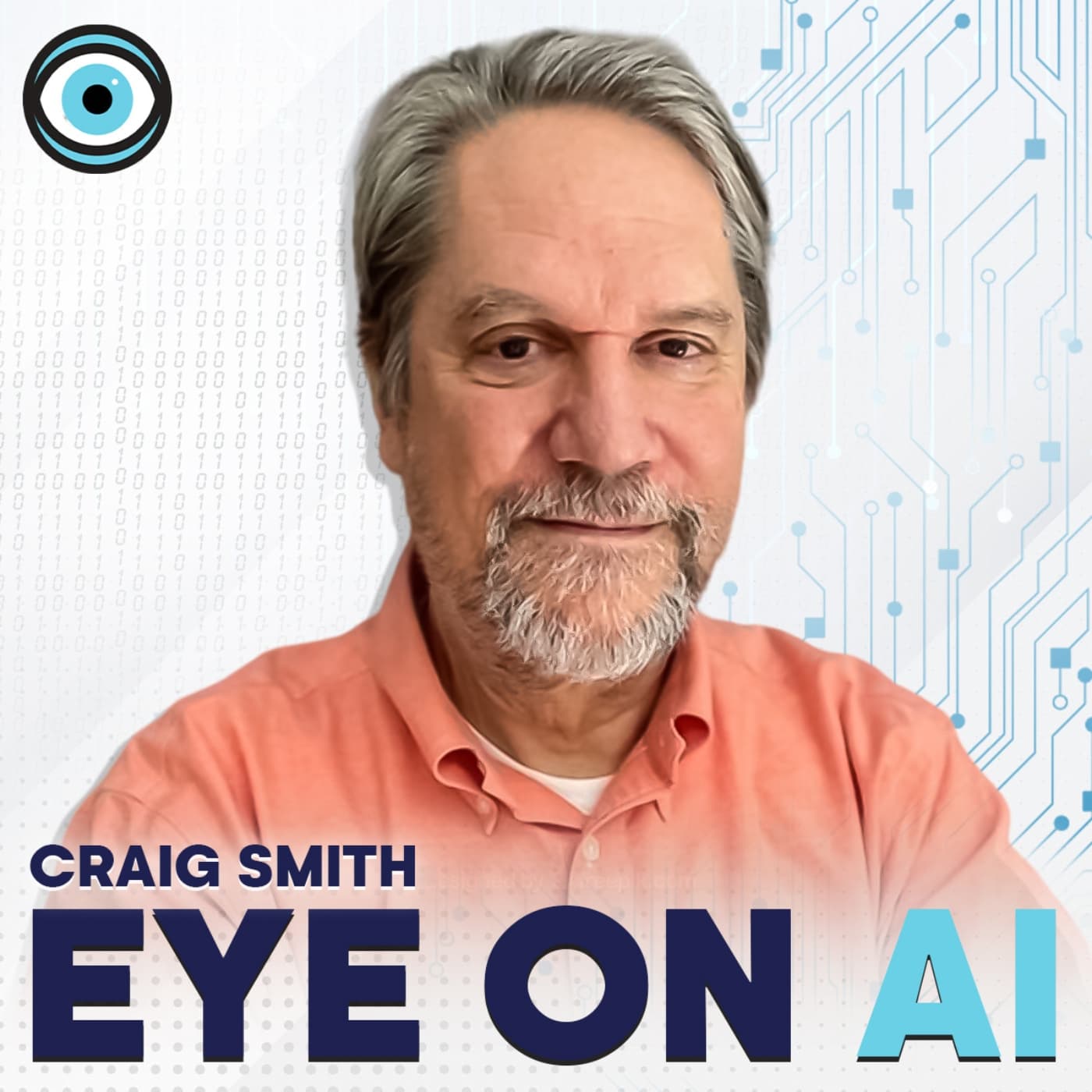
In this episode, Craig Smith sits down with Victor Riparbelli, co-founder and CEO of Synthesia, to discuss the $4 billion company that is now redefining what video communication means for the enterprise.
The conversation opens with the founding insight that still drives the company: AI is going to drive the marginal cost of creating video to zero, which changes not just how content is produced but who can produce it and for whom. Victor describes how Synthesia found its first real market not in Hollywood - which rejected the technology as too low quality - but in corporate trainers and educators who were comparing it not to a film but to a 10-page PDF no one was reading. The most forward-looking section of the conversation covers Synthesia's next product: moving video from a one-way broadcast into a two-way interactive conversation, where an AI avatar can conduct a real-time sales demo, simulate a customer for sales training, draw graphs on screen to explain pricing, and score whether the person on the other side actually understood the content. Victor also makes a sharp prediction about where AI entertainment will actually emerge, not in cinemas or on Netflix, but from film students with laptops posting 17-minute short films on Instagram, the same way synthesizers didn't replace pianos but created entirely new genres of music.
Key Topics Covered:
● How Synthesia found its first real market: corporate trainers creating content nobody was reading, who compared AI video not to Hollywood but to a PDF, and found it vastly superior
● The transition from one-way video broadcast to two-way interactive avatar conversations, and what that means for sales demos, corporate training, and education
● Why Hollywood will be the last industry to adopt AI video, and why the first AI-generated entertainment will come from broke film students on Instagram, not studios
● Why AI content won't replace real video, it will become its own genre, the same way synthesizers didn't replace guitars but created electronic music
● How the CEO uses Claude daily for strategic thinking, playing devil's advocate, and replacing the long memo with a voice note
As AI video tools proliferate, this conversation offers one of the clearest frameworks for understanding where the technology is actually headed, not toward Hollywood, but toward transforming the way every company communicates internally and externally, with interactive AI avatars replacing the static website as the primary interface between a business and its customers.
Subscribe to Eye on A.I. for weekly conversations with the people building and deploying the future of AI.
Craig Smith on X: https://x.com/craigss
EYE On A.I. on X: https://x.com/EyeOn_AI
Connect with Victor Riparbelli


