In short
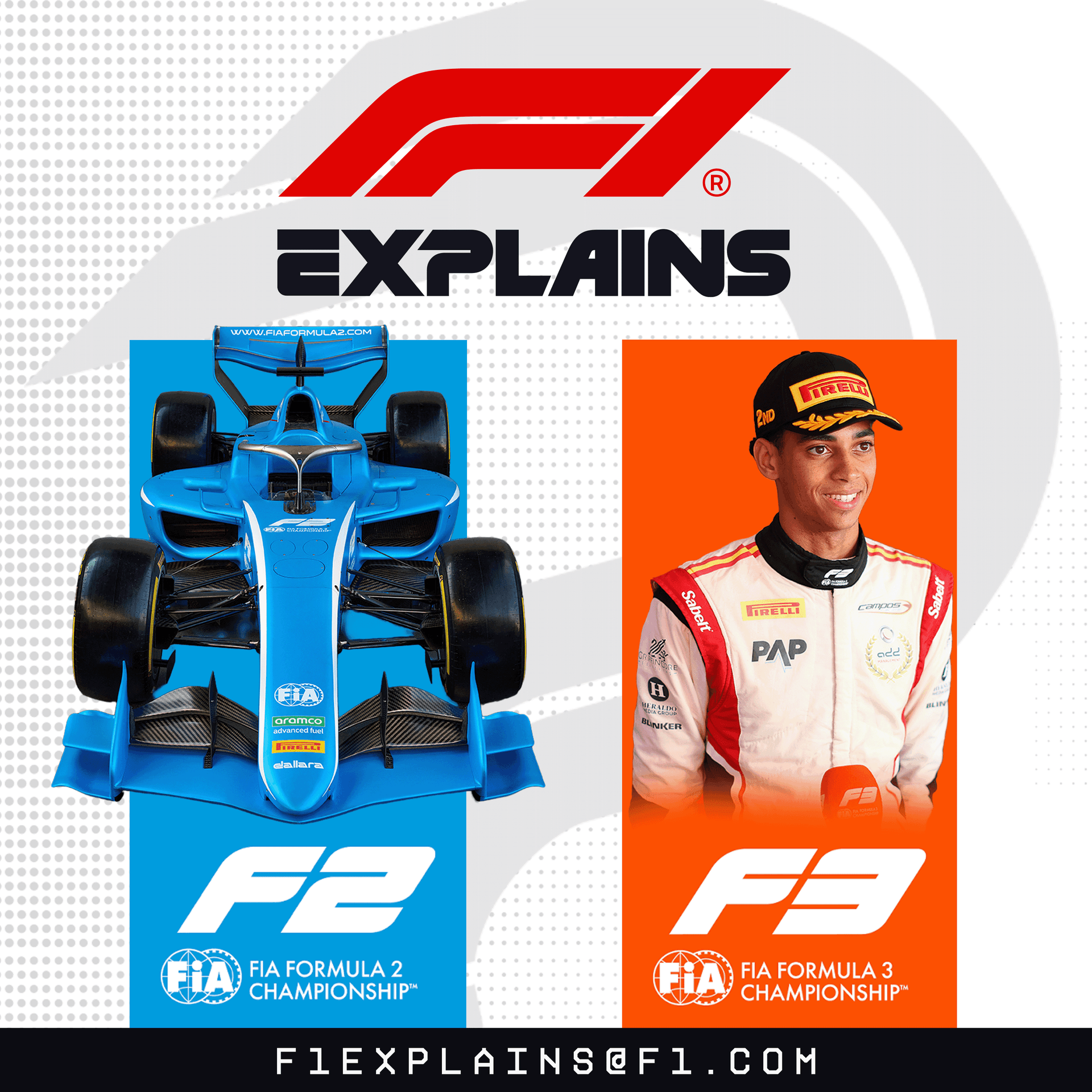
F1 Explains covers Formula 3 and Formula 2 as the feeder path to Formula 1, using the Azerbaijan GP weekend in Baku. It explains how F3/F2 prepare drivers for F1, compares car specs (F3 380 hp, F2 620 hp vs ~1000 hp in F1), and details F2’s 2027 car updates. It also explains how support series logistics work alongside F1 (shared F1 pit lane during sessions).
Guests
Ugo Ugochukwu, newly crowned 2026 F3 champion and the first American to win F3; grew up in New York, started karting in upstate NY, progressed through F4/FREKA to F3. Pierre-Alain Michaud, F2 technical director.
Key claims
F2’s spec equal machinery highlights driver/team skill; F1 rookies succeed when prepared in lower categories. F2 differs from F1 mainly by lacking hybrid powertrain; F2 uses IC-only. 2027 changes include new aero (front/rear wings) for closer racing and gearbox/differential evolution plus an on-board starter to reduce red flags.
Notable examples
Mentions F1 rookie success after F2/F3 (e.g., Kimi Antonelli, Gabriel Bortoletto, Lando Norris, George Russell, Charles Leclerc, Oscar Piastri). Pierre cites F1 examples like Berman performing after a call, and rookies such as Aja Linblad and Colapinto.
Written by AI. May contain mistakes. Listen to the episode to check what was said.
Chapters
Tap a time to open that second in VOExploring F2 and F3
0:59 to 3:52
Discussion on the purpose and structure of F2 and F3 in motorsport.
“I am Christian Hugill and welcome to the paddock here in Baku.”
Interviewing Ugo Ugochukwu
3:52 to 6:10
Ugo shares his journey in motorsport and feelings on becoming champion.
“Of course it's the dream and you're the first American to win Formula 3.”
Challenges of Junior Racing
6:10 to 8:34
Ugo discusses the competition and challenges faced in F3.
“Apart from obviously winning the series, what are the things that you've sort of held most dear this season?”
Career Structure and Future Plans
8:34 to 11:44
Ugo outlines his racing career structure and aspirations for F2.
“The drivers we've asked in the past have said two things.”
Transition to Formula 2
11:44 to 12:08
Discussion on moving from F3 to F2 and what to expect.
Understanding the Transition from F2 to F1
14:01 to 14:42
Explore the challenges drivers face when moving from Formula 2 to Formula 1.
“and to, I would say, play with the system around the track to find the best compromise and the best speed from the IC and hybrid powertrain.”
Designing Formula 2 Cars
14:42 to 16:34
Learn how Formula 2 cars are designed with F1 inspiration.
“So in the end, it's difficult to say why some are struggling and not the others.”
Cost Considerations in F2 Engineering
16:34 to 18:24
Discover the cost-related decisions that impact F2 car features.
“We have a limited number of people working on the car, so we need to make sure that the cars we provide them is quite straightforward, but still high technology and high safety standards.”
Differences Between F2 and F1 Powertrains
18:24 to 20:25
Understand the differences in powertrains between F2 and F1 cars.
“The other improvement will be on the gearbox side.”
The Appeal of Formula 2 Racing
20:25 to 21:00
Highlighting the excitement and entertainment of Formula 2 races.
“just to make sure that if at some point we have a stall on track a driver can be able to restart on his own and continue and limit the number of red flags.”
Show all 12 chapters
Team Dynamics in Formula 2
21:00 to 23:00
Explore how driver and team setup can influence performance in F2.
“And that fusion between driver and car and team setup is so important, isn't it?”
Logistics of Racing Weekends
23:00 to 24:11
Discuss the logistics of how F1, F2, and F3 coexist during race weekends.
“Actually, a few listeners sent in the same question, actually.”
Transcript
Automatic transcript. May contain errors.0:03This is the official F1 podcast which answers your questions, of course, about Formula 1. But not just F1. This time we're talking about the categories that lead to Formula 1, inventively called Formula 2 and Formula 3. Emily in Nashville, Tennessee, Bogdan in Romania, Marissa in Germany, Andrew in Malaysia, Gina in Texas and Toby in Sicily have all emailed f1explains at f1.com. they all want to know more about our feeder series. So welcome to Baku, the Azerbaijan Grand Prix, the ideal place to talk about it, because F2 are running a supersized weekend with an extra race here. The new F2 car for 2027 has also just been unveiled, so we're going to hear all about that.
0:49And we're going to meet the newly crowned Formula 3 champion, Ugo Ugechukwu, the first American to win the category. All that and plenty more on the way. Welcome to F1 Explains.
1:08Well, hello everybody. This is F1 Explains. I am Christian Hugill and welcome to the paddock here in Baku. I've never been here before. What a fascinating city. I'm sat outside Formula One's hospitality building where they look after people. there are beautiful skyscrapers in the clear blue sky ahead of me and for what is a very busy paddock I'm actually recording this talking to you on Wednesday highly unusually because I'm sure you know by now if you don't know by now it's important everything has shifted back a day this weekend the race is on Saturday F1 Explains is still talking to you on Friday of course when this episode is released but we have a very busy paddock for a Wednesday with teams and drivers flooding around me with people pushing bright green trolleys just in front of me at the moment so it's lovely to be here in Baku and as I've just mentioned talking about F2 and F3 a couple of things we should talk about before we meet our expert guests now F2 and F3 exist to let young drivers learn prove their talent and rise through the ranks to F1 I mean loads have just done that we're going to talk about a few a bit later on but Kimi Antonelli, Gabriel Bortoletto, Lando Norris, George Russell, Charles Leclerc, Oscar Piastri.
2:21In fact, most of the current F1 grid are graduates of F3 and F2. They race on F1 weekends, on F1 circuits, on Pirelli tyres, all to prepare drivers to make sure they are ready to step up to the very top of motorsport Formula One. Now the cars, they do look like Formula One cars, but they're smaller, they're less powerful. F3 cars, for example, have 380 horsepower f2 cars have 620 horsepower that's compared to about a thousand for f1 cars you can see how the steps go up step by step by step every driver in each category has the same car so it really is the drivers who make the difference and in f3 in 2026 and it's ugo ugechuku who takes the championship win what a drive from this american and there will be lots of buys on him from the f1 paddock we've already crowned our champion let's go meet him ugo welcome to f1 explains great to meet you thank you nice to meet you now i don't know if you're aware of this i know i'm aware you're the formula 3 champion but you're the first formula 3 driver to appear on f1 explains is that arguably a greater accolade than winning the championship for you has to be pretty close I would say pretty close I'll put the championship a bit higher we're offended and shocked it's great to meet you you are only what a couple of weeks into being crowned champion has it worn off the feeling of elation and joy how are you feeling well maybe a little bit but you know for sure still feeling good um yeah I mean it's a great thing that we've managed to achieve this year to get the championship done so you know of course I'm still enjoying the moment um but yeah I went down a little bit on the celebrations yes you can't keep celebrating for weeks you've got things to do i get that and we've got people listening to this podcast from all over the world a lot of brand new to formula one so for those unaware of you and your journey tell us a little bit about you where are you from where did you grow up and how did you get into motor racing well yeah i'm from the i'm from the united states i'm from the u.s i grew up in new york my first time in a go car was actually in upstate new york and um that's from where the the journey started the dream started uh you know my dad made me try go-kart one day and you know from there i really enjoyed it uh and then yeah made my way over to to italy to europe uh already in karting you know started quite early and and yeah moved up slowly through the ranks uh through f4 freka and now f3 so yeah it's been a it's been a long journey but you know a really good one and you know happy to have achieved a lot of things i have along the way you're young you've devoted your life to motor racing and you've now won a Formula One support series how does that feel?
5:12Yeah it feels really good I think to win an F1 support series is amazing with you know all the fans and all the people watching and yeah it's really what you need to be able to prove yourself and show yourself to really make that next step to you know the dream which is F1. Of course it's the dream and you're the first American to win Formula 3. We know how much Formula 1 has grown in the US in recent years. Does that mean an extra little bit, being able to represent the US on the global stage? Yeah, really happy to represent the US on the global stage. You know, that's my goal to try to do as best as I can always.
5:55And it's really cool to see that, you know, the sport is growing a lot in the US and, you know, that's my dream. hopefully one day have a nice home race and be able to race there with the American flag over the podium. We've got everything crossed for you. Apart from obviously winning the series, what are the things that you've sort of held most dear this season? What have been the parts of being in the championship that have been most valuable to you? I don't know whether it's driving the cars or the circuits, but what has been particularly cool about being an F3? well i think you know there's first thing is racing with f1 you know being in the same paddock as them on the same weekend seeing the races week in week out that really gives you more motivation to you know keep pushing on and because that's where you want to arrive one day i think you know there's a lot of bits throughout the year which you know i definitely learned from and took from i think to never give up is super important as well you know maybe there are a few races where stuff far and going your way but you always got to keep pushing pick up the points because at the end of the season that's it's going to pay off so uh yeah definitely uh picked up on a few things throughout the year and it did pay off and and what's it like as a racing driver because we we all know in the junior series everyone looks up to f1 but to be so close to it i mean here we are with we're talking here in back here we've got i was about to say friday practice thursday practice this weekend just to catch us out going on behind us like you're sort of following in their footsteps quite Literally, that must be a cool feeling.
7:24Yeah, for sure. It's really cool. Like I said, you're seeing them week in, week out, and it for sure gives you more motivation. At the same time, you've got to focus on your own thing as well and keep focused on what you're doing in the moment, which is always what I try to do, kind of tackle what's right ahead of me and then see what comes next later on. It's such a competitive series. 30 cars on the grid, 15 different winners this season. It's remarkable. What's the key to winning a series like that? What was particularly important for you? Yeah, I think that says it all. 15 different winners have the drivers.
8:01Yeah, for sure, it's not easy. Super competitive grid. And, you know, each weekend you're trying to battle to really qualify in that top 12, which is crucial for getting lots of points in the weekend. So it's not easy. I think consistency is the most important. There are a lot of factors that kind of happen through the weekend. So being on top of everything and maximizing each race, I think, is what's important to be in the fight for the championship. We've had loads of listener questions for you. Plenty asking the biggest difference between the Junior Series and F1. The drivers we've asked in the past have said two things.
8:36The amount of interviews you have to do, like this one. The bad thing is if you climb up the Series, you have to speak to people like me more. I'm sorry about that. That's one of the negatives. And the increased size of the team working with you. Is there anything else that you add to that that you've noticed as you look up to F2 and F1, the differences between all the different series? I would say another thing is probably in F3, I mean, the race format is a little bit different. It's very intense right before Quali, which is something that's a bit different. You know, we have one practice session where we get a few laps in to get a feel of everything of the circuit and then we're straight into Quali.
9:15So you really need to be focused and be on it and be as prepared as possible before coming into the weekend, you know, with a sim and all the factors that could happen. So, yeah, definitely a lot of preparation goes into it, as is an F2 and F1, but less laps on track to kind of put it all together before Koli. Yeah, of course. Give us an idea as to your setup in terms of how your career is structured, because every different racing driver works in slightly different ways. Do you have a manager? Do you have a team around you? Who are you sort of with on a race weekend? How does your setup and structure work in F3 and hopefully in future the likes of F2 and F1?
9:52Yeah, I think, you know, I have a manager, of course. And I have, you know, my coach who, you know, he's there every weekend with me. And, you know, a lot of effort goes in with him and with me, you know, working together as a team is super important. and then yeah all the people in the team you know my race engineer all three drivers have one engineer and we have two mechanics each and you know throughout the year you build a relationship with the team and it's super important as a team how you work together and I think you know in campus I felt an amazing chemistry within the team and that's really what you need for sure to succeed in a championship.
10:30We've done all the motor racing questions we've done the serious important questions let's do some less serious stuff uh tell me you win the championship in madrid whole season climaxes at that point what do you do how do you celebrate it's a cool city to win a championship in yeah it is a pretty uh cool city um yeah just celebrate a bit with the team a few other close uh friends drivers you know just enjoy a little bit um last weekend you know that we were all together as a team and look back on how the year was there must have been a meal there must have been something there must have you been able to see any friends or family or yeah had a a few friends around you know a few not from racing few teammates so yeah we celebrate a bit and of course such is the relentless nature of motorsport that you've just won one championship and then boring people like me ask you what's next so what are you looking for next well looking forward to 2027 you know i think f2 will is the next plan you know going forward so uh yeah here in Baku looking and uh supporting the F2 drivers and you know I'm preparing already for what's next in 2027 so try to have another good year like this one we're looking forward to following your progress once again congratulations and we're watching on screens behind us as we speak practice we hope we're seeing you out there before too long I'm sure we will thank you and speaking of Formula 2 we're going to be talking about that and plenty you more after the break on F1 Explains.
12:08Welcome back to F1 Explains. Let's now do what Formula 3 champion Ugo is hoping to do and move up to F2, where everything's a little bit faster and F1 is another step closer. The 2026 season is not settled yet, but we already know some details of 2027, including an updated car. The F2 technical director, Pierre-Alain Michaud, is the man to ask about that and all things F2. Pierre, welcome to F1 Explains. Great to meet you. Nice to be there. Let's start by asking how you make sure the Formula 2 car is the perfect preparation for helping drivers hoping to make that step to F1. It's important for us to make sure that the drivers have an equal machinery to compete with and we want to make sure that they prepare properly when they are on the F1 environment and I think we have seen it quite well in the past two three years with young drivers arriving in F1 and performing straight away like Berman in Jeddah when he had a call from Ferrari and jumping in the car and performing well for the quality in the race I mean it's it showed that the preparation is a is well and we've seen it in the past two years as well with all the rookies that performed well straight from the beginning like Aja, Linblad Gabriel Portoleto all of these drivers who perform while having a call early in advance or last minute like Biermann or Colapinto as well when he went to Williams.
13:39Absolutely let's stay on that theme because we've got a question from one of our listeners Noah has emailed f1explains at f1.com now Noah asks what's the main difference between the Formula 1 car and the Formula 2 car? The main difference is the powertrain. We have only IC engine. We don't have the hybrid system, so we don't have all of the system and the need of the driver to accommodate and to, I would say, play with the system around the track to find the best compromise and the best speed from the IC and hybrid powertrain. So that's something we do not have in F2. and beside that we have a a aerodynamic package that is close to F1 we have worked quite a lot to make sure that the machinery is close to F1 in terms of handling just to make sure that we prepare them properly and we have seen some rookies struggle in the past as you say the vast majority particularly in recent years have taken to Formula 1 really well but of course it's designed to test the drivers, it's supposed to be a step up when you go from Formula 2 to Formula 1, what are some of the challenges that drivers do sometimes struggle with do find harder when they're making that step up it's difficult to know i mean uh the good thing in f2 is that we have a single make series so they can really show their pure performance and compare to the other one so they all have access to the same equipment so they can really show their pure skill in f2 whereas in f1 there are many factors that are linked to the the teams and everything that are in their new environment.
15:17So in the end, it's difficult to say why some are struggling and not the others. But in the end, we can clearly see that all the last, I would say, rookie that arrived in F1, like Antonelli last year, performing really well this season. They are well prepared when they have performed well as well in the single and lower categories. I think we can safely say Kimi Antonelli is performing well, can't we? I think so. now do you use f1 cars as inspiration do you try and replicate f1 cars when you're coming up with the formula 2 car or do you completely cast a formula 1 car aside and start with your own piece of paper no no not at all we really start from f1 uh first the first step is to work with the FIA to define the regulation and the perimeter on which we will work.
16:11And then we take the F1 regulation that sometimes we downgrade a little bit on our side just to make sure that we accommodate and we are a little bit, I would say, simpler in some areas for the teams to work on the car and to be able to perform with our teams which are not the same number of people, operational people like F1. We have a limited number of people working on the car, so we need to make sure that the cars we provide them is quite straightforward, but still high technology and high safety standards. So we start from this and then we define the perimeter on which we want to work with and to achieve the performance goal and sporting goal for the championship.
16:58Pierre, you've mentioned it throughout our chat, but F2 is what we call in motorsports a spec series. it means every car is the same teams buy them from the supplier it's one of the costs of being in the championship are there some things about the formula one car that you couldn't replicate simply because it would cost too much like active aero for example that's one of the of the technical that's one of the technical components that we decided not to use or not to implement for the new car that will be on track in 27. That's something that is... It's possible to do it on F2. I mean, we have already hydraulic components and everything to manage it, but in terms of cost, it would have been quite a significant cost to implement it.
17:44And the fact is that in F1, they implemented it to cope with the new powertrain regulation and the new hybrid system that we have in the car. So it was like a complete package. Straight line mode plus powertrain to achieve the results they wanted to have in F1. Whereas on our side, we don't have the hybrid system. So in the end, having only the IC powertrain means that we can still use the old-style DRS to keep some active aero, but not the front active aero like F1. It was really a decision made with the spec of the powertrain. And just remind us, for those newer to motorsport, what IC means?
18:23Yes, it's an internal combustion engine, IC. so it's an engine that are purely run by fuel and you don't have a powertrain which has a fueled engine plus electric motor and battery we are only using fuel for our cars and that's why we developed a lot this fuel in the past year with Aramco to to get some more and more sustainable fuel in the car yes one of the differences isn't it the Formula One cars are hybrid between electrical power and what we sort of call old-fashioned engine power whereas the f2 car is 100 old school engine power but as we say with these sustainable fuels still excellent on the environment and let's talk about a little bit more about the new car what are the main differences talking broad brushstrokes from the new car that as i say is going to be on uh it's going to be on the track next year to the old car that we're currently seeing on track in baku this weekend one of the main difference will be an aero package when we designed the car in for the 24 season we were on the 22 f1 22 regulation so with the old set of wings mainly and now this new car will will be there with in mind the 26 regulation so a new front wing new rear wing a lot of the package has been adapted to make sure that we can do a step forward on the following car performance that's what we assess with the FIA just to make sure that we continue to improve our what's in our DNA for quite a long time the closed racing we want to make sure that drivers can follow each other properly on track so we are improving year after year this what we call closed racing factor and that's one of the main thing and why we moved as well to this new configuration.
20:17The other improvement will be on the gearbox side. We have some evolution on the differential and we implement an on-board starter just to make sure that if at some point we have a stall on track a driver can be able to restart on his own and continue and limit the number of red flags. And you talk about the closest racing. I mean at Formula 2 there will be plenty of people listening to this podcast who are new to Formula 1 or love F1 but haven't got around to watching f2 yet i can't recommend it enough you know it's such entertaining racing the same with formula 3 which we were talking about a little earlier in this program it's great racing we should say you can watch it uh across f1's youtube channels on f1 tv on sky sports f1 in the uk now the cars are all the same but we do hear when we're watching f2 commentators refer to you know one team having an advantage over the other now we know that's not the car as you said the cars are all the same but yet in other ways i suppose it is the car isn't it explain where these teams do get advantages over each other in the end ultimately it's the package and set up package is driver team car yes the thing is that they all have access to the same equipment they all have access to the same car they all have access to all the optional parts we can have for this car to to differentiate the setup so in the end it's really the work they can do between the driver and the team to accommodate the driving skills of the driver just to make sure that he has a car he likes to drive so in the end it's really a combination of driver feedback and team capacity of analyzing this feedback to make sure that they have a car that behaves as they would expect you explain that fusion so beautifully because it's something we saw possibly most notably in Formula 1 in recent years at Red Bull, where we had Max Verstappen winning in what was clearly a phenomenal racing car, but teammates of his, various teammates of his, struggling with it.
22:19And that fusion between driver and car and team setup is so important, isn't it? And in the end, if you have a driver who can explain and feedback properly his needs, they will be able to have a good alchemy between the car the driver and the team to make it work properly so in the end it's really important that the driver can show his skills by being a quick driver on track but being a good feedback giving a good feedback to the the teams in the background developing those skills on track in racing but it's so important in modern formula one isn't it to be able to give that feedback off track and work with your engineers and they're all skills being developed in Formula 2.
22:59But yeah, you're a very busy man on a race weekend. We'll let you go in just a second. But one final general F2 question. Actually, a few listeners sent in the same question, actually. So hello to Marissa from Germany and Bogdan from Romania. Just a couple who both want to know how F3, F2 and F1 are all at the same racetrack in the same weekend. Do they have their own pit lane, their own garages, their own paddocks? I know this is a question you could take hours to explain. the logistics of Formula 1 is fascinating but more broadly how do all the categories coexist with each other on a race weekend?
23:34Yeah F1 has his own pit lane and his own paddock and as a support series we have our own support paddock where all the teams have their own garages or tents depending on where we are around the world and in the end they operate and work in this paddock to prepare the car and then we have all the equipment and the cars going to the F1 pit lane. And when we are doing a session of repractice qualifier races, we operate from the F1 pit lane. So in the end, we bring all the equipment to operate the car in the F1 pit lane. And from this, I would say we operate like F1 is doing, but all in the pit lane.
24:20We don't have specific garages in the pit lane, but we have a movable equipment with trolleys and a quad that the older teams are bringing it on track that's why sometimes you have some some nice images of all the trolleys in line on track and people waving uh the public so it's uh i'm so glad you've said this that is one thing you don't half know about it if you're in the pit lane when the trolleys are moving from one area to another it is like being in piccadilly circus or in times square new york with all the trolleys moving around you have to have your wits about you in those bits those people must be very good at driving those trolleys oh it's uh they have a lot of equipment at the back so they need to be really careful and uh yeah even if on some track like for example barine we have our own garages and our and a pit lane that could be used we are always operating from the f1 pit lane so we move from our garages to the f1 pit lane we operate from the f1 pit lane using the f1 pit wall so we are using all the pit walls that F1 teams are using during their races.
25:19So we have access to this just to operate from there. Pierre, fascinating insight. It's been great talking to you. It's such a fantastic series to watch. So congratulations on what's been an excellent season. And we're all very excited for the next one. Yes, that will be an interesting one. And it would be good to reshuffle a little bit the car with a new car. And get a break in before that, won't you? We'll try. Thanks, Pierre. Great to talk to you. Thanks a lot.
25:45Thanks so much to Pierre. I really enjoyed talking to him. And I've really enjoyed this whole episode, actually. Focusing in on F3 and F2 has been absolutely fascinating. And I mean it. I said it earlier in the episode. It is such fantastic racing. It is phenomenal entertainment. And listen, I know there's an awful lot of Formula 1. Of course there is. It's a lot catching up with that. But if you've got time in your very busy lives to squeeze in some Formula 3 and Formula 2 of a weekend, make sure you check it out. As we said earlier, you can follow it on F1 TV. the F1 YouTube channel, the F2 website and social channels, on Sky Sports F1 in the UK, your local broadcaster, wherever you are around the world.
26:23It is well worth checking out, as, of course, is F1 Nation, which lives on this very feed. Tom and the gang will be here after the race here in Azerbaijan to debrief the action. Beyond the Grid is over on our other feed as well. Plenty to get stuck in there with in-depth stories from the world of Formula One, featuring some of the sport's biggest names. and here on F1 Explains we have new episodes every Friday we'll be back with another next week so until then from me Christian Hugill in Azerbaijan bye for now
From the publisher
They're the racing series which prepare drivers for Formula 1. F2 and F3 are where Kimi Antonelli, Charles Leclerc, Oscar Piastri, Gabriel Bortoleto and many more F1 stars have honed their skills behind the wheel. How are these categories different, what do the drivers drive, and what does it take to win?
2026 Formula 3 champion Ugo Ugochukwu tells Christian Hewgill the key to topping a competitive field of 30 drivers, what he learned from racing on F1 weekends and how he hopes to make the step up to F2 and beyond.
Formula 2 Technical Director Pierre-Alain Michot answers your questions on how the F2 car is different to F1 machinery. He also explains how the updated F2 car for 2027 will give drivers the best possible preparation for F1.
Got a question about Formula 1?
Curious about cars? Wondering about wings? Send your question on any F1 topic to F1Explains@F1.com
Listen to more official F1 podcasts
In-depth interviews with Formula 1 stars on F1 Beyond The Grid
Expert opinion, analysis and reaction on F1 Nation
Follow Formula 2 and Formula 3
- Official Formula 2 website
- Meet F2 rising stars in Chasing The Dream
- F2 Highlights on YouTube
- F2 social media