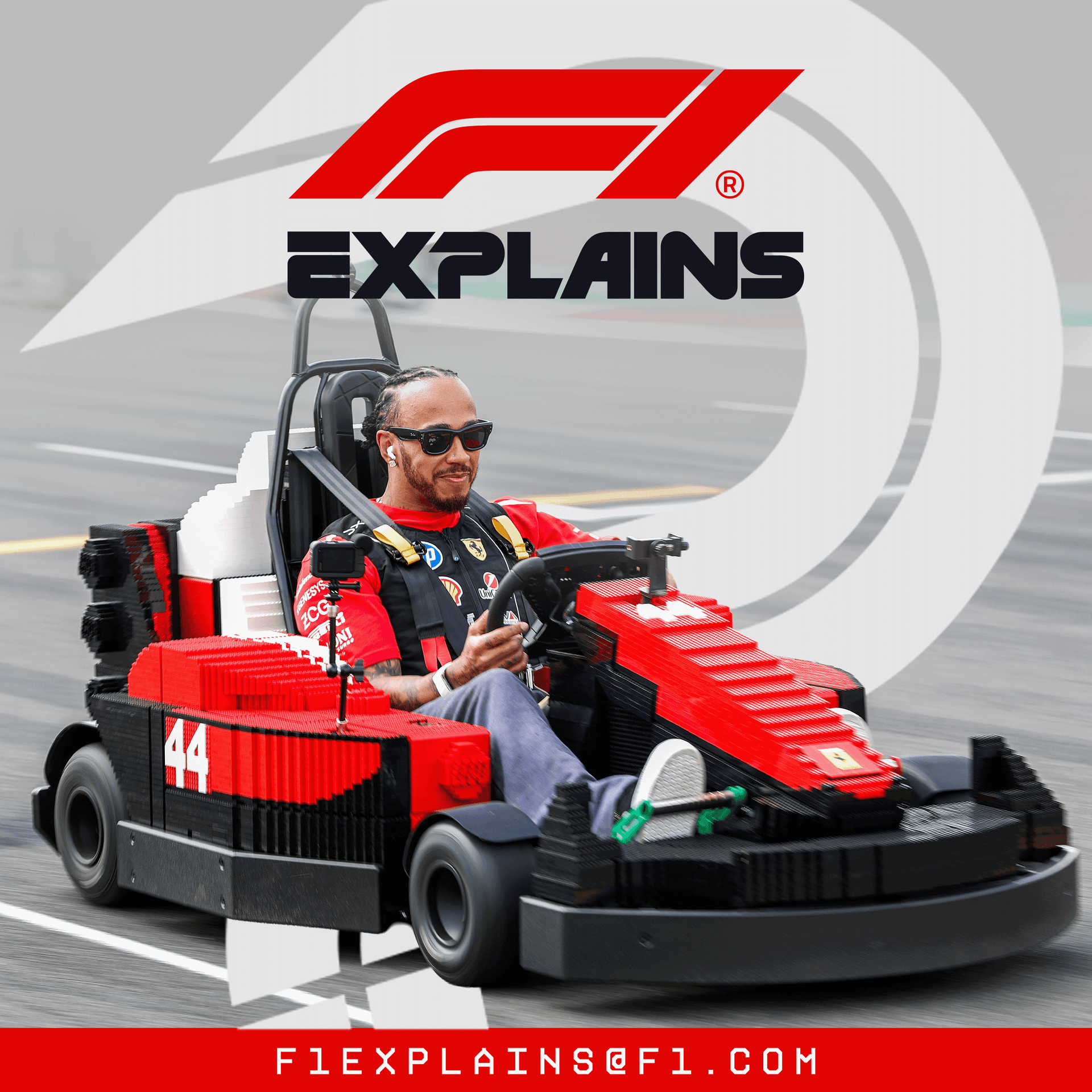

In short
How LEGO and F1 create driver “minicars” for the drivers’ parade, including design, engineering, building, and what happens when they race on real circuits (Miami and Silverstone referenced).
Guests
Jonathan Jurian, senior designer at the LEGO Group’s Kladno model shop (Czech Republic), part of the team that designs and builds large LEGO models/activations that can drive.
Key claims
Each car is engineered to fit one driver and is built by hand (not instructions/assembly-set style). Cars use electric motors, batteries, and LEGO-built steering controls; they reach about 25 km/h. Each car uses ~28,000+ bricks and weighs ~280 kg; ~20–22 specialists build them in LEGO’s Czech factory. Teams help iterate colors/shapes.
Notable examples
Alex Albon’s Williams-branded LEGO car; Miami’s earlier “two drivers in one car” format; Silverstone drivers each get their own car, leading to “chaos.”
Written by AI. May contain mistakes. Listen to the episode to check what was said.
Chapters
Tap a time to open that second in VOIntroduction to LEGO Drivers' Parade
0:03 to 1:13
Explore how F1 drivers engage with LEGO models in a fun way.
“Since its first Formula One victory in the 1965 Mexico Grand Prix, Honda has always taken what's learned on the track and used it to build better cars for everyone.”
Introduction to LEGO Drivers' Parade
2:01 to 3:14
Explore how F1 drivers engage with LEGO models in a fun way.
“Formula One, home to 22 of the most competitive elite athletes in the world.”
Childlike Fun with LEGO
3:26 to 4:50
Discussion on how LEGO influences the behavior of F1 drivers during events.
“After three long weeks and to F1 Explains, my name is Christian Hugill, talking to you from a sunny Zandvoort.”
Interview with LEGO Designer Jonathan Jurian
4:50 to 6:14
Christian interviews LEGO designer Jonathan Jurian about their work.
“And to explain more, just before our latest cars took to the track, I spoke to Jonathan Jurian, the senior designer from the Lego group.”
The Process of Building LEGO F1 Cars
6:14 to 10:40
An in-depth look at how LEGO F1 cars are designed and built.
“And when producer Jamie said to us, you're going to talk to someone from Lego, I was like, this is the greatest day of my life.”
Continuation of Honda's Innovation Story
14:44 to 15:47
Further exploration of Honda's advancements in car technology.
“Honda has always taken what's learned on the track and used it to build better cars for everyone.”
Behind the LEGO Drivers' Parade Minicars
15:58 to 21:58
Explore the design and creation of LEGO models for F1 events.
“Now, as we saw in Miami, it's my job to interview Formula One drivers.”
F1 Paddock Shenanigans
22:14 to 24:04
Catch up on the fun and atmosphere in the F1 paddock.
“Jamie, producer Jamie, welcome back to F1 Explains.”
Transcript
Automatic transcript. May contain errors.0:00This episode is sponsored by Honda. Since its first Formula One victory in the 1965 Mexico Grand Prix, Honda has always taken what's learned on the track and used it to build better cars for everyone. From pushing limits in F1 to engineering the next generation of hybrids like the Prelude Hybrid and Civic Sedan Hybrid, Honda proves that racing doesn't just inspire innovation, it drives it. And that idea of taking lessons from the racetrack and applying them to road cars has always been a part of Honda's DNA. Decades of engineering in the demanding world of Formula One have helped shape the performance and efficiency you see in Honda's road cars today.
0:44And now that same thinking is shaping the next generation of hybrids as well. Cars like the 2026 Prelude Hybrid and Civic Hybrid show that electrification can be both efficient and genuinely fun to drive. The 2026 Prelude Hybrid and Civic Sedan Hybrid are engineered for fun. From the racetrack to your driveway. Learn more about the Prelude and Civic and the latest innovations at Honda.com. Sleep Number's new collections are designed to adapt to the changing nature of your life and your sleep needs. Whether it's the personalized comfort of the Comfort Mode mattress, the targeted pressure relief of the Comfort Next mattress, or the climate collection that actively cools or warms to help you fall asleep and stay asleep.
1:30And now, all beds are on sale during our biggest sale of the year. Save 25 % on the new Comfort Next Luxe, plus free delivery on any mattress. Ends Monday, only at a Sleep Number store or sleepnumber.com. Meet the Red Bull Dragonberry Energizer. It's one of the many new drinks out now. Who knew ice cold drinks could be so fire? Try them all, only at McDonald's.
2:01Formula One, home to 22 of the most competitive elite athletes in the world. Yes, they are world class talents, but they are also children.
2:22Boys with toys. And nothing proves this more than the fact we give them giant Lego cars to drive. Lego is an official partner of Formula One. And in Miami last year, we ripped up the rules of the driver's parade before the race and put our 20 heroes in 10 model F1 cars made up of nearly 400 ,000 Lego bricks in each car. But how could we top that? Can you turn the power up? No. Why? It's important to finish. It's true. It's a long walk. We will not finish. Well, at Silverstone this year, every driver got their own car. Of course, chaos ensued. This is so stupid. So how do F1 and Lego do it? Let's find out.
3:13Welcome to F1 Explains.
3:22Well, hello you. Welcome back to the Formula One paddock. After three long weeks and to F1 Explains, my name is Christian Hugill, talking to you from a sunny Zandvoort. but approximately three-tenths of a second ago, it was not sunny at all. The weather here this weekend is what I would describe as changeable. I'm talking to you on Thursday afternoon. You'll be listening to this Friday or Saturday. So all I would say is keep an eye on the weather this weekend. It could be a lot of fun here in Zandvoort. A weekend where we've had lots of breaking news already. Carlos Sainz, Max Verstappen signing new contracts.
3:57There is a breaking news episode of F1 Nation on this feed with Tom Clarkson for you to listen to to get all the latest on that. But here on F1 Explains, as I say, we are explaining Lego. And this is one of my favourite things we've ever done on this podcast. And the whole Lego tie-up is one of my favourite things F1 has ever done. Because as I just said in the intro, it just immediately lowers the mental age of our drivers by at least half, probably more. They all turn into children. They all want to bash into each other. They all want to drive them into the gravel trap just to get them stuck.
4:32Why? Because they can. They're Formula One drivers. They can do what they like. But how does it all happen? These things aren't just thrown together, quite the opposite. What goes in to getting these drivers into these fantastic Lego cars and making them go around actual Formula One circuits is truly remarkable. And to explain more, just before our latest cars took to the track, I spoke to Jonathan Jurian, the senior designer from the Lego group. Jonathan, welcome to F1 Explains. I'm very excited to talk to you. Thank you for having me. It's an utter pleasure. And the reason I'm so excited to talk to you is this is a bit of me, this episode of F1 Explains.
5:14I don't think I've ever said this on the podcast before. I am a Lego builder. And don't think I'm saying this just because Lego is an official partner of Formula One and this is an official Formula One podcast. I love a bit of a Lego build. So before we get into all of these mad creations that are sat behind us, tell me about you. Tell me about what you do for a living. All right. I'm a senior designer at the Kladno model shop, which is part of the LEGO group. We build models like that. We also build other models for Legoland parks, for shops, etc., for other activations. So this is really in our DNA, these big models.
5:53What I do is mainly the brick part of the models. And together with our teammates, you know, technical development, engineers, all of these people, we put together models that drive. Yeah, that's what we do. I'm buzzing about this podcast, you can tell. So, not to make it all about me, let me tell you what I built. Because I've sat there building Lego with so many questions. And when producer Jamie said to us, you're going to talk to someone from Lego, I was like, this is the greatest day of my life. So, forget the Formula One, this is far more exciting. So, for legal reasons on F1 Explains, I should say that's not the case.
6:25We also like Formula One. But still, Lego. I build the little F1 cars that are like the Speed Champions. Speed Champions, yeah. Thank you. I also build the much bigger Nintendo sets. I'm a big gaming geek. I've always wanted to know, because all the Speed Champions sets, they're all subtly different. The Williams is a different shape to the Ferrari. Who on earth sits there and goes, we're going to make it have this brick for this bit and makes the picture of the car or the real car into a Lego model. Is that what you do? That's not exactly what I do, but these are super talented designers back in Billund in Denmark that have the pleasure of designing these models.
7:11As I said, they're really talented. They really know every brick, how it's shaped, where it goes, all the building techniques. So that's it. That's the question I'm asking. There is someone that goes and will use this brick for this bit and this brick for this bit. That's how it works. It's not a computer. No, it's not a computer. It's all handcrafted. It's amazing. So where does your bit come in? So our bit comes way later in the process. We actually don't, we have nothing to do with the product. So we're here to create activations like that. So for this example, like I know we're going to talk about it a bit later.
7:46Yes, yes. But in this case, we're really focusing on the big builds. So this is what we do. It's really, you know. So you do big Lego. We do big Lego, yeah. You wouldn't get that in a box. I mean, maybe several boxes. A big box. Yeah, absolutely. Right, and we should get on to this. So I will describe what we can see around us. We're just outside the paddock at Silverstone, which is literally over there. You may be able to hear cars on track behind us. And in this great big tent with me and Jonathan, there are the cars, which by the time you all have heard this podcast go out, have been around Silverstone.
8:19They're all in one piece at the moment, which I suspect might not be the case afterwards. but every team is represented. We've got the blue of Williams in front of us with number 23, which is Alex Albon. We've got Ferrari with Lewis and Charles just behind us. They're all there. They're all the right liveries and they look absolutely amazing. Jonathan, let's pick, because no favouritism on F1 Explains, but let's pick Alex Albon's car as it's next to us. Tell us, how does this come about? This Alex Albon model giant thing of beauty that's in front of us. Talk to us about it. Right. So we got to go back to the beginning.
8:56So when we start designing these, I brought a little prop here. Got a little prop. So we start designing in small. So we try to get the shapes right, et cetera. So here the fans asked, after Miami last year, the fans asked, can we have a driver per car? Because in Miami we had both drivers in one car, right? so we tried to figure out how could we make a mini F1 car fitting one driver and do 22 of them so this is where we started well and this is when we where we ended up actually so this is the prototype that came before we upscaled the whole model and so as I just mentioned once this is ready we work with our engineers to make you know all the insides all the steel work and all the the batteries and electric motors and everything.
9:47And then we upscale these elements in that shape. So you can really find all these elements, for example, in the back wing here. Yeah. We have also the Lego knobs with the logos up there. So that's the first part of the process. Then there's, you know, engineering that goes in. We have dedicated builders that build these, actually. And building these is not like building a set, right? So you wouldn't be building instructions like in a box. we really build them like a house it's more like layer by layer so we start really you know base layer and then we go a little bit like a 3d printer you would say but manually of course yeah and then throughout the design process we work with the teams to you know get deliveries right so if we're talking you know albon's car uh we had to go through iterations with williams to you know get the colors right get the right blue and get the right blue get the right shapes on it.
10:39Obviously, the proportions are quite different from an F1 car, so we had to do it a little bit differently, but, you know, Williams was really happy with that, so that's how it turned out. And what I love sitting in front of it is, of course, not all of it's Lego. The tires, for example. We need some rubber to fix the track. But so much of it, looking at it, is Lego. Looking at where the steering wheel comes up looking at the front wing looking at the nose of the car as it droops below the steering wheel so much of its lego yeah right uh it's about 70 kilos of bricks uh 70 so each car is about 70 kilos of bricks of bricks uh overall it's 280 kilos the whole thing so wheels and the chassis etc um it's about 28 000 bricks actually so well quite a few so producer Chris from F1 Explains has given us some key facts.
11:36Each of the Lego F1 minicars has more than 28 ,000 Lego bricks. How many people or who would be responsible for putting it together brick by brick? So our team is about 20 people, 22 people, I think. Some of them are, you know, engineers, as I already mentioned, some of them are designers as myself, some of them are builders as well. So, you know, in our factory in Cladno, we build these 24-7, not only cars, but as I already mentioned, also different other models. Big fun stuff, basically. Big fun stuff. So yeah, it's a tedious process, but it's done by hand. It's incredible. And again, you sort of, it's part of the magic, isn't it?
12:17You sort of think nowadays that there'd be computer things that could help you build these, but the fact that there is a team like yourself who is there building it all by hand for stuff like this is just remarkable. They can reach speeds of around 25 kilometers an hour. That's 15 miles per hour. So they're actually faster than the ones we saw in Miami. I think it's a similar speed. Maybe the sensation would be a bit different because you're lower to the ground and it's a smaller vehicle, maybe more agile. But the speed would be quite similar, I'd say. And we've discussed the weight, but again, to go into a bit more detail, each car weighs approximately 280 kilograms, whether you say 65 to 70 kilograms of that being Lego bricks.
12:54So what a massive chunk of a machine that moves is actually Lego bricks. It's insane. And talk to us about how they move. What are these cars fitted with? So these cars are fitted with an electric motor. That's what makes them move. We've got batteries, obviously, in there. We've got lights on the back as well, you know, for signaling braking and all other kinds of stuff. The steering wheel is actually half Lego as well. So as you go see, you can see buttons and dials built out of Lego elements.
13:33In today's world, planning ahead isn't always top of mind. But not having life insurance can leave families facing difficult financial uncertainty during already emotional times. In many cases, loved ones are left managing expenses, debts, or long-term obligations without a clear plan in place. Life insurance is one way to help provide financial security and support when it's needed most. That's where Ethos comes in. Ethos makes getting life insurance fast and easy, and it's 100 % online. You can get a quote within seconds, apply in minutes, and even get same-day coverage. There's no medical exam, you just answer a few simple health questions online, and coverage options are flexible with up to$3 million available and some policies starting at around$30 a month.
14:18Ethos has also earned strong customer feedback with a 4.9 out of 5 star rating on Trustpilot based on more than 5 ,500 reviews as of August 2026. Help protect your family with life insurance through Ethos. Get your instant quote today at ethos.com. That's E-T-H-O-S dot com. Application times and rates may vary. This episode is sponsored by Honda. Since its first Formula One victory in the 1965 Mexico Grand Prix, Honda has always taken what's learned on the track and used it to build better cars for everyone. From pushing limits in F1 to engineering the next generation of hybrids like the Prelude Hybrid and Civic Sedan Hybrid, Honda proves that racing doesn't just inspire innovation, it drives it.
15:08And that idea of taking lessons from the racetrack and applying them to road cars has always been a part of Honda's DNA. Decades of engineering in the demanding world of Formula 1 have helped shape the performance and efficiency you see in Honda's road cars today. And now that same thinking is shaping the next generation of hybrids as well. Cars like the 2026 Prelude Hybrid and Civic Hybrid show that electrification can be both efficient and genuinely fun to drive. The 2026 Prelude Hybrid and Civic Sedan Hybrid are engineered for fun. From the racetrack to your driveway. Learn more about the Prelude and Civic and the latest innovations at Honda.com.
15:58Now, as we saw in Miami, it's my job to interview Formula One drivers. And I can promise you they're big kids. They are children. I mean, quite literally children in Kimi Antonelli's case. But still, they can't resist but bump each other. A lot of people listening to this will be able to hear with the benefit of hindsight what happens. We're recording this before Silverstone. But how much bumping can these things take? So we made sure to protect the brakes as much as we could. So we added some bumpers and some protection, some fenders, etc. So hopefully we don't lose any brakes on track. Hopefully.
16:37Hopefully, I think I'd be surprised if they escaped scot-free, but let's see. We've talked about this a little bit. Let's delve into a bit more detail of who built them and where does the work happen? And then how do you get them here to Silverstone, to the British Grand Prix? Right, right. So we built them in Kladno, that's in Czech Republic. The Lego Group has a factory there where all these models are created. And for the shipping part, well, they ship in big crates. which it's it's starting to feel like before long we're going to have a full-scale formula one championship because the fact that you're sort of shipping them in crates you're starting to mimic actual formula one cars here they're being looked after to the same level as f1 cars it's quite the operational too yeah i would imagine um i'm told that they took more than 6 400 hours to develop and build and created by as we've just said 20 specialists in design engineering and building in LEGO's factory in Chez Chessier, Central Europe.
17:35And you've said you work with the F1 teams and F1 drivers to create these cars. They must be really enjoying this because it's something a little bit of fun. It's something different. Well, yeah, I certainly hope so. And, you know, from the communication we had, the teams were really satisfied from how they turned out. So, yeah, I hope the drivers enjoy it. Absolutely. I mean, F1 and the LEGO group have been working together since 2025. Obviously, as we discussed at the start of the show, because I buy them you can get models of every car on the current grid all different sizes historic cars from different areas of the sport duplo cars for young kids they're all amazing how much do you enjoy designing and working within the f1 world oh wow i i enjoyed it a lot uh for me as a as a formula one fan and a lego fan for since i was a kid it's a it's a dream come true honestly now We've seen the big full-size cars in Miami.
18:28I also remember the pink Lego Cadillac in Vegas, driven by Terry Crews. We've obviously got these mini cars at Silverstone. What's next? You've got to top it now. That's the problem. You're going to have to wait and see. I wouldn't ask you to break any form of promises, but are there plans in the pipeline for more things? We don't have an announcement yet, but just wait and see. Just wait and see, he says, with a coy raised eyebrow. Now, I ask this question a lot of guests on F1 Explains. We, on this podcast, we do delve into the wider world of Formula 1 beyond just what you see when you flick on the TV.
19:06And there's a question our listeners love to know, which I've never asked to somebody in your position before, but how did you get into your job? Because I don't imagine, and correct me if I'm wrong, that when you were at school, you were sat there going, actually, miss, sir, what I'd like to do for a living is build Lego bricks and make them into massive things? Because if he said that, they'd have been like, yes, but that's not a job, is it? And of course it's a job, it's hard work. I'm sure you work very hard. But how on earth did you find yourself here? It's really a coincidence, I would say.
19:37So at the base, I'm a 3D designer. So I worked in advertising and I did a lot of animations, 3D videos, et cetera. Amazing. But what the job really requires is being able to work in 3D, being able to work with volumes, and also knowing the Lego ecosystem, knowing the elements, etc. So having all of that is the right chemistry, I would say, to get this job. You must have to be good with your hands. You must have to, because I love building Lego, right? I am terribly impractical. I struggle with changing a light bulb, but what I love is I can build Lego. The instructions are clear. For those who don't build Lego, there's never words on them.
20:20It's just all pictures, so anybody from any language can pick them up. And it's achievable for somebody even as rubbish as me. Are you good with your hands? Have you always been practical? I hope so. I mean, for the job, we have specialists that really specialize in building. What I do is designing the shapes, etc. So I don't get to build that much or as much as I would like. but certainly you need to you need to certainly know how LEGO works how the building techniques work and how all the elements interact between each other so yeah and the thing I just want to end on and I can't emphasize enough is that we see them go around the track and we're sat there now we've got them surrounding us in this awesome tent and yet every single one has been built piece by piece by a human being, it's remarkable that's right, yeah the amount of work that goes into it is remarkable and i have to emphasize the builders we have are are amazing they're awesome and they do an awesome job even the details like the numbers of the drivers on the sides number 30 here for liam lawson 41 arvid limblad next to us like even the numbers are lego bricks put onto it like the level of detail is absolutely phenomenal i love it well listen i've already said i mean you converted me anyway i was always a fan but i'm hoping that from listening to this podcast and getting a little bit of behind the scenes as to how the madness of miami and silverson actually happened has helped convert a few more fans to the world of lego and formula one so congratulations for everything you guys have achieved it's been a huge pleasure talking about this on f1 explains awesome it's been a pleasure as well and we hope to inspire as many builders of the of tomorrow as weekend get building lego kids
22:09jonathan jury in there senior designer from the lego group that was absolutely fascinating finding out how all that comes together lego do a fantastic job i can't wait to find out what's next how are they going to top that meanwhile back here at the dutch grand prix There are some men, three of them, in luminous orange suits, playing... Jamie, producer Jamie, welcome back to F1 Explains. What is that large instrument that looks like a giant violin? I think it's a cello. A cello. I always forget what a cello's called. There's a man with a cello, there's a man with a... Are we saying saxophone? Yes.
22:53Yeah, we are. Sax Verstappen. Good lord And then finally A man with what looks like A cross between a guitar And a banjo On the right hand side I've never seen that instrument In my life before Do you know? A ganjo Have you made that up? What do you think? Yeah you're right Producer Jamie Also produces The Formula One podcast Beyond the Grid He's been busy this weekend Jamie If our listeners would like To listen to Beyond the Grid For some more podcast Based entertainment This sounds like we're recording This podcast in a lift It's remarkable with just this music in the background. Jamie, what's coming up on Beyond the Grid?
23:28So at the moment, we've got Damon Hill out, which is Damon reflecting on, obviously, 30 years since he became world champion. Really, really interesting insight. I love Damon Hill. Remarkable man. He is a legend, isn't he? And it is a legend episode of Beyond the Grid, actually. So do check that out. Next week is Sergio Perez. Another brilliant man. Another legend. And the week after that is Charles Leclerc, head of Monza. What a run on Beyond the Grid. Full-on legends. Well, it's great to be back here in the Formula One paddock. I hope you did enjoy the summer break. It is lovely to be talking to you again.
23:59Esteban, Oli, what do you think of the music? Awful. Oli! Esteban Ocon and Oli Behrman just went past, and Oli said, awful. He's joking, I'm going to point out. They're absolutely wonderful. We need to go and have a word with that, Oli Behrman. Naughty man. Anyway, it's lovely to be back in the Formula One world. We're going to be here every week between now and the end of the season. talking to you about all things Formula One. If you've got any questions that you'd like us to explain, you know how this podcast works by now. You email F1 Explains. Oh, they're starting to sing now. You email F1 Explains at F1.com and tell us what you would like explaining.
24:37And we run about the paddock and find the best people to answer them. So for me, producer Jamie, a naughty Oliver Behrman and three orange suited men playing music, it's goodbye for now.
24:56This episode is sponsored by Honda. Since its first Formula One victory in the 1965 Mexico Grand Prix, Honda has always taken what's learned on the track and used it to build better cars for everyone. From pushing limits in F1 to engineering the next generation of hybrids like the Prelude Hybrid and Civic Sedan Hybrid, Honda proves that racing doesn't just inspire innovation, it drives it. And that idea of taking lessons from the racetrack and applying them to road cars has always been a part of Honda's DNA. Decades of engineering in the demanding world of Formula One have helped shape the performance and efficiency you see in Honda's road cars today.
25:41And now that same thinking is shaping the next generation of hybrids as well. Cars like the 2026 Prelude Hybrid and Civic Hybrid show that electrification can be both efficient and genuinely fun to drive. The 2026 Prelude Hybrid and Civic Sedan Hybrid are engineered for fun. From the racetrack to your driveway. Learn more about the Prelude and Civic and the latest innovations at Honda.com.
From the publisher
After the huge success of the LEGO Drivers’ Parade at Miami in 2025, the driveable LEGO cars returned at Silverstone for this year’s British Grand Prix. And this time, all 22 drivers had their own car to race in – creating even more chaos than the first time!
Who designed and built the cars? Where does the construction happen? What contribution do the F1 teams make to the creation of the cars? And how are they powered?
Christian Hewgill is joined by Senior Designer from the LEGO Group, Jonatan Jurion – who shares brilliant insight into how these extraordinary vehicles come to life and the fascinating facts about them – including the number of bricks used and the top speeds they can reach.