
In short
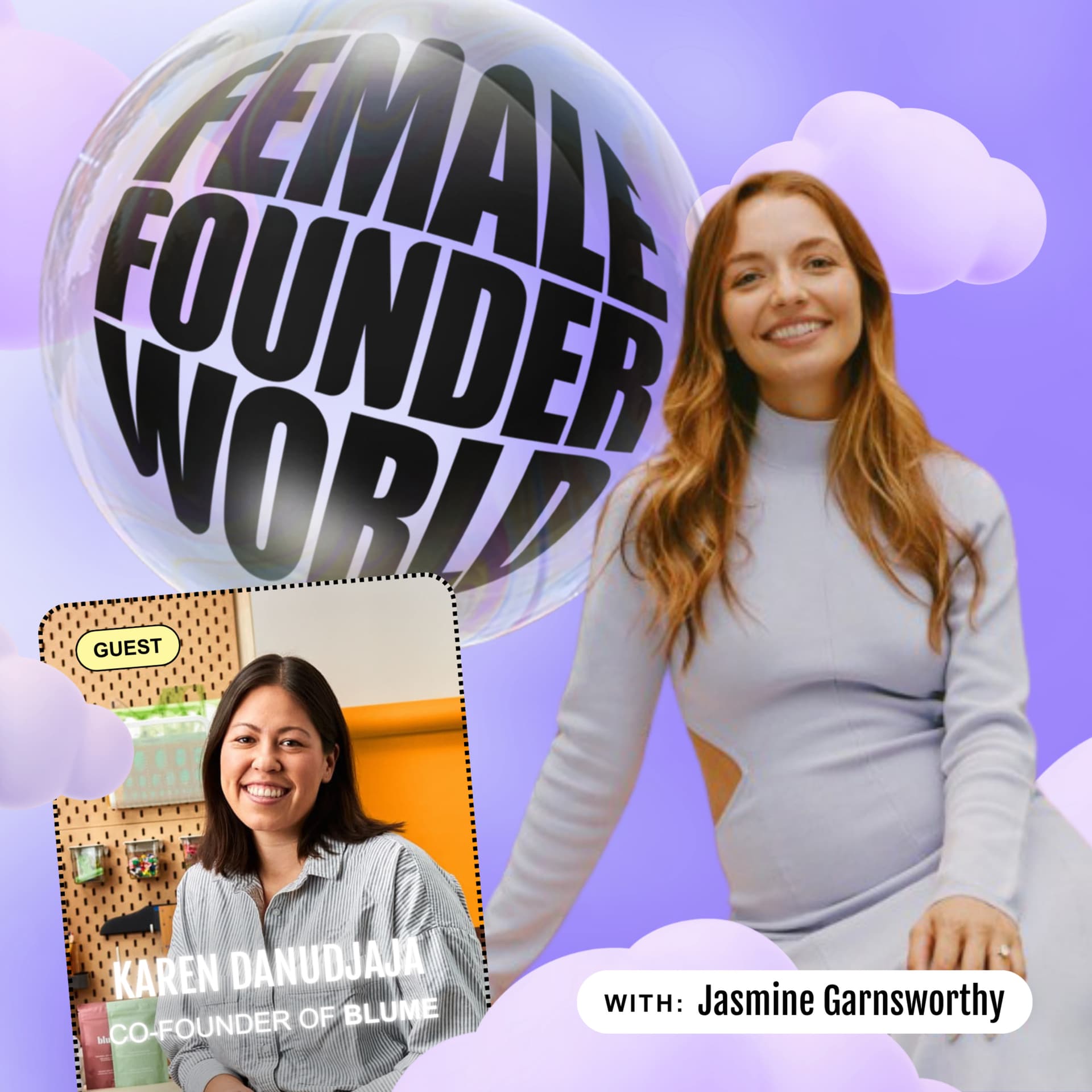
Podcast Summary: Female Founder World - Episode with Karen Danudjaja
Episode Title
$20 Million Product Launch: How To Predict The Next Big Product Trend
Host
Jasmine Garnsworthy
Guest
Karen Danudjaja, Co-Founder and CEO of Blume
---
Episode Overview In this episode, Karen Danudjaja shares her entrepreneurial journey from starting a side hustle in 2017 to leading Blume, a successful wellness brand projected to achieve $20 million in sales with its product line, Superbelly. Karen discusses her motivations for starting Blume, her experiences in bootstrapping, significant milestones, product development, and the importance of community engagement.
---
Key Themes and Discussions
- Founding and Early Days
- Initial Motivation:
- Karen started Blume out of dissatisfaction with her corporate job in commercial real estate and a desire to promote wellness.
- She recognized a gap in the supplement market for inclusive, accessible wellness products targeted at women.
- First Product:
- Launched with a golden milk (turmeric latte) targeting a modern palette, which she later discovered to be one of her lower-performing products.
- Bootstrapping Experience
- Early Challenges:
- Karen bootstrapped for five years which instilled a culture of frugality and thorough understanding of financials within her team.
- She started paying herself within the first two and a half years to ensure she could sustain herself and her business.
- Value of Bootstrapping:
- Emphasized the importance of learning every aspect of the business without external investment, which prepared her for later growth.
- Funding and Growth
- Transition to Investment:
- In 2022, Blume raised $2.5 million in just five weeks, facilitated by a well-nurtured network of relationships.
- Milestones:
- Massive growth: Achieved 300% revenue growth within a year leading to the funding round.
- Product Development and Market Fit
- Launch of Superbelly:
- A gut health product that generated $1 million in sales within its first three months.
- Development was guided by customer feedback, revealing a strong demand for gut health solutions.
- Listening to Customers:
- Engaged directly with customers to inform product development, which helped to maintain alignment with market needs.
- Marketing Strategies
- Community Engagement:
- Shifted focus from macro influencers to community-driven marketing and sampling programs.
- Utilized feedback from social media to improve customer experience and product offerings.
- Retail Strategy:
- Blume’s omnichannel approach includes partnerships with small cafes, natural stores, and major retailers like Whole Foods and Costco.
- Sales Channels Expansion
- E-commerce and Amazon:
- Amazon has become a significant growth channel, allowing the brand to reach customers searching for health solutions.
- The integration of different sales channels (retail, direct-to-consumer, and Amazon) has diversified revenue streams.
- Leadership and Personal Growth
- Development as a Leader:
- Karen emphasizes surrounding herself with a strong team and dedicating time for personal development.
- Implements regular reflection on strategic goals and seeks mentorship to evolve as a leader.
---
Key Takeaways
- Bootstrapping Offers Valuable Learning:
- Building a business from the ground up without external funding cultivates deep understanding and resilience.
- Customer-Centric Product Development:
- Direct engagement with customers is crucial for innovating and refining products that meet market demands.
- Power of Community:
- Engaging local communities can create strong brand loyalty and grassroots marketing.
- Adaptability is Key:
- Be open to changing strategies and products based on real-time customer feedback and market trends.
- Effective Leadership:
- A founder must evolve from a doer to a leader, focusing on building a strong team and fostering a collaborative environment.
---
Recommended Resources
- Books:
- "Good to Great" by Jim Collins
- "Ramping Your Brand" for insights on positioning products.
- Tools:
- Archive (Platform for managing influencer partnerships and content).
- Mentorship:
- Finding a business coach or peer advisors can provide support and growth opportunities.
---
This episode serves as an inspiring case study for entrepreneurs, particularly women, on how to navigate the journey of building a successful brand while emphasizing the importance of community, adaptability, and ongoing learning.
Written by AI. May contain mistakes. Listen to the episode to check what was said.
Transcript
Automatic transcript. May contain errors.0:00Hey, business besties. Welcome back to Female Founder World. It's Jasmine. I'm the host of the show. and today I'm chatting with Karen Dana Jaya. She's the co-founder and CEO of Bloom. Welcome. Oh, thanks for having me. I'm so excited to chat. Okay. People that don't know Bloom, what are you guys building? So Bloom is all about kinder rituals. We use superfood blends to create wellness products that make you feel good. So we have two product lines. One is a superfood latte. So low caffeine, low sugar, a replacement for your second cup of coffee. And then we recently launched Superbelly, which is, we call it a gut building hydrator.
0:34It's probiotics, prebiotics and hydration altogether. This started in 2017 as really like a side project. And you've built this into a business that this year, one product line alone is going to do 20 million in revenue. And so I want to talk through the steps of how you get from there to here. And let's just start in the beginning. It's 2017. You come up with the idea for this project that's not really a business yet. What were you thinking? What was happening? Well, really, the story starts even before 2017. I was I had gone to business school. I have Asian parents. I was going to be an accountant, you know, do the corporate ladder, the corporate office sort of path.
1:17And so I started a career in commercial real estate, actually. And I hated it. I hated it from the very beginning. It just, it was so much like reporting and middlemanning and just felt really out of sync with intention and being around my community. And so really that was what started me on the path of Bloom. I wanted to live more intentionally. Being so out of sync with your work, what you're doing eight hours a day also influences how you feel, like your actual mental health and wellness. And I just felt more anxiety. I wasn't sleeping well. and I wanted to start a wellness routine that really helped me feel good.
1:55And when I started that journey, I just thought the supplement aisle was so confusing, so clinical, so athlete-focused, male-focused. And as someone who didn't have a nutrition background, I just didn't feel represented there. And so I started making my own elixirs in my kitchen, sort of drawing inspiration for my dad who's Indonesian and I had grown up with Ayurvedic ingredients like turmeric and ginger and lemongrass and that's how really Bloom started as a side project. So I would literally do deliveries morning and night and mix things in my kitchen which I probably shouldn't have done and I became so obsessed so singularly obsessed and inspired by just doing and the people I was meeting through doing and that's really how it all began.
2:44What was the first product? It was a golden milk so a turmeric latte turmeric was really in its heyday and in indonesia there's something called jamu which is really similar to a golden milk lots of ayurvedic ingredients and you take it more like a wellness shot it's the original wellness shot is what i say but it did not taste good like you take this when you're feeling terrible and i just was like this needs to be modernized for the north american palette and so that was the original product the interesting thing about bloom story is that first product that you launched with is actually one of your like bottom performing products now and you have this amazing product line called super belly which is uh i think what really catapulted things to the next level for bloom you bootstrapped for like five years right yeah that's right and honestly i think i had you know you see these stories of founders raising and i just didn't think that was me like i didn't really believe that I could ask people for money and that I was investable.
3:43A lot of people feel this way. It's a really intimidating process. And, you know, it's different by every category, every market. How do you even meet these people that are writing checks into these super risky ventures? Like how I felt about myself then, like I didn't have the confidence. And so I'm so grateful for those bootstrapping years now. I think our industry really celebrates raising. And for women, it is very hard to raise. It is something to celebrate, but it forced us to look at every dollar, to understand our P &L so deeply, to really assess the efficacy of everything we did and built a culture at Bloom that's honestly a little frugal.
4:26And that lives on, like that lives on now that we have more marketing budget, just really looking at everything we do so thoughtfully. And so it built in like this entrepreneurial rigor to not just me, but the whole team, because we had to, it was survival. And I mean, I'm so grateful we got to raise and the opportunities they gave us, but those bootstrapping years were like where I learned so much. And those skills hopefully are going to take us forward as a business and as a team. In 2022, you went on to raise two and a half million Canadian dollars in like five weeks, which is so quick. I am curious about what happened in those first five years that got you to the point that you could do that.
5:06Were there milestones that you hit? Yeah. So at that time, our whole business was superfood lattes. So from golden milk and that first turmeric latte, we launched matcha coconut, blue lavender for sleep, really like functional lattes that were targeted at different need states that consumers have. and we were in the digital age. We were scaling online. People were coming out of the pandemic more aware of their wellness and their rituals than ever, more online, used to shopping online than ever. And so at the time that we raised, we were in thousands of doors in Canada. We were profitable. We had gone, like that year, we had grown about 300%.
5:50And so it was just the right moment to take the business out to a network that I had been cultivating for the years before the raise. And so, you know, those headlines like the five week raise, I mean, it's true from the first pitch to getting all the dollars and the signatures. It's true. That was five weeks. But really, those people, I had been in touch with them, cultivating that network, telling my story, getting out there for the years before. And so I think for anyone considering raising, don't think about just the process when you need it. It's really about building those relationships over the long run so that it's a smooth process when you eventually go out there.
6:33I think something that we don't hear enough about is the financial side of this. And you're bootstrapping for five years. You have a physical product, which is expensive. How long did it take before you were able to take a paycheck from the business? Was that something that happened quickly? Not very quickly, I wouldn't say, but I always paid myself something. To get the business off the ground, I was labeling packages in my living room. I was doing really small runs where I was actually doing the production. And so I think, at least in my industry, it's like a little bit of a fallacy that you can't start small and test and learn.
7:08At least for us, it was definitely possible. The first production run, I think, was 200 units because we made them ourselves. And so in the beginning, of course, like that first few years, and then the first year I was actually like working a regular job. I wasn't paying myself, but early on I started paying myself something because ultimately if you can't take care of yourself, are you going to take care of your team? If you can't pay your own bills, are you going to show up your best way and have the ability to just stay in the game, which is like such a big part of success in entrepreneurship is just giving yourself time and runway.
7:44And so maybe like within the first two and a half years, I was starting to pay myself a small salary. That's such a good call out. It's kind of like you can't stay in the game if you're not able to pay yourself something. And it's literally just like time and reps a lot of the time. So much time. A hundred percent. And the longer that I'm doing it now, I'm like at eight years of bloom, the more I understand that. And that's why I think profits power because it just gives you runway to learn, to iterate, to talk to different people, to see your product and market in different stores and to make changes.
8:19And if you don't have that, you can't, you just like literally don't have the time to make those changes. You hear these stories where people start their business and exit after three years, or they scale to a hundred million a few years. That's one in a million and incredible stories. And I find them so inspirational and so easy to be like, but what am I doing wrong? How do I compare? But the majority is like people putting in the reps, putting in the time, hard work pays off over the long run, just like anything. And so that's really been my approach to Bloom is slow and steady. There's one part of running a business that ChatGPT or Google just can't solve for me.
8:56And that is business finance. It is one of the most gatecapped areas of business. And yet it is what separates running a thriving company from really just having a very expensive hobby. Every founder at every stage of business deserves to feel confident managing your money. And that's why Female Founder World is partnering with Mercury to bring you Cash Camp. It's a free three-part live workshop series designed to teach women in business the financial skills that we need to scale. Across three virtual sessions, you are going to learn how to build a pitch deck that attracts investors, how to understand the different funding options that are available to you to help you grow your business, because it is not just about fundraising and getting investors.
9:36And finally, how to forecast cash flow and plan for long-term financial growth and stability. Each session is led by an expert founder or operator from the Female Founder World community, and it'll be delivered in our simple, easy to follow, no fluff format. If you haven't tried Mercury yet, they are the banking platform that every founder seems to be switching to right now. It's simple, intuitive, refreshingly modern, and just nothing like the business finance tools that so many of us business owners are used to. Head to femalefounderworld.com and click on Cash Camp to join the workshop series or click the link in the show notes.
10:12Mercury is a fintech company, not a bank. For important details, check the show notes. In 2023, I read this story that you were having like issues with conversion rate on the website or something was going on and you reach out to your customers on Instagram to get their feedback and figure out what was happening. And you just had this really overwhelming response. And I thought it was such an interesting story. Can you tell us what happened and what you learned? Yeah. So Bloom's website is hosted on Shopify and they do all these like amazing like beta tests. And so what we found out later is that we were on Shopify markets and that the US side was sort of not working basically.
10:51People's carts were getting emptied as they go, but my team almost 100 sits in Canada and even though we use like VPNs and we're trying to recreate it you always you know how your site works so you're you're using a certain journey and so we just saw our conversion rate plummet and at that time so much of the business was dependent on the direct-to-consumer Shopify store channel we've since diversified because of incidents like that where we're like we need multiple feet to stand on but at that time I think it was something like 80 % of the business went through that store. That must have been so stressful.
11:27It was. It was. It was really stressful. And we weren't at that time necessarily sophisticated enough to like keep a log of every single change you make. Like when you're running a small business, there's so many cooks in the kitchen. We're all doing little changes all the time. Sometimes a single message test can have a huge impact. So we were having a really hard time tracing back what change we made that created, like, why did it change overnight, basically? And so what we did is we just put a really honest letter on social media. We were like, we don't know what's happening. We're going to do a hot deal, but please, like, write in to us about what you're experiencing on the site.
12:08And we had competitors reach out to us and be like, oh, I just went through it. This is like a screen recording of what I experienced. It is still our single biggest, highest sales day that we've ever had on the site. And it was like no spend. It was just a social media post where we were honest and vulnerable about needing support and not knowing what was happening. And I think it's just like an example of why it's so important to build community. That it shows up when you really need it. And you can also harness it in ways that are not obvious. So we use community to help us with product development, to give feedback on product.
12:51You know, we do events and sampling and all that sort of like traditional how you work with your community and cultivate community. But this is an example where it's like they're giving you advice on the functionality of your website. And so it helped us reprioritize how community, like how important community should be as we build brand. In 2024, you launched Superbelly, which I feel like was this wild unlock for the business. What is Superbelly? And I've also got written in my notes here that you did like a million dollars in sales in three months or something wild as soon as you launched this product.
13:28What was that unlock and why did the product hit? So Superbelly is a gut building hydrator. It has probiotics, prebiotics, apple cider vinegar, real fruit, no sugar. And basically people take it to make their water fun and have additional benefits while also supporting digestion and bloating. And that line was initially going to be non-alcoholics. So basically we had been going through all this product development on, you know, how do you make an espresso martini in powder form? And we've been working on that for months actually. and something just didn't feel right in my gut about it it just like wasn't working something about you know when you're having a cocktail you want an experience like is there a powder ever gonna actually give you that and so we went we decided to like go all the way back to basics and we went to do a survey with our customers as a d2c store you have amazing access to your actual customers and we didn't even reference what we were working on we were like what do you want from us.
14:33And we found out that about 80 % of our customers have problems with their gut every week, which is actually consistent. About 60 % of North Americans have issues with their gut every week. And most of them weren't taking probiotics, which is interesting because probiotics have been around a long time, very science-backed. People understand how they work. Why aren't they taking them? And we just realized that they're so, again, so clinical, such a, the experience of taking one is not necessarily accessible, part of a lifestyle, something you do consistently. And so we felt like with Bloom's mission of really trying to introduce people to science backed efficacious ingredients, that we could do it, that we could bring probiotics in a new format, innovate the format and the experience of it.
15:23So people would take them every day. And that's what Superbelly ended up being. And it was just an immediate hit for us. And it was all from listening to our existing customers, what they actually wanted from us, instead of us trying to intuit it. And also being willing to just throw out. Throw it out, yeah. Which like I do think a lot of people, and I've been guilty of this, you get so far down a path that you feel like I'll just launch it and see. And then if it doesn't work, they'll try something else or whatever. But you were just like, no, it's not working. Let's go back to the like back to the ground and start again.
16:00Well, I think founders know their customers so well because it's often you originally were trying to solve something for yourself. But as you go along the journey, it gets muddier and muddier. it's easy to get further and further away from your customer as you have an ops lead, someone in finance, you've got someone doing customer service now, and it's easy to like lose that connection. And so that whole experience was like, no, like that is my job. My job is to understand who we are as a brand, like the vision for the brand and how we support our customers today better than anybody else. And so now we spend way more time in customer interviews.
16:39I'm in the DMs. Like, how was that experience? Like, I need to know that stuff to make the products better. And in my list of prioritization, it's totally changed because of the experience launching Superbelly. That's so interesting. So you mentioned you're like in the DMs, you're doing customer interviews. What else are you doing? And how often are these customer interviews happening? We also do a lot of work with professionals in it. Like, so dieticians, nutritionists, They're seeing clients with their real issues every day, multiple times a day, eight hours a day. And so we want to hear that, not just about how our products interact with it right now, but what are people looking for that they have trouble making recommendations for?
17:17And so we have like an advisory group, almost very informal, that we meet with really regularly to talk about what would they like to see different in our products? What would they like us to add to our product line? What other products are they recommending? so it's sort of trying to get a sampling of what's actually happening in market when you're so stuck sitting behind a laptop you got to work to get that connection to those that are really picking up your products and shelves. So if your belly has grown really quickly we're talking 20 million in sales this year and it's only the second year of this like product line being in the market what do you attribute that to beyond just like product market fit is obviously a huge part of this.
18:00People just want what you're creating, but you're launching new flavors around this. What's the marketing engine behind it? Why do you think, why do you think it's kind of had the success it has beyond just being a great product that people want? It's a really good question because now as we're looking at other categories, I'm like, how is it even possible to replicate what we replicated with Superbelly? And like, I do think timing is a big piece of piece of this game. Part of building is getting the timing right. And it was right as hydration was coming up right as people were understanding their gut health in a different way.
18:34And so I think we did get like lucky there or we were ready for that. But I think also in CPG, the use case occasion, like how frequently people go to a product is underrated as a factor. So are you using that toner every day? Are you putting that moisturizer on every day? Even if somebody loves a product, if they're using it once a month as a special treat, you're not going to get the turns on the shelf and the repeat rate that you need to really build a successful startup when you have the amount of money that you have. And so I think that as we look to new product categories, we need things that people are interacting with and feel the benefit of really quickly so that they're repeating in a way that builds a sustainable business.
19:20And so that's one thing that I've learned from Superbelly. And I also think that in terms of like the marketing engine, what we actually do, we really spend a lot of our energy in seeding and community. So we have even like little sample kits where you get like one of each flavor. We're sending it out in an envelope just for people to try. Tasting is believing. You have to have a product that people love the taste of and we'll talk about. And we just put way more emphasis on that than we ever have before. So we actually don't do a lot of like macro influencer things like that. It's much more community driven.
19:55Tasting is believing more like this grassroots ground roots sort of path. Can I ask a little bit more about this seeding program? Is there a particular platform you're using to do it? Are there a number of creators that you're trying to seed every month? Just something for people who are listening to this thinking, okay, I need to have this strategy too and maybe we're not focusing enough on it? We do have a target of how many people we're seeding every month and it consistently grows. So we started with 100 every month and you know now maybe we're closer to a thousand and we actually focus very regionally.
20:28So it's not the US, it's LA SoCal, it's you know Colorado and that'll move with the events that we have in the area. Are we doing trade shows at that time? Do we have a bigger partnership? Are retailers there? So we're very, very focused and trying to build meaningful traction in a small region, very focused so that we can build momentum around the brand. And the reality is with the budgets that we have, even doing SoCal is a stretch, right? Like there are so many creators and people to touch just in the LA region. We use a platform called Archive to actually save and see all the content that comes in.
21:11And that has been game changing because you also can make tweaks and optimizations for the program from it. So initially when we launched, we realized that people were mostly doing story shares, which are great, but don't live for very long. And so we're changing the way we reach out to people. We're changing the type of briefs we sent. We're changing the experience that people receive so that they're more likely to share the products. And I think that a seeding program without a clear objective can look a thousand different ways. Ours ultimately is to build community, like real brand fans in a small region.
21:47And so that means having one-on-one connection with them, means following up, means asking questions, means engaging. Versus if it was just impressions, then you could go wide and send it anywhere. So I think seeding programs can be designed and look differently for every brand. And for us, we really want, we call it Bloomkind, basically like our community of super fans and people who are going to help us spread the word about Bloom's mission. And so we keep it very, very focused and tight. That's really interesting, the focus on regional, like certain specific geographical areas rather than a certain type of person or like a wider net.
22:26I've heard a couple of people do this and it sounds like it's been really successful over and over again. So you're choosing those regions based on like retail launches, trade shows, other things that are going on. Is that right? Yeah, that's right. And, you know, it's not to say that we wouldn't focus in on a type of like a niche. Yeah. But I think that we really want to be accessible wellness. We want to reach people where they are. Superbelly isn't niche down in itself. It's gut health. And people support their gut for a number of different reasons. immunity for their skin, for their metabolism, maybe it's perimenopause.
22:59And so we're focusing more on like regional momentum around our store density. But I think the key is like we're open to listening, adjusting. If that's not working, we're going to try something else. We're not, we're not like one and done on the strategy. As we learn, we're going to make adjustments and tweaks. And also the landscape changes so quickly that you need to be that way. I want to talk about stores and retail now because you've had a lot of success in retail as well you're in Whole Foods I think you launched 2024 so last year into Whole Foods and it sounds like that account's been growing also Costco Walmart now as well what was your first kind of step into retail and then let's talk about how that's grown into majors initially bloom was like very focused online and I think we like we sort of touched on it, but it was a lot of eggs in one basket.
23:52And we decided that, no, Bloom wants to be an omnichannel brand. We got to be where the customers are. We got to reach people where they're shopping and we need to exist in retail. And retail is a totally different beast. You often hear that it's very expensive to play in retail. And that's true. With a lot of retailers, you're paying big upfront listing fees. You're paying for all their promotions. It's so spread out. It's really hard to market in those stores until you're established. So we actually started with the specialty channel. So Bloom's first retail partners were the beautiful cafe on the corner where you go with your girlfriend for an amazing experience.
24:32The little gift shop where you find pretty gifts and things that are made locally. And those specialty stores, they love the products that are in them. They're educated on the products that they carry and they're incredible brand equity accounts that don't require the big listing fees and, you know, the full supply chain that you need to service like a Whole Foods or a Walmart. And so we really started with these specialty stores and cafes to build brand equity and also allow people to try the products made perfectly for them by a trusted barista. After that, we launched into natural stores. So sort of the Bristol Farms, the lazy acres of the world.
25:16And we had to adjust a bunch in that change. What's there? It's more like, what set are you in? What's your positioning? How do you show up with your pricing compared to your competitors? It's a totally different game than it was in the specialty store that often only carries one product from each category. And so after that, once we had like sort of perfected that mix and the four Ps on in the smaller stores, that's when we started going into the larger, more conventional stores. And so now Bloom has just done its first rotation with Costco. We're on the shelves of Walmart. We're in Whole Foods nationally, Sprouts nationally.
25:54But all those little baby steps along the way were so critical to us eventually getting our place on those shelves. Are you still in those kind of smaller cafes and smaller boutiques? We are, which is a really amazing thing. I thought that, you know, once you're in a Walmart store, are you going to be in that specialty boutique? But what we ended up doing is actually creating two different pack formats and two very different programs for those retailers. And so we decided that those specialty stores are so important to the brand equity of the business and also an incredible place for us to test and learn new products.
26:33And so we build out special programs for them. They have the newest flavors first. They have their own pack formats. They have their own marketing programs. And I love that channel because it's often women who are doing passion projects themselves who want to support the brands that are in them. And it's just an incredible platform for building a business. What are the marketing programs that support an independent store? Well, an example of one we're doing right now is that we've set up basically scratch and win cards, prize packs. So in those stores, you're able to do a lot more interesting marketing in-store than you are in a big Walmart store, for instance.
Read the full transcript
27:16And so we can have signage. We can have little prizes for people who are engaging with Bloom. We can do little sampling events. So we do a bunch of different things like that, like gift with purchase, sampling, in-store signage. And we also have a program that rewards top specialty boutiques, too. Do you run that through FAIR or anything or is it all in-house? We have our own Shopify store. So we have like a Shopify wholesale store. And then that integrates with FAIR actually. So people can shop on FAIR or they can shop directly through our website. Did you work with a distributor and someone to help you get into this mass kind of retail space?
27:56So for Whole Foods, Sprouts, they require that you basically go through distributors. So we work with distributors for a lot of our retailers. And it is, if you think about it, they're managing so many products. They want to order from one place, make it smooth. So we do work with distributors for that. Can I ask who the big distributors are that work with folks like Whole Foods? Yeah, Unify is the preferred distributor for Whole Foods and Kahee is the preferred for Sprouts. And I'm not saying that there aren't other ones or other ways to get in those stores. Like I've heard of different programs, but I would say like the vast majority of products are going through those channels.
28:33And then as you grow and you become bigger partners and have more SKUs and have shown proof of concept, then you can work on going direct with retailers. So in Canada, where we're a little further along in our journey, we have all these direct relationships as well, where we're going directly to their distribution centers, which is like ultimately where you want to be. And so I think that the distributors play a really important role in getting your product to market and making it easy for a Whole Foods or Sprouts to say yes. But you've got to have an anchor for basically each distribution center.
29:09And so you don't want to open a center before you can pull the demand through it. Otherwise, you're going to end up with a bunch of chargebacks and other problems. Talk me, explain that a little bit more to me. So you don't want to, when you're working with these distributors, you don't want your product in a certain distribution center unless it's basically being sold. Is that right? Yeah. And they won't even give you a spot. So you have to do the work of opening a Gelson's or opening a Whole Foods or opening a Sprouts to basically earn a spot in their distribution center. And then it's about the product sort of flowing through and out to store.
29:44So it's not something like you just sign up for a distributor and it's going to open a bunch of doors. there's a whole bunch more layers to it. I want to talk a little bit more about the major retailers that you're in and just the lessons about how to succeed in these retailers that maybe folks who are just kind of embarking on that journey might be a hard one lesson. What have you learned through experiencing it? I think where you are in the store is like a study in and of itself. Like physically where your product lives. Physically where it lives. So the first time we got like a knock at the door for big distribution I was just like wherever they want to put it yeah like yeah like a hundred percent let's go it's like a high to like the idea of the revenue of a big box retailer but ultimately unless it works on the shelf afterwards and people can find it it's no matter what amount of marketing you're doing if people can't find it in the store and it's not where they would look for it it's not going to work and so I as an example at Whole foods there's probiotics there's digestion there's hydration there's super foods bloom could be in any of those like super belly could be in any of those sets and does your what you say on your pack on your like little four and four by five inch pack will it convince someone to try it in three seconds because that's the amount of time that you have so those are i think like when you've got 40 ,000 different products on the shelf and you have three seconds to convince someone to buy, you have to be so clear on your why and so clear in the communication of it in that little space that they give you.
31:26And so I think that the placement in the store is something that people don't think about. They think about, oh, the Whole Foods customer is going to be a Superbelly buyer, but is your Superbelly customer or is the Whole Foods customer going to find you there? Is that where they're going? And that's been like a challenge for us too. I want to talk a little bit more about the packaging on shelf and like we're getting really granular here, but that's where I love to go. Are you, have you changed the packaging as you've been growing in retail and like what little tweaks have you made? Let's take the superfood lattes for this.
32:03We've definitely changed it. We're still changing or still iterating, but initially they were very minimalist, really elevated. Again, we were D to C in specialty. We had full landing pages or in specialty you're shopping for you know more like how things feel like more luxury minimalist works. Now we've added like an image to the front of pack so you know exactly what it is. A function how to use it. There's way more instructions on how to make it because previously if you bought on our website we sent you a video tutorial of me making the drink with you. And that's just not an option at retail.
32:39And so definitely we've made those changes. And with the lattes originally, we were also in the coffee and tea section. And now we're, no, we need to be in the superfood section for our price point. And so all those tweaks, nobody's like announcing it in a headline. You're not going to see it on the cover of Forbes. It's the work that you have to do it's the riddle to solve is what are those changes how are you iterating to just have better and better product market fit and a better experience for your customer so that when they take it home make it they're going to come back another time and so for the latte specifically we've changed like what the product description is we've changed the saturation of the colors we've changed the functional color we've added an image to the front we'd also changed the height of the package so that it takes up more space on the shelf and so constant tweaking that's smart take up more space on the shelf you don't like that feels like something that would not be the most intuitive thing but if you've got a really small packet it's sitting on the shelf it's not as obvious like you may as well take out the space available to you which is the opposite of d2c right because for d2c you want it to be as small as possible Let's get it in a little box and cheap shipping.
33:53And so I had like optimized direct to consumer product sitting on a shelf and it just doesn't, it's not the same product. Yeah. And so all of that I had to learn the hard way. Well, thank you for sharing it with us so that hopefully some people skip those lessons. Something else that seems to be working really well for you is Amazon. Can you talk through a couple of milestones that you've hit with Amazon and like a couple of the big learnings from launching on the channel? Yeah, Amazon is actually our fastest growing channel. And it was part of our omni-channel diversification. In the beginning, I was really nervous about Amazon.
34:29I think as a small, independent brand, emerging brand that's really trying to be premium, like better for you, I wasn't sure how Amazon fit in that playbook. And in the end, what we decided is Bloom is accessible wellness. We need to be where customers are shopping and they're shopping on Amazon. It's really convenient. And I thought that it would cannibalize our direct to consumer business. I thought it would cannibalize our retail business. And it really hasn't. It has been very expansive for us because of how people shop there. It's like a search engine. They're searching gut health. They're searching turmeric.
35:05They're not searching necessarily bloom. And so it's been a lot of lessons in trying to figure out how Amazon fits into the overarching channels and how it all blends. But now, for instance, you know, Amazon Prime just passed on our email list. We're sending people to Amazon because those pages are optimized. People are shopping there. It's part of their regular orders. Don't we decided why fight it? And if it's convenient for them, shouldn't we want that for our customers. And so it's something that has given us just like another leg to stand on, just another pillar, another channel to work through.
35:45And I'm really glad we did it. I'm curious about how you as a founder have been able to up-level and grow as you've been building the business. So look, okay, 2017, this is a side project. And then five years later, you're raising money. And now you're running this business where how many team members did you say you have 30 team members 25 25 okay it's close to 30 multiple millions in revenue these big distribution partners and I feel like that takes a level of just like growth as a human to be able to lead that is there anything that you've been intentionally doing or is it just like reps and self-trust along the way I really appreciate you saying that I think it's like uh you need to be aware that you don't know everything and fill in your gaps so I have an of incredible team.
36:32I realized early on that ops wasn't my, that wasn't my thing. That wasn't my zone of genius. And so part of it is that I'm surrounded by people that I learned from, that I trust, that inspired me to be a better leader and who genuinely have more experience leading than I do. And so part of it is that it's like who you surround yourself with and listening and not thinking you have all the answers. But I do spend a lot of time in reading in podcasts like this one to just hear what's going on in the world and pick up pieces for inspiration and how I can get better. I do something called, I call it different things, but basically Fridays are my personal development days.
37:14So I'm in the business in the morning, but in the afternoon, I'm really trying to dedicate time to looking at my strategic goals. Like how am I doing on them? Am I heading in the the right direction? Did I get distracted this week? Am I working on the 80? And spending time reading too. So I think I do dedicate time to personal development. And one of my biggest fears is holding back the business instead of being a catalyst for it. Obviously in the beginning, the business wouldn't be here if it wasn't for me, but I don't want to become the barrier for my business growing. And I think being a leader is really different than being a founder.
37:53so a founder is you can make anything happen it's this energy of just like passion for the mission passion for the products that gets things done when you have a team and there's a different scale involved that energy doesn't necessarily help people getting in people's way writing the copy for every email like there's you have to find a balance there and so I'm personally trying to like make this jump and I don't know if I'm exactly where I want to be but I'm you know somewhere in between trying to get to the other side. The last thing I want to ask you is for a resource recommendation. It could be a tool, a book, something that's been helping you build bloom that other people should check out.
38:32I loved this book's good to great. I'm sure you've heard that one before and ramping your brand was really helpful too. Also in the creation of super belly, it's around like positioning of products and how to think about it. But I've also had a business coach for years. And I think if you're able to invest that time, like a dedicated hour every week or every two weeks on just thinking about how you show up and how you're working towards your ultimate goals, it can be a really big unlock and super powerful. So if you can find someone you trust who can guide you on the journey of becoming a stronger and stronger founder, highly recommend it.
39:10You have advisors that have been helping you as you've been building the business and that's a question we get a lot in the female founder world community. We've got our business bestie group chat and people are often asking like how do I find advisors or mentors or how do I bring these people into the business? What's been your lesson of working with people in like a formal or an informal way to get advice to grow the company? I think that advisors do have an important place like having a community but advisors don't necessarily have to be paid given equity, there's also peer advisors, people who are going through it with you, people who are running their own businesses and have tried different platforms and are in it today.
39:49And so I think that those informal advisors, that peer-to-peer advising has honestly been the most impactful and you don't have to give away a bunch of equity for it too. I think I would just say that if you're taking from that community, you have to make the time to give back to it too. It's only as good as you're only going to get the energy you put into that network. And women are naturally givers. Like I don't want to make generalizations, but almost every woman entrepreneur, woman founder that I've met wants to see other women win and are open books about resources, agencies, how they got on shelf, all that sort of stuff.
40:28And so I think start there. Start building your network of other people who are in it right now because with advisors, they might have had really successful exits and have all this incredible knowledge to share, but it's also a different time, a different business. And you have to ultimately trust your gut and what's right for the business because you're the one who's in it. Amazing. Karen, thank you so much for coming on Female Found World and congratulations on everything you're building at Bloom. Thank you so much for having me. I really enjoyed the chat. I just wanted to end the show with a quick shout out to all of our paid business besties subscribers.
41:03For$12.99 a month, you get access to a weekly live call with mentors who we handpick from this podcast community. These are founders who have been on the show, experts and operators that are helping to build their businesses. And we want to give you access in a small group setting on live calls every single week so that you can get the mentorship and advice that you need to take your business to the next level. In addition to the live calls and the community, you also get access to a big database of workshop recordings, group coaching call recordings, templates, contact lists, and just all of the tools and resources that you need to make this business a success.
41:42Head to bestie.femafounderworld.com or the link in the show notes to sign up now.
From the publisher
Blume founder Karen Danudjaja is on the Female Founder World show with Jasmine Garnsworthy. In 2017 Karen started a side hustle to bring superfoods to local coffee shops in her city. Eight years later, Blume is an 8-figure brand, with a team of 25, and viral product lines (like Superbelly) sold into thousands of retailers.
In this conversation Karen shares when and why she started paying herself at Blume, the product line Karen scrapped for Superbelly (which sold $1M in its first quarter), and how she’s levelling up as a leader.
LINKS
Get the Female Founder World resource roundup https://femalefounderworld.beehiiv.com
Become a Business Bestie subscriber: bestie.femalefounderworld.com
Check out Karen’s business: https://itsblume.com
Karen’s resource recommendation: https://archive.com/
Karen’s book recommendations: https://www.amazon.ca/Good-Great-Some-Companies-Others/dp/0066620996 https://www.amazon.ca/Ramping-Your-Brand-Killer-Growth/dp/1733444645/


