
In short
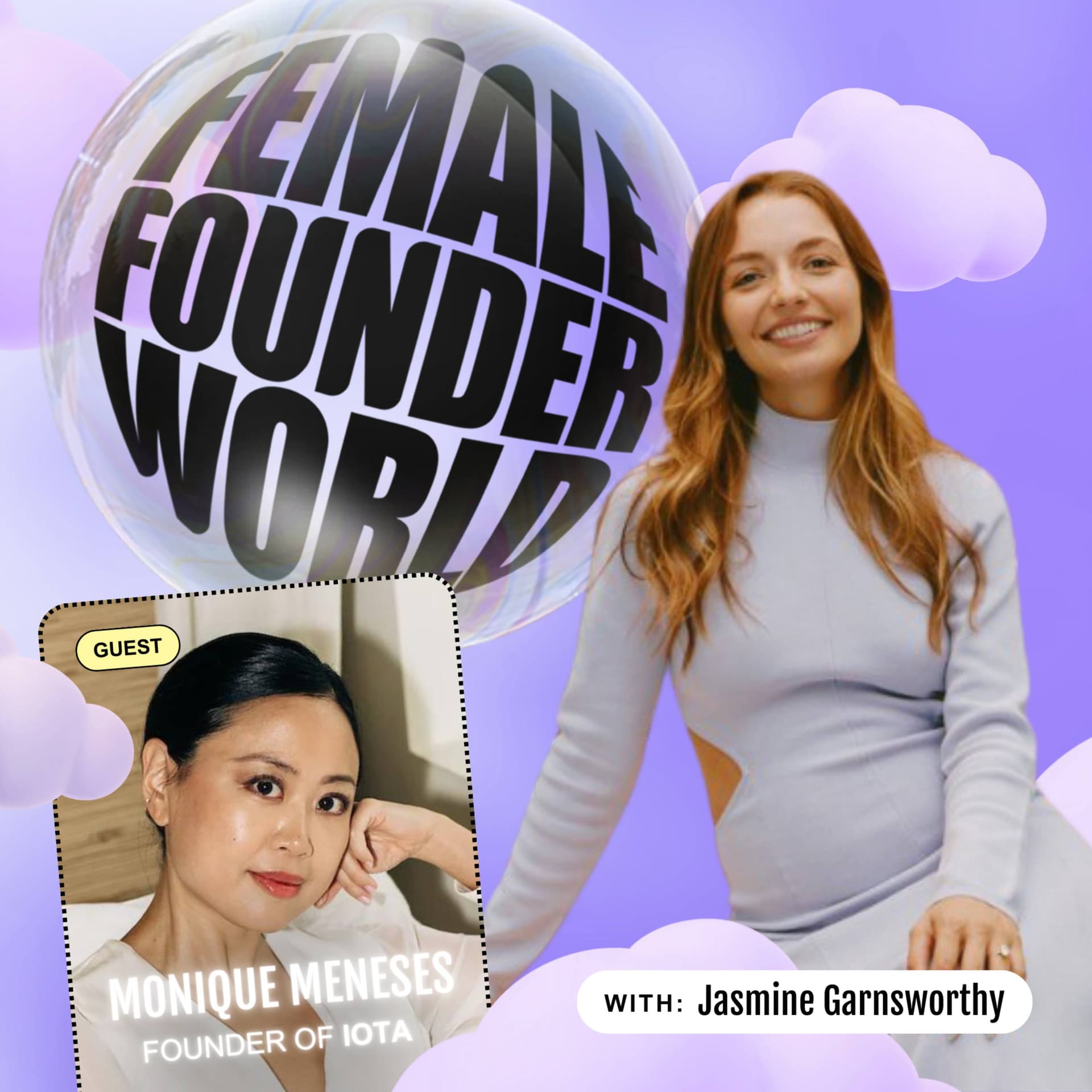
Podcast Notes: Female Founder World - Episode with Monique Meneses, Founder of Iota
Episode Overview Title: This 2-Year-Old Beauty Biz Won 11 Awards: Monique Meneses, Iota Host: Jasmine Garnsworthy Guest: Monique Meneses, Co-founder of Iota Release Date: TBD
Description: Monique Meneses discusses her journey in founding Iota, a science-backed skincare brand focusing on the skin’s microbiome. The episode covers her personal motivations for starting the business, strategic decisions, and insights into navigating the beauty industry successfully.
Key Concepts and Discussions
Introduction to Iota
- Business Model: Iota is presented as the first nutritional body care brand, integrating pre and postbiotics with vitamins and minerals.
- Customer Perception: Often likened to a combination of Osea and Olipop for its focus on body care.
Founder’s Journey
- Personal Challenges: Monique shares her experiences with health issues, including infertility and discovering a tumor during her pregnancy, which prompted her to focus on skincare health.
- Industry Experience: Previous role as a beauty editor contributed to her insights into the confusion consumers face regarding skincare products.
Importance of the Microbiome
- Skin Health and Microbiome Connection: Monique emphasizes the significance of a balanced microbiome for effective skincare. She explains that just like a clean canvas is essential for painting, healthy skin requires a balanced microbiome for products to work effectively.
- Changing Industry Conversations: Monique aims to elevate the discussion around skin health to be as prevalent as gut health in wellness conversations.
Product Development Process
- Collaboration with Experts: Monique highlights the importance of building a strong scientific advisory board, including dermatologists and cosmetic chemists, to ensure product efficacy.
- Iterative Development: The development of their products involved multiple iterations (e.g., 72 attempts for their body wash) to achieve the desired formulation.
Building an Advisory Board
- Networking Strategies: Monique shares her approach to building an advisory board, including attending relevant conferences and cold emailing potential advisors.
- Equity for Advisors: She recommends offering equity to experts as a way to ensure they are invested in the business's success.
Launch and Growth Strategy
- Initial Launch: Iota launched with four SKUs in September 2022. Initial sales were slow, prompting Monique and her husband to refine their understanding of their customer base.
- Funding Approach: The couple utilized their savings to fund the business and emphasizes the importance of fully committing to the venture.
Retail Strategy
- First Retail Partner: Credo was selected as their first retail partner, securing a six-month exclusivity deal shortly after launch.
- DTC Focus: Monique stresses the need to build a direct-to-consumer (DTC) channel first before expanding to larger retailers to understand customer needs.
PR and Awards
- Awards Achievement: Iota has won 11 beauty awards, which have helped in gaining recognition and credibility within the wellness space.
- PR as a Marketing Tool: Monique discusses how strategic PR efforts led to significant opportunities, including connections with retailers.
Recommendations for Founders
- Resource Suggestion: Monique recommends using the customer service platform "Gorgeous" to manage customer interactions efficiently while maintaining a personal touch.
Key Takeaways
- Understand Your Customer: The foundation of a successful business lies in truly understanding and engaging with your target market.
- Collaboration is Key: Forming partnerships with industry experts can lend credibility and insight crucial for product development.
- Be Strategic with PR: Utilize PR not only for immediate sales boosts but as a long-term brand-building strategy that attracts potential retail partners.
Links and Resources
- [Iota’s Website](https://iotabody.com/)
- [Join the Retail Bootcamp waitlist](https://bestie.femalefounderworld.com/retail-bootcamp)
- [Female Founder World Newsletter](https://femalefounderworld.beehiiv.com)
- [Become a Business Bestie Subscriber](https://bestie.femalefounderworld.com)
Conclusion Monique Meneses’s journey with Iota serves as an inspiring example of how personal experiences can shape a business's mission. Her insights into navigating the beauty industry and the importance of understanding consumer needs provide valuable lessons for aspiring entrepreneurs.
Written by AI. May contain mistakes. Listen to the episode to check what was said.
Transcript
Automatic transcript. May contain errors.0:00Hey, business besties. Welcome back to the Female Founder World Podcast. I'm Jasmine, the host of the show and the creator of the Female Founder World universe. Today, I'm chatting with Monique, the founder of IOTA. You are now entering Female Founder World with your host, Jasmine Grimesworthy. Monique, welcome. Hi, thank you so much for having me. For people that don't know IOTA, what are you building? Sure, we are the first nutritional body care brand. We focus on the microbiome and essentially our customers basically call us the Osea meets Ollipop. of body hair. And that's because we have all the multi minerals, the multivitamins, the face grade actives, and then most importantly, the pre and postbiotics all in one.
0:42Okay. I need to understand more about this before we get into your founder story. So what does that do to your skin? Why is that important? So I like to basically, when I talk about it, paint like an analogy. And so think about a blank canvas in painting, right? So you, if you wanted to start a painting, would not start on a muddied up canvas. You would start with a clean canvas. Think of the canvas as your skin. If you don't have that blend of pre and postbiotics to balance your microbiome, it basically is a muddied up canvas. And when you have all of the niacinamide, hyaluronic acid, all those amazing vitamins that you're layering on, they can't penetrate and do their job.
1:25However, if you start with a very balanced microbiome, and that's where the pre and postbiotics come in. All of that good stuff that you're layering on top, whether it's a lotion or a body wash or a serum, can do their job that much better. Okay, that's really interesting. How did this idea come to you? So it happened during my beauty editor days. And when I was a beauty editor, I was rifling through and testing out hundreds of products every day. And I found myself getting really confused as a beauty editor, and I was supposed to be an expert on this? And I thought if I was getting confused, how's the average customer not getting confused, especially when it came to personal care?
2:04Everything back then, this was before the clean movement was a thing, was very much after the fact solutions, right? It's, I think I smell bad. How do I get rid of the odor? I have a sudden flare up of bacne. How do I conceal that and treat that immediately? Nothing really got to the root of skin health and talked about skin health in the way that I was hoping for. And that's when the first idea for IOTA started. But really the impetus for starting the business was when I personally experienced a series of health scares before, during, and after my pregnancy. It took us years to get pregnant. We were diagnosed with infertility for reasons unknown.
2:45Thank you. Thankfully, we did get pregnant through IVF. And then in my second trimester, doctors found a tumor the size of a tennis ball on the tip of my pancreas for reasons unknown. Apparently, it had been growing in me since my teens. I had to make a decision right then and there whether to terminate my pregnancy or move forward with it. That still makes me super emotional thinking about it. Luckily, everything was fine. I moved forward with it. And after an emergency C-section, I was then diagnosed with high blood pressure. I still take medication to this day for reasons unknown. I had never had high blood pressure issues prior to being pregnant.
3:24And this really led me down a path of just analyzing what I was doing in my daily habits all these years. For the most part, I felt like a healthy, a pretty healthy person. I was trying to eat all my greens and veggies. I tried to incorporate movement where I could. I was trying to get enough sleep. But the one area that I kept going back to was just my largest organ, which is my skin. What had I been doing since my teens all this year on a daily basis, whether it was bubble baths, you know, filled with dyes from my childhood, you know, to lotions and other things I was putting on my body, feminine hygiene habits, where I wasn't really paying attention to the ingredients that were listed.
4:07What were the cumulative effects of doing all of these things over the years? And what impact could they possibly have had on my body and my overall health. And that's what led me down this rabbit hole of research that led me to finding out that there's actually a link between poor skin health and a compromised skin microbiome. And that led me down a rabbit hole of research that kind of unearthed that there is an actual link between a compromised skin microbiome and broader health issues like increased allergy rates, cardiovascular disease, heart health, of course, autoimmune disease, in a way the beauty industry currently isn't talking about.
4:53And that's not because it's like shame on you, beauty industry. It's because we've been talking about the clean movement for so long. And we are just in the very, very early beginning stages of the skin microbiome and the implications it has on overall health. And just so in the same way that the gut microbiome has become just a part of everyday conversation with brands like Seed and Olipop and Poppy, everyone now just like kind of understands that concept and how the gut has an impact on your overall health. That's really what we want to do with the skin microbiome and skin health and make it part of everyday language around health.
5:31In the same way we talk about mental health, gut health, right, exercise, nutrition, we should be talking and using the same vocabulary and giving it the same amount of importance as we do every other pillar of health in our life. So once you make this kind of discovery and you're connecting the dots here, like, how do you actually then kind of turn that into a product that is effective, that you can stand behind? What were the steps behind into doing that? And you launched with four SKUs. So why, you know, why those four and what was the process to get there? Sure. Of course. That's a great question.
6:09So I launched with my husband. We're the co-founders and neither of us are scientists, of course. Also didn't, had zero experience in e-commerce. We're kind of going into this blindly. Beauty editor is a relevant skill. Yes. Yes. So it was really important from day one to work with a very robust and esteemed scientific advisory board. So from my past as a beauty editor, I reached out to a cosmetic chemist that I was very friendly with. and I'd interviewed over the years that I knew specialized in formulating for the skin microbiome. She had spent like decades and like had written research papers around this.
6:51And also two dermatologists, one who's a professor at Brown University, the other one graduated from Harvard dermatology. And the three of them, in addition to our lab team and this vision of sort of being this first smart microbiome body care took, honestly, when I look at the body wash alone, 72 iterations to perfect. It took a very long time. Wow. So we did not settle for less. And the reason it took so long is because you start with the core, which is your pre and post biotic blend. And to find the right sort of dance between the plant-based minerals and vitamins and, of course, face-grade actives took a lot of iterations.
7:41And it wasn't something that we were like, you know, iteration number two, this has been solved. We're so happy with this. It is a delicate dance. And it was thanks to the scientific advisory board and their input that we could launch our collection. how do you get an advisory board like that this is something that I've seen you know we have a group chat for about literally thousands of different business owners and I've seen this question pop up quite a few times but from beauty founders saying how do I get a dermatologist as an advisor or how do I become like dermatologist approved like what is that what is that process to bring these people along who have they've got something to lose right they've got like a reputation that they want to protect.
8:28How do you sell them on this idea and bring them along with you when it's, you know, you've got just an idea? That's a great question. That's a fantastic question. And, um, you know, one that I'm something that I'm actually kind of going through right now, I think we are this smart microbiome company and it's very important to me to have someone who's a microbiologist as well. And so I have been on the hunt for someone to also bring on to our advisory board. And it's been a years long process. And I will give you this tip on the way I've approached it. And I think we may be close, knock on wood, not gonna give anything away, but I attend conferences, right?
9:13If there's a microbiome conference where it's open to brand founders, ingredient suppliers. I live in New York, so there are a couple here. I recently went to one. And you'll be surprised at the number of potential experts, whether they can be someone that you can ask to be on your advisory board or just someone you can learn something from. But that is my advice is go to these conferences where the experts are. And if there's someone who just really strikes your fancy and you're like, this is an amazing person that I want to get to know, I honestly just would just cold email. Cold email, present your brand.
10:01I would leave it to maybe like one to two short paragraphs max. See if they're even open to something like this and take a chance. I mean, it sounds really scary, honestly, just the thought of it in the beginning. I was like, no, no one is going to want to answer any of my emails. Like, why would they? But you'd be surprised. And why not? When you're talking about advisors that are like expert advisors, you know, you can have advisors who are maybe more like business side of what you need. Are you giving equity? Do you pay them? Like what, what do you recommend? I recommend equity. Yeah. I think that, you know, you're not going to want to be doling out equity left and right.
10:47However, I think that it's important that equity be part of it because that way they're fully invested in the growth of the company. Like you're in it for the long, you're building something together, this is not just an employee that you're just paying a salary to because at some point that can end. However, if you go into this being like, we're building this brand together, you have value. And because of that, we can get to where we are going. That I think just speaks volumes and has the other person just that much more passionate about what you're creating together because it is something that's meant to be created together.
11:30Yeah, that makes sense. So then in 2022, you do launch with those four SKUs. What did that launch look like? That was September 2022, I think. That was September 2022. I mean, again, going back to the fact that my husband and I knew nothing about e-commerce and whatever business plan we had in mind, okay, that goes out the window because you're constantly learning new things every month. It is a complete roller coaster. I can also talk about founding a business with your husband because that's a whole host of other challenges, but exciting. So we launched with four SKUs. And, you know, honestly, it was a good launch.
12:09I don't think we knew what to expect. We got like a few press hits, but our first big press article came, I think, maybe one month after launch, right? The launch was good. But it was like friends and family knew about us. But I didn't have a gauge of what I was expecting. But the days after that, I mean, crickets, right? I'd be happy if I got, we're like, ooh, we got two sales. It was like the second day after launch when the excitement had faded. And my husband and I are just looking at each other being like, what are we going to do? I mean, clearly, we have to brand build. I mean, that was always part of the plan.
12:48but it's kind of like a punch in the gut when you wake up the next day and you're like, okay. So what did you do? Well, you know, we took it piecemeal. I think one of our biggest things was we don't want to hire until the two of us fully understand to the best of our capabilities, every single aspect of this business, whether it is sales, whether it is, you know, the influencer social part of things, whether it's creative. And so the next few months were built around that and, you know, really understanding our customer, what our customer loved, why our customer was coming to us. And from that, we iterated on our formulations.
13:34I was talking to you about that before, just a few months later. And I think that really is going to be customers and what their needs and wants are, are going to just be the driving force of our brand. Because at the end of the day, we create the products for them. How have you been funding this as you've been going? So to fund the business, we took a large chunk of our savings. We had been working on this for years, but really took a leap of faith and quit our jobs after the pandemic when we're like, we got to go all in. And that really is another piece of advice. I think that I have some friends who see what we're building and they have full-time jobs, but at the same time, they want to do a side hustle.
14:19And they're like, what do I do? Do I quit? Do I leave now? And it's such a struggle. And I relate. It's so hard. But my piece of advice is it's so hard to kind of do this with half a heart in it, if you know what I mean. I think you need to take a leap of faith and just burn the ships behind you and do it. You have to give it your all because if you don't give it your all, I just think it's doing the business and yourself a disservice. Yeah. So you and your husband are both working in the business full time. We are. Wow. Amazing. Oh, my God. I know. I have friends, too, who are like, oh, yeah.
14:59I mean, when we first started, I think our friends were like, oh, that's nice. You're starting a business. But like, how's it going? How are you guys still married? Number one question. And it's tough. I think that for any couple who is looking to start together, I'm not going to lie. I think that I've listened to enough podcasts where, you know, the husband or wife or a partner will come on and say that, you know, it's great. Everything is great. we're able to compartmentalize and like separate I will give you the true hard the cold hard truth is that that does not happen yeah in the same way that your relationship changes when you're a parent right and it evolves because there is a third or fourth person in your life the same thing goes for a business your relationship is going to change there is no going to date night thinking that you can't talk about work because you end up talking about the kids the dot whatever in your life.
15:55And of course it's going to be, this is like our second baby. But it must be nice also, because like when you're building a business, it's all consuming anyway. And so it must be nice to have someone who is also completely consumed by it, like to share that with. It is, it's, it's great. And I think that in that way, you know, I'm kind of seeing him in a different way and that like he has new, he has skills and like talents that like I had no idea. He's got skills In other ways. And I was like, okay, you know, we started this. He comes from the world of finance. And I'm like, all right, clearly, you know, division of labor, you're going to be, I categorize him as like the numbers guy, the finance guy.
16:36There's this whole other creative side to him that I had no idea about and I'm impressed by. So in that way, it's really, it's really been fun. And like, you're building something together and, you know, you have each other's backs. At the end of the day, it's like, we're in this in life and we're in this in work. And that's like really solidifies a bond, but it's not easy. It's hard. It's really hard work. You've won, I think, 11 beauty awards. How did they come about? Who applies to them? How do you hear about them? And why do you think that you're winning them? Yeah, we are so humbled and so grateful for all of these awards we've won.
17:15You know, it's a combination of the great press that we've been getting and seeding out to the right editors and having them really experience it. I just feel so lucky. And I think you also, for some of them, you apply. But the ones that we got in the very beginning were ones that we, some of them were unexpected. Editors had tried it and talked to their editor friends within it. It just kind of like spread word of mouth. but what I've been really excited by is that the industry has recognized us as like not just a beauty brand our most recent award was best new breakthrough wellness brand and I think that's super exciting we're really trying to fill that white space between being a personal care brand and being a wellness brand and for our peers in the beauty industry to recognize us as really pushing the boundaries and become and being a wellness brand is is exciting and humbling and and we don't take this for granted um at all and PR was kind of one of your first like marketing expenses right you've been doing this since pretty much the beginning yes why did you decide to do that and how has that impacted the business I'm really curious about like what beauty awards like what they do for the business like you notice an uptick or if it like legitimizes you to retailers is or like where, what you think it, um, it does.
18:40Yeah. You know, PR has, has been great. And I think PR too, when you start out, it's, I think it's that relationship you have with the person, right? I, I think when you're looking for a PR agency or a boutique firm or whatever it is, you really have to connect with the person because this is like your speaker phone to the rest of the world and to um and and the person has to really buy in and believe in the product you're marketing and just like live the life yeah you know and and I'm so lucky we're so lucky that we've we found someone to do that and you're working with Sophie wheel from nude nation who I love like I met Sophie when I was a beauty editor and then I have used like she's worked with me I've been her client before as well she is the best she is she's like joy personified And she is like a complete wellness girly.
19:36And that is exactly who, you know, sort of the brand is. And that is a really great question about press because, you know, when I talk about the difference between my husband and I, I come from the editorial world as well, like yourself. And I do have a bit of PR in me. And my husband is very much cut and dry, like the finances, the numbers, the way he looks at, you know, things like media impressions. Like, what is that? And what does that, what is the ROI on that, right? And so it's bringing our two views together and like, because there's merit to each, right? And so to your question about press, I think that it has a compounding effect, right?
20:21I think that with the awards we've won, with the press we've gotten, it's led to some really fantastic opportunities. And I know you wanted to touch on retail, but I'll give you one example.
20:36Glossy had written an article on just how body care is like the next big trend, but it's like a trend to stay. It's like booming. All these brands are coming in and they interviewed me and it was a long interview, but there was only honestly, when I tell you there were five words that made it into the article. And I saw the article. It's like everyone else. I love Glossy, but it was a fantastic article. I'm not trying to say anything about Glossy. They've like given us so much love over the years. It was one of our first articles and I was so excited to read it. And I remember saying to Ray, my husband, oh, wow, there's just four words in there.
21:15But we were mentioned. So I'll take it with some amazing other body, some other amazing body care brands. I would say within 48 hours in our inbox, our customer inbox, I get an email from a buyer at Credo. And she's like, listen, I've been seeing some of the press that you guys have been getting. I'm interested. There's a void in the body care market at Credo that we think you can fill because a lot of our customers are now starting to get interested in the skin microbiome, haven't found a company like yours. Let's chat. One of the first questions I ask is, How do you hear about us? And she said it was the Glossy article.
21:54It was, and I was like, those four words, but it was the skin microbiome that just was that green light. And so, yeah, you never know how things will work out or how they'll translate. So press, I think is really important, but do I think right from the outset, you need to be like spending thousands, like hundreds, you know, so much money on press? No, I don't think that's the right approach. It's like, just be strategic about it. Yeah. Let's keep talking about retail for a bit because I agree with what you just said about, and I've had that experience as well, where direct opportunities have come through press, industry opportunities.
22:31And I think that it's actually super important to be in press because that's actually what the buyers and investors and like they're reading though, it's like a very hyper-focused group of your, I guess, like potential customers or stakeholders that are reading those articles. And so why, while it might not mean like huge uptick in sales anymore, someone like the buyer at Credo is reading those stories. So that's why I think it's like super important. I agree with you. That's absolutely correct. And I think also with sales too, I think that was also a big realization for me. I just was never on the side where I knew how much, which, which publications would convert, what type of article would convert.
23:15But now like being able to see that is like totally eye opening. And it's not, it's more of a brand build brand building exercise than it is like, okay, you're, we're going to convert like all these customers immediately because it's not, that's just not the way it works. So let's keep talking about retail. Who was your first, was Credo your first retailer? Yeah. When did that happen? That happened pretty early on. I think maybe month three is when Credo first reached out to us. We had a six month exclusivity with them. It was honestly, if you had asked me who my dream first retailer would be, I would have told you Credo and the fact that the stars aligned and it worked out that way.
23:57I mean, I couldn't be happier and they've been a dream partner. And, and I think they really, they, the way that we've approached retail and them as a partner too is like exactly the way. And if I had to give actionable tips at all in terms of retail, I think there are a lot of founders out there. And I think it really is very product dependent too, right? So I'm only speaking about, you know, being an indie beauty brand within the personal care space. I don't necessarily think that for us and our type of messaging that being in huge, big box retailers from day one is the right strategy. But that's for us because we really want to own our DTC channel, right?
24:45We're mostly DTC. And we want to understand our customer at every single touch point. I'm on text, email, DM, you name it. At the tip of my finger, I am constantly engaging in conversations with our customers, understanding what they want. What do they want for future products down the pipeline? What do they want from us now? What do they love about us? And I think really understanding who your customer is and giving the time to that, right, I think is important. Because once you go to a big box retailer too, and even with Credo, this is like a marriage, right? We have to support each other. Credo expects us, you know, your retail partner expects you to bring your community, you know, also like all of the support, whatever that means to their DTC channels and all the stores that they have.
25:41And if you're not ready for that as a brand, and like, mind you, it's my husband and I right now, right? With our lab team. If you're not ready for that, the worst thing, and I think the greatest fear is that you enter like a big box retailer, you're there, amazing launch, a few months in, and then you get kicked out. And then what? I like preach this all the time to brands because I think that there are a lot of brands in the community who think that like just got to get that Target deal. Like I'm just going to like keep pitching Target or if I can get into one of these chain or mass retailers, then all of my problems will be solved.
26:23and if you haven't got the foundation in place which usually comes from focusing on direct to consumer getting to know your customer doing like either independent or boutique chain retail where you're like still close to feedback um if you haven't done that and you mess up your target launch when you get it like you'll never get another opportunity and you'll have wasted a lot of money because they're really really expensive to be able to scale through those channels and so I agree with everything you just said 100 % same same um so what so you're in credo are you in any other retailers yeah we're in a full in some like select spas nationwide we are um sold through push which is Courtney Kardashian's sort of wellness emporium um internationally we are at the lab organics in Australia that's sort of like the credo of Australia it's very specialized and clean beauty.
27:23We're at Ralph Lauren's Round Hill Hotel and Villas in Jamaica. So we've just been very strategic about aligning with partners that have that same core philosophy of, you know, overall wellbeing, health, sustainability, and just taking our time. And we just want to make sure that whoever we partner with, we are being the best partners we can to them before we expand further. Amazing. The last question, Monique, that I ask everyone who comes on the show is just for a resource recommendation. It could be a book, another podcast, a habit that you have, something that's been helping you as you've been building IODL.
28:04I would say, you know, when it comes to like tech stack, the most important one for now, this could always change like next week or a few months down the road, is a customer service platform called Gorgeous. Oh yeah. Obsessed. Okay. Like When you are a two-person team and you need to be answering DMs and answering customer service and just you're wearing a million hats, I mean, I could literally just do that all day and not be able to focus on any founder needle-moving stuff. But this just cuts all that time down. You still have that personal touch. You can still have full on multiple layered conversations with your customers and not have to sacrifice the time behind it.
28:54So highly recommend. Gorgeous has actually been a sponsor of the show before, but this is not sponsored, everyone. This is a very organic recommendation. So I love that. You've like validated that who we like selected as the person to recommend. Thank you so much for coming on the show. It's been very cool to hear about what you're building. I think that it's so interesting, the space that you're going into. and the way that you kind of like spoke about retail and I just think like as the conversation around the microbiome evolves and that market matures as well you're kind of going to move into more it'll become more mass and more mainstream I just think that's like an inevitable way that it's going to go in the same way that I mean like clean beauty became this like really mass term I think you're like heading that way and it's just about like timing to get there I agree yeah thank you so much this has been awesome thank you quick shout out to all of our business bestie subscribers if you are loving this show and you are building a consumer cpg or e-commerce business or you're about to build one this membership will give you access to the people experiences and the tools that you really need to build your dream business head to femalefounderworld.com forward slash subscriber for more
From the publisher
Iota founder Monique Meneses is on the Female Founder World podcast with Jasmine Garnsworthy this week.
Monique is the co-founder of Iota, a science-backed skin and body care brand that focuses on the skin’s microbiome. After dealing with infertility and some scary health challenges Monique saw how impactful the products we use are on our overall health, so she decided to do something about it and launched Iota with her husband. They’ve gone on to win a ton of awards, like the coveted Allure Best of Beauty, sell out 10 times, and do it all with a lean team.
In this episode we chat about starting and growing a biz with your partner, how Monique has landed such great PR and awards (11 awards since launch), how they’ve built an advisory board, and their retail strategy.
Links
Join the Retail Bootcamp waitlist: https://bestie.femalefounderworld.com/retail-bootcamp
Get the Female Founder World newsletter https://femalefounderworld.beehiiv.com
Become a Business Bestie subscriber: bestie.femalefounderworld.com
Check out Monique's business: https://iotabody.com/


