
In short
Podcast Summary: Generative Now | AI Builders on Creating the Future
Episode Title
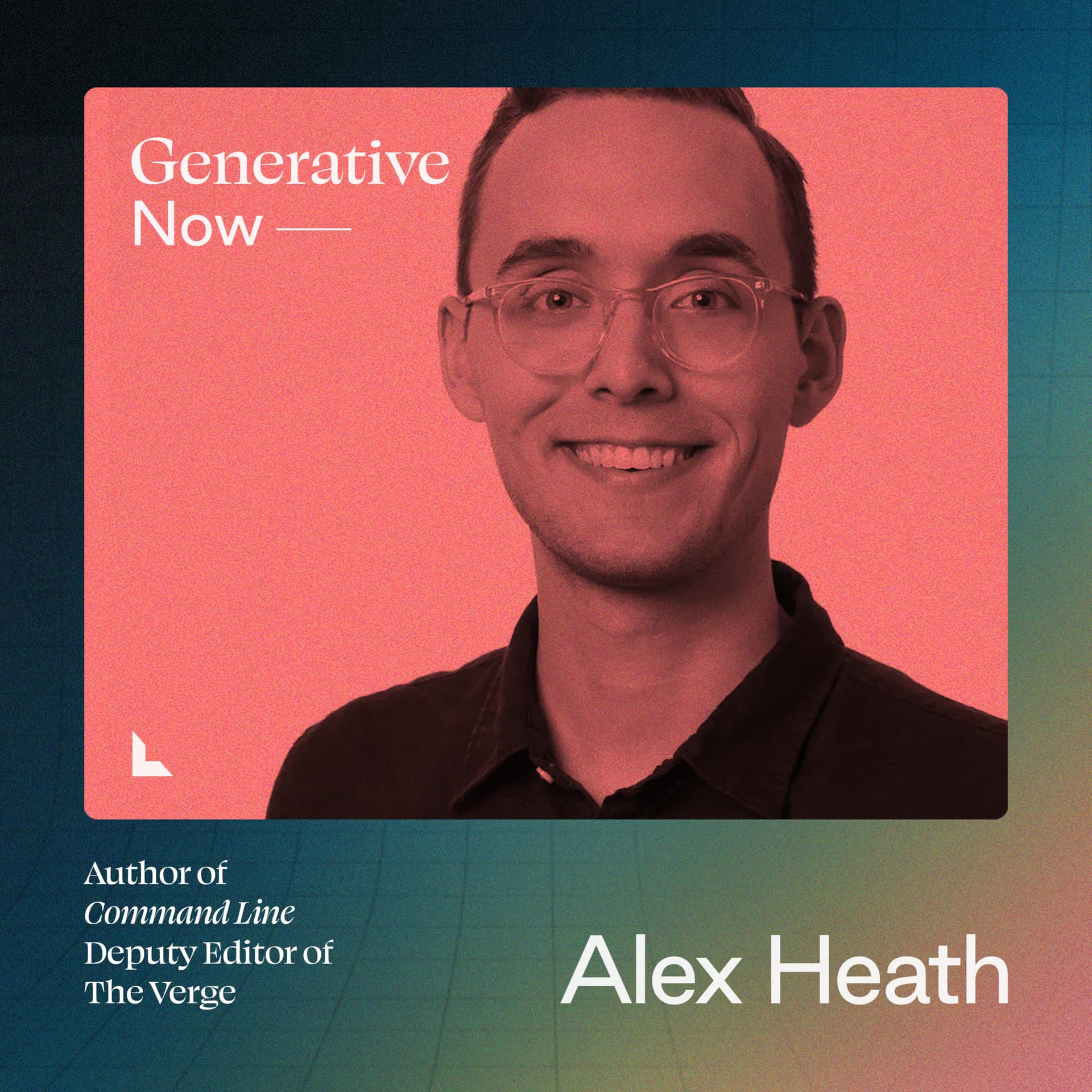
Alex Heath: Tech Journalism in the AI Era
Host
- Michael Mignano (Partner at Lightspeed)
Guest
- Alex Heath (Deputy Editor of The Verge and author of the weekly newsletter "Command Line")
---
Episode Overview In this episode, Michael Mignano speaks with tech journalist Alex Heath about the rapid evolution of AI journalism, covering significant events, trends, and the implications of AI on the industry. Alex shares insights based on his experience in tech reporting, including breaking news stories related to OpenAI and Meta's rebranding, as well as the challenges facing journalists in an AI-driven landscape.
---
Episode Chapters
- (00:00) Introduction to Alex Heath
- Background on Alex Heath and his work at The Verge.
- (1:20) Inside the AI News Cycle
- Discussion on the fast-paced nature of AI news and how it impacts journalism.
- (6:41) Covering OpenAI and Meta Rebrand Breaking News
- Insights into handling breaking news stories, such as Sam Altman's firing from OpenAI.
- (10:14) Top of Mind Trends: Databricks, Perplexity, Meta
- Examination of current trends in AI reporting and companies gaining attention.
- (13:35) Google’s AI Strategy and Gemini Fallout
- Analysis of Google’s challenges with its Gemini AI model.
- (20:25) Second Order Effects of Microsoft’s Inflection Deal
- Discussion on Microsoft’s acquisition tactics amidst regulatory scrutiny.
- (24:02) Journalism Adapting to AI & Future of Industry
- Exploration of how journalism is evolving with AI advancements.
- (32:08) What’s Beyond SEO?
- Considerations for the future of SEO in an AI-dominated landscape.
- (36:19) The Value of Content in Training
- Discussion on the importance of content quality in AI training.
- (38:10) Elon Musk’s X and Grok
- Insights into Elon Musk's AI ambitions and the implications for journalism.
- (41:11) Closing Thoughts
- Final reflections on the discussions.
---
Key Discussion Points
- The Rapid News Cycle of AI
- Intensity of Coverage: AI developments are happening at an unprecedented pace, requiring journalists to adapt quickly.
- Filtering Content: Journalists must discern which announcements hold real significance amidst the hype.
- Covering Major Stories
- Breaking News: Alex describes the urgency to confirm news stories, like Sam Altman's firing, often requiring communication during personal time (e.g., family gatherings).
- Source Development: Building long-term relationships with sources is essential for reliable reporting, especially during fast-moving situations.
- Trends and Predictions
- Emerging Companies: Focus on startups like Databricks and Perplexity that are innovating within the AI space.
- Google’s AI Strategy: Discussion about Google’s difficulties with the Gemini model and organizational challenges in adapting to AI technologies.
- Impact of AI on Journalism
- AI as a Tool: While AI can enhance journalism, there is hesitance to rely on it due to issues like "hallucination" (inaccurate outputs).
- Long-term Adaptation: Journalism will need to focus on human creativity and connections, emphasizing unique narratives that AI cannot replicate.
- The Future Landscape of Media
- Direct Relationships: There's a growing trend toward direct connections between journalists and their audiences, as seen with newsletters and social media.
- Concerns Over AI Aggregators: The rise of AI tools that aggregate news raises questions about attribution and revenue for original content creators.
- Regulatory Environment
- M&A Scrutiny: Big tech companies face challenges in acquiring new startups, prompting them to explore alternative strategies, such as hiring talent while avoiding regulatory red tape.
---
Conclusion Alex Heath emphasizes the importance of adapting journalism practices in the face of AI developments while maintaining a focus on original, human-centered reporting. As the industry evolves, the need for authentic connections with audiences will become increasingly significant, enabling journalists to retain their value amidst technological change.
---
How to Follow Alex Heath
- The Verge: [The Verge](https://www.theverge.com)
- Newsletter - Command Line: Available through The Verge, focusing on insights for tech industry insiders.
---
Additional Information
Stay connected with Lightspeed and Generative Now
- Website: [Lightspeed](http://www.lsvp.com/)
- Twitter: [LightspeedVP](https://twitter.com/lightspeedvp)
- LinkedIn: [Lightspeed on LinkedIn](https://www.linkedin.com/company/lightspeed-venture-partners/)
- Instagram: [Lightspeed on Instagram](https://www.instagram.com/lightspeedventurepartners/)
- Email: generativenow@lsvp.com
---
This markdown document provides a comprehensive overview of the podcast episode featuring Alex Heath, highlighting the key insights and discussions that unfolded throughout the conversation.
Written by AI. May contain mistakes. Listen to the episode to check what was said.
Transcript
Automatic transcript. May contain errors.0:04Hey, everyone, and welcome to Generative Now. This is the show where we talk to the builders who are creating the world's most exciting AI products and companies. I am Michael Magnano. I'm a partner at Lightspeed. And for this week's episode, I talked with someone else who is typically asking the questions. Tech journalist Alex Heath. Alex is the deputy editor for The Verge and author of Command Line, a weekly newsletter with the tech industry's inside conversation. He's interviewed everyone from industry titans like Zuck to founders of AI startups like Perplexity. In this episode, Alex takes us behind the scenes of his tech stories, like when he was covering OpenAI breaking news while at his in-laws on Thanksgiving when Sam Altman was briefly fired from the company.
0:47Alex and I talk about what it's like for his stories to break into the mainstream, how he develops his sources inside tech, and how the journalism industry is adapting to AI. So check out this conversation with Alex Heath. Thanks for doing this. I've been looking forward to this. We've had a lot of founders on here, engineers, designers. We've had some other VCs. We have not talked to any other journalists. So I am very, very interested to get this side of the perspective of everything that's going on in AI. You and your fellow journalists have had quite a year. Yeah, it's been a crazy year. The news cycle has been nuts and just covering this stuff and especially AI.
1:31It's unlike any time. I mean, I've been doing this for over a decade. It's unlike any time I've witnessed covering it in terms of the energy and excitement right now. Yeah, the pace alone, like just, it must be insane. I mean, for builders, you know, watching that pace force constant pivots or sort of reframing of or like resizing of opportunity, I know for sure that's disorienting. Like, how does that manifest over on the journalism side when, you know, there's a there's a new scoop hitting like every single day? You can't like develop sources over weeks or months. It's like you probably got to do within hours.
2:11What does that look like? Yeah, stuff is hitting so fast. I mean, AI alone is just feels like dozens of announcements every week that are interesting or have, you know, significance to the industry. and I think the challenge is parsing through a lot of the hot air and a lot of the stuff that is maybe just trying to take advantage of this kind of rise and then what is real like what is who are the people actually building like lasting important companies versus people that are just trying to ride the wave right and I kind of saw this with the crypto the last crypto boom a little bit with the metaverse stuff and the pandemic.
2:56This time, though, it's different. The level of interest and the fact that people are actually using these products, and a lot of people are using them and getting value out of them already, and we're only a year and a half maybe max into ChatGPT, right? It just feels different in that way. And I don't know when the hype train dies down, but it seems like it's just up and to the right right now. How do you figure out what clears the bar, right? Funding story versus product launch versus new hire? Well, I think the media in general is moving away from funding, at least I hope so, funding in and of itself being a reason to be covered.
3:41I give this advice all the time to founders who I either know personally or just I'm talking to through work. Like you have to have a narrative and a perspective that is unique and a product that stands out. And so we really look for all of that. And I look for that personally. You know, a lot of my coverage and what we do at The Verge is big tech, right? So we're covering, you know, meta, buying all the H100s or Apple's AI struggles or the morale crisis inside Google over the Gemini diversity. disaster. But I'm also interested in the early stage. I'll write about a series A company if the founders have a proven track record, the investors also are the same, and it's a really interesting space.
4:34Yeah, there's just a lot of interesting consumer applications of this stuff relatively quickly, which it feels unique, especially, again, relative to the crypto boom. You know, you saw a lot of hype, but not a lot of actual in consumer application. For big stories, right? The open AI drama, inflection, Reddit IPO, like those are known and you know sort of what you're running at. With the type of thing that you just mentioned where maybe there's a Series A or Series B company that just for whatever reason, you know, gets your attention and your interests. What is the process for that? I often say that a lot of what I do and what a VC does is very similar in terms of like the difference is the outcome, right?
5:18You're looking to write a check. I'm looking to maybe cover or build a relationship over time. And I mean, I'm in it for the long game. I'm, you know, taking coffee with founders. And even if there's something that I'm not going to cover, right? Like if I'm not necessarily going to cover the A rounds, you know, I think maybe this founder has a shot at building a really big lasting company. and I want to be there as they progress. And, you know, I do, the advice that I'm starting to give more is that founders should really lean into social and their own channels, especially when they're early in the company's trajectory.
5:51I think press, like myself, starts to make more sense when you're kind of at the D and beyond stage. But I, you know, I want to just know these people over time and I've had the benefit of being able to see that bear out over the last decade or so. And it's interesting, you see the people that work in these big tech companies too, they leave and they go start companies. And yeah, I don't know. There's not like a formula. It's more of like, how do you feel about the founder and the team? And then also just the timing of the space and what I'm covering. But I'm generally interested in anything kind of platform shift related touches consumer kind of big secular uh tech trends uh so obviously like ai's at the forefront of that right now so sticking with the analogy to vc uh you know journalism kind of like kind of like vc you know your your coffee chats your networking kind of similar to vc networking vc coffee chats and then every once in a while in vc there's some really hot company that's raising around and everyone drops everything they're doing yeah man uh when When we heard that Sam was, Altman was getting fired, that was like a drop everything, you know, start hitting the phones.
7:10Took up my weekend, took up my Thanksgiving weekend. I remember taking calls at like 3 a.m. in my in-laws dining room when we were out like traveling for the holidays. And so like in an open AI, Sam Altman getting fired moment or inflection moment, what are you doing in that moment? Obviously, you're writing, you're publishing, you're editing. But what are you trying to find out? Is there a specific person you're trying to get to? Is there a specific angle you're trying to uncover? Take us behind the scenes of the story in a moment like this. Yeah, you're trying to figure out what everyone wants to know.
7:55And as a journalist, you have this really cool position where you just kind of have carte blanche. Not always, because oftentimes the things people want to know, the companies or the primary subjects don't want the world to know, right? So that's the hard part of the job. but you are literally, you know, you're, my job is to find things out that the world wants to know. And so at the time it's like, why was he fired? Right. And we still don't really know, uh, fully, which I think is wild. And I think is something that, uh, open eye will have to reckon with at some point. But, uh, yeah, like it's finding out like, uh, the personality drama, the, like what call was made when, what is going to happen next, right?
8:37It's getting the next tick on the storyline. And we did that during that weekend. Myself and our editor-in-chief, Neil Patel, I'm really proud of the coverage we did. We broke a lot of stories during that saga. But yeah, it's what we were talking about before, building up relationships over years of people that you now know are in certain positions to know things. And that's when you pick up the phone and hey, what the hell is going on here? So I've had many moments like that in my career. I remember another fun one is when Facebook rebranded to Meta. I got a random call from a source who knew about it.
9:20I was like, hey, have you heard about this rebrand? And I thought the source was talking about some smaller thing, like even rebranding one of the apps or something. And they were like, no, they're going to change the company name. I was like, what? So that was like, That was another 24-hour crazy cycle of getting that confirmed and scooping that. And then it was a joke on SNL the following weekend. And I don't know. It's cool to see when stuff breaks through like that from the nerdy kind of Silicon Valley world that you and I are in all the time to mainstream. And I would say that, the Elon Twitter thing, and then this recent OpenAI thing, I was actually really surprised how that broke through into the mainstream.
9:58I mean, just the request to go on like mainstream TV and my parents knew about it. Altman really became a much larger public figure than I more quickly than I had expected. And I think that moment really showed that. What are the stories you're most recently fascinated by? What's dominating your mindshare right now? There's some big picture things. So how open source is increasingly rising with the LLMs, you know, just, you know, the week we're recording Databricks just put out this new model that supposedly beats Lama and Mistral on a lot of key benchmarks. And they trained it for$10 million.
10:39And so the rapid pace of innovation and open source and costs coming down, what that means for the highly valued closed private model companies, I think is going to be a really interesting, messy storyline for the next 12 to 18 months. and more company specific. I remain fascinated by Google and how they will or won't rise to this moment. And can they overcome the missteps they've already had with Gemini? How big of a market is this going to be relative to search? Does it eat search? Does it complement it? I actually think the jury's still out. You've got really interesting startups in the kind of nexus of search and AI.
11:24I just interviewed the CEO of Perplexity in my newsletter command line. And, you know, I'm always trying to meet interesting and interview interesting kind of people at the forefront of using AI in different ways. Another thing is just the middle. And I think another thing is where consumer hardware and AI meet. and whatever OpenAI ends up doing with Johnny Ive, for example, or a lot of these really interesting consumer devices that use LLMs, Rabbit, Humane's not using LLMs really, but I'd put them in that category, these wearable companies. I have the meta Ray-Bans with the multimodal AI enabled on them.
12:13And it doesn't take long to realize like, Like, oh, this is maybe like what everyone has actually been talking about when they're talking about what comes after the smartphone. And that feels closer. You know, I've been covering augmented and virtual reality for a really long time. And it feels closer than ever now because of how contextual AI actually makes sense in this kind of egocentric first person modality. and I don't know, I think we're in for a wild ride of consumer hardware kind of innovating on LLMs in the next couple of years. Do you agree with that? I totally agree. I think you and I touched on this a little bit at Upfront a few weeks ago.
12:56I think obviously there are potentially really new and cool hardware devices to be built, but I also think existing hardware devices now with the benefit of having an LLM attached to them can do some really, really interesting things. And so, you know, this is probably the most obvious answer in the world. But, you know, when my Apple Watch gets an LLM in it, powering Siri, that is going to be an absolutely life changing experience. Right. I am so trained to talk to Siri, but obviously Siri does not do nearly as much as I would like it to do. And if it could do everything an LLM does right on my wrist, that's a that's a really, really powerful shift.
13:33So I totally agree. I want to touch on Google a little bit. You know, you mentioned the Gemini fallout. That was very, very recently. What are you, you know, through your reporting, which I'm sure you're all still digging in on this. What are you hearing from inside the company? Not necessarily about what their plans are for the product or how they're going to bounce back, but like more of the sentiment. Like, what do you know about how the tone is inside of those buildings for what comes next? I think it depends on the team. I mean, Google is such a sprawling conglomerate. The research team, the team building the actual AI, they're pretty jazzed.
14:13I think Gemini as a model is impressive, the context window aside even. And they're psyched about the work. They have the resources. They have the buy-in from Sundar and Sergey Brin is back in the building, giving that kind of founder weight to the project. at the same time I think they're suffering from a lot of this just kind of organizational fiefdom that has been real in Google for a very long time but is now becoming much more of a problem when they're trying to move a lot faster you know I always joked over the years that like I wasn't the only one to say this but Google is very much like Game of Thrones where you have like the different houses and different corners of Westeros who all think they answer to a different person.
14:59In the last 12 months, the big project has been how do we unify these very different teams? So it's like merging the research teams, brain and deep mind, which is still kind of ongoing, but also just like the product team and the search team. How do you get them to work better with the research team? And how do you avoid things like what happened with diversity stuff, which I think and what I've heard through reporting could have been caught if teams had been more aligned kind of in the initial build up to that release. Yeah. A lot of it is like knocking down heads and knocking down walls and getting collaboration going.
15:39And this is where startups, of course, have the advantage of not only moving faster, but just being smaller and not having this massive kind of not just it's like organizational debt, not technical debt, but just this, you know, the org chart problem. And so Google is like suffering from being such a huge thing that now needs to move fast. And I think you could contrast that with Meta, another company that I follow very closely and talk to Zuckerberg pretty often. There you've got a founder still who is very dialed in and they have less. I'm not saying they don't have it. They're huge still. They definitely have the organizational problems, but I would say they have less of what Google is dealing with.
16:27And as a result, they're shipping, I think, a little faster on a lot of this stuff. So it's really, it's, you know, I've never seen a wave like this where not only does it build up so much energy and excitement in startups, But, you know, big tech is like completely re-rotating around AI at the same time in a way that I just didn't see with crypto, with metaverse, et cetera. So I think the jury's out on like where the value accrues over time. And if you view this as a platform shift, you know, history would tell you that it will be startups that end up, you know, accruing the most value over time that usually the incumbents have a hard time with shifts like this.
17:13And that's the getting back to Google. That's Google's dilemma. It's like, can they can they shift fast enough and not compromise their their business to really answer to this moment? Do you think Google internally is worried about open AI? Open AI seems like the most direct, like the most obvious direct threat or, you know, some combination of open AI, Microsoft. But do you think they think at all about companies like perplexity? I think they're worried about anyone carving off any percentage of search. Perplexity is obviously very small, but things always, you know, big things start small. They have to at some point, right?
17:49Right. Yes, obviously, OpenAI has been the technical leader in just producing the best models. I think what's been really interesting over the last month or so is the gap between OpenAI and everyone else is quickly shrinking, right? And so OpenAI is talking about GPT-5 later this year. If that's another massive leap, that really needs to put them 12 to 18 months out from everyone else for them to maintain their lead just because of how quickly these models are commodifying. I think OpenAI feels that pressure. They also feel the fact that Microsoft is intentionally diversifying away from them with hiring the inflection team, the Mistral deal, etc.
18:39At the end of the day, you need distribution. Good tech is great and it matters, but to really be a massive consumer business distribution wins. I mean, we saw this Google having the foresight to pay Apple what is now on the order of billions a year to be the search default on iPhone. Apple being the richest company in the world because it owns the most important mobile hardware platform in the world. OpenAI doesn't have hardware. They don't control the endpoints to the consumer. And it's why Zuckerberg and Meta is spending DARPA level money on building what he thinks may be the next hardware platform.
19:19He doesn't want to be a surf on Google and Apple's mobile platforms. And so that's the real question for OpenAI, Anthropic, a lot of these model companies is just investing in models and building the best models enough to win here? Do you actually, you know, if you're meta and you have 3 billion users and you can do something that's even half as good, but it reaches 3 billion people, what does that do to the company that's technically has a better model, but doesn't have even, you know, a 10th of the distribution? We were in the kind of like initial, this is so cool. This tech is amazing. The world is changing mode for, I think the last like 18 months.
19:59And I think we're entering the, okay, got to figure out business model, got to figure out distribution phase of this now. Otherwise, you know, there's a lot of money that's been plowed into this sector. And, you know, it has to, this has to be figured out for there to be returns. Right. We can't just like keep riding on like the cool tech and like feeling of like, this is the future for, for much longer. I want to touch really quickly on the inflection Microsoft story, which you covered, you know, I think. I forget the exact words you used, but it seems clear that this was some sort of possible workaround to regulators and the lack of ability to do any real M &A right now.
20:48What are you hearing in your reporting about how this eventually plays out? I mean, do these deals become the norm? Do these deals then also get squashed by the regulators? Does this force the regulators to rethink how they're regulating M &A currently? Like, what are the second and third order effects of what just happened? Big tech has the red light on big acquisitions, especially in something like AI. You know, there's already a Biden executive order. The government is really concerned about concentration in AI, as they probably should be. But it's early and the level of like interest from the government is different than any other kind of tech wave.
21:26Usually it comes in much later. So big tech knows that they can't buy in this space, much less really much of anything. I mean, you just saw Figma getting blocked, that acquisition by Adobe. And so, yeah, what you're seeing is like, I thought the inflection thing was pretty brazen on Microsoft's part because they tried to hide it, but they're hiring basically the entire company, paying a licensing fee that is conveniently just enough to make the investors in inflection whole, a licensing fee for a company that is now running on autopilot without its team. And so it's like, you're not technically acquiring the equity or the IP, you're just making it worthless and taking the team.
22:14And you're going to see a lot more like this because, again, because of the rise of open source and how quickly the cost curve is coming down on building AI, I think you're going to see a lot of these AI model companies go under because really it's going to end up being like, I think one or two, I think it's going to be similar like mobile. There's only going to be one or two lasting independent players in this space that aren't already tied to a hyperscaler or a mega cap, you know, Magnificent Seven company. And, you know, if inflection couldn't figure it out with co-founder of DeepMind, Reid Hoffman.
22:53What does that say about everyone else? It's just it's a tough slog. And so, yeah, everyone in big tech is going to be doing more of these kind of aqua hires, these these fake acquisitions because they do an acquisition that gets put in FTC red tape for 18 months, potentially unwound at the end. And no one wants that with how quick the industry is moving. You got to you got to move fast here. So it was smart of Microsoft to do what they did because they get the acquisition without actually making an acquisition. It's a matter of whether this will catch up. I don't think regulators can come in and say like, oh, we're going to sue you because you did a fake acquisition.
23:33I think Microsoft knew what it was doing here. But over time, it will probably mean more stringent regulation on these kinds of deals. And I would expect that. I wouldn't expect that in the near term. That's not like a this year thing. But yeah, you're going to see a lot more of these kind of over frankly overvalued uh no revenue ai startups looking for lifeboats like this um because uh it's it's tough out there in the in the ocean right now let's talk about the future of journalism and ai maybe maybe starting at the individual level aka you uh as a journalist how are you currently using ai in your work or are you i am i would say cautiously and slowly um Yeah.
24:20Hallucination is a huge problem, right? Yes. And it's something that is a problem for me when I deal in facts and needing numbers to be correct and references to be correct. So I would love to use LLMs more for the padding of stories and all that, but I just don't trust it. I actually had this conversation with the CEO Perplexity. Like he thinks they're solving it better than most, but, and I've, I've talked to Sam Altman about it and he thinks like, we won't be talking about this problem in a few years, which, you know, that would be awesome. But until that's solved, what I really like is the more creative applications.
25:04So, you know, I've got, you know, notion Q and A, which has been kind of helpful for summarizing and kind of engaging more creatively and in a brainstorm way with my notes. A friend of mine has this interesting product called Lex, which is basically like an AI assisted Google Docs. And Google is doing some of this in work in their software natively to which I've tried, but I'm not really using the image generation stuff. I don't haven't really, you know, we have an amazing art team at the verge, you know, we like, we are kind of new thing internally is like, if you're writing or your art could be done.
25:44mostly by ai like uh what are we doing right it's like yeah why are you working what were the value we're adding is like our humanity uh and right right uh and so i actually tried to intentionally steer clear of of overusing it um but you know i have you know open ai's uh audio thing as my action button on my iphone um oh wow and i've been trying that as a serial replacement and And when it works, it's awesome. And when it doesn't, like when it makes up where the moon is or something, you're like, oh, okay, this is why this is not ready to be like default in the phone or an actual Google search replacement.
26:27And again, the multimodal in the Ray-Bans is a really fun thing that I've been trying where you can literally just like look at a plant and say like, how much water does this need or something like that. I'm going on a trip to Japan in a couple months and obviously don't know the language. So I'm actually very interested in using them there to be able to look at things as I'm walking around and translate them in real time. So that's super exciting, like wearing this stuff, especially when the application, you don't need to necessarily have like a factual search answer. It is really exciting. But yeah, I don't know.
27:05It's different for me in that way because I covered the crypto, last crypto wave too. And it just felt like a lot more of fluff. And I got it conceptually and I still do. And I still think a lot of these L1s and L2s are really interesting and have real world applications. But I don't know, man. It's different this time. This is stuff you can actually use. Totally. And that's exciting. Yeah. I could see the hallucination thing totally makes sense. Like you, you can't be having chat GPT, right. You know, write your piece on that point though, like getting to what I was saying earlier, I cannot wait for a model, whether it runs locally or not that.
27:48And just all of my writing in a privacy safe way where I know it's not being like sucked up into some bigger training cluster and shared with everyone else. Cause I have notes that are like very sensitive that like, I haven't like anonymized that could get people fired. Maybe Apple do that. Yeah, something like that where my notes app is an LLM of all of my writing. And I can say, here's my... Because there are some reporters who love the writing process and I'm just not one of them. I actually just love reporting. I love talking to people and learning new things and connecting dots. So if I could just dump all that into a doc and say, here are my notes for the newsletter this week, write this in my voice.
28:24I would pay$50 a month for that. That's cool. Because it saves me time. And that's the promise of AI, I think, is that it can accelerate and solve parts of what we do day to day that is either just drudgery or things we don't look forward to. And for me, that's like a huge thing. Like when I finally have that in a product that I trust, I will use that all the time. Yeah. One of the things I think about with this right now is the tools will get better, right? Like the product you just described, like that seems like it's going to exist, right? Yeah. And there'll be lots of other products that'll kind of give you as a journalist superpowers.
Read the full transcript
29:03At the same time, obviously, there are more and more ways for journalists to, you know, go direct, Substack, Beehive, whatever. Plus, there are all these tools, these AI-powered tools that are making it easier to do things like accounting and payroll and, you know, yada, yada, yada. So I just, I'm curious how that is going to affect the business of journalism more broadly. Like we're already seeing sort of all these, you know, this consolidation of newsrooms, layoffs of journalists. Play that out for us. I mean, is that something you think about or you talk about in the news? Oh, yeah. Yeah, we talk about this all the time.
29:40I do with friends in the industry, but also like inside The Verge. And we're a part of Vox Media, which is a much larger company. We talk about it inside Vox a lot. Yeah, I mean, the industry is going through a seismic shift. And I think what will survive is actual human beings, is people who are doing stuff that only humans can do, which is original creativity, finding new things out in the world, which is not like scraping the internet. It's like actually going out and talking to other human beings and then putting what you learn on the internet. That's something AI is not going to do until we're at like the Terminator phase where we have, you know, the Skynet robots walking out among us.
30:21So it's leaning into that, leaning into personalities because people increasingly, you know, you know this well, like Rise of the Creator economy. People increasingly look to other people instead of brands, right, for authority on what they care about. And so we at The Verge care about this a lot. And I'm doing my newsletter. It's my own thing inside Vox that is me. It's my email. If you respond to it, it goes into my inbox. We are trying to lean into this even as a large-scale publication that's been around for over a decade. But you're seeing Beehive, Substack, newer media companies like Puck, which kind of blend a newsroom with the economics and kind of distribution of a Substack.
31:11That really, to me, is the future. It's more niche, more personality focused, less leaning on the overarching brand and more on like your connection with the human being. And that's something that I think has lasting power, even with kind of the tidal wave of generative AI and spam and Google. And, you know, the ticking time bomb underneath a lot of these publishers is that a sizable percent of their traffic is Google. And when Google, you know, keeps changing things and introducing generative search, which increasingly doesn't link out or doesn't send people out to sites, that's going to create even more pressure on media.
31:52So you have to lean into like the personality and having the direct relationship, whether that's through a newsletter or your social channels or YouTube or what have you. And that's something that I'm definitely leaning into personally, but that I see like the smartest people in my field doing as well. Yeah. So it's, it feels like what I'm hearing from you and I'm, I'm glad you brought up the Google thing, um, is there will be this increased pressure on the creation side because it becomes easier for, for journalists and individuals to again, quote unquote, go direct. And then it sounds like there is also potential disruption on the consumption side when Google changes their algorithm, et cetera, et cetera.
32:32Um, I, you know, the, the thought that comes to mind to me is, you know, I know we've talked about it a couple of times on this episode already, perplexity, you know, products like perplexity, these sort of, these sort of new approaches to content discovery and servicing. Do you, do you feel like that can be an opportunity for journalists and media or does it present a risk? I think any aggregator is always a risk in media. I think we have to stop thinking, you know, I was around during the pivot to video era when Facebook was throwing millions of dollars at publishers to do video and spin up video teams.
33:05And then that money went away. Like, I'm not saying that's the same as perplexity, but we have for too long just depended on the shifting sands of like whatever new tech aggregation for how people find information is shaping out. And yeah, I do think if perplexity can figure out attribution and linking out. And I just think inherently, though, these these chatbot and these LLM products, the value of the product is that it gives you the answer without you needing to go find it, right? So how does that square with the incentives of a publisher, which is to have people find you through search and come to your site and monetize through viewing ads on your site, right?
33:45So we need to have that direct relationship where people come to survive in media, I'm saying. Like media brands and journalists need to have people coming to them to hear what they have to say. That's why I did the newsletter. Um, and that's why we at the verge are, are focusing more on all of this. It makes me think like I, it, it almost makes me wonder if there's going to be almost like this new form of SEO, right? If it's like you said, if perplexly, if perplexity can figure out sort of the attribution model, you know, is the new incentive to, to feed the LLM with the perfect answer. You know what I mean?
34:20Um, so then you can sort of take that to develop a direct connection with the reader. I don't know. I'm just like thinking about how that could play out. Maybe, but the thing is media companies have learned their lesson from the last social era. Right. And I don't think they're ready to give content away anymore. And they're going to want to get paid. You see the New York Times. Yeah, you're seeing this. And this is happening really early in this industry, which is a sign of just how much PTSD there is in the publishing world about kind of having their content scraped and not seeing the economic value.
34:51There was a time at the rise of Google where a lot of the biggest publishers were talking about banding together and forming almost like a union and like a single bargaining entity that would force Google to have to pay to be able to index all of this media. It'd be interesting now to think about what that would look like in an AI world. I think we're publishers are kind of talking about that in a similar way, right? Does that happen? And, you know, you and I talked about this on stage at Upfront a while ago, but like, I think there's a ticking time bomb underneath a lot of these LLM companies, which is like the training data.
35:26And is it actually fair use? Are they stealing copyright? I think the jury's out on that. I think everyone is like running as fast as they can and will beg for forgiveness later. But we're kind of in that like Napster era of this where the rules are very squishy and it's a gray area and the courts will have to figure it out. But there's a lot of incentive from the content creator side to see money from this because it's like you have companies just capturing the value right now. So I hope that creators, not just journalists, but creators in general are fairly rewarded for their contributions to these models and these companies because if not, I think it's going to be a stain, honestly, on the industry and it's going to create a lot of ill will that may fizzle over time, but it's going to be really painful for a few years.
36:18How are those deals shaping up? What are you learning in your reporting about the content deals between the OpenAI's of the world and the Axel Springers and the New York Times? How is content being valued? How do they work? An interesting stat I heard from someone who's done a deal with OpenAI in the news world was that OpenAI tells people that less than 10 % of their queries are for news. So people aren't really using the products, at least ChatGPT, as a way to find news, at least yet. But I feel like these are almost like payoffs to keep you quiet. It's not because - Interesting. Yeah. It's like the New York Times was talking to OpenAI about a deal before they decided to sue.
37:01I think they was like, take one of the pills and they picked.
37:09They're trying to make a lot of the deals right now. And I think every publisher is going like, are we backing ourselves into a corner? Are we setting the bar too low? It's like, once you do a deal, what happens for the next deal? I think you could extrapolate this out to Reddit, which just went public and has that deal with Google for training. Are they going to get more money out of another LLM company now that Google is paying the max amount. I mean, it's a messy thing when you go down this road. It's like, once you set your price, you set your price. And no one actually knows the value of this content in these models long-term and how to appropriately compensate for that.
37:54Because it's so new and people are changing their behaviors and their use cases and there's new products every day. and it's just, yeah, really, really fast moving. And so that makes these conversations very difficult. Maybe last topic before we wrap it up. Obviously you have done a lot of reporting on Twitter and Elon Musk and the transition to X. Maybe any predictions about what we can expect from that part of the industry in terms of Grok and X and how that will all fit into the world of AI? I know XAI is out there right now. telling people they're worth 25 billion uh which i think is is amazing um uh you know grok is like i've tried it it's fine um i i think that you know it's obviously hard to bet against elon um and you know he hasn't shown that he's been able to you know run x uh super well yet um but on the ai side he's certainly hiring good people and is um has resources so So I don't see, I don't know the long-term aspirations there.
39:02I don't know if there really are any necessarily, except to just be a counterweight to OpenAI and his qualms with how that's going. I think X.ai could rescue the entire X Corp thing, the Twitter to X project, right? Talk about that. Yeah, what do you mean by that? Well, because as a business, like it's, you know, it's an ad business, brand heavy, and that's very fickle and that's very perception-based. and Elon has totally torched the reputation of it being a stable, brand safe environment, right? And so their revenue has collapsed since he took it over and it's self-inflicted. Some of it is secular, but most of it, and I'm saying this like, I know this, like a lot of it is just self-inflicted, like the Elon of it and him pissing, him telling advertisers to go after themselves, that sort of thing.
39:50And so Twitter as like a business or X now as a business is it's not really one, right? He wants to make it an everything app, but like I don't really, I think he's speed running all of the bad decisions that every social media company has made over the last 10 years. And he's going to find that out in due time because he's kind of reliving his dream from the 90s, right? With x.com. But, you know, if x.ii hits and he builds like models that are really cutting edge and have great use cases, he'll obviously get a higher valuation for that. maybe that rescues the entire enterprise value of X Corp.
40:28And so that's why X.ai is, there's an equity, you know, tying component to X, formerly Twitter for investors. So I think he's hoping that, I think investors are hoping that. I don't, haven't seen Grok light the world on fire. I'm not, I don't really care for it. It's like, I don't know, nasty dad humor, I guess you could call it. But I think like, you know, it's Elon being Elon, right? Like it's going to be binary. Like it'll either be huge or he'll, you know, shut it down or move on. But I think that could be the lifeline for X, the social network. Alex, where can all of our listeners find you on the internet?
41:15Tell us about the newsletter, your writing at The Verge. Point us in the right direction. Yeah, thanks so much. Yeah, so I'm on the verge all the time, Alex Heath. My newsletter is called Command Line. You can find it on the verge. It comes out once a week. It's really for people who work in tech, the builders, the investors, the employees at these companies we've been talking about this whole time. So I hope people find it interesting. It's kind of just my notebook dump each week on kind of what's happening. And yeah, man, it's been great talking to you and congrats on the podcast. It seems like it's going super well.
41:52Yeah, it's a lot of fun. Thank you so much for coming on, Alex, and looking forward to doing it again sometime. Yeah, thanks, man. Thank you so much for listening to Generative Now and my conversation with Alex Heath. If you liked what you heard, please do us a huge favor and rate and review the episode on Spotify and Apple Podcasts. That really does help. Also, subscribe so you get notifications about when we drop new episodes. And if you want to learn more, follow Lightspeed at LightspeedVP on YouTube, Twitter, LinkedIn, X, Instagram, and everywhere else. Generative Now is produced by Lightspeed in partnership with Pod People.
42:29I am Michael Magnano, and we will be back next week. See you then.
From the publisher
AI news moves fast. But reporters covering AI move faster. This week on the podcast, Lightspeed Partner and host Michael Mignano talks to journalist Alex Heath about predictions for independent model companies, the conversation around training data, and how journalists are adapting to AI disruptions. Alex Heath is the Deputy Editor of The Verge and the author of Command Line, a weekly newsletter about the tech industry’s inside conversation.
Episode Chapters
(00:00) Introduction to Alex Heath
(1:20) Inside the AI News Cycle
(6:41) Covering OpenAI and Meta Rebrand Breaking News
(10:14) Top of Mind Trends: Databricks, Perplexity, Meta
(13:35) Google’s AI Strategy and Gemini Fallout
(20:25) Second Order Effects of Microsoft’s Inflection Deal
(24:02) Journalism Adapting to AI & Future of Industry
(32:08) What’s Beyond SEO?
(36:19) The Value of Content in Training
(38:10) Elon Musk’s X and Grok
(41:11) Closing Thoughts
Stay in touch:
LinkedIn: https://www.linkedin.com/company/lightspeed-venture-partners/
Instagram: https://www.instagram.com/lightspeedventurepartners/
Subscribe on your favorite podcast app: generativenow.co
Email: generativenow@lsvp.com
The content here does not constitute tax, legal, business or investment advice or an offer to provide such advice, should not be construed as advocating the purchase or sale of any security or investment or a recommendation of any company, and is not an offer, or solicitation of an offer, for the purchase or sale of any security or investment product. For more details please see lsvp.com/legal.


