
In short
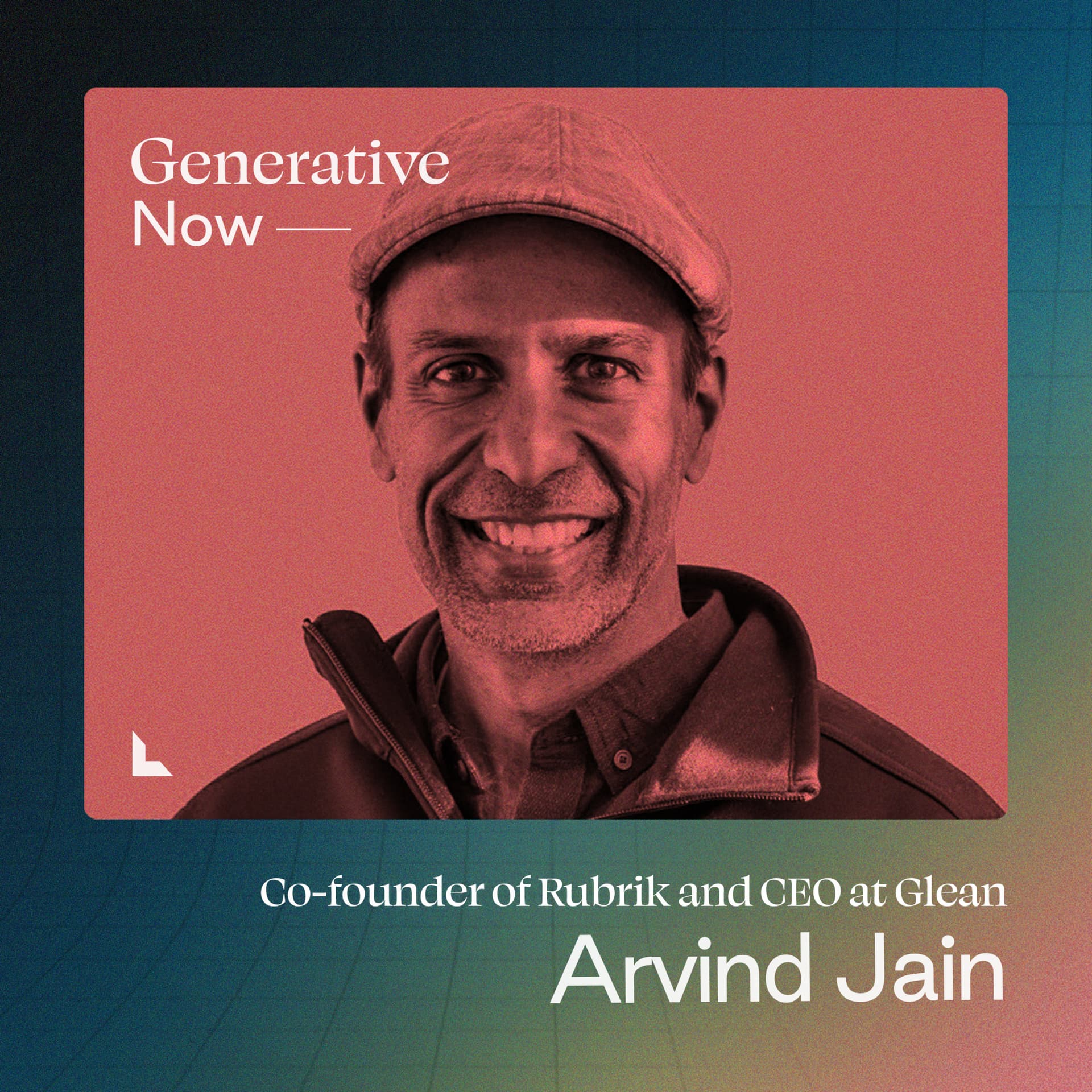
Podcast Summary: Generative Now | Arvind Jain: Why Now Is the Time to Solve Enterprise Search
Episode Overview In this episode of *Generative Now*, host Michael Mignano talks with Arvind Jain, founder and CEO of Glean, about the evolution of AI-assisted enterprise search. They explore Glean's journey since its inception in 2019, its technical foundations, the impact of transformer-based models, and the competitive landscape of the enterprise search market.
Key Points and Discussion Topics
Introduction
- Host: Michael Mignano, Partner at Lightspeed
- Guest: Arvind Jain, Founder and CEO of Glean
- Theme: The necessity and evolution of AI in improving enterprise search capabilities.
- Glean's Origins
- Why Glean was Created:
- Arvind experienced significant productivity loss at Rubrik due to fragmented company knowledge.
- The realization that existing search products were inadequate led to the vision of Glean.
- Technical Foundations
- Building with Transformers:
- Glean implemented transformer-based models early, recognizing their power in search technology.
- The use of models like BERT allowed for more semantic and conceptual level search capabilities.
- Product Market Fit and Early Challenges
- Initial Market Perception:
- Enterprise search was viewed as a "vitamin" rather than a "painkiller," making it difficult to gain traction.
- Glean had to educate the market on the importance of better search solutions.
- The Impact of ChatGPT and Market Evolution
- ChatGPT as a Catalyst:
- The emergence of ChatGPT created awareness and demand for AI-powered solutions in enterprises.
- Glean positioned itself as an enterprise version of ChatGPT, tailored for internal company knowledge.
- Glean's Architecture and Integration
- System Architecture:
- Glean integrates with various SaaS platforms using their APIs to compile data for effective search.
- Emphasis on security and permission-aware access to sensitive information.
- The Future of AI in Enterprises
- AI's Role in Business Processes:
- AI will transform how employees access and utilize enterprise knowledge.
- Glean aims to simplify data access and enhance employee productivity.
- Leadership, Competition, and Company Culture
- Approach to Competition:
- Arvind values competition as it drives innovation and urgency within teams.
- Glean's strategy continues to focus on partnership with AI model providers rather than direct competition.
- Growth and Success Metrics
- Recent Success:
- Glean recently crossed $100 million in ARR, with significant growth attributed to product readiness and market timing.
Key Takeaways
- The Importance of AI in Enterprise Search: AI is essential for addressing the complexities of knowledge and data retrieval in modern organizations.
- Innovative Applications of Technology: Glean utilizes existing models to create a sophisticated platform that enhances employee productivity while ensuring data security.
- Market Education is Vital: Educating potential clients about the value of enterprise search solutions is crucial for market adoption.
- Adaptability and Continuous Improvement: Glean's architecture allows it to adapt to evolving AI model capabilities, ensuring ongoing improvement and feature delivery.
Conclusion Arvind Jain's insights into Glean's journey highlight the transformative potential of AI in enterprise search. With a focus on leveraging advanced technology to solve practical problems, Glean stands at the forefront of a critical evolution in how organizations manage and access their knowledge.
---
For more information, connect with Lightspeed [here](http://www.lsvp.com/) and follow the podcast on your preferred platform.
Written by AI. May contain mistakes. Listen to the episode to check what was said.
Transcript
Automatic transcript. May contain errors.0:04Hey, everyone. Welcome to Generative Now. I am Michael Magnano. I am a partner at Lightspeed. Enterprise AI is transforming how companies work, and few understand this revolution better than Arvind Jain. As the founder of Glean, Arvind has been building one of the most sophisticated AI workplace assistants since years before ChatGPT became a household name. And now it is a massive player that dominates the enterprise search space. Starting his career at Microsoft and then working as an engineer in Google's early days, Arvind co-founded Rubrik and took that company public in the high-stakes world of data security.
0:39Arvind and I had a great conversation about why he loves competition, how technical innovation informs product strategy, and how Glean found product market fit. Take a listen. Hey, Arvind. Good to see you. Good to see you, too. Glean has been, you know, an obvious success story in the world of AI and generative AI. The interesting thing about Glean is it seems to have started well before the current wave of generative AI and the AI explosion that we've now been going through really since kind of the launch of ChatGPT. I figure a good place to start would be to hear the story of Glean and how it got started in 2019, you know, from your journey at Rubric to starting this and like really what you saw before others did, before the AI wave took off.
1:28So we started in early 2019. And at that time, we didn't have that much of an idea of how AI was going to take over the world like it has today. But the problem that we wanted to solve was an important one. We started with this vision of building a really powerful search experience inside businesses for people in their work lives. Before Glean, I was one of the founders of Rupric, which is an enterprise data security company. And one of the things, you know, like at that company, like we grew very fast, we were very successful. But as the company grew, like, you know, as we sort of crossed 1 ,000 employees, we started to see like, you know, big drop in productivity, like across all of our different teams.
2:22And part of it is like, you know, you sort of like take it for granted that, yeah, like, you know, as things, you know, as companies get bigger, like things become more complex and slower. But I felt there was more to it. Like we were actually seeing very, very steep drops in productivity. And I think part of it was caused by this issue of the company has so much knowledge, so much data, you know, spread across so many different systems. And also like, you know, as the companies grow fast, like, you know, people's roles, like, you know, it's not always clear, like, you know, who works on what, who's an expert who can help me on any given topic.
2:56And these were actually the largest complaints that we were seeing in our pulse surveys at Rubrik. People are complaining about these, that people are saying that, you know, I'm not enabled. I can't actually get my work done because of, you know, these issues. And so me being a search engineer, like, you know, before Rubrik, I spent over a decade of my career building, you know, Google search. I said like, you know, well, you know, people are complaining about not being able to find things and we should go and, you know, buy a search product that can connect, you know, our enterprise data that's, you know, fragmented and spread across all these different systems so that, you know, it's easy for people to find things.
3:32And also it's easy for people to find other people who can help them, you know, do their work. So we just had to, you know, that was sort of the origins of we're trying to solve a problem internally, you know, at our company. and that's when I realized that there's no good search product that we could buy. And so we wanted to go and solve that. And one of the interesting things is that in 2018, in the search industry, among the search engineers, we were already seeing the power of the transformer-based neural nets and these models. There were some language models. You know, they're small, like, you know, the BERT family of models that were already out there.
4:15And in Google search, we were seeing, like, you know, how you could take a, you know, every, like, you know, component of the search technology and you could actually build a new system using these transformer based models. And they would actually perform better than, like, you know, these, you know, previous generation of models that were built over the last 15 years. And so we knew that transformers was going to completely change how search works. You can actually do search at a much more conceptual and semantic level. And so that was an opportunity to actually also leverage and build a really good product in the industry.
4:52So that's how we sort of got started. In fact, Glean became the first company, I believe, that has brought the transformer technology to the enterprise in that sense. It's so cool. And it's such a great insight. I mean, you know, even relating to my own experience, I was building a small startup, you know, got it to a couple dozen employees and then we sold to a much bigger company and we show up at this big company and there's thousands of employees and there's all this context that we're missing. And you go and grab it in Slack or an email or in Google Drive or in any any number of these confluence Okta.
5:27But it's all disconnected and there's no and there's no way to sort of bring it back together and bundle it. And it sounds like that's the opportunity you saw. I mean, even though you saw that this opportunity was coming for LLMs, I imagine that you weren't necessarily leveraging them from day one in the product. So, like, how were you tying all these systems together that I just mentioned? Like, what was the actual technical approach to connecting all of these endpoints? Yeah. So, like, if you think about the search stats, number one, like, to be able to search over information, you need to have access to that information.
6:02If you look at a modern enterprise, most of their systems where their knowledge and data is, is a SaaS cloud-hosted system. And typically SaaS systems interoperate well with each other. They have good APIs available to them. We started to build these integrations with products like Confluence and Jira and Google Drive, SharePoint, whatnot. not, right? And all of these integrations were built using the already published APIs that these systems exposed to us. You guys should connect with these systems. You could see all the data inside them, and then you can bring it together in one common search system.
6:40So that was the first step of building the technology was building these integrations. But you have to also understand that enterprise search is very different from search on the web. On the internet, we can all access all information. You know, everything is available to us. In an enterprise, like information is privileged. It's secure. Like there are certain documents you can access, but then there are many others that you can't. So when you actually build a search product, you have to actually build a safe version of search. You can't actually start to leak information to people from this search experience.
7:12So you have to sort of think about the problem differently. You have to figure out how you're going to actually solve, you know, secure, you know, permission-aware access, like, you know, within the search results. So we had to sort of build a lot of security infrastructure to actually handle that. But to actually, you know, on your question about transformers, actually, the transformer models were part of our first version of the product. Like, it was from day one. Yeah. So from day one. That's really cool. Well, because, you know, the technology was in front of us, you know, we saw these models were so powerful.
7:43And you can build a such, like, much more smarter search. you can actually come in and you can ask questions in natural language. And we could actually match it much better at a conceptual and semantic level, you know, to those documents in Confluence or Google Drive, as opposed to doing the brittle keyword-based search. So it was a great technology and it was available to us. So what we did there was we took BERT, which was, you know, a model that Google had put in open domain for startups like ours to use. and then we would take that model and for every enterprise customer of ours, we would actually build a model, you know, customized to that company.
8:25We would actually train, we would actually train, you know, retrain these models on the enterprise corpus, on that data in a safe and secure way again so that, you know, the model starts to understand your company, your lingo, your code names, you know, acronyms, you know, all of that stuff. And then in our core search stack, we would use both traditional search techniques to figure out what's the best information to return given a question, but we'd also use this transformer-based semantic meshing technology. So it was a hybrid search stack that we built from day one. So what was sort of finding product market fit for that like?
9:08Like, you know, I think about all the startups that have launched over the past couple of years, they almost have this truly magical experience the first time you experience them because the AI is just so powerful, right? It's like the first time you use ChatGPT or the first time you use one of these image generators. Going back to 2019 or 2020, when you started to go to the market, the concept of Transformer must have been so new for all these enterprise companies. Did you find that same sort of magical experience where you're like, oh, hey, Enterprise, let us show you how you now can, you know, prompt semantically against your entire organization and just have it, you know, come back to them like a human being?
9:44I mean, that must have just been really, really powerful for them. Yeah, actually, you know, it's interesting that we didn't actually talk about Transformers as a cool thing. It was not a hot thing, like people are not talking about it. I think what they cared about was what you could do with it, which was that, well, like, you know, in Glean, you can ask questions in natural language and it will conceptually match the information with your question. You don't have to, like, remember the exact keywords, you know, and that was sort of one of the big pain point of the previous generation search systems is that, well, I know I'm looking for this email, like it's in my outlook, but I still cannot, you know, get to it because I don't remember the exact words.
10:21So I think it appealed to people, but you actually, you know, ask a very interesting question. we I don't think you know we had a product market fit for a long time like in the sense that the somehow like you know like the industry felt that search was a vitamin and not a painkiller like you know well yeah like you know everybody would everybody would like you know they would they would acknowledge that yes you know we have a problem like you know we have lots of information it's you know spread and fragmented across many different systems and people do struggle like you know, with finding information, but well, ultimately they find it.
10:56And like, you know, I guess, I guess, you know, things are working for us. And there was not a product that they were actually buying. Like, you know, they're not buying a search product that we would say that, hey, look, you know, we have a better one than what you buy. There was no concept of them buying a technology like this. So we had to create a market and it took us time. We had to do a lot of evangelism. We had to talk about why it is important. Like, you know, it reduces frustration. It makes employees happier. You know, they spend a third of their time just looking for information. So you will save a lot of time.
11:24And so it took us some time, you know, before, like, you know, we started to gain that traction and gain that word of mouth, like, you know, from our initial customers. And what was the moment that it all flipped? Was it just, you know, but you reached some moment that you had enough people talking about in the market that it just sort of snowballed from there? Or was it a key customer or a key sort of product unlock? Like, what really did it? Yeah, I would say there were two, like, I would say two distinct moments. Like one is where we actually had like about 30 or so companies and we were first focused on the tech sector.
12:00So we got most like, you know, the most iconic tech companies, you know, they started to use our product at a net scale. And the word of mouth started to happen from there, which sort of created like, you know, that further momentum and inbound like, you know, to us in terms of more interest in the company. And then there was another big moment, which was ChatGPT. In some ways, you can think of Glean as the enterprise version of ChatGPT. It does everything that ChatGPT does, but it does it with that knowledge and context of your company. When the world saw ChatGPT and the power that it has, as an enterprise leader, you were thinking about, well, what if I had something like this inside my company?
12:44something that knew everything about my, you know, my employees, you know, my, you know, internal data. And it could also answer questions for me using all of that. That would be fascinating. Right. So, so that actually, you know, started to create that, you know, organic, you know, demand, you know, it was a second wave of like, you know, massive momentum for us. Yeah. That's really, really interesting. It's almost like ChatGPT kind of did a lot of the external marketing for you. That's right. But all the things you had previously been working on, like security and, you know, safety, and like you mentioned, permissioning between different users, obviously, like, so, so important to bring that technology into an enterprise.
13:17So that's fascinating. You mentioned early on that, you know, you started out, the first transformer based model you're using was Bird. Since then, like, how is your, like, how do you manage the sort of model component of the product? Do you train your own models now? Are you, you know, you hot swapping things under the hood between, you know, OpenAI, Anthropic, et cetera? Like, Like, how's that all work? Yeah, more of the latter. So let me explain the architecture of this. We're not a foundation model company. We don't train these super large models. When you think about like the product, like how does Glean actually work?
13:53So it looks and feels like ChatGPT, right? You come in, you ask questions and Glean will actually use either all of the world's knowledge and context to answer those questions for you, or it's going to actually use, you know, your internal company's data and knowledge to answer those questions for you. Now, the way like the models themselves, like, you know, when you think about, you know, GPD or Cloud or Gemini or X or, you know, DeepSeek and whatnot, like, you know, none of those models are trained on your enterprise information. So they don't know anything about like, you know, how work happens inside your company.
14:26And so how do you how do you actually like answer questions, make these models answer questions, you know, you know, using data and knowledge that's inside your company? you know, the architecture for that is, you know, drag, right? Where you actually, you know, you know, it's a two-step process, like, you know, given any task or any question that a user comes and asks, you know, first we use our core retrieval and search technology to assemble like some relevant pieces of information from inside our company. And then we give all of that to the model so that the model can actually reason over it and actually generate, you know, the appropriate, you know, answers or responses back to you.
15:03So that's the architecture that's typical, like, you know, most enterprise agents or applications are built in this, you know, rack style architecture where search is a first leg. I mean, not search or retriever, whatever you want to call it. And then the model reasoning and inferencing is the second part. Now our architecture, you know, is, so we, we do build models and they are, they are, they're still built all like, you know, bird or modern bird, like, you know, these small, you know, I guess these are SLMs, you know, is what the industry calls them now. So we actually still train models on your enterprise corpus, but that is done mostly to actually do semantic matching of people's tasks with your enterprise knowledge.
15:43So it's used for that, you know, retrieval task. But then for reasoning and generation, we use the foundation models. And our architecture is like, we're not tied to one particular model. like what we're seeing in the industry is that there are many, many model providers. They're all in different models are getting better at different things. For example, like, you know, these days you'll hear a lot of people say that for code generation, like Cloud is actually doing better than any other model for reasoning. GPT is doing better than others. And so they're all like all these models are getting better at different things.
16:20And our goal, you know, at Glean is to make sure that for our enterprise customers, like we can bring all the amazing innovation that's happening in the industry, you know, to our customers. They don't, they should not have to choose, you know, what model to use. And so like, so that's how the architecture is that behind, underneath, you know, we have access to all these different models. And given, you know, given the task, given, you know, we can actually, you know, help an enterprise choose what's the right model to use for that. Yeah. Yeah. And what's really cool about that is as these models keep getting better and, you know, you know, and I'm sure everyone in the audience knows, like, feels like every week these things are getting better.
17:00Your product just keeps getting better and better as a result, right? Anything these models can do, you get to now offer to your customers, your enterprise customers. What must that be like? Because I have to imagine that as these models improve in capabilities, they probably unlock like completely new feature sets for you. You know, like, you know, one thing I keep thinking about with Glean is like, as these models become truly agentic and they move from, you know, they move from individual sort of retrieval of information to more sequential task oriented, things like that. Like, that's got to open up a huge service area for Glean and your customers.
17:37Is that how you think about it? Absolutely. I mean, I think the and these features are actually coming every day. like you saw in the last month with operators is a new thing, which actually really unlocks our ability to work with many, many more enterprise applications. One of the important things, like the way I think about AI and its impact in the enterprise is that if I'm a business user and I have a question or I have a task which requires me to play with or work with some data inside my enterprise, like AI is supposed to make it super seamless for me. Like, you know, like I don't want like, you know, this, this, we don't, we're not going to be in a world anymore where we know that the data exists, but accessing it is hard.
18:22Like, you know, AI is going to make it super easy. Like, you know, a lot of it, you know, we do through our integrations, but a lot of it we can also do through these, you know, like new LLM capabilities, like computer use, you know, operators where you don't even need those systems to have APIs. You can still sort of go and drive, you know, a browser and sort of, you know, like, you know, get that data that you need to work on, you know, for your agents. So the innovation is going to, you know, keep happening at the fast pace. Like, you know, our strategy at Glean is always very clear. You know, everything that the model providers, that the cloud hyperscalers, all the technology that they are building, you know, we basically don't compete with them.
19:01You know, we leverage that technology and we do the remaining part, which is like, you know, how do you make it easy to access that, like, you know, all that technology and make it work on your data in your enterprise. The third thing that you can do with Glean, like, so we have a Google like search, we have a chat GPT like AI assistant, but then we also have an agent building platform. So you can actually build all kinds of agents to transform your business processes using AI. and in fact I think the best thing with AI is that it's actually bringing that power to you know to every business user you don't have to be a developer anymore to be able to build something you know complex or like interesting like you know you don't need developers you know for everything anymore like you know there are a lot of like you know agents that you can actually just build by expressing you know a business process in natural language to AI and then AI sort of like, you know, like does, you know, things like what you mentioned, like, you know, you don't, you don't do the reasoning is actually take the business process.
20:04It will create a multi-step workflow that you can then go and review and execute. So, so I think, yeah, we are definitely, you know, going, you know, towards a world where a lot of like, you know, how, like just how work happens is going to fundamentally change. And yeah. Yeah. So this agent builder, which you mentioned, what does that require from the models to work? Does that require models that are specifically capable of reasoning or being able to browse the web like operator or computer use? or is Glean really the product in the system that enables to take these LLMs and sort of piece them in a way together that they're actually executing on tasks on behalf of your enterprise?
20:55Yeah, it's a combination of that. Like today, if you just work with an LLM, that's not enough for you to actually build an agent and automate a business process with it. you do need some more work that needs to happen on top of it. For example, you need to figure out how to actually bring the right data to these models that's in your enterprise. And over time, there's going to be more and more features that you will get from the LLM providers. Computer use, for example, is an example of that. This is a feature. This is not really the model, but it's a feature that the LLM companies are actually providing to you.
21:42You know, it's a mechanism for you to sort of, you know, bring more data into the models, into the LLM reasoning. The way things will evolve is today, I think that you still need, you know, agent building frameworks and platforms that will actually sit on top of LLMs. The way we are helping our customers build agents is, you know, you get this, you know, agent builder UI, where you can just talk in natural language, converse with clean to build an agent together. Behind the scenes, we're using both our API-based integrations to enterprise data sources. But like that, the overall orchestration is being done by us.
22:22Got it. That makes a lot of sense. Speaking of computer use, and again, these models getting more agentic, and the fact that it does seem like a lot of the big sort of model providers, the open AIs, the Anthropics, et cetera, like they are leaning more and more over time into the enterprise, offering, you know, more and more ways to connect different parts of your, of your, of your business. How do you think about the landscape of competition when, you know, I'm sure many of your competitors are sort of building kind of like at the application layer on top of the models. And now there's also this, I don't know, new sort of a front from the model layer where they're coming at it as well.
22:58How do you keep the product sort of competitive when you have this competition coming from all different angles. Yeah, it's true. From a technology stack perspective, like an overall agent architecture, you're going to have the LLMs and model capabilities at the base level. You're going to have a data connectivity layer and a retrieval and search system. And then you have basically like, you know, the overall like agent building and, you know, like the reasoning flows, you know, that you're going to build on top of them. First, I'll make this assertion. A lot of things are going to change about work in five to 10 years from now.
23:45Majority of the work that we do today, we won't do anymore. It's going to be done by, you know, AI, you know, assistants and agents, you know, that are going to be helping us, you know, perform those tasks. Our work is not going to go away. like you know it's just gonna change a little bit like you know it's going to become maybe more creative more uh thinking oriented and like you know the base level working with data doing you know some research analysis on it like you know the models can actually do a lot of that work for us so so so majority of our work is going to you know change um the way the organizations are built the business processes like most of these business processes are going to actually also get automated you know, with AI.
24:25So, so one thing that I feel is that the body of work that needs to get done versus the companies that are actually doing that work, there's a big delta between that, you know, the white space is huge. And the, like, if all of us, you know, work super hard, like, you know, we're still only getting 1 % of, you know, what needs to happen done in the next one year. This is not the time where there are too many players and, you know, and not enough, like, you know, problems to solve, like, you know, within the opposite. Right. It's probably the opposite. Yeah. And so therefore, we don't feel like, you know, any sort of concern, like, you know, with competition.
25:05You know, our strategy will remain, you know, what it is today, which is we will continue to partner with all of these, you know, players. We'll continue to partner with the language model companies, with the cloud hyperscalers, and will, you know, fully leverage, you know, all the innovation that they are making because, well, like they won't be able to cover more than 10 % of what needs to get done. And so we have enough, you know, for us to work on. And so we can't, like, so basically think of us as, you know, sitting on top of, you know, like the core technology from these players as, you know, as they build more, like we also rise and like, you know, we start to build like, you know, the other things, you know, that we haven't built yet.
25:42So we think, you know, of all of these companies more as our partners, not as our competitors. But now, practically, if you think about as a customer, you're being pitched agents from 300 different vendors. And who do you pick? Who do you choose? I think Glean has a very unique architecture and a position in the marketplace where we're telling our vendors that we're not an LLM company. So when you actually think about your AI stack, you have to work with the language model companies anyway, and you can work with them through us or directly. We're fine with both those options. But what we are doing is we're giving our customers a horizontal AI platform, a platform that's connected to all of your enterprise information and data and knowledge.
Read the full transcript
26:39So you can actually use this as a way to consolidate your AI work, as opposed to buying AI agents function by function, product by product. And if you use a thousand SaaS applications, you're going to have 10 ,000 agents in your company in the future. And so one model is that you actually go very functional and you get a lot of these vertical agents. The other approach is you pick us as the horizontal AI layer and then use us as a central platform to build many of these agents. So I think right now we definitely are unique compared to any other approach that you see from other vendors in the enterprise.
27:23And it remains to be seen how many of these agents will be built on a horizontal platform like us versus fully dedicated verticalized agent solutions. Yeah, it's kind of like that classic saying that like, you know, the only money to be made in software is sort of bundling and unbundling. You're taking both the, you know, the unbundled SaaS products that exist and now all the different models and you're bundling it up into one experience, which makes a ton of sense. Speaking of competition, you really like competition. Talk to us a little bit about that. Like, how does that factor into sort of your management, your leadership of the team, this love that you have for competition?
28:04Well, as an engineer, I know that a lot of inspiration as an engineer comes to you from amazing technologies that you see outside. And you want to actually go and match those technologies. You want to actually go and beat those and build better products. And so I think competition actually always serves a really strong purpose in driving the R &D engine at any enterprise. I'll tell you just from our own company's perspective, when we started with our core search and before everybody decided to actually come into the search and the AI assistant market, we were alone for a long time. We were the first company to sort of actually really take Transformers and start to sort of, you know, work on these search and assistant products like, you know, six years back.
29:06So for a long time, like, you know, we were by ourselves. And when you're by yourself, like, you know, it's very hard to pace. It's very hard to actually figure out are you moving fast enough or not? Like, you know, because there's no comparison, there's no benchmark, you don't see anything outside. And so you have to be really just like, you know, you're just charging ahead with no clear indication of that. Like, you know, do you need to move faster or not? Sometimes, you know, actually get, you know, complacent, like, because, you know, you are the best product out there. And, and, and, and I think so that, and that's, that's the, that's, that's what competition does to you is that not only does it actually, you know, create that urgency, you know, in your team, because now you know that like, you know, well, if you don't innovate fast, you know, and if you don't, you know, if you don't stay ahead, then you're going to be dead.
29:52And so it sort of creates, you know, that, you know, that sort of urgency and velocity, but also like, you know, competition is good because no one company has like the monopoly and all the ideas, like, you know, we, like, we can't think of all the great things, like, you know, we learned so much from like what other people like, you know, come up with, like, you know, the ideas that, you know, that, you know, like they have new ways of thinking, new things that come out. And then we take inspiration from them and like, you know, build our own R &D roadmap based on that. So I think it is essential.
30:22In any industry, the more people that work on an idea, it's actually better for all of us. And ultimately, it also creates, the pie gets just bigger and all of us benefit from it. Yeah, it makes total sense. I mean, it's a driver of urgency, which you need as a startup. And like you said, it sort of shows you where to focus. And it seems like it's working. You know, I know this past year has been massive for you. Just announced recently that you just crossed over 100 million ARR. Super, super impressive number. And I believe the business has tripled over the past year, which is just incredible.
31:03What would you attribute this to? Obviously, you know, there's a lot of excitement and demand for the product, but were there key drivers that enabled you to drive that kind of growth over the past year? I mean, it's really phenomenal. Yeah. Yeah, I think so. So first of all, I think it's all about timing. So we feel fortunate, like, you know, that all the work, you know, that we did over the last six years, you know, has allowed us to actually create a product that is ahead of the market, you know, in a very significant way. And so when people are now looking for this product, like, you know, they like our they like what they see, you know, from Glean and they're embracing and adopting it.
31:39One other thing that I want to actually also, the market itself, like I think when you think about like AI, you will also hear like no stories on that. Well, like, you know, I see all these great demos and but when I try to actually deploy AI in production, you know, it doesn't actually work. And like, and I'm just, I feel like I'm just experimenting and, and I don't know like where the value and the ROI is coming from. And one of the things that changed in the mindset that I've seen last year is that people are also realizing that, look, AI technology is very powerful. There's no doubt about it.
32:18It's going to change our world. There's no doubt about that either. But it's also very difficult to use. It's a machine, like a machine that nobody has ever seen before. As a human, when you use a machine, you know a machine is predictable. Like, you know, it does, you know, it does one task and it does it, you know, precisely the same way. You know, that's the definition of the word machine. And, you know, AI has changed that. Like, you know, it doesn't feel like that. Like, you know, you ask the same question to it four times, it's going to answer it four different ways. And so sometimes, you know, people get very confused, you know, with a technology like this.
32:53And they give up. And a lot of people actually gave up after they asked some questions in chat GPT and made some things up. and they said like, you know what, I don't believe it, I don't trust it. And so you have this conundrum. You have this conundrum where as a leader, you know that AI is going to transform my business. I need to be ready. I need to get ready for it. But at the same time, this is a hard technology. So how do I make sure that I don't fall behind because my employees give up? And you have to drive that education inside the company. And so that's a big thing on the CEO's minds these days is that, well, look, you know, yes, I want ROI from AI, but I also want education to happen.
33:33I want like, you know, every employee in my company to become an AI first employee. I want them to be fully comfortable, you know, figure out like, you know, how to actually get the most out of AI. Clean is actually growing at a rapid pace. It's because companies feel that, you know, we are the most accessible tool that you can actually give to every employee and it can actually help them with their day-to-day work and like sort of get them familiar with like, you know, how to use AI and make it part of their work lives. So, so that's, that's been a big catalyst for us. How do you do that with your own team?
34:06I mean, you know, is it, is it through dog fooding? Is it through, you know, constant communication? Is it through certain OKRs? Like, how do you drive a culture like that? Yeah, that's, that's, that's a great question. I think, you know, like, you know, humans are creatures of habit. And even in a Gen AI native company that we are like, you know, we've, we have found that like, you know, people will not automatically, like, you know, bring AI into their day to day work, like, you know, you have a particular way of doing things, and you keep doing it that way. So, so one of the things that we've done, like, you know, I was, I was frustrated personally about it, like, you know, it was sort of, frankly, embarrassing that, like, you know, we are going out there to our market and talking, evangelizing AI when we can't get our own employees to actually fully embrace it.
34:52Like, you know, of course they all embrace clean, but we're not using many, many more other AI tools. We're not actually also seeing an interest from our team to actually try and, you know, see like, you know, what's out there. So you have to, you actually do have to have some top-down initiatives. And one simple thing that I did was because everybody's busy with like, you know, their current work and all that. So I said that, look, you know, you know, I want every executive leader, You know, to actually come up with one use case in a quarter. And it could be a small use case. I don't care how big or small it is, but one use case, you know, that you'll actually start to use AI and LLMS.
35:31So I think that's one thing that we also recommend to all of our customers as well is like, you know, these kind of top-down initiatives to force a change. Because otherwise, humans are like, you know, creatures of habit, as I said. Yeah. It's a really, really cool idea. Yeah. Maybe on that note, like this is your second startup that you founded. Obviously, we talked very, very briefly about Rubrik. How has this experience differed from that one? You know, maybe what things have you done differently? Or what did you learn at Rubrik that you've been able to take to building Glean? Yeah, it could be more different because of just the nature of the product and the domain.
36:09And also the role, like, you know, for me personally, so a lot of learnings for me, for sure. The most important thing you could do to build a successful startup is to build a great team of engineers. And it's obvious, everybody would say it. But you've got to bring the best people, the best engineers, best salespeople, best marketers, and let them be. People do best when they feel the autonomy, the agency. In the first one year of Glean, or the first two years, the primary role that I felt I had as a CEO of the company was being the recruiter. Just bring, build, assemble the best team. And that's the culture that, you know, we followed, like, you know, like we used to follow at Google and now at Rubrik and now at Green.
36:48And I think that has served us well. Like, you know, we have an amazing team and the amazing team, you know, obviously were able to build an amazing product for us and an amazing business. In terms of like, you know, differences. So one of the things, you know, like I was mentioning this before, like Rubrik was in a very established market. People were buying a product like Rubrik. we went, we built a better product and we could go to our customers and say that like, look, you're spending a million dollars on data protection, like buying this old technology, which is not kept up with the times, you know, buy a modern one from us.
37:20So it's an established market and you don't have to actually, you know, do category creation versus like, you know, we came, we built a product and we knew it from day one that we're building a product for which there are no budgets, you know, and so it's going to be different kind of emotion. Like, you know, there's no competition, but there's also no budget. And like, you know, it'll be long slog. You have to actually sort of, you know, figure out like, you know, ways to create those budgets. And then the second big difference between Rubrik and Glean was that we are an end user product that every single person in the company uses.
37:57In Rubrik, you know, is a product that like, you know, very few people used and you actually had relationships with them. So like, you know, in Rubrik, it allowed us to actually accelerate the go-to-market and start to sell the product before it actually really worked properly. Because all the people that you were selling the product to were people you had relationships with, your touchpoint, and they were willing to build the product with you. Here, you don't get to do that because we don't know all the people who use Glean at a company because it's everyone. And so you had to change the go-to-market motion.
38:31We had to actually really build, you know, bring the product to a level of quality and, you know, and make sure that it feels amazing to people before you could actually unleash, you know, the go to market motion. And so, like, you know, we had a very different journey in terms of like how much R &D we had to do first before we actually really, you know, scale the business. You mentioned that, you know, you had been at Google and my understanding is you were a distinguished engineer there. You seem like the type of founder CEO that's very technically minded, very technically oriented. That seems to be increasingly common for CEOs of startups, I would say, especially in this AI wave.
39:10Like, how do you think that differs from sort of the CEO? Maybe we saw like the last wave was very like product oriented or very business or sales oriented. And maybe like how does that work to glean strengths? It's a good question. I think like, you know, at startups, like often, oftentimes, you know, companies, engineers, you know, are the ones who start, you know, companies, you know, because they like, and that's because, you know, they have that capability to build something, you know, and, and, and, and, and, and so I think the is like always like, you know, I've had like, you know, like, you know, even in the last 20 years, like, you know, the first startup CEO always tends to be a technologist in some ways.
39:52And like, you know, like very quickly they realized that, well, like the role of the CEO is a lot more complicated than building a product. And so therefore you sort of make your way, you know, to somebody like who actually knows how to build a business. And I don't know like, you know, how much of it has, it is actually changing. I mean, I know that like, you know, founders are like increasingly like staying longer in those roles. But ultimately, building a business is complicated and it does require you to have the ability to think about competition, customers, strategy. And sometimes they may not align with an engineer mindset, which is about, well, I can go and build a product.
40:42But me personally, for example, I constantly have that doubt on as the company keeps scaling, can I handle the complexity? Yes, I want to learn and hopefully I can keep scaling. But I would disagree with the notion of that engineers are better CEOs. I don't think so. Yeah, got it. Well, it sounds like you're very humble and it also, it's been working well. So I'm sure you can handle each additional scale. I know you're on a tight schedule because you've got a lot going on today. We're going to do a very quick lightning round. So I'm just going to hit you with a quick question. Feel free to just answer when the first thing comes to your mind.
41:23So maybe what's one of your favorite productivity hacks using Glean? Like what's a really interesting and fun way that you use Glean to be more productive? I mean, like the, I ask every question that I have these days, like the, I don't actually ping somebody. Like, you know, the first thing I do is actually ask lean. And I do it for two reasons, like not because it'll be, not only because it's going to be faster for me to get an answer, because obviously like, I like to keep testing our product and I want to make sure it actually is working. But the favorite, like, you know, like, you know, thing for me is that when I actually go do demos with customers and, you know, they're always asking me like all these questions about like, you know, does, you know, do you do this?
42:06Does Glean do that? And I realized that, you know, I don't actually answer those questions anymore. Like, you know, myself, I actually want to put them right in front of them in Glean and like, you know, do a live demo. And so that's the thing I really love, like, you know, about our product. Like, you know, like, you know, we were able to show the power of like, you know, of it so easily, like, you know, to our customers. That's really cool. It feels like every day there's like a new tech trend or a new breakthrough. Like what's one thing that's sort of bubbling under the surface that you feel is like the most underrated technology or AI trend?
42:38What is underrated is, you know, the fact that these models are so powerful. You can do so much engineering on top of like, you know, the current state of where the model technology is. Like we're always focused on that, like, hey, like the models are not like smart enough. They're not, you know, they can't fully reason. and, you know, we're looking for AGI or the next advances. But what I'm saying is, what I feel is that there's an amazing technology at our disposal right now, and we've not even used 1 % of the power that, you know, the current models actually provide. Not just like, you know, the frontier ones, but like, you know, even all the other smaller models, you know, in open domain.
43:22So there is a lot, like, you know, there's a lot of work that we will see over time. Like when you combine engineering and effort with the power of these models, like, you know, so much more can be done. Yeah. What's what's a technology from a movie or science fiction that you wish existed? Well, I so I love this concept of, you know, there's a thought that comes to my mind, you know, like or a question that came to my mind. Before I even had to actually say or speak, we fed the answer back to it. Like, you know, that's that's the thing that's going to happen. like, you know, I think, I love this concept of like zero friction.
44:00Like, like a lot of times, you know, I'm, I'm curious, I have these questions, but like, I don't have the energy to, to actually like, you know, say it, say it or speak it like, but I, you know, just, I would, I would love to have a system where like, you know, thoughts like convert into answers, like, you know, just automatically. That's awesome. Maybe, and hopefully it'll be powered by Glean. Arvind, thank you so much. This has been amazing. Really, really appreciate your time. Thank you for having me. This was a lot of fun. Yeah, likewise. See ya. Thank you so much for listening to Generative Now.
44:33If you liked what you heard, please rate and review the podcast. That really does help. And of course, subscribe to the podcast so you get notified every time we publish a new episode. If you want to learn more, follow Lightspeed at LightspeedVP on YouTube, X, or LinkedIn. You can follow me at Magnano, M-I-G-N-A-N-O, in all the same places. And Generative Now is produced by Lightspeed in partnership with Pod People. I am Michael McNano, and we will be back next week. See you then.
From the publisher
Enterprise search is a problem that’s plagued companies since the advent of working on computers. Now, AI promises solutions. In this week’s episode, host Michael Mignano from Lightspeed sits down with Arvind Jain, founder and CEO of Glean, to discuss the evolution of AI-assisted enterprise search. Arvind shares what insights helped to start Glean's journey in 2019, how the company leveraged transformer-based models early on, and how Glean developed the market for this product. They also talk about competition, the technical aspects of integrating Glean across SaaS platforms, and the monumental impact of ChatGPT on the industry.
Episode Chapters
(00:00) Introduction
(01:15) Why Arvind Created Glean to Solve Enterprise Search Problems
(03:50) Technical Foundations: Building Glean with Transformers
(09:04) Product Market Fit and Early Challenges
(12:16) The Impact of ChatGPT and Market Evolution
(13:42) Glean's Architecture and Model Integration
(17:58) The Future of AI in Enterprises
(27:52) Leadership, Competition, and Company Culture
(35:48) Reflections and Lessons from Rubrik to Glean
(41:15) Lightning Round and Closing Remarks
Stay in touch:
www.lsvp.com
X: https://twitter.com/lightspeedvp
LinkedIn: https://www.linkedin.com/company/lightspeed-venture-partners/
Instagram: https://www.instagram.com/lightspeedventurepartners/
Subscribe on your favorite podcast app: generativenow.co
Email: generativenow@lsvp.com
The content here does not constitute tax, legal, business or investment advice or an offer to provide such advice, should not be construed as advocating the purchase or sale of any security or investment or a recommendation of any company, and is not an offer, or solicitation of an offer, for the purchase or sale of any security or investment product. For more details please see lsvp.com/legal.


