
In short
Generative Now Podcast Episode Notes
Episode Title
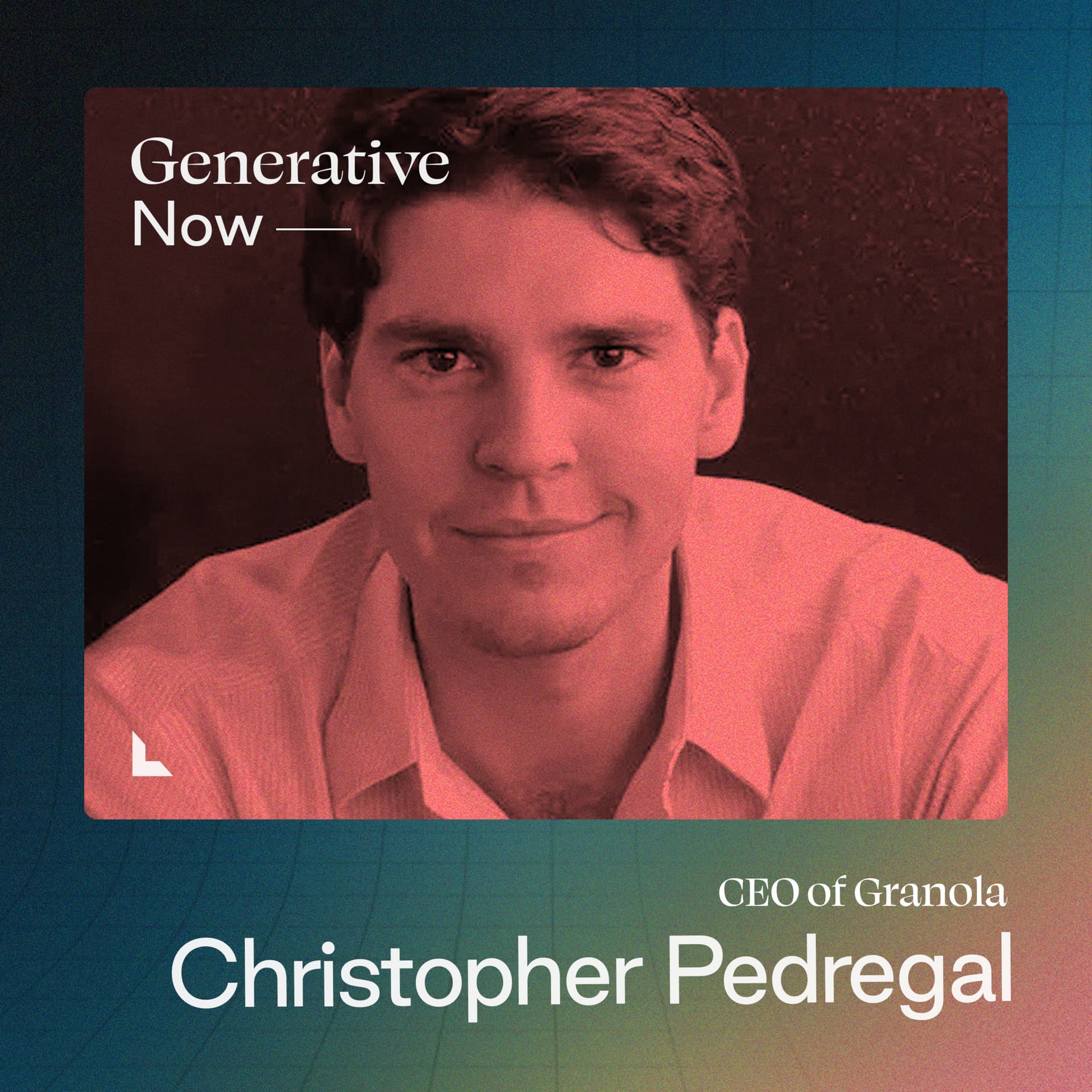
Chris Pedregal: Revolutionizing Meetings with AI
Episode Description In this episode, host Michael Mignano speaks with Chris Pedregal, CEO and co-founder of Granola, an AI-powered meeting assistant. They discuss the challenges of meetings, Granola's innovative features, user feedback, and the future potential of AI-human collaboration in the workspace.
---
Key Takeaways
- Granola Overview:
- AI-powered notepad designed to enhance meeting productivity.
- Integrates user notes with AI-generated insights.
- Focuses on augmenting, not replacing, human capabilities in note-taking.
- AI and Meetings:
- Meetings often consume a disproportionate amount of work time.
- AI tools can significantly improve the management of these meetings without losing control.
Episode Structure
- Introduction (00:00)
- Life in London - From Shoreditch to Street Art (00:39)
- Building Startups: London vs. New York (02:10)
- AI Talent Pool in London (03:53)
- Granola’s Product Design (05:03)
- Unique Approach of Granola’s AI Meeting Bots (11:33)
- Avoiding the Feature Trap (18:38)
- User-Centric Design in Granola (20:14)
- Accuracy in AI-Generated Notes (21:07)
- Collaborative AI Interfaces (23:43)
- Future Directions for Granola (26:23)
- Insights from User Behavior (31:43)
- Conclusion (37:20)
---
Detailed Insights
Building Startups in London vs. New York
- Cultural Differences:
- London has fewer consumer success stories compared to NYC, impacting the startup culture.
- The technical talent is strong, especially in AI, largely due to the presence of major tech companies.
Granola's Unique Design
- AI-Powered Notepad:
- Provides a text editor similar to Apple Notes with an additional AI component that enhances user notes post-meeting.
- Focuses on augmenting the user's note-taking capabilities by providing context-aware enhancements.
- User-Centric Approach:
- Prioritizes user feedback in the design process through prototypes and testing.
- Users maintain control over notes, allowing for personal insights to be integrated alongside AI-generated content.
Avoiding the Feature Trap
- Focus on Core Functionality:
- Granola avoids the temptation to add excessive features, concentrating instead on delivering high-quality note-taking.
- Recognizes that writing is a critical part of thinking, hence does not suggest complete automation.
AI Generated Notes and Collaboration
- Accuracy and Trust:
- Users can trace AI suggestions back to the source in the meeting transcript, enhancing trust in the AI's output.
- Distinction between user-generated notes and AI-generated notes is maintained for clarity.
Future Directions for Granola
- Beyond Meeting Notes:
- Granola is considering expanding its functionalities to include action items and task management, while still emphasizing user control.
- The development will center around helping users execute tasks discussed in meetings, reflecting real-world complexities.
---
Conclusion Chris Pedregal emphasizes the importance of maintaining a collaborative relationship between humans and AI in the workplace. Granola aims to enhance the user's cognitive ability rather than replace it, ensuring that AI serves as a supportive tool in navigating the complexities of modern work environments.
---
Stay Connected
For more insights and updates, follow Lightspeed on
- [Website](http://www.lsvp.com/)
- [Twitter](https://twitter.com/lightspeedvp)
- [LinkedIn](https://www.linkedin.com/company/lightspeed-venture-partners/)
- [Instagram](https://www.instagram.com/lightspeedventurepartners/)
Subscribe to Generative Now
[generativenow.co](http://generativenow.co/)
Written by AI. May contain mistakes. Listen to the episode to check what was said.
Transcript
Automatic transcript. May contain errors.0:04Hey, everyone, and welcome to Generative Now. I am Michael Mignano. I am a partner at Lightspeed And this week on the podcast, I speak with Chris Pedregal, the CEO and co-founder of Granola. Granola is an AI-powered notepad for meetings that works with you by combining your notes with AI-generated notes in order to provide you with insights, takeaways, and next steps. I speak with Chris about what makes Granola different, the AI startup scene in London, and how he sees the future of AI-driven products as human and AI collaborations. Take a listen. so i saw on your your twitter your ex rather uh that there's a new banksy in london that that i guess what is right right near the granola office a block away yeah it's one of the it's one of the perks that we our office is in shoreditch which is east london it's the uh yeah the most new yorky part of london it's like the creative side of things and uh yeah a new banksy popped up two days ago about a block from our office.
1:06So is that a thing? Like, does that happen? Is that a thing that happens in London? Like we're like famous street artists. They just, their work just happens to pop up all over. I guess it kind of happens in New York sometimes. It happens a lot in Shoreditch. Banksy kind of goes on, I think every couple of years, he goes on a rampage and drops a bunch of artwork. So it's definitely a thing. I actually didn't look closely at it. What was the, what was the piece? Swinging monkeys on a, on a overground bridge. Yeah. Some monkeys. It's a bunch of animals. He's putting animals all over the place. Why?
1:37Why animals? Is this a theme? Don't know. We don't know. Yeah. Shoreditch is really cool. I haven't spent a ton of time there. I hung out with you there once. And yeah, I know what you mean by it feels New York-esque. Yeah, I love it. It's a lot of the tech startups are over here. West London is, you know, beautiful. East London's a bit edgier. It's where all the chefs who want to experiment new stuff, They'll do all that new stuff that you're testing out and around with creative energy is usually happens on the east side. So it's got a nice vibe to it. What is it like building a startup in London versus building a startup in New York City?
2:17Your other startup, Socratic, you built that in New York. The whole journey was a New York team, not distributed, not remote. Now you're doing it in London. Same thing. What are the differences or what are the similarities? I would love to hear you just talk about it. There are fewer, let's say, consumer or kind of consumer-esque success stories out of the UK than there are in New York and obviously the US, right? And I think that kind of permeates. So a lot of the... There aren't a ton in New York either, right? That's true. The fintech, like the financial apps, the Monzos, the Wise, the Revoluts, they really kind of like set the bar in terms of consumer tech in London.
2:57So I think a lot of the culture is kind of defined by that. Um, there's amazing technical talent, incredible technical talent in London, specifically in AI. Um, there's less of a startup culture here. And I guess there's the startup culture difference. And then there's also just British culture is a little different, right? Our team's very cosmopolitan. Yeah. Um, but I'm conscious that I'm, I'm the American, you know, in, in the room. And I might talk about things a little bit more differently, a bit more loudly, a bit more directly than would be the norm in British culture. But it's also really, it has a little bit of that, in my opinion, the energy that New York had when I was building Socratic.
3:43Whereas there's a lot happening, but it's a little bit the underdog, if that makes sense. So there's a lot of camaraderie between the startups in London. So you mentioned there's a ton of technical talent. Where does that come from? I mean, in Silicon Valley, it obviously comes from decades of these generational companies being built and then people leaving them and starting new companies. In New York, it comes, I think, similarly from some of these incumbents which have had their roots in the city for many, many years. Where does it even come from in London, especially on the AI side? A lot of the big American tech companies, the first office they open is in London.
4:21right so you have the the googles the metas the um i mean stripe has an office here snap has an office here so it's like if you're going to open one office in europe it's usually london and you get talent from across all of the eu to come here um specifically ai there's like four places it's basically there are really good ai programs at oxford oxford cambridge ucl um and imperial and then DeepMind was started here, right? So DeepMind kind of became a center of gravity. Meta opened up an AI research division here. So basically it's kind of been a leader in AI before the recent waves of AI. I have so much I want to talk to you about with Granola.
5:05Obviously you and I talk often. I am, you know, full disclosure for the listeners. I'm very lucky to be an investor in Granola on behalf of Lightspeed. But I feel like something when we talk, we we talk very tactically, right? That's that's sort of the relationship between kind of like founder, board member, investor, like we're talking about the next project, the strategy, etc. I feel like we don't often have a chance to get sort of into the nitty gritty of like product design or how you made certain decisions about the product. And, you know, I think one of the things that I certainly feel about Granola, which I know many other people do as well, definitely many of your users, is that it is this perfect example of an AI application.
5:49Right. There's been so much talk and love and investment and capital poured into the foundation model layer. but there are a few examples of really, really high quality products. So things at the application layer of AI. And again, I'm biased, I'm an investor, but it feels like people, many, many people who are not investors in granola have commented on it being one of these great examples. And so that's where I think it would be great to spend some time today talking because I'm sure that you have lots of insights that you can share from the first couple of years of the company. I know what Granola is.
6:31I'm sure many of the listeners do as well, but for the benefit of those who don't, maybe just start with explaining the story of Granola and what it is. Yeah, absolutely. I'll start talking about what the product is and thanks for all the the kind of things you said, Mike. So Granola is an AI notepad for meetings. So it's specifically designed for people who have lots of back-to-back meetings. And it looks like Apple Notes. It's a simple text editor, and you can take whatever notes you want during a meeting. And the difference with Granola, what makes it so powerful, is that when you're in a meeting, it's also listening to what's being talked about.
7:14So it has the whole context of the discussion. And the moment the meeting ends, Granola will take whatever chicken scratch notes you've written and rewrite them to be really nice, high quality and understandable to other people. They still feel like your notes though. And it's in a text editor. So you can go in and you can edit and change. The whole idea is that it's augmenting your note taking ability as opposed to taking notes for you or on your behalf. that's the basic idea of granola well how did how did you get there i mean you know your your experience your history before granola wasn't rooted in well i guess you it was in many ways you've been working on sort of ai before it was cool with socratic but how do you go from building a product for students um and homework and and education to building this like you know llm powered super notes.
8:09In March 2022, I, is that right? Yeah. March 2022, I played with, it was the Instruct version of GPT-3, right? And within a week, I was just, it blew my mind. I was like, this is, this changes things. I think we have all had that moment at different times, at different moments. Maybe it was when ChatGPT came out, but for me, it was Instruct Update to GPT-3. I was like, this is going to change the tools we use for work. This is going to change how we interface with computers. That was really clear to me. I didn't know how, but I wanted to work on it. And in short order, I quit my job and started building prototypes and playing around with it.
8:55LLMs are extremely good at manipulating information, right? That's like one of their superpowers and taking information that's in one format and translating it into a different format. And that different format might be useful for different needs. Like in our example, it can take 30 pages of transcript, which is impossible to read. I don't know if you've ever, well, you probably have because of granola. But if you try to read a transcript from a meeting, it's like gobbledygook, right? And LLMs are extremely good at being able to take all of that and turn it into different artifacts that might be useful from that meeting.
9:29Anyway, so it became clear to me that LMS can have the superpower for manipulating information. I really wanted to work on tools that help us think better, like tools for thinking, right? Because that is like, in essence, what language is, what notes are. And I teamed up with my co-founder, Sam, because he was in this world also thinking about how can we build tools that help us think better. and when we started interviewing users real people we realized like the main place where people take notes and they generally take terrible notes are in meetings but like that is the killer application of this so if you could build a tool that would elevate the information or your thinking during meeting but also free up you know your cognitive cycles to be a better version of yourself in that meeting, it's a double win, right?
10:19Because you can perform better in the meeting. You can be smarter, pay more attention, but also have the higher quality notes and outcomes. So once that became, when it became clear that that was a really big opportunity, because there's so many AI meeting bots that had already launched at this point, right? So we kind of entered the space begrudgingly, but we kind of got at it from our first principles of like, how could LLM technology be most useful to people? Like what is a great application for it? And we entered it. And then we just spent a tremendous amount of time building prototypes, putting it in front of people, figuring out what works and what doesn't work.
10:56I think the fundamental question in Granola was, so you have a text editor, right? And you have all the context that Granola is aware of from the transcript or from the calendar events or from bios of the people who are in the meeting. So there's all this context that the AI knows about. How do you let the user make use of that or interface with all that context without being overwhelming and distracting or pulling you in directions you want to go? So that was a lot of trial and error and testing and experimenting and iterating. It does feel, and you mentioned, it does feel like there are lots of other products that are doing this.
11:37There are these meeting bots. There are these things that sit in the Zoom meeting. I think Zoom themselves is doing this. I think Google meet. There are a lot of these things. You don't really hear people talk about loving these products. And it does seem like there's been kind of this outpouring of love for granola. So what is it about granola that you're doing differently that is sort of leading to that user love? Is it just the fact now that you also have the scratch pad that pulls in context? Like that doesn't seem like that big of a difference. So where is the difference? Or maybe that is it.
12:10I don't know. On the surface, Granola and an AI meeting bot, they look very similar, right? They help you generate notes from a meeting. I think the moment you zoom in a little bit, you realize there are different categories of products, right? So I think what an AI meeting bot is trying to do, I think the premise is actually pretty flawed in my opinion, is you're going to say like, hey, I don't want to take notes. I don't want to have any control over the notes, right? This bot, this other entity is going to join this meeting and they're going to take perfect notes and the same notes will work for everybody.
12:44And now I don't take notes anymore. I've outsourced that to this AI entity and that's going to be great. And I think the position we took with Granola is one that was completely different. We don't want to take away note taking from you. right we want to augment your abilities so i think like a good metaphor here would be uh let's say you're used to riding a bike right and you know how to ride a bike and you know how to you're really good at bike riding you've been doing it your whole you know whole career uh and then all of a sudden granola comes along and it's like a it's like an e-bike right so now you you pedal once and all of a sudden boom like the bike goes right so you still have total control but you can get you can you can do whatever you want you can just do it with way less effort way faster.
13:35And I think if you come at it from that place where it's like, how do we augment what you can do so you can be the best version of yourself in a meeting or in the notes that you're trying to capture, you end up with a very different product. Something that's like really important to call out is that writing is a big part of the act of thinking. Like you talk to a lot of people and they're like, no, no, I write notes in large parts so that I'm processing information and so I'm smarter. And that's like a really important part of the process. You take that away from people. Like they might not be thinking in the same level that they'd want to be.
14:08What we want to do with Granola is we want, there's a very big separation between work that's just busy work and that work that requires judgment. Right? And I think this is like a, not just a question for Granola, but for all AI products where you want to automate as much of the busy work as possible. But you want to keep the judgment, like you want the human in the driver's seat, everything that's like nuance and judgment, because that's why you're in the meeting. right? You're there, right? So it's very easy to be like, oh, okay, now an LLM can write this thing for me. So we're just going to have it write this thing for me.
14:43There's the real danger of throwing the baby with the bathwater out, right? Which is like, you want to automate the busy work. You outsource your thinking to a bot. I don't think that's a future any of us want to live in, right? You want the thinking to be done by humans and you want AI to elevate or augment our abilities. Yeah. So it sounds like what you're saying is it's actually very, very important for the human being, the user in this case, to feel like they're in control. And even though that the bot is maybe now doing, I don't know, 50 % of the work, maybe even 75 % of the work, the human being does feel like they have agency to either drive the quality of the notes or change them or augment them in some way.
15:21And in fact, if we were to go all the way to 100%, well, now we're not even really thinking, right? We're just kind of, we're pointing the bot in a direction and just having it do all of our work, which kind of defeats the whole purpose of why we even have our job in the first place. I think that's exactly right. And I think an example is sometimes the most interesting notes from a meeting are not things that were ever said out loud. They're thoughts that you have. If you think about a hiring interview, oftentimes the most interesting notes are like, oh, I noticed this behavior. I'm going to write that down.
15:57There's no way a bot can read your thoughts. Maybe one day with Neuralink or something like that, they'll be able to. But for now, that high quality stuff needs to somehow still get into your notes. Sorry, did you mention that the bot also has context of other elements? Like it looks up bios of the participants and talk a little bit about that. What other signals do you grab to increase the quality of the notes? We found that the best way to think about LLMs is to think of them as a human, right? And you have to think like how, what context or what instructions would I have to give a human for a human to do a really good job at this?
16:33So in a meeting, if you just say, hey, there are five people in this meeting and they're talking about something versus saying, here are the people in the meeting. Like a good example might be like, here's a founder that is pitching an investor, right? On like trying to get an investment for their deal. That context really matters in terms of what are the quality of the notes and what you want to focus on. So Granola does, I'm not going to tell you all the different contexts we do, but we're tied into your calendar, right? So you can think of who's in the meeting, what are their bios, what type of jobs they have.
17:07Yeah, that's super interesting. I actually didn't know that about Granola. Another thing we do is, just so you're aware, is depending on your job, you have different types of meetings. and we're pretty opinionated about, okay, what would good notes for this type of meeting be? Or if the, for example, like if you're an investor and you're meeting with another investor versus a founder, whether that investor is a colleague, right. Or someone you're just gossiping about deals or like an LP, like those are very different meetings as well. Um, and Granola has an opinion of what, what's important in each of those.
17:42Yeah. That's super interesting. So it sounds like what you're saying is kind of taste and opinion is really, those things are really important. It's not about just like building the rails and handing it over to the user. It's about guiding the LLM in like a very opinionated way. And by opinionated, I mean the opinions of, I guess, you and your team. LLMs are really interesting because they're very good at a very wide range of things, right? Which means that you can build a decent or okay feature experience for an extremely wide range of things. I think what separates your ability to build something that's like okay or so-so to something that's really fantastic requires you to be very specific about, hey, what's the problem or the user flow that we're trying to solve for?
18:33And then be very opinionated on how to do the best job on that user flow. There's this trap, and I think there's this trap that we definitely fell into or flirted with before launch, and then we ended up cutting half of the app that we had built, where it's very easy to build features. It's very easy to build features that are like 60, 70 % of the way there, because with prompts, it's extremely, extremely easy to do that. And because it's so easy or so tempting, you're like, oh, it's silly that granola can't do X or can't do why, right? Like, it's silly. Like right now, we don't consolidate all your action items automatically for you in Grinnell, right?
19:11That seems like a no-breaker. But, and we had that, and we cut it before launch. And we cut it before launch because it worked okay most of the time, but sometimes it totally failed. And like action items are really important. And we can't, you have to get that right. And you have to design that in the right way. And you can't design and build everything from the get-go at a high standard. So you have to be very opinionated about what you what you prioritize. So, so it sounds like, you know, what I'm hearing from you is like constraints are really, really important. You know, you could build a million different things.
19:42LLMs, as you've noted, like they make it easy to build stuff. But you got to resist that temptation and you got to stay focused and you got to stay really, you know, laser, laser focused on, on the most important thing. And I guess in this case, it's, it's the notes, it's the notes, right? Is that, is that, is that a way you think about it? In a world where everything's possible, right you decide what's important by the constraints you place on yourself and and the users right so there's a constraint in terms of you know we're going to focus on this user flow or this experience and make that great there's also a bunch of opinions in granola but you talked about user love and i think a lot of what what resonates with people in granola is that we make a lot of decisions on your behalf based on what we think is important so we don't give you too many choices.
20:27We don't let you do a million different things. We do let you edit text, right? But we really try to reduce the number of decisions you have to make as a user because you're trying to rush to this meeting, right? The mental model we have is like, you are three minutes late to an important call, right? I don't really want to think about my software. I just want it to work and I want it to be there and support me when I need it, but don't make me think. So we, granola is not the best product for everything, right? But it's, it's really optimized for people who need to jump into a meeting and capture the important stuff and make sure that their thinking is all there and, and to leave with, with great notes.
21:07Maybe on the topic of great notes, I'd love to, love to pull on that a little bit. You know, one of the things that strikes me about meeting notes and LLMs is that the stakes are really high, right? If you're outsourcing a lot of your work to a bot, you want to make sure it's great. But LLMs, as we all know, are not yet imperfect. They hallucinate, they get things wrong, just like humans. How do you manage that? I kind of feel like if the notes were to get something wrong, I would have a hard time trusting Granola. So how do you make sure they don't get things wrong when we know they do all the time.
21:45The most important thing here is that the relationship with the LLM is one of collaboration, right? Going back to the meeting bots, they just give you the notes and they're like, here are the notes, right? Take them or leave them. You had no say on what was important or not, which is like a very different world. I wouldn't trust a lot of people to take notes for me, let alone an AI bot. So the fact that it's an editor is really important. But there are a bunch of principles that we kind of came across, I guess, through experimentation that matter. So the first is, if you see a note that Granola writes, you should be able to see where it came from in the transcript, right?
22:28So that's like this idea of being able to view source or view provenance is super important. I guess the high level idea here is LLMs, like you said, will get things wrong. or will hallucinate, or will do things that are maybe not exactly what you want. So you have to design for that. And the ability to kind of view the source or view the provenance helps a lot. So in Granola, if there's a note, there's a little like a magnifying glass that you can hit, and then it'll show you where in the transcripts, sometimes it's multiple places in the transcript that it pulled together to make a point. So you can kind of see the original source and be like, if you agree with that note.
23:04The other one is we try to make it clear to you what notes came from you and what notes came from the AI, from Granola. So notes, because like I said, it's a text editor, you can write notes and then Granola will enhance them or add other notes. Your notes show up in black and the AI written notes show up in gray. So at a glance, you can kind of quickly see like where did this come from? And is this something that I, you know, So it's like, what I want to double check, just having an understanding of like what came from your brain versus what came from, from the system is I think super important.
23:39So speaking of that and like where the notes are coming from, was it the human or the LLM? I feel like one thing that I hear talk about often in product discussions about AI right now is sort of figuring out like what the right interface is for engaging with LLMs, right? Like obviously, you know, a chat makes a lot of sense. you know you're chatting with this agent but at the same time chatting is a pretty like primitive interface for things and in many ways it's very it's it's very efficient for some things like fast communication it may be very inefficient for getting tasks done how are how are you and the granola team thinking about designing uh the interface of interacting with an llm as an industry or like it's very early days, right?
24:28And I think we have like the first UIs, people often talk about the metaphor of like the chat UIs a little bit like the terminal was, you know, in the early days of computing. I think the interesting question is how, what are the UIs where you and the AI are collaborating on the same thing as opposed to working side by side on different things? And I think that's an unsolved problem. And I think that will be different depending on your medium, right? If you're working on an image or text or a video or what have you. I think if you like chat is great because it's universal. You can use it to ask all kinds of questions.
25:13God, does it feel weird sometimes? So let's say I'm asking ChatGPT to help me write some text. it feels so weird that I have to then like write another instruction to make a small change in it as opposed to I can't go and edit what chat GPT wrote right this it feels a little bit like I'm trying to make a sculpture or like a like I'm doing pottery or something like that and there's like the AI next to me building it's doing its own pot and like like we're working on two things next to each other as opposed to both of us working on the same pot or being like oh can you can you change this on here?
25:43And I think that's a lot that needs to be figured out. For Granola, we're just the early days there. The idea that there's one editor, you write text, then the AI takes that, enhances it, but you can still see what came from you and what came from the AI. And I think we're starting to discover some things that seem to click. I think this idea of black text and gray text, which I think was pioneered by IA Writer, and those guys are great. That seemed to be one of those paradigms that might stick around because it's a it's like a simple way of like quickly seeing provenance but i think we have i don't know five six seven more kind of discoveries like that that are going to come along and become become ubiquitous so in this conversation we've talked a lot about kind of focus and really focusing on the use case and and just nailing that um and i think that makes a lot of sense how do you think about kind of the future and where granola can go So like, do you just want to focus on meeting notes or, you know, are there tangential use cases?
26:43And how do you even think about tackling those when it is so important to stay laser focused on the task at hand? It's a balancing act. I think they're right. If you look at this in terms of features, it becomes a really hard decision to make because there are so many features that our users ask us for that we want to build. and we know they'd be useful and some of them would be really awesome. So it's like, how do you decide this or this or this or this? I think if you zoom out and look at it from a jobs to be done perspective or a user journey perspective, it becomes a little bit easier, right?
Read the full transcript
27:21So it's like, do we stop? Great question for Granola. Do we stop at meeting notes? No. Meeting notes are a stepping point on the path to what you're actually trying to do. And that's actually get the work done, right? Like, why are you meeting with someone, right? What have you learned? What decisions have been made? What work do you have to do after that? There are lots of dots along this path of you doing the work you need to do. And Granola is there to help with that. So I think if you look at that, what Granola has is a lot of context, right? In a 30-minute meeting, you talk about a lot of stuff.
28:01If we have a series of meetings between two people, we have a lot of context on the trajectory that you're on and what you're trying to do. I think a natural extension of where we're going is actually try to help you do some of those things that you talked about in the meeting that end up on your to-do list. Now, again, I think we're going to, when we approach that, we'll take a very granola-esque approach, which is we're not going to try to do everything for you automatically, right? We'll try to get you like do 50 % of it, 70 % of it for you maybe, and let you take it to the end and make sure you're in control.
28:37And we're also, there's a lot of nuance in, in action items and basically any kind of real work. So we're going to have to design it in a way where you still have total control, right? And you feel like it's your work that you're doing or just speeding it up and, and elevating it. The first thing that comes to mind for me is, is action items. And maybe it's because you mentioned earlier in the conversation that that was something you had to cut early on. I guess, like, how do you even go about executing those action items? Do you have to adopt some, you know, some new form of agentic model that can go and kind of do other things and other tasks besides sort of summarization and language?
29:14How do you think about that? This is a recurring theme. So I don't actually think that the hard stuff here is on the technical side. I think the hard stuff here is a lot around the nuance of human interaction and just the complexity of the world and work that needs to be done. So a good example here is oftentimes in meetings, people talk about a lot of things that maybe they should do. There's a very big difference between the stuff you talk about that should be done or maybe you suggest that you're going to do and the stuff that you actually think is important and that you're actually going to do.
29:53And that, once you start looking, it's like very easy to ask an LLM to spit out what are the action items from a meeting, right? We've all done this, right? Getting the right action items or maybe the unspoken action items and getting the action items that you trust, that's a world harder than that. This is like the classic Twitter demo issue with LLMs, right? Like, oh, it's like, oh, Bernola spits out action items. We could do that tomorrow, right? And it would look really cool, right? And I'd be like, oh, now that problem is solved. It's not solved, right? Because what you really want is you want a list of action items that are the ones that you care about and you want it to help you do that.
30:32And that's really a human and psychological and like nuanced kind of problem. In terms of actually helping execute, that one's interesting. I'm like, we haven't built it yet, but I'm optimistic because the majority of action items out of a meeting fall under maybe seven or eight canonical actions. Oh, interesting. Yeah. It's like, it's, it's schedule a follow-up meeting, send a message to this other person, right? Send a follow-up email, um, ask for an intro. Like basically you could, you can see a world where it's like, if granola was really good at helping you schedule, like find like scheduling, let's say, right.
31:09Really good at like recapping a meeting in an email, in a specific format that you care about and sending it to the person you met with. Really good at kickstarting some other workflow, right? Like maybe you now have a client, so you need to update the CRM and put them in the right place. Those are all things that seem, those actions seem quite doable because they're discreet. We're not going to do the hard thinking. It's like, okay, come up with the strategy for X. There are a lot of tasks that are like that, but usually that ends up in a to-do list, right? So then you can go do it. You mentioned that there are however many, seven or eight different types of action items.
31:49It makes me realize you probably get a lot of insights about meetings in general, just by people using the product so much. I mean, in aggregate, not in a micro individual meeting level. Like you just said, oh, there are seven to eight different types of actions. What else have you learned about meetings? I don't know, that either influence the product or influence kind of the roadmap in the future. That must be really, really fascinating. Something that's super interesting that Granola doesn't do a great job at yet, but will, is oftentimes you think of writing notes during a meeting as just, okay, I'm taking notes so that later I have this record of what was talked about or what decisions were made.
32:28People use it during the meeting to do real-time thinking and organization a lot. So oftentimes people might have, before a meeting, they might write down some questions they want to ask. They might put in an agenda. again for themselves. But then during a meeting, they'll do a lot of thinking, organizing. It's like, oh, they said this thing and I want to ask a follow-up question, but I don't want to interrupt them now. And that's a very different type of note than what you would expect. So there's a lot of building we want to do there. Other thing that's really cool, not many people know this, but you can create templates in Granola.
33:03It's a bit of a beta feature right now. and people have come up with really interesting templates for meetings. Because when we first thought about templates, it'd be like, oh, again, you're an investor, you're a VC, Mike, so all the examples I'm coming up with are kind of putting myself in your shoes. But let's say you're talking to a startup for the first time. You might want your notes as in like, okay, team, product, problem, like traction, things like that. What are the questions I didn't ask that I should have best, right? Or what are like the best quotes, like specific quotes about user problems or something like that?
33:39And it's like a dip, you get like a lens or a filter on the meeting that's very different than just like an information organization. It almost makes me think like the way that people are using granola can sort of dynamically over time inform kind of decisions you make in the product or maybe like one specific example, like you can imagine that template for the founder in the BC kind of like dynamically evolving over time based on how people are using granola in real time, if that makes sense. Yeah, absolutely. Interesting insights about meetings around like length or I don't know, cadence of, of speaker or like even speech, like, and, and dialogue.
34:23Have you noticed in anything interesting about how people speak to one another, two things stick out. One is in the era of Zoom, people have no time between meetings. It's kind of nuts, right? So if you look, and I didn't realize this, but I think it's become really widespread since COVID, where people who do Zoom meetings, they tend to do a lot of Zoom meetings, and they're oftentimes back to back. And what that means is that you have no time between meetings to process any of the stuff that you've talked about. So people's workflows today are oftentimes back-to-back meeting, back-to-back meeting, back-to-back meeting.
35:03And every meeting you have is like you open up all these threads that you don't have a chance to resolve or to do anything with. And then at some point at the end of the day, you have to go back and deal with that stuff. I was surprised to the extent of how back-to-back people are. The other thing is that, again, with everything in life, it's like so much more nuanced and complex than you think when you first look at it. There are all kinds of meetings and with very different goals. So for example, how much people write in a meeting in Granola is extremely variable, right? There can be tons of meetings where users will write nothing.
35:38And then all of a sudden there's this high stakes meeting where they'll write like five pages of notes and all of that. And that's like the same person.
35:49So you would expect at first glance? I actually would expect that it was very consistent throughout. Yeah, maybe you have these outliers, you have these people that maybe write a ton. Once in a while, you get somebody that writes a ton of notes. For the most part, everyone is using sort of the same general template. I guess actually, as Granola gets adopted more and more, and people adopt the templates more and more, you probably can expect to see more and more consistency through how people are taking notes. You design Granola for this. It's optimized for meetings, but it's a generic tool to help you think.
36:19And the thinking you need to do in different meetings or different situations is very different. So an example might be like, okay, when we first started off, maybe again, for the VC case, it's like, okay, we're going to do a really good job for an investor meeting with a startup for the first time. You can nail the constraints there and try to do a good job there. And then we realized with those beta users that they went off and they'd use granola for one-on-ones. They'd go off and use granola for meetings with their doctors. Basically, there's a wide array of moments where you are talking to people and there's important information that you either need to process or remember or deal with in the moment.
36:58One of the things that was very important to us when we designed granola is that it should almost be like a physical object, like a notepad that you can just grab and write stuff on. It should always be there and should always just work. So granola doesn't work as well, but it does work for an in-person meeting. right? Like if you're sitting with someone, you can just open up your Nola and use it as you would like a, like a notepad. It doesn't have to be on a, on a zoom call for example. Well, it's a, it's an amazing product. Again, I am biased, but, um, it's, it's, I'm a DAU. It's part of my daily habit.
37:27I'm guessing it's, it's becoming part of many people's daily habits and, uh, really, really cool to hear some of the secrets behind the design and the UX and how you're just thinking about building it. Uh, thank you so much, Chris. Looking forward to doing this again some time. Thank you so much, Mike. Thank you so much for listening to Generative Now. If you liked what you heard, please rate and review the podcast on Spotify and Apple Podcasts. That really does help. And if you want to learn more, follow Lightspeed at LightspeedVP on YouTube, X, or LinkedIn. Generative Now is produced by Lightspeed in partnership with Pod People.
38:04I am Michael Magnano, and we will be back with another fascinating conversation. See you then.
From the publisher
For many of us, meetings take up a disproportionate amount of our time at work. But with the advent of AI-powered tools, meetings may become more manageable and even productive, all without the sacrifice of control.
This week on Generative Now, Lightspeed Partner and host Michael Mignano speaks with Chris Pedregal, CEO and co-founder of Granola, an AI-powered notepad and meeting assistant. Chris discusses the unique features that set Granola apart from other AI meeting bots, as well as the challenges of building AI-driven products. Michael also talks with Chris about Granola’s development, user feedback, and the importance of AI-human collaboration. Chris shares his insights about the nuances of effective note-taking, and the future potential of augmented thinking tools.
Chris Pedregal is the co-founder and CEO of Granola, an AI-powered meetings tool designed to to change the way we work, with tools that understand us, anticipate our actions, and augment our abilities. In May 2023 they raised a $4.25m Seed round from Lightspeed Venture Partners, betaworks and FirstMinute. He is based in London. Prior to Granola, Chris studied Computer Science at Stanford before joining Google as a Product Manager, where he worked on Gmail, Search and Maps. In 2013 he quit to launch Socratic, an AI-powered tutor for high school students, which was acquired by Google in 2018.
Episode Chapters
(00:00) Introduction
(00:39) Life in London - from Shoreditch to Street Art
(02:10) Building Startups in London vs. New York
(03:53) The AI Talent Pool in London
(05:03) Deep Dive into Granola's Product Design
(11:33) Granola's Unique Approach to AI Meeting Bots
(18:38) Avoiding the Feature Trap
(20:14) User-Centric Design in Granola
(21:07) Ensuring Accuracy in AI-Generated Notes
(23:43) Collaborative AI Interfaces
(26:23) Future Directions for Granola
(31:43) Insights from User Behavior
(37:20) Conclusion and Final Thoughts
Stay in touch:
LinkedIn: https://www.linkedin.com/company/lightspeed-venture-partners/
Instagram: https://www.instagram.com/lightspeedventurepartners/
Subscribe on your favorite podcast app: generativenow.co
Email: generativenow@lsvp.com
The content here does not constitute tax, legal, business or investment advice or an offer to provide such advice, should not be construed as advocating the purchase or sale of any security or investment or a recommendation of any company, and is not an offer, or solicitation of an offer, for the purchase or sale of any security or investment product. For more details please see lsvp.com/legal.


