
In short
Podcast Notes: Generative Now | Episode with Gaurav Misra
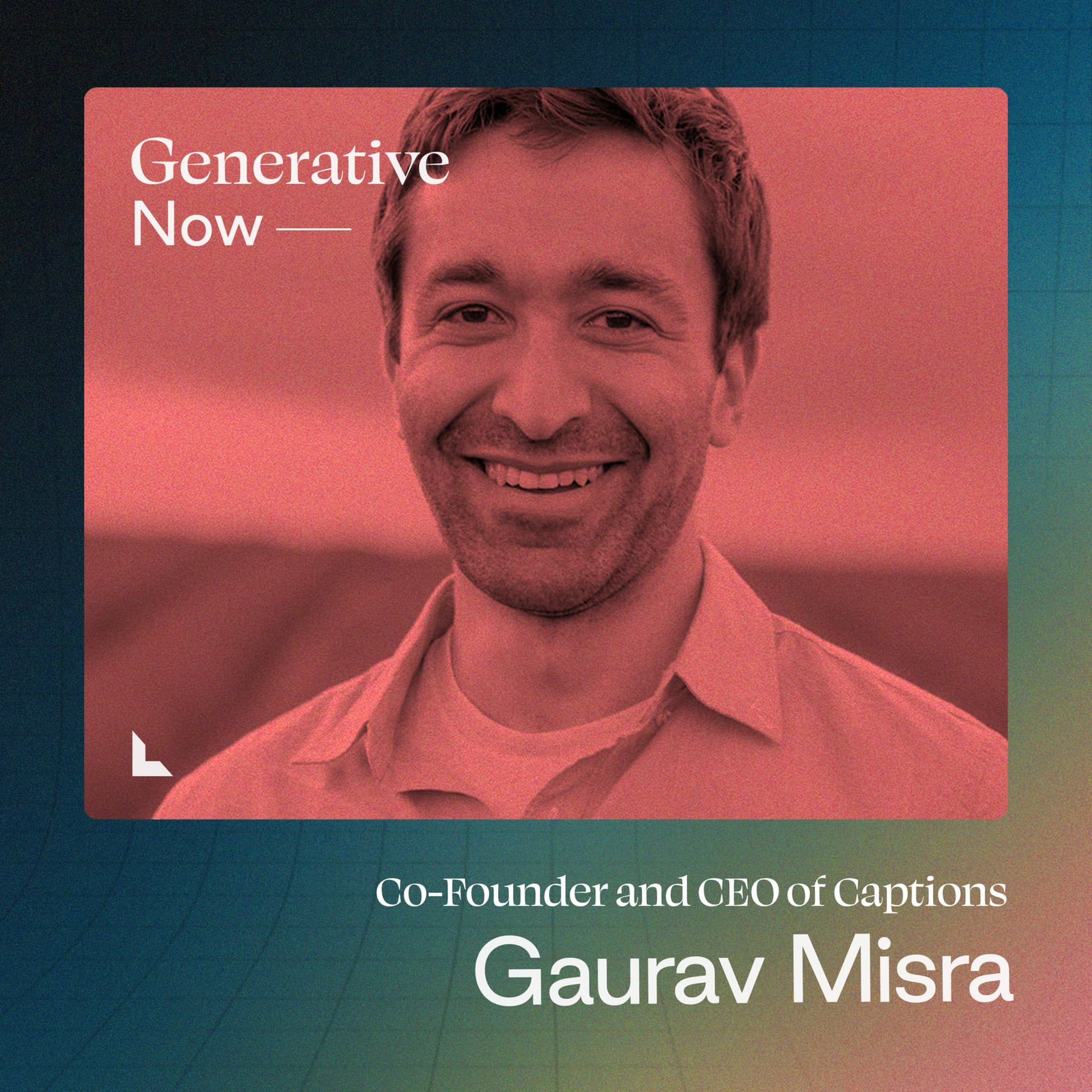
Episode Overview Title: Gaurav Misra: Building an AI-Powered Creative Studio (Encore) Description: In this episode, Michael Mignano interviews Gaurav Misra, co-founder and CEO of Captions.AI, a company revolutionizing video creation with features like AI-corrected eye contact and automatic captions in 28 languages. Gaurav shares his journey from being a design engineer at Snap to leading an innovative AI company.
Episode Chapters
- (00:00) Introduction to Gaurav Misra
- (06:03) Early Start in Startups
- (09:24) Pursuing a PhD in Machine Learning
- (12:04) Career Path: Lattice Engines to Microsoft to Localytics
- (17:26) Joining Snapchat's Elite Engineering Team
- (30:47) Founding Captions.AI
- (33:48) Transformation from Social Network to AI Tool
- (50:00) Building a Text-Based Video Editor
- (58:25) Launching AI-Powered LipDub
- (01:04:14) Future of Video Editing
- (01:06:52) Captions.AI Hiring
Key Insights
Background of Gaurav Misra
- Gaurav grew up in India and moved to the U.S. for college at Boston University.
- His early exposure to computer science and diverse extracurricular activities shaped his skill set.
- He had significant experiences at companies like Microsoft and Snap, where he contributed to innovative features and learned about keeping innovation alive in large organizations.
Journey to Captions.AI
- Gaurav co-founded Captions.AI to address the changing landscape of video creation, especially with the rise of platforms like TikTok.
- Initially envisioned as a social network, the idea pivoted to focus on tools for video creation, particularly talking videos.
- The company’s early success came from a simple app that provided automatic captions, achieving significant user traction overnight.
Captions.AI Features
- AI-Corrected Eye Contact: Enhances videos by allowing creators to maintain eye contact with the audience while reading scripts.
- Text-Based Video Editing: Revolutionizes video editing by allowing users to edit videos based on word text rather than traditional timeline-based editing.
- LipDub Technology: A feature that allows users to dub videos into different languages while making it appear as if they are speaking the new language.
Interactions with AI
- Gaurav emphasized the transformative potential of AI tools in video editing and creation, particularly how they can simplify processes for creators.
- He highlighted the use of large language models, such as GPT-4, for nuanced translations, significantly enhancing the quality of multilingual content.
Future of Video Editing
- Gaurav predicts that video editing will continue to evolve with advancements in AI, possibly incorporating text-to-video capabilities and allowing for extensive modifications post-recording.
- The focus will remain on simplifying the user experience, enabling creators to focus on content rather than technical challenges.
Conclusion The conversation with Gaurav Misra provides insightful perspectives on the intersection of AI and creativity in video production. Captions.AI exemplifies how innovative technologies can empower creators to express themselves more effectively and expand their reach globally.
Call to Action
- Hiring: Captions.AI is looking for talent in various roles, including marketing, engineering, and design. Interested candidates can visit [Captions.AI](https://captions.ai) for more information.
- Follow Generative Now: Stay updated on the latest in AI and creative technologies by following the podcast on your favorite channels.
---
For more detailed conversations and insights, tune in to [Generative Now](http://generativenow.co) and follow on social media platforms.
Written by AI. May contain mistakes. Listen to the episode to check what was said.
Transcript
Automatic transcript. May contain errors.0:28Hey, everyone, and welcome to Generative Now. listen this conversation with Gaurav Misra. Hey, Gaurav. Hey, how's it going? Good. We did it. We finally made it happen. Finally made it happen. I'm excited. I know. Me too. Thanks for doing this. Of course. Yeah. Anytime. So captions, obviously, you know, an amazing success story. We're going to get into it. I want to hear all about it. But I always like to start these things by sort of going back to the beginning, I think, I feel like the company is in many ways about the founders. And so to understand the company, we need to understand you. So take us back early days, Gaurav, you know, give us, give us your life story.
1:10Yeah. I mean, where do you even begin? So all the way, all the way back. Yeah. So yeah, I mean, so I was born in, I was born in Boston actually. And when I was three, we moved back to India where we were originally. And so I grew up in India for the most part. Went to like, you know, school there, middle school, high school, all that good stuff. Where in India? In New Delhi, in New Delhi. Okay. Which, you know, it's a, it's a whole place. There's so many people. Yeah, it's amazing. But for college, I, it was just always known or sort of like a plan of like, oh, I got to come back for college. And so, yeah, Yeah, right when that came around, started applying to a bunch of places.
1:55I think I applied to like, you know, 20 places, which apparently nobody does. Like most people just pick like three or four or something. I had no context, right? I had never seen, you know, what I went to Boston University. Like I had no idea what Boston University looks like, right? Or for any other university for that matter, right? Or like how they even compared to each other, what's better or worse? And what do you study at different places? Like I had no idea. And so I was kind of like blind coming in. never even toured the campus right um but my parents were like you know boston's really good so you go to boston yeah and you never you never went back you never visited no never yeah got it so basically it was brand new you know it was just like wait i've yeah i have no idea what i'm getting into and my parents just like came here they just dropped me off and they're like see ya Wow.
2:47I mean, that must have been really, really hard. Maybe going back a little bit, what were you into growing up in India? What were your interests? What did you do to keep busy? A lot of different things. My parents were very much believers in these extracurricular activities, as they call them. And they were like, oh, you have to learn as many things as possible. So So I was essentially enrolled in like almost every class and anything that you can possibly learn, every sport, every musical instrument, like just as many things as you can possibly learn. My parents were just like wildly spending on all this stuff.
3:24It's like having me learn as many things as possible. So that actually, I think kind of helped me quite a bit because I think there's a skill to be able to learn something. Like being able to learn something is a skill in itself. and it's something that you can actually practice. And if you do more and more of it, you get good at it and you can pick up things really quickly. I did like language classes. I did all kinds of stuff, right? So it was, yeah, quite interesting. But I definitely had like a special place for just computer science, you know, because in India, the education system is a bit different and like you actually learn computer science like part of the curriculum from way the beginning, right?
4:05Literally from the first grade, I think, right? And so by the time you get to like fifth grade, you're doing programming. So they start you off with like visual basic, which is what used to be back then. An interesting language to learn. I did some basic back then. Yeah. Yeah. It was the cool, it was the cool thing when you and I were young. It was a cool thing. And it is like a little bit further back in technology too. So like a lot of like, we had like DOS computers, right? Like, and we would like, when we would make like graphics programs and stuff, they would be written, right, like, on the, there was no GPU, it was just written on the VGA controller or whatever was there at that point, right?
4:43And so it felt like, you know, probably growing up, like, I mean, we had, like, dot matrix printers and, like, yeah, some weird stuff, some old technology. But, yeah, so I was always very interested in that stuff. And I always was like, you know, spending extra time just learning programming, learning like, you know, how to do all these different things that weren't taught in class and stuff. So it was like a special area for me and something that I always like really cared about. And so by the time you get to college, it sounds like you know how to program your programming. Did you major in computer science?
5:19I did. Yeah. Got it. So you already knew you already knew how to do it. Totally. I mean, yeah. In like 11th grade, we do C++. Right. And so we'd already covered essentially all the stuff that you usually do in college back in high school. So you come out of BU, and I think you had a couple engineering jobs out of school. Is that right? Yep, that's right. Tell us about that. Yeah. So out of BU, when I graduated, I got an offer from... So I had interned at Microsoft. And there was a Microsoft Research Development Center in Boston. I think there still is. It's still there. and um so i had interned there and they kind of gave me an offer and they gave me an offer for like a software engineer in test what does that what does that mean so i think the role was basically essentially you were supposed to test software and write automation that tested software and i didn't take that role just because and i think it probably was the right move because they were offering like very high salaries for these roles because I think once you kind of get into that path it's very difficult to escape it and they were trying to get talented people into this role but Microsoft actually completely eliminated that role at some point I think maybe a few years down the line just completely yeah and so people had to like either switch and there were also layoffs and stuff so it was a probably the wrong path to have gone down but But I ended up taking a job at a startup for a very low salary.
6:58And honestly, I learned so much over there because that was my first actual application of machine learning in real life. So I actually got to work on the actual matrix multiplication happening when computing in inference. right uh which and doing that like in a scalable way uh because the libraries and stuff didn't really exist at that time so a lot of people would just do manually like they would just write the code for it um so that was exciting what was the startup it was called lattice engines it was like a boston startup okay and they were doing like sales and marketing like lead scoring basically which was like all the hype at that time got it okay so you're so you're there you're doing that um what was that experience like i mean what ended up happening at the company uh yeah learn i mean the experience was definitely interesting in many ways because you know i met a lot of people uh in at that company a lot of great very talented people that actually kind of kept in touch with afterwards and then also had joined me in future jobs and like pulled them into kind of where i'm working in the future but um the company didn't do too well i believe i think it did did well for what it was but it didn't have like some spectacular exit or anything like that um and yeah i think why that might have been it's tough to say i was probably too junior to be able to figure it out at that point as to what was going on like my scope and vision and sort of like what I could see was very limited but yeah I did enjoy the stuff that I did and you know yeah and to sort of like complete the story a little bit more like after I graduated from college I was doing a PhD oh wow for like a good yeah it was like a little less than a year um but I started doing that PhD in machine learning and I was kind of disillusioned with it a little bit because the academia that just the academic side seemed just a little bit slower than I wanted it to be and a little bit more incremental than I wanted it to be.
9:11And so that's why jumping to like a startup where everything is fast paced and we're just like making stuff and, and getting things out there was like actually like super exciting, you know, in comparison. Yeah, I'm sure. So wait, what, what year was that? And I mean, I guess I have so many questions about this ML PhD, like curious to know, like how different what you were studying and learning back then is from what, you know, what you're seeing today. Obviously we're going through sort of like an explosion of AI and machine learning. Like talk to us a little bit about those differences. Totally.
9:41I mean, it was a totally different time, right? I think, you know, this is a time when TensorFlow didn't exist, right? And just explain that for the listeners. Yeah. So it's like a library that, you know, a lot of people use for their machine learning training and inference and all kinds of things. It's something that's made by Google, right? And this was, you know, before that. And, you know, it was just around the time where deep learning was, you know, catching on and people knew there was something there. And there were some really promising, like, really promising research that had come out of it.
10:13And we could now actually train deep learning models, you know, efficiently, which, you know, wasn't the case before that. And so people knew that it's going in some interesting direction. but maybe it wasn't clear exactly where and I don't think anyone could have imagined that we would end up here at this point. But what I was working on in my PhD was very unrelated to a lot of that stuff. It was more towards the side of almost like data mining or combinatorial optimization like those types of problems. But it did prepare me for a career in this domain and I wanted to sort of get more just closer to the actual sort of ML applications and being able to actually build and ship stuff.
11:01And I would hear from my friends who were working at like companies being like, oh yeah, we're, you know, we just built this thing and we launched it and people are using it. And I'm like, oh, well, I wrote, I could write a paper about it. I wrote a paper. That wouldn't actually, yeah, exactly. So yeah, that's what got me to the startup, right? And so then I got to do like the actual, like nitty gritty and sort of like figure out like doing the actual math and like, you know, storing these models and retrieving these models and yeah, all that kind of stuff. So it was super fun. That's awesome.
11:35So, so you leave, you go to Lattice Engines, you're there. What ended up happening? I know you said the company didn't have a great outcome. Did you end up leaving? Did the company get acquired? What happened there? Yeah, I ended up leaving. I think eventually the company got acquired, I believe. But I think, yeah, I went to Microsoft after that. And that's kind of where. So you ended up at Microsoft after all. I did. I did end up at Microsoft, but this time in the right role and on the right team. So they had spun up a new team in Boston, sorry. and that new team was focused on building like an ML platform on Azure.
12:20And so the idea was that, oh, anybody should be able to do machine learning, kind of this classic like drag and drop, you know, you can drop in different models and you can connect data to it and you can train these things in like a GUI type of interface, right? And the models like at that time, like these weren't deep learning models or anything, it was like support vector machines and like decision trees and random forests and like that kind of stuff basically. And you would be able to like have this visual interface where you can like drag and drop stuff. And the idea was like more people will be able to, you know, access this technology and use it.
12:57And so this was a brand new team. So it was like a good time to join because it has like the startup energy, met a bunch of great people there that I still keep in touch with. Actually in that group, a bunch of really interesting people came out of it. Actually, my manager was, at that time, I think most recently was running engineering at Cruise. Oh, wow. And then the PM lead who was there is the CEO of Slack now. Oh, wow. Some interesting people came out of it for sure. A little bit of like a mafia. The Microsoft Azure ML mafia. Yeah. That's awesome. But yeah, so ended up obviously getting a lot more exposure to ML over there.
13:46But one of the interesting products that sort of was in that orbit was this product that would guess your age. And essentially you would like upload a photo. And this is a Microsoft product, by the way. And it was a web page where you would upload your photo and then it would just guess like how old you are. I think it was called howold.net. and it went like completely viral. I think I remember that. Yeah. And so it got me really excited about like those types of applications. That's how I heard about Snapchat initially. Really? Yeah. What do you mean? Because Snapchat was sort of in that domain of like face filters and things like that.
14:27Right. And so it felt like, oh yeah, is there a company that's sort of in this domain that's working on anything like this? So that kind of stuck with me. But yeah, I ended up leaving Microsoft, I think, after a while and then joining another startup after that. So that was where I met my co-founder, actually, at Localytics. Yeah, that was I feel like at a certain time, that was like a pretty important company for startups. It felt like one of the most accessible sort of analytics platforms if you're building an app or a website. It was one of the first. Yeah. Yeah. Yeah. It was one of the first.
15:06I mean, there was like that was there was another one that was even before like Flurry, probably Flurry, Flurry. I was thinking, yeah, yeah. But Localytics is a great combination of like being powerful and also being really accessible, affordable for startups. I mean, I used it as a couple of startups that I that I worked on. So, yeah. So my company, Anchor, was definitely the first thing we used. And then I think we used it at Aviary before that. So it was a good product. Yeah, definitely a good product. So what were you doing there? Yeah, so I came in as like an ML slash data engineer. So there were a couple of different sort of big opportunities at the company at the time.
15:44So they were using like a database called Vertica, which is like a column database, basically. And it's an older school sort of technology. And it was reaching the limits of its scalability in terms of like, how many requests it can serve and things like that, just because of the way the database was designed and it was costing the company a lot of money to run that thing like a ton of money and so we discovered this thing called snowflake which nobody had heard of at the time um and we were one of their first customers and actually the largest customer at that time yeah no way so part of what i did was you know migrate to snowflake basically figure that out got it um and then And the other part was building ML models for different types of things, like best time to send, things like that.
16:37So I was hired as part of the ML team, basically. Got it. So did that. And like Dwight, my co-founder, he didn't directly work with me. He was on a different team. He was a PM, you know, working on other things. And we overlapped for like less than six months, I think, actually, in total. So it was a short period of time. I have a couple of questions about that, but we should let's cover that when we get to the get to the caption story. But I guess in between localytics and captions, you go from from doing sort of analytics infrastructure to being at kind of one of the most like consumer facing companies there is right.
17:19Snap. Yeah. Talk to us about that journey. Yeah, I mean, I think, you know, I was trying to figure out what my next step is. And, you know, I wanted to see sort of what it was like, you know, at a large scale sort of consumer company, and kind of, you know, what problems there are. And like, people were obsessed with distributed systems and things like that, at that time. And everybody wanted to work on those types of problems. So that's like what got me excited. And plus, like the ML applications and stuff, I knew that there was something interesting about this company. company. And at the end of the day, like, you know, yeah, I spend a lot of time thinking about whether I want to move to New York, right?
18:00Like this place I've never been to, right? And all my friends are in Boston, et cetera, for this job. But it just something has felt right. I think there was something about that team. The person who started it is probably one of the most amazing, like, just technologists, I guess, that I've ever met, like someone who's really able to just create something out of nothing. And this person started the New York team. He's like a engineer by trade, I should say. And he started off the team and the interview was pretty wild and just different than anybody else. The people were just like very smart and something just felt like, wow, there's like something happening here that I can't really exactly put my finger on, but I love it.
18:52So when you say this team, that's the New York team, or is there a specific like function of this team? It was just the New York engineering team. It was very small. It was like at that time, maybe like 20 people or less. It was probably like 10 to 15 people. I don't remember exactly, but in that range. And this amazing, super innovative person, who who is this person his name is andrew lynn um okay he's uh he's done a bunch of different stuff he was at hulu i think uh he was like the cto of airtime i don't remember this company yeah of course so yeah a bunch of different things but he's like exceptionally smart person very different very rare to run into these types of people so and he'd built this whole team around like that just that culture of just innovation and just like, hey, let's just build something.
19:40You know, let's just try a bunch of things and see what happens and throw some things on the wall and just see what sticks type of thing, you know, which I wasn't really used to because like that wasn't, you know, as an ML engineer and stuff like it's just not what you're doing normally. Right. You know, everything is like a two year process or something like that. And you're just kind of going down a road. There's less exploration maybe. Right. And so, yeah, that was like completely new. I think it definitely taught me a lot about kind of how to build good product, how to think about exploring in the product space and how to think about actually solving user needs and solving, you know, real problems that users are having.
20:18And you were this team or I think, you know, the role that you I believe you ended up taking on was running design engineering. Is that right? That's right. So I actually wrote a blog post on this, which is on the I think it still might be on the Snapchat blog. but, and there's a story of kind of how I got to design engineering. That was like maybe two years down the line from when I started on this team at Snapchat in New York. And the specific purpose of design engineering was that as companies grow, they kind of slow down a little bit, right? And like there's massive organizations for engineering and product and all kinds of stuff.
20:58And the company itself starts to operate a little bit slower. it becomes a little bit more risk averse. So there's like, you know, you don't want to just like change a bunch of stuff and move super fast because, you know, there's existing sort of business to protect. Right. And so the idea was having a team that's able to iterate quickly and ship products very quickly in isolated ways, like a couple of high schools or like things like that. Right. Test the product, figure out whether it actually works or not. And only if it actually works? Do we move sort of the larger engineering organization to build that thing at scale and solve all the problems of scale that are needed for a company like Snapchat, right?
21:40So we would like build tons of products very quickly and experiments and like even small changes, features, like whatever just, and we had this system where we would be able to layer that on top of the Snapchat like main app basically. So it would be like a series of PRs, right? that would all get merged, you know, on top of, without having any, you know, branches or anything actually truly checked in, it would all get kind of merged automatically on top. And people will be able to work on different things and it could create different combinations, builds with like different combinations of features and things like that.
22:17And that was distributed as an internal build inside Snapchat called Spooky. And people could get Spooky to see like what experiments the company's running, basically internally or what, where the thought process is going, basically around how the product evolves. And you'll see all the new features in there. And some of those things might make it, right? So then engineering will have to help sort of build those things out and actually take them out to market. Got it. So design engineering, when I actually read it, I thought when I read the title, I thought, oh, this was the team that sort of like implements design, you know, whether it be like animations or, but that's not it at all.
22:55It actually, it sounds like it's more like the innovation team. and it's like the skunkworks team. It's like a product experimentation team. Yeah, exactly. It's a skunkworks team. That's exactly right. So we would get a lot of like direct feedback from Evan on like Evan is like the CEO of Snap and he would say like, you know, we should try something in this space or we should do this or that, right? And then we would come up with a lot of ideas and kind of try to build things and present it to him, present to other people in the company and anybody could download Spooky so they would see these things And it would also build momentum in the company very quickly because people would see these things and it would kind of go viral like inside the company, you know, where because people would talk about, oh, my God, like this is a cool thing.
23:38Someone's trying out, right? Like, have you seen it? Have you heard about it? Right. And so a lot of things would like gain momentum very quickly. So that was like the general nature of how it worked. And so that team was a part of the Snapchat design team. so it was like part designing part engineering sort of like a mix of the two got it i've heard that snap had a very unusual product development process in which a pm or a product manager is basically also a designer and they're just sort of living in at the time i believe it was probably sketch maybe it's figma now and and you're just designing features and then just sort of like showing them to Evan and Evan's like that one.
24:22And Evan's obviously a designer and a product person too. Is that accurate? Is that how product works at Snap? It's not inaccurate. I think I'm not sure how it works now, but at least at the time that was, you know, you know, I think Evan cares a lot from what I can tell. I can't speak for him, but it seemed to me like he cares a lot about design and to make sure that products are built well. And I think he had some unique insights about what made Snapchat tick that really almost nobody got ever, right? Like he knew things that nobody else knew. He understood the product and the people, the users in a way that nobody else maybe ever did, right?
25:04And so there were many instances like, so I think what you're describing is correct. Like he had this design team. He still has a design team, I guess. But like there was this design team that was, you know, directly working with Evan. he would meet with them. They would drive both sort of the product roadmap and design things as well, right? Both at the same time. And they would be kind of driving a lot of like what the company did in terms of product, obviously guided by Evan, right? And so it's a unique structure. And like having like 10 or 12 designers running things in a, you know, three to 5 ,000 person company is definitely, it's a unique way to do it.
25:44I mean, it worked in many ways, right? Like It did. And I think one of the benefits of that approach is that it keeps everything very cohesive and doesn't let things kind of diverge into different directions. I think the design team and Evan probably cared more about visual changes and product changes that were happening. And maybe a little bit less about like, oh, let's optimize the login conversion rate or whatever, something like that maybe could continue to go on and driven by PMs and stuff under the covers, but new products and like true like product changes were always driven by the design team.
26:20Got it. And so maybe shifting away from that, your team, the design engineering team, Skunkworks team, trying new things, running experiments. I believe some like fairly big features came out of those experiments. Is that right? That's right. So we actually did the first prototypes and the first builds of Spotlight, which is like like Snap's like vertical scrolling, you know, video platform basically. And it was pretty wild because we actually, you know, Snap used to be different if you remember, right? Like Snap's always about horizontal scrolling. Snap's always been about video scrolling horizontally.
26:58Yeah, stories. Yeah, exactly, right? And so video scrolling vertically was like a whole new concept, right? And I think there was a lot of internal discussion about like even just like the ease, the thumb, right? like moving up is easier than moving sideways and like just the efficiency of that or something like that right and what impact that could have um but with spotlight we did sort of the we did the initial prototypes we built out like we experimented with whether we should have a like button or not and we we had like different variations with like you know a lightning bolt i think it was like called boost at some point um there were many other like just like experiments that we did.
27:39And we even made our own little algorithm, which would rank some of these things. It was very like, it was a prototype, right? But we took a bunch of the videos, ranked them with this algorithm, used different signals to like, resort them. And like people in the company would play around with it, they would like swipe through and be like, Oh, I don't like these videos, like what algorithm is this one, right? And so we did a lot of that initial exploration for that product. Another sort of big thing that we ended up doing was, if you remember, Snapchat used to be like three screens. The inbox, the camera, and then the...
28:12Discover plus stories on the right side. Yeah. Okay. But there were a couple other features like the map, right? And the map actually was the most amazing thing. It was behind a pinch, right? You had to pinch on the camera to get to the map. And then there was also a shows page, which was really like, you know, premium content, like miniseries, things like that, which was actually one additional swipe after discover and it was quite hidden actually because of that and so and snapchat never had like buttons for any of these things you just had to swipe and you just had to know that to pinch or to swipe or whatever at the right time there was no labels buttons or anything so one of the big things that we did was actually introduce the navigation bar having the five tabs uh you know yeah and that's actually something we not only sort of concepted and like, you know, designed, but actually also shipped in production.
29:04So like the actual production code went out from our team, which was a little bit different than how we normally operate. Like it's tough to do production code. It's a lot of work and you need, you know, a lot of time and a lot of just like eyes to be able to make sure it works at scale. So normally we wouldn't touch that, but, and we would have like engineering teams build that out in the right way. But it was a bit of a rush thing And we, yeah, that's one of the things that we actually like truly shipped to production as well. Yeah, I remember this. It was a big deal at the time because I think what you're talking about, these sort of like hidden gestures was sort of a big part of the culture of the Snapchat product.
29:45You know, if like you were in on it, you understood it. But I sort of remember and I might be imagining this, but I kind of remember some like earnings call or something where Evan was like, we need to make the product easier to use. Like our interface is like holding us back. And then I remember them shipping this big navigational change. And it was just like this huge shift for the product. That's really cool to know that your team was behind that. That's right. Yeah. It's actually one engineer on our team who did the whole thing. Oh, wow. So, yeah. That's amazing. So, an amazing experience at Snap.
Read the full transcript
30:18And maybe talk to us, like, how do you go from Snap to then starting captions? Obviously, I had been in touch with Dwight. And, you know, we were sort of meeting up every couple of months and, you know, we would discuss startup ideas and like what all we could build and, you know, what the opportunities are. And it did seem like, you know, there was a big opportunity on the video side and that things were, you know, getting really interesting because, you know, 2019-ish is like when TikTok really started to take off in the US. and we saw like that evolution from like dancing videos to like talking videos and then people like actually expressing themselves and sharing opinions and stories and things like that.
31:05And I think what got us excited about that was that for the first time, like in the history of the internet, people were able to really express themselves on a new level and things went viral, not because of the visual or aesthetic nature of things, which was kind of the case before, but more for like people would go viral for their personality, right? And so if you can see body language and facial expressions and like just the level of information, right, just was elevated like never before, right, compared to text, right? And that was new. And it definitely was exciting because of that. And so our initial take was like, hey, let's actually build, we're going to build a social network or something like that.
31:52And we would start with sort of the creation tools and then use that to bootstrap some sort of network or something like that. But that's kind of what got us excited. I mean, of course, things were going great at Snap. It was an amazing place to work, amazing people. But I think I just wanted to do something and it felt like the right time. um and yeah it just yeah it's just a feeling i guess so you you and dwight you decide to do this together maybe talk a little bit about that because it's that you you made a point earlier of saying you worked with dwight but not that closely you didn't know him that well how do you guys end up then co-founding something which is about as close as you can get to another person that's not like your spouse or family member?
32:39Yeah, I mean, so we actually, we did keep in touch quite a bit after we both sort of left Localytics. And we both obviously ended up moving to New York and we would catch up like every couple of months and like get dinner or whatever or drinks and just like throw out ideas of what to build and what could be cool and what's interesting. uh but it was always the case of like oh well it's not the best time for me and then oh yeah it's not the best time for you okay i get it right like and so like that kind of continued for a long time until 2021 when the when the stars aligned i guess and and and what is the idea behind the initial social network that you guys decide you want to build is it is it similar to tiktok or is it something else completely i think we wanted to focus more on the communication aspect right like just like, I think we were not sure exactly what it was going to be, to be honest, but just that we wanted to focus on talking videos and get people like, you know, either talking to each other or something like that, you know?
33:45So that was just the general gist of the idea. That's all we really had. And we were experimenting with like community apps and like video communities and things like that. That was like the first couple of weeks we did that. And captions actually was created in that time as well got it what is a talking video and sort of what's the what's the origin of that where does that come from that behavior yeah i mean i think so it's a video in which someone is actually talking basically right and that could be a voiceover or it could be you know someone talking with like a talking face video basically and um it's something that i think really gained popularity post tiktok i think it's actually something that originates from TikTok a little bit.
34:33Because before that, like, videos were just like, you remember how, like, videos used to be just like someone zooming into food? Like, that was a video, right? Or like someone panning across a landscape, another video, right? Or, yeah, that was the nature and extent of videos before that. Like, no one ever said anything in a video, right? People would just, like, kind of zoom and pan into things, basically. And maybe write some text on top of it, right? Which was a Snapchat thing, I guess. um but the talking video i think really took off with tiktok uh especially at the scale that that we see uh i think there were probably other companies doing similar things like loom is kind of like talking videos in a way um but for different use cases right what what is what do you think the the tiktok use cases of talking videos people are taking landscape videos or food but like what are they trying to do with talking video on tiktok and why did it happen on tiktok I guess.
35:29Yeah, I think it happened in TikTok because TikTok was the only platform where the default behavior was to wait and watch, right? Like by default, anything that comes on your screen, you're kind of like, oh, TikTok, the for you page chose this for me. It must be good. I'm going to watch a little bit at least, right? And so you give everything a chance. Whereas before that, every platform, including stories, like the default was skip. So how people, a lot of people consume stories is like skip, skip, skip, skip, skip, skip, skip, skip, boop. That was interesting. Go back. All right. Skip, skip, skip, skip, skip, skip, skip, skip, right?
36:03Like that's how people consume stories, right? Whereas TikTok, it's like swipe, you're watching, you're watching, you're watching. Oh, it's not good. Okay. Next. Right. And so it's a complete shift, right? It's actually like one of the most amazing innovations in many ways, right? It's almost like a platform that's just like constantly running ads and everybody's making ads and all these ads are competing with each other, right? That's basically what it's doing. I was just going to say that. It's a great analogy because, I mean, per your point, you know, the default behavior is sort of look at the video and decide if you want to consume it.
36:38And so if you think about how that drives the creator's incentive, their incentive is to basically win you over in those first few seconds, right? Or the first second. And so how are they going to do it? I mean, I think per your point from a few minutes ago, they're going to talk to you. They're going to talk to you and they're going to, and they're basically going to try to win you over. Totally. Yeah. It's a sales pitch. It's a sales pitch. It is. Yeah. And personality and all that stuff really comes through. And like the minor things really matter on platforms like TikTok, right? Because all these things are competing on a global scale of content, right?
37:07Like there's this everybody making content. They're in constant competition. And TikTok's algorithm is constantly looking at the top performing in all these different metrics, finding the best of the best, surfacing it to more people, looking at their performance, finding the best of the best, surfacing it to even more people. Right. And that's just a constant loop that's running and incentivizing everybody to optimize, like, how do I really best connect with the audience, have them watch, you know, whatever video they're making as much far through as possible. So that's the game. Right. Right.
37:42And so, okay. So, so, so talking videos happens, you decide to build this product, maybe a social media company at some point or a social media product. How does that lead you to the product that you have today? Like, how do you end up optimizing for creating talking videos? I guess is the question. Yeah. So I think that was the big question for us, right? Is how do we make a talking video platform is what we were thinking at that time. Right. And so we thought, let's start with the tools. Right. So when we thought about the tools, we were like, well, let's start with something we can do for talking videos, right?
38:13Where people can have it easier somehow, right? And so that's where the idea for captions came was, oh, let's have maybe automatic transcription, right? Because that's not something that existed at that time. I think a lot of people forget that TikTok, Instagram, like nobody had that at that time. It didn't, you know, exist in the form that captions made it, where it's like appearing on top of the video and stuff like that. And so a lot of people at that point, there was a movement around accessibility and a movement around like, you know, people would sound off and I want to understand what they're saying.
38:52And so a lot of people would manually do that. You know, they would manually put all those words and there was been an hour, like a whole hour doing that manually. Transcribing their own audio. Exactly. Yeah. So, you know, we kind of noticed that we saw that we're like, hey, perfect. this is the place to begin because it caters to talking videos is the perfect thing to start and we made it you know made the app i think it took like a couple of days to put together the first version launched it and kind of went to sleep and woke up the next morning and it was at the top of the app store so that was a surprise oh my god yep it took you three days yeah very fast yeah i mean I remember just calling Dwight and be like, oh my God, there's like, you know, 600 videos an hour being made.
39:39Like, did you do something? And he's like, no, I didn't do anything. And yeah, it just did that like crash your servers. Like, I mean, were you ready for that? Yeah. I mean, the app was very simple at that time. Like we had no service. There was no backend. It would just call directly into Google APIs. And I mean, the bills went up and we hadn't raised money so i was paying like ten thousand dollars a month or more out of pocket but it it didn't like there were no servers so yeah nothing could crash basically um it was quite a simple app really and that was the beginning right and that's kind of where we got interested in like oh we can solve problems in video creation and use you know ml in different ways or you know design different ways to solve them.
40:29And we got really excited about the talking video space. Obviously, after that, we got even more excited, right? So that's kind of where things started off. And when was this? This was 2021, like early 2021, probably. Yeah. And was this the first thing you tried? So you were like, okay, here's this problem transcription, three days, build it, boom, top of the app store. Yep, it was the first thing we tried. And actually, we were doing sort of VC pitches at that time. so the timing was absolutely perfect right because in the middle of the pitches where people were starting to question like well is this really going to work we had something to show off like wait it is working you can go check it out right so that helped us a lot wow what a story i mean it's so rare that that actually happens and and are you like what while you're pitching are you pitching the social media side too and he said you want to start with the tool.
41:22Yeah, we are pitching exactly that. But I think people would obviously question, like as I would, if anyone told me this idea, right? It's like, okay, sure. Maybe if you pull off the tool, which is pretty hard to begin with, you know, how do you even make that into a social network? That's a whole other challenge, right? Right. It's hard to actually believe that, right? And so, but people were getting even stuck up on like, well, actually making a tool is pretty hard. Yeah. And so the timing was absolutely perfect because we could then show like, hey, wait, actually we did make a tool and it is working.
41:52Wow. Okay. So you have this like success out of the gate. You said it inspires you to now want to solve these other problems. Where do you go from there? It's just you and Dwight at this point. It was, yeah, me and Dwight, we had a contractor who actually is still with us. Nice. It was awesome. Yeah. He's in the Canaries, the Canary Islands. That's awesome. So where, so where do you go from there? I mean, the thing is exploding. You're raising money. Yeah. I mean, then we set out on our path to make a social network, which basically we did. Yeah, we did. And that lasted about a year or so. We spent a year, you know, really trying every possible idea, trying every possible angle.
42:37And I mean, the bottom line is it's really hard. I think, you know, everybody knows this. And I think we knew it too, but we really wanted to do it, right? So hard to blame us for it. But we pivoted to doing more photo stuff at some point. And that started to really work. So I think there was also a little bit of a movement at that time around like Instagram was becoming more video. And so people were like, well, where's my photos? Right. Like, where do my photos go? And so there was a need building that we could see on like platforms like TikTok and stuff with people talking about, you know, well, where do photos go?
43:18Right. And so we started doing photos for a while that worked fairly well. we had like a us only app that we built for photo sharing and uh that took off and you know we hit i think we hit like 50 60 000 dow in the us which solid you know and yeah totally and so we ended up going and raising a series a on that actually um which was like early last year yeah and at this point is the is the talking video tool still happening it's like running off to the side while you're building the photo app it is it's there it's kind of sitting there and we actually you know we're a little bit worried because it's costing money right yeah yeah like it's not a lot like 28 000 a month or something but that's that's a quarter million dollars a year right Yeah.
44:13It's not nothing on a seed company's balance sheet. Right. And so we were debating whether we should just kill it, which was we discussed for a bit and we were like, actually, we decided, you know what? Yeah, let's shut it down. so when i went to actually go shut it down i had this like random idea of like why not just put a paywall and that way if and the paywall will block the entire thing and so if no one pays then it's essentially shut down right right for all purposes and if people pay then it'll pay for itself and we don't have to shut it down so we can stop worrying about it and so i put the paywall and I shipped it just like on the weekend without telling anybody actually.
45:04I think our iOS engineer, I told her, I was like, oh, if you see PR coming in from me, don't worry about it. And yeah, and that was it. Then we forgot about it basically. And then we were working on our photo sharing app, which was doing really well. And that's all we were focusing on. And we raised a series A for that app. We hit, you know, 50, 60 ,000 down and literally millions of photos are being posted. Things are going pretty well. After the Series A raise, I went into my account, my personal Apple account, which was separate from the company one. And the personal account had the Captain's app on there.
45:48And I go in there and it's made$500 ,000 basically.
45:55And you're looking at the ARR growth and it's just like going straight up basically with zero employees, just zero people working on it, you know, zero customer support. There were like 1800 open support tickets that no one had answered for six months. Right. And it was just kind of just going. Right. And so that's kind of where we had to really think about, you know, what do we really want to do here? You know, and we got really excited about the original vision with, you know, captions and all the things we had thought about with ML and AI and all that stuff. And, you know, yeah, it kind of made clicked for a second a little bit more of like, you know, this is all the things that I've worked on in my career in one thing.
46:41And it's working. Exactly. Yeah. And it's all of my skill sets in one place. Right. That's fascinating. So it wasn't even like the social network had necessarily failed. Like you hadn't given up on it. You just have this other thing over here that is just clearly working so much better. So, oh my goodness. So how do you then make that transition? Everyone just signed up to do this social app. Like, how do you tell your investors? How do you tell your team? Yeah. So, I mean, we had to, team was, you know, hard in a way, but I think we had the right team. We only were, we were four people at this point, right?
47:19Okay. So, you know, I think people were in the mindset of like, yeah, let's just build new stuff and we'll pivot and we'll do whatever we need to do. So it was definitely a setback, though, in a way, because there was so much excitement. We had just raised Series A, right? Like people were actually excited about what we were doing. But I think once we discussed it as a team and like thought about the pros and cons and like we thought about like, you know, what the business model could be for a social media company and like where that could go. And the options were getting more and more limited, right?
47:48A lot of companies are still struggling to figure out monetization. They're public companies, right? And Apple is not a friend to these companies either in many ways. So that was definitely heavy on our mind at that time, right? And so we got a lot more excited about the video space because it was back to videos, the things that we really cared about using ML, like what we really cared about. So yeah, that's what got us really excited. But the team was so easier in a way. I think investors, you know, maybe we took it a lot more seriously than the investors did. You know, we went to our investors, we told them and they were like, oh, like, are you sure?
48:28Like, what are the pros and cons? Like kind of the classic questions, right? But at the end of the day, they were like, you know, do what you think is right. And if you think this is right, go do it, you know? And we were like, amazing. Let's do it then. Was there any sort of hesitation from them around, hey, we signed up for a social network, social networks end up you know the winners end up being the biggest companies in the world like that's what we signed up for or were they just it sounds like maybe they were just like whatever whatever you want to do i think there was i think maybe to some extent they still thought that it could still evolve into that at some point okay um at least in the beginning but and there was some like proving out to be done from our side too that this can work as a business um Um, but I think once we started working on it and the trajectory changed like almost instantly in an almost like extreme way, I think everybody was on board very quickly.
49:27What a story. Crazy. Yeah. Yeah. It's, it is crazy. So then you, so you go all in on the video app on captions. Um, and initially you're just doing dubbing or not, not even dubbing. You're doing, you're doing captions. Yeah. Translations. What next? Now, how do you start thinking about other problems you can solve? So, I mean, at this time, you know, there wasn't really a text-based, like, video editing app that existed. There was Descript, which was doing more audio-related stuff at that time. And so we saw that, like, as a natural transition of, like, okay, how do we make talking videos easier to edit, right?
50:07Right. So the first thing we did, this is the first things we literally started working on is making editing word based. Right. Because you're talking in the whole video. You don't even have to listen to it now. You can kind of like scrub through, find the right words, you know, add an image there, you know, cut the word, cut the video after this word. Right. Or whatever you want to do, basically. But on your phone, simple interface, very easy to use. Right. Low, just low touch, almost like low complexity, few buttons. Right. And it was a huge sort of exercise in like progressive disclosure and just like designing things in a way where things kind of reveal themselves to you when you need them rather than all the time, you know, being present.
50:50Like you don't want like 30 buttons on the screen and like overwhelming choice all the time, especially as someone starting out. Right. You want like limited, you know, simple to use things come up when you need them. Right. So a lot of it was an exercise in designing that type of interface. which is very different than any other app that was in the market at that time. And that's where the real product market fit started. When we started doing the text-based editing, the video editing stuff, but you do it by word, that's where it really took off. And that's where the trajectory just completely changed.
51:27What looked like a straight line up before became a flat line after that. It was that big of a difference. Wow. Was it a specific feature or a specific release that you remember where it just changed? Yeah, it was like a July release from last year. It had all the text-based editing stuff. It had like, you can basically do all of video editing just based on words now. That's so cool. It's so funny, like, and I think we've talked about this with other guests, but sort of one of those moments where you kind of, before it, you kind of think you have product market fit, but you're probably doing a lot of like the pushing the boulder up the mountain yourself and then you get over that that hump in this case like that july release and you see it actually rolling down the other side you're like oh wait totally now this this is product market very true that's so cool so you so okay so you do the text picks video editing and then um what other features do you start to bake in i mean now the captions app has so many features how do you get to those totally i mean so at the end of the day like our goal was to help people make videos, right?
52:32And we've thought about it from really a first principle standpoint and just like thinking about like, you know, forgetting about how things have been done today and what's been done so far and really thinking about how do we provide the best experience for people, you know, and really focusing on our target customer, which is like not the professional, not the person who's already done this for two years, but really people starting out, which we think, you know, is a pretty big market. And so we designed the entire app, everything from like, you know, the idea generation stuff, script writing, all of our camera related features, right, editing features.
53:07And then even on the export side, right, we did a bunch of innovation there on distribution. And so all that was designed to make the process as simple as possible for anybody, right. And at the end of the day, what people come to us for is making videos, right. And so we are trying to build and have built almost every feature that you would want to have to achieve that, right? And so over time, people would ask for things of like what they thought we should have, features we should have, shouldn't have. People even have opinions on like what we shouldn't be doing, right? And so we think of our roadmap in like two different categories.
53:43There's like the public roadmap, which we think about as anything that someone would ask us for, right? If anyone asks us for even a single time, that's public roadmap for us, right? And sometimes there's obvious stuff, operational, nitty gritty, like people want HDR export or people want the ability to undo and redo or something like that. These are obvious things in the workflow. And we must do these things. We should prioritize them as what might be most important to users and get them done in the right order. But they are must-dos and they're essentially table stakes to be able to just sit at the table.
54:24Right. And the other thing is everybody will have them. Right. We will have them. Everybody else will have them. They'll be fine. So that's the public roadmap. And then we do the secret roadmap, which is really about, you know, coming up with new things that nobody asked for directly, but we think will like change behavior in a meaningful way. Right. Like when someone tries this new way, they'll never go back to the old way again. Right. Whatever that might have been. Right. Right. So if we can look at sort of user behavior and figure out those places, you know, how can we really change user behavior, simplify things, right?
54:58Like draw new paths and new lines across, you know, places that were difficult to get through for people before. Right. That's been sort of our play of how we use AI specifically too, right? Is to cut through a lot of the noise for people. What are some of those features that you've shipped where, you know, you sort of said going in, this will change the way people do X? Yeah, I mean, eye contact is probably one of my favorite examples because that came out of like, we did a bunch of work on teleprompters first, right? And we were helping people record videos. How do you actually make it easy to record something?
55:34And it's kind of hard because you'll have to memorize the script and repeat this thing and you have to do all these retakes and like, oh, I said it wrong, start again, right? And you have to think about so many things. And on top of that, you have to think about like, okay, I got to be looking at the camera, right? because I want to build trust with my audience and it matters. And so we started doing, we introduced a teleprompter and we were trying different sort of like AI-powered teleprompters or I should say just like ML-powered teleprompters. So listen to what you're saying, do the pacing automatically, things like that.
56:09That's smart. Yeah, so small things like that can make a big difference. But then people were like, well, it looks like I'm reading. My eyes are moving side to side. It looks like I'm reading. And so we're like, oh, okay, so maybe we'll move the teleprompter right close to the camera, right underneath it. But it still looks like I'm reading, right? And so then we're like, how can we just get rid of this reading problem? And that's kind of where the eye contact thing came from, right? And we got immediately super excited about that as soon as that idea kind of came across. And we spent a good month or two building it out, testing it.
56:46And it was one of our most popular features. Like we still go viral for it today. You know, it's been like, what, a long time since we shipped it. Right. And it still goes viral until today because people are like, wow, this is actually pretty cool. That's really, really cool. Yeah. I mean, it makes total sense. It's like you could try all these different band-aids and hacks to like fix the problem or you could just change the output. Totally. Yeah. Just let them read however they want to read. Right. I mean, that's exactly right. Really smart. And you're right. it does kind of change the way people would think about reading for their videos right totally i'm sure with that tool you can just focus on whatever you have to do to make it easy to read exactly you can put a script to the side like a lot of people like to read from paper right you can do that if you want to you can do whatever you want right and right i think that's the kind of stuff that just it's a workflow changer right it's like it's and and it's hard for any other company that then compete with it right if we're building teleprompters in the business of building teleprompters there's competition in teleprompters then it's like you know everybody's copying each other's teleprompters all of a sudden but with something like this it just completely changes the entire game right you don't even need a teleprompter anymore right yeah so and recently you announced lip dub to talk a little bit about that yeah so this is something we've been working on for a while we actually started working on the dubbing the lip dubbing technology um right about that time when we were doing the eye contact thing right we actually started uh looking into what was available, what the research was so far.
58:18And it was pretty limited at that time. I think it's kind of accelerated since then quite a bit. But we started working on training for initial models back then. And over time, we've had to evolve and evolve a bunch and build these things over and over again from the ground up to be able to get to the point where we are. So to give you the context, you know, LibDub is an app and it's a technology as well, right? Which is able to basically take a video in one language and then convert it to a totally different language and make it look like you're actually speaking that language. And, you know, I think what got me most excited about this is because I'm actually like, I love languages and like learning languages and things like that, just from my background and stuff.
59:09And so seeing something like this, it's like just so amazing to like see yourself speak like a totally different language that you wouldn't expect, right? And the use cases that come to mind with it, you know, obviously with dubbing, you know, you could think about like creators, you could think about film, you could think about all kinds of different things. So we were just really excited about this application. I think one nice thing about this application too is that it's generally like a, it's like a net positive for the world. Like people just get more connected, right? And there's limited abuse potential, which is amazing for this type of technology, right?
59:43It's like an opinionated product. And so, yeah, that's, you know, that got us super excited about it. That's awesome. And what are you seeing people do with it most? Is it the creator use case? Is it, I don't know, communication, people being able to have a conversation but not speak the same language? Definitely. I mean, I think we're seeing a little bit of both, but maybe more on the communication side, even than we had expected. Oh, wow. Like people like sending messages like to their grandparents who don't speak the same language or people like sending like a message to their significant other who's from like a different country or like grew up with a different language and like surprising them or something.
1:00:21Right. We've seen even people like talking to each other kind of back and forth, you know. And I mean, you're hearing that from like, you know, from our users, like we have an intercom and stuff. So people reach out to us. And then we kind of get that in reviews and all kinds of places. How much of this is made possible by what's happened within the past year or so in AI, right? Like, obviously, there's been this explosion of AI technology. It feels like, you know, the first big moment was Dali. Then, of course, it was ChatGPT. Like, how much has that actually enabled what you're able to do today?
1:00:57So much. So much. I mean, I think it would have been practically impossible before that, right? Because think about it, the core translation has come along so far too, right? Like we use GPT-4 to power a lot of the core translation, right? Like the actual language to language, right? And, you know, it's so much better at being able to figure out like nuanced translations. I think one thing that a lot of people don't think about with translation is it's actually not as simple as Google Translate makes it seem. Because in a video specifically, depending on me being like using masculine or feminine pronouns or just like my own identification, right, certain languages will completely structure the sentence differently, right?
1:01:45The sentence will sound different depending on, will be structured differently depending on what you choose. And so that can like completely, that can be lost in a Google Translate context, right? The Google translate will always pick like the masculine i think or i don't know which one and so you can't tell google translate like translate this you know with with this specific nuance right or there's respect levels in certain languages both for yourself like in hindi for example you can speak a sentence respecting yourself or kind of like lowering your respect level for yourself and you can speak to other people with three different respect levels right of like sort of the everyday sort of the middle and like the high respect level.
1:02:25And that kind of context can't be provided to like Google Translate, right? But it can be to GPT. And so it really changes the game for a lot of like translation oriented use cases just in a way that wasn't possible before. And it actually ends up being a lot more accurate too. And it's really good at different types of translations, including using like slang and using like everyday language. And, you know, we actually have a feature that makes you like just uses all of gen z terms from like tiktok and makes you sound like you know a tech talker or something so yeah all that kind of stuff isn't possible you know without some of the more recent technologies and then you know with our own models you know when we were training them even with the a100s which was the state of the art you know a year ago or whatever uh it would take three to four weeks to train these models on a100s right and with the h100s we can do them in like less than a week right like five days or something like that so it is a huge leap and the more data we use the better models we can train you know with these more recent sort of gpus we can train them even faster run the cycles even faster because every time we find some issue and then we fix that issue we rerun it again that can happen a lot faster so all these things like wouldn't have been possible.
1:03:45That's incredible. A few minutes ago, you mentioned how, you know, these features, each time you have one of these like really transformative features like eye contact or the or the text based editing, like it just it completely changes the way you solve a problem or a person solves one of their own problems. If you sort of fast forward and you look into the future and you think and you think about all the ways that you can sort of like 10x improve these problems, like what is video editing or creation even look like five years from now? Yeah, I mean, it's going to look completely different from from what it is today.
1:04:20I think that's for sure. I think there will still be like levels of like how deep people want to go into it. And there's gonna be professionals to do it, there's gonna be everyday people who are going to do it. But, you know, I think with how the technology is evolving, a lot of companies are working on text to video, you know, which definitely could be interesting. And as that evolves as well, we can see that becoming, you know more and more popular i think it's already you know getting quite interesting and people bring some of these text to video videos into our platform to edit sometimes and we see that a bunch so um i think use cases like that might take off a lot in the future and then similarly maybe text to video editing you know really prompt based editing or something like that maybe that could be the future um i think one thing's for sure though that people will be able to modify videos in almost any way you can possibly imagine post-recording, right?
1:05:14And maybe they'll be able to even generate them from scratch, right, without even ever recording at all. What are, maybe outside of video, what are some of the other AI products or applications of AI that you personally find really interesting right now? I mean, I hate to be boring, but I just really, I love GPT. You know, I just, it's one of the most amazing things. I think it's only scratched the surface of its potential, where it can reach. I heard recently that they were valued at like$80 billion or something like that. And I'm like, you know, that's too low. It should be like a trillion or something.
1:05:48What do you use it for? A lot of stuff, almost everything. Like these days, yeah, it's kind of funny because like my parents discovered ChatGPT. They live in India and nobody in the neighborhood knows about ChatGPT. and so all of a sudden my dad's sending out to the neighborhood like these well-written emails you know with like all these like just amazing words and everybody's just like how are you doing this how did you get so good at writing this and i mean that's you know it's noticeable that's how big it is right so i don't know it's just it's powerful yeah it's it's really really powerful um where can people learn more about captions are you hiring make all your plugs Yeah, I mean, yes, we're hiring basically across all roles.
1:06:34I think, you know, we're really excited about, you know, we're solving some of the most interesting problems, I think, right at the cutting edge in technology. You know, not just the AI angle and sort of the ML training, ML operationalization, but also on the, you know, graphics side and GPUs we use there, you know, for mobile. So it's all like super exciting. I think you know it's one of the most interesting times to be in this space at least from what I've seen so far in the last 10 years or so there's so much happening every day every week and yeah it's just super fun so we're looking for people in New York for essentially every role so marketing you know engineering design so yeah and you can check out more on captures.ai awesome And Gaurav, this has been an incredible conversation.
1:07:28I learned so much. Thank you so much for your time. Thank you. It's been awesome. Thank you so much for listening to Generative Now. If you liked what you heard, please do us a favor and rate and review the podcast on Apple Podcasts or Spotify. And if you want to learn more, follow at Lightspeed VP on X, LinkedIn, Instagram, or everywhere else. Generative Now is produced by Lightspeed in partnership with Pod People. We will be back next week. We will see you then.
From the publisher
Captions.AI is taking the world of video creation by storm. With features like AI-corrected eye contact and automatic captions in 28 languages, more creators than ever can bring their ideas to life. This week, we’re revisiting a conversation with Captions.AI Co-Founder and CEO Gaurav Misra. Guarav joined Lightspeed Partner and Host Michael Mignano for a conversation spanning from his days as a design engineer at Snap to finding a surprise $500k in his Apple account.
Episode Chapters
(00:00) An intro to Gaurav Misra, co-founder and CEO of Captions.AI
(06:03) Gaurav got an early start in startups
(09:24) Getting a phD in machine learning before it was cool
(12:04) From Lattice Engines to Microsoft to Localytics
(17:26) Making the leap to Snapchat’s elite engineering team
(20:57) Keeping innovation alive at a huge consumer company
(26:48) Being on the ground floor of Snapchat’s major feature overhauls
(30:47) Leaving Snapchat to found a top-tier AI company
(33:48) It all started as a social network
(38:10) The happy accident of the original Captions.AI tool
(44:08) They raised a series A for the social network only to find a $500k surprise
(50:00) Building a text-based video editor from the ground up
(58:25) Beyond the editor - launching the AI-powered Lipdub
(01:04:14) What will video editing look like 5 years from now?
(01:06:52) Is Captions.AI hiring?
Stay in touch:
LinkedIn: https://www.linkedin.com/company/lightspeed-venture-partners/
Instagram: https://www.instagram.com/lightspeedventurepartners/
Subscribe on your favorite podcast app: generativenow.co
Email: generativenow@lsvp.com
The content here does not constitute tax, legal, business or investment advice or an offer to provide such advice, should not be construed as advocating the purchase or sale of any security or investment or a recommendation of any company, and is not an offer, or solicitation of an offer, for the purchase or sale of any security or investment product. For more details please see lsvp.com/legal.


