
In short
Podcast Episode Notes: Generative Now - Josh Miller: Building a Better Browser with AI
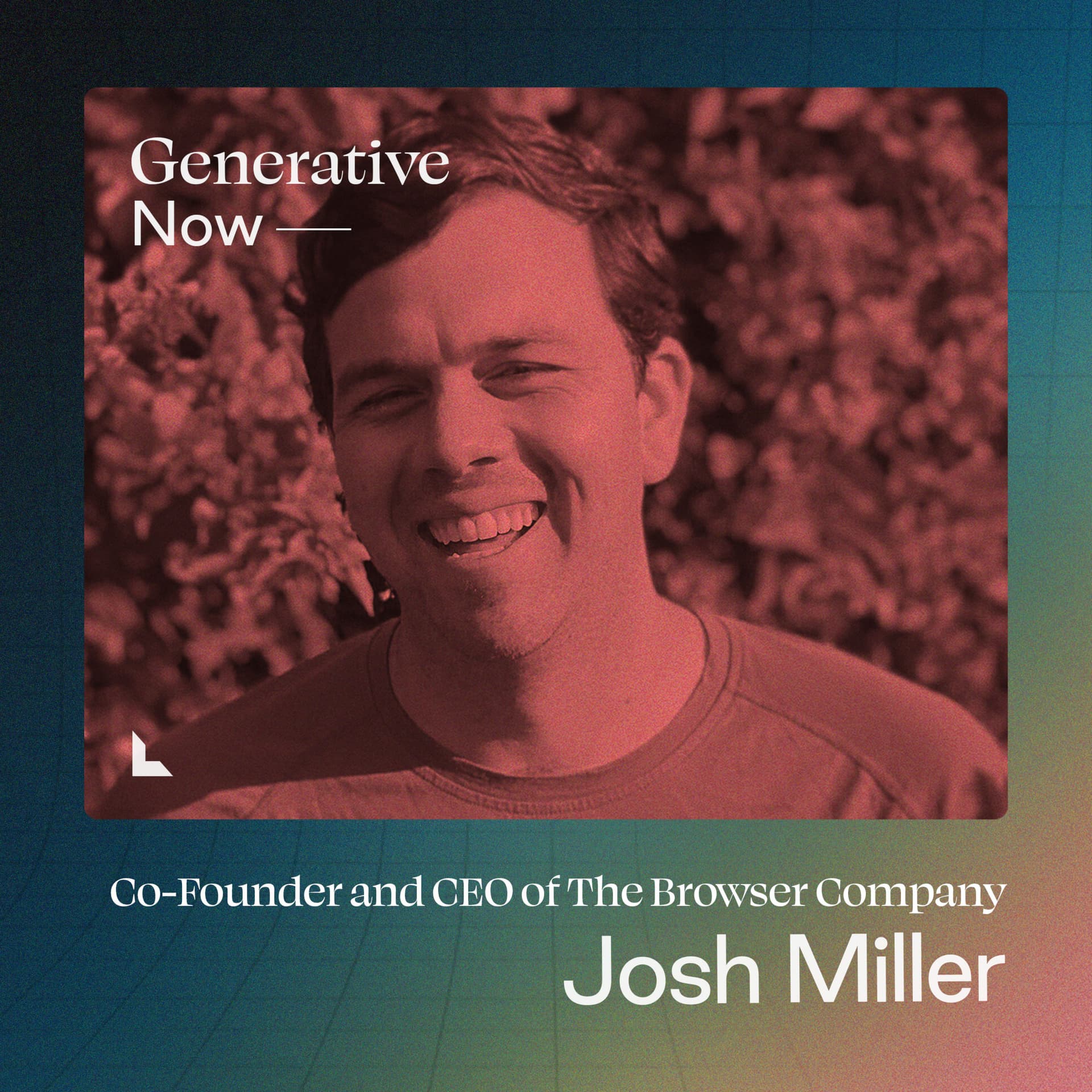
Podcast Overview Title: Generative Now Host: Michael Mignano, Partner at Lightspeed Guest: Josh Miller, Co-founder and CEO of The Browser Company Episode Focus: The evolution of web browsers with AI integration, challenges of tech startups, and the future of personal computing.
Episode Summary In this episode, Michael Mignano engages in a conversation with Josh Miller about the transformative journey of web browsers, particularly focusing on Arc — the innovative browser developed by The Browser Company. They discuss the impact of AI on browsing, the challenges of web content summarization, the pressures faced by tech startups, and ethical considerations in technology.
Key Topics Discussed
- Inspiration Behind Arc
- Josh reveals how personal experiences, such as long walks in the Swiss Alps, inspired the creation of Arc and The Browser Company.
- Navigating Distractions in Tech
- Both discuss the overwhelming distractions in the tech industry and the importance of finding time for deep thinking to foster innovation.
- Role of AI in Browsing
- Exploration of how AI can enhance the browsing experience. Josh explains the initial skepticism towards AI features in Arc that later evolved into embracing the technology as a key component.
- Future of Browsing with Arc
- Josh shares his vision for Arc and how he aims to redefine personal computing. The browser is positioned as an essential operating system for daily tasks.
- Competitive Dynamics in AI
- Discussion on the evolving competitive landscape in AI, including the challenges faced by startups versus established companies like Google.
- AI-Powered Functionality: Incremental vs. Leapfrog
- The conversation centers around whether to build on existing technology incrementally or leapfrog to entirely new experiences that disrupt traditional workflows.
- Challenges and Opportunities in AI Summarization
- Josh addresses the complexities of AI summarization and the responsibility of companies to ensure ethical practices in utilizing content from the web.
- Thoughts About Regulating AI
- The need for thoughtful regulation in AI technology is discussed, along with the dangers of premature legislation without understanding the implications fully.
- Raising Capital and Managing Pressure
- Josh shares insights on the pressures of raising significant capital and the expectations that come with it, emphasizing the importance of ambition in the startup journey.
- Personal Experience Living in France
- Josh reflects on his recent experiences living in France and how it provided him with personal and professional insights, helping him reconnect with his vision for the company.
Key Takeaways
- Innovation Through AI: Embracing AI is crucial for modern web browsers to enhance user experience and functionality.
- Focus on User Experience: The future of web browsers involves creating intuitive experiences that integrate seamlessly into users' daily tasks.
- Ethical Responsibility: Companies should consider the economic implications of their technological advancements on content creators and the wider web ecosystem.
- Navigating Challenges: Startups face unique pressures in a competitive landscape, but maintaining a clear vision and ambition is essential for success.
- Cultural Insights: Immersing oneself in new environments can lead to vital reflections and inspire innovation.
Conclusion The episode encapsulates a forward-thinking vision for the future of web browsing, driven by AI and rooted in a deep understanding of user needs. The conversation between Michael and Josh not only highlights the challenges of the tech landscape but also inspires confidence in the potential of innovative solutions like Arc.
Stay Connected
- Website: [Lightspeed Venture Partners](http://www.lsvp.com/)
- Follow on X: [@lightspeedvp](https://twitter.com/lightspeedvp)
- LinkedIn: [Lightspeed Venture Partners](https://www.linkedin.com/company/lightspeed-venture-partners/)
- Instagram: [Lightspeed Venture Partners](https://www.instagram.com/lightspeedventurepartners/)
- Subscribe to the podcast: [Generative Now](http://generativenow.co/)
- Email: generativenow@lsvp.com
---
*Disclaimer: The content in this podcast does not constitute legal, business, or investment advice.*
Written by AI. May contain mistakes. Listen to the episode to check what was said.
Transcript
Automatic transcript. May contain errors.0:04Hey, everyone, and welcome to Generative Now. I am Michael McNanno. I am a partner at Lightspeed. If there's one piece of tech that we probably take for granted and don't really think that much about, it is the web browser. From Netscape to Internet Explorer to Google Chrome now, the browser is the portal through which we consume much of the internet. And not much has changed about browsers. So this week on the podcast, I spoke with Josh Miller, the co-founder and CEO of the company that is trying to change the browser, and that is the browser company of New York and their product, Arc. Arc. Josh wants to change our relationship to the internet for the better with Arc and all the products and features they're building around it.
0:47I spoke with Josh about what makes Arc different, how AI can enhance the internet browsing experience, and what he sees next as the successor to personal computing as we know it today. Hey, Josh. Hey, Mike. How's it going? Good. How you doing? I'm very, very happy to be here. Yeah, likewise. So before we were rolling, you were telling me about this chalet that you're in. And I mentioned I recognize this from this famous browser company video. So remind me again, where are you? You're in the Swiss Alps or something? Yes, it sounds fancy. It's not fancy. My wife's family is from the French-speaking part of Switzerland.
1:24And every summer, one of the deals with marrying her was we spend the summers with her family up in the mountains. And it's gorgeous. But boy, do they do a lot of walking in Switzerland. They just walk and they walk and they walk. And one summer on a walk was actually where the idea for the browser company came from. It was like a four hour walk and I was just lost in my own thoughts. And the following summer got inspired on a walk again was like, hey, let's sit down and record a video and kind of share where this is all going. And maybe it'll be inspiring at the time was like kind of for talent hiring.
1:56And that ended up being our first ever YouTube video called the Internet Computer. So this is the exact same backdrop. I look a little bit older, but otherwise the exact same place from a few years ago. No, you're a spring chicken. I mean, I guess like another good idea could come this summer because you're probably going to be doing some walking. I kid you not. My coach was like, you got to get to Switzerland, man. I was like, what are you talking about? He's like, when are you going to Switzerland? And I told him it was in three weeks. He's like, I don't know if that's soon enough, but but OK, that'll do.
2:25So anyone in my life when I when I'm in a place where I have to take a step back and think about something, they know that this is my happy place. So no pressure. but I'm hoping some good stuff comes this summer. Cause there's a lot, as you know, there's a lot going on in our industry right now, browser company aside, and it's fascinating and terrifying and all of the things. So I definitely am feeling like I need some long mountain walks right now. Yeah, it's so true. I mean, I, I definitely can relate to this. Like I feel like, um, I do my best work when I just have time to be kind of alone in nature or whatever.
2:59Um, we, I was actually with a group of, uh, friends and people in tech last night and everyone was talking about how distracted they are right now like it's so easy to be distracted obviously for the you know for the obvious reasons of like we're all now addicted to our smartphones but also just like the news cycle of everything that's happening right now whether it's in politics the election ai like there is constantly an off-ramp to your phone and even when you're at your desk like even when you're working there's this off-ramp to like pick up your phone and so the minutes we have in the day to actually just like think and sit with our thoughts in the way that I think you're talking about that typically like breeds these great ideas.
3:40You really have to be intentional about it. You got to go to Switzerland or something. Yeah. You got to marry right. I guess I I'm curious though, Mike, I, I know you're supposed to ask me questions, but one of the benefits of my job is I sort of need to keep my head down and focus from a work perspective. So as the CEO specifically, I got to keep my eye on what's going on and new technologies, but your job is to make bets on things that are going on right now and coming next. How have you been doing that? Because I was thinking back to last time you and I had a deep conversation and some of the technologies, hypotheses, latest prototypes that were feeling good, totally different than whatever it is six months later now.
4:20How for your job are you finding yourself making bets on companies, especially in the space of LLMs when it is changing so rapidly? Part of it is what we just talked about. Like part of it is giving yourself to actually giving yourself time to actually think or maybe do some real deep research and honestly just strategize. I think it sort of starts with going back to what we talked about earlier. Like, I think, first of all, it starts with finding time and space to think. And me, like as a former founder, as you know, my natural inclination and mode is to just like work and just like plow through, you know, my backlog.
5:00And VC is not really like that. Like, you can do that. like you can just take every single meeting that comes at you every single founder um every single other vc there's like there's plenty of stuff to reach for if you want it but i find that when you do that you you don't have the time and space to think and form theses and do research and like you know read the papers and so um i constantly have to like check myself and like and like fight fight back against my default mode if that makes sense are there any things you wish you had told yourself 12 months ago in terms of not specific investments you've made, but assumptions you made about this new world of LLMs and how it relates to early stage products and investments?
5:45Yeah. I mean, and ask me actually partially, cause this is what we're dealing with too. Now we've, we've been prototyping products and features for four years, but it's a new type of Play-Doh. So I'm actually curious, you've actually seen many more teams prototype many more things, some of which get escape velocity, others hit a roadblock, others get escape velocity and then hit a roadblock and for different reasons than probably messing around with AWS and Twilio 10 years ago. So I'm curious what you wish you'd told yourself 12 months ago now that you've placed some bets and learned some things.
6:14Yeah, it's a great question. I mean, for one, you know, and you'll remember this, but 12 months ago, you know, there was new technology coming out and it was so easy to just be so blown away by the tech and to be like, it's all about the tech, you know like wow that that that model is so magical like it's going to be the biggest company in the world you know it's going to be the foundation of the biggest company in the world um i i guess maybe what um i wish i told myself is yeah like the tech can make a huge difference but at the end of the day it's still about a lot of the same fundamentals that it was pre-ai which is great people like the best founders and the best teams you know make it are the difference and it's about products, right?
6:59Like there are probably, there's so many ideas and technologies that I feel like we heard about or we talked about, you know, maybe 12 months ago, 18 months ago. And it was so easy to just be like, an incumbent is going to own that or there are too many startups chasing that opportunity. And then you realize that like the best people and the best products break through. Like the best products are the things that people pay for and the things that they use and retain. And so even if there is an incumbent in the same space, if there's a small team that is making the best product, it will do great.
7:32And I'm talking my book a little bit here, so I apologize. But a perfect example of that, I would say, is I don't know if you've played with Granola yet. Granola, for those listening, it helps you take great meeting notes and focus on the meeting. Speaking of focusing, there are a lot of companies trying this. but they just like ruthlessly focused on the details on the product. And as a result, it's, it's doing phenomenally well. And it's the one that everyone is, is jumping to and using. So I think it's about the people in the products. And I wish I told myself that, you know, 12 months ago. Yeah.
8:07It makes a lot of sense. Yeah. I mean, what do you think? I mean, you're, you're obviously you're building the browser company, but like, you're very, very plugged in. And so you've seen the, you've seen the cycles of the past two years as well. Like what's it been like for you observing work in progress i'll tell you the journey that we've been on yeah from an ai perspective it started with me being extremely skeptical we actually the first ai powered features we built were largely just pulled from us from our members what we call our customers because they pick arc our product which is a web browser because they view it to be that kind of macintosh to the windows of other browsers they pick it because they feel like it is at the forefront of technology.
8:49It'll give them the most premium, powerful features. And we had nothing powered by AI at a moment when that's what everyone was talking about. So our first set of features were sort of begrudgingly, look, we got to do something with this Play-Doh because otherwise from a brand and marketing perspective, from a positioning perspective, we can't lose that position. And so we kind of begrudgingly tried these little things and then got totally blown away by what was possible and realized we were so wrong to doubt this technology. Of course, it's going to be wild. Then we went off and imagined this wild future where you could do X and you could do Y and everything would be different and computing would be different.
9:27And then we realized, wow, that, whoa, too far. The technology is not there yet. It's far from ready. And then we pulled it back and we've been kind of going on this ping pong back and forth. And what I've realized personally, I think, which is pretty spiritually similar to what you just said about people and product and nothing's changes. Why are we here? Why did we start this company. What are we trying to do? Let's unapologetically do that and not get distracted by anything else. And I guess a more tactical way of saying that is if it feels like the cost curve and the speed curve and the quality curve of some of these new technologies are going a certain direction and there's something with that Play-Doh that can help us reach that internet computer vision, which I recorded right here that we always wanted to do.
10:09Great. And if not, let's not get distracted. Let's not be reactive. Let's not chase the hype. Let's not even chase what our customers tell us they want at this stage. Let's stay true to why we started this company. And so I think candidly for a while, I was at least a little bit too reactive. And as soon as we came back to like, wait, why are we here? It became a lot clearer. Now, at the same time, because there's been that seesaw and that whiplash, I don't know if that's the right call. And one of the things that terrifies me, some of the bets we're placing do require some of these curves to keep curving in the way they're curving.
10:45And if they don't curve in the way they're curving, we're not going to be in a good place. What's an example of that? Like, what's a future curve you're betting on that has to play out? Latency of these foundational models. Just the speed at which they can return tokens needs to go down. Why? Why for ARK? The reason it's so important for us is we're building a web browser. And in 2024, a web browser is the computing platform at which all of the other tools and applications you use sit on top of. It's the application. If you're someone whose livelihood is on your laptop, which is probably everyone listened to this podcast, the web browser is the application you spend the most hours in every single day, many, many hours.
11:28And the web browsers that have historically won are ones that optimize for speed. The reason that Chrome blew Firefox out of the water is because it optimized for speed and offered a faster browser. The reason Firefox blew Internet Explorer out of the water is because they optimized for speed in a different sense. Internet Explorer was bloated and it was distracting, et cetera. And so in our product category, if we're going to innovate, it doesn't necessarily mean we need to be the fastest browser in the traditional sense. But there needs to be very low latency with everything you do because you are doing everything in your web browser.
12:02Uh, so for us, latency is important. Also, you know, cost is important. I'm less worried about the cost curve. That feels more likely to curve in the direction we want. But for example, we did this project where we were a concept car leapfrog. What is this product category going to look like in five years? And we built a concept car hobbled together. That was really, really exciting. And the basis for a lot of what we're doing right now,$100 per user per month in costs. Wow. Oh my God. but it's going to come down. It's going to come down. If we optimize that, we could bring it down to 50 easily, maybe even to 30, but as you know, 30 bucks a month in cogs is just per user.
12:44It's not going to scale, but it's going to come down. I mean, like I buy the curve. I mean, we're seeing this play out in real time. Like every week, there's a cheaper and faster model. I mean, GBT four. Oh, came out. I don't know. It was only like two months ago. And then last week there was GPD four. Oh, a mini and it's cheaper and it's faster. It's just, I don't know. I think, I think you'll be okay. I will say right now, I feel most confident about cost and speed being curves that continue from the little that I've heard in people that I've talked to. I worry a little bit more about quality, quality, our power, but at the same time for what we're doing, that's not really the blocker.
13:23Um, but again, it's just, it's a new world to be in. Um, and so it can be hard to know what what are you what are you betting on and why because it's such a different the play-doh itself is very different even if the principles and the values behind what you should do and why are as we're learning are the same at a high level you know everything you're saying makes sense around like the browser just needs to be as fast as possible maybe to like zoom in and get a little more specific what are like the key features that you think about is browse for me where your head goes with that like if browse for me could just be instant it would be that much more valuable to members?
13:57You can roughly think about what we're trying to do next in Arc 2.0 as browse for me, but with a zero added to the end, just like take it to its logical extreme. But for the sake of this conversation to make it very tangible so we can talk about it, let's take browse for me. For people listening, browse for me is very simple feature. You've probably used it before in any number of products. Now you do a traditional search query. Instead of taking you to a search engine page, we actually go read those first five, six, seven links for you and try to answer your original query with that information.
14:33And then we actually create an entire custom web page for you just dedicated to answering or responding to that query as if someone on the internet made the perfect single web page just for you in that moment. And it's been a big hit in our mobile app, ArcSearch. Yeah. To your question, you got to wait a minute for, I mean, not literally a minute, but you got to wait a while for it to load. And if there's one thing Google has worked on for the past many decades, it is speed. It is actually mind blowing how instant it is. Even some of their new AI overviews, which are, you know, kind of a reductive feature from ArcSearch or perplexity, they, even they, they load instantly.
15:12So not only does it feel like The latency is tough just in general, in isolation. It's very tough relative to Google, and it will always be tough relative to Google. Then there's the quality perspective. We make a custom web page for you, and part of the appeal of our features, we don't just give you an answer. We give you a whole, like we're a 90s internet, and some geek in the corner of the web made this web page just for you and geeked out about all the ways it could respond to your query and answer your question and give you photos and videos and all that stuff. these LLMs don't always like listening to the instructions we give it.
15:48No matter how much we function, no matter what we do, sometimes they just don't respect what we say. Other times, we don't have as many issues with hallucinations, but sometimes it'll make stuff up. And is that a data issue? Do we need more data to get better accuracy? So there are so many, this is kind of what I mean. There's so many aspects of quality, But one one one place where we're finding a lot of leverage is actually if you think about this concept of reading a web page, what does that mean? Are you reading the HTML? Are you reading the code? Are you reading the text on the page? Which text on the page?
16:22If you actually were to like really go and look at, let's say, a Yahoo News article, there's a lot of text on the page. It's not the article that you are reading. Do you take that? So one of the things we're getting a lot of leverage on is just being more intelligent about what we parse and pass on to the LLM to read and understand. There are also things you can do around, OK, the person typed a query, but we've been trained to talk to computers, to talk to Google and this like Google syntax. So you can sort of actually infer what the person is asking behind that query as if they were asking a question to another human being and ask that question instead.
16:59But sometimes you might infer that poorly and get that wrong, which then hurts. So it's this kind of mine. It's extremely complex and very individual issue is very tractable. But then there are some things like, you know, we can't control what the foundation model provider gives back to us in terms of the speed of the tokens that get back to us. We can't control cost to some extent. But again, I feel better about those curves. But it's just a it's just a new world. And it's a new world in terms of incumbents, I think. we're in a slightly different position because we spent four years building a web browser.
17:35And our thesis as a company is you need to be a web browser to do the things that we want to do. And if that's wrong, well, then we're screwed. And if it's right, then we have a little bit more of a moat and ability to do things that others can't. But I will say, as much as I do think the best products win the day and startups have advantages versus incumbents if they invent good products. I don't know if you think about some of these things, you know, cost, quality of the technology, speed and latency, distribution. I actually do worry a little bit about the startups, startup industry in general.
18:14So like something like Granola, I think Chris, the founder, the CEO is one of the best, best in the business. And I hope they win just like I hope that we win. But I worry more for this company than Chris's first company where I was like, no one else can do what they do and no one else did. Right. And they were successful. So I'm betting on Chris. I'm obviously betting on myself, but I also think it's not only the, uh, the cost and latency and the quality curves and, and, uh, the kind of new textures of this, this, this building material called LLMs, but also I think the competitive dynamics do slightly favor the incumbents in some ways, uh, that make me a little bit nervous, but also makes it more fun.
18:51So yeah, especially while the cost is so high right i think i actually think once the cost comes down um it will level the playing field somewhat right like google microsoft meta like infinite access to resources and capital and compute um if the cost of all this stuff comes down like it becomes easier for you to compete right because then you don't have to go out and raise hundreds of millions or billions or whatever like you're in the game um so that's going to favor startups speaking of startups and incumbents and first to markets, best to market. I'm really curious to see what happens with ChatGPT versus Anthropic.
19:26I think I have a lot of respect for OpenAI. I have a lot of, how can you not? They invented this moment in many ways or popularized this technology. And ChatGPT is an application that I've been using weekly for a long time. At the same time, I would say I've grown to much prefer Anthropics product experience. And I feel like they're shipping from a product perspective much quicker than OpenAI is with ChatGPT. I think that's reflected in the missions of the company. I think OpenAI is very clearly a we want AGI company and a research organization. But it'll be interesting to see OpenAI and ChatGPT.
20:03ChatGPT has the distribution. It has the name, brand, and recognition. You would expect that they're going to run away with it. But at the same time, you have someone like Anthropic with Claude that is pretty damn close in terms of quality, if not better in this current moment at which we're recording the podcast. And I think shipping much more innovative features faster. Will they capture market share? Will they not? I think that'll almost be, even though it's not big startup like Google versus small startup or big company like Google versus small startup, but interesting to see how that competitive dynamic plays out and what that suggests for companies like Granola or the browser company yeah anthropic's been on an absolute tear uh feels like you know maybe it was quintessential but when when mike krieger joined a cpo i just feel like since then they've just been like on a tear of shipping really really innovative new features like you said it's been really really fun to watch i think like my impression well you even touched on it it feels like chat gpt has like the brand edge right now like they're the one that every every consumer knows about like my mom knows what chat gbt is um i feel like outside of tech anthropic doesn't have that that brand uh notoriety yet um and and maybe it's because like it feels like they started more with like an enterprise angle where it feels like from the beginning like chat gbt is like we want to do it all we want to do enterprise we want to do consumer we want to be everything to everyone so yeah it should be interesting but like that's that's exactly what i'm wondering is you're totally right chat gbt is in tv shows now totally yeah it's being it's being mentioned on the news yeah it's in a lot of people's bookmarks bar right and so in that sense uh i almost think anthropic is the equivalent of a startup that might be in your portfolio that has is shipping faster has the better better product leader is on a tear is innovating on ux anyone that knows loves this product but the end of the day chat gpt is just what people know so if you extend that to something like Google, for example.
22:02Let's just say Google ripped off perplexity like pixel to pixel. I think you would say, hey, it doesn't really matter how much it would tear perplexity is on. My mom knows Google. She's been using Google forever. Take something with presentations, you know, Acme Co. doing wild stuff with what a slide deck is in the future. Well, I know I've been using PowerPoints for two decades and I didn't know there was some stuff. So I hope not. Just to be clear, I hope not. Like I'm rooting for Mike Krieger and co. And I actually and I like I would bet on Anthropic. But I don't know if that's just like who I am as a person and aspiration what I want to believe in.
22:41But it'll be an interesting microcosm of what that might suggest what else might come. I totally agree. And yeah, they're doing amazing stuff. So staying on browse for me for a second, you mentioned something earlier that I'd been thinking about a few minutes ago where, you know, you're figuring out all this like syntax stuff, right? Everyone's trained on the Google syntax. They know how to Google. They know how to get to what they're looking for through their query. And I think people are still figuring it out with LLMs. They're still figuring out with these like answer engines like perplexity.
23:15you mentioned early on that like the goal of browse for me is like answer the question as like directly as possible in the most efficient way possible i wonder if there's something to like training people how to search within the browser company like right now you're saying browse for me when i think about browse for me i'm thinking like i don't know um help me find like a restaurant or something like go do work for me which feels different than like answer this question. Have you thought about using different prompts there beyond just browse for me? Again, I hesitate to give too much away just because we're working on a lot of this stuff right now.
23:51But what I would say is what we realize is what is interesting about the browser to us and what has always been interesting about the browser is the fact that it really is your operating system on your laptop. For most, the knowledge worker, anyone listening to this podcast, most of the applications they use are probably within their web browser, which means it is the place where you get stuff done end to end. There's a task you have to do and end to end, you get it done in your browser. A search engine is one part of that. So if you are trying to buy a new bathing suit because it's the summer, you might do a Google search or a perplexity search or an arc search or whatever that is, whether men's bathing suits with a couple of qualifier words.
24:36What is unique about the browser is you end to end need to make sure start to finish you get that bathing suit on the way to your home. And so the way that we're thinking about it right now is instead of just starting and ending at an answer, how do we make sure from start to finish of that thing on your to do list, it gets done. And we build a system that end to end through that flow can help you do that faster and can accelerate you and keep you focused and make you speedier throughout that entire journey. It's a little bit different than what others in the ecosystem are doing, given where they sit in the software stack.
25:12I think the question we're all going to be grappling with, and we're grappling with from a product perspective is, do you layer on AI-powered functionality incrementally onto the existing workflows that we all have today? That's something like browse for me. That's something like perplexity. Or do you try to build a leapfrog experience that touches on the same fundamental human need, but does so truly from a blank page saying, hey, if we invented this today, how would you do it? And so I think your question about Google syntax is related to that. So long as you're building a product that relies on the syntax for this thing called the search engine with links that was designed three decades ago, you're going to be somewhat constrained and limited both in the behavior and assumptions that a human brings to it, but also what you can do at the other end.
26:02Now, the benefit of that is you got to do what we do and what perplexity does when you set it as the default or what Google's doing with it. You don't need anyone to change any behavior. They just hit command T or new tab like they always have. They type in the same thing they always have and you get that distribution and you don't have to teach new behavior. On the flip side, it's wildly constrained. On the other hand, if you look at what's in that other category, maybe nothing except for ChatGBT, potentially something like a mid journey, but even the chat GPT, if you think about what it's really capable of, it's really intimidating.
Read the full transcript
26:36I think my hunch is if you look at chat GPT retention curves, they're not good. I bet the chat GPT retention curves, especially from a DAU or even weekly active user perspective are fairly bad. Um, I think there are some people that have really found it, but I think it's hard to understand what is this thing? How does it fit into my life? How does it fit into my day? How does it fit into my hour? Because I think there is power behind GPT-4O that should be helping us hourly for sure. But when you build something that is truly net new and truly a leapfrog product, it has all these other challenges that come with it.
27:12I don't feel bad for chat GPT. I think they're going to figure out and be fine. Ditto with Claude and Anthropic. But I think that's the fork in the road that we are facing that I think others will face, both are very hard. Both have strong upsides and strong downsides. And that's what you have to grapple with. Where I have landed personally for us is leapfrog or bust. And maybe that just, and honestly, part of that comes back to why we started this company. If you go back and watch the internet computer video that we referenced earlier, we've always been trying to leapfrog, but it is scary and it comes with its own difficulties.
27:47But I think that's the question. And so, yeah, coming back to what you said, Google syntax is extremely limiting. And if you build a product that relies on it because it relies on existing user behavior, you get the benefit of not teaching something new, but you will forever be shackled by that constraint. Makes so much sense. So since we're talking about browse for me, we mentioned perplexity a couple of times. I got to ask this question and hopefully this is OK to go into. You said nothing's off limits. Anything. so there's been a little bit of controversy around products like this um you know i don't believe you're training your own models i don't think perplexity trains their own models either i'm not totally sure um so you know they're they're the controversy that i've heard around these products is not around training right and like ingesting copyrighted material um it's more on the summarization and the the output that sort of cobble you know sort of mashes together others work and I've seen you go back and forth on Twitter with some some notable journalists like yeah and I think you actually made a comparison to what browse for me is doing being similar actually to what an actual journalist does and so yeah I would just love to hear your take on this whole topic because I thought it was interesting and I was following following the chain I think this was a few weeks ago at this point I'm happy to go deep on this it might be easier if you have specific questions but I think what I would say is I think it is it is truly a gray area and there are strong arguments on both sides.
29:16And it's the first thing that we've done that I'm honestly very torn about, if not questioning, do we need to radically change some aspect of it to have it out in the world just because of how I feel about it ethically. And at the same time, I think, I think there's a lot of emotion right now. And I don't think there's a ton of intellectual honesty about how this technology and this Plato compares to very similar ones in the past, even if it's different. So what I would say is the act of summarization of content on the public internet that was voluntarily put on the public web to be consumed by people freely, that doesn't feel problematic to me.
29:58I think we could talk about the scale at which people do it now, but there's nothing new about that. Literally the blog started as people writing a little blurb or pulling a little excerpt of something they like and linking to it. And most of the time, people just reading that little excerpt on Tumblr or blogger or whatever it is, and sometimes clicking through to the link. And the public web, I do believe the promise has always been, this is out there in the public good, do with it what you will. And so the idea that there's a new technology that says it can save someone time, you shouldn't summarize, because that is somehow ethically dubious, does not pass the sniff test for me as wild the new world as it may be.
30:40What does pass the sniff test and does feel problematic is part of that open web ecosystem is a series of implicit promises or assumptions about how people are going to make money and how they're going to get paid when they put stuff on the internet. And so I do think what products like Google's AI summaries and perplexity and browse for me don't do is answer the question of if you are that recipe blogger putting out your content on the internet and the way you've made money historically by putting money on the public, putting content on the public web is to show banner ads and have trackers. And now all of a sudden you have browsers and you have these search engine things that are blocking trackers and not even showing you the web page, it does break the economic model.
31:32And there needs to be, I think it is the responsibility of companies like ours and perplexity and Google and so on and so forth to have a proposal or put some thought into that economic aspect of it just to be good actors. I think that is really important. Candidly, I think that's been broken for a long time. One of my other jobs in 20 % time is I've been on the board of Patreon for five years. Let me tell you, you will not talk to a single creator who says, I make a fair amount of money for the podcasts I put out or for the videos I put on TikTok or for the blogs I put on the public web. No one feels good about that or has felt good about it.
32:08So that doesn't mean we don't have a responsibility. That doesn't mean that that gives everyone permission to do whatever they want because creators have been getting fleeced for the past decade. And so go ahead and fleece them. That's not what I'm saying. But I think that the conversation we need to have is I think it's exciting. We have this tabled flipping technology that can actually rewrite how the web works and is going to rewrite how the web works. Of course, the way the web should work is if it can save all of us a bunch of time by summarizing stuff, it 100 % should do that. Because why wouldn't we want to save all of ourselves a bunch of time for something we don't need to do?
32:44That is absolutely how it will and should work. And it is also true that there won't be a web if in this new web, we don't also close the circle and say, how are people going to make money from publishing content? And so the thing that is candidly tricky for us is we are an 80 person subscale startup. I would love nothing more than to sit at a table with Google and the New York Times and and all of the big Apple. And let's let's let's get creative. Let's have a brainstorm. Let's all agree to do something. No one has invited us. No one's talked to us. And so actually, we are having some conversations with publishers, some that have reached out to us, some proactively because we're really excited.
33:25But I think the tricky place we're in is we don't have the convening power that a company like an OpenAI or a Google does to. So what we're going to do is we're going to try our best to put out a proposal or a case study or product feature. I actually think one company that's done this very well, even though they're a competitor of ours, is Brave. So Brave, totally unrelated to AI, had this idea for how the ad model might be better for the Internet that was more privacy preserving. And so they sort of did this thing where it was like, hey, we're going to put some money aside for publishers as part of this.
33:59They don't really want to talk to us right now, but if they ever want it, it's here for them. I'm going to flub the details a little bit, but you might see us do something like that. But yeah, the long story short is the idea that we have this new technology that can save us all time by summarizing public web content in ways that humans have for a long time, but now it can just do it automatically. That is just a net positive that I think should, of course, happen. But I think it is also the responsibility of companies like ours to have a seat at the table and propose how might we close that circle at the other end when it comes to economic incentives.
34:30You mentioned earlier in what you just said that there's a lot of emotion right now. And I think that's natural, right? Like you said, the table's getting flipped and like the whole world is changing and definitely will change very, very, very quickly. And we're seeing this emotion just like have ripples kind of everywhere. We're seeing the whole deck get reshuffled right now as a result of all this stuff. and and you know as someone who worked in the obama administration i'd love to get your take on a few of these things maybe just starting with regulation like how do you feel about the regulation of ai i know there have been a couple of bills uh have been put forth which frankly i believe are like going to be uh really really bad for startups but but what do you think like should should the government be rushing to regulate should it be a little more wait and see like where do you fall on the topic of to regulate or not to regulate i went into the government i spent two years in the Obama White House as a political appointee.
35:25So a very short period of time in the grand scheme of things. But if I were to summarize what I took away from those two years was, it's never binary. It's really gray and it's really nuanced. And it's really unfortunate, that's true, because it'd be a lot easier if it was simple, but it's always much more complex than meets the eye. So I think my take, as unsatisfying as it may be, is, of course, there's going to have to be regulation of AI. Of course, period. I also think it's true that there is way too much hype from our industry about the current capabilities of these models. And I realize they're changing quickly.
36:02But as we just talked about, every six months is changing. And so I don't think rushing to get something out there from a symbolic political perspective benefits anybody. And I think we've seen from something like GDPR in the EU, how corrosive a poor regulation can be from a just trusting government, candidly. And so I think the worst thing the government can do is rush prematurely because of hype and because of all this noise and do something like GDPR that just furthers this narrative that you can't trust the government to do anything, which I don't think is true, but I think is out there. So I also think one of the things that people probably miss that haven't been the government is the government loves talking to people in the private sector.
36:48It loves using its convening power to understand. And so I think the best thing that we can do right now is have an extremely active dialogue with the regulators, with the lawmakers, with the executive branch, teach them, teach each other, help understand. Because I will say there are some aspects of LLMs that are extremely scary from a national security perspective today. So there's some truth there, but I guess if I were to take a full step back, I would summarize it as yes, the government should regulate this technology in some way. And I think it is disingenuous or pretty radical to say otherwise, but I don't think we know enough about how this is going to unfold.
37:30And I guess the other thing I would say that I don't see people in our industry talking enough about is talking to your mom, who you referenced earlier. I think People in the technology industry would be surprised to go out on the proverbial street, unless you live in San Francisco, don't do that. But if you live anywhere but San Francisco, go talk to someone in the street about what do they have a used AI? What do they think AI is? What do they think of it? I think that that public opinion perception is going to be the swing vote on where this stuff nets out. And I think people would be surprised how much of a gulf there is between what the person on the street perceives AI to be and do for their life and what people in an industry do.
38:14So you raise a huge round of funding. Congrats. What kind of pressure does that put on you and the team, I guess, to raise a big chunk of capital at a really big valuation? Like anytime you do that, you bring in a new round of capital. It changes the trajectory of the company. Like, how as a CEO do you manage that? And what does that look like internally with the team? Obviously, they know it. They know how much you raise. They know what the valuation looks like. It's a tremendous amount of pressure, candidly. We raised the round. We raised$50 million. And then I went on paternity leave for our second child.
38:46Congrats again, by the way. Thank you. So that was an interesting time to take a step back and, though tired, reflect. And you get all existential. I guess what I would say is where it is netted out is it puts pressure, but it also clarifies the only thing we need to do is be our most boldest selves and go for the largest version of what this company should be and can be. And that's extremely scary because there was a path for the browser company and for ARK, which was much more follow a playbook, monetize like a SaaS app, start selling some Teams accounts, start selling some enterprise licenses.
39:23And I'm not saying we won't do some of those things in the future, but there is much more of a like run the playbook. And it had a higher likelihood of success, a much higher likelihood of success. And we wouldn't have raised that sort of capital, at least in that way, in order to do that. and the ceiling would have been a lot lower. And I mean a lot lower, not in terms of the financial outcome for us and the team, but a lot lower in terms of what we set out to do, truly changed the way people use the internet and interface with the internet. We wouldn't have done that at any sort of scale. And so what we decided and what we opted into by taking this capital was, no, we're gonna try to build this internet computer vision.
39:58And we think there's a moment in time with this new technology that actually there's more of an opening than even when we started this company four or five years ago. it is going to be more capital intensive though much more capital intensive like like we they were like zero marginal costs of building a browser when we started this now they're like the most marginal cost possible it's gonna be much more capital intensive we have much more competition we know for sure a lot of people are building browsers that weren't building browsers before say more yep and there i can't say more but there will be more browsers and uh there are people that have always had browsers didn't care about their browsers that now really care about their browsers.
40:36And one of the things that was interesting about building a browser four years ago was it was sort of this backwater. Like, why are you working on a desktop web browser? We love that we knew a secret that others didn't take. And so it is really exciting to rediscover the reason we all started this company and get inspired again by the magnitude of what might be possible. And it is terrifying that it's going to cost a lot more money than we expected. we're going to compete with a lot more people of all shapes and sizes than expected. And despite having four years of compounding user growth, hiring, bank account, all of the things layering, we're sort of at a blank page again in terms of how far we have to go from a risk perspective.
41:21But I would summarize it as a lot of pressure, but also the most inspired I've been since the day I came up with the idea probably. Yeah, that's actually really interesting. And It sounds like what you're saying is now with this next round, you've set the ambition so big that you almost get to free yourself again. You almost get to go like backwards and open the aperture wider again because the ambition is so large. And in a way, the capital and the valuation is freeing in that sense, which is pretty cool and counterintuitive. We have no other choice. I think one of the things that I put it like this, I was really scared about how other people would feel about this ambition.
42:01you know other people in the team like or what do you mean employee yeah employees investors customers because you know i think having this talk about quiet moment paternity leave four years in right you know what what do i want what i want to do it was pretty clear to myself what i wanted and the and reminding myself of why we started this company and what we wanted to do and it feeling so consistent let's just stay it's like stay focused on what we want to do But it was pretty scary to think about how would other people receive it? You know, you know, other people. And it was so memorable to feel our team.
42:37Oh, of course. And I forgot. That's why people joined this company. That's why people invested in this company. That's why people even downloaded ARK because they saw the Internet computer video or they bought into this idea. Like people want to be inspired. People want to go for it. Most people don't want to work for something that will be an incrementally better tool that will make incrementally more money than some other thing. Not that there's anything wrong with that, but no one ended up at the browser company to do that. And so it was a very memorable series of moments to realize that like, yeah, of course, this is we're going to go for it.
43:10So, yes, it's a lot of pressure. Yes, it is scary. Yes, there have been conversations that I've been nervous to have. But I think coming out of it, there's just sort of like, all right, game on. Let's do this. You know? Yeah. That's awesome. And yeah, I mean, you guys have been so good at getting that positive feedback loop from the community going. Like you're such like a public, not a publicly traded company, but like a company that exists and builds in public. You know, you have so many like videos you put out and marketing materials. And I have to imagine that just fuels that fire you're talking about right now.
43:46Like you see that love like very directly from the community, which probably gives you even more freedom and more like, you know, permission to yourself to dream big and bet big. And so, yeah, you guys have done a really, really good job at that. Yeah. And I think actually we've always built in public because of that feedback. This is why the browser company exists. This is our ambition. It's not for everyone. We actually think this version of our company is for more people than, you know, the one that some people thought it was. But yeah, the building and public building alongside our members, learning from our members has been a lot of what actually I was visiting my parents in L.A.
44:24And I was going my dad to the market to get some fish. And there's this guy jogging down the street. He like he runs up to me, guys, headband on, sweating like, hey, Josh, the browser company, like, keep going, man. Like, I know it feels like a big hill, but you got this like love your product. And I can't wait to see what it's going to be next. And it's like, man, those moments, I mean, not, not the, like someone recognized me publicly, but those are the moments that are like, all right, let's go, let's like, what do we, let's go for it. So yeah, there, there are little moments where you're like, Whoa, we're missing the, we're missing the forest for the trees that that's what people are asking for.
45:00And there are moments that are just like that emotional, Hey, keep going, keep going. You got this that are, that are really invigorating. Talk to us about living in France. What's it like? I mean, this is the first time you've ever lived there, right? I'm a junkie for new experiences. And so just the experience of truly moving, you know, my son was in school and I had a office and a commute. I have a friend named Antoine who runs a company called Amo. Previously ran a company called Zenly who invited me to have a desk in their office. And so I got to hang out with them. And being in a totally new culture and a totally new place and even a totally new tech company in terms of the office I was in, I just found very inspiring in terms of the things you see and hear and then the ideas it sparks at work.
45:43Never mind all the ways for my personal life that it was fantastic. But I definitely think the timing was pretty fantastic because being in a new environment, I found forced me to step out. As you say, it's so easy to get on that treadmill. Everyone's got that treadmill, whatever that treadmill is. And I think for most people, like we're just trying to get through our day. And no matter who you are, no matter how privileged you are, whatever, there's just the like, just getting through that calendar, getting through that inbox, getting through that whatever it is for you. And so I think being thrown into a new environment almost forces you to take a step back.
46:20And it was around that time that we raised this new round of funding while I was there and was having all these existential thoughts while I was there. And so I think I'll always associate my time in Paris and France with that. Wait, what do I want from this thing? Do I want to keep doing this thing? It's been four years. Should we like gracefully exit? Are there other things I want to do with my life? What is worth keep doing? And I don't know if I would have been able to like be so existential and take a step back having been in the same kind of treadmill that I had been on. And I think the flip side of that is as soon as we decided it was like, we got to go back to Brooklyn, like, wow, recommitting, you know, recommitting.
46:56Oh, we had it. We had a second child. Our friends are there. Some of our families there. You know, we're the browser company of New York for a reason. We got an office in Brooklyn that's buzzing. It's just like now that it's clear what we're doing game on like game on let's get back time to go uh from a professional perspective and from a personal perspective but you know for anyone that has the kind of like is lucky enough to have the opportunity to consider living abroad even if it was just for six months i would highly highly highly recommend it's the second time that i've done it in my life did you um did you know french and if not did you pick it up you were there you've been here like six months right?
47:31No, I failed at that startup. My wife grew up speaking French and she only speaks to our now two sons in French. And my firstborn only speaks French. So part of the mission of moving to France was for me to learn French. I do not know it. However, there was this one interaction where Valerie was doing something and she said, Sebastian, go read a book with Papa. By the way, wild that I'm Papa coming from Los Angeles, but I'm Papa. Go read a book with Papa. You know, I'm doing something like go read them. And he turns to Valerie and he goes, Mama, Papa can't read because he because he grew up speaking French because he speaks French.
48:11And I don't know French. He's my son is convinced I'm a literate. And so after that, I got a tutor. I got Duolingo. And I'm now at the point where like I'm pacing with my three year old at least. So I got I got fragment sentences. I can, I'm really great at ordering food. I've got food down, but otherwise I've not learned French and, uh, but I'm working on the, like convincing my son. I am not a literate cause it's not a good role model. Josh, thank you so much. This is a blast as always looking forward to the next one. Awesome. Thanks. Thanks for having me, Mike. Thank you so much for listening to generative.
48:44Now, if you liked this episode with Josh Miller, please do us a favor and rate and review the show on Apple podcasts, Spotify, or wherever you get your podcast. That really does help. And of course, subscribe, smash the subscribe button. That will help as well. And you'll be notified every time we drop new episodes, which is on a weekly basis. And if you want to learn more, follow Lightspeed at Lightspeed VP on X, LinkedIn, YouTube, and everywhere else. Generative Now is produced by Lightspeed in partnership with Pod People. I am Michael McDonough. Thank you again for listening, and we will be back next week.
49:23Thank you.
From the publisher
Browsers have been with us for nearly as long as the internet, and not too much about them has changed. But with this new wave of products enhanced by generative AI, that may be about to shift.
This week on Generative Now, Lightspeed Partner and host Michael Mignano speaks with Josh Miller, the co-founder and CEO of The Browser Company, about their innovative web browser, Arc, which seeks to transform our experience on the internet. Josh discusses the impact of AI on browsers, as well as the challenges of using AI to summarize web content. Michael and Josh also talk about the pressures and ambitions of tech startups, the challenges of balancing innovation with ethical considerations, and how Josh envisions the future of personal computing.
Episode Chapters
(00:00) Introduction
(01:05) The Inspiration Behind Arc
(02:51) Navigating Distractions in Tech
(03:46)The Role of AI in Modern Browsing
(11:05) The Future of Browsing with Arc
(19:17) Competitive Dynamics in AI
(23:50) The Browser as Your Operating System
(25:12) AI-Powered Functionality: Incremental vs. Leapfrog
(28:02) Challenges and Opportunities in AI Summarization
(34:53) Thoughts About Regulating AI
(38:14) Raising Capital and Managing Pressure
(45:06) Josh’s Experience Living in France
(48:34) Conclusion
Stay in touch:
LinkedIn: https://www.linkedin.com/company/lightspeed-venture-partners/
Instagram: https://www.instagram.com/lightspeedventurepartners/
Subscribe on your favorite podcast app: generativenow.co
Email: generativenow@lsvp.com
The content here does not constitute tax, legal, business or investment advice or an offer to provide such advice, should not be construed as advocating the purchase or sale of any security or investment or a recommendation of any company, and is not an offer, or solicitation of an offer, for the purchase or sale of any security or investment product. For more details please see lsvp.com/legal.


