
In short
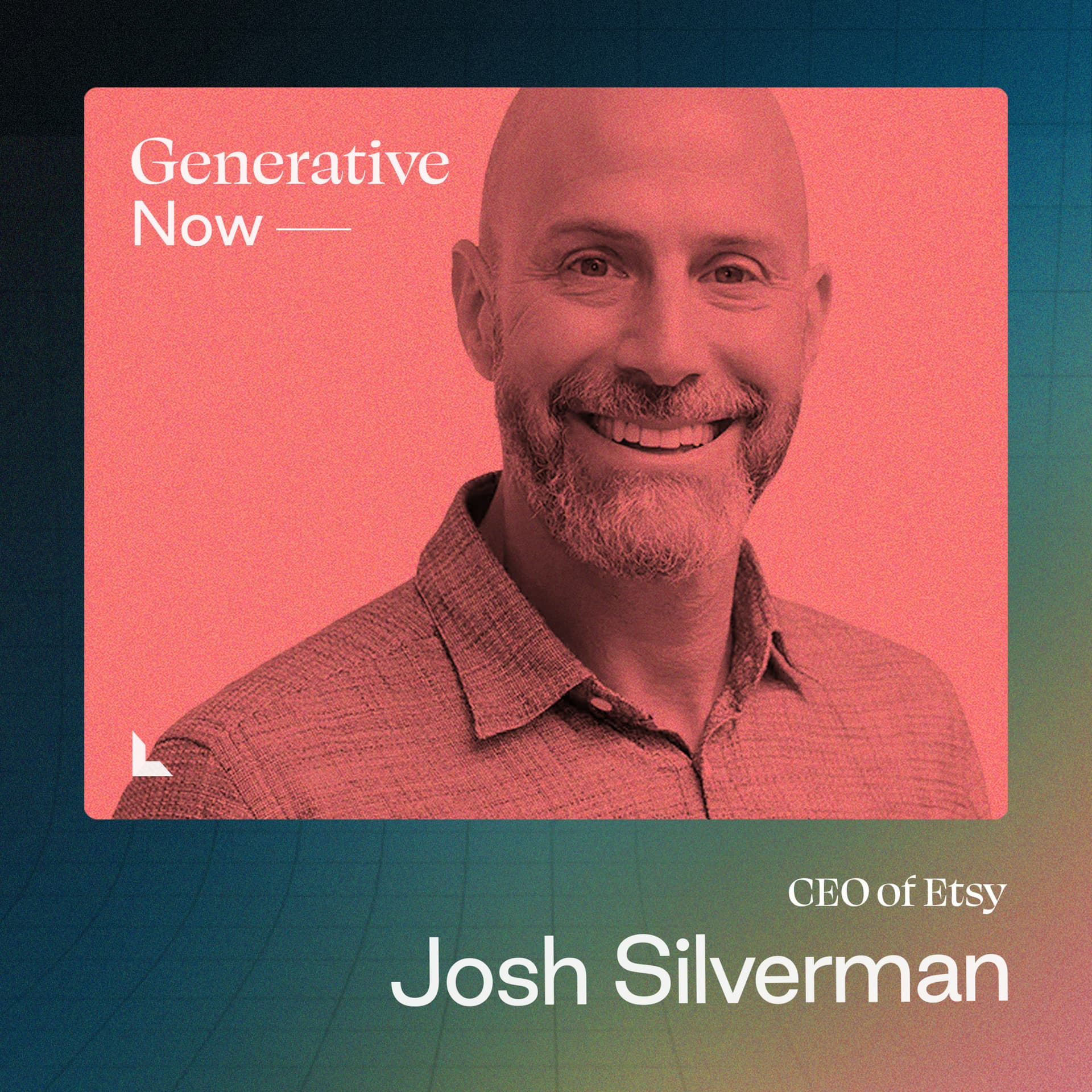
Generative Now Podcast Notes: Episode with Josh Silverman, CEO of Etsy
Episode Overview Title: Using AI to Transform Etsy’s Consumer Experience Description: This episode features Josh Silverman, CEO of Etsy, discussing the integration of AI technologies to enhance consumer and seller experiences on the platform. The conversation revolves around the balance of human creativity and AI capabilities, the mission of Etsy, and future trends in online shopping.
---
Key Themes and Concepts
- AI and Human Creativity
- The integration of AI can empower human creativity rather than oppose it.
- AI technologies can enhance the consumer experience by allowing for more personalized and human-centric interactions in commerce.
- Josh Silverman's Background
- Silverman has a diverse history in technology leadership, including roles as CEO of Skype, Shopping.com, and co-founding Evite.
- His experience offers insights into the evolution of technology, from the internet to AI.
- Etsy’s Mission
- Core Mission: To keep commerce human despite the rise of AI.
- Philosophy: AI at Etsy is viewed as a tool to enhance human connection and creativity, rather than replace it. The term "superhuman" is used to describe how AI can elevate human capabilities.
- AI Integration Challenges
- Consumer Readiness: Consumers may not be prepared to fully utilize AI capabilities yet. The technology may advance faster than consumer understanding and comfort.
- Experimentation: Etsy has experimented with AI interfaces (e.g., chatbots for search) but faced challenges in consumer acceptance and performance.
---
Episode Chapters
- Introduction (00:00)
- Josh Silverman’s Career (01:24)
- Discussion of Silverman's journey through multiple technology platforms.
- Etsy’s Mission and AI Integration (06:16)
- Balancing technology with human-centric values.
- Enhancing Search and Discovery with AI (08:36)
- AI's role in improving how consumers find products.
- Empowering Creative Entrepreneurs (15:27)
- AI’s potential to provide small business owners with tools to grow.
- Balancing AI Innovation with Human-Centric Mission (16:10)
- Strategies to ensure AI serves to enhance rather than detract from the human experience.
- Etsy's Engineering Culture (20:51)
- Emphasis on collaboration and democratizing machine learning for engineers.
- Audience Q&A (25:26)
- Discussion on various topics, including creativity, AI challenges, and consumer expectations.
- Closing Remarks (32:57)
---
Noteworthy Insights
AI's Role in Commerce
- Generative AI can help organize and filter vast amounts of data to enhance the shopping experience.
- The evolution from traditional keyword searches to context-aware AI interactions can improve user engagement and satisfaction.
Etsy’s AI Implementation
- AI has been leveraged for various purposes, such as improving search relevance and personalizing recommendations.
- The shift from basic machine learning to generative AI represents a significant evolution in Etsy's technological strategy.
Democratizing Machine Learning
- Etsy fosters a culture where engineers can deploy machine learning models without extensive oversight, enhancing innovation and agility.
- This approach allows teams to experiment and rapidly implement AI solutions to improve the platform.
Consumer Expectations and Future Trends
- As generative AI becomes more integrated into daily life, consumer expectations for online shopping experiences will evolve significantly.
- Companies must adapt quickly to keep pace with new standards set by emerging technologies.
---
Conclusion Josh Silverman's dialogue in this episode provides a comprehensive look at how Etsy is leveraging AI to enhance user experiences while maintaining a focus on human creativity and connection. The challenges of consumer readiness and the importance of engineering culture in implementing AI solutions are critical themes that reflect the broader implications for the future of e-commerce.
---
Stay Connected
- Follow Lightspeed: [Lightspeed Website](http://www.lsvp.com/)
- Social Media:
- [Twitter](https://twitter.com/lightspeedvp)
- [LinkedIn](https://www.linkedin.com/company/lightspeed-venture-partners/)
- [Instagram](https://www.instagram.com/lightspeedventurepartners/)
> Note: This content is for informational purposes only and does not constitute business or investment advice.
Written by AI. May contain mistakes. Listen to the episode to check what was said.
Transcript
Automatic transcript. May contain errors.0:27Hey, everyone, and welcome to Generative Now. the consumer and seller experiences alike. But first, a little bit on Josh's background. He is a leader known for growing consumer technology companies and scaling global marketplaces. He was previously the president of consumer products and services at American Express. He was the CEO of Skype. He was the CEO of Shopping.com. And he was also the co-founder and CEO of Evite, a company that is now a verb. Pretty impressive career. I spoke to Josh on the generative NYC stage. This is a meetup we do in person in New York City for founders and builders creating the future of AI, all hosted by Lightspeed.
1:04And if you weren't able to attend, you're in luck because we have the full interview here. So enjoy my conversation with Josh Silverman from Etsy. Without further ado, please welcome Josh Silverman from Etsy. Hey, Josh. How are you? How are you doing? Good, thanks. How are you? Good. Thank you so much for doing this. It's a pleasure. Sure. Maybe just picking up right where I was talking about you having had a front row seat to all these other platform shifts. It feels like we're in the middle of one right now. Some people feel like this is the biggest one yet. Throughout your career, what has it been like going through all these and how would you compare AI to the Internet, mobile, cloud computing?
1:45Yeah. Well, if I think back to the beginning of my real career in the late 90s, my co-founders and I started something called Evite. And it was based on a brand new platform technology called a browser. And there was this thing called the Internet that some of us thought was going to change everything and most people thought was nonsense. and it's funny to think now of all the skeptics in the late 90s but most people thought that's just a bunch of hoo-ha from a bunch of people in Silicon Valley and you know things went pretty well through the late 90s and a lot of people raised a lot of money and then it all crashed and there was a lot of schadenfreude of like see we told you it was all nonsense and this internet will amount to nothing after all which was what a lot of people thought from like 2002 to 2006 But what we were building back then, we were trying to, if I'm thinking about Tiny Little Levi, you know, we were trying to build something that would allow you to organize events and activities online.
2:43And we built this technology, which was kind of cutting edge in a browser to let you do things. But there were challenges. So many people you wanted to invite didn't have email. Most people didn't have broadband internet access, which caused the experience to be pretty inferior. And so a lot of people threw up their hands and said, see, I told you this can't be done, those were obviously very solvable problems. And the world would come around. It just wasn't solvable in the time frame of a year or two, allowing a lot of people to be skeptics. So where I'm going with this is obviously a lot of you probably are very passionate.
3:19You go to dinner with other people in the room and you say, we're going to change the world. This is incredible. And then you go out about your lives and you meet skeptics everywhere who say this whole AI thing is a bunch of nonsense. It's going to amount to nothing. And the reason is I used it yesterday and here's the reason it failed. So, you know, I do think that this is a massive platform shift. I do think it will change the world in some very powerful ways, and it may not just be quite on the same timeline. And thinking about where is this particular technology, where is the ecosystem around it?
3:53We had at Evite the ability to create events and activities, but a lot of people didn't have email. and then where is consumer adoption and consumer readiness and in my experience that's been the laggingest thing the technology gets there a lot faster than consumers know how to use and adopt the technology I'm sure we'll get there but that's what we're finding at at Etsy with Jenny there's so many wonderful ways to use it but when we just put a chat bot in front of a customer and say here's a way to search Etsy in a really interactive really context-rich way they're kind of like, ah, I don't know how to do that.
4:29I'm just used to typing in a few keywords and getting some search results. And so I think the technology is probably further ahead right now than where consumers are quite yet ready to be. How far ahead? Like, where do you think we are on the sort of hype cycle slope such that, you know, everyone we know is going to be interacting with AI the way maybe the people in this room do today? Well, I think it'll be partly generational, like what age group are we talking about, who's native to it and who's not. But if I'm going to go back to Evite and keep using that as a metaphor for a sec, because why not?
5:04In the early days of Evite, it was pretty geeky to send one. This was not paperless post. The people who were using the Internet at that time were very tech-forward people, mostly men, who were not terribly worried about what this invitation looked like. and our competitors got it wrong because they were all trying to create pretty customized invitations pretty customized invitations matter to people who care about their self image and those were not people who were using the internet in 1998 so I think that my 16, 17 year old son is native to Gen AI already, it is a very useful tool by the way and I love that he uses it for homework because it helps him to think about how to solve problems, and I think it's a very helpful tool like a calculator is for him.
5:56It's already pretty native to him, and for many others, it's going to take a little longer. But I think it's going to be a few years before people are really comfortable interacting with the technology. And a few years from now, the technology is going to be a lot further ahead than it is even today. For sure. Jumping into Etsy, Etsy's mission is to keep commerce human. I feel like many of the labs that are building in AI right now are trying to do the opposite, right? They want to build AGI. But obviously Etsy is leveraging AI. So how do you square those two things, right? Where the technology is doing something almost inhuman and your company's mission is to value the human above all else, right?
6:40Yeah, that irony is not lost on us. So in fact, we talk about being superhuman at Etsy. Not unhuman, but superhuman. And so to give some sense of scale, we have about 7 million sellers on Etsy, and right now about 100 million things for sale, serving about 92 million buyers. And every one of these 100 million things for sale on Etsy is a snowflake. It doesn't map to a catalog. And so we have to understand what is this thing, and then we have to understand you. What are you actually looking for? and not just the substance of the thing, because whatever you are looking for, we have 30 or 40 ,000 of those.
7:21And now of the 30 or 40 ,000, which are the 30 that we should put on the first page of search results? So like, what is your sense of style and taste? And that kind of much, much higher level abstraction of what is this thing? What style does it represent? What preferences do you have? Would have been literally impossible years ago. I remember when I was running shopping dot com in the early 2000s, someone pitched us on a technology that could look at a photo and tell us that that is a chandelier. And in fact, the style of the chandelier is Gothic or Art Deco or whatnot. I got that pitch. I remember that pitch.
7:59And I thought that is impossible now. And I was right. The technology back then was impossible then. But I was wrong that today, that's exactly what Gen AI can do. So it's enormously helpful for us. And it helps us actually to make commerce human. If we didn't have Gen.ai, if we didn't have AI, different tools, we use many, many different ML technologies, including Gen.ai, but if we didn't have this kind of machine learning, we never could match 92 million buyers to 7 million sellers. It's only because of these machines that we can actually keep commerce human. I have to imagine, given that Etsy has been a massive marketplace for a long time, You've probably been leveraging AI or machine learning for discovery for a while.
8:46How has the product in terms of search and discovery evolved and maybe the culture of Etsy's engineering organization to support that? Yeah, Greg. So we started leaning into ML in a pretty big way in 2016. Okay. And it's a very big part of our investment at Etsy. And, you know, we started mostly with the question of search relevance. And we've been on a real journey there. But the past three or four years in particular, we have made a ton of progress, in particular because of neural network translators. And so we weren't technically using Gen.AI. But understanding what you meant, not what you said, has been a very big part of our journey.
9:28And so when I write cocktail attire for men, our search engine in 2016 and 2017 would have looked for listings that include the word cocktail, attire, and men. And sport coat has none of those. Right? So we would have done a terrible job. In fact, one of the big problems we had, one of the most popular things you would search for on Etsy is wedding dresses. And when you search for wedding dresses, what you would find is page after page of wedding dress hangers. sounds almost exactly the same to a machine, doesn't it? And a hanger costs$3, and a wedding dress costs$100 or$500 or$1 ,000, so you're more likely to buy the hanger, right?
10:10So the machine's going to rank the hanger number one every time. So understanding that a wedding dress hanger is a totally different thing from a wedding dress has been revolutionary for Etsy, and that uses translator technology, which I'm guessing every single person in this room is sophisticated enough to understand what that is, and that's the basis actually of Gen.AI, most people on the street wouldn't. But that's where when people talk to me about Gen.AI, how is it changing your business? I always want to say, well, are you talking about machine learning generally or are you talking about this very specific technique of Gen.AI?
10:41Because they're related, but not entirely the same. So what are some of the new ways that you've been deploying, not just machine learning for the sake of discovery and search, but Gen.AI in particular? So one of the areas I'm really excited about is organizing search in a way that's much more easy to comprehend. Today, you type in a keyword on Etsy, and we vomit 10 ,000 listings at you. And it's just very hard to make sense of those. And so organizing those into a set of ideas. I'm looking for gift for mom for Mother's Day. Very common query on Etsy today. We have maybe five or six million relevant search results on Etsy.
11:23millions of very relevant search results. And if we can organize that into a set of here's 15 ideas, and within each of those ideas, here's four or five relevant results, then you can engage in a conversation with us, and we can start to really narrow the world down and decrease your cognitive load. I think one of the biggest problems all of us face in this world is the tyranny of choice. Everywhere we're going, we're being asked to make thousands of decisions that are not going to change the world for us. We don't want to spend an hour thinking about that decision, and yet we're asked again and again and again to do that.
12:06So part of our job in commerce is to try to reduce that cognitive load. It's a huge challenge or opportunity at Etsy. And so I think getting context through Gen.AI, I think can really help us to narrow the world a lot more quickly. We launched something called gift mode on Etsy, and that's a recognition that when you're buying for someone else, you're in a different mode than when you're buying for yourself. In a bunch of ways, one of which is you know a lot less about someone else. You probably know, like, two things. So if you can tell me two things about this person, I can give you ideas. I told this shareholder that the other day, and he said, Bitcoin and stake.
12:46And he thought he'd nailed it. And I was like, okay, we've got custom steak knives that I can stamp your Bitcoin logo into. I searched for it on Etsy, and sure enough, we had a T-shirt that said, I heart Bitcoin, but the heart was in the shape of a steak. So we had like three or four super relevant things for Bitcoin meets steak on Etsy. How's that been going with GIF mode? I mean, has it been solving a lot of these problems? What else can it do, leveraging AI? I think we're off to a great start with gift mode. So one of the big problems we're very focused on is obviously helping you to find exactly the right gift.
13:27Some other things we're working on in gift mode are less relevant to Gen AI. So, for example, the problem of last minute. It occurred to me today that I need to buy a gift for my wife's birthday, which was actually yesterday. But let's pretend it's tomorrow. Let's pretend it's tomorrow. So we have this gift teaser where we can send you something saying, I've just bought you a gift. It's amazing. You're going to love it. It's on its way and still make the date. Actually, one area that Jen, another area that Jenny and I is really helping us is there are millions of digitally created items for sale on Etsy.
14:04And we spent time thinking about does that count? because, as some of you know and some of you may not, the rules of the road on Etsy are you need to have made the item yourself with your own two hands or you need to have designed it and then made it in close partnership with a production partner or it needs to be vintage, more than 20 years. And so we spent time wrestling with this idea of if you made it together with Gen AI, does that count? And as we thought about it, given your Spotify background, I'm sure you've thought a lot about music and EDM, electronic dance music, is the most popular form of music in the world right now.
14:41And that's a human collaborating with a computer in order to create music. So I do think that a human collaborating with a computer to create art does count. And in fact, it's probably a lot of where art is going. One of the advantages of that is if I want to buy a gift for my wife, pretending her birthday is tomorrow, I can actually go on Etsy and there are artists who will create a painting or a sketch or using sometimes digital tools, a portrait of me, her and the dog that they can create in three hours, send it to me digitally. I can print at home and have a gift that same day. It's a great way to meet that need of last minute.
15:24And by the way, it feels super personal. Yeah, I have to imagine that generative AI and the ability to be creative in more easy ways is going to lead to an explosion of new entrepreneurs, creative professionals on Etsy and other platforms. Yeah, I mean, all of us can suddenly become creators, even if we aren't good at drawing or painting or whatnot. I think, you know, becoming a DJ is one of the most popular forms of being a musician. I think for young people out there, if any of you have teenagers at home, my hunch is one out of three of you, they've become a DJ recently. And that's a way to partner with a computer.
16:04Even if you're not necessarily dexterous or musical, you're not going to be great at the piano. know you have a way of creating creating music so I've heard you say that Etsy is not going to leverage AI for AI's sake and you're only going to use it in situations or products where it makes sense is that a difficult thing right now when everyone on the planet is pounding the table for AI right you've probably got customers asking for it maybe employees probably investors and earnings calls asking about it is that is that a difficult tension to balance as a CEO I don't think so I I mean, they'll love us when we win, right?
16:40So what matters is not what we say in an earnings call about what we're going to do. It's the results we put up at the end of the quarter, at the end of the year. And I do think there's a lot of ways that we can apply Gen.AI. So what we think about is what are the ways that are going to have the most impact to make our customers' lives the fastest better? And we have a finite team. We have finite resources. And so what are the problems Gen.AI can really help us to solve that are big problems for our customers? like organizing search results around ideas instead of just throwing a lot of listings at you I think is a good one.
17:13Even there, we have an experiment live on Etsy right now. So if you open the Etsy app, you can search using Gen.ai and you can engage in a conversation with Etsy chat. I want to buy a gift from my mom. Oh, tell me more about your mom. Oh, she likes this and that. And okay, great. Well, we have that experience. We had it as a default for about 19 % of searches that we saw as what we call high-effort searches. We defaulted customers into a Gen.AI chatbot experience, and they hated it. It was one of the worst-performing experiments we've launched during my entire tenure. But the problems were largely solvable.
17:54Latency is super high. We're always trying to improve latency by 10 milliseconds in search, and this was adding megaseconds, two or three seconds to latency on search results. We know that problem is going to get solved, right? It's just right now it's taking a little bit too long, and people aren't as used to engaging in that kind of dialogue. So now it's still live on Etsy, and it's probably slightly deleterious to sales, but it's live as an option on Etsy. But it's important that we keep doing it because we've got to learn. I know customer adoption is going to get there. Customers are going to learn how to use it, and we're going to learn how to present it to them in the right way and in the right place.
18:36And so that's an important investment we're making in the future. So Etsy sellers are referred to as creative entrepreneurs. And to me, that sounds similar to solopreneurs or SMB, small, medium-sized businesses. One of the themes that's come up in a lot of these conversations is how AI is going to empower SMBs, right? We're all of a sudden gonna have SMBs and individuals that are, you know, their businesses are worth billions of dollars, but it's only a person or five people, you know, as opposed to a huge organization. How do you think about that in the context of Etsy? And maybe, you know, are the sellers on Etsy basically going to have superpowers to build massively much larger businesses than maybe they ever previously could?
19:17I think so. And, you know, I think that's been a trend that's been happening for quite some time. So when we were getting Evite going, I'm going to keep harping back to that because why not? You know, we had a large team of people whose job was to buy servers and put them on racks. In fact, even in 2017, when I arrived at Etsy, we had a large team of people running servers. Now you just plug into whichever cloud provider is your choice, but that's an entire team of people you don't need anymore. In fact, debugging the Oracle 7 database was a huge part of what we were trying to do at Evite a long time ago.
19:49That's a solved problem now that you need to spend zero time and effort on. So many of the things that used to take a lot of time and effort that are not central to your particular business, We've now allowed you to outsource, and I think Gen.ai is going to do even more of that. So for our sellers that are succeeding in scaling, for example, answering conversations with customers is a big part of their job. And you want to do it in a way that's very personal, but they get the same question a lot. And so maybe some Gen.AI tools can help them to answer that same question they get a lot while spending more of their time actually potting their thing or whatever it is that they make, spending more time actually doing the craft.
20:37So I'm pretty optimistic, actually, that Gen.AI is going to give people more time back to put into the few parts of their business that are truly strategic that only they can do. Like making the products. Making the product, right? Yeah, which is what it's all about. I've heard that Etsy has a really amazing engineering culture. You've got a lot of engineers in the room. I heard about an issue called democratizing machine learning, where any full-stack Etsy engineer can deploy ML models. What's the back story there? Yeah, so we are very proud of our culture at Etsy and the engineering culture, which predates me.
21:12But I've been very proud to inherit and hopefully continue to nurture it. There's a few key parts of it, but one of the parts that was counterintuitive to me is at a time when everyone was talking about service-oriented architectures, I arrived at Etsy to find that we had one monolithic code base. There's a couple pieces that are run as services, but much of it is a monolith, which felt very counterintuitive to me. But what it allows is it allows pretty much any engineer at Etsy to touch any part of the customer experience they want. So we organize Etsy into squads. The squad's about eight people.
21:45And we give that squad a customer problem to solve. Shorten the time for a package to arrive by one day. It'd be a very common assignment we'd give to a squad. And the advantage of the way we're architected is that squad can go work on the seller side of the customer experience, maybe prompting sellers who've left too much processing time more than they need. Or they can go on the buyer side of the customer experience. They can kind of go anywhere they want because we've got a monolithic code base that they can all work on. Unlike other places I've worked before where this team is waiting for availability from that team, there's all these dependencies.
22:19And I want to ship my thing, but I've got to wait for this team to help, and they're not available to help me until next week. There's so much inefficiency in that. So at Etsy, I think we've gained a lot of, actually, efficiency. So we're always trying to democratize more things so every squad can work independently. One of the bottlenecks right now is I'm waiting for ML. Every team wants ML, and ML can be an amazing tool to make almost every single team's mission better. Actually, on that example of shortening time to ship by one day, we did have a new model that better estimates exactly how long it's taking packages to get from this zip code to that zip code, and that was a big win for that squad recently.
23:05So the ML teams are working on what we call paved paths, where they can create paved paths that make it so that a full-stack engineer with only a few days of training can utilize many of the most common ML techniques. techniques. And there's always going to be edge cases, very sophisticated things where they're going to need the ML specialists to come in. But for 80 % of their work, they're going to be able to leverage these paved paths in order to implement ML and then move on with their day. I think it's super fun and exciting for the full stack engineers who get exposed to a lot of the new technology.
23:40It's fun for the ML team as well, and it's way more scalable for us. It sounds really cool that anyone can ship to any part of the product for improvements. Do you ever have issues where maybe teams are working on the same part of the product at the same time and basically commits are sort of running into each other? Like what wins, basically? First, you know, the team has done a wonderful job on our, you know, building and architecting a site that allows lots and lots of squads to ship. Every hour we're shipping on Etsy. And the average squad ships twice a week on Etsy. So one of the rites of passage as a new engineer on Etsy is we try to get you to push code on your first day.
24:16And just in this habit of people are just pushing all the time. So we're quite good, actually, at DevOps and allowing many, many teams to ship at the same time. But the resource contention, every squad, many squads at Etsy are gold based on how much incremental GMS can you create. What that means is how much extra sales did our sellers make because of what you did today? And that's kind of every squad wakes up thinking, how can I help our sellers sell more stuff? And they've got quite a lot of license. Here's the customer problem you're focused on, but you can go anywhere in the experience to fix it.
24:50People pretty quickly realize that the high traffic pages are the pages where they can get the most bang for the buck. So for example, the search results page or the listing page or the homepage. And so we do have a challenge where many, many squads are all trying to improve the same page at the same time because that's kind of where the traffic is. And so we spend a little bit of time traffic cupping that, but honestly not much. I mean, you can pretty quickly just run some experiments, figure out what's going to yield the most bang for the buck and move on. That's fascinating. I could go on all night, but I know there are lots of people in the audience that have questions as well.
25:26So we're going to move over to audience questions. There are a couple microphones running around. If you want to ask a question, just raise your hand really high. Hey, I'm Rohit. I work at PortKI. One thing that's always made me very curious of Etsy is that it's all about creativity and creative entrepreneurs. And what makes creativity stand out was always scarcity. So that you've got these amazing creative entrepreneurs who are selling on Etsy. And it was scarce. With genitive AI, now creativity is getting democratized to some extent. And you've got so much more creativity that AI will start to produce.
26:04At Etsy, do you see that as a challenge, an opportunity? because it's a little bit of both, I guess. Yeah, I think our job, so first, great question, and it's something we struggle with a lot. But, you know, we've been talking a lot internally about quality and how do we make the very, very best things on Etsy rise to the top. And as we've dug into that question of quality a lot, what we've come to is originality, is a lot of what matters. Originality. And Gen AI helps us to determine what's original so we can map a world of every item on Etsy and look at nearest neighbors and how many near neighbors, and this is an audience that kind of understand this stuff more than many would, right?
Read the full transcript
26:45But if there's tons and tons of extremely near neighbors, maybe there's not a lot of originality in that. We can also start to look at at least who was first, right? And so at Etsy, there's always been a challenge that I create something and then six or 10 or 50 other people, if it's successful, copy it and sell it for one penny cheaper. We really want to reward people that were the first innovators of it. And I think Gen AI is going to really help us at scale identify what's original and what's just a copycat and then who was first. It also, I think, can help us to come to a better point of view around quality.
27:26Is this actually handcrafted or is it not. That's really hard. It costs 100 million items. There's kind of like no number of humans you could reasonably hire to do that. But actually, with modern machine learning techniques, we're getting better at trying to identify what, you know, for example, does the same item exist for sale on Alibaba or Amazon or Timu? And, you know, now if the same item exists on those kinds to marketplaces, we can presume it's probably not handmade, and we take it down automatically. That kind of technology would have been very hard. Does this same photo exist in these other places?
28:06Even three or four years ago, that would have been a really hard problem. Now, you know, Google's got an API for that. It's not that hard. The world's getting better. Hey, thank you for coming today. I'm Jason. I'm from Schmidt Futures. what is one thing that you feel AI or pretty confident that AI will not be able to help you with if anything to help us with it's hard to think of anything it can't help us with it can't independent there's a lot of things I don't think it now or in the near future will be able to independently do so it does still feel to us like we're a fairly far away away from having a machine tell us what is truly artisanal and the best of Etsy without some level of human intervention.
28:57It can serve up pretty good candidates, but the precision and recall is still not awesome, and it feels like it's going to be a while before the precision and recall of that is great. What are the hot trends right now? You'd think that's something that ML can serve, but there's lots of clickbait that ML still can't tell. This is an item that gets clicked on all the time, so you think it's a hot trend, but it's really just a bunch of sellers gaming the system by doing things to get a click. There's still a lot of these problems out there. There are just two examples off the top of my head, but there's a lot of these problems that humans just solve way better than machines, and I think it's going to be a while before machines solve those totally independently.
29:47But you asked a different question, which is where can AI not help? Honestly, I can't off the top of my head think of almost anything where AI can't help. I just don't think it's all of the solution for a bunch of things for a while. Thank you so much. My name is Zach. I work at Google within our commerce organization, so this was a real treat. My question is... Google's been a great partner. We appreciate you very much. Thank you. Thank you. The feeling's mutual. So I was curious, with all of this advancement in generative AI across many platforms, and the mass market sort of laggards, as you will, in adoption, how will adoption of generative AI impact what consumer expectations are for what a good shopping experience is once it reaches that mass market adoption.
30:44Consumer expectations change very quickly. It can be a while for them to get used to something, but once they're used to it, if you're not delivering it, you can disappoint them real fast. So when Wi-Fi got launched on a plane, it was the newest technology for about a week. And then if I couldn't instantly, respond to emails, you're like, what the heck? This is like a week old technology and you're already frustrated that it's not perfect. So I do think that, as I said, I think it's going to be a little bit for people to get used to how to interact with a chatbot and then if you're not offering that technology, people are going to get frustrated pretty quickly and they're going to go.
31:28I also think we're in a world where people have a lot of choice right now and they're liking to experiment. Habits are being reformed at this moment. And so there's a bit of a jump ball out there, and it's really important for all of us in e-commerce to be leading. Awesome. Thank you. Thank you. Hello, my name is Makai. I'm a founder. I'm building a company called Expanse. And I have a question for you. We've talked a lot about how customers, like customer-centric features with Gen.AI. Gen.AI has been in Etsy. where are you in both trust and adoption for Gen.ai in your workflow? Do you trust it to write your own emails, copy, ads, and all?
32:10We're medium high on adoption and very low on trust, I would say. So we are leveraging it in many, many parts of Etsy. We are using it on our trust and safety team to try to identify things that are fraudulent or likely to be fraudulent. We're using it in our search team in many ways to help make search better. But it is very rare that we trust it enough to use it without human supervision closely in the loop. And there are some places where the precision and recall is so high on it that it's gained, that we are, I don't want to say unsupervised, but less supervised in our use of it. In most places, it serves up a set of candidates that humans still intervene with.
32:56Josh, thank you so, so much for the time this evening. Everyone, can we please have a huge round of applause for Josh? This has been great. Thank you so much. Really appreciate it. Hey, everyone. Thanks for listening to Generative Now. If you liked what you heard, please rate and review the show on Spotify and Apple Podcasts. And also, please subscribe. If you'd like to learn more, follow Lightspeed at LightspeedVP on YouTube, Twitter, X, or LinkedIn. Generative Now is produced by Lightspeed in partnership with Pod People. I am Michael Magnano, and we will be back soon with another episode.
From the publisher
Human creativity and AI are often characterized as being at odds with each other. But as the capabilities of AI grow, so too grow the possibilities for empowering humans in creative endeavors.
This week on Generative Now, Lightspeed Partner and host Michael Mignano speaks with Etsy CEO Josh Silverman about the integration and impact of AI technologies in enhancing the consumer and seller experiences. He shares insights into his journey of scaling technology companies and the evolution of internet technologies, starting with founding Evite. Michael asks Josh how Etsy uses generative AI to keep human connection in commerce and empowering sellers and consumers. Josh shares the challenges and opportunities presented by AI in creative marketplaces, Etsy’s engineering culture, and the future of AI in enhancing online shopping experiences.
Josh Silverman previously served as President of Consumer Products and Services at American Express, CEO of Skype, and CEO of shopping.com, and he held various executive roles at eBay. Josh also co-founded Evite, Inc. where he also served as the company's CEO. He is currently on the board of directors of Shake Shack.
Episode Chapters
(00:00) Introduction
(01:24) Josh Silverman’s Career Spanning The Evolution of Technology: from Internet to AI
(06:16) Etsy’s Mission and AI Integration
(08:36) Enhancing Etsy’s Search and Discovery with AI
(15:27) Empowering Creative Entrepreneurs & SMBs with AI
(16:10) Balancing AI Innovation with Etsy’s Human-Centric Mission
(20:51) Etsy's Engineering Culture and Democratizing Machine Learning
(25:26) Audience Q&A: Creativity, AI Challenges, and Consumer Expectations
(32:57) Closing remarks
Stay in touch:
LinkedIn: https://www.linkedin.com/company/lightspeed-venture-partners/
Instagram: https://www.instagram.com/lightspeedventurepartners/
Subscribe on your favorite podcast app: generativenow.co
Email: generativenow@lsvp.com
The content here does not constitute tax, legal, business or investment advice or an offer to provide such advice, should not be construed as advocating the purchase or sale of any security or investment or a recommendation of any company, and is not an offer, or solicitation of an offer, for the purchase or sale of any security or investment product. For more details please see lsvp.com/legal.


