
In short
Podcast Summary: Generative Now | Lisha Li: Lessons on Creating Consumer AI Products from Creating Generative Games with Rosebud AI
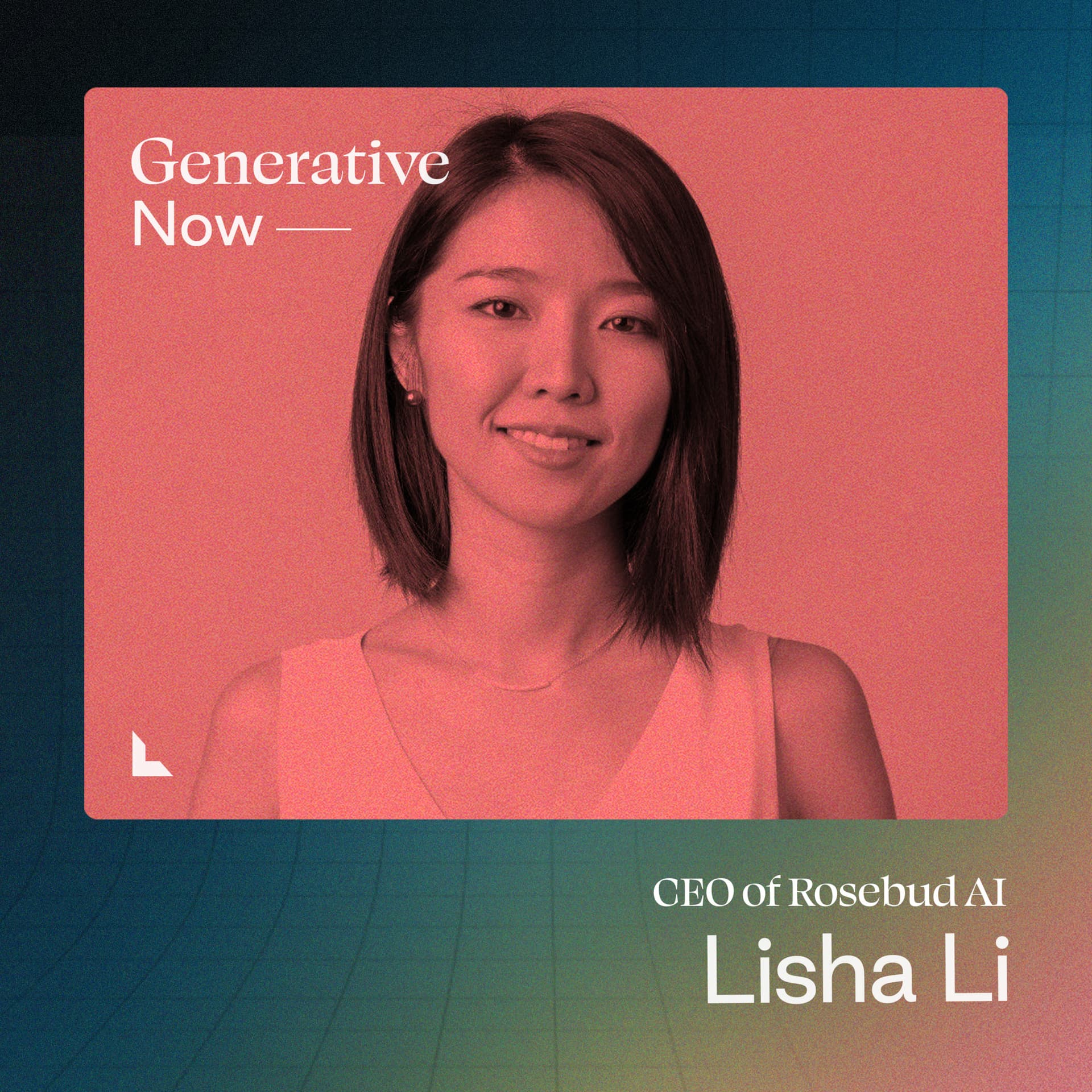
Episode Overview In this episode of "Generative Now," host Michael Mignano talks with Lisha Li, Founder and CEO of Rosebud AI. The discussion revolves around the development of consumer AI products, particularly in the realm of generative games. Lisha shares insights from her diverse career path, the evolution of Rosebud AI, and the future of AI in gaming.
Key Points Discussed
- Introduction to Lisha Li and Rosebud AI
- Background: Former principal at Amplify Partners, PhD at UC Berkeley in deep learning and probability.
- Rosebud AI: A platform enabling users to create custom AI-generated games.
- Lisha Li’s Unique Career Path
- Transition from academia to venture capital and acting.
- Emphasis on the intersection of art and science in her work.
- The Genesis of Rosebud AI
- Initial ideas focused on leveraging generative AI to democratize game creation.
- Evolution from stock photo applications to generative games.
Episode Chapters
- 00:00 - Introduction to Lisha Li and Rosebud AI
- 00:47 - Lisha Li’s Career: Academia, Acting, VC, and AI
- 07:54 - The Genesis of Rosebud AI: Creating a Creative Consumer AI Product
- 12:14 - Navigating Game Development with AI
- 17:43 - Democratizing Game Creation with Rosebud
- 31:20 - Building Rosebud's AI-Powered Platform
- 35:56 - Looking Ahead: The Future of AI in Gaming
Key Concepts
- Interdisciplinary Approach
- The blending of technical skills and creative expression is noted as a common trait among successful founders in the AI space.
- Consumer AI Product Development
- Importance of failing fast and pivoting based on market feedback.
- The focus on user experience and how generative AI can make game creation more accessible.
- Generative AI in Gaming
- The potential for generative AI to transform the gaming industry by simplifying the game development process.
- Emphasis on enabling non-technical users to create complex interactive experiences.
- Community Engagement
- Leveraging user-generated content and community feedback to enhance the platform and improve user experience.
- The importance of building a community around a product to drive engagement and retention.
- Future of AI in Game Development
- Anticipation of a shift towards more integrated AI solutions that can handle various aspects of game development.
- The potential for a new generation of interactive experiences powered by advanced AI models.
Insights and Takeaways
- Creating Value: Rosebud AI aims to create a platform where users can not only generate games but also modify existing games, promoting creativity and collaboration.
- Market Dynamics: Lisha discusses the challenges of competing against established platforms and strategies for attracting users through innovative game mechanics.
- Technical Framework: The use of a customizable agent framework to facilitate user interactions and generate code and assets for games efficiently.
- Hiring Opportunities: Rosebud AI is actively looking for machine learning candidates passionate about gaming and AI technologies.
Conclusion Lisha Li's experience and insights provide a fascinating glimpse into the future of gaming and AI. The episode emphasizes the importance of creativity, community, and continuous adaptation in the rapidly evolving landscape of AI-driven products.
For more details about Rosebud AI, listeners are encouraged to visit [rosebud.ai](http://rosebud.ai).
Stay Connected
- Website: [rosebud.ai](http://rosebud.ai)
- Discord: Engage with the community!
- Hiring: Check the website for job opportunities.
Written by AI. May contain mistakes. Listen to the episode to check what was said.
Transcript
Automatic transcript. May contain errors.0:05Hey everyone and welcome to Generative Now. I am Michael McNanno. I am a partner Lightspeed. You've heard about AI-generated images, videos, writing, and essays, but what about AI-generated video games? That's what we're talking about this week on The Pod, where I talk to the CEO of Rosebud AI. Using Rosebud, users can create custom AI-generated games with just a few lines of code. Alicia has a fascinating background that spans academia, venture capital, even acting. But now, of course, she's the co-founder and CEO of Rosebud. We talk about her career, the evolution of Rosebud in gaming, and the future of AI in general.
0:41So check out this conversation with Leisha Lee. Hey Leisha. Hey. Thanks for doing this. Yeah, of course. You just have like this really, really interesting background that spans academia, I believe acting, company building, VC. Like it seems like a really interesting story. So I'd love to hear your story before we get into Rosebud. My kind of guiding philosophy has always been like solve for what's interesting and that's changed by based on like what I've been exposed to, right? So I moved to the Bay Area in 2011 to start my PhD and before that I was based in Toronto, Canada. And I was always kind of like very intellectually kind of curious about certain topics around physics and philosophy and basically the intersection of those two.
1:25So my intent in coming to the Bay Area and doing a PhD was to be a professor. and how it kind of eventually, you know, came into, you know, actually starting a startup was just one, some exposure to, you know, internships at consumer-based startups here. And just realizing that actually building was a really nice way to combine both my technical and my more creative artistic interests. You know, you mentioned acting as well. It's, you know, I've definitely, done a bunch of things in the arts. So anyways, while I was here, yeah, I got to intern during the PhD at Pinterest and then also Stitch Fix and just realized, oh, wow, you can actually build products that reach millions, if not hundreds of millions of people.
2:07But also there were so many things interesting happening around deep learning at the time. You know, I was in Toronto around, you know, the time when AlphaGo actually released the results. This was like mid, you know, midpoint of my PhD. It was like, oh my God, this stuff is actually working. And so I realized that basically changing my, I guess, thesis from something in pure math to something more applied in deep learning would give me the opportunity to actually apply these new techniques to something that actually can affect the real world. And so I was much more interested in that given the exposure around here.
2:41Your experience is interesting to me because it blends a mix of of art and science. There's a natural desire to like separate these things. But when you talk to founders in the Bay or in New York or really anywhere, what I often find is a lot of these people have elements of both in their background. So so I was a founder, as we were talking about before we started recording. I'm a VC now, but I was I was a musician and I was I also, you know, did some some film and TV stuff. And and I think that's I think that's that's common. And maybe it's because startups and company building, they're also a mix of art and science, right?
3:18Like there's the science behind product design and obviously engineering. And then there's the art of product design and building things people love. So, you know, not surprised to hear that your background spans sort of all the above. What were you studying at Berkeley? You know, you talked a little bit about it in the beginning. Yeah. So when I first came in 2011, I was part of the math department. So that's where I was writing my, you know, it was a PhD program. I was doing pure math. But a couple of years in, when AlphaGo came out, Go is revered in East Asian cultures as its, like, incredibly creative pursuit.
3:54It's not just like, oh, you're, you know, machine solving problems or exhausting all the possibilities of, like, moves. You can't do that. And so it's very much, like, about creativity. And so I thought, wow, this is like kind of the first instance where we can program a machine and have methods to really have creative expression. I think one of the interesting moves in that famous, you know, five game showdown was just like AlphaGo actually made a move that was really interesting and people studied it and then it moved forth, you know, Go theory. So, yeah, I mean, to your point, it's just like I think, yeah, there was a lot of that kind of like creative and technical blend in a lot of founders.
4:34The creative impulse is also about expressing ourselves and sharing stuff. And so I think also in like product building, I think it's almost like natural design that there's that impulse in all of founders because it's not just about kind of innately analyzing something, but to like kind of put forth something in the world that other people can experience as well. How do you go from, you know, academia to dabbling with building products at super large scale and then going into venture before starting Rosebud? You know, I wrapped up my PhD in 2017. And, you know, at the time, there's very obvious moves you can make coming out of a, you know, technical degree of PhD in deep learning.
5:11You can join labs, you can like, you know, work as a researcher. I was always a little bit like, you know, a bit more kind of horizontal in my curiosity. And especially after I sort of tunneled vision in the PhD for like six years, I was like, okay, I'm going to try to go wide and explore. So my now husband, then boyfriend at the time, was at the GSB. I just got to learn a little bit more through some of the exposure there of like what venture capitalists do, because it's kind of black box, even if you're in the Bay Area. And so I got connected with one of the GPs at Amplify Partners, Mike Dauber, having gone and done a PhD in this area, actually could bring in a lot more kind of understanding and networks of people that they might be interested in connecting with.
5:51And so there's something I can bring to the table. And obviously, I can learn a lot more about what early stage venture is about, which is really just identifying, you know, what are really interesting people and projects to develop, you know, understanding and relationship with and see how you can be helpful. And I'm like, oh, actually, that's kind of that's kind of like a breath of fresh air from just tunnel visioning on my thesis all these years. So I ended up joining Amplify and I really enjoyed actually that aspect of venture. It was very much like, you know, and you'll you definitely know this.
6:24But like, it's it's very strange that the analysis part, I think, is quite small and much more of it is just like actually getting exposure to not that it's not important. It's just that you actually have to have exposure to the right projects and people in order to do in order to find the best deals. And that's really interesting because it really just meant that a lot of my time was spending like talking to who I thought was like interesting and doing really deep projects and where I thought the future was heading in terms of what kind of product should be built with this new tech. So that was great.
6:58However, you know, I didn't join with the anticipation that I would start a startup. It was just that about a year in, you know, taking us to 2018, we had the first results from StyleGAN. And before that, there was like very more trivial results out of like, you know, like generative adversarial networks that were really hinting at where generative AI can go. And to me, it was like, you know, at first I was like, OK, you know, I'm a venture capitalist right now. So I'm just looking for companies that are building interesting products with this. the more that I was looking for these things, the more I realized I was actually thinking about building it myself.
7:35And I'm like trying to seed ideas to people and, you know, doing that. And I'm like three months into that, I was like, okay, I think I kind of want to just try to build it myself because I don't know if it's going to happen in two years or 10 years, but I feel like generative AI was going to be, yeah, just instrumental to changing up content creation. I mean, what's really cool is because you had the benefit of being in venture at the time and seeing what some of the smartest people are working on. You had this insight, I imagine very few people had at the time that this was going to matter, right?
8:06You were like multiple years ahead, which gave you this unique strategic wedge into starting a company before everyone else. So that's awesome. I mean, at the time, like, did you, you knew you wanted to leverage this technology. Did you know how you wanted to leverage it? Like, did you have a vision for the product at the time? Or was it just like, I know this technology is going to matter. I want to be a part of it. I have to be able to build myself. And so I'm going to go start a company. Yeah, it was definitely more of the latter. It was very kind of almost like you have to have this foolish naivete, quite frankly, to have taken.
8:38Because everyone says you go and start a startup and it's going to be like five year plus journey, but you don't internalize that viscerally and think you can't because you have to kind of be naive enough to ignore that. And that's exactly, I think, the path that I led. I was like, okay, I don't know if it's two years or 10 years, But in my mind, I'm thinking, OK, definitely two years. So we're going to have to just jump on and do it now. So there's a there's a very stark sense of urgency. I had I had definitely concrete ideas of where I wanted to take the tech. But as you kind of see the journey in Rosebud, we definitely pivoted along many different verticals because, you know, this is kind of both a founder preference and then also what is venture scale kind of constraint.
9:18So the founder preference is that I don't I knew that I wasn't going to want to spend time doing a B2B type of startup. And that's not because, actually, it was really inconvenient for me that I didn't, because I feel like there's many good B2B opportunities. And I love kind of angel investing in B2B companies, because I feel like, you know, the risk is a little bit easier to underwrite, and you can really understand the use cases. But just for myself personally, I just like to think about consumer experiences. And what was really magical to me about Generative is how do you increase a creator class?
9:51So those were my general theses. Like, how do you make something that used to be technical far less technical or not technical at all? How do you kind of increase people's like ability to express themselves? And so there was a couple of different domains that I thought this was, you know, the tech was right for application. Obviously, the image generation side was the strongest in the beginning, especially if we're walking ourselves back to 2018, 2019. And so that's why I, you know, dabbled in areas where it's like, okay, image generation, where does that matter? Is it stock photos? Is it just like, you know, even in content creation apps on mobile like that, you know, obviously a lot of things kind of went viral there.
10:29So it was very interesting to kind of not only apply the tech, but force myself to think about UX experiences that are really magical. So that was fun. But the gaming stuff, it was always sort of like in the back of my mind in terms of that is a very deep vertical. and not every part of the stack is ready, right? So it's like, if it's just image generation for gaming, you're just going to be shoved into a corner sort of making assets, which is not that it's not lucrative, but it doesn't really attach to the, it doesn't attach to empowering creators. It's much more like, well, it's lucrative by like selling to studios.
11:06And so then you kind of get, you become a B2B opportunity again, which is perhaps, you know, a profitable endeavor, but doesn't change at all. the increase in creator class to like 100x number of people. So anyways, that's a long way of answering. You know, there were guiding impulses in terms of like what I thought generative was going to be powerful for in terms of consumers. But the verticals that they applied to were only ripe for application when the tech slowly revealed its hand in terms of how fast it was getting better. I mean, it makes a ton of sense, right? And I think like even pre-AI, there's a ton of precedent for this, right?
11:44Photos, obviously, you know, there's been technologies and applications over the past couple of decades that have made it far easier for people to express themselves creatively. Video, you know, platforms like YouTube and TikTok. But there are some formats, I think, per your point, that have, you know, massive consumer value today, even with them being really hard for creators to express themselves through. whereby if you imagine if you did make it easy for everyone to express themselves through these formats, they could become so much bigger. And so, yeah, I mean, like music comes to mind, comes to mind to me as one of them, but games are so obviously one of them.
12:21I mean, gaming is a gigantic industry, but very, very small number of people actually contribute the IP to this industry. So it makes a ton of sense. And I think that's really smart as sort of like you're an North Star for the business. So how do you go from sort of that general idea for the usage of a technology to landing on what the product is today? Like maybe take us through some of those twists and turns. You know, earlier on, because I knew that I was probably, you know, it's going to be a consumer company, I wanted to give myself an opportunity to really fail fast. And therefore I joined YC.
12:57That might sound counterintuitive. It's a good way to do it. I tried to make a stock photo product. I actually entered by making another mobile app. It was a way to use Gans to apply makeup to your face. But the underlying tech there is like, you want to be able to change anything in a photo to another photo. And I knew that that paradigm was going to persist. And so if you start with makeup, you know, maybe that was, you know. So that's kind of how I got into YC because I had a working mobile app that I made. But then like quickly within YC, I was like, okay, this is interesting. but, you know, I'll keep the tech that I made there and I'll transfer it to other things, which eventually became talking heads.
13:33But it wasn't, it wasn't like a very, I think, a big use case that would, you know, entrench itself in a vertical. You end up selling to makeup companies, which is like not super interesting. There probably was some precedent for this though. I mean, even just focusing on sort of photo editing through AI, you know, beauty. I mean, I'm thinking about products at the time, which I don't, I don't think leveraged AI like facetune, right? So you have to imagine if you can take this behavior of so many people taking selfies and, you know, changing the way they look and applying AI in it. I feel like there could be some opportunity there.
14:08At the same time, I've heard, I've never done YC myself. I've heard YC is a great forcing function for figuring out the market you want to play in and maybe ditching and pivoting away from your first product quickly. So that also makes sense. Yeah, yeah. No, you're totally right. The reason why I was trying to make a product in that area was that I saw Facetune and some of these selfie editing apps having so much traction and they were using classical techniques. So it was like, well, there's obviously a way to kind of add AI, not just as a sprinkle of flavor, because it actually enabled people to do more photo editing in an intuitive way.
14:44so as a kind of like technical ux exercise it was super useful because i'm like nobody was deploying things uh like gans and prod at the time so there's no you know like replicate of the world you know to to deploy these models you have to figure out how to do it so i get to like transfer those technical skills but then two it's like the ux is like kind of underspecified as well so that was interesting but yeah to your point like i guess what i was realizing when exploring in the you know, mobile app space is like, okay, what, you know, how do you get verticalized? So you're not sort of, um, you're just not sort of like this feature, this photo editing feature, because I think especially coming from a VC background, I was like, I don't want to build a lifestyle business.
15:28I can see how these things get to like maybe around 10 million in ARR. Not that I was anywhere close, but I'm like, I could see a path there. But then I also see that these things can get pretty saturated. And so that's kind of what gave me a reason to abandon certain types of directions where I just like, I didn't see a reason why this would depart from being a feature of a photo editing experience. So a lot of the mobile experiments that I did were of that nature. Same thing with talking heads. That was something where we made a meme app to animate photos of somebody's face. It was actually really endearing that people ended up using it for, you know animating nostalgic photos of their like past loved ones and so just being able to learn how to do viral loops there and you know have like photo attribution of like where you know the app that made this like that was like again like a great exercise in like ux and viral loop design but at the end of the day i'm like well a lot of people could end up you know releasing the same feature and so there's no way to really grow this into something really massive and so i took the learnings that I had, which is like, you know, all this distribution learnings, how to actually deploy these models, improve it, whatever, scale up, you know, deployments in the cloud for inference.
16:46But I was like, okay, but if the goal is to increase kind of the creator class for content creation in an area that's like really entrenched, I don't think this is the final form factor. So I had to leave it, even though there was positive, there was definitely profit from the app. And we still run it because it's like, it's profitable and we just don't have to do anything with it. Talking heads. And it sounds like even the first products were, were pretty magical, but you're essentially outputting a format that you can't capture any proprietary value from, you know, like you said, it's a meme or a photo or a video that probably then travels on someone else's platform, right?
17:24Whether it be like messaging or TikTok or, I don't know, Snapchat. And so, yeah, I can see why maybe that wasn't inspiring enough as a potential outcome for you, whereby what I understand about Rosebud now, and I would love for you to explain it to everyone, like you're building a platform now where you capture value on the creation side, on the demand side, and then it seems like there's opportunity to build on top of it as well. So, yeah, tell us about how you then get to gaming, right? Because, yeah, it seems like a big shift from what you were doing before that. Absolutely. So, you know, the length of time before, between, you know, talking heads and gaming, image generation got a lot better.
18:09But slowly, but surely, next token prediction got incredibly impressive. And that led to, you know, to extraordinary results in code generation. And so by the time that, to your point, if we're just building features that are decoupling photo editing in Adobe, I think there are some winners that are massive there, but it's far smaller. And so I just didn't see a huge opportunity to become deeply entrenched in the creative process. Whereas once I saw cogeneration get better, I was like, OK, this is really interesting now. Because in gaming, it's not just about producing assets, it's about the entire process of making a game.
18:45And so there was an opportunity to go after the giants, like giant UZC platforms like Roblox, you know, whose business model is not just about charging as a developer tool. It's about like capturing the entire kind of like economy of like, you know, producing games and then players of games. And so that became incredibly interesting. You know, Roblox is a really good maybe anchor or comp for what are the larger economic opportunities here. But also I think what's changing is, you know, it's not like you're producing the same games as Roblox anymore, too. And so for somebody who's like not really like traditionally a gamer, but somebody who wants to create interactive experiences.
19:26And I can get into like why Rosebud is called Rosebud. It's a reference to the Sims and the cheat code. But like just to kind of give a flavor of like why I was, you know, captured by this idea of making games. But it's just that Roblox, you know, can make us, they were able to do this pre-generative AI because they're very opinionated about the type of games you can make on Roblox. So it's like this easy to use physics engine that you can create a certain type of game. And then as a result, UGC was easier for that type of game. But like with generative, that is far, it's a far wider class of stuff because you're getting co-generation to, you know, in a fully fleshed game engine.
20:04And then also you're plugging in not only just traditional components of that game engine, but like say the rendering engine could be completely replaced by generative methods as well. So like how fast that's moving also presents a amazing opportunity for startups because the incumbents just like can't rip out huge swarts of their technical stack fast enough. You know, as much distributional advantage as they have, like it's just going to be very difficult for them to adapt. And so then it just became like so obvious as like, despite all of the disadvantages startups have, this is the time to be kind of like diving into, you know, trying to replace the massive UGC platforms of today.
20:41But the content itself, like it's pretty robust, right? Like not only are you giving anyone the ability to make a game, but there's also like there's there's code as well, right? Like it's generating code that then the creator of the game can go in and modify it to go a layer deep or some other engineer or builder can go into to modify the game on a deeper level. Is that right? Yeah. Yeah. And like the modify part is actually really key here because, you know, we're generating code, the code trying to take more of almost like an open source type of analogy where it's like then you publish on the platform.
21:14somebody can actually take that, fork it, and mod it. These are all kind of developer terminology, and really we're trying to make it accessible to even people who can't develop. But the developer terminology here is app because it really allows you to mix and match creations a lot more quickly. And so previously, there's already a lot of desire in the gaming community to mod stuff. And so this is why mod communities, they produce very interesting new games that are successful. And that's because that's the only way for, I guess, players to participate in the creation process. But now with generative AI, it's like you can do a lot more by quote-unquote modding existing games.
21:53And if you kind of design your platform to make that easier, then you're gonna really be able to benefit on whatever creations are already in the platform and have that combinatorially explode. Totally. You're taking a whole practice that would technically be very, very difficult for a non-engineer to build, and you're not only giving them the tools, but you're giving them the ability to fork other people's work, to be inspired by other people's work. It's really, really cool. I think what else is really powerful from what I understand is you're leveraging AI for multiple aspects of game development.
22:28So you're using it for generating scenes, generating characters, creating NPCs for how they interact. So you're really getting leverage from the AI for every aspect of game development, if I understand correctly. Yeah, exactly. The thing that we're trying to solve for is just, if you want to make a game, how do we make that journey easier for you? And so having it kind of live in one place is great. People can actually generate assets in other places and upload. That's fine as well. But if you haven't done that, then there are custom models we've made on Rosebud that allow you to kind of quick start.
23:04It's just like, how do we reduce that time to magic as quickly as possible. So it serves that purpose. And the other thing is, because we've chosen JavaScript as the programming language here, which is not traditionally great for gaming because a lot of the classical pipelines, like whatever, Unity, Unreal Engine, they're based on compiled languages because they have to worry about optimization. But JavaScript is actually quite adaptable to a lot of the new generative techniques because it's dynamic, obviously. And then you can actually add in a lot of the in-game generation, or if you have to rip out certain parts of it, you can do that because of how the language behaves.
23:47So that's to your point about why are we able to add different generative methods to the whole process? It's because we're doing this browser-based approach. I imagine that for aspiring game developers, this is like a no-brainer. like the value prop is so clear um but i also imagine you run into the same challenge any you know sort of two-sided marketplace runs into sort of you know chicken or egg you know i'm people are coming to create the supply but demand is super hard when people are already playing games on a ton of other platforms whether that's you know games on their iphone or android device games on Steam, you know, their consoles.
24:33Like, how do you solve the distribution problem so you can create this flywheel that keeps the creators coming back? This is not particularly degenerative AI, but like in terms of like all UGC platforms, there's some sense of like, what are the incumbent maybe creators that already have some distribution? What are they not satisfied about? And then you try to, you know, appeal to them. So there's a little bit of that. But actually there's something else that's kind of really interesting what's happening in terms of like, can we ride a wave that exists, that kind of looks like gaming, but doesn't, that isn't really being addressed or can't be addressed as well by incumbents.
25:11And so, you know, when Character AI came out last year, I think what was really interesting to me about it is, like, one, it has an incredible amount of traction organically. Two, it wasn't just because it's not safe for work, right? So it's like in the beginning, I think there was some issues because it was just like not safe for work. So nobody's maybe surprised by that. But then they try to fix that problem. And it still has it still has some, you know, it still has attractive traction. And so then you start seeing other apps kind of spring up that tried to imitate like what was like perhaps, you know, attracting or retaining users there.
Read the full transcript
25:47I think part of that is just like having an LLM that creates really compelling characters that have relationships with, you know, people. And I just don't, I don't mean that just in a romantic sense. So I, so what was really interesting to me about that is like, okay, that's obviously a mechanic within gaming, like just developing really compelling relationships with NPCs. So what can we sort of use there that there's obviously a wave for some level of organic growth, but as a seed to build up like more AI native mechanics that is just like a very different type of flavor game than what the incumbents already do well.
26:23And so that kind of is our general strategy for distribution. It's like, let's try to dog food our own game engine to create a bunch of games that are, you know, that are in this like new area that could attract users. But because we've built a game engine that should be easy to use, we can actually scale those games up ourselves. And that doesn't look very different from like what Roblox did even in their early days. Like they had to like dog food their engine a little bit to create a bunch of games that could go viral. So it's a similar strategy, but like a different type of constraint. And then just try to actually, you know, gain users that way.
26:59So that would be the general strategy. And kind of right now we're executing on that as well. You're leveraging the platform as Rosebud, the company, to build like the best examples of games that could be made on this to drive interest in the platform. And then some percentage of those game participants end up creating themselves. Is that kind of the way to think about it? In order to gain players, you'll have to do that. Before, when we were just focused on building a game engine that was good enough to attract no-code users, we didn't actually dogfood our engine at all. We just kind of let the users build stuff.
27:35But to your point, it's a chicken or egg problem because I think what people build is very interesting, but it's not necessarily going to attract maybe a ton of users. And so you also want to be more opinionated about what will attract users and try to dogfood it so that you can test it out in those domains. And what are the types of games that are resonating most with people? What has surprised you and what has maybe gotten the gamers, the players most excited? On the player side, since we haven't really pushed on that yet, I think it's a little bit harder to assess at the moment, though I can talk about what we're trying to make more of.
28:17um but that's like pre you know pre-player data but the the creators like I've actually just been really charmed by what people were making because it was a lot better than what I was like doing um just by myself on Rosebud um it I think what I was so super impressed by and you could kind of like you know see this but based on what we've um pushed out onto you know in trending in our platform is people have really pushed our game engine to its limits like they would do a lot of like hacky stuff to to make sure that like the projects can be incredibly long and complicated and so um the things that you know you have your um you can like create some pretty i guess almost like polished looking games um on rosebud already so it ranges from these like top-down rpgs to like um these uh uh like you know you have like different shooter type games but then also like things with incredible storytelling.
29:18So like I get really excited when people don't have a background in coding, they start using Rosebud because they were artists in some regard, like they were sound designers or they created their own assets, but wanted to like put storytelling behind it. And then they end up making something that just feels incredibly like atmospheric and it draws you in, you know, entirely because they're really good storytellers, but now they finally have a tool to like make it an interactive experience. And so we have a couple of those that are on the platform that I'm like, oh, wow, I'm clicking through and really enjoying it myself.
29:53So I think those things have a lot of potential. But now as a team, we need to do our part in also drawing in an audience so that more people can enjoy those things. To that end, I wonder, would you ever let somebody or let creators distribute these games to other platforms so they get that audience? or is it really important to you that the audience exists specifically on Rosebud? It's a great question. So one of those platforms, I think that makes sense for us, are like, you know, there's like itch.io where people are publishing games, but you can actually publish an iframe. And so there's some like way to kind of bring them back to Rosebud as at least a tool that people can use.
30:37I think in terms of like publishing as a formal game on say like Steam, it becomes a little bit more tricky because there's a little bit harder of an attribution kind of coming back because we're not charging the developers to use the platform yet. And we haven't figured out what's the right, I think, balance there because there could be a freemium option, but really we just like want to actually have people come to the platform and also play the games and be able to kind of clone it. So it is important that they come back. I guess we would allow publishing if there's some way to kind of like come back to Rosebud.
31:09But one way that we're addressing this is we've released a mobile app ourselves. And so there's like different ways that we can try to get people to come and find us from a player angle. Yeah, that makes so much sense, right? Like you're trying to enable and democratize an existing behavior. And so you don't want to charge creators for it. You want to reduce the friction as much as possible. And so if you're going to distribute to other platforms, you just want to make sure you have that flywheel. So it makes total sense. One thing I'm really curious about sort of from the technical side, Like, how are you doing all this, this generative AI work?
31:45Like, are these your own models powering, you know, character development, NPCs, the worlds? Like, what, like, are these, are these your own proprietary models or are you leveraging, you know, GPT-4 to do NPC conversations? Like, how does it, how does it all work? It's a combination of both. Um, so the, the, the important thing is we're, we actually need to like make an agent framework work underneath the hood. So if you think about, like, let's talk strictly about the creator experience right now. So it's prompt based. So if a creator comes in and they ask our, you know, chatbot, which the community has coined Rosie.
32:24So they ask Rosie, like, hey, you know, I want to make this type of game or I want to like, you know, have some ideas for like how to do this. Like what we have to figure out underneath the hood is like, hey, does this person want Rosie to generate code? Do they want suggestions? Do you want to like break some like a plan down? And a lot of users are actually they tend towards the conversational, which is great because like the thing with these agent based frameworks is you have to kind of get to a level of certainty and feedback of like what you should do. You can't just like come in and be like, OK, they just wanted to generate an asset.
32:55And then it was like not even close to what they wanted to do. So anyway, because it's a framework, it uses many different models. So when it is generating code, at the first splash, you can use something like GPT-4 or maybe Claude, and you can test all of these different endpoints. But at some point, you also run into issues with just using those to generate code, because you want to do something a bit more custom with the game engine. So for instance, if we're basing this on, say, an open source game engine like Phaser, we want to be able to parametrize different aspects of that game engine and have the LLM sort of in a customized way use different parts of the game engine to actually generate the right stuff for the user.
33:40And so there's another layer of customization there as well. You're almost like creating a domain-specific language for the LLM to kind of speak to. So you don't have to interact at the level of just JavaScript code generation. So there's a lot of different fronts we have to improve there. And the ultimate goal that kind of brings it all together is when a user asks to make a certain type of game, how successful are we at satisfying that request and getting the rosier chatbot to actually kind of converse and get to the right answer for them? You know, as a team that's building in this space and clearly, you know, based on what you just said, leveraging a lot of the stuff that's being that's being built by the broader market in a space that's moving so, so fast.
34:22Like, how do you both keep pace with that and make sure that you're able to leverage all the stuff that's that's coming out in ways that are additive to the product? I mean, it must just be like completely disorienting for for any team in this space right now. Yeah, the exciting stuff is that you're really at the forefront of like, how do you use and improve evals of, you know, both open source LLMs and, you know, stuff that you've, you might have fine tuned yourself. And so what I mean by that is like, there's actually a lot of, like, I guess what's exciting is like, you're really trying to build a lot of moat by having your own users give you better, give you like a better distribution to eval on.
35:05So for instance, you might have some preconception of like what are good code game code generation evals, but they might not approximate actually what your users really want to do. And so you can take that user prompt data and then translate that into like much better evals. And so you're constantly trying to evaluate what the best models are and how they perform against these like evals for what you're getting like real user data to create. So that's actually really exciting for us. And I think the entire space in terms of like assessing B2B companies that try to solve this problem is also interesting for us because like we don't want to be building everything in house.
35:42And so it's a lot about like, okay, these are the real problems that application AI application companies are facing right now. Are there good tools out there that enable us to do this faster? So yeah, that's an active problem that we're working on. You know, we talked earlier in the conversation about how you kind of had this ability to see the potential of this technology coming before anyone else did. And that was one of the reasons you wanted to start this company. What are you seeing now, maybe even outside of what Rosebud is doing and what, you know, what tools Rosebud is building with that gets you really excited?
36:17Like, what are people not paying enough attention to right now in the broader AI space that we all will be paying attention to, say, a year from now? You know, code generation is the structure and a very kind of powerful path to doing a game creation. But what's, I think, really interesting is how much that might also be completely subsumed under a just like one generative model. I don't know if we're close to that future as in the next year or two, but I feel like that's kind of the inevitable path. Um, and so just to, just to be very precise here, I'm not saying models like Sora will replace the game engine because that's actually, it's, it's still very different, but I am saying that there's some probably larger model that kind of ends up becoming a much more, um, coherent, like world model for creating interactive experiences.
37:13And so in anticipating some of that kind of like future research, you know, part of what I'm doing at Rosebud is also striking a very active relationship with academia, co-advising PhD students in certain universities to actually try to do that kind of research. and so that we're ready to apply that stuff when it becomes possible to use it in prod. More and more of that pipeline gets subsumed under just like a model and its like weights rather than us kind of just pasting in different aspects of like features and then kind of, you know, adding models as a feature set. You have to really think about like how does it replace the entire pipeline?
38:01So anyways, that's exciting for startups because it really makes it hard, I think, for incumbents to try to adapt that quickly. but it also makes it hard for startups because you have to try to anticipate a lot that can change. Leisha, where can the audience go to learn more about Rosebud and what do you recommend they all check out? And of course, are you hiring? And where can people find out about hiring opportunities at Rosebud? Thank you. So just go to rosebud.ai. That will lead you to both play.rosebud.ai, which is where our games are featured and where you can just get started creating a game.
38:37We're removing the closed beta soon, so you should be able to get started. If not, just go to the Discord, introduce yourself, and you'll be able to use it. And then in terms of hiring, absolutely. We are looking for excellent machine learning candidates, obviously, who are interested in making games. And so I think our sort of unique, I guess, strength there is just like you get to, if you're passionate about making games and you want to see LLMs and other generative techniques being used in prod, in this way, then definitely check out our product and apply. And that information is all at risva.ai as well.
39:13Awesome. Leisha, thank you so much for doing this. This was fascinating. I learned a ton. I'm sure the audience did as well. Yeah, thank you. This was great. I love the conversation. Thank you so much for listening to Generative Now. If you liked what you heard, please do us a favor and rate and review the podcast on Spotify, Apple Podcasts, and also please subscribe to the podcast. That stuff really helps. And if you want to learn more, follow Lightspeed, Lightspeed VP on YouTube, Twitter, or LinkedIn. Generate Now is produced by Lightspeed in partnership with Pod People. I am Michael Magnano, and we will see you next week.
39:46Thanks so much.
From the publisher
This week on Generative Now, Lightspeed Partner and host Michael Mignano talks to Lisha Li, Founder and CEO of Rosebud AI. Rosebud AI allows users to generate video with a few simple prompts by leveraging AI for every aspect of game design. Lisha shares her diverse background from academia to venture capital and acting, leading up to the inception of Rosebud. Michael and Lisha talk about lessons learned when developing consumer AI products and the different iterations of Rosebud AI and its evolution including stock photos and the viral app TokkingHeads.
Lisha is the Founder and CEO of Rosebud AI. She is a former principal at Amplify Partners. Lisha completed her PhD at UC Berkeley focusing on deep learning and probability applied to the problem of clustering in graphs. While at Berkeley she also did statistical consulting, advising on methods and analysis for experimentation and interpretation, and interned as a data scientist at Pinterest and Stitch Fix. She earned her Master of Science in Mathematics at the University of Toronto, with Highest Distinction advised by Prof. Balazs Szegedy in the area of Graph Limits.
Episode Chapters
(00:00) Introduction to Lisha Li and Rosebud AI
(00:47) Lisha Li’s Career: Academia, Acting, VC, and AI
(07:54) The Genesis of Rosebud AI: Creating a Creative Consumer AI Product
(12:14) Navigating Game Development with AI
(17:43) Democratizing Game Creation with Rosebud
(31:20) Building Rosebud's AI-Powered Platform
(35:56) Looking Ahead: The Future of AI in Gaming
Stay in touch:
LinkedIn: https://www.linkedin.com/company/lightspeed-venture-partners/
Instagram: https://www.instagram.com/lightspeedventurepartners/
Subscribe on your favorite podcast app: generativenow.co
Email: generativenow@lsvp.com
The content here does not constitute tax, legal, business or investment advice or an offer to provide such advice, should not be construed as advocating the purchase or sale of any security or investment or a recommendation of any company, and is not an offer, or solicitation of an offer, for the purchase or sale of any security or investment product. For more details please see lsvp.com/legal.


