
In short
Generative Now Podcast Episode Summary
Podcast Overview Title: Generative Now Host: Michael Mignano Description: A weekly series from Lightspeed focusing on AI companies and their impact on work and society. The podcast features interviews with entrepreneurs and innovators shaping the AI landscape.
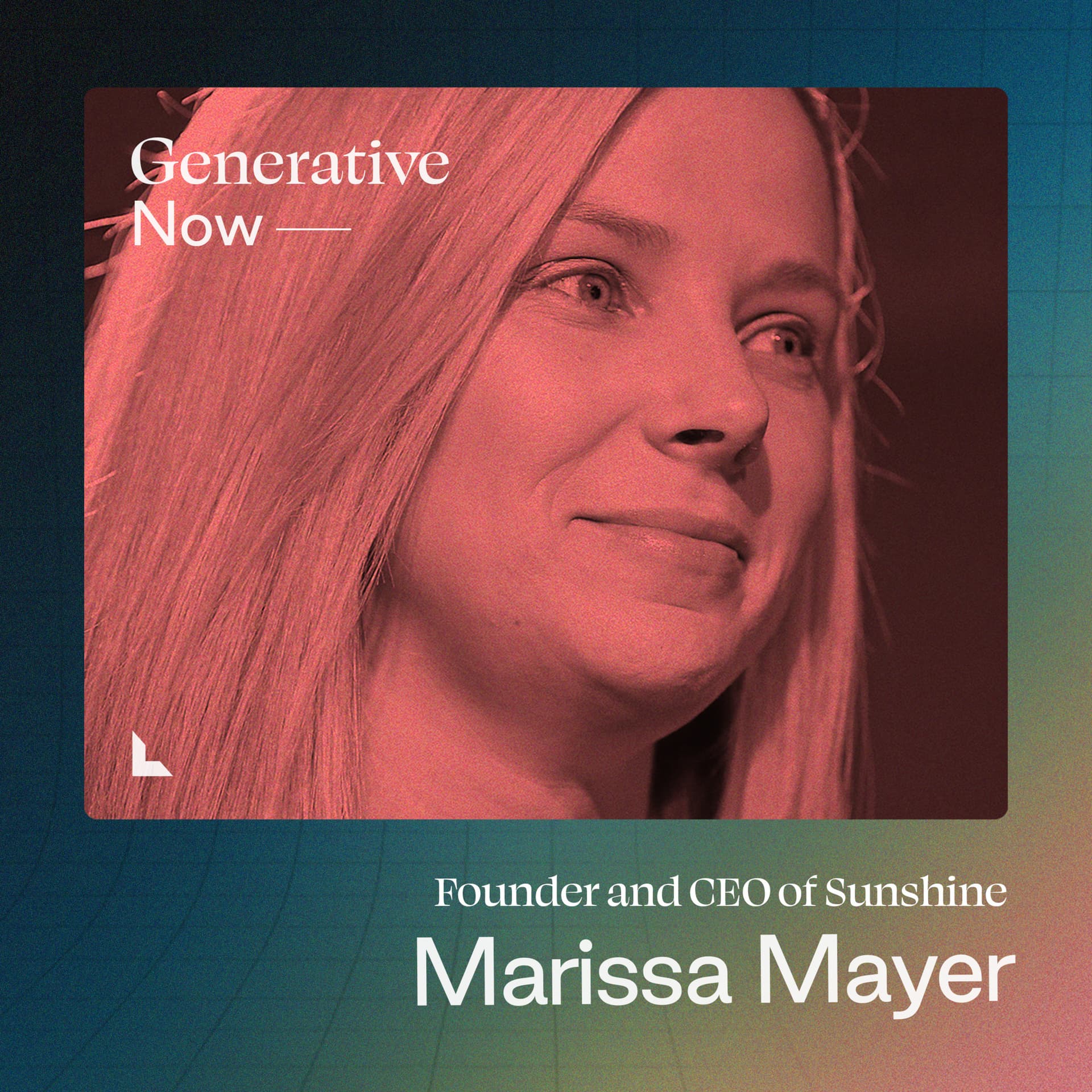
Episode Title Marissa Mayer: AI to Make the Mundane Magical
Episode Description Marissa Mayer, co-founder and CEO of Sunshine Products and former CEO of Yahoo!, discusses her extensive experience in consumer technology and AI's potential to transform everyday tasks into magical experiences. She reflects on her career at Google, her views on AI's evolution, and the vision behind her new startup.
---
Episode Chapters
- (00:00) Introduction
- (01:23) The Evolution of AI: Learning, Reasoning, and Expressiveness
- (05:22) Scaling Laws and the Future of AI
- (09:00) AI's Impact on Business and Team Dynamics
- (14:47) The Future of Search and Advertising
- (19:52) Sunshine: Making Mundane Tasks Magical
- (24:04) The Future of Advertising in an AI World
- (35:39) Looking Forward: The Future of AI and Sunshine
- (37:55) Closing Thoughts
---
Key Insights and Discussions
Marissa Mayer's Background
- Career Highlights:
- Early employee at Google, worked on major products such as Google Search, Gmail, and Google Maps.
- Served as CEO of Yahoo!, modernizing the platform for mobile.
- Currently CEO of Sunshine Products, focusing on AI-driven consumer technology.
AI's Evolution
- Three Pillars of AI:
- Learning: AI's ability to learn from data.
- Reasoning: The capacity to abstract and formulate inferences.
- Expressiveness: The ability of AI to communicate and express itself effectively.
- Observations:
- OpenAI's ChatGPT demonstrated the power of expressiveness, capturing public interest and showcasing potential applications of generative AI.
Scaling Laws in AI
- Current Landscape:
- Scaling laws have been a significant factor in AI advancements but might be approaching limits.
- The existing models may soon reach a plateau in performance due to finite information available from the web.
Impact on Business and Team Dynamics
- AI's Transformative Role:
- AI technologies are reshaping user behavior and expectations across industries.
- Companies that adapt quickly to these changes will thrive, highlighting the importance of teams that can leverage AI to enhance productivity.
Advertising and Search
- Future of Advertising:
- Advertising remains essential, but its format must evolve alongside search technologies.
- New AI tools could enhance personalized experiences, reshaping the ad landscape to align more closely with user intent.
Sunshine's Vision
- Mission of Sunshine Products:
- Focus on transforming mundane tasks (e.g., photo sharing, contact management) into enjoyable experiences through AI.
- Current product offerings include Shine (for photo sharing) and Shine Events (event organization).
- AI Implementation:
- AI enhances photo sharing by simplifying the process of organizing and sharing images based on group relationships and events.
The Broader Implications of AI
- Recommendations for Businesses:
- Companies need to rethink their structures and processes to incorporate AI effectively.
- Understanding user needs and adapting to behavioral changes will dictate organizational success in the AI-driven future.
Closing Thoughts
- Mayer's Perspective:
- Emphasizes the importance of humanizing AI to make it relatable and beneficial in daily life.
- Encourages building products that enhance user experiences and address real-world problems.
---
Contact and Further Information
- Check out Sunshine products at [sunshine.com](http://sunshine.com) or via app stores.
- Follow Lightspeed at [YouTube](https://www.youtube.com/), [X (Twitter)](https://twitter.com/lightspeedvp), or [LinkedIn](https://www.linkedin.com/company/lightspeed-venture-partners/).
Conclusion This episode provides a deep dive into the intersection of AI technology and consumer applications, highlighting the potential for AI to enhance everyday tasks and the importance of adaptability in businesses navigating the evolving tech landscape.
Written by AI. May contain mistakes. Listen to the episode to check what was said.
Transcript
Automatic transcript. May contain errors.0:05Hey, everyone, and welcome to Generative Now. I am Michael Magnano. I'm a partner at Lightspeed And this week on the podcast, I spoke to Marissa Mayer. Marissa is the former CEO of Yahoo and was one of the original 20 employees at Google, where she led Google Search, Gmail, Google Maps, and many other products that shaped the digital world we still know today. And now she's the founder and CEO of Sunshine, a company that's dedicated to making the mundane magical through a bunch of great AI-first products, Specifically, Shine, which is meant to make photo sharing easy and intuitive and magical.
0:42We talked about her career, AI, what she sees moving forward for AI, and of course, Sunshine, and why she and her team chose to deploy AI to make our lives easier and a little more magical. So take a listen to this conversation with Marissa Mayer. Hey, Marissa, thanks for doing this. Thank you very much for having me. Yeah, so I've been really, really excited to talk to you. Um, obviously you are somebody who has been in and around AI for a very long time. I think you studied it, uh, back in the day in your undergrad. And I think graduate degrees, obviously you worked at Google, you worked at Yahoo, you're CEO of Yahoo, and now you have a startup that's very AI focused.
1:23So you've been thinking about AI for much, much longer, uh, than any of us have. And so maybe like first and foremost, I would just love to ask you, did you see all this coming? Are you surprised by what is happening right now? I've been fascinated by AI for a long time. And there's obviously people who have longer 10 years in it than I do. What I will say is, you know, when I was at Stanford, there was this interesting major that ended up being my major called symbolic systems, which combined cognitive psychology, philosophy, linguistics, and computer science. And the idea was cognitive psychology is how people learn.
2:01Philosophy is how people reason. Linguistics is how they express themselves. And computer science, can you create something that can learn, reason, and express itself? And for years in AI, there was a lot of focus on the learning. And there was a lot of focus on the reasoning in the models, inferences, and things like that. And for me, it's an oversimplification, but I have to say that I often was somewhat dismissive of the linguistics piece of it, being able to express itself. But it was really fascinating to watch as OpenAI released ChatCPT and people could actually chat back and forth and watch the artificial intelligence actually express itself in language that sounded human.
2:45I think that was really interesting to see that, you know, you really have to work on all three of those pillars as you're building AI. But it was really the expressiveness that helped capture people's imagination and really show people the potential of what generative AI could do. Yeah, it feels like that word express, you know, this act of expression is kind of has actually been the magic of generative AI, right? You talked about ChatGPT and the chatbot expressing itself through words. Obviously, also, we've seen this through images and videos and music. It really can express itself to the point that I think most people would define as creativity.
3:22Obviously, you also mentioned learning. I think that's definitely been an aspect of it that me, somebody that hasn't been in AI that long, even years ago, felt like it could do. We think about things like the YouTube algorithm or Spotify, Discover Weekly. These things can learn our preferences. But what about the second one you mentioned, reasoning? That one still seems like these models are figuring out how to reason. But is this something in your mind that it's been able to do for a while? I think it's been able to do it for a while. Because to me, reasoning is just the abstraction of learning.
3:59And so, yes, I think that now we certainly see today that these models are reasoning quite well. But I think they've been reasoning quite well for a while. So if you look back at other examples that were in many ways some of the underpinnings of what we see happening in AI today, translation, right? Pulling in all the language from the web and understanding this is the, you know, this web page in English, this is this in Spanish, and therefore beginning to make inferences. if someone types a new wholly unseen English phrase, how would you translate that into Spanish? Things like that. Similarly with facial recognition, the fact that it can have me be tagged in one photo, but then in another photo where the angle, the lighting, the shading on my face, things like that are different, yet it still recognizes me.
4:49That's, in my view, these models really reasoning. It takes a set of learnings, very specific learnings, and abstracts them. So you can actually reason and say, well, if that was Michael, that must be Michael as well. Right. So is the difference then now between this reasoning that sounds like it's been doing for a while and kind of what's coming next is like this multi-step reasoning, like this ability to like reason and then go through like this chain of thought on multiple levels and come to like sort of complex answers and tasks? Is that kind of the difference? I think so. And I also just think that what you're seeing is a scale law playing out.
5:27So what was, you know, what looked like groundbreaking work in 2010 in translation, when you play that 15 years forward and you've got something that's rapidly evolving and scaling, it starts to look a lot more sophisticated. And it's not just doing rote translation from one language into another anymore. It's doing complicated reasoning across, you know, hundreds of thousands of web pages on a topic and putting together a synthesized answer. And so, yeah, there's very complicated chains of reasoning that are at play now. Yeah. You mentioned scaling. I mean, like one of the things that a lot of people have been talking about over definitely over the past couple of months, but definitely over the past couple of weeks is like, you know, the story of the past five years has been scaling and scaling laws constantly being proved right.
6:16Now there's a sense that we may be sort of like reaching the upper limits of the existing scaling laws, especially as it relates to maybe transformers. Do you feel like we're hitting some sort of ceiling or plateau or are we about to like blow right through this thing? I don't know that we're actually approaching a scaling law. And I think you have to be working pretty directly with these models to really observe whether or not that's what's happening. One of the things I do suspect, though, is we've gotten really good at collecting information. And so I think that a lot of what you're seeing with a lot of the LLMs in particular is that the world of words online is vast, but it is in fact finite.
6:59So once you actually crawl all that information and you ingest it, yes, there will be differences between the different engines in terms of how they process and use that information, but they'll probably be more alike than they are different. And I think that that's one of the things that you're seeing is that that consumption of new information to ingest and synthesize is in many ways, you know, we're getting to the 80-20 rule or maybe even the 90-10. And so that element of it, do we have new creative thought, new creative content for these LLMs to ingest and learn from that wasn't created by another LLM, which has its own difficulties?
7:42I think that that is, it's clear that they can consume information faster than humans can generate it in large part. And so I think that we might be seeing some element of a plateau there, which I also think will lead to some amount of commoditization across LLMs, where in many cases they may be more alike than different. Right. And when we get there, it's probably then the value is going to shift to other aspects, right, around maybe distribution or capability of, or, you know, specialization of one model versus another. Obviously, you've you've been involved with some iconic companies and products.
8:19AI, at least from my perspective, like seems to be sort of resetting the playing field a little bit. It's not only like creating a new type of product opportunity to be built. It's also creating new opportunities inside of organizations. How do we staff teams? How do we, how do we like build processes and actually get these products made? Maybe starting at like, at like the team level, like what do you, how do you think teams are sort of going to evolve as a result of AI? Like, will we value engineering more? Will we value product management more? If product managers can just generate code through natural language, like how are sort of teams and team building strategies going to change in the coming years?
9:00Well, I think that what's happening on a product level with AI is often the most powerful technologies change end user behavior and they change end user expectations. And we saw that in the early day of search, right? All the search engines were kind of the same. They could all kind of get things done. They weren't incredibly efficient. And then Google came along and had just better answers, caused people to search more on Google, caused them to search way more. There's way more internet search being done today than there was before Google existed. And, you know, it basically caused people to ultimately change their behavior in terms of how often they searched, how they searched, what they searched for, and also change their expectation in terms of what they got.
9:45And I think that what you're seeing now across many forms of generative AI is whether it's chatting to get a better understanding of a problem, get editing help, get visual help in visualizing something and creating an image or a graphic. The way that you can do that, the speed with which you can do it, and the ease with which you can do it, is going to cause users' behaviors to change and their expectation to change. So I think that ultimately, the groups that will be valued most in organizations as a result of this change will be the ones that can adapt, be most insightful about those user behavior changes and expectations, and adapt most quickly and respond.
10:31So I don't necessarily know that it will be a functional revaluing across companies. But I definitely think the companies that respond to these user behavior and expectation changes are the ones that are going to win. That makes me think of an area of business right now that to me on the surface looks potentially highly sort of disruptible. And that is consulting, right? Where you've got these huge teams of people that are being paid and billed hourly to do this type of manual work that potentially could be replicated by agents. I'm certainly very curious to see if large consulting firms sort of adapt and embrace the way you're talking about, or sort of try to hold on to existing business models and structures.
11:14Yeah, I'm curious what your thoughts are and like the types of businesses that you think will be most quick to adapt this versus the ones that will be sort of resistant. Well, not surprisingly, I think that technology-rich industries are ones that are going to adopt this most quickly and readily. So I wouldn't be surprised if we see consulting actually, you know, they generally do use technology effectively and study it. And it's like packed on HR and office and workflows, you know, as part of what they do. So I wouldn't be surprised if they actually do well in terms of adopting it. But I think that anywhere where there's a tension between the new way of doing things and the new way your customer wants to do things and attention with that and your existing business model, I think those are the companies that have really hard choices to make.
12:05Because they can probably cling to that existing business model, a la your consulting example, and make more money in the short term. But in the long term, they're really mortgaging their future. So I think that, you know, right now, most companies need to be thinking about and, you know, most people working in those companies need to be thinking about how can AI make me better and faster at my job. And there's all kinds of people who are doing studies now in terms of, you know, who does better? You know, the consultant, the doctor, the lawyer, or the AI, right? If you go to the AI, old suggestions.
12:41And there certainly are some professions in some cases where the AI is outperforming the people. And if the people attempt to actually edit what it's suggesting, things only get worse. But, you know, it's early days and there's anecdotes right now that cut both ways. Yeah. Yeah. I saw some, I think it was a New York Times article just like two days ago that said it compared sort of doctors on their own versus doctors with AI versus just AI. And I thought it was going to be doctors and AI were the most effective. And it actually, according to this study, I have no idea how accurate it is. It was just the AI that was the most effective or I don't know, however they were measuring it, which kind of blew my mind a little bit.
13:24I've seen that study and I've seen some in a few other industries as well. And so, you know, those industries where the AI solo can outperform and the value that the people are adding could be negative, which is kind of the point that that makes. And I don't necessarily think that it was a big enough sample study to say that conclusively, but sample size in the study. But I think that it definitely is thought provoking and it does make you realize that where you should be spending your time and where we can add value versus where the AI should be adding the value is something that companies are going to have to be strategic about.
14:01Yeah. I mean, you know, as somebody who's spent a lot of time building products, you know, as like sort of a traditional PM, but also a designer, I know, obviously, you've built a lot of products like I do wonder, like, what is the future of design or product management, product management, maybe specifically, if like, like, isn't AI just going to be able to write out like the perfect product spec and make like the exact right assumptions about what a user wants? And then, boom, maybe even take out the coding part of it at some point as well and just spit out the code or not even spit out the code, just generate the product in real time.
14:33But I guess we'll see what the role of the human is. You mentioned business models. Just one more thing I want to touch on before we get to sunshine. So something I've been thinking a lot about is sort of the business model of search. and sort of the fact that kind of search and advertising has been this economic engine behind content on the web and sort of the free and open web as we've experienced it over the past couple of decades. But now through AI and through these agents, we're having the AI go out and do stuff for us and in many cases consume content for us, thus obviously disrupting sort of that that economic engine and the advertising, the attention that we we humans normally give these things.
15:18What happens like play this out? Like what happens to this sort of economic engine of advertising that sort of underpins the whole Internet when kind of we outsource everything to these answer engines? Well, I think that the advertising still will have value. And I do think one of the critical signals that happens in search is that a result's ability to pay does affect its quality. The classic example is concert tickets. For example, you know, if I type in Taylor Swift concert tickets right now, there are lots of articles talking about the fact that the Ares Tour has been, you know, such a phenomenal seller and what it is and where it's been.
16:01But if I type in that, I'm probably looking to buy tickets. And there's a lot of vendors who are very economically motivated to get in front of you to ultimately achieve that sale. And I want them to get in front of me because that's what I'm looking for. So it's counterintuitive because a lot of people say, well, look, if they have an economic motivation to be in the search results and they're willing to pay, they can pay and then there's not a quality factor. But I think that Google has really shown over time that they do have a really good handle on good quality, good quality ads and formats and really using that ability to pay as a quality signal.
16:40Not exclusively, because you can't use it exclusively to understand if it's a good match to search, but really including it. And the other key thing that I think Google got right about advertising in this classic model is the search results and the ads are congruent. They're clearly marked, you know, it's sponsored, but it's easy to absorb the information because it's in the same format as the search results around it, which means if search results fundamentally change their form, they're more synthesized, they are paragraphs that, you know, summarize content, people are going to want that. It means that when I'm doing that concert ticket search, I don't want to have to go through four different, you know, ticket vendors ultimately looking for the best price and the best seat.
17:28I'm going to want that really, you know, brought together and be given, you know, the best available seats in this section or the best available seats for this price and have the same type of synthesis applied to the paid results as you would have to pay for the results. So I think that one of the things, that notion of what's native or, you know, what's twinning with the content where you've got, you know, organic content and paid content, but they live in parallel to each other. However, if the format and it's not 10 blue links, then it can't be 10 ads, each with their own link. That has to change, too.
18:08And so if we're starting to look at things that are more paragraphs, as I said, synthesized information, I think the ad has to follow that format. That's something that we know works well for advertising. So it may be quite disruptive to the type of format of what people are expecting. Super interesting. What I'm gathering from you is that the ads model won't be disrupted or is likely not to be disrupted. In fact, it'll probably be strengthened because as a result of AI, we can probably get a better sense of the person's intent. but 10 blue links is one example is really a representation of the amount of signal we have and so we're we're sort of presenting you with array of options because we don't really know exactly what you want but if we knew exactly what we what you wanted like arius tour tickets we would just give you that one blue link hypothetically i mean i even be a blue link and i just say you want these tickets right exactly exactly surveyed and these are the best ones that are available and are most reliable and most likely to actually materialize or verified resellers and things like that.
19:12And that element could come in quite strongly. So I think that just like AI answers right now, those AI summaries at the top are in fact summarizations. The question is, do you have an ad summarization that runs there as well that summarizes, yes, you were searching for a TV. In summary, we have TVs that range in this size to this size and from this price to this price and ultimately really let you, you know, play with those parameters. Right. The company that will be most successful is probably the one that can accommodate the right format. Right. Tell us about Sunshine. It's been awesome to see.
19:52I've got, I think I've got all, there are three products right now. I think I've got them all on my phone. There's birthdays, contacts, and photos. Are you focusing on all of them? Is this sort of like an app constellation strategy or is the focus really on photos now? Well, we do have a portfolio strategy. We knew it would always be that. And we started the company to take mundane tasks and make them magical and easy and apply AI where we could to everyday tasks. And today, what we're very focused on is taking photo sharing and fixing it using AI, helping apply facial recognition. So we share our photos with the right people or the people we forgot to share them with, understanding how to cluster photos.
20:38So we can say, you know, look, you and your friends, you each took the same photo a bunch of times. This is the best one. Most eyes open, best lighting, you know, the most share worthy is a term we tend to throw around a lot. But we're very focused on how do we take photo sharing, make it easier, make it better once you add, you know, once you make it AI powered. Awesome. And how do you do that? How does the AI make it better? We think that right now, sharing photos works reasonably well when you text person to person. We also think photo sharing works really well on things like Instagram, where you're trying to get your photo, one amazing photo in front of thousands of people.
21:19But we think things are pretty broken when you're dealing with small groups. say like five or more up to a few hundred people. Maybe it's an event. Maybe it's a conference. Maybe it's a soccer team. Maybe it's a party. So we have started working in some events, basically, because we know when someone's about to have an event that they're about to take a lot of photos that matter to them. And even people want to generally share them at those types of events. But we think that that type of photo sharing is really broken. So trying to understand groups and relationships among groups, the types of photos that you want to post to that group and who should be in the group.
22:01Those are all things that we're working on and understanding people's photos and helping them share them more efficiently and effectively is just a really hard and fun and interesting problem. How did you decide on this focus to like really focus in on these sort of like mundane tasks of life and sort of breathe new life into them via AI? Like, I feel like, you know, people would look at some of these things like photos or contacts and be like, oh, those categories are baked. You know, Apple, Google, they've already got them locked up in the OS. How did you and the team decide to narrow in on that as the area to focus on?
22:39I've always worked in consumer tech and I love consumer technology. And I've generally worked on consumer tech that people use every day in really small increments. search, email, maps, stock quotes, sports scores. And so what I really love when I build a product is thinking about how people use it and how can we really simplify it and really kind of grind it down so they have a simple, beautiful experience where there could be very sophisticated technology working behind it, but yet it presents itself as extremely intuitive and straightforward to the user. That's really how I like to approach things.
23:17And coming at it from another angle, so that's why we kind of focus on mundane, everyday tasks. But as you mentioned in the beginning, I've been fascinated by AI since my college days. And when I look at the landscape, I think one of the biggest problems that we can work on today isn't necessarily the building of these models. That's very complicated. There's a huge barrier to entry. I do think to some extent there will be some commoditization across it. So when you're doing a startup, there's almost nothing worse than saying, look, there's a large barrier to entry that could be in the billions of dollars.
23:58And when you're done building it, you might end up with a commodity product. That's very scary and very daunting. But at the same time, to me, I think that humanizing AI, making it useful every day for people and having them understand how it can help them in these types of everyday tasks is one of the most important things that we have to get right in the field of AI. So AI isn't necessarily this abstract thing or this thing that I kind of play with when I want to chat or make pictures, but it actually helps me every day in something that I want to do. I think that that's something that's really important.
24:35I heard that there was a physics professor wants to like to ask people three questions. They would say, what are the biggest problems in your field today? What are you working on? And the third one is, why are those different? And so for me today, I'm very excited about where AI is going, but I have real concerns that, you know, I grew up in Wisconsin. If I went to the center of the country and I do sometimes, like I go home and like ask people, you know, what do you think of AI? They're really concerned. Is it going to take their jobs? You know, are we going to lose control of it? Will it hurt us?
25:07You know, there's a lot of fear in terms of what it is. And it feels like something you can't touch or use or understand. And so I think creating applications that can use AI in a way that makes it really obvious how helpful it can be for people is something that ultimately is really empowering and really something that can move the whole field of AI forward in a positive way. How do you, you know, you talked about these services, these sort of mundane tasks, and I mentioned earlier, like oftentimes these are things that come bundled with the OS. How do you think about distribution and sort of edging out these incumbents that already put like a contacts product on your phone when you turn it on and a photos app?
25:53Like, how do you think about that that element? What we found is we started building on contacts mostly because for what we want to do, contacts is foundational. If you're trying to understand groups and relationships, how people like to share, how they like to communicate, you really need to make sure you've got the right phone number, the right email address, the right methods of communication, social media handles for a particular individual. You know, if you send someone an email or an invitation or a photo and they don't get it because it went to the wrong place. It doesn't matter. So we started off in contacts, but and it's counterintuitive because contacts are, of course, you know, in theory, everyone, you know, but contacts are inherently not that viral and not that social.
26:39Like you've never said to your friend, hey, there's this great contact manager. You've got to try it. That's true. And it is the highest rated. And, you know, it was app. of the day in the app store. And it's a great product, but it didn't have the type of social and viral growth that we really ultimately want. And so that's one of the things that made us think, okay, well, how will some of these grow, especially that they are in spaces where there are really, you know, fearsome competitors. And so we thought, you know, what really has to happen is we've got to work on spaces that are inherently social, which is why we moved to photos and also implicitly events where we feel like the event space has not been disrupted much.
27:22And, you know, there's just a lot right now of kind of friction and organizational overhead that we think that we can make easier, both with technology and with AI in particular. How much do you think about events as its own sort of discrete space being one that is just like totally locked with photos? I mean, the event, it's a really great observation you just made. Events hasn't been innovated on. I also saw like I opened the app recently and I'd recently been in Paris with my daughter and it just like knew that it knew that I was in Paris. It organized all the photos with my daughter in Paris.
Read the full transcript
27:54It was amazing. Is that how you think about events, like always attaching to photos? Or do you see events as a whole new surface you can tackle, maybe even in another app? Right now, what we have is we have the Shine app on the phone, which organizes photos and it can do event photos and has great suggestions, as you pointed out. And you can also do things like, you know, sharing over time. We introduced this new feature, Streams, where you can define a family or a soccer team or a classroom and share photos over, you know, could be over a few hours or it could be over years. And, you know, really just it's basically I think of it almost like WhatsApp for photos.
28:33So right now everyone dumps photos into WhatsApp, but WhatsApp is just not a great photo viewing experience. So what we try to do is build something for groups that really helps you share photos in that same type of conversation like flow. So we have that app. And on the web, we actually have Shine Events. So it's at shine.sunshine.com. And there we allow hosts. It works a lot like Evite or Papro's Post or Partyful. It really seamlessly goes back and forth between web. If you want to do email-based invites or link-based invites on mobile, it does both. but it uses generative AI to actually come up with really cool, witty, stunning, clever invites.
29:15Like, so, you know, the fun things that we've seen it come up with over the time, we were doing a pizza party and we asked it just to create an, you know, an interesting and witty pizza party invite. And it created, I recreated the picture of the last supper with the disciples all eating pizza, which you're like, that's just a much more fun way to invite people over to your apartment for pizza. Right. My twin daughters were obsessed with dragons and they were turning eight and, you know, and it created this amazing, like intertwined two dragon bodies that made a figure eight. Oh, that's awesome.
29:53As like, as like the invitation. And so, you know, we see it doing just really clever and interesting things that you can't really get outside of generative AI, where it's custom to your event, it's thoughtful, and it has a wit to it that it otherwise wouldn't. And so we feel like it's a fun way to use AI, again, to bring it, humanize it, and bring it into people's everyday lives as they're organizing their events. And then we can streamline that, because we know if you're organizing an event, you're probably going to want to share photos of what you did there. That's what just dovetails. When you RSVP to the event, you're immediately joined to the stream for that event.
30:31So your photos that you take there get joined with everyone else's. That's really, really smart. I love that. And, you know, it's so cool because like there are all these products and these companies out right now that are trying to handle like calendar management and events on the sort of business side and the enterprise side using AI, right? Like how can we use AI to make, calendar scheduling easier events, but there aren't too many people thinking about the consumer side, which you are, in which obviously, like you just described, all these things that it does can bring so much delight and innovation through AI.
31:09I think that's a really, really clever approach. So that's awesome. I have to check that out. I didn't know about the events app on the web. I have to ask, what's it been like for you to go from, obviously, you started at Google when you You were the, I think, 20th employee. Then obviously Yahoo, you were the CEO. And now you're back building a startup on a small team. It's got to be like exhilarating in many ways. I mean, I went sort of the other direction in my career where small company, small company, big company, big company. To go back in the other direction would probably be a lot of fun.
31:48And also I wonder personally, like how much of sort of big company processes and sort of habits I would bring back to the startup? Like, I guess, what's it been like to go back in that direction? Well, I think it's been, you know, for me, my company now is about the same size as Google was when I started. And so it's been exhilarating to be back in that very early phase where everyone knows each other and we all know what we're all, you know, each of us is working on and what we're getting done on a daily basis. And so I love that close-knit team. And I will say we have a tremendous team. I really love our team.
32:22And I love the work that we get to do every day. I love thinking about, you know, what users want, how we can make this better, right? How can we make this grow faster? You know, I really love building product. And so that's been, it's been really fun to be refocused on that. I will say that I miss scale, you know, so now my goal is really to try and take and build sunshine into, you know, a scale that, you know, that really marries the two. because I love working at scale and I love working on building product. And so, you know, to have something where I've had a foundational role and it operates at scale is really the hope and the dream.
33:05And that's what we're working very hard to do here. Yeah, that's awesome. Did you feel like you had to sort of like relearn how to work at sort of small scale? Again, like, you know, I feel like I've probably picked up all these bad habits from working at big companies that wouldn't work with startups anymore. If I tried to do it again, like what's that been like? I think it's maybe been the opposite because I always I like to lead by example and I don't like to ask people to do things that I wouldn't do. So I will say that when I first got here, like, you know, when I was like designing the business cards and building the desks and like, you know, ordering the refrigerator and like figuring out to get it installed and like and, you know, and then in some way you also have to say, wait, like if I'm spending time doing all of those things, what are all the other things that, you know, know, are more important in terms of the long term success of the company that I need to be focused on instead.
33:56So as exhilarating and fun as it was to be like, wait, like, you know, you know, there's all these different pieces of like what I can do and being in service to the company and the team at those early days and saying, you know, look, you know, we all have to get this done. We all have to take on things that, you know, might not be the most glamorous at any given moment. And setting that example was really fun. uh and but then you also have to strike the balance of saying okay you know also we've got to make sure that we're focused on the right things and that that's where we're spending time as a team and that's where i'm spending my time so um you know i would say it's less of the the big uh the big company piece because i just think by definition it's just different like and there's an element of it you're just like look i don't have to worry about how this is going to work for 20 000 people i just have to figure out how this is going to work for 20 and I've always been a big fan of thinking about management in terms of orders of magnitude.
34:50I think that each order of magnitude, things change pretty profoundly. So, you know, you go from tens to hundreds or hundreds to thousands or thousands to tens of thousands. That's really in this and those types of scale events and it happens gradually over time, but that's when processes break and need to be redefined and things like that. But, you know, right now we're still, and I think the same thing happens on a management base of your managing singletons, tens, hundreds, thousands. And so, you know, right now we haven't necessarily crossed those types of scaling barriers, at least not on the company size standpoint, from that standpoint.
35:25So, you know, right now we haven't necessarily had to redefine processes. So we've just tried to find what process works really well for us. It's really cool. What are you looking forward to from AI, both, I guess, for Sunshine, for the company, for your products, and maybe more broadly for consumer, for technology, for maybe products you use in your life? Well, right now, Shine is really focused on, as I said, events, sharing photos. But a lot of these are, you know, tasks that are requested by the user. And they're somewhat mechanical, moving this photo here to there. Yes, we can do some magic with it in terms of grouping your duplicates and identifying people, creating a great event invite.
36:08But over time, I really hope that AI can become much more suggestive. I don't think that everyone will let all AIs in, but I think you'll selectively decide to let different applications that use AI into your life and allowing it to suggest, here's the event we think you should host or the one we think you should go to, right? Based on what we've seen in your photos, we've noticed that you always like to ski with this person or you always like to play soccer with that person. And it seems like it's a nice Saturday in October or November. And therefore, like, you know, probably you should, you know, reach out to that person and see if they want to do this.
36:47I think that, you know, there's so much that can be analyzed and learned, particularly in the world of photos, where we could actually really help enrich people's lives, their interactions with each other, by being able to go that extra step and not just necessarily do what was what's requested of us, but also analyzing and making suggestions around how people should spend their time. That's awesome. Marissa, this has been fascinating. I've learned a ton. I'm sure the audience has as well. I really, really appreciate you doing this. And everyone who's listening should check out Sunshine. Where should we go?
37:21Should we just go to sunshine.com or somewhere else? Yeah, you can do sunshine.com or check us out on the App Store. Shine, photo streams for groups. and if you're throwing a holiday party, definitely take a checkout shine.sunshine.com where you can see Shine events. Awesome. Thanks so much, Marissa. Thank you. Thank you so much for listening to Generative Now. If you liked what you heard, please rate and review the podcast. That really does help. And of course, subscribe to the podcast so you get notified every time we publish a new episode. If you want to learn more, follow Lightspeed at Lightspeed VP on YouTube, X, or LinkedIn.
38:01You can follow me at Magnano, M-I-G-N-A-N-O on all the same places. And Generative Now is produced by Lightspeed in partnership with Pod People. I am Michael Magnano, and we will be back next week. See you then.
From the publisher
What is the future of AI in consumer technology? Marissa Mayer believes this future includes AI that makes the mundane magical. Marissa has been leading consumer technology that affects billions of lives since the dawn of the modern Internet. She was one of the first 20 employees at Google and worked on Google Maps, Gmail, and Google Search. She served as the CEO at Yahoo! where she reinvented the website for the mobile era. Now she is the co-founder and CEO of Sunshine Products, a technology startup focused on making everyday tasks, like contact management or scheduling, magical.
Episode Chapters
(00:00) Introduction
(01:23) The Evolution of AI: Learning, Reasoning, and Expressiveness
(05:22) Scaling Laws and the Future of AI
(09:00) AI's Impact on Business and Team Dynamics
(14:47) The Future of Search and Advertising
(19:52) Sunshine: Making Mundane Tasks Magical
(24:04) The Future of Advertising in an AI World
(35:39) Looking Forward: The Future of AI and Sunshine
(37:55) Closing Thoughts
Stay in touch:
LinkedIn: https://www.linkedin.com/company/lightspeed-venture-partners/
Instagram: https://www.instagram.com/lightspeedventurepartners/
Subscribe on your favorite podcast app: generativenow.co
Email: generativenow@lsvp.com
The content here does not constitute tax, legal, business or investment advice or an offer to provide such advice, should not be construed as advocating the purchase or sale of any security or investment or a recommendation of any company, and is not an offer, or solicitation of an offer, for the purchase or sale of any security or investment product. For more details please see lsvp.com/legal.


