
In short
Generative Now Podcast Summary
Episode Title
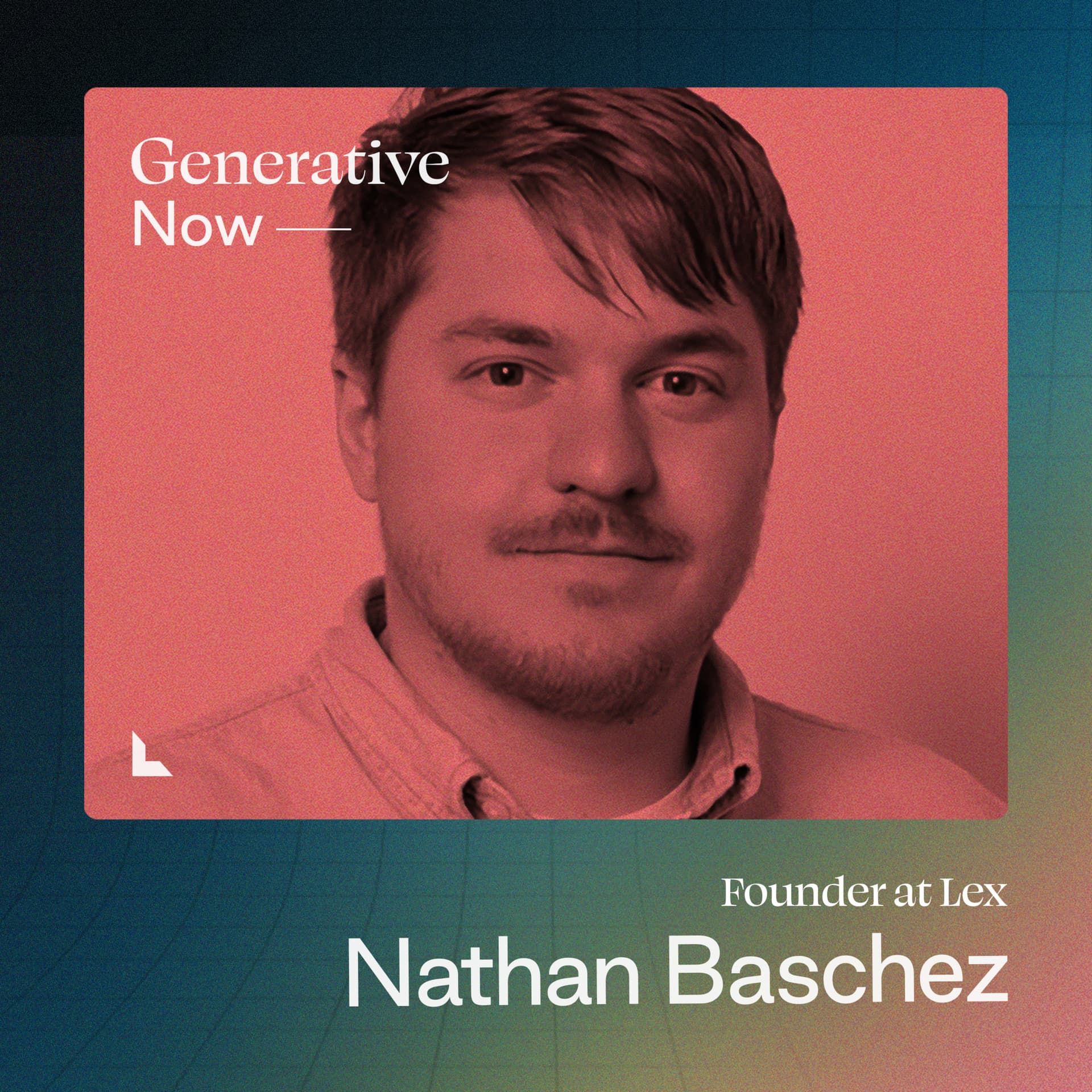
Nathan Baschez: The New Age of AI Writing Tools
Episode Overview In this episode of Generative Now, host Michael Mignano speaks with Nathan Baschez, Founder and CEO of Lex, an AI-assisted writing tool. The conversation revolves around the evolution of Lex, its features, the impact of AI on the writing process, and the broader implications for creativity and collaboration in writing.
Key Themes and Discussions
- Genesis of Lex
- Initial Concept: Nathan describes Lex as a response to frustrations with existing writing tools like Google Docs. Initially, it aimed to solve specific user experience problems (e.g., managing images and formatting).
- AI Integration: As Nathan began to develop Lex, he recognized the potential of AI to assist in the writing process, leading to the introduction of basic AI features.
- First Impressions and Growth
- Early Success: Lex gained significant traction with 25,000 sign-ups within 24 hours of its launch, attributed to effective demos showcasing its capabilities.
- Recognition in the AI Boom: Nathan mentions that while he does not have a machine learning background, the rapid growth of AI tools during this period positioned Lex uniquely in the market.
- AI's Role in Writing
- AI as a Collaborative Partner: The conversation highlights AI's potential to alleviate writer's block and enhance productivity by offering suggestions or content prompts.
- Specific Use Cases: Nathan explains how AI in Lex can provide context-aware feedback and help maintain style guidelines, which improves editing and collaborative writing processes.
- Challenges and Competition
- Marketplace Dynamics: Nathan discusses the challenge of competing against larger incumbents like Google and the influx of new AI tools, emphasizing the need for unique value propositions.
- AI Innovation Cycle: The discussion touches on how Lex can benefit from the advancements in AI models while also facing competition from other startups developing similar technologies.
- Future of Writing Tools
- Collaboration Focus: Nathan indicates that future updates and features would prioritize enhancing collaborative writing, allowing teams to work more efficiently and effectively.
- Writing Process Evolution: The vision for Lex includes features that help writers explore new ideas and manage revisions more intuitively, akin to design tools that allow for easy version comparisons.
- Regulatory and Market Predictions
- Predictions for Search Industry: The conversation also diverges into speculation about the future of search engines, particularly the potential impact of AI on traditional platforms like Google.
- Acquisition Speculation: Nathan speculates that Google may look to acquire emerging competitors (like perplexity) to maintain market dominance while adapting to the changing landscape.
Conclusion Nathan Baschez's insights into the development of Lex and the evolving role of AI in writing underscore a significant transformation in how creative processes are approached. As AI tools continue to advance, the emphasis will shift towards collaboration, feedback, and a tailored user experience that empowers writers.
Episode Chapters
- (00:00) Introduction
- (00:43) Early Days of Lex and AI
- (04:06) Frustrations with Google Docs
- (04:53) The Birth of Lex
- (06:18) AI Integration in Lex
- (10:06) ChatGPT’s Impact on Lex
- (18:41) Future of AI in Creative Tools
- (22:29) Improving Team Workflows with AI
- (26:47) Enhancing Collaboration in Writing
- (31:09) The Evolution of AI Models in Startups
- (37:09) Innovations on the Horizon at Lex
- (41:15) The Future of Search
- (46:55) Closing Thoughts
Stay Connected
- [Lightspeed Website](http://www.lsvp.com/)
- [Twitter](https://twitter.com/lightspeedvp)
- [LinkedIn](https://www.linkedin.com/company/lightspeed-venture-partners/)
- [Instagram](https://www.instagram.com/lightspeedventurepartners/)
- [Subscribe](http://generativenow.co/)
Note: The content of this episode does not constitute legal, business, or investment advice.
Written by AI. May contain mistakes. Listen to the episode to check what was said.
Transcript
Automatic transcript. May contain errors.0:05Hey everyone and welcome to Generative Now. I am Michael Magnano. I am a partner Lightspeed And this week, I'm talking to Nathan Bashes, the founder and CEO of Lex. Lex is an AI-powered word processor designed for writers ranging from book authors to bloggers. Nathan and I talked about how Lex burst onto the scene as one of the first AI products to hit during the AI boom about 18 months ago and the misguided way in which many people talk about GPT wrappers and what separates great AI products from the rest of the pack. Take a listen. Hey, Nathan. How's it going? It's going well. Good to see you.
0:41Thank you for doing this. Pleasure to be here. So I've really been looking forward to this for a bunch of reasons. First of all, you're an amazing entrepreneur. You've got brilliant stories. But I think like in particular, the story of Lex is probably one of the more unique ones because I feel like you've been at sort of AI products like almost since the beginning. And granted, like it's been like only two years or maybe not even, but that's kind of the entirety of like AI, right? Or this current wave of AI. So in many ways, like you're an AI OG. I guess I'd love like the quick overview of sort of how you got started with Lex and kind of what's happened since then.
1:29Because I imagine it's been a lot. If I remember correctly, when you started, like GPT-4 wasn't even out yet, right? GPT-4 was definitely not out yet. GPT-3 was out, but it was before the whole kind of, it was before chat GPT. And it was before the sort of like wave of people building on GPT. At the time, all of the hype in AI was actually about image generators. So Dali was out, Stable Diffusion had just come out. And that's all what anybody was talking about when it came to AI. GPT-3 was out, but people just didn't realize what it could do, I think. Um, although I will say the big sort of success story at the time, um, was Jasper.
2:11There was, you know, they were, they were growing real fast based off of, uh, GPT-3 kind of powering, powering their product. But, um, anyway, yeah, no, it's, it's kind of funny because, um, yeah, it is sort of weird to be like, oh yeah, OG of like AI of like the current wave, I guess, of AI. Um, I don't have a machine learning background or anything like that. Actually, um, uh, my background is really in, uh, like building, building products kind of at the intersection of media and technology. And most of the time I've been on the technology side of that intersection. So, you know, started a company that had like this, uh, tappable visual kind of storytelling format for mobile called hardbound.
2:53Um, went to work at Gimlet media, the podcasting company that, that, you know, very well, um, kind of, did y 'all get acquired like at the same time by Spotify basically, or? It was kind of all part of one big cycle. Same day, actually. Same day. So literally the same time. Yeah. And then after I was at Gimlet, I was at Substack. I was the first employee there. And while I was at Substack, I got really jealous of the writers that were using the platform. I was like, oh my God, it's so boring coding the settings page. I want to write cool things for people on the internet. So I was there for a little while and then left to start Every with my friend Dan Shipper.
3:29and that was based on the insight that it's really hard to build a sub stack solo, but it's, it could be easier if you kind of work within a team and you have multiple writers and you're pooling an audience kind of like a magazine, you know, it's not like a completely original idea, but, you know, built around the sort of subscription unbundled era and sharing a lot more of the economics with the writers that wanted to join the bundle. Um, so anyway, did that for a little while. And that was the first time in my career where I was really writing and editing on a regular basis. And I went from using like Figma and VS code as my main tool set to like Google docs basically.
4:05And, um, it's a real love hate relationship I've discovered that writers have with Google docs, um, or word, you know, it's the other, the other one, if you're writing a book, it's kind of like word or like, I guess a legal contract, but other than that, pretty much everybody uses Google docs. And, um, there's just so many things that I was kind of like, yeah, this isn't great. It kind of reminds me of when I was a designer and before Figma, before Sketch even, Photoshop, right? Because it's like this general purpose. And in Photoshop, you're manipulating pixels and Google Docs, you're manipulating characters, but there's not a lot else built into the workflow.
4:39It's just a very general purpose tool. And so over time, I got more and more sort of frustrated with it and also more and more excited about what else could exist. Right. And so I started thinking about, you know, building, building my own Google Docs. How hard could that be? Right. Like, were you thinking about AI when you were like, well, a little bit. OK, it wasn't the first thought. The first thought was literally it was very unambitious. It was just could I make the minimum thing that would make us not have to use Google Docs that would solve these couple problems we have on a regular basis?
5:13Like getting an image out of a Google Doc. Like, my God, you have to like go to the inspect network tab and like filter to like image requests to like find the actual source image. You can't just right click on it and hit like copy or copy URL like you can normal images. Or like if you want to use an emoji, you know, on the Mac, the keyboard shortcut is I think I just muscle memory. So I don't know. Command option space or something like that. It brings up an emoji picker. It doesn't work on Google. There's just a lot of little things like that, that like, and also like just pagination or if you turn off pagination, the width gets all weird and there's just lots of little stuff with it.
5:44that was honestly the main thing. And then the other big thing is copying and pasting. Like in Google docs, if you hit enter, it's like, there's no paragraph break. So if you paste into a CMS, a lot of times you have to manually go in and like add a lot of extra paragraphs or remove extra paragraphs that you made in the Google doc. Cause like the underlying sort of data model doesn't match. Anyway, I just want to fix those things kind of to start. It wasn't like supposed to be a startup, you know? Um, it was just like, maybe we could build our own thing. And it's kind of my fun software project because like nights and weekends, because it's, you know, I wanted to write code again and solve this problem I had.
6:17And then, but the more I started working on it, I did get curious about AI and it was kind of like, yeah, what could it do? We're not using it at all in our writing process or our editing process. It feels like someday we will. So it'd be fun to have like a playground to experiment with different ways that AI could maybe help the writing process. And so basically just built the kind of really simple thing, launched it with like the only AI feature and the main AI feature was like, if you type plus, plus, plus, then the AI will fill in the next paragraph for you. And the idea is like, when you're writing, oftentimes you get stuck, or at least I mean, I get stuck and I beat my head against the wall and I don't know what I want to say next.
6:57Very painful experience. You know, usually I would just like go to Twitter or something. I don't know. It's like a, not, not a fun place to be, but if you have this other thing to do, then maybe it helps you kind of streamline the writing process where you're not like using a lot of stuff that the AI actually says, but it just kind of gets the wheels turning and it gives you something to do to help you get unstuck. So that was what I really launched Lex as, like within every, it's kind of like this side project that was just like a fun AI experiment. And the response to it was like dramatically different than I ever would have imagined.
7:27It was like, people were like, oh my God, I can never imagine like writing the same way again or whatever. Or like this, literally one person said it feels like an iPhone moment. And I knew that the thing that was the iPhone moment about it was not my little demo. It was GPT-3, right? And so no delusions that it was like, cool, I've created some iPhone on my own nights and weekends, like little hack project. But the thing that I did do was like, kind of connect GPT-3's amazing capabilities to like a problem that people could relate to and experience and made for a really good, like, you know, 30 second YouTube video, or like within the first 30 seconds of the video, like you kind of understood, wow, that's, that's pretty cool.
8:12And you, in a simple way to just sign up and try it. Right. Um, and so we had like 25 ,000 signups just based on like a tweet, you know, um, and a YouTube video that the tweet links to within 24 hours. That was like just the first day. Uh, and then it kept going from there and it was just kind of like, wow, that's incredible. I accidentally have this like incredible wedge on my hands. I know it's not the thing, right? But just getting to 100K signups in a matter of a month or two is wild. And I'm just having more fun than I've ever had working on this thing. So I just want to keep doing it. And it really deserves to be talked about it with my co-founder, Dan.
8:52It felt obvious that this is a different company. It's not necessarily just a side project within this other company. and so we decided to spin it out um which is like you know a whole process went through that uh worked with our investors and dan to like make sure everybody was was as happy as they can be with like the deal and then um you know once the spin out was closed raised the seed round from true ventures and up until that point it was pretty much just me working on it and so it was great to use the seed round to kind of like hire a hire a small team and really the team formed kind of like last fall so in some ways i feel like wow i've been working on this almost two years.
9:29In other ways, I feel like the starting line was almost like the end of last year, because that's when the real nucleus of the team formed, you know? And the stuff that we've been doing in the last like six months has dramatically outpaced anything I ever did on my own. And we're just kind of, I think you'll see another wave of Lex, you know, later this summer and this fall, as we have some really big things that we're excited to launch that we're sort of developing and testing right now. But it's definitely kind of, our thinking has evolved a lot and we're really, really excited to, I don't know, just keep going with it because it's so much fun to build these things.
10:05And what's so amazing about this, again, like this is, like you said, this is all sort of, I think the story you just told, although correct me if I'm wrong, was kind of pre-ChatGPT, around the time of ChatGPT. Like what did that moment do for Lex? Like in what ways did that help Lex? and what ways did GBD4 help Lex? And obviously there have been so many things that have happened in AI since. Like I have to imagine that you've just had tailwind after tailwind. Yeah, definitely. I mean, there's tailwinds and headwinds, right? The tailwind is like the core products that we offer is still at its essence, a really simple yet nice version of Google Docs that has AI built in to help you with what you're writing.
10:50And so because we've got new versions of GPT coming out from OpenAI, we have Cloud coming out, new versions of Cloud, right? It's like the product just keeps getting better and better without us having to do anything. Of course, the downside of that is everybody else can access those same models too. So if we're a pretty thin layer on top of those things, then the benefit doesn't accrue to us so much as it does just to users and to the world because they have so many different options of things they could use. And then the other headwind is because I've never in my entire, like, you know, over 10 years in tech seen a hype wave this big, you know, there's like a million, everything from startups to side projects and everything in between, like building and kind of writing is like the most obvious first thing.
11:38now um you know i think that over time uh the stuff that we're building in lex uh is moving further and further away from kind of like whatever you might call a rapper or whatever but there's no doubt that the first version of lex was like you know it it was it became like the hello world demo kind of it's almost like hey we have this new thing called ajax and like maybe the hello world demo is like a to-do list that updates without having to refresh the page or something like that. Like, um, we kind of like built that and then it becomes the, like the hello world for a lot of things. Like even, um, you know, tip tap, which is like the open source text editing framework that, that Lex uses, like built in a lot of the AI stuff after we built it, um, to let any of their users use it.
12:24Right. So it's kind of like, uh, it's an interesting, like you've got to figure out, um, a specific vision of who you're serving and what problems they really have and beyond just sort of like, let's give people access to AI and kind of like a simple way. Um, and so that was like, in some ways it was hard, but also it was the most fun because, um, and the thing I think that makes Lex the most different is because it comes out of this thing where like, you know, I've been writing my whole career and I did it full time for like three years as a writer and as an editor. And I got a chance to work with a lot of really amazing editors.
12:58So I think the perspective that Lex has on what are the kind of problems that that writers specifically face not just anyone who's typing into a text box but like someone creating a blog post or a book or an academic article um you know all that what what problems do they have it's um i think we have a different um perspective on it than a lot of other companies you you mentioned you mentioned the term uh rapper or i don't know if you said gbt rapper or gbt rapper like that's that's obviously a term that a lot of people yeah a lot of people a lot of mention that like and I think it often gets used in a negative way I'm actually like not as convinced it's it's necessarily a negative I mean I think like it implies that whatever is wrapping it is thin but I think the benefit of it is it enables you to focus right and enables you to really focus on the details that the thing that it's wrapping GBT is is not going to focus and And then going to the complete opposite end of the spectrum, maybe something that's not a wrapper, like an incumbent product, like Google Docs, as an example, they're not going to be able to move fast.
14:09They're not going to be able to move fast and focus on those little attentions to detail that a company like Lex can. So I don't know. I think it's kind of interesting. And I'm curious. I'm sure people have asked you about this in the past. And I'm curious how you sort of respond to it. Yeah, I think that the term is a hilarious one and points out there's a kernel of truth in it, but there's a lot. I think that people use it in a way that is misguided. Um, and, um, I'm kind of, uh, I'm kind of, I'm kind of pumped that we were like, I think Lex was maybe part of where that term came from because we were like, you know, this thing that got a pretty insane amount of traction within like a very short period of time on a very thin, you know, value proposition on top of open AI.
14:58Right. Um, I don't think we're the only thing obviously that it refers to, but I think like part that term kind of came out a little bit immediately post Lex's crazy initial run there. And like, the thing that I think is true about it is if you are literally a thin wrapper, then yeah, there's not a lot of value. There's not a lot of defensibility. The thing that's false about it is any meaningful product might seem really thin or really simple, but actually involves a lot of work, A lot of work in understanding who your user is, what their problems are, how to speak to them, how to design something in a simple way.
15:37And even companies that seem like the most literal possible wrappers where they're just providing literally like a chat experience that's like an alternative to chat.openai or cloud.ai or whatever. Even those, I believe that there will be large businesses built that look pretty much like very similar to those things. And the reason why is, like, you can imagine there's companies who do it like, oh, but it's for a team context in a way that's like, in the long run, are OpenAI and Anthropic really going to focus on, like, all the different sub -variants of, like, just milking the chat interface?
16:15No, they're going to have to pick a lane. And it seems like they're picking the lane of consumer where they want to be, like, the top-level entry point, kind of like Google, you know, competing with perplexity on this front. But that kind of, that's a focus. And that means that you're not doing the like enterprise version of it, or you're not doing it as well, right? They'll take some steps in that direction, but it's really hard. Most companies don't end up being all things to all people. And the kind of the different contexts of value are like fractal. Like you think it's simple from far away.
16:45You're like, that's all basically this thing. But the secret of every great product person that I've ever met is they're extremely sensitive to small differences because they understand that in the market, those differences actually matter a lot. It matters a lot more than it might seem from a distance. And it's almost like the more you learn about a problem, the more detail you see, the bigger the differences appear to you, the more you understand that those differences matter. So when I think about something as different from a chat interface as like a writing experience where you're dealing with versions and you're dealing with comparing different versions and suggesting changes and all this kind of stuff, it's like, that's really, really different from chat.
17:18And all the stuff we're working on now is like, it's mostly just about how to collaborate on a piece of text that, you know, merits revision, that goes through a revision process and how to make those revision processes that happen within companies. Like when you're putting out a press release, you're putting out content marketing or an academic paper or an article on a news website or a newsletter, like you want to go through a sort of standard process, right? Developers have this with GitHub, with pull requests, with linters, with tests that run. Writers will have all this too, is just my really firm belief.
17:53they'll also have better interfaces to compare different versions of things. Cause right now the state of the art is kind of like suggest changes mode, you know? And I, that was one of the biggest things that like, if you ask any writer, they're like, it's a nightmare when you have a document with hundreds of suggested changes and like multiple people suggesting different things. It's just, everyone's fighting over the same space. It's horrible. So these are the kinds of problems that we're focused on. And like the more you zoom in, it's like, yeah, we're barely, it's like not even anything to do almost with, There are some chat parts of the interface, but basically anyway, to bring it back to the term GPT wrapper, just the closer you zoom into actual users and problems and building interfaces that solve those problems in the most elegant way, things start to become way more different than they might seem at first glance.
18:39And the differences matter a lot more. I actually wonder if we're now going to start to see, I know we saw like a wave in the beginning when, you know, like the beginning of sort of the AI hype. now that people have had these tools and these SDKs and these libraries for a year and a half, two years, like, are we actually going to start seeing a bunch more? Like, are we going to start to see many, many more applications, products at the application layer where the teams have sort of like figured out the best ways to leverage this stuff. And now they're starting to invent new experiences. So, um, I think it's like a really interesting time.
19:12And I think the benefit that Lex has is like, you've got this huge headstart, um, and you've been able to focus on, on these details and figure out what actually matters. And it sounds like collaboration is a big thing. Totally. And the thing you say about timing, I think is just so important. It takes time. It's so funny because people like, you know, even now, I think it's still, it's still early, but like a year ago, it was so, it was laughable that it's like, why aren't there any AI startups that have a moat? Like none of them have moats. It's like moats take like five years to build in a lot of cases.
19:44Exactly. And it's like, even companies, there are some cases of companies that start to develop very real modes much earlier in life. And typically what that looks like is a network. So if you look at the trajectory of an Instagram or something like that, then clearly they had some sort of very real mode much faster. And that is the interesting thing with AI is it's not very, it doesn't seem like there's new networks really being built on it. But for the category of companies like creative tools, right? Those things especially take time to build because it's a complex piece of software, you know?
20:21Like Dylan Field from Figma has recently said that like you shouldn't take as long as they did to launch. But like, I don't know, like could they have really launched sooner? Because like I think they were showing it to designers from a very early, I think they probably took a little while to get to the point where they decided that they were gonna focus on product designers. But once they made that decision, takes a long time to build all the things that product designers need just as table stakes features. And for a lot of other categories of creative tool, you have a similar problem. We certainly have a similar problem.
20:49Um, and you know, it's some things you just build it the way that it already works. Some things you, you want to innovate on and it takes, you know, some art to kind of choose those things carefully, but either way it takes, it takes time to build that and you can't just throw more software engineers at it and expect to come to a better solution faster, that you still have to have like a tight team with a high standard of craft to build something that writers actually want or any type of creative field wants to use. So I'm really excited for kind of, I think we're getting to the point now where some of these products are starting to mature a little bit.
21:24They've been able to go through enough feedback cycles and spend enough time to become as sort of feature rich as you need them to be to switch your primary tool. And now's a really interesting time. uh from also the big existing players are obviously they're they're building in more stuff so i i think over the next couple years is when we'll really move beyond like okay here's like cool prompts for chat gpt as like the main way that people use ai in their work or like you know okay engineers have co-pilot kind of experiences um to like a much broader class of creative adoption um so we'll see but it's i think you're right that the timing thing is so So people overestimate how much you can get done in a year or two and underestimate how much you can get done in like five years or 10 years.
22:12There's this narrative out right now about how, you know, AI is overvalued, like the technology and the features. There's so much hype. People love the idea of it, the concept of it. People are trialing every product in the world. But like, are they actually getting value out of the AI? What have you learned in the year, 18 months or whatever it's been since Lex has been out about the things that people actually like about the AI or maybe don't? And as you mentioned, it sounds like AI is actually becoming less of a focus. Yeah. Does that suggest that the AI is not as valuable to the users as you initially anticipated?
22:52um well it's funny because i had no real if we're talking about really initial anticipation like i did not anticipate how how many people would find it yeah you know interesting or whatever when we first that's true yeah like you said it was a surprise but i will say um a little bit as anticipated a lot of people they try it they feel like wow this is really cool and then there's some subset that they actually settle in with in the long run. And the most important thing is like being very specific about the problems you can solve for people and picking and making sure that that works really, really well, which is just as much an AI problem as it is an interface problem and a marketing problem and a design problem, all that kind of stuff.
23:37Um, and so for instance, like, um, you know, one of the features that I constantly use in Lex and wasn't a part of it at the beginning is you can select any line of text and leave a comment where you at mentioned AI and the AI knows the whole context of the document and it knows what line you've highlighted and it can give a response. So I use it for asking for feedback on specific parts. I use it for like brainstorming or research. Like if I'm writing, like, uh, I'm making some point, I'm like, is this, what's like some counter arguments to this point? Or, uh, what are some other examples of this phenomenon?
24:14It's just amazing for stuff like that, where it's just like this really specific in context kind of quick interaction that I want to have. Um, and then the other thing that we've learned is it's really good for in Lex for sort of like enforcing a guideline, a rubric, a style guide, you know? So if you, let's say, um, you know, you've got show notes for this podcast, right? Um, AI is not amazing yet at generating the show notes for you, right? If you just feed at the transcript and you say, here's some of my past show notes and here's the transcript, can you like figure out how I turn a transcript into show notes and like do it for me?
24:52AI is still not great at that. But what it is really great at is if you're like, hey, here's the like five key things I want my show notes to do. And here's some examples of it doing each of those things. Now, can you sort of like grade this draft against that and give feedback and give suggestions? It does a great job at that. It also, whether that's that sort of like a line level or like high level kind of feedback. And so we're building workflows for teams that's like, hey, here's a new edition of our newsletter. Here's a new edition of our changelog. Here's a new press release. Here's what our standards are for those things.
25:28And as a part of our workflow, can we have some of our editorial principles sort of like, let AI give them a first pass. Usually there's someone in a team who kind of plays the role of editor that like has the final say on what goes out. And often they're a bottleneck. And so if we can even help sort of make their job a little bit easier and help also for the writers on the team who, you know, you want to turn in something that's good, right, to your editor. So it's great to be able to like sort of self-edit with the help of AI. You learn a lot faster and it just feels very empowering. So it's kind of funny because it's totally opposite to this narrative of like, oh, like, you know, AI is just going to like put people out of work.
Read the full transcript
26:09I think in our case, it helps put more people in work because A, it removes an important bottleneck from the process and B, it helps train people faster and helps you work with a wider variety of people maybe be on your team if you need to, if you want to produce more, more, more content. Um, and so those are examples of some of the kinds of things that it's like, you just have to get really zoomed in on, uh, you know, a specific type of problem that people face in specific contexts and then, uh, like build for that. But if you're just building like, uh, you know, AI write a draft for me and it's like, well, what kind of draft who's writing this?
26:40Why it's, you know, it's hard to, it's hard to make that something that's like a compelling, sticky value proposition. right and and and talk about you you talked about collaboration about how that's become a big focus and you you talked earlier about how like as one example you know suggestion mode in google docs is a total disaster like is that the type of main challenge you're trying to solve with with collaboration mode or what other things do you want to do with collaboration yeah like kind of um so like from first principles right writing is rewriting there's some types of writing where it's like a chat to a teammate or whatever, you don't need to like spend a lot of time editing that.
27:16Maybe it's good to have like grammarly, like, especially if English is not your first language, you know, helping around the edges kind of clean up your writing. But, um, the type of writing we're really focused on is something that wants to go through a thoughtful revision process because you want it to make an impact. Um, and our North star is kind of like, if you want to sit down and do that type of writing process, you have some important goal behind it. You know, maybe for a company, there's like economic goals behind the content. Maybe for a person you have creative goals behind it, but you're putting a lot of work in, right?
27:47You want to, you want to revise it. Um, and so Lex's job is to help increase your odds of success, right? With whatever your goal is, um, to achieve it in a bigger way and in a more likely way than, than had you not had Lex. So, okay. One step down from there, how do we do that? How do we make the rewriting process better, I think the biggest part of it is fundamentally, what is the way that you understand, like, here's a different version of what could be, um, unburdened by what has been, uh, yeah, yeah, yeah, no, but like literally it's about exploring new ideas, right? Um, if you, any sort of design, this is just a general design principle, whether you're designing a sequence of words that might run through someone's mind through their eyes or, an interface or anything else, you want to make it easy as possible to try different ideas, to have different options.
28:40So that's one of our north stars with a lot of the new stuff we're developing. And then of course, once you have different ideas, you need to be able to say, what's the difference between this idea and this other idea? In a product like Figma, it's relatively straightforward to look at two artboards on a canvas and sort of visually be able to see the difference. With writing, that's not the case necessarily. You just look and it it looks like a wall of text, right? And that you can maybe see like one's a little longer or whatever if you were to like zoom out or something. But what's actually going on inside the changes is not so transparent.
29:11So we're also building new stuff, some of it AI related, some of it not, to make that process a lot easier. So if we can make it easier for people to try new ideas, both themselves, with colleagues, with AI trying new ideas, and we can make it easier to see the difference between ideas so that you can kind of take the best of what you like and discard what you don't from those different versions and kind of consolidate into one final version, then I think that's a really powerful thing for a lot of different types of writing. It's just like a low, it's like a new interface paradigm almost for writing.
29:42And I don't want to give it all away because we're launching it a little bit later. But that's the sort of problem space that we're exploring now. And it's interesting because we started out by building ways for AI to generate suggestions and to be able to try, show you different ideas of how a piece of writing could be. and we realized the most important part about it and the hardest part about it is making it easier for people to understand what changed and why and to be able to view the difference. So that's our whole focus now. And it just ends up being a collaboration problem and a kind of a versioning problem almost rather than a AI problem.
30:21It's just that AI makes this problem way more valuable because now any document or any piece, any type of creative artifact has an always on, you know, 24 seven available, hyper-intelligent collaborator, right? So the sort of returns to collaboration tools are a lot higher than they were now because anyone can have at any time versus before it was very scarce to have someone who would be an actually helpful force in a creative process. That's why, you know, creativity is, you know, famously can feel kind of isolating and isolated because it's like, well, who will understand this? um ai is not going to like understand you in the way that a deep collaborator would but it can provide some helpful ideas for you to pick and choose what you like and don't like especially if sort of guided the right way well i'm very excited to see uh what you launch soon we don't want to give away any any spoilers um one thing that i'm pretty curious about is it feels like there's an evolution of through every startup that's building an ai there's like an evolution of which models you use.
31:21Like it almost starts with open AI, like GPT-4 or whatever. Then like maybe there's this graduation to being like model agnostic and like just letting anything sort of plug and play. And then maybe you graduate to like training your own models or at least like maybe like fine tuning something off the shelf. Walk us through that journey, especially at a time where there's a lot of really exciting things happening on the model side. You mentioned Claude earlier. I know people are really excited about that. Obviously, there's really exciting things in the open source world with with Mastral and and even Llama.
31:55So, yeah, like what are you doing on that side of the business and how is your perspective evolved over time? Yeah, it's so interesting because that's literally our exact path of development. You know, Lexa version one was just GPT-3, right? Um, and then, uh, you know, new models came out. We, from open AI and, and, and from other providers like Anthropic. And so we incorporated those into the product. Um, we actually put in a setting for users to be able to change their model and try, try different ones. Um, cause it's been really surprising to me how much people have preferences. Like probably most users don't care, but the users who do care, care a lot.
32:37and they are the most valuable sticky users for us. So it's worth it. But I think part of the reason why people care is if you've used a model like a couple of times and you try a different model, especially the difference between like open AI models and anthropic models, you can tell a difference in sort of personality or tone or something. And people have affinity to one or the other. And I actually think it's a big opportunity in training these models to give application developers more control over that. Because it's an artifact of the sort of reinforcement learning from human feedback process where they do the pre-training and then they do like the kind of, now let's, okay, I learned all the kind of raw stuff that we wanted to learn and now let's make it safe and let's make the responses have bullet points and let's make it have this certain helpful tone and to apologize if it messed something up and all these little things that they're trying to encode in it.
33:34it's kind of a mixture of safety and like style. And I don't think actually OpenAI or Anthropic cares about having one specific style. They would probably rather their users be able to steer that. But right now they just, you just can't, you kind of like it's, or it's hard to, I'll put it this way. You can try to with prompt engineering, but it's sort of fighting against the grain of the model. And I think ideally they figure out a way to decouple style from safety so that, um, So you have a lot more control over kind of the vibe or the format of the responses, especially in the shift from early on.
34:13It was just completion. So you'd give it a string and it would give you a string back of like what could come next. Now it's like this whole chat paradigm, which is good for a lot of cases, but it's kind of like I think overfitting. Like responses tend to feel chatty. you know? Um, and so it makes sense that that's what they're optimizing for. Cause that's the number one use case that they have for their own customer facing, you know, interfaces. But you know, a lot of uses don't, you don't want that actually. Um, so anyway, what we've done is we started, we started with the one model, then we had multiple models and we let users pick which model they use.
34:45And then for certain features we fine tune. Um, and, um, so far we've just been fine tuning open AI's, you know, 3.5 line and, um, it's, it's worked really great for our checks feature. So checks is basically like an editor going through and making, making line edits in your document. But the way we built it is it's not a kind of one size fits all thing. You can tell it what you want it to focus on. So you can have it check for grammar. You can also have it check for like brevity or cliches or readability or different, like kind of specific things. And so we started off with just sort of prompts basically to power those features.
35:23And then we found we got a lot better performance once we started fine tuning, especially to help it preserve the user's original kind of like tone. So especially for like a brevity check, we found that no matter how we prompted it, it kind of the grain of the model was it wanted to make things sort of sound like Hemingway. And it's like, actually, this academic paper shouldn't sound like Hemingway, but you can find ways to make it more concise, but like it should sound basically how it sounds, you know, and like how academic papers sound or like vice versa. This like, you know, marketing email shouldn't, shouldn't sound like Hemingway.
35:56Um, the fine tuning opened up a world of difference where it's like, you just have a variety of different types of writing inputs and outputs. And it kind of learns to triangulate, oh, here's what you mean by brevity. It's I'm not like overfitting anymore on this idea of brevity. That's probably I was trained on when like, Because probably what's happening is all the writing that it was trained on that was talking about brevity kind of was like literary-ish and kind of like talking about the value of like concise writing. It's kind of makes it – the tone of voice of those articles is probably like sort of emulating Hemingway a little bit.
36:28And so I think that's what causes stuff like that to end up being overfit in the data. whereas when you can fine-tune it, you sort of can undo a little bit of that and learn for it to have a more abstract conceptual understanding of what brevity means uncoupled from any specific tone. And I think in general that's an opportunity for, you know, if we want to talk about what's coming next with Open Ananthropic, I have no idea if this is what's coming next, but I think it'd be a huge opportunity for them to make the models just more steerable without necessarily having to fine-tune or making like lightweight on the fly, find some sort of fine tuning, like easier to do, but just uncoupling their, their safety from, from the style stuff a little bit better.
37:09So outside of collaboration, what are the other big, big rocks that Lex is really excited about right now? Like on the horizon, things are coming. Another thing I'm thinking about, um, is helping people write like they talk. I think a lot of people are really good. This is kind of getting back to like just getting down the first draft as like a problem worth solving. If we can expand the top of funnel of who can get down a first draft, I think it's really valuable in a lot of different contexts. And the first wave of it was kind of like, you know, Jasper, like fill in a couple of farm fields and we'll generate a draft for you.
37:51And I think there's a limited amount of use cases where AI is capable of producing something worth publishing and you know jasper sort of like saturated that and then lex's thing was like well it's not going to generate the whole draft for you but it'll help you get unstuck when you write the first draft but you're still kind of like writing it uh i think a really cool experience would be one that helps because most people are capable it's far easier to have a conversation and to say a lot of interesting things than it is for whatever reason to type it out um and i think AI could help with that.
38:21So that's another thing I'm thinking about. But honestly, the biggest thing is just launching these collaboration features and really growing with it. Because I think that I'm like a product nerd. And so for me, like I'm like, product is my hammer and like everything is a nail and like we should solve all problems with product. But I'm starting to realize a little bit more like how limiting that can be. And I really think that, you know, So there's like a number of teams using Lex in the way that we're kind of building these new features for. And the response we're getting from them is kind of like, we should just focus on bringing this to more teams.
39:02Right. So there's not a lot of other big like product rocks. It's more of the big rock is like, take it from one to a million rather than from zero to one on product stuff right now. on the conversational thing it's it's a really really interesting concept um i i'm guess i where my head went and maybe this is how you're thinking about it is maybe you'd leverage some sort of like gpt 4-0 you know voice mode like experience where somebody's literally talking with an agent maybe it's even interviewing them in some way and then it like spits them out this this beautiful first draft is that is that kind of what you're getting at something like that i think there's a lot of different ways that it could look.
39:45One way is like the AI is talking to you and you're talking to the AI and there's some transcript that gets generated. And then there's like a process to organize that into a sort of a first draft. Um, another way to think about it is like, maybe the AI doesn't even really need to like vocally say things to you, but it could like show you stuff, show you questions on a screen and you talk it out and then you can kind of like help organize the draft as you're talking and it's like asking you questions but like in a more multi-threaded way potentially than like a verbal in a more organized way than like a just a back because the problem with voice is it's invisible and it's ephemeral right so it's great for like you and i can just have this connection in real time where we're talking and people can listen and but like for creating a draft of a thing you might want some sort of visual artifact if you're like in front of a screen you know that you could use that it's a capability of computers that like humans, you know, don't as easily have, uh, you know, so like, I guess it would be maybe more similar to standing in front of a whiteboard together, right?
40:47Like working on something. So maybe that's, um, that, that's a sort of mode with it. Um, but honestly, it's like just a super early idea that, um, I barely started playing with prototypes of, or like think, you know, imagining what it could be. The, the overarching principle though would be to like help people write like they talk and help more people get down to first draft that they're proud of and that doesn't it's ai helps them but it's not like ai generated the post for you it's stuff you it's your words what what else is interesting to you right now uh in the world of ai outside of lex i mean i know you're you're from what i know about you you follow a lot of products like you're deep in the product world so i mean what are you seeing that's that's intriguing you right now i think i think the most fascinating thing to me like uh kind of I don't know, just like a question mark about how a market will evolve is like search.
41:39Search is like, it's wild that for the first time since I was in like, I don't know, middle school or something, there's like a dominant, like the dominant search thing is like Google is like, I don't know, is it going to make it? their AI rollout is like starting to kind of happen. It's like sort of fine, but it doesn't really seem to be slowing down people's adoption of like, you know, perplexity and chat GPT and cloud. And like, certainly for me, like I just, I'm sure if you graphed my like Google queries per month, it fell off a cliff over the past year or two. And that's a huge problem for one of the most valuable companies on the planet.
42:20And you know, if we think that they're like in urgent mode now, like wait until it really, I'm sure it's like lagging. Right. Cause like people like me, it's like the futures here, but it's not evenly distributed yet. Like I'm sure it's like not really showing up too much in there. Like, especially ad revenue or whatever, like maybe queries are kind of like down a little bit, but like the types of queries that they make a lot of money off of are potentially like not down as much. Cause you know, I might still use Google for like things that I don't know, purchase type stuff. Um, so anyway, um, that's just fascinating to me.
42:54Um, and I, and, and also perplexity is fascinating to me in another, I think, amazing example of how you could think that something's just a rapper, like what's closer to a rapper than perplexity, right? It's like the hello world demo of like rag, you know, kind of right. It's basically just like, or not rag necessarily, but like, okay, you type in the query, it searches Google, it summarizes the pages into like using not an LLM that they have built, right? Like, but incredible the way that it's growing and people are choosing it over, you know, ChatGPT and Cloud for certain things. So anyway, that to me is just like a really fascinating space and development to watch because it's sort of like, I kind of keep waiting for it to feel like it's slowed down maybe and like it doesn't.
43:41So that'll be a big change if it actually does flip it. What do you think will happen? do you have predictions yeah my prediction is that um well this is really tough so i think in the in the in the regulatory environment that we have now there's not a lot of options my prediction is that the regulatory environment will change and google will acquire perplexity for like a lot of money that's my that's my prediction i could be totally wrong about it But I feel like they're just going to have to pull like a Facebook Instagram on it where it's like, listen, perplexity is the brand now. And like, it's just people like it.
44:20Let's just own it and pour gas into that growing fire and also be able to kind of maintain the existing Google thing and not sort of risk it the way that they currently are. If I were Google, I would much rather be able to kind of keep Google Google and not have to be as aggressive about changing the core search experience and the core search economics. And I can kind of manage that decline a little bit, kind of the way that Facebook's managing the big blue app decline, you know, but have perplexity be like my Instagram. It's sort of like a multi-bank shot thing, like the regulatory environment might change and Google, you know, and all that kind of stuff.
44:58I don't even know. But my second most likely prediction is that the regulatory environment doesn't change and Google can't acquire perplexity and they just have to compete. And it's a little messy, I think, because perplexity grows slower in that scenario. Like what would have Instagram have been if had they not been able to be acquired by Facebook? Probably not what they are now. Right. So that world is a little bit less precedented, honestly, because like if you think about like, you know, the sort of when do you have really large, powerful incumbents that are certainly capable. So maybe it's more of like Snapchat, right?
45:40Or it's like big, but it's not like whatever, like mega cap. and uh but like the the big company it hurts a little bit because of it but they're not like you know fundamentally unseated or whatever like facebook's not unseated by right they were able to use use instagram but the thing is is google doesn't have the like facebook the reason why they were impacted less by snapchat than they would have been otherwise is because they had they could use instagram right so totally what can google use for this just google search right which is riskier right right so it's yeah it's interesting maybe it's like snapchat but kind of worse you know it's like uh like a little bit worse for google than snapchat was for facebook kind of a thing but i'm reasoning by analogy here and it's it's hard to it's extremely hard to know how it'll play out well it'll be fascinating to see and uh maybe maybe you and i can can do this again in a couple of months or a year or something and yeah we'll do an update on uh what happened between Google and perplexity.
46:37Nathan, this has been a blast. Thank you so much for doing this. Lex is awesome. We're all very, very excited to see how collaboration rolls out and some of the other things you talked about. So thank you so much for your time and can't wait to see what you and the team cook up. Thank you. Thanks for having me.
46:56Thanks for listening to Generative Now. If you liked what you heard, please rate and review the episode. That really does help. And if you want to learn more, follow Lightspeed at LightspeedVP on YouTube, Twitter and X, or LinkedIn. Generative Now is produced by Lightspeed in partnership with Pod People. I am Michael Magnano, and we will see you next week.
From the publisher
We’ve all experienced writer’s block at some point in our lives. But thanks to emerging AI-powered tools, writer’s block may soon become a thing of the past.
In this week’s episode of Generative Now, Lightspeed Partner and host Michael Mignano speaks with Nathan Baschez, Founder and CEO of Lex, an AI-assisted writing tool. Nathan discusses Lex's development from a simple alternative to Google Docs to a sophisticated collaboration tool with AI features, as well as the challenges of developing AI-integrated writing software. Michael and Nathan also talk about the future possibilities for AI-driven writing tools, the implications of AI in the creative process, as well as the broader AI landscape, including competition with major companies like Google for dominance in search.
Nathan Baschez is an entrepreneur, programmer, and writer. He is the founder and CEO of Lex, a collaborative word processor with AI editing tools to unlock your best writing. Previously, he co-founded Every, was the first employee at Substack, and led product at Gimlet Media.
Episode Chapters
(00:00) Introduction
(00:43) Early Days of Lex and AI
(04:06) Frustrations with Google Docs
(04:53) The Birth of Lex
(06:18) AI Integration in Lex
(10:06) ChatGPT’s Impact on Lex
(18:41) Future of AI in Creative Tools
(22:29) Improving Team Workflows with AI
(26:47) Enhancing Collaboration in Writing
(31:09) The Evolution of AI Models in Startups
(37:09) Innovations on the Horizon at Lex
(41:15) The Future of Search
(46:55) Closing Thoughts
Stay in touch:
LinkedIn: https://www.linkedin.com/company/lightspeed-venture-partners/
Instagram: https://www.instagram.com/lightspeedventurepartners/
Subscribe on your favorite podcast app: generativenow.co
Email: generativenow@lsvp.com
The content here does not constitute tax, legal, business or investment advice or an offer to provide such advice, should not be construed as advocating the purchase or sale of any security or investment or a recommendation of any company, and is not an offer, or solicitation of an offer, for the purchase or sale of any security or investment product. For more details please see lsvp.com/legal.


