
In short
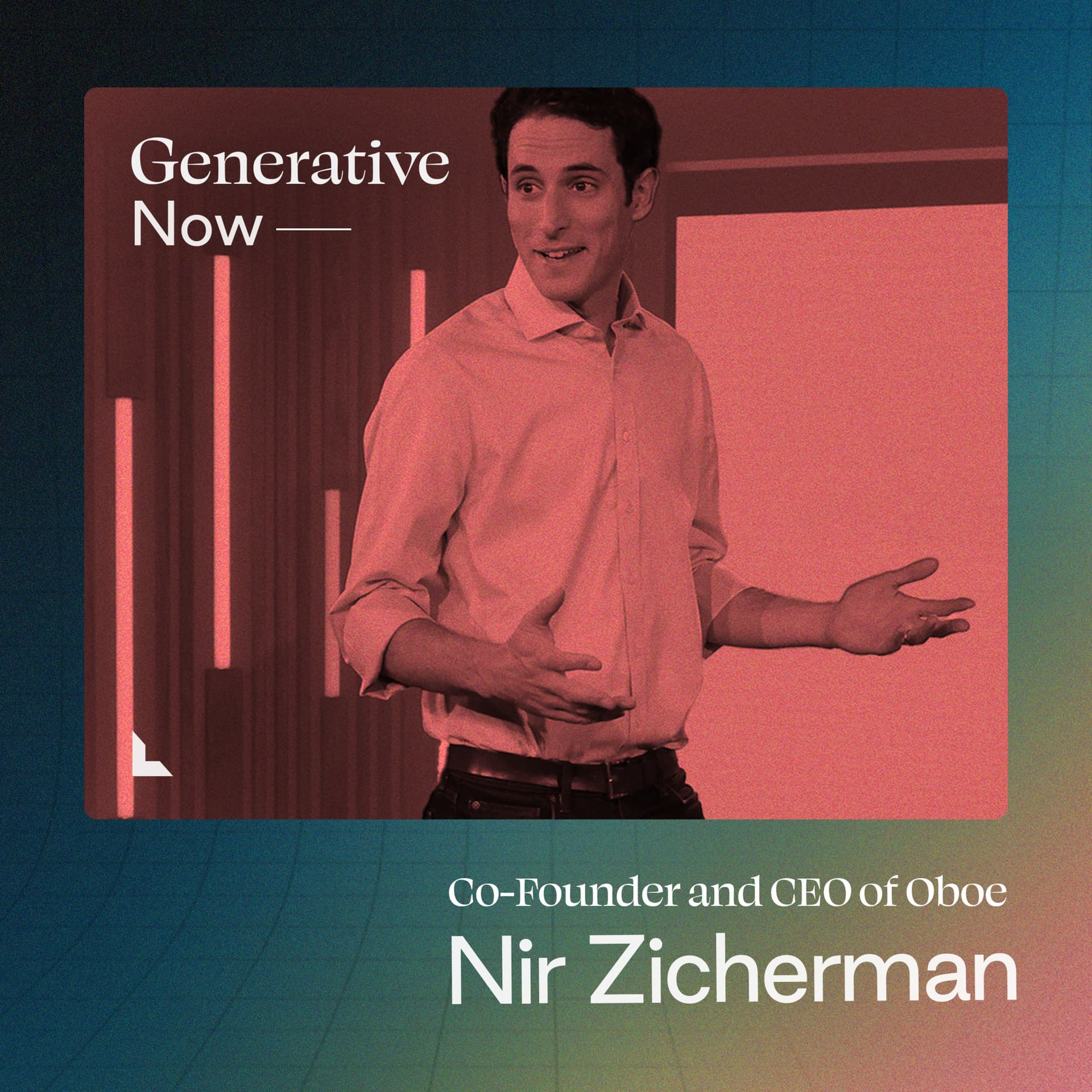
Generative Now | Episode Summary: Nir Zicherman: Looking Back at Anchor and the Future of Oboe
Episode Overview In this episode of *Generative Now*, host Michael Mignano converses with Nir Zicherman, co-founder of Anchor and currently the CEO of Oboe. They reflect on their entrepreneurial journey, share insights about the evolution of podcasting, discuss challenges faced while building Anchor, and explore the vision behind Oboe, an AI-powered tutoring platform aimed at revolutionizing education.
Episode Chapters
- Introduction (00:00)
- Reflecting on Anchor's Early Days (00:36)
- Podcasting Challenges and Insights (02:08)
- Introducing Oboe: The New Venture (03:11)
- Limitations of LLMs in Education (05:03)
- Lessons from Being a Second-Time Founder (09:40)
- The Evolution of Product Development (13:04)
- Are MVPs Relevant Anymore? (17:36)
- Reflecting on Social Audio and Anchor (24:56)
- The Bet on Podcasting (28:32)
- Distribution Challenges (29:33)
- What if Anchor Had Pivoted to Video? (30:27)
- The Future of Audio and Video (34:14)
- Hybrid Work Model (37:30)
- Acquisition by Spotify (43:26)
- The Future of Learning with AI (52:27)
- Closing Thoughts (57:26)
Key Discussions
Reflecting on Anchor
- Early Decisions and Lessons Learned: Nir and Michael discuss initial choices made during the development of Anchor, including successes and mistakes.
- Distribution Challenges: They delve into how Anchor initially struggled with distribution which led to a pivot towards traditional podcasting models.
Introduction of Oboe
- Vision for Oboe: Oboe aims to provide personalized learning experiences through AI, simulating the benefits of having a human tutor.
- AI in Education: The conversation covers how AI can revolutionize learning, making it accessible and tailored to individual needs.
Limitations of LLMs (Large Language Models)
- Inherent Issues with LLMs: Nir explains the limitations of using LLMs for long-term learning, emphasizing that they deteriorate in effectiveness over time.
- Need for Innovation: A hybrid approach that combines LLMs with proprietary architecture is proposed to improve educational outcomes.
Second-Time Founder Insights
- Easier Navigation: Nir shares insights into how being a second-time founder has made tasks like fundraising and product development smoother.
- Importance of Delegation: The discussion highlights the importance of trust and delegation within a team, contrasting it with their hands-on approach during Anchor's early days.
Evolution of Product Development
- Iterative Processes: They discuss how assumptions about product development often need to change based on user feedback and market dynamics.
- Shift from MVPs: The conversation shifts to the relevance of Minimum Viable Products in today’s market, suggesting a move towards higher quality standards.
Social Audio and Future Trends
- Audio vs. Video: Nir reflects on the evolution of audio content and the potential merging of audio and video formats in future platforms.
- Impact of Distribution Changes: The duo discusses how changes in social media and audience behavior present challenges and opportunities for new content formats.
The Future of Learning
- Integrating AI into Learning: Nir envisions a future where AI-enhanced learning blends seamlessly with real-life experiences, expanding beyond digital environments.
- Transformative Potential of Oboe: The discussion culminates in the ambitious goal of making Oboe a tool for comprehensive learning experiences across various domains.
Key Takeaways
- Personalized Learning: There is a strong belief in the potential for AI to create highly personalized and effective learning experiences that mimic human tutoring.
- Importance of Quality: As the market evolves, products must meet higher quality standards to achieve traction and user engagement.
- Future Integration: The interplay between physical and digital learning environments will shape the future of education, emphasizing the need for innovative approach to learning tools.
- Trust and Team Dynamics: Building a successful startup hinges on the ability to trust team members and delegate responsibilities effectively.
Conclusion The episode provides a deep dive into the entrepreneurial experiences of Nir Zicherman and Michael Mignano, reflecting on past lessons while exploring the transformative potential of their new venture, Oboe. The discussions underline the importance of adaptation, quality in product development, and the future of learning in an AI-driven world.
Stay Connected
- [Lightspeed Ventures](https://www.lsvp.com)
- [Follow Lightspeed on X](https://twitter.com/lightspeedvp)
- [Follow Lightspeed on LinkedIn](https://www.linkedin.com/company/lightspeed-venture-partners/)
- [Follow Lightspeed on Instagram](https://www.instagram.com/lightspeedventurepartners/)
- [Subscribe to Generative Now](https://generativenow.co)
---
This markdown file serves as a comprehensive summary of the podcast episode, capturing essential discussions, insights, and reflections from Nir Zicherman and Michael Mignano.
Written by AI. May contain mistakes. Listen to the episode to check what was said.
Transcript
Automatic transcript. May contain errors.0:04Hey everybody and welcome to Generative Now. I am Michael Mignano and I am a partner at Lightspeed and I am so thrilled to be sitting down with my good friend, my co-founder, and the CEO of Oboe, Nir Zickerman. Nir and I co-founded Anchor together almost a decade ago, and we are back at it now again with a new company called Oboe, an AI learning platform with a mission to make humanity smarter. Nir and I talk all the time, like every day all the time, but in this episode, we go even deeper. We revisit the early days of Anchor. We reflect on some of the early decisions we made and the things we got wrong and maybe some of the things that we got right.
0:44And lastly, we respond to the questions that some of you all sent in through Twitter about OVO. So take a listen to this conversation with Nir Zickerman, CEO of OVO. Hey Nir. How you doing, Mike? Going well. This should be interesting. Did we ever record any podcasts when we were building Anchor or when we were at Spotify? Like you and me? Obviously, individually, I think we both did, but did we ever do any of these together? Shout out to Startup Soundtrack. Remember Startup Soundtrack? Oh, yeah. Yeah, yeah. That was you talking about music with founders or something? Yeah, when Spotify released the music and talk feature, which was one of the initiatives that I helped lead, you and I thought it would be fun.
1:31This must have been in 2020, maybe. we thought it would be fun to do podcasts where we would talk to founders about the music that inspired them while they were on their startup journey you and I actually did an episode that was about the anchor journey although I can't remember the songs that we talked about but then we talked to a few others it's still on Spotify is it oh it's still up I think so I never took it down you didn't last too long with that right maybe six episodes or less yeah I think it was mostly experimental podcasting isn't for the week you know it's uh it's it's tough um i wouldn't be able to do it without our team it's like yeah this is hard this is hard there's anything that you and i learned during the anchor days it's that uh and i think this is true for any type of content creation but especially true for podcasting consistency matters more than oh yeah there's this there's this podcast i may have told you about it's it's relatively new um technology brothers have we talked about this yep um it's first of all it's very funny and it's it's good but like those guys i know one of the guys doing it and like they're working so hard it's like it's probably more work than like a startup i think it's one of those things where uh if they're doing a good job you don't realize how much work went into it you know yeah exactly totally i mean i know everything about you um including including your about your new company because i'm a co-founder of it Um, but, but you're, you're, you're in the day to day.
3:01I'm not, I, this is not my full time thing. Um, and so there's a lot that goes on in the day to day that, that I, that I don't know about. So, so I'll probably ask you some stuff about that for the audience. It's probably best for people to hear it in your words. You think about this all day, every day. So you're going to probably explain it better than, than I have. Um, plus I'll probably like reveal something that we're not ready to reveal. If I explain it, what is Obo? Uh, we're building the most personalized and efficient way to learn anything. Um, the, the dream here is that, especially now, now that we can in the age of AI do, uh, do this to build a learning platform that is more effective and catered to a student's needs than anything else that has previously existed.
3:50Um, I think the only analog that really has ever existed at the level of what it is that we're trying to build is a human tutor, which is, you know, one-on-one, completely personalized, completely goal-oriented to what the student needs. And the reality is technology, for whatever reason, has failed to deliver on the promise of allowing people to learn as effectively as they could with a tutor, which is obviously a very cost-prohibitive thing. It's not something that most people on earth have access to. So the dream is if you could take the effectiveness of a human tutor and the level of personalization and customization and control and motivation behind it, right?
4:31Because one of the big things that tutors do is they also focus on finding ways to motivate the student to continue learning and to be excited about what they're learning. If you can take that and leverage technology to democratize access to that type of learning across anything that someone might want to learn, that'll change the world. I mean, that's, I can't think of a more inspiring mission to work towards. And it's something that I'm personally really excited to work on. So when I tell people about this and I give a similar pitch, the thing that people always ask me, it was like, isn't this just ChatGPT?
5:06like chat GPT can tutor me right now. I can ask it anything. It could tell me anything I want to know. Um, I, I have a response to that question, but I'm curious, how do you, how do you respond to it? Look, LLMs are incredible. And, uh, candidly what we're building would not have been possible to build prior to LLMs, which is why I think now is exactly the right time to build what it is that we're building. The fundamental architecture that powers large language models is inherently unable to sustain effective, high-quality learning over long periods of time. When I say long periods of time, I mean students that are taking courses for an entire semester, not just people who are cramming for their finals, right?
5:53And I'm sure you know this, that Chachukiti went down a few days ago. Chaos for anybody studying for finals, I'm sure. But the truth is that if you're not just cramming or trying to get a short answer to something, but you're actually trying to learn over a long period of time where you are retaining information, using it to learn more complicated and advanced things, synthesizing information that you've already learned before over months, over years, the way that true learning journeys are supposed to take place for anybody from K through 12 students learning things for school to higher education to people teaching themselves programming or musical instruments or anything like that, LLMs are just not effective at teaching that way.
6:36They deteriorate in quality over time. Context becomes increasingly inefficient to store over time. And because of the fact that they're all based on just probability models, the likelihood of errors and of drifting and of hallucination actually increases the longer you use them. If you've had long conversations with LLMs, any of these models, it's not just ChatGPT, they deteriorate over time. And I think that's a fundamental limitation of the architecture. It's not because these models just have to get bigger and ingest more data. If you think about the way that they work under the hood, it's just probabilities multiplied by probabilities.
7:16And at a certain point, the longer the context window is and the longer the conversation takes place, the higher the likelihood of drift and of compounding errors. I think what needs to be built is a system that's actually the exact opposite. It's predicated on this idea that the more you interact with this platform, the better it should get at teaching you. It understands how you learn. It understands what you're excited about and what motivates you. It understands what mediums and formats you like to learn in. Are you a visual learner? Are you a type of person who memorizes things really well?
7:46Do you need a lot of examples? What types of examples do you need? And just like a tutor, the longer you spend with this thing, the better it should get at teaching you, which is not what an LLM does. I'm curious if that matches, does that match up with how you think about it? You say, yeah, I mean, yes, but you just say it better than I do. Probably because you think about it all day. I also talk about this all the time, yeah. Yeah, of course. So an LLM can't do this. And so this is not an LLM. This is not AI. It is AI powered. But I think one of the important distinctions is that there are a lot of companies nowadays that are attempting to kind of serve as wrappers around LLMs.
8:27leverage LLM technology, but create unique interfaces for whatever the use case might be. And that's great. And I think for a lot of use cases, including certain educational use cases, that is very powerful. But the problem with that is that if you're leveraging LLMs to power your architecture under the hood, then you are subject to all of the limitations that LLMs have, including what I just talked about and how the system will not improve over time generally. it actually gets increasingly inefficient and less accurate over time. So the approach that we are building is actually, I think about it as a hybrid.
9:05It's both reliant on LLMs and as I said, could not have existed prior to the advent of LLMs, but it is also half a unique proprietary architecture, a data architecture that I think allows us to do things that you just can't do a traditional LLM alone. And it's a combination of those two things that unlocks this magical ability to build a learning platform that's better than anything that's ever existed before. And that really is what we're striving to do. We're striving to build a 10x better learning experience for whatever it is that you want to learn 10x better than anything you've seen before.
9:41So I've never been a startup CEO twice. I was a startup CEO once. You're now doing your second startup full-time. And you and I have always talked about how we always imagined if we were to do it again, which we are now, it would be so much easier the second time around. There are obviously so many things that happen with Anchor where we probably made mistakes we didn't need to. We wasted a lot of time, wasted a lot of money on something stupid. What are the shortcuts you have found in the day-to-day the second time around? Obviously, some of the things that we've done already with Oboe, like fundraising went way faster than I remember some of Anchor's first rounds.
10:27I know it was easier for you to get a lot of the operational stuff set up where last time, it's like navigating a maze. But what are the things in the day-to-day when you're with the team or building product that are just 10 times easier the second time around? It is definitely easier the second time around. I'm pretty amazed by that every day because I think back on the early days of Anchor and how, for lack of a better word, I'm going to just pick the word stressful. Everything was stressful. And when you talk to first-time founders, when I talk to first-time founders, I advise or I invest and I meet with them and I hear about how it's going.
11:05And I just like, I can feel the stress. And that's not to say it's easy the second time around, but it's a lot easier because I think there is a, there is more perspective on what actually matters and is worth your time. Right. I think there were a lot of things that you and I probably stressed out about the first time around with Anchor that we learned later. We're just, it wasn't worth the energy of stressing about it or focusing on it because there were just more important things to do that were higher impact. Time is the most limited resource. And it is the thing, I think, when you're a first-time founder, at least this was the case with me.
11:45I'm curious if you felt the same way. I felt in the early days of Anchor, like it was our baby. We wanted to, obviously, we wanted it to succeed. We were willing to do anything that it took. And as a result of that, I felt like I needed to be hands-on in control of everything in the early days. Even if I wasn't controlling it, I needed to be involved in everything. I needed to be aware of everything. It took a while for you and I to feel comfortable giving up responsibility where there were parts of the business that you weren't aware of and that I wasn't aware of because we trusted each other and eventually delegating that to other people on the team.
12:19I mean, what a way to waste your time. Yeah, but doesn't that drive quality and perfection where it's needed? Obviously, not everything requires perfection in the early stage, but there's benefit to the fact that you and I were very hands-on in the beginning of Anchor. I think the important distinction there is perfection where it's needed. There are many parts of running a business day-to-day that need to happen. And they don't need to happen by the founder. And I actually think that it builds trust with the team and it builds a sense of more excitement if you could delegate autonomy early on and allow people to have decision-making authority, or at least be involved in decisions in a way that was hard.
13:08I think it's hard for a first-time founder to do. It also, I mean, this ties into a second thing, which is the second time you go through this, you also know what types of people you effectively work with, right? Building a team is really hard. It's still really hard the second time around, but I now have a very great reliable network that I could plug into the people that I've hired or people that I've, the people that are on the team right now are both people that I've worked with before and that I love working with and that I trust already. And I have a way of working with them that's really effective.
13:35That's huge. I mean, you can, you know, to my point about wanting to delegate responsibility early so that everybody could just focus on things and move the ball faster. Being able to do that with people that you've worked with before is key. And even if it's not people you've worked with, I think knowing the second time around what types of employees do and do not effectively thrive in startup environments, that part just gets easier. You have a better intuition for that the second time around. Yeah. What else? What else is easier? iterating, it, I think, becomes easier the second time around because you know how wrong - On the product, you mean?
14:13On everything, because you know how wrong your assumptions are going to be going into this. Like when you and I started Anchor, I remember in the early days, we were so sold on the vision that we were trying to build. And you need that. You need excitement about the long-term vision, right? 100%. Like you and I were very excited about that. But I think one of the issues is we were overly excited about the implementation that we had in mind. And when you're overly excited and enthusiastic about the implementation, what ends up happening inevitably, and I'm pretty sure any founder listening to this would agree with this, almost everything that you think going into building a business and a product will be wrong.
14:48Your assumptions are just going to be wrong. Your vision doesn't need to change. I hope that even if the product that I'm building right now evolves a million times, that long-term vision that I outlined at the top still stays the North star. But the way to get there has to constantly be iterated and refined and improved. And you need to put it in the hands of users so that you can learn and fail and learn and fail. And eventually you'll get to something successful. And I think first-time founders, they tend to assume that they have an answer to the how I'm going to get there, not necessarily the what I want to achieve.
15:17You and I certainly did. But what ended up happening with Anchor was we had to do several major pivots to get to the product that we ended up building, none of which we could have done unless we had these wake-up calls where we're like, oh, actually, these assumptions that we had in the early days about what people were willing to do and how good the quality of the content and how it was going to spread and where people wanted to listen and just what podcasting would turn into as a format. We were just wrong about so many of these different assumptions. So I think the second time going into this thinking, okay, I know I'm going to be wrong.
15:51I have, uh, what's that saying? Strong convictions, weekly health. Yeah. Right. Yeah. That's how I feel about the way that I'm going to get there. It's like, I'm trying, and I tell the team this too. Yeah. I was just going to say, is this something you talk about with the team? Like where you say, Hey, we're going to spend however many months building this thing, but guess what? Like we might just throw it out when we're done. I say that all the time. Yeah. I think it's a critical thing for people to understand is that the work that you do is not necessarily the work that's going to end up being in the product, but it's necessary work, right?
16:18It's the steps that you need to get there. You know, it's like, I'm making up this analogy on the spot, but when you're cooking a dinner for your family, uh, they don't necessarily see that you're going to the grocery store to buy all the groceries, right? They just see the final output, but like you have to go to the grocery store. You have to, you have to shop the aisles. You have to walk down and realize what it is that you forgot to get, uh, before you actually make the meal. That's going to end up being delicious. Yeah. But you're going to use those ingredients regardless. You know, you're, you just talked a while ago about building this new architecture.
16:50If your product implementation invalidates the need for that architecture, that's a lot of wasted food. That's true. Yeah, I guess I'm actually kind of contradicting myself, right? Because I just said that we're investing heavily in building this foundational architecture. And I think that's part of the challenge of being a founder is you need to know where to draw that line. I have strong convictions weekly held on what this product will look and feel like when it's the hands of users and whether it'll work. I have strong convictions more strongly held about what the architecture should be that powers the future of an educational platform.
17:24And that's where I think we're really investing our energy. And then I have strong convictions very enthusiastically held about what the future of education needs to look like in general, like philosophically. One thing I'm sort of feeling in the market is right now is we're moving away from a world of MVPs. When you and I started Anchor, it was all about this whole school of thought about around the lean startup and building the thin slice and the MVP and getting it out as quickly as possible, even if it's half broken. And I actually will say that that mentality, I think, actually worked pretty well for us with Anchor.
18:04But I feel like the world seems to be moving away from that quite a bit. Maybe it's because AI has made it so easy to build products. There's just like a lot more crap out there. And now you're seeing things ship that are just like mind blowing and beautiful in the V1. How do you feel about this? And like, do you think that we are the viability of sort of MVPs, the viability of a minimum viable product is becoming less relevant and how does it affect the work you and the team are doing on Oboe? To clarify, are you seeing that you think that from a consumer standpoint, there's maybe a higher bar that we need to reach, a higher expectation of quality?
18:51I think it's starting to happen. I think you're seeing more products being shipped that are really good right out of the gate. And yeah, and I do think like it's going to, if it hasn't already, it will start to create more of an expectation with consumers, partially because if you want to stand out in an ocean of crap, you got to make something pretty good. Yeah, I think I agree with that. Although I do wonder how much your perspective and my perspective is skewed by the fact that we're surrounded by people who are in tech, who are early adopters and who see things, they see a lot more in the early days.
19:27The average consumer who is not an early adopter is used to seeing a final polished, finished product anyway. It's almost like you're talking more about the initial traction phase of trying to go from zero to one and getting it, finding your core audience and finding product market fit. Once the product has product market fit, I think, I don't know that I would say that the products today - How do you find it if nobody's going to give it a chance? Well, yeah. One of the things that we talk a lot about internally is we have a very ambitious vision long-term for the future of education and leveraging the same product to learn many, many things.
20:11any things, getting from here to there is a very difficult process, right? You need to not only iterate, but like the long-term vision for this is really you can come into this product and you can learn absolutely anything with it. And I do not think, and maybe this is a contrarian approach. Like I don't know that a lot of companies take this approach when they build something like this. People tend to want to go big fast in terms of their offering. And I think that's probably inspired by products like ChatGPT, which is like the day that this thing shipped, it was able to do pretty much anything that you needed us to do.
20:46And it just increased in quality for different use cases. And so there tends to be a tendency now, maybe this goes to your thing about building more polished products. There tends to be this tendency to want to deliver value to as many people as possible, as quickly as possible. And I don't know that that's actually the right approach. I don't know if that's going to be a sustainable thing in the industry. I'm not referring to market size or TAM. I'm referring to product quality. Something that feels great is robust. It works. It's magical. It blows your mind. And again, maybe it's because anyone can, like you said, build a GPT wrapper in under a day, especially when you have AI writing code for you.
21:30Yeah, I mean it less in terms of the TAM, more in just the quality. Look, I think in our case with, I think with a product like anchor, for instance, the user interface was the main thing that we were innovating on. You know, we were building in an industry, especially in the beginning, we were building in an industry that was very antiquated, that had a lot of, uh, legacy way of ways of doing things. And we had this build the future core value, which was like, we don't care about how things were done in the past. We're just going to focus on building things the way that they should be built going forward and the way that podcasting should look like going forward.
22:05We're wrong about some of our assumptions, as we talked about. But that energy to create, to innovate on the UX, I think was critical. I think Oboe is very different. I think that for education, the issue has not been user experience. There are beautiful products that exist in education with gorgeous UIs and really fluid user experiences that are seamless and that are fun and gamified and approachable. I don't think that's where the room for improvement comes in. I think when it comes to education, it's a fundamental underlying architecture and content issue. And so we're talking about quality.
22:41Actually, this is a thing that I do talk to the team a lot about is when we're building products, we need to build products that allow us internally to have what I call an, wow moment where you're using this product and you're like, Oh wow, this thing does something that I've never seen. That's kind of what I'm talking about. You kind of need that now, right? You need that to stand out. And I think the distinction between us and a lot of the products that are out there is that we're working in an industry where I believe the innovation is not going to come from having a really polished UI or UX.
23:10The innovation is going to be because you are able to learn with this product more effectively, which is an underlying content and architecture issue. It's not a UX issue, right? It's a technical innovation. It's a technical innovation and yeah, it's a technical content innovation, I'll call it. And I think that the innovation on that front is the thing that's going to have people suddenly have light bulbs go off where they say, wow, I am able to do something with Ovo that I can't do with any other product. It's not to say we don't need a beautiful product and we don't need it to look really polished.
23:43And we are hiring a product designer right now. So shout out that if you are a product designer who's inspired by this mission, please reach out to us. But I think we are going to be capable of building that product that has that oh wow moment that really blows people away by innovating fundamentally on the architecture of how educational products are built. Yeah, makes sense. You mentioned Anchor and how in the early days we were trying to innovate on the user experience. I actually coincidentally saw a tweet a little while ago that made me think about this in this moment, a tweet from Nikita.
24:21He was referring, he was replying to somebody who talked about how Naval had, you know, over the past, whatever, six months launched AirChat, which was similar to the early version of Anchor, iterated on it, used it daily, you know, lots of daily activity. And then after all that, shut it down. And Nikita's response, which I thought was interesting, was, quote, in a way, it was a success. It was the very best version of open network audio chat to date and basically invalidated the whole space as viable. meaning like it proved that this can't work social audio as I take it have you reflected much on anchor uh in the years since uh we've left spotify especially since we sort of pivoted away from the early versions of anchor which which were very similar to air chat um do you do you agree with this like can social audio work can sort of a um a non-podcast version of people talking and listening?
25:21Can that work at scale? I think the biggest flawed expectation of the future that you and I had in the early days was that audio would be its own standalone thing that would stand differentiated from the rest of content on the internet. And that clearly has proven to be not true because you and I are recording a podcast right now. We're still calling it a podcast, but it's a video, right? Like audio and video have merged in a way that you and I did not expect to happen. And the reason that we thought that it would not happen was, I think, we thought it wouldn't happen because our assumption was always that there were hours during the day when you could listen to audio that you wouldn't want to listen to, or you wouldn't want to consume video, right?
25:59It's a very different passive listening experience than sitting down and watching something actively. And we assumed that that meant that the content had to be different. There would be a bucket of content called passive audio content, and there would be a bucket of content that was lean in video engaging content. And those two buckets of content would be different. And what happened was something that you and I did not expect to happen, which is they actually ended up being the same bucket. You just use it in different ways. People who want to consume this through video are going to be able to consume it through video.
Read the full transcript
26:29And every single person who wants to consume it through passive listening experiences is audio only does not need to go and find another version of this podcast. They just listen to the same content, just audio only. And it's obvious in retrospect, but you and I, I can't remember a single time we ever talked about the fact that that was a viable future, is that actually video is a really unique format because video has the exact audio component that you want in a podcast plus this added optional visual layer. So to go back to your question, I think social audio, I actually do still believe in social audio, but I think the assumption, I do, but I think that the assumption that social audio is an audio only experience is the flawed assumption.
27:11Magic wand back in time, able to build Anchor. And we still wanted to build the very first version of Anchor that was social. And then maybe there are other reasons why we wouldn't have wanted to do that. But if we knew that we wanted to do that, and I could go back in time and give younger you and me a single piece of advice, it would be put video onto the platform. Stop treating it as an audio only platform, because the thing that'll allow this to really take off is giving people the ability to listen to audio if they want to, and the ability to consume it as audio and video if they want to.
27:42Yeah, but it sounds like what you're saying is it's you, you, you actually have to match a format that already exists, whether it's like video calling or asynchronous video chat, or like, aren't now we, we're now just kind of like talking about Snapchat, right? Or I guess I don't really understand what that would be if you just layer video on top of like asynchronous audio posts or synchronous audio posts right now we're just streaming like now we're just on Twitch right okay so I'm I have not thought of this before yeah no me either I mean but this is a really interesting just just to point out to the audience Nir and I talk every day, we never talk about anchor.
28:27We never talk about the early days of anchor. So this is like, this is totally fresh for, for all of us. So let's, all right, let's frame the conversation. This is fascinating. Let's frame the conversation here in the early days of anchor. You and I believed that there would be a, uh, an explosion in the demand of audio, audio consumption. And we believe that because of the fact that suddenly, which happened, which did happen. We were right about that. We believe that it would happen because suddenly accessibility to audio skyrocketed, right? The year that we launched Anchor was the year that the Amazon Echo came out.
29:01And it may have been the year that the AirPods came out. I don't remember, but connected cars started getting built where cars were connected to the internet. So there were all of these reasons to think that demand would skyrocket for audio. And our core assumption was that we could build, we could piggyback off of that growth and demand by being the platform that made it easier than anywhere else to actually record content. And then we made a bet and this bet ended up being wrong, I think for the reasons that Nikita would probably agree with. Our bet was that yes, demand would grow. And yes, there needed to be a growth in supply by making a platform that made it really easy to record this stuff and distribute this stuff.
29:41But we assumed that the format of podcasting was broken and needed to be reinvented. Right. So the first product that we built, the first version of anchor was basically people called it like audio, Twitter, audio, Instagram. It was threaded conversations, short form audio. We call them waves. They were, how long were they two minutes max and one minute max. Yeah. So you would record a wave. I would record a reply. Somebody else would record a reply to me. Person D could come in and listen to the entire of conversation in order and hear us having an asynchronous conversation. I think there were a lot of awesome things about that.
30:17These conversations were super easy to record. We were right about that. I actually think in a lot of cases, they were compelling. We could have done a lot more to make them more compelling. The biggest challenge that we had was a distribution challenge. The issue that we had was that people had to come to Anchor to consume this content. We did years of iterating on that flawed assumption only to realize that the only way to really make this work was to distribute through existing distribution channels. And that's when we leaned into podcasting exactly. And in order to do that, you can record two minute waves.
30:49You have to record an actual real podcast. And Anchor's growth skyrocketed the moment that we decided to invest in existing distribution channels. Again, this is one of those things that in retrospect, It's like, oh, that's so obvious. It wasn't very obvious at the time. But doesn't this just doesn't this disprove your point, though, that social audio can work like the whole anchor journey to me is sort of proof that it couldn't. And podcasting was actually the format that was going to have staying power. And clearly it still does. I mean, look at how much Spotify is still investing in podcasts and video podcasts.
31:24YouTube's going all in and podcasts like I agree with Nikita, I guess. is the point. Okay. Okay. But hold on. So I think there was a fork in the road and we chose to go in one direction. And I'm just talking about a hypothetical where we could have gone in the other direction. The direction we chose to go in was to say, we were right about how to make it really easy to do this. And we were right about the fact that demand would grow. And the thing we were wrong about was distribution and therefore less leverage the existing distribution channel that existed, which was podcasting. Okay. We could have actually done a different pivot, which is we could have said actually distribution is not the issue the format is the issue and we didn't innovate on the format the right way now if you're a person who believes hold on you have to benefit you have to piggyback off distribution to have growth of anything i don't know if that's true like look at tiktok tiktok invented a completely new format snapchat invented a completely new format when they came out and they unless i'm i mean you know more about this stuff than i do but like tiktok not a super fair comparison they invested like billions of dollars and marketing sure but even then like the product has to be good and compelling and have network effects for it to actually work but let's take snapchat as an example snap's a great example yeah because it was a completely net new format with the disappearing photo yeah so clearly there is the ability twitter is another example when twitter first came out right clearly there is the ability instagram instagram to another to create a format that is net new that doesn't piggyback off distribution.
32:51And that does actually get adoption to a point where there's critical mass that you have network effects. So in this hypothetical universe that I'm talking about, rather than saying you and I should lean into podcasting, the alternative approach would have been actually there are signals that show that video and audio are going to end up converging. And so our bet on an audio only social experience, asynchronous social experience was wrong. Let's layer video on top of it. What does that actually look like? It looks like asynchronous video messages back and forth, just like early anchor, right?
33:19Like waves public. You can listen to them. You can watch the entire conversation. You can watch the replies. You can see the whole thing. You can listen to it passively if you wanted to with your headphones or in your car, or you could be in front of your computer watching the entire conversation. And we would have basically built the exact version of anchor that we had, except it would have been video, optional video. That's, that's what, you know, what's really interesting about this. And now I'm maybe agreeing with you. What I think of when I think of the format you just described is talking video clips on TikTok, on X, on Instagram.
33:53It's actually the format that podcasts are slowly becoming. And so, yeah, maybe it would have worked actually. We'll never know. Well, maybe somebody out there listening to this will decide to build this. Yeah. If someone else is building this, let me know. Maybe we should talk about an investment. I still think audio is a really, really interesting format. I think there's a lot of opportunity in audio. Audiobooks being another really great example of this, that's like an industry that's just prime for innovation and ready for massive disruption. That's starting to happen with Spotify's entry into the industry and things like that.
34:34There's a lot of room for growth in audio, but video is a key component of audio. And, uh, 10 years ago, we didn't know that. I just think, um, if anything requires audio, it's going to, it's going to always be really tough to compete with pure video or images or text, because there's so many moments in your day. It just cannot fit because again, you have to listen to it and you can't always listen to stuff. I also think video and anything visual is just going to always be more compelling to your brain. It captures more of your senses. And so I actually think it needs video. I think the format that you're talking about, video can't be optional.
35:17I think it needs video. And I think it needs to have the option to consume without audio at all, which is why I think these talking head videos work. It's because they all have captions on them. Right. Right. Maybe that's what this ends up looking like. On the video optional thing, just to clarify, I meant video optional to consume, not video optional to create. I think everything you make on this platform Sure. You have to be on this hype. But I think audio has to be optional too. Audio optional as well. Yeah. I mean, why limit yourself? Maybe this is the big takeaway. It was like, you know, the thing I said earlier around having too strong, your convictions be too strong on the how you get there.
35:58if you're making a format bet, you have to be really, really bold and really, really right to win on a format bet based on core assumptions that could be flawed. And I think you're pointing out a key thing, which is we were wrong about the fact that audio only was a good experience. Or sorry, it was a good experience. We were wrong about the fact that that was the key to success. But I think your other point is you'd also be wrong about assuming that like both of these things together would be the key to success. And you actually have to build a platform that allows you to be have either one be optional whenever it is that you want to switch modes, right?
36:36Maybe flexibility from a consumer standpoint is the thing that really matters. And you just want to offer people as much optionality for how to consume content as possible. I mean, again, it does feel like this. That's where the podcast medium is organically going, right? I mean, even just look at Spotify. Video is completely optional. You can watch it or you can put the phone back in your pocket. It doesn't stream the video. So you save the bandwidth. They have captions that are auto-generated for every podcast now. So even if it's not baked into the video, it just does it automatically. Um, I just think like this is, um, maybe less intentionally.
37:07This is where, this is where like the culture and the, and the medium's going because, because of these exact demands from users. I want to, I want to switch things up a little bit. So before the podcast, I posted on X, you know, letting everyone know that you and I were going to be talking and asking whether or not anyone had had questions. And so we'll just take through some of the questions now. I will say this first one from from Ann Bordetsky. She asks some things you've sort of already answered. She asked, what are you building? You talked about it. She also says, what non obvious lessons from your first company are you taking into this one?
37:40I think you answered some like obvious ones. No offense. What like what is something really not obvious that like is surprising you about how it's different this time around? I think there's a shift now post pandemic of people saying in person, uh, teams, you know, to get together 100 % of the time is the way to go. That's the future. We're going to bounce back to that future. And in the early days of anchor, I, you and I were both very, very gung ho about having the team in person together every single day. Yep. There are huge benefits to that. and there are huge disadvantages to being distributed.
38:17And when I say distributed, I mean not physically located in the same city so that you can't commute into the same office. Not co-located. Not co-located. What we have been doing at Oboe, and it has been awesome, is everybody that we hire is in the New York area. We have an office in New York. We go in two to three days a week. We have the in-person days. What I am finding is that the non-in-person days are incredibly productive because of the fact that we have the in-person days where we're able to spend time together and divvy up our week so that there are things that you're just more productive doing in person.
38:48And there are things that you're more productive doing when you're not distracted by being in person and being able to approach every single day saying like, this is the day where I do category A and this is the day where I do category B has been really, really helpful. I can think of many cases where in the early days of Anchor, we got together in the office five days a week and it was really hard for me to do this stuff that today I would just allocate to my days working at home because I'm getting pulled into stuff. You and I are having conversations. There are team members all around. I'm surrounded by people.
39:18I'm surrounded by noise. I'm surrounded by distractions. That's not what building a company is like, right? Building a company has, it uses different parts of your brain. And I think one of the hybrid advantages is that you're allowed to structure your days and you're allowed to structure how the team interacts with each other around how to utilize those different parts of your brain. I have days where I go into the office and I don't write a line of code. But those days are incredibly productive. And then I have days where I sit at home writing code exclusively, working on the product, working on designs, things like that.
39:50And those days are incredibly productive. And there are a million other things that I haven't done that I know I'm going to do tomorrow when I go into the office. So I actually think it's, you know, who knows how long it scales for and whether the dynamics change when the team is 10 people, 20 people. Right now, in these very early days, I actually find this to be the most effective motive. working. Is the structure an individual thing or is, does the team, does the team, is the team sort of operating in the same wavelength in terms of the structure based on the days you're in the office and out of the office?
40:19Like Mondays are sort of heads down coding days, whereas Tuesdays are, we cram all our meetings in, you know, like, is it that sort of thing? Uh, yeah, I think that sort of happened organically because there are conversations that we know we need to have at the start of every week. We say, you know, what are the conversations we know we're going to need to have this week. Oh, these are the types of things that are going to work when we're in office. Let's focus on putting those on the in-office days. And on the non-in-office days, let's have as few distractions as possible. And it really is a win-win because like I said, use different parts of your brain to do different things.
40:50And if you can allocate long stretches of time to really focus on those things and put yourself in the environment that benefits you for accomplishing those things, I think it's great. We're consistent. We know every single week, like these are the days we're going into the office. Everybody can plan their week around that. Everybody can plan their work around that. And I don't see a lot of companies doing this, but I think it's like, it's, you know, it's worked well for us so far. I am skeptical just to, just to like be the contrarian here. I am, well, this is probably more in line. What you're saying is probably more contrarian than what I'm about to say.
41:24It's like, I don't think this can scale. I think, I think it probably the reason it's working right now is the team we have now, which is amazing. Like, you know, them all work very well together. There's a lot of trust built in there. You know, when we're, when we're at 50 people, a hundred people, I don't know, like, I feel like that's when communication breaks down, you know? You're right. You're right. And remote work is hard. I've seen distributed teams work very effectively, but I think where it really takes a toll on distributed teams, uh, and a hit to productivity, it happens when you are unable to get together in person for long periods of time.
42:00I think that's necessary for a reset and for resetting the enthusiasm and realigning people. Here's a contrarian point of view to your contrarian point of view about my contrarian point of view. If I were to say to you in the early days of Anchor, when you and I were heads down building product, and I said to you, Mike, from 12 to 4 p.m., I want focus time where I'm able to sit and focus. I think you did say that, and I just constantly interrupted you. Let's pretend like you weren't interrupting me constantly. You would think that that's fine, right? We use the mornings to, I think people do this all the time, especially people who need to get in the zone, programmers and things like that.
42:41All I'm suggesting is a work environment where you extend that focus period of time that people constantly are trying to carve out for their days, extend it to the bounds, the end and the beginning of the day. And the benefit that you get out of doing that, instead of having four hours of focus every day is you have eight hours or nine hours of focus on a particular given day of the week. The huge benefit that you get out of doing that is that you don't need to commute. This is like forced no meeting days, basically. Yeah. Or fewer meeting days. Yeah. I think it's it's forced, uh, it's forced focus time, forced focus time to, and, and prioritize into this time, the things that benefit from that and deprioritize the things that will benefit from being in person tomorrow when we're able to actually talk about things in person.
43:25going to debunked early anchor user. First question, he says, how's the baby? I'm assuming, you know, because he was an early anchor user, he's probably referring to the fact that you and I both had kids back then. Not babies anymore. Not babies anymore, all grown up. And then his second question is, aside from the money, how did you guys know it was the right time to be acquired? And were there other suitors besides Spotify at the time? I've answered this question publicly a bunch, but I don't know if you have. And so I'd love to just sit quiet on this one and hear how you respond to it. How did we know it was the right time to sell?
44:03I think probably the biggest piece of it is that the vision that Spotify sold us on was exactly the vision that you and I wanted to set out to build when we first started Anchor, right? It was innovation on the format of podcasting, the ability to build at scale with existing distribution through Spotify, all of the things that you and I had failed to build because back to our conversation earlier, the number one thing that we realized we were missing is distribution. And Spotify more than any other platform, can't think of any other company in the world that could have been a better partner for us, allowed us to do that with existing distribution and with a team that was super aligned with the vision that you and I had.
44:44It was crazy. I remember you and I walked out of the first conversation that we had about the acquisition with Daniel. I remember we walked out of it and we said, wow, so much of what he just said was stuff that you and I had started talking to each other about five years earlier when we started talking about Anchor. And he just said it in a different way, coming at it from a different perspective. He was coming at it from the perspective of a person who had built a massive distribution platform and had all the demand, but they had not been innovating on the format. And you and I were originally purely innovating on the format and we had no distribution.
45:18And so we were just really like two sides of the same strategy coming at it from two different sides that fit together perfectly. And I think once we realized that, for me, that was the moment where we're like, yes, this makes perfect sense. This is exactly what you want an acquisition to look like. Yeah. How aligned is that with how you talk about it? Yeah, it's very similar. The other thing he asked was, were there other suitors besides Spotify at the time? I don't know if we can totally answer that, but maybe one thing I'll say, which I don't think I've ever actually said publicly, is that another company who many thought were a suitor, Apple, was actually trying to kill us at the time.
45:58I don't think I've ever actually said that. But it was a long time ago. So whatever. Apple was trying to kill Anchor. Was trying to get Anchor shut down. Not everyone at Apple. In fact, a lot of people at Apple were really supportive. But there was a small, vengeful team that thought that Anchor was a detriment to Apple podcasts. Look, I think we had people that worked, you know, were very aligned with our vision. That's true. At many companies, including Apple. I think that there were people who were not aligned with our vision at many companies, including Apple. I think, you know, probably a bit of an exaggeration the way you said it, but.
46:33That story, probably the full story will probably never, never be told unless, you know, somebody maybe gets me really drunk one day and sticks a camera in front of my face on the spot. Or you can write a tell-all about our. Yeah, we'll write a tell-all one day. Okay. Bessart asks, how does growth marketing look different today from the anchor days? Anchor was probably already at the tail end of this period of time where you could piggyback for free author distribution on other platforms. Tell me if you agree with that. But when we launched Anchor and for the first few years of Anchor, Twitter had programmatic tweetability built into it.
47:14Facebook, we did early Facebook integrations and Twitter integrations and other types of integration, medium integrations and things like that. So many different programmatic integrations that allowed us to leverage our growing user base to amplify the content that was being created to then attract more users. And we got a flywheel spinning off of that. I don't know that anybody can do that anymore. It's so hard now to piggyback off other distribution. And I think that that makes running a startup harder. harder. But I actually also think like just to point out a silver lining with this, I think the consequence of that is that more people now have to focus on building products and content that are organically discussed.
47:56And that's huge because that really allows the cream of the crop to, you know, like the best. This is my point from earlier, by the way, you can't just like hack your way to product market fit anymore with some crappy MVP. You certainly can't hack your way to - Distribution is impossible. Correct. Yeah. Yeah. Then the only real distribution, and yes, you know what? To go back to your point about higher quality, maybe the reason why there's more of an expectation of higher quality and why you can't really build MVPs anymore that are not high quality is because of the fact that the only real way to grow is to showcase user value.
48:32And that used to not be the case. You could basically hack your way to success, or at least to a critical mass of users, without having product market fit. Anchor being a great example of this. The Anchor core product for the first few versions of Anchor did not have product market fit. And despite that, we were able to grow very successfully because of our ability to leverage other distribution channels and to promote the content and get an audience that way and grow our top of funnel. Today, the products that people talk about organically are the best products. Now, the downside to that is there are probably many, amazing products that are created that nobody sees because they can't get that initial traction and they can't get that initial set of eyeballs to look at them or they're reaching the wrong audience.
49:15And that's a problem that I really don't know how you solve. Like if you have no distribution at all, if you have no audience at all, you're building an amazing product, but you don't have somebody to help amplify it, then I don't know. That's a hard position. Yeah. I think these things like they're available for moments in time. Like I think Twitter at one point was a really, really good distribution channel that you could hack. Obviously not the case anymore. Elon has shut down the ability for tweets with links to gain traction. Now it feels like the thing that people have been taking advantage of for the past, I don't know, two years is TikTok algorithm.
49:55If you crack it, you can get crazy distribution. I'm sure that's not going to last forever. Something about that will change either intentionally or not. I think there's like these moments in time where these windows of opportunity open and you have to find out what they are and you have to exploit that. I think you have to exploit the hell out of them and you need to be really, really aggressive with them. I strongly believe that. And sometimes there's pushback, right? And sometimes there's blowback. I remember in the earliest days of Anchor, we did something that a lot of companies were doing.
50:26Maybe in hindsight, it can be considered like a dark pattern or whatever, but we were, we were trying to get you to automatically share to Twitter. There was like a checkbox. And if you put it on once, it was always on. And every time you posted audio to anchor, it would, it would tweet for you. And most people didn't care, but some people really cared. And, you know, we got a lot of angry tweets about that and, and that, and, and, and that opportunity was gone, right? Like it was like, okay, this is no longer acceptable. We're turning it off. We definitely upset some people with that. Yeah, and so I think you have to find the arbitrage when it exists because it goes away pretty quick.
51:07And it's so rare to be able to find one of these things. This is actually like the main reason or one of the main reasons. I'm so excited to have Nikita as a partner at Lightspeed because he's like the master of figuring this stuff out. And it's been a big help to our companies. Okay, last question from the tweets. comes from Maggie Mindy. Very interested in your thoughts on memory formation and digital learning. Given studies showing lower retention with digital versus handwritten notes, I'm curious how Oboe approaches this challenge. Can AI tools effectively complement our natural memory processes?
51:47Or should we be thinking about learning differently in an AI augmented world? I definitely think we should be thinking about learning differently. But I think the data that has shown how ineffective online learning platforms are relative to in-person learning, to me, a lot of that stems from what I talked about earlier, which is that there are just foundational decisions around how educational content should exist on the internet that I just don't agree with. And I think there's an opportunity now with AI to reinvent that. I realize it's a little vague, but it touches on this unique architecture that we're building, this unique foundation that we're building.
52:26That being said, I think if you have a unique foundation that allows you to generate extremely personalized content for the user and get better the more the user uses it, I don't see why, maybe this takes five years or 10 years or whatever else, but I don't see why you can't take that technology and apply it to real in-person learning as well. Perhaps the future that is the real unlock for humanity is leveraging AI and leveraging these innovations and how educational, like the foundation of educational platforms works, but plugging it into real life working, sorry, real life learning environments or real life studying environments, right?
53:09Whether that's putting pen to paper or sitting in a classroom or allowing educators to use these platforms to actually incorporate them into their syllabus, into their curriculum. I don't see these things as mutually exclusive. I think we could take the innovations that have happened in AI, we could combine them with the many, many centuries of learnings that we've had about how people learn effectively. We could combine those into this grand vision of what learning should look like in the future. I don't think there will be in the future such a thing as purely digital online learning. Everything is going to get more and more integrated into our actual physical lives.
53:45And maybe that's a good thing. last questions for me and then we'll wrap after this um obo's mission as we have defined it is to make humanity smarter right now uh we are building um a new as you mentioned a new technical approach to both tutoring and learning through ai through through a hybrid model of ai that couldn't exist before. But as you said, somewhere along in our podcast, the vision stays the same, but the implementation doesn't. So if the mission is to make humanity smarter, if you were just to sort of fast forward 10 years, 20 years of this company, in what like very innovative ways might we possibly be able to take this?
54:43And, you know, I'm curious to, you and I talked a little bit about this a long time ago, but I'm curious to know how your thinking has evolved. Like, is this the sort of thing where if our mission is to make humanity smarter, that we're eventually going to be sort of taking advantage of, you know, know, brain implants and, you know, things that go well beyond a consumer product that helps teach people things. So I guess your question is like, what's the sci-fi, you know, 20 years. How far can we take this? How far can we take this? I used to talk about Ovo used to meaning like two months ago, I used to talk about Ovo as an education platform.
55:24I don't do that anymore. I actually tried not to use the word education at all. And I think, uh, and instead I say the word learning. And I think it's because the word learning is so much more ambitious. It's so much bigger. It's so much, it represents so much beyond what people typically associate with education. And one example, I'm actually, I'll give you credit for this because you're the one who originally talked about this as like, maybe this could happen in the future, is the number of things that we interact with in the physical world on a day-to-day basis that we don't fully understand.
55:57And one of my dreams is near a term, anything you come across, you should be able to learn about in the digital realm. Anything that you don't understand, anything you need context about, you should be able to add this to your curriculum and fully understand it through Obo's teaching tools. But there's no reason to think that that should be restricted purely to the digital world. And you're the one who originally pointed that out. There's going to be more and more touch points between the physical world and the digital world. There's no reason to think why 20 years from now, I shouldn't be able to learn as much about this couch behind me or that guitar or anything in the physical world that I interact with just as much as I can through the digital world.
56:37It's all about entry points. It's like, how is it that I come into contact with the ability for Oboe to teach me about something? And what is it that Oboe can teach me about? And the real ambitious thing is like, it doesn't need to be everything online. It could be everything, period. And that's how you really make humanity smarter. That's how you really level up what we're able to do. It's like anytime a person wants to understand anything better, regardless of where it is, regardless of how they interact with it, they should be able to come to Ovo to do it 20 years from now. Nir, always a pleasure.
57:09Thanks for doing this. Thanks for having me. Even I learned things about our company that I didn't know. So I'm sure the audience learned a bunch as well. Well, I appreciate it. Thank you. And thanks to everybody for listening. Thank you so much for listening to Generative Now. If you liked what you heard, please rate and review the podcast. That really does help. And of course, subscribe to the podcast so you get notified every time we publish a new episode. If you want to learn more, follow Lightspeed at LightspeedVP on YouTube, X, or LinkedIn. You can follow me at Magnano, M-I-G-N-A-N-O on all the same places.
57:49and Generative Now is produced by Lightspeed in partnership with Pod People. I am Michael McNano and we will be back next week. See you then.
From the publisher
Nearly a decade after launching Anchor, cofounders Michael Mignano and Nir Zicherman have a new venture: Oboe. Oboe’s mission is to make humanity smarter through AI-powered tutors. The duo delves deep into their entrepreneurial journey, starting from the early days of Anchor to their latest venture, Oboe, where Nir is the CEO. They discuss the trials and errors of building Anchor, their vision for Oboe, and why AI-driven learning could revolutionize education. Additionally, they touch upon the evolution of social audio, challenges in growth marketing today, and answer questions from X.
Episode Chapters
(00:00) Introduction (00:36) Reflecting on Anchor's Early Days (02:08) Podcasting Challenges and Insights (03:11) Introducing Oboe: The New Venture (05:03) The Limitations of LLMs in Education (09:40) Lessons from Being a Second-Time Founder (13:04) The Evolution of Product Development (17:36) Are MVPs relevant anymore? (24:56) Reflecting on Social Audio and Anchor (28:32) The Early Days of Anchor (29:33) The Bet on Podcasting (30:27) Distribution Challenges (31:29) What if Anchor Had Pivoted to Video? (34:14) The Future of Audio and Video (37:30) Hybrid Work Model (43:26) Acquisition by Spotify (52:27) The Future of Learning with AI (57:26) Closing Thoughts Stay in touch: www.lsvp.com X: https://twitter.com/lightspeedvp LinkedIn: https://www.linkedin.com/company/lightspeed-venture-partners/ Instagram: https://www.instagram.com/lightspeedventurepartners/ Subscribe on your favorite podcast app: generativenow.co The content here does not constitute tax, legal, business or investment advice or an offer to provide such advice, should not be construed as advocating the purchase or sale of any security or investment or a recommendation of any company, and is not an offer, or solicitation of an offer, for the purchase or sale of any security or investment product. For more details please see lsvp.com/legal.


