
In short
Podcast Notes: Generative Now - PART 2: Generative Quarterly with Semil Shah | ASI, AI Agents and The Future of Work
Introduction
- Host: Michael Mignano, Partner at Lightspeed
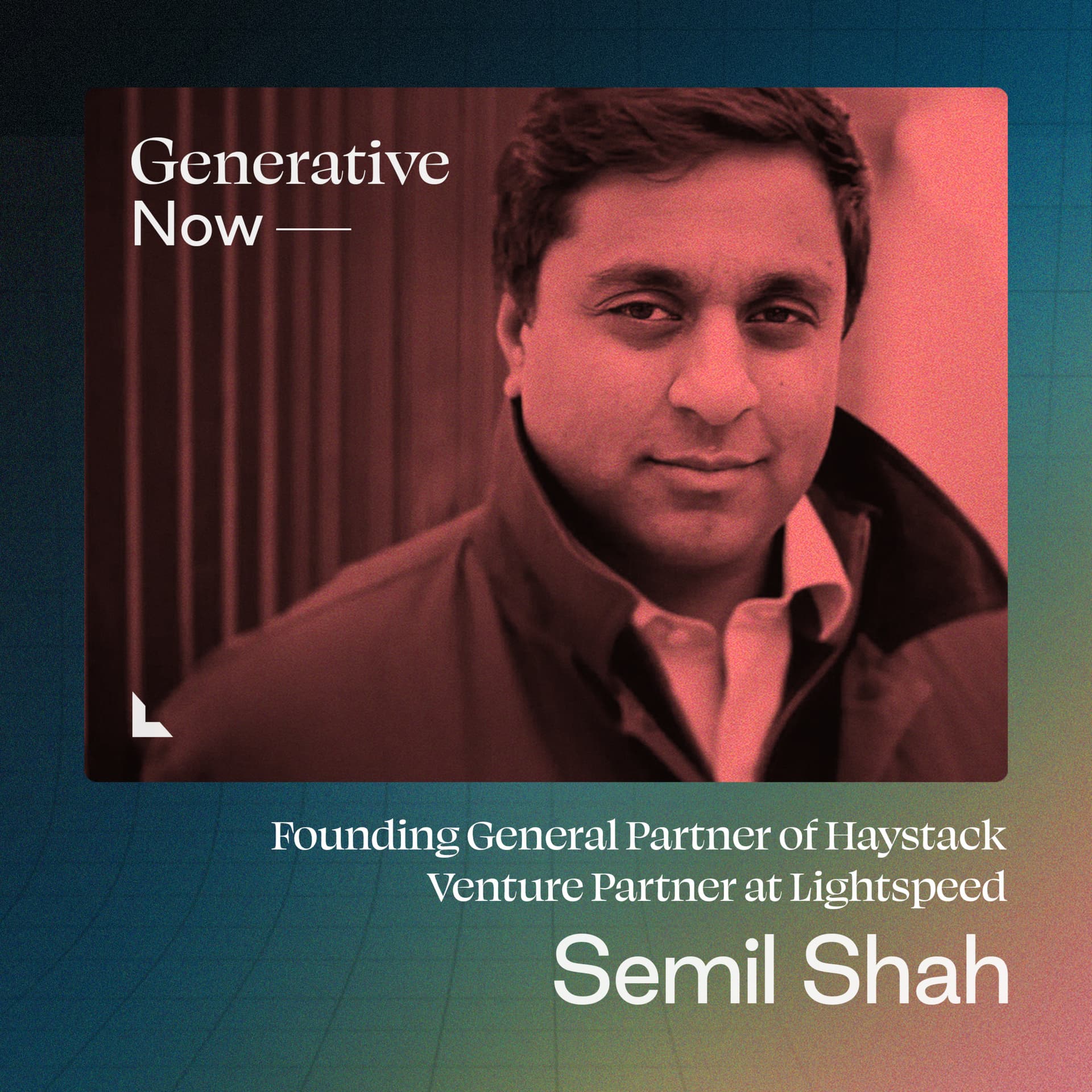
- Guest: Semil Shah, Founding General Partner of Haystack and Venture Partner at Lightspeed
- Focus: Continuing the discussion on consumer AI technology, Artificial Super Intelligence (ASI), and implications for the future of work.
Episode Chapters
- Introduction (00:00)
- Consumer AI Tech (00:31)
- Autonomous AI Agents Versus Copilots (03:05)
- Matt Levine's Insights on AI Junior Analysts (04:19)
- Future of Training Entry Level Consultants (05:53)
- ASI as a Drop-in Coworker (07:55)
- Will We Have Our Own Agentic Consultants? (09:38)
- Software On Demand (11:50)
- AI Generated Music and Content (16:32)
- Conclusion (20:31)
Key Discussions
- Consumer AI Technology
- Emerging Applications:
- Discussion on unique consumer applications, particularly Friend AI, a social app that uses AI to engage users in a companion-like manner.
- Emphasis on the need for innovative applications that engage users meaningfully.
- Co-pilots vs. Autonomous AI Agents
- Trust Levels:
- Current technology is seen as co-pilots (assistive roles) where users maintain control.
- There’s hesitance to fully trust autonomous agents due to potential errors and lack of control.
- The Role of ASI in Work Dynamics
- Impact on Job Training:
- ASI could replace traditional roles (e.g., junior analysts) in investment banks, raising questions about the training and value of human workers.
- Concerns regarding how organizations will adapt their training methods if AI takes over more tasks.
- Software On Demand
- Future Outlook:
- Speculation on dynamically generated software that could be created in real-time to meet specific user needs.
- Contrast between existing dedicated software and the possibility of AI-generated solutions tailored to individual tasks.
- AI Generated Music and Content
- Consumer Acceptance:
- Discussion on the future acceptance of AI-created music and shows compared to traditional productions.
- Noted skepticism regarding AI's ability to evoke genuine emotional connections as seen in human-created works.
Key Takeaways
- Trust and Control: As AI evolves from co-pilots to more autonomous roles, establishing trust will be crucial for both users and organizations.
- Future of Work: The advent of ASI may lead to significant job transformations, requiring businesses to rethink training and employee roles.
- Innovative Applications: The potential for creative AI-driven applications is vast, with ongoing development promising new user experiences.
- Cultural Impact of AI: As AI-generated content becomes commonplace, the challenge lies in balancing quality and emotional engagement with user expectations.
Conclusion
- The conversation highlights the transformative potential AI holds across various sectors. With rapid advancements, understanding the implications of these technologies will be vital for future work dynamics and consumer interactions.
Stay Connected
- [Lightspeed Website](http://www.lsvp.com/)
- [Twitter](https://twitter.com/lightspeedvp)
- [LinkedIn](https://www.linkedin.com/company/lightspeed-venture-partners/)
- [Instagram](https://www.instagram.com/lightspeedventurepartners/)
- [Subscribe to the Podcast](http://generativenow.co/)
Written by AI. May contain mistakes. Listen to the episode to check what was said.
Transcript
Automatic transcript. May contain errors.0:05Hey, everyone, and welcome to Generative Now. I am Michael Mignano. I am a partner at Lightspeed And this week, I am back with my friend, colleague, and fellow investor, Samil Shah. Samil and I pick up our conversation about consumer AI tech. We also get into the future of work, software on demand, the theory of artificial super intelligence, and lots of other great stuff. So let's get into it. Just to go back to the consumer thing, I do think there are opportunities here. I don't think we know what they are yet. I don't think we've seen the killer consumer app of AI yet, unless you count ChatGPT, which the revenue figures that have come out suggest that this is all consumer revenue.
0:46But I do see people doing creative things that they weren't doing before. There's this app, no idea if it's going to be big or anything, but a fun idea, which is this social app where all of the people are bots. Do you know about this one? it's a social network and you post and you get you get replies and they're all bonds oh yeah like you mean it's hilarious like it's just it's just fun well you saw that graph of like where is the ai heat and it's like you know ed tech this tech blake tech but then the power law was towards companion co-pilot so that is where it's gaining the most traction yeah leaps and bounds people do want to talk to these things um i'm still not sure if i believe it's uh for anything other than like fantasy stuff you know what's a subset of the other is a companion bot that you talk to for therapy or can you know intimate companionship a subset of a co-pilot or is a co-pilot a subset of companionship i don't know i don't know i do know that um there are people trying interesting things it's this device called friend it's by this this founder avi um really smart kid and it listens you know you've seen these products that like listen in on your conversations yeah but this isn't an agent that transcribes meetings for you or like you know fills out the grocery list this is a friend that's what it's supposed to be and so it listens and then it actually sends you messages on your phone based on what it's hearing.
2:23So, um, for example, if I have it on right now, which I don't, I don't have this device. I don't think anyone has it. When I finished this conversation with you, it might message me and be like, Hey Mike, that was a great conversation with Samil. Like nice job. I talked to somebody that has tried this thing and they said it was just like this insanely magical experience. And it's somebody I trust somebody whose opinion I trust. And so that's like a new take on the companionship that I hadn't really ever heard of or thought about before. So again, who knows what's going to happen with consumer, but I am fully confident we're going to see people building experiences that have not existed before that are going to be really, really cool.
3:02I 100 % believe that. What's your view on an agent just doing the thing? Because I think it has really interesting implications beyond the technology as well. Yeah, I think about this on sort of scales of trust, if that makes sense. So right now we're more in like the co-pilot phase of things right now. And I think it's easy to trust them. But it's especially easier to trust them because you get to basically check their work, right? Like you still have your hand on the wheel. You know, when I think of co-pilot, I think of Tesla full self-driving. I think of Granola. I think of Microsoft co-pilot.
3:39Like you're using these things and they're augmenting your capabilities in such a way that you are still in control. But as we all know, these things still make mistakes. They hallucinate. They don't always do what you're intending to do, which is why that control is so important and which is why people are not yet fully comfortable trusting these things. to get to an agentic world outside of the technological improvements that that will need. And and by the way, I believe are coming. I think that trust factor still has a ways to go, right? Like you're not going to farm an agent out to go handle all your personal business without your hand on the wheel.
4:16The reason I found this interesting was from a different vector. I was reading um matt levine from bloomberg you know he used to be this like crazy smart lawyer he writes a lot about like like really arcane fraud or creative fraud yeah and he writes a lot about like just things happening in financial markets and products and so he was saying basically that like we've all had these friends who graduate college and go to kind of investment banking and they give up two to three years of their life and they're doing all this grunt work of analysis. And he basically said the main three or four things that a junior investment banker does, like AI is either there already or very close to basically completing it, but that the leaders of the bank use those two to three years to immerse those people in the business and all the vagaries of the business and nooks and crannies so that in every class, if they have 100 investment bankers coming out of school, maybe one becomes an MD in 10 years, right?
5:20So if you're leading one of those investment banks or law firms or what have you, and you're trying to groom the next layers of leadership down the road, like, would you allow a full agent to come in and do everything at the risk of not training your underlings? or do you have to train them in a different way? I just thought it was a super interesting question that goes beyond like, what can the technology do to actually like what's right for the enterprise to implement? Right, like what is the risk we introduce into this business if we're no longer training people, right? We're putting ourselves on a path to be fully locked into these things.
6:02Yeah, like yesterday, met a guy who's just building an ability to go into and do these 500 ,000 slide slide decks for deep consulting work. That's his first product in, super hyper-focused. So imagine you and I were McKinsey leaders and the top GP managing different offices. And we're thinking about this problem. We're in our 40s. We're going to be here into our 60s. And we need to groom the 20 to 25-year-olds in that world. How would we approach the introduction of that technology the short-term carrot is to like reduce our opex costs and we make more money but then there may not be people who were like trained by fire later i don't know i just found that fascinating we're sort of like proactively signing up to eliminate ourselves by doing that like once we crack the door open we're already heading down the path because basically what you're saying is like we're basically um making ourselves extinct because we're not even training the next generation.
7:08Well, the way you frame it is fascinating because I had a different frame. I think it's more like people who run businesses will still want like Anderil when it becomes the next thing it's going to be is still going to use consultants because consultants are valuable in some ways. Maybe the ants, maybe I'm not thinking broadly enough. Maybe I'm thinking like they'll have their own little army of consultant agents. Right. I don't know but I think of it as like the human to human like the person leading the company will want to talk to another principal who has expertise across that sector and to give them an outside perspective right and then will those people still exist 10 20 years from now well this this feels like the right time then to start talking about artificial super intelligence I mean this is the theory of artificial super intelligence ASI is that once it is created and it is agentic that you basically get a drop-in co-worker that can not only do everything, but that can do it way better than you and I ever could or any McKinsey consultant ever could.
8:17And by the way, it's going to be a fraction of the cost of hiring that consultant. Yeah, I think there are a lot of people believe that that's the future we're headed towards, and it might be here pretty soon. Right. So let's go back to the McKinsey example. If you and I are the co-leaders of McKinsey right now. How do you not want this? How do you not want this? The short-term juice you get, right? Like each mid-level consultant who's getting on a plane and building these decks and doing all the synthesis, they have their own teams, right? They have their own entourage that you're paying and you're delivering this to the client.
8:53You can reduce your cost of goods sold tremendously and the profits go back to the partnership and the endowment. Your short-term incentive is quite perverse. You're taking a leap of faith that it doesn't start at the bottom and ultimately eat its way all the way up to the top. Right. Because it would probably start from the bottom, right? If you factor in this trust dynamic, you're going to trust the lowest level employees to be replaced or augmented by these things first. And slowly, as the capabilities increase, they're going to go a layer up and a layer up and a layer up. And where does it end?
9:28I don't know. I almost talked myself into a different corner because of the andro thing of like, I've listened to all these Palmer Luckey interviews and I'm almost can imagine him being on this podcast and being like, we'll have our own agent to consultants. Like you're an idiot, Samuel. Like you're not even going to use McKinsey. Yeah. You're just going to have. Yeah. I mean, that's actually probably the reality, right? Well, I actually think it's the same observation, right? I think as McKinsey is getting more and more efficient, it's happening also directly within the companies, ultimately to the point where McKinsey is just completely irrelevant because the access to the technology.
10:03Unless, counterpoint, by this being deployed throughout McKinsey, there's such a strength of a data moat inside McKinsey. Actually, that's where I was going to get to. I think if I were leaving McKinsey, I would say we should have our own agents that run on our own corpus of proprietary information. That's right. You keep the finders up top, make more profit per partner. And the way McKinsey works is you have grinders on the bottom that are doing all the work, right? They're flying to Bentonville, Arkansas every Monday to Thursday. Then you have the minders. You have the middle management mining all the projects, making sure everything is synthesized and packaged properly.
10:43And then you have the finders on the top who are finding new business and maintaining business relationships, right? and you basically sell a co-pilot or a gentic mckinsey service to an anduril and say look you can you can benefit from our our institutional knowledge yep and and get recommendations from us and if you want more human involvement it'll cost more and if you want just a gentic involvement it'll cost this i i think that all actually makes quite a lot of sense now if you were an entrepreneur this is fascinating would you try to go build something to go sell to the mckenzie's bcgs banes of the world or would you try to build your own native consultancy i mean i think it would be very hard because you don't have any institutional knowledge to build off yeah i think that's that's the risk um i think you'd probably need to try to find a way to you'd probably try to find a way to sell some data to McKinsey.
11:48Anyway, it's fascinating. Things I've been thinking about with all this stuff on the topic of ASI and, you know, just sort of this curve that we're on is like this notion of software on demand. First of all, I guess my question to you is like, do you believe that we are headed towards a future where software is being created on demand? How do you define software on demand? It's a sliding scale, right? I think on one respect, there could be existing products that exist today, vertical products, also horizontal things where maybe an element of software on demand is that the interface or the experience is somewhat dynamic in that whatever you need to do, the experience for that, the Chrome, the user interface is being generated almost like on demand and on the fly.
12:31But I think a further step of this is actually the lack of a need to use dedicated software products for things and instead having software spun up for you and for whatever problem you're trying to solve in real time. In that latter example, you might be invoking it right from within a model, like a GPT-5 or something. In which case, that model is somewhat of a God model, right? It can literally do anything for you. You can look things up on it and it can help you answer questions you can perform agentic tasks and you can literally have it solve any problem because it can just spin up software for you instantly i wonder if i'm getting tripped up on spin-off software because i don't know if most people need software to be created for them versus just using natural language where the prompt um sets off a series of like api calls and tasks that are done under the hood maybe that's the same thing i don't know i don't know if i'm on the the right track, but I kind of come back to this Mark Andreessen conversation in the Lex Friedman podcast from like a year ago.
13:42Lex was talking about, you know, will we go into like these more siloed command line interface worlds where we're just talking to something and it spins up software on demand or gives us a recommendation or a recipe and like what will happen to the open web. And I think to paraphrase Mark just said, the open web will always be there and it's an escape patch from any container you're in yeah and maybe the ai can just create a browser for you in the moment that's kind of what i'm what i'm talking about yeah um and i think that's fascinating of like i've been talking to somebody about this idea of like um doing you know as an example doing some kind of cooking like group travel trip to italy where you're immersed in cooking and wine which sounds pretty good right yeah um so we're using that as an example and like imagine you're like planning that in perplexity or whatever your favorite engine is and then you start to do actions or you start to need a browser it can almost create a italy cooking travel wine browser for you where you just tell it to like not go anywhere else yep that's kind of cool i think it's totally cool and i could i could totally see it i'm somewhat bearish on this notion of the command line being the way that we do everything like i i just don't think that that is a really efficient way to to to do stuff like i think that's why we have buttons and screens and things we tap on now counterpoint i have not yet used um chat gpt new voice mode like the one that they demoed a few months ago.
15:27I'm very, very curious to see what that feels like and see what it feels like to be able to talk to someone and get anything done instantly. Well, think of our experiences so far as consumers, right? It started with Siri, which was like basically a bag of shit. Then it went to Amazon Echo and people were excited for a while until you realize like you can add things to your grocery list yeah so i think a lot of us are sort of like you know i believe it when i see it what where voice makes sense as the truest natural language interface to prompt a question but i feel like we're twice you know once bitten twice shy yeah Certain types of consumer products will remain extremely defensible in this future.
16:19And I think those are the products where you sort of like waste time, really around like content and media. Like there's no need for an agent to play Spotify for me. Like I want to listen to Spotify. Well, remember that Matt Levine post I sent you on the Spotify like computer generated song scam? yeah of course I mean I think you can you get someone in reels or shorts and you just start creating the 10 second clips it's so cheap and you know how to tune it you know how to prompt it I mean I think that's already happening the perverse incentive around driving engagement around that is kind of kind of scary so yes and no like I I do think like more and more people will listen to AI generated music.
17:12And, you know, who knows, maybe there's a world in which Spotify plays heavily in that, in that future. And, and, and they probably could because they have close to, you know, I think they're closing in at a billion users. The product has, it's got such tremendous lock-in, but you know, if you think about like, I don't know, Netflix, um, or, or even one of your favorite shows, right? What's one of your favorite shows? I don't know. Pawn Stars. Yeah. Pawn Stars. Like that piece of content gets created. Like you're watching it, you're watching it wherever it is. It's so bad. I have a hard time imagining how like an AI generated version of, I think one of the pond socks guys is in jail and like maybe the dad died or something, but like, I would prefer that to live on, you know, I guess to get back to my point, like, I don't think we need agents, uh, to, to help us, help us solve our boredom, you know, and to help us do the things that we like to do when we don't have work or, you know, whatever.
18:11Like, so I think those types of products are actually quite sticky. I don't know if you saw the Michael Ovitz talk from the All In Summit. They were sort of asking, like, what do creatives and producers think about, you know, this generative AI wave and are they scared? Are they harnessing it? He said a lot. He said quite a few things about it, but like one of of the elements he was talking about was like, do you need Steven Spielberg and a real child actor and E.T. to create this nonverbal visual emotional connection that the audience feels? Or can AI do that? And I think that's sort of an unknown.
18:53Yeah. Fascinating question. I don't know.
19:02And You've seen that? No, I've heard of it. I don't know what it is, though. Yeah, I think it's like eight minutes. It's about like Asian family where like the mom is really strict with the kid and then she like eats dumplings and then eats him as a dumpling. I can't remember, but it's like very moving. But you can then imagine an AI creating that because it's all animated. Right. Yeah. When we were considering the investment in Suno, I called one of my one of my best friends in the music industry. and I just said, do you think there's a world where people can have affinity for an AI-generated artist or song?
19:37And this person made some really interesting points. He said, look, we already can engineer what we think will be perfect music. Producers, they rip off different elements from each other. We put the same hit producer on a bunch of different artists. It's like, we always try to recreate a hit and it never works. We don't know why these things resonate. And so he's like, I have a hard time believing that you can sort of manufacture this affinity because we haven't been able to do it yet. But on the other hand, who the hell knows? Maybe this technology would be way more powerful than anything we've ever had before.
20:13I think it also goes back to distribution. If you have someone like Jay-Z or Taylor Swift releasing kind of an AI song that they prompted, I think a lot of people would listen. Probably. Samil, as always, this is a blast. I appreciate you doing this. We'll do another one soon. Before the end of the year. Let's do it. Thank you so much for listening to Generative Now. Now, if you liked what you heard, please do us a favor and rate and review the podcast on Spotify and Apple Podcasts. That really does help. And of course, follow the podcast if you want to get notifications every time we drop a new episode.
20:51If you want to learn more, follow Lightspeed at LightspeedVP on YouTube, X and LinkedIn. Generative Now is produced by Lightspeed in partnership with Pod People. I am Michael McDonough and we will be back soon. See you then.
21:09Thank you.
From the publisher
This week, we are back with part two of Generative Quarterly with Semil Shah and Lightspeed Partner and host Michael Mignano. Semil is a founding General Partner of Haystack and a Venture Partner at Lightspeed. Semil and Mike pick up their conversation on consumer AI technology, starting with innovative consumer tech like Friend AI by Avi Schiffmann. Mike and Semil consider the impact of Artificial Super Intelligence on the future of work, debate the future evolution of software on demand, and ask if we need AI agents to help us solve our boredom?
Episode Chapters
(00:00) Introduction
(00:31) Consumer AI Tech
(03:05) Autonomous AI Agents Versus Copilots
(04:19) Matt Levine: Robots Make Good AI Junior Analysts
(05:53) Future of Training Entry Level Consultants
(07:55) Artificial Super Intelligence as a Drop in Coworker
(09:38) Will We Have Our Own Agentic Consultants?
(11:50) Software On Demand
(16:32) AI Generated Music and Content
(20:31) Conclusion
Stay in touch:
LinkedIn: https://www.linkedin.com/company/lightspeed-venture-partners/
Instagram: https://www.instagram.com/lightspeedventurepartners/
Subscribe on your favorite podcast app: generativenow.co
Email: generativenow@lsvp.com
The content here does not constitute tax, legal, business or investment advice or an offer to provide such advice, should not be construed as advocating the purchase or sale of any security or investment or a recommendation of any company, and is not an offer, or solicitation of an offer, for the purchase or sale of any security or investment product. For more details please see lsvp.com/legal.


