
In short
Podcast Notes: Generative Now - Episode with Semil Shah
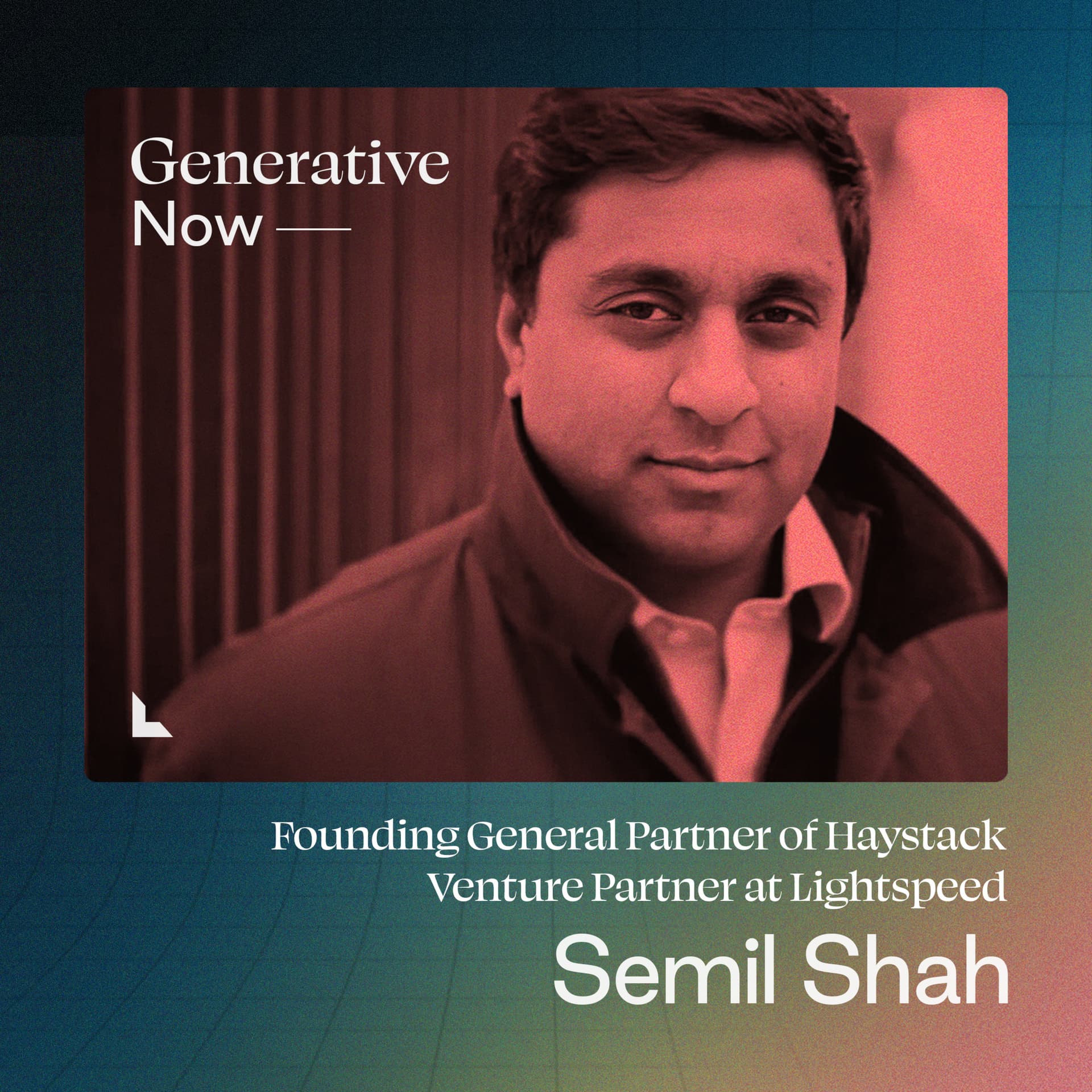
Episode Summary In this episode of *Generative Now*, host Michael Mignano speaks with Semil Shah about the rapidly changing landscape of AI, its implications for startups, venture capitalists (VCs), and other tech incumbents. They delve into various themes, including the evolving role of software, AI's democratization, and the recent outcomes of Apple's WWDC. Semil shares insights as the Founding General Partner of Haystack and a General Partner at Lightspeed Venture Partners.
Key Topics Discussed
- The End of Software
- Chris Paik's Essay: Semil discusses Paik’s perspective on AI leading to the democratization of software, much like how the internet democratized media creation.
- Concerns: Questions arise about distribution and the existing power dynamics of platforms that currently dominate the media landscape (e.g., Google, Salesforce).
- Technology’s Limitations
- Semil expresses skepticism about the complete automation of software development, emphasizing the craftsmanship required in both front-end and back-end development.
- He reflects on how AI will impact the demand for programming skills and whether future generations will pursue traditional computer science degrees.
- Tech Cleanse and AI Impact
- Discussion on the potential 'Tech Cleanse' and its implications on technology usage and product design.
- Semil highlights the importance of balancing technology integration with tangible human interactions (e.g., in education).
- Apple’s WWDC and AI Integration
- Analysis of Apple’s announcements at WWDC concerning AI, particularly their partnership with OpenAI for ChatGPT integration.
- Semil discusses Apple's strategic approach versus competitors and the cultural implications of their product decisions.
- Views on VCs and AI Landscape
- Semil emphasizes the current FOMO in venture capital surrounding AI investments and how it may lead to irrational funding decisions.
- He notes that while AI presents exciting opportunities, it also creates pressures for VCs to adapt their investment strategies.
### 6. Cultural and Personal Reflections
- Semil shares insights on personal growth and decision-making through "opposite George" thinking, inspired by a classic *Seinfeld* episode where George does the opposite of his instincts.
- The conversation touches on the value of taking time for introspection and resisting herd mentality in the fast-paced tech world.
Key Takeaways
- Democratization of Software: AI has the potential to significantly change software creation, but existing infrastructure and distribution methods will continue to shape this landscape.
- Role of Craftsmanship in Tech: Despite advancements in AI, the need for skilled human input in software development remains critical.
- Investor Psychology: The current venture capital environment is heavily influenced by fear of missing out, which may lead to hasty decision-making.
- Cultural Dynamics: Companies like Apple and Google play crucial roles in shaping technology trends, and their actions can have widespread implications for the industry.
- Personal Practices for Decision-Making: Embracing different perspectives and stepping back from conventional strategies can lead to better decision-making in both personal and professional contexts.
---
Conclusion This episode of *Generative Now* offers a thought-provoking exploration of the intersection between AI and the future of software, emphasizing both the opportunities and challenges faced by entrepreneurs and investors alike. Semil Shah's insights provide valuable context for understanding the evolving dynamics within the tech industry.
Listeners are encouraged to reflect on their personal and professional strategies in a rapidly changing landscape.
Written by AI. May contain mistakes. Listen to the episode to check what was said.
Transcript
Automatic transcript. May contain errors.0:05Hey everyone and welcome to Generative Now. I am Michael McDonough. I am a partner at Lightspeed And for today's episode, we are talking to someone we had on the show back around three months ago, Samil Shah. He is the founder and a partner at Haystack VC and also a venture partner at Lightspeed. The episode that I did with him a few months ago actually turned out to be one of our most popular episodes ever. And so we thought, what if we talk like roughly once a quarter about everything that has happened in AI in the preceding three months? And so that's what we did today. And you know what? If you all like this episode, maybe we'll do it again in another three months from now.
0:41So check out this episode with Samil Shah and let us know what you think. Hello, sir. Mike, how are you? I'm good. How are you? Good. Just have a little bit of a different... You kind of blew up my schedule today, so I had to kind of plan around you, you know. Yeah, I did the same for you, just to be clear. I moved my schedule around for you also. That's how special you are. yeah it's also a baseball baseball i know you you played baseball growing up so it's a yeah big baseball time in our household where both my boys are playing but one of them he's just sinking his teeth into it so oh really you have to go get a bag today and get a bat and get a new helmet and you know big decisions i think our kids are around i think your sons and my daughters are sort of around the same age but my kids don't play baseball so i don't know is he old enough such that like he has a position and stuff or is it just no literally it's just like you just go everywhere they're going from second to third grade if you play competitive now which i don't i don't know if he'll do now but they definitely slot you they definitely evaluate you based on like position but he's also lefty lefty so once it gets competitive they constrain you to like outfield pitcher first base that's it got it oh man so much pressure it gets serious quick you You know, there's no third grade, left-handed third baseman.
2:08You played ball, right? Yeah. Yeah, I played a lot of baseball. I mean, that was my life growing up. I guess at some point you probably imagined not being a VC, a famous VC and tech personality, but a famous baseball player. Well, I never thought I would play like super competitive baseball, but I just really loved it. And I was only a catcher and pitcher. So I was always involved in the game. Yeah. And it makes a pretty big impact. Yeah. Like strategically. I mean, obviously with pitcher or catcher, you're in the game every play that you're in the game. Totally. And with the catcher, you're the only one to see all the fields.
2:48So you're directing a lot of traffic and calling signs. Yeah. It's the only thing I really knew, you know. Occasionally I played first base, but like honestly, I didn't have the hands. I didn't have like the hands and footwork for that. Yeah, I played. I come from a baseball family, but I wasn't that good. And so I always got stuck in the positions where they stuck the not-so-great players. I think I played a lot of right field. I did a little infield, actually, a little shortstop, a little third base, but also some right field. I feel like that's where you get stuck. I had a good arm, so I was always pitching at the end of the rotation because I was the fourth or fifth best arm.
3:32but it wasn't like the best position for me but yeah the catching really impacts a lot um of yeah you learn so many things by doing that it's almost like it's hard to strip those away over time so moving away from baseball um we last did this almost exactly three months ago yes This felt like six months ago. Do you know that your episode, I believe, is my second most popular episode of all time? Oh, thank you. What do you make of that? I don't really read into episode popularity. So I don't read anything into it. I think that I do think, you know, it's easy to kind of crap on VCs and they're a fun punching bag.
4:21But the reality is like there are some really good ones. Hopefully you and I will be good ones. And they do see a lot at a high level and can put points together. And I do think those insights are valuable to the ecosystem. So maybe that's why you let a VC into the hen house. Yeah. One of the things that has happened, I think it was a couple of weeks ago that I thought was really interesting, was this essay from Chris Pape about the end of software. Did you read this? Yeah. The point he makes is that in a previous era of computing, the internet basically made it, the internet and smartphones basically made it such that there was a democratization of media creation.
5:07And as a result, now anyone can create media, whether it's photos or videos, et cetera. And now AI will do the same thing for software. and AI will democratize software. Anyone will be able to make any products. And the thing that we haven't seen yet is like, where and how does the distribution happen, right? The platforms that figured out how to distribute media at scale, those ended up being the ultimate winners, right? YouTube, Instagram, et cetera. Who's going to do that for software when software is democratized via AI? I thought that was kind of interesting. It is interesting. I mean, I think it's just fun to talk about.
5:44And obviously Chris is super smart. I don't, despite Chris being a super smart guy, I personally don't put a lot of stock in that for two reasons. One is the same people that distribute all the media, whether it's Salesforce and enterprise side or all the way to Facebook, Google. Did you mean software? Sorry. Yes. You said media. Software. Software is like a version of media. Okay. Got it. That's how I think about it. But the other thing is that before we even uttered the phrase generative AI or generative models before that, people were talking about and building low-code, no-code things and connectors and all that stuff.
6:26And I used to work at this company, If This Then That, building connectors and people can stitch together these things in very crude ways. So I just wonder how much of this is all the same thing and was possible before. I also think it underestimates the amount of craftsmanship that goes into both the front end and back end of designing really intuitive software. Like I know, I know you were working with Chris and the granola folks, like could AI have really come in with those opinionated insights in the beginning? Like, I don't know. Not today. Not today. But it seems conceivable that it could in the future with enough data.
7:15Yeah. I don't mean to sound, I don't mean to sound bearish on it. I just still think this idea of a human in the loop or developer in the loop, um, will not go away and not be marginalized. What do you think though of like the demand to learn how to program? What will happen there? I mean, I majored in computer science. I want us to learn how to program. I want us to be a programmer. the biggest thing that uh chris's essay got me thinking is like when my kids get ready to go away to college like are they going to want to major in computer science or will nobody be doing that i think it's a more it's a it's an interesting question and maybe even more philosophical because you could say like hey do i want to go learn a skill or vocation and be able to learn scripting languages like Python and Java, et cetera?
8:10Or do I want to actually understand how computers work and how the bare metal works and how the silicon works and being able to understand a program maybe and see or something where you're able to interact with the whole system, right? And I still think there are people who will do that. what's what's so funny and interesting about what you just said um is that so at least part of my um cs degree and i'm you know i'm sure the same is true at other universities and programs like you do learn about all that stuff how computers work you know all you you learn about the most foundational stuff and at the time i remember thinking myself like why do i care about this i don't i don't want to know any of this i just want to know how to go build a product some product, some piece of software.
9:03And only recently during this whole AI boom, have I been like, oh, that was pretty interesting stuff to learn. Well, another way to articulate what you just said is that like, you know, I mentioned there's a vocational, like, how do I do the thing path, or I want to be a systems integrator, or I want to be an Oracle database architect or whatever. and you just go and you bang that out. The thing that you're talking about is how do you set up a foundation for continuous learning over time, right? So like not to side swipe this into like cooking, but like I think a lot of this is related to like, oh yeah, I was trained to like cook in a kitchen and like learn these basic techniques, right?
9:49Whether it's cutting things or flavors that go together naturally or like ways to thicken up things or thin things down or boil them down or expand them per se. And so now when I get a new recipe or I'm trying to think about something new, I just know all the base level techniques and I can pick up something new and put it together without any, I don't have to write anything down or recall anything about the recipe itself. Do you know this guy? Do you know Joe Albanese? Joe Albanese. He's the founder of a company called Stir. I've heard of Stir. Yeah. I saw this thing that he's working on recently where he's leveraging the GPT-4.0 APIs to do like a sous-chef, which I thought of you actually, speaking of cooking.
10:46because it's basically, you know, right now it's on the phone. You know, maybe you could have it on some other device in the future, but it's like watching what you're doing. And you can only ask it questions like you would a sous chef, but it might like actively be able to see something and make a suggestion or a recommendation. Oh, you want to know how to thicken this up? Just, you know, go over to your counter over there or your cabinet over there and get some flour or whatever. I thought it was kind of interesting. It is. I think for me it might be, I mean, I appreciate Joel's. You're really good.
11:17You're like an expert chef. No, no, no. For me, it's more like that's one of the few things I do where technology isn't really involved. So I'm hesitant to bring it in. But going back to the CS thing, I do think people will go pursue a computer science degree for the intellectual pursuit of a Bachelor of Arts or Bachelor of Science in a field because they're interested in how these things work. but I think the larger question you're asking is will our kids want to go be an oracle database architect or a salesforce integration consultant and I do I do think there there are a lot of things where you know the I kind of bind to the Nabeel argument of like a lot of these things will let free up developers to do more creative higher level abstractions and tasks and the lower level stuff will get metered out so so maybe chris is right to a degree and maybe it's also not fully fully correct in another sense yeah what's interesting about what you just said it's making me think like okay in the world where he's correct or at least directionally sort of accurate this this he has almost become i think to your point around being a database engineer versus not, does it become like almost like a type of history degree?
12:53Well, you know, I mean, I'm sure you've met Chris Dixon in the past. I was lucky to meet him right between this first and second startup. And he was like one of the most prolific angels in the late 2000s in New York. And, you know, if you read all this stuff or look back and everyone thinks, oh, he's super thoughtful, clearly thoughtful guy and understands how these large platform network affect companies, what their strategies and weaknesses are, you know, as a philosophy and computer science major. Right. And so I do think you see a lot of people like that, like Charlie Cheever is like this in a way.
13:33Right. Or you talk to Adam D 'Angelo, he's kind like this. Right. And a lot of the people who are building the most exciting models today have that pedigree. Right. There's a much bigger element of philosophy in technology right now happening right now that I can remember out of my entire career, I would say. Yeah. And it's, it's way beyond my pay grade. I mean, I just, I look kind of like you, I know the players and I've interacted with some over the years and you You can see the pattern in the pedigree. You're not going to hatch this in your dorm room. There has to be some intellectual underpinnings to building in this world.
14:16The exciting thing, though, is on top, what people will build on top, I do think Chris is right. It's more democratized in a way. And so you hear all the arguments on Twitter. It could take fewer companies, right? I think Instagram was like 11 to 15 people when it was acquired. I think WhatsApp was about 50, right? So, you know, those were happening pre-generative AI, right? So you have to assume it can happen now because conditions haven't really changed. And, you know, could that increase in velocity where we had maybe, let's say if we're being generous, maybe five of these. Oh, Minecraft, right?
14:56Twitch, I don't think, had tons of people. Could you increase the velocity of those over time? Yeah. I always think, too, when someone writes a post like this, even if it's someone as smart as Chris, they're probably 49 to 50 percent right and 49 to 51 percent, you know, maybe overestimating the impact. Yeah, I think that's probably right. You said something interesting earlier when we were talking about the sous chef. You said cooking for you is a place where technology does not go. And I thought that was interesting because it does seem like with AI, technology will go in more places that it previously did not go.
15:44Right. Especially if you think about agents and like transcription. I mean, even like Granola, you know, we talked about you talked about Granola a little while ago. People love this product. And yeah, I'm in full disclosure. I am an investor. We unfortunately passed, but we love Chris. And so good on you. Yeah, I had the good fortune of getting close to Chris when he was building his last company and just seeing how amazing he was. Actually, I was catching up with Asha and my partner yesterday, and we were talking about it. And I remember distinctly liking Chris. And distinctly, we had this conversation.
16:21I was like, I've seen like a hundred pitches of people trying to like summarize and getting to the meeting notes flow. And we both started laughing. Chris and I started laughing and he was like, yeah. And I was like, I don't, I don't know. And he was like, yeah, it's crazy. We made, we made the wrong decision. We'll see. It's, it's still early. I am, I feel very, very lucky. But, you know, with that product, as an example, that feels like a place that technology normally wouldn't go. And now it's going there. Right. I'm trying to think where else technology will go as a result of AI. I mean, obviously, like Humane imagined a world where you're filming everything at all times.
17:07Right. Well, remember, this was the Snap Spectacles, which I really like that product idea of just being able to have the light on the phone mentioned if the camera's on or off. And I don't mind that. I think having wearable, this is just my two cents. I mean, I'm one person, but a world in which visible wearable technology that has clear sensor indicators on, I do think will happen. People love those Meta Ray-Ban glasses. People love those things. I haven't tried them yet. Yeah. And of course, Apple's working on that, too. So they're not dummies, you know, and there's so many applications of it.
17:53So I think it's just a matter of when, not if. oh so you know that will come in and create issues for for people and people will have to figure out the right way to do it you know it's all tbd even airpods by the way like i i have my airpods in all the time you know four years ago i i didn't even own them or whatever it was no i mean that those little things that yeah absolutely make a difference i mean how many people fall asleep with like ear pods. Right. So then that's just kind of nuts and potentially not a good thing. Yeah, that's true. The other thing, I mean, aside from like the obvious stuff, you know, a lot of VCs will say like, hey, it'll seep into other parts of the economy that were slower to transition, you know, over.
18:44And I've heard that for a decade. And the reality is, is like, it's true. Like what? into like aerospace and defense or like industrial manufacturing or you know fill in the blank it doesn't even matter what you fill in the blank with education yeah classroom i mean the classroom is a place another place where as a as a parent and a contrarian opinion i am extremely concerned about these sort of devices in classroom and doing assignments on them after. I think if I were to vote right now, I'm a kind of hard no on it. Like right now, I'm like pencil, pen, scratch pad, write it out, write it out again, write it out again.
19:30Don't flip between tabs, you know. I think there are probably lots of places where technology doesn't go today. it will increasingly go probably at a greater rate as the result of AI. I agree with that. Yeah. Maybe not cooking though. I don't mean to say that it shouldn't go in there. For me personally, when I'm doing, like I was cooking last night outside, I don't want it there. Like I just, it's, it's a, you know, like some, some investors will go kite surfing or they'll go mountain climbing to like remove themselves and like not, not be thinking or having AirPods in all the time. For me, that's like cooking where, okay, 30 minutes, 45 minutes, whatever, an hour or two.
20:12I'm kind of focused on arranging something else analog. Yeah. I think it's important to have those protected spaces. I've been trying to go no phone until I sit down at my desk for work. So wake up. Don't look at it. Don't engage with it. You know, work out. Get ready for the day. take my kids to school, sit down at the desk. Okay. It's a great discipline. It's hard. I don't do it every, I can't do it every day. I'm trying. I'm trying. I recently, I think I mentioned to you, I recently went on a, like a meditation, like very short, short, like not a silent meditation retreat, but I went on this group meditation.
20:57That's cool. I didn't know about that. Yeah. And I didn't have my, I wasn't really allowed to use my phone to communicate for, it was about a 48 hour period, I was able to like check texts for like family stuff, you know, nuclear family stuff, and then played a lot of the meditation and guide work. And like the time in between was like listening to music. So I was able to use Spotify, you know, but yeah, it was very difficult. Like, I don't think I've ever done that before. You know, How did you avoid the other apps? Was it all just like honor system or? It was honor system, like other people there too.
21:36And like, it's not as you know, it was policing you, but yeah, like it was easy not to check email. It was a Friday and Saturday into Sunday and it was easy not to check Twitter. Yeah. You know, or Instagram, like I'm not hooked to that, but the hardest part was like iMessage. Yep. Yeah. Same for me. That was like, you know, so if you were to say again, like, Hey, Samil, would you do that again could you go through it well of course i have to have spotify uh like that's a like i'm absolutely not getting rid of that um and i messaged that was tough because so much like people were like are you okay like you know it's like i was like it is a little disturbing that people are that conditioned to hearing back yeah where i've struggled a little bit when i when i When I am doing one of these things where I don't have access to my phone, I also notice that the times when I struggle the most are when I feel like I have to get in touch with somebody.
22:42Like I'm running a little bit late for something and I feel bad and I want to let the person know, hey, I'm late. Or, yeah, like I don't even know what time it is. That actually, like I'm surprised how much that has affected me when I do these things. Like I don't know what time it is. I have to go be somewhere or pick up my kid. or but but i think what i'm getting at slightly different which is imagine this weekend you were to say with your wife and family like hey i'm just gonna have my watch and i'm not gonna use my phone and like yeah i'll monitor work email in my office when i need to at home and whatever you can probably do all that but if you're not doing iMessage that i think is really hard yeah i don't know why i haven't i haven't fully sat with that to understand why is it because everyone we are we are we are conditioned to be immediately accessible to everyone at all times and vice versa like we we have gone from a world in which we we are disconnected to being always always always connected i mean if you text somebody you don't hear back in an hour you're like huh that's weird yeah so anyway that was like the big realization i had from that was like wow that the stickiness of that is is much deeper than email or a social network yeah so uh the other big thing well one of the very big things maybe the i i think maybe the biggest that has happened since you and i last saw each other was very recent that was wwdc oh yeah apple's worldwide developer conference i think you know the impact that that uh but let's say potentially has on ai vc tech feels pretty feels pretty big do you agree did you feel like that was a big moment i think all these things like i mean we can kind of joke about it and poke fun at all these big folks uh but the reality is they're the they're the straw stirring the stirring the drink yes and they have a lot of the things that are needed you know they have the eyeballs they have the financial cash resources they have the infinite time horizon uh they have a political international political power and branding.
25:10They have direct relationships with their customers. They have the sophistication to protect, in some cases, people's data or create more personalized things or control the point of delivery. And I could go on and on, but I do think these things matter a great deal. And then I kind of reflecting back on our previous conversation of why I tried to not be too thesis specific in this, in this world, because it, you know, I know we're doing this, we're going to try this out quarterly now, like, how much is going to change every three months? Like, it just feels like it's just going to be this constant, constant treadmill of changes.
25:58Yeah. do you uh are you one that that that watches these do you watch every wwdc every major apple event yeah i'll watch i mean i won't watch the whole thing but i'll watch the video i mean i love the opening and like i i think apple puts on a great thing i didn't like the google one with that crazy musician guy oh yeah what was that guy's name i don't know but i loved it that i think he's like a known guy like he i mean he was like yelling and stuff at first i was like did they just find this guy off the street but i think he's like a real he's like a real musician he's a professional yeah he's a pro yeah you just don't go up there on stage and do that or maybe you do i don't i don't know i don't know yeah so yeah i so i do watch them and i think on the apple one like one i loved um you know it's so simple and subtle but i love that they call it apple intelligence or short for AI.
26:54Oh yeah. Classic, classic Apple. I like that they're not panicking to like push something out the door first or do all this stuff. And I just think of it as like, you know, when we raise money from these institutions where they have like an infinite time horizon of like permanent capital, you know, it's like, what if we took a 2030 view, 20, 30 year view on, on how we want to deliver, uh, this kind of technology to Mike and his family and my, me and me and my family, you might make different decisions, you know? Uh, so I think that's really interesting. That's typical for them, right? They, they, they tend to do that.
27:35They wait, they sort of wait to watch the market develop a little bit. Yeah. And like, you know, we never see like the sausage being made. So imagine the debates and iterative stuff happening internally. So I think all that's super exciting. And of course, it is one of the main repositories where the creative class is dumping a lot of data to. So we're perpetually in the first inning of all this stuff, and we have a long game ahead of us. For sure. What did you make of the ChatGPT thing? Well, a couple of things. I mean, sometimes I think about this stuff from like in international relations or like risk, meaning that board game risk point of view where it's like, yeah, if you're if you're open AI, you don't want to be perceived or beholden to one mega platform.
28:32So that makes sense that you would spread your tentacles out from the Apple point of view. I feel like it's like, hey, let's partner and try to make friends with an industry leader. We're not going to give away our store. And we may be able to help them out a little bit. And they may be able to help us out a little bit. Let's start dating. That's how I view it. They did signal that there will be more models that can integrate at that point. And, you know, it almost feels like it's one of those things like a browser search where you'll have a default, you know. Is it Google or is it? I don't know.
29:13I feel like Bing had one of the default slots. Maybe they still do. Well, one of my favorite lines from the recent pod with Lex Friedman is like maybe the AI just gives you a browser when you need it. For sure. I did find it interesting. I went back and listened a few times just to make sure this was right. they never mention open ai they only mention chat gpt ah interesting yeah who knows i mean like this is like you're dealing with like dod levels of classification right of like people watching every single word that comes out uh it's beyond me but yeah that is interesting i didn't pick up on that yeah i was wondering like i mean there are a number who knows why this is this is the case But like, you know, on one hand, maybe it's because ChatGPT is kind of the consumer brand.
30:03Maybe they feel like that's the thing people would know most. You know, maybe the more cynical take could be that past couple of weeks, OpenAI has been in the media a lot for some controversial topics. Maybe they wanted to distance themselves from that. Well, I think if you ask, if you ask like in your kid's school district, a thousand parents, do you know chat gpt probably 70 to 80 percent would mark yes i know what that is then if you ask the follow-up question who creates chat gpt i would say less than five percent would know yeah it's probably a lot lower so it's probably just a brand thing like a brand awareness thing um i do think you know you mentioned risk earlier i do think risk plays a role here right you mean the board game the board game yeah no the uh the the the risk of well there are risk on a number of different dimensions um so first of all i think i think a model on an ios device is like a clear obvious win for apple i think a model that reaches out into the world beyond the Apple device, you can see some very obvious risk vectors, right?
31:22Number one, perhaps being that it's really, really expensive to train these things. And it seems like it's only getting more expensive. And by the way, the business model of these things is still very uncertain. Although yesterday, the figure came out that said, ChatGPT is now doing 3.4 billion annually, which is nuts. but increasing costs and unclear return on investment i would say is one risk factor yeah maybe i'm not understanding like when you say there's a risk there do you mean a risk for apple yeah for a risk for so i think there's a benefit to apple potentially maybe by the way maybe this is not how they came to this decision i think there's a benefit to apple having somebody else do this for now oh right 100 like again we're we're dating yeah exactly well i'm saying rather than do it themselves because you have to assume they could do this themselves if they wanted to right no i mean let's be clear like everyone loves apple i met the siri founders here when i first moved to the valley we were at the same cocktail party and they had just been acquired i was literally i was literally at that stage of my career i was just trying to get invited to like events and parties you know what I mean and I happened to meet them and just even hearing them talk about this is like over 10 years ago right how they were bought and integrated into this thing I mean Larry David like the the series skit I mean is like that says it all like so you don't think they could have a chat gbt like or gbt4 like model no interesting okay I hadn't considered that not today i assume this was like an active choice sorry i i believe like i'm not like mark german or mg or any of these guys i don't know shit i don't know like gruber mg all these guys are like gods like they they know way more than me and i actually really like tim cook like i actually live he actually lived in my neighborhood in palo alto so i'd see him around um and he just he strikes me as like a super nice guy so it's nothing personal but i don't think apple will ever be able to do something like that until the leadership changes say more i just think he the there's nothing wrong with him i think he's great you know i just think like siri is a product that got worse over time yep which is really hard to do yeah i wonder if it got worse or like the requirements and the expectations of the consumers got higher no just never no no it sucks yeah it just it has always sucked it is it has always sucked but it but it's it it gets worse over time like just the basic stuff so like just based on that i would not bet on apple being able to do it themselves and they have the i think the decision to do it this way to start is wise yeah do you think it gets so let's take the chat gbt and just to be clear what we're talking about we're talking about sort of new siri where if i'm understanding the presentation correctly new siri is like within the container of the iphone and then if you want to go out to the open internet that's when chat gbt comes in right so based on the presentation do you think new siri is going to be a meaningful step up from current shitty Siri
35:03I want to say I hope so yeah it seemed like it from the presentation I hope I guess what I would say my politically correct but true like truthful answer is I hope that to be so but like this is an area in which you know it's just a kryptonite area for them yeah it's just straight up kryptonite i do think they all right for maybe take setting aside um whether or not they could pull off something like gpt i do think let's assume they could for a second i do think by them partnering with chat gpt now it does enable them to avoid some landmines and i'll just i'll just name a few one is what we just mentioned the rising cost of these things and the still very much tvd business models um number two is i think there's still a lot of controversy about these things right open ai is getting sued left and right right i think they're being sued by publishers um around training data that is a big question mark this is a great point like why touch that right now why touch it why touch it and by the way if for some reason open ai goes away or has like some catastrophic situation just plug in gemini or plug in whoever that's the way we're going right whether you're a developer you're you may now know household you're apple you're not going to be beholden to one thing yeah but but i agree like the thing you're riffing on totally agree it's interesting though like they're walking such a fine line because apple always wants to do the really safe privacy oriented uh thing well this is the whole upgrade cycle for devices too right like everyone in our industry is absolutely going to get is going to upgrade within the next year definitely this yeah this is this is the thing now now but it does raise the stakes too right because you're paying premium dollar for the device you're paying you know whatever apple one plus or whatever they call it membership for whatever integrated services and um you know like let's see we could be a year from now and larry david does another skit about his his siri iphone and it's even worse like it's possible yeah like it's a coin flip to me it's a coin flip let's say it works you know you flip the coin lands on heads it works and it changes mobile computing moving forward so much so that maybe the paradigm around hardware changes to bring back tim cook to the conversation who we were just talking about like do you think he can pull off that transition let me answer those in reverse because the first one is can tim cook pull off that transition um my humble view no again i like tim cook i think he's been great i think you know like goldman sachs changes their leadership every 10 years like it's not a criticism of the previous leader it's just things change um in terms of like the coin flip working out and changing the paradigm i don't know like i'm not a uh future of computing savant this is like one of the reasons you know people love to rag on vcs of like isn't that platform shit yeah it's like okay um so like what are those like um you know the one i've heard for 10 years is voice well jeff bezos got a hundred million echoes and hockey pucks connected all the time wired up in people's households there were connectors set up to like order an uber or put something to a grocery list and like i would just say like just taking away stripping away all the possibilities from that it's just easier for my wife and i to write in the grocery list strawberries and i think a lot of it does come down to that where um i do think we have gotten what's the word um spoiled in that like text input in an app is pretty good but it doesn't mean it won't ever change it doesn't mean it won't ever change i think that's why apple has a watch right of like think of how many people are going through central park and being like yeah not even that i want to you know philosophically leave my phone at my desk and take a run in the middle of the work day but actually i don't want to run with my phone yeah so okay Okay, I agree with all this.
40:14I guess then the question is, if there were to be a new, completely groundbreaking, innovative hardware platform shift, could Tim Cook pull off that transition? Could Tim Cook's Apple invent the next iPhone? I don't think Tim Cook's Apple will figure out how to integrate these cutting edge AI technologies in a way that just works for us. right away that being said i do think he gets credit for overseeing the process of the airpods coming out which again is not revolutionary it's more of an evolution right and the vision pro which i would argue um i actually just saw a friend my friend of mine like did a jungle expedition like in a real jungle whoa yeah in like a real jungle like tropical kind of jungle and took a lot of video through spatial video.
41:16And I saw some of it in the pro and I was like, kind of blown away. So he should get credit for those two things. So could there be a new thing that emerges from there? I would give Tim Cook more credit as an orchestrator of people based on those two things. I mean, to his credit, I mean, he took over in 2011. Think about the value creation out of that company since then. Oh, again, I'm only was I was only on like the ability to take Siri into a place where we're not it's not a punching bag. I don't think he can do that. But I think he does get credit for a lot of other stuff. Yeah, it'll be interesting to see.
Read the full transcript
42:03It does feel like we're entering a new era. and I even think that there are other products and companies that could stand to benefit massively from this ship. I mean, you mentioned Amazon and the Alexas. I mean, you are right. It is not that convenient to do a grocery list on my Alexa. It's not that convenient to order an Uber. It's not that convenient to, honestly, like, it doesn't even always work with Spotify. but I imagine it will be 10 times better if it's powered by an LLM. No doubt, but that's different than the interface or the interface, right? I don't know. What's serving the content?
42:44Yes. What the interface, I mean, I don't really know. Again, do I think something's possible? Absolutely. I'm not saying it's impossible, But when people say fill in the blank can be the next computing platform, I'm generally pretty skeptical. Yeah. OK, I agree with you. I think both things are kind of true. Like, I don't know that voice will be the next platform shift. I do feel like voice interfaces can start to steal away a meaningful chunk of time that we currently spend on screens. I don't think they'll replace them. I don't even think it'll be 30 percent. It might be 5 percent. It might be 10.
43:25But in some cases, it's faster to type and tap than speak. And most people don't speak in true natural language. They actually meander and it's all over the place. That's the beauty of the LLM, though. You don't need to speak perfectly with them. So actually, yesterday I did something that a lot of people have done. You see this on Twitter all the time, but I haven't done it until yesterday. I wired up ChatGPT voice with the action button. You've seen people do this? Yeah. It's pretty cool. it runs in the background i can have my airpods in i can just tap and hold the button start a conversation and uh it was kind of nice it was almost like i was instantly connected to a customer service rep for my life what did you use the action button for so um next week i'm flying to europe and i have a very tight layover in a certain airport going to another airport and And I was talking to my wife about this, and she's like, well, why don't you call the airline?
44:28And I'm thinking, man, it's not going to get someone. It's going to take forever to get through. I'm like, let me just see what ChatGBT has to say about this. And I tried it, and it was a pretty cool experience. I kind of liked it. It wasn't perfect. You know, there were some delays in there, which I think are going to get much faster with 4.0 new voice mode. But it felt pretty cool. and I was walking. I was on the go. So I didn't have to type. I didn't have to look down and type. You know, I was just like, I was on the go. Just having a conversation. Yeah, I think it's possible. I mean, I think if I were to bet then whatever the new little platform is, I think it will be an extension of the hardware we already use.
45:13Yeah, I think I agree with that. And I do think Apple will try to control that. 100%. Did you see how the Apple stock price was down during the presentation? And then the next day, right after Ben Thompson published his take, it like exploded? You think that was all him? You think it was Ben Thompson? I mean, of course, there's always a Ben Thompson effect. But I just like I don't pay. Like, I just have given up trying to figure out like why stocks move up and down. Of course. People are crazy. Of course. But yeah, Ben is a God. Ben is a living God amongst us. He is a living God. Do you read him daily?
46:01Yeah, I mean, I've known Ben a long time. I mean, he and I kind of know each other because we were both like writing about stuff. Yep. And he really, really blew up. I mean, he's just, I've never met anyone in our industry who can do what he does. true and of true and of one yeah the volume of stuff he puts out is crazy like the volume is high and the quality is just insane yeah i mean i think i think ben is truly unique i mean i've thought about this in reading some of his stuff i mean obviously i don't read everything every day but when i do i think of it as like you know in in order for someone to write this post It requires a knowledge of internet architecture and how the internet is set up and works on a protocol level.
46:52Then it's like the knowledge of like application creation and delivery, a legal understanding of like patent and technology law and like the international kind of quote, international relations between these companies and how they compete and cooperate. Yep. That's crazy. And this isn't to demote anybody else, but like all the people who comment on what NVIDIA can be doing or what Apple is doing or Google is doing, Ben is really the only person who you can attribute a stock price movement to. Yeah, for sure. You know, I think you and I might read his NVIDIA stuff and all the top hedge fund CIOs read it too.
47:45Yeah. You know, so it's really powerful. I've really been enjoying his interview series with Nat Friedman and Daniel Gross every couple of them. I don't know how often they do it, but like, I feel like I get smarter from those on all. I don't know. It's just a very good zoomed out view. Yeah. I mean, he's smart too. I mean, he doesn't do that with many people, right? No, no. He won't have VCs on. No. What about Google? Like, what's your take on Google in all of this? Obviously, a lot of people are they've taken a lot of shit, but they're Google. Someone recently pointed out, which I think is like common knowledge, although maybe forgotten is like, I think Larry and Sergey, when they were PhD students, were in the AI lab.
48:28Yeah, I think that's right. So they this is in their blood, so to speak. Right. I think Sergey is like committing code. Sergey's like in the trenches right now, they say. Yeah, I don't think this is like an earth-shattering statement. It's like just the largesse and the sort of plaque buildup organizationally makes it really hard to get going, you know? So do they have the capabilities, the financial resources, the cutting edge, just even like just being around TensorFlow, being around that ecosystem, right? Like they're an amazing position. And, you know, I wouldn't count them out by any means.
49:13So, so I, I think they're in a different position than Apple and probably a good wake up call.
49:23And, you know, I'm not like a management consultant type. Like, I don't know what the right thing to do is, but like, I know they tried to break up Google into like Alphabet to like, like make sure that all the projects sprawl that was there, my understanding, is that there's some accounting for it. And like the CFO, when they go report, you know, quarterly can kind of give shareholders a clearer view of what's happening. I wonder if that needs to happen on an even grander and more intentional scale to release some of these product creators out. Because even if you think about some of the new stuff coming out now, a lot of those people have Google pedigree.
50:08And, you know, that seems like kind of a shame, right? Like if I'm Larry and Sergey, I just think a lot of researchers at OpenAI, obviously the Anthropic folks, the original, you know, Transformers paper, etc. I mean, this is all common lore now, but it seems a kind of a shame that the competing interests inside the organization, there's so many competing interests in so many people that it's not producing the very best of what they're capable of. Yeah. Yeah. And I guess per your point, now a lot of these people have left. They've gone on to start very prominent companies. Maybe we will continue to see that.
50:53It's possible. I do think like, you know, we talked a little while ago about Apple and how they are leveraging ChatGPT, perhaps because, as you pointed out, maybe they can't pull off a GPT-4, perhaps because some of the risks you and I talked about. You know, Google does have that whole stack, right? They have the OS for half of the market share of smartphones in the world, and they do have Gemini, right? And they have the dominant search platform. So obviously like maximum, maximum distribution. I don't know. I think that could be interesting. That could be very, very, very, a very, very formidable competitor to everything Apple's lining up right now.
51:43But of course, people were not nearly as excited about Google's conference a few weeks ago as people were about WWDC just a couple of days ago. Yeah, but people don't have the same like hardware and emotional connection to Apple as it is to Google. you know so i think that that's the proof will be in the pudding like what what drives revenue um what drives the incredible business model right what have you observed about vc um or in the vc landscape in the past couple of months well i think that's why we're gonna experiment with doing this quarterly because I think that is bonkers. Like anything we discussed.
52:22Tell me your observations. I think a lot of VCs have conflated that this is going to be the next thing with, let me just invest in it at all costs. I think as VC firms have gotten bigger, they do need to move more money. And this is a perfect vessel to move a lot of money in right now. I do think that entrepreneurs are picking up on this, some in genuine ways and some in, I think, potentially harmful to the ecosystem ways. Like I was joking with a friend yesterday who mentioned that they were talking to a potential founder who's thinking about starting something. And the founder casually mused to them whether it was easier to raise money for an AI startup or to actually get a job at an AI company.
53:19It's kind of sad. I think there's been a really fever pitch around this stuff. And people are, they're almost getting kind of like Braveheart about it. What do you mean? Just like it's moving from like business and technology conviction into like more religious conviction and, you know, tremendous amount of FOMO. So a lot of it doesn't, a lot of it makes sense to me in the sense that I do think there'll be great opportunities, but, um, there's a huge fear of missing out right now. Yeah. And there's a lot of capital, so it's kind of a perfect storm. How does that end? You know, it's funny, like Ken, Ken Griffin, who arguably is the most successful hedge fund manager in the world.
54:11And he gives a lot of talks. His most recent talk at Milken was a couple of weeks ago. He was even more forceful in his statements than he was in the past. He's very prepared. But he basically said that they've been using AI a lot and a lot of their own computer scientists and developers have been integrating it into their own systems for their different working groups, you know? Um, but then when he goes and asks other companies they're evaluating, um, you know, to invest in or other pitches he takes and he asks them like, well, what have you done? He does, he said he doesn't really get a lot back.
54:49You know, it's a lot of, it's a lot of hand wavy stuff for someone like Ken to say that is, I think pretty interesting. and he also said, and I'm paraphrasing now, that a lot of people feel like the correction in the economy started in the beginning of 2022 and the last few years had been that kind of unwinding, but tech has kind of taken off. I don't want to speak for Ken, but the way I heard his milk in talk was like more that like, we're now nearing the end of the cycle and this could be a part of the end. This, this sort of froth that's happening now. I thought that was an interesting framing.
55:34I haven't sat with that long enough to come up with my own view. And obviously he has better data than, than me, uh, going, but I do think it's a provocative thesis that actually the correction never really happened, but it's, it were on the precipice of it and it could be triggered by this this is like a sort of last last gasp yeah again who knows i mean it could be totally off but i do think it's an interesting comment and provocative because i think most people in our world in the technology world would have said no actually the clock started again in 2022 and then chat gpt and then the anthropic and then yeah that's interesting what are you seeing I think you may have actually put out some tweets about this about sort of the state of seed and A about how well really about A I guess how hard it is to raise A series A and beyond but maybe with the lens of AI versus not AI yeah I think AI is in its own sort of space I mean I don't fully understand that market.
56:49I mean, I think it's very competitive. I mean, you live in there, so I'd love to learn from you. I think we think about things more broadly. So what I see is that if you're a company that's not like a true AI native technology company, and you're trying to raise the next round, everyone's pretty distracted right now. So it becomes tougher. There's two ways to read that, which is, hey, those people will be left behind and the venture market is just fixating on the place where every investment can be a 10x investment or you can say hey that's actually a good place to deploy capital because there's a scarcity capital and attention there and like if you take a 10 10 year view on this stuff like there will be good companies that don't have this as like their core ethos and like they're all being right now right that's like the contrarian bet to make right now if everyone's investing in ai invest in things that are in ai for the alpha there's also just like a price there's like a price thing going on too where it's like you know to go in above 50 million price like at a 50 million price you can you can get a billion dollar exit 20x that entry that's a lot like you know so so i think a lot of these things are just distorting the economics there.
58:14Right, right. So yeah, AI being frothy, valuations being higher for a seed fund like Haystack, the business model maybe breaks down on some of these deals where it just doesn't make sense. Yeah, in a funny way, a lot of what we've done have been AI applications that are very specific and would never be built into a core model. But the reason we did that wasn't because we thought about the landscape and narrowed in on that. It was because those rounds were actually like normal seed rounds. Yeah. The entrepreneur was raising like$3 million or$4 million. And I still think that's a lot of money. you know but we we get desensitized to um how much people need or how much people can raise do you think this current dynamic ends up um having basically like a long-term or let's say like permanent impact on vc altogether like will this change the way the game is played from here on out the the difference today is that you have multiple large platforms that have multiple billion dollar pockets of money to invest globally and so they're playing for the chance to be in the next sales force or you're referring to the lps lps and vcs yeah okay they're paying for the opportunity and chance to be you know a 10 8 percent owner in the next sales force or whatever right and what's interesting is that like the market supports that potential hypothesis like if you look at the trillion dollar companies like a couple of them were started within the last 20 years or so right or one of them just really picked up that market cap in less five to whatever years, right?
1:00:22So could that happen with one or two more companies? Like, can you get a hundred,$200 billion company in 10 years? Like, I think it's possible. And that's a game that they're playing. So they'll all be chasing the things at work to get a spot in that, right? And then the problem becomes is you want to move earlier and earlier and earlier, and keep it captive in the portfolio. So I do think it'll change venture. I mean, it already has because you have these like multi-billion dollar platforms there that now can go attack global markets. And the data is already set, like even in the, again, putting Ken Griffin aside in that correction, what is Datadog still a$30 billion company?
1:01:07It's still legit. So if OpenAI were to go public, right let's just assume that we're going to go public this year would probably be a 50 to 75 billion dollar company maybe more a minimum i mean yeah a minimum right so so that's how lps think about it that you you think they think about it as in you know as an asset class us. it's going to be, you know, 2x, 3x. But what I really want is I'm just hoping this vintage, maybe I end up getting a 20X because of the next OpenAI. I actually just was texting about this with a group this morning. So if you look at, he was sharing like the VC DPIs across different vintages and different size of funds.
1:02:01and most of them are between one and two, meaning like you're locked up in this illiquid thing as an LP for 10 plus years. And in aggregate, you're going to get one to two times your money back, which sucks. I think what sophisticated LPs will say who have a book, diversified book of assets, will say in traditional private equity where I have a control investment, where something's already working, we're trying to make it work better. I can probably get a 2 to 3x net in these funds where my underlying GPs have more control and are investing in improving more mature businesses. But if I want to get a 5x or a 10x, I need to go into venture.
1:02:47and that's why people pile into what they perceive to be the best funds because if you go back to my friend's data and you just take the aggregate it's a dumb decision but if you're able to be in with a VC that you think is properly sized positioned etc then you might be able to get a 5 or 10x not in every vintage but if you back them over a two decade period say they have seven or eight vintages over that two decade period, two of them, you might hit the five or 10 X and it'll cover the cost of the rest. I think that's a game these folks are playing. And because of that, I think what they'll do is some of them will orient towards being in funds that are of a certain size and smaller because they want to drive the multiple.
1:03:34Some of them will say, hey, I'm going to stay with my incumbents, my big multi-billion global platforms because, hey, if I ever leave, I'm not going to be invited back, you know? Yeah. And they're going to be there and we'll kind of ride it out. So I don't know how much it changes per se. I do think this AI wave will put new people on the map too. Like I, you know, in the last time we've mentioned what Dan and Nat are doing of like just separating themselves from everybody else. Like it's so clear, right? Right. You know, if I think about another fund, you know, that should get credit is Menlo.
1:04:13I think they've been very creative and aggressive for a fund their size in the space. It's a bet they're making. Right. I I admire that. I admire when people make bets. Yeah. Clear bets. You know, you're sort of hanging in there for the year when you might get an outsized return. And you know that the cost is that most years you won't get that. And that's okay. Because that's the price of admission. But think about open AI. If you're the university of, you're Harvard University and you have this huge endowment. If one of your underlying managers at exit can own 5 % of open AI, and you look at the cost basis of what you had to pay to get in, you'd want that option versus having Citadel be trading in and out of it.
1:05:11Right. Right. So you're betting on, I always call it flypaper, like you're buying into a fund, that fund creates flypaper, and you're hoping that the flypaper that you're invested in is going to catch a few things per decade. You mentioned Menlo. They're doing things differently. They're placing bets. You mentioned Nat Friedman and Daniel Gross. They're obviously doing really interesting, creative things. What about, are you guys doing anything differently at Haystack? Are you playing, you're doing the same thing you've been doing, which clearly has work. No, it's just a philosophy is like people build the companies and technologies and just find interesting people and they'll take us in place we need to go.
1:05:52Yeah. But I've never tried to figure out like where the market's going to go. I have no idea. Yeah. Yeah. So same, you know, same strategy and approach to fund size, check size, entry point, you know, generalized, not super sector specific. That's kind of been your bread and butter each and every fund. Yeah, I mean, what ends up happening is if you follow or orient around interesting people, invariably those people will be touching this stuff. And so, you know, some of them do raise huge rounds. Like I, you know, shall go unnamed, but a kid I funded out of college right when I started investing started this huge AI company and raised, you know, big eight figures out of the gate.
1:06:38now we decided not to do that because the entry price was really high and um but we wrestled with it you know yeah and it's a great great person like super brilliant person um maybe we should have maybe we shouldn't have i don't know and how do you think okay now maybe like stepping away from haystack specifically how do you think vcs so well we talked about how like lps think about investing in VC and specifically in terms of AI right now, like how do you think GPs and the funds and the different flavors of them, right? Seed, large platforms, you know, the stuff in between, like how are they thinking about their business models in this moment of AI?
1:07:26Well, I do think there's FOMO cross stage because a lot of VCs are marketing to the ecosystem and founders in their own LPs that this is something they're really excited about and orienting around. But once you start doing that in a couple of years, you'll have to point to, well, what did that yield? and for the earlier funds that means that you have to point to like what are the companies you're in so like an example i use here to describe this conundrum is like if you think back to previous trends that got super white hot um you could say crypto um fill in the blank once you go deeper deeper into a sector and start to evangelize the benefits or the conviction or your interest around it.
1:08:23That'll influence the flow of what comes in and what you put in the portfolio and increase the scrutiny and megawatts and spotlight when people say, well, what's in there? What do you mean? Let's say you're a big believer in climate technology. It could be everything from mitigation to core technologies. And you've built a couple of funds around it. but nothing's really broken out, you know, but it takes longer to break out. People may say like, well, you know, what, what is breaking out? What is working from there? So you always run a risk when you go kind of vertical or sector specific as a VC and especially make that intentionally so public that people will start to ask, well, okay, what's your flypaper?
1:09:14What'd you catch with the flypaper? Yeah. So that's one way that can manifest. Another way is that we don't know if it can go out of favor. Everyone believes this is going to be that way. But what if there is an AI winter? No one has talked about an AI winter. Yeah. Are there still major funds that are not placing bets right now? I feel like I remember like six, eight months ago, it was like, oh, X firm is not betting here. They don't think that AI is an opportunity. Well, I don't want to speak. I don't want to speak for another fund. But my observation from the outside and listening to Founders Fund is that they initially looked at the whole landscape and said, I'm just going to invest in open AI and call it a day.
1:10:03I don't want to deal with all the head trauma of trying to figure this out. And one of their interns from 10 years ago helped start Cognition. So they did the seed round of that. Yep. and now they're probably like well i'll just wait around for something to knock off knock my socks off and until then i'm good yeah don't chase just sort of wait to see if anything like super obvious comes our way if not we already have our bets placed and the 29 entry when they put in 300 that was open ai they they put in 300 at 29 billion got it something like that yeah Yeah. What did, what did Khosla, what was Khosla's entry point?
1:10:41I think it was 500 or so. Wow. But remember, like, I always tell this story about Vinod because he, he really is like in a totally different class of gunslinger. Like when Jack Dorsey was starting Square, I remember, cause this is right around when I was like getting into the ecosystem and people were being like, oh, this guy Jack Dorsey is a Twitter. who's going to start this new thing and, you know, the little reader and all that stuff. And he wanted 10 million out of the gate. People were like, that's a series A out of the gate. Jack wanted 10 million. Jack wanted 10 million. Yep. So, you know, what did Gideon and Binot do?
1:11:19It was like, here's 10 on 40. Crushed it. But that broke a lot of conventional wisdom of like how VCs like to trunch their bets. um with with um with open ai i don't i don't know who would have done that deal at 500 post right because everyone knew everyone knows sam and like sam's super connected he's always going to optimize for exactly what he wants and he usually gets what he wants you know and people are probably like i wonder what yeah but so okay this notion of you know sort of like backing great founders, pre-product, pre-company, whatever. Like that seems like a pretty common thing in VC today.
1:12:03You're telling me at the time of Square, that was not a common thing to write. I mean, Jack Torr is, we're talking about the Twitter founder here. Again, at that time, there were a lot of people who were like, I'll fund Jack. I don't want to give him 10 million bucks to start to do this little hardware reader on phone. Right. You're saying it was hardware. It was like a very, very out there concept. Yeah, I mean, like before Square existed, it did seem, I remember when they announced it, it was like, wait, how the heck can that thing process a credit card? That doesn't make any sense. Plugs into the audio jack?
1:12:35What? It was super sci-fi, actually, now that we talk about it. I don't know. I wasn't around that round, but they, you know, they took the pitch and I think we're probably like, hey, let's, this is important. and let's invest in this guy and see what happens. Yeah, and it seems like he's still doing that, right? I mean, you hear a lot about the node taking these pre-product bets or maybe just very, very early bets showing up at every YC demo day, etc. The thing that's really interesting about him, and I feel like there are a few people in the ecosystem like this, which is one, if you get a meeting with him, there's it's enough of a it's enough of a series of checkpoints where it's probably interesting right then if he's in the meeting because he's wired the way he is right he's got 30 years of experience on top of the success as an entrepreneur and his just energy force field around him right he can very quickly size up like can this person hang in the room with me and that i think is just i mean just very hard to replicate you know and and just the ability to ask questions on the fly and not give a not care what the other party thinks about your questions yeah when i was building anchor we had the good fortune of pitching to him um and yeah i mean highly highly engaged in the meeting um You know, I don't know if he prepped or not, but he seemed like he had thought a lot about or even in the moment was thinking a lot about our business and where it could go, asking really, really thoughtful questions.
1:14:26Definitely impressive, for sure. Left an impression on me, for sure. It's the same thing with people like Mark, where when they've done it and they're operating at a level of intensity and rigor, they can just tell them, am I in the ring with the right person? right oh wait a minute i'm i'm in a different class like call me later yeah haystack has sort of been doing what you know what you all always do i want to talk about this thing you've been saying to me recently which i like and and i'm curious to know where you're actually applying it to your life clearly not haystack and that is opposite george um obviously opposite George classic Seinfeld episode George is doing everything that he normally wouldn't do I do a lot of this and I try to do a lot of this in work and life as much as I can tell me about it you know the personal side like going on this retreat yeah you said it was the first time you'd done it right yeah and a lot of the retreat work at the end is like the integration of it right so it's like the the kind of idea is like when you go into these different meditative meditative or conscious states i mean i don't i don't mean to sound like pie in the sky but the the hope is that like as your brain is quieted down and you think about things and you work in this group conversation about things you want to talk about you have to integrate it because for a period of time your brain is like open to being rewired in certain ways right so in work i would say you know there's been a lot of opposite george which is like um like i'll give you an example like i uh haystack for years has funded a lot of um dual use dod type technologies um explain what you mean by that like one of one of the interesting technology companies we invested in and it's going going through a little bit of a rough patch now but I think should be okay, was a team out of the Wright-Patterson Air Force Base in Ohio that had become specialists in using electromagnetic signals to take over unmanned aerial aircraft and then take it over.
1:16:53So they were trying to commercialize that solution. We've done a ton of these things. But, you know, if you notice now, because of the success of Anderle and other companies, and I think it's a real market, it's become more fashionable and in vogue to talk about the defense market as a market for VCs to invest in, right? Like 10 years ago, a lot of people would have said, you know, we're not going to touch it. Right. That's not the case today. Yeah, of course. Yeah, it's one of the most, one of like the hottest areas right now. Yeah. So the opposite, George, for us is I have this draft blog post that kind of walks through how we have done it over the years and how we got there.
1:17:39Again, much more of a follow the founder approach, right? Like, oh yeah, I met this person. Like, I remember meeting Grant, the drone takeover guy in a coffee shop in Palo Alto and just like hearing his whole story. And I was like, you know, I said yes at the end of the meeting right now. I don't know if it'll end up being a good investment or not, but super fascinating company. And I have this whole post written and I think the regular George mode would have been like, well, hey, everyone's piling into this now. It's a thing. It's a thing. Put Haystack out there. Get Haystack in that zone. And actually, I just decided like, no, I don't need we don't need to do that right now.
1:18:25So that's an opposite George kind of view. Are you guys doing a lot of AI? Yeah. I mean, I think a lot of the founders we back are technical and curious enough that they're going to include it in what they're doing. And some of them are explicitly focusing on it. So it's either one or the other. One, I would say they're going to use AI to augment some of what they do, but it's not core to what they do. and another recent one like the two next ones that we're wiring one of them is a straight up legal you know vertical application in a medical medical law area for ai yeah i think i'm doing this a bit as well maybe because i've been hanging out with you so much but uh i'm trying to recently just like fight against some of my instincts you know i think for a while even just like getting settled in VC, I was trying to get really specific around my schedule and building my days in such a way that I allocated a certain percentage to this and then to that.
1:19:28And, um, just so I could feel like I was being more productive. And recently, like I decided I'm just like throwing all of that out the window. Well, it's natural for someone like you. Cause you're what, two years in, right? Yeah. And your, your ramp has been amazing. I mean, most people two years in are flailing um you figured a lot of things out a lot quicker so that's a testament to like if you're doing opposite mic or even even sprinkling in opposite mic it's it's good right you should keep doing that for me i think it's more just a reminder that like i do do have to constantly make adjustments and make these decisions and that we you know we make a lot of mistakes and can get trapped in a lot of things.
1:20:13Right. And so I have a whole opposite philosophy, honestly, like I don't take it to its extreme, but a lot of times I'll just kind of be like, I'll kind of say, Hey, a bunch of people are doing this. And actually I like those people and I admire those people and they're really smart, but do I want to do that? Yeah. Resisting the, resisting the impulse to follow the herd. I think it's just like, stop for a minute and say, do I want to do that? Like, I was invited to this like very exclusive tech event. I've been invited every year. You know, I profusely apologized that I didn't want to go. It was going to be a who's who of people there.
1:20:55So for me, just to be seen there would have been great. Right. Job accomplished. And I woke up that day and I was like, I don't want to go. I feel like I'm behind on deal flow. I'm behind on these emails I got to write. And like the day before I was totally going to go. And then I emailed my friend who puts it on. And I just said, I feel really backed up. I don't think I'll be able to like really enjoy the event. I want to give my seat to somebody else. Like, I'm sorry. And, you know, his assistant was like, thank you. And then a bunch of people texted me and they're like, why aren't you here?
1:21:31And I'm like, I don't need to see these people speak. And I was like, I was just too distracted by other stuff. And then I had a couple of text threads with people and they were like, yeah, you didn't miss much. Or like, you know, sorry, I try to do that when I can. Or even around like deals, like we, we lost something recently where the round escalated and like the founder, you know, we met the founder early, but he went and talked to like 30 to 50 people. And I get it. Like it's an overwhelming process, but I try to channel just like, Hey, it's okay. Like he chose different direction, chose to raise big around, kind of broke our model and like, you just kind of move on.
1:22:18Yeah. I've, I've, I've had a couple of deals, uh, over the past year where like, I get really close to doing it. And then fortunately for whatever reason, maybe you advised me or somebody, you know, hey stop for a minute like really think about don't you know pull yourself away from the momentum from the sort of like riptide that's pulling you out to see and just like stop for a second and on a number of occasions i've i've gotten really close and then bailed after taking that moment yeah well you know no no shocker here like one of the best articulations i've heard from this and has always stuck with me is from Belsky.
1:22:59Scott Belsky. Yep. Yeah. When Scott was thinking about joining Benchmark, obviously I was talking to him a lot about that. And we talk quite a bit. And he's like, okay, I'm going to go do it. Okay, great. Then he's in there. And so I'm kind of asking him like, hey, how does it work? Because they're kind of famed for being fantastic pickers, right? And one of the things he said always stuck with me is like, you try to get in a constant conversational flow with a set of people that you admire. You know, it's great. Like we're just kind of helping each other out. But I think creating the time for the subconscious to kick in and guide you a little bit is really important.
1:23:41And if your calendar is full, or you go into all these events, or you're trying to do the hustle stuff to the next meeting, your subconscious will just never be able to have a say yeah and it's all external signals it's like all momentum all external signals and then by the way you've just signed up for a 10 year 10 year commitment yeah what's kind of cool is there have been well there's one time in particular but you know a couple a couple other times um where i do that i back away and then it comes back up and the subconscious actually says no you made a mistake um and that's that's even more powerful i think and and actually in the case that i'm thinking of i won't name the company that was a signal to me that like i actually really needed to go and work with this company and and did end up investing in this company and and now like i'm i'm so glad um Um, so almost like giving yourself permission to have like extended space and see if your subconscious pulls you back in can be the most powerful thing I've found.
1:24:55Yeah. Like one opposite George feeling I have is like investors shouldn't be in meetings all day. Hmm. Yeah. VC. Sorry. Yeah. Yeah. Like if I were running a big firm, I would want my top people like only, I wouldn't want them in meetings all day. Yeah, no time to think. Yeah, I want them meeting high impact people and then go on a boat ride, like go on a long walk, go play nine holes of golf, whatever it is. Yeah. Past three months since we last did this, slightly shifting away from tech. What content have you been into? You and I have obviously talked a lot about Larry David, Curb Your Enthusiasm, I think, ended during that time.
1:25:37But what else are you listening to, watching? no well first i need to i need to thank you for the neil brennan jerry seinfeld tip like that i listened to that three or four times it's great i could listen to those guys talk for 10 hours saturday but but jerry's done a bunch of stuff recently but that was 10x better than all the other stuff it was really good it was fantastic so got into that i mean um I listened to a bunch of Rick Rubin interviews. Those are fascinating. His stuff is great. I listened to a lot of Lex Friedman. I know he's a fun punching bag for some people. I think he's great.
1:26:25He's good. The questions are really thoughtful. Yeah. And then weird content stuff is I listened to a lot of astrophysics stuff. It was random. Really? Really? I didn't know that about you. Really? It's just entertainment, you know. Tell me more. What about astrophysics? You know, what actually happened in the Big Bang? Or why did Karl Perlmutter win a Nobel Prize in 2011 for proving that the universe is expanding at a faster rate? Or what happened before the Big Bang? Or like, how did Einstein improve on Newton's theories or equations? Where is this, by the way? this is youtube what is this yeah youtube well i know i know a lot of the people who um who like talk about this stuff often who are like train astrophysicists got it but it's more like entertainment like in the same way i was very curious like i love sports so i don't i don't really care if dan hurley became the lakers head coach but i wanted to understand how the lakers could have screwed up that yeah you're into the storylines yeah yeah i feel like you that you've said that before like you're not a football you're not a fan of any nfl team but you love the storylines is that right oh i absolutely do yeah like yeah the storylines the nfl's content generation machine but yeah um but yeah like the dan hurley thing like fascinating i knew as soon as that story dropped he wasn't going to take it and i'm like i just want to see how the lakers are going to screw this up and it will be amazing to watch this train wreck happen uh and of course it happened so i'll like that's more just like mindless stuff but some of this is like brain clearing stuff versus like you know the neil brennan jerry seinfeld thing i'm really listening to right like i'm really listening to that um the the other thing i've i've decided to do that i started doing is like i i watched chef table before the pandemic and then i i started re-watching it again, because so much of my cooking went to another level in the pandemic.
1:28:36So I'm actually going to like, I've been taking like notes on like, what are the three or five most interesting things I'm getting from each episode? Because I think a lot of it can map back to entrepreneurship. You know, I don't know if you've ever watched that series. I haven't, I'm aware of it, but I paused because your, your, your point about entrepreneurship has me thinking a little bit like okay let me make a connection here you you actually said something to me a while ago you said you read a dinner i won't name the person obviously you can name the person if you want but i won't name the person and you said that they said something like um the reason they love tech or they love working in tech or vc or something is because it's the greatest show on earth oh yeah sure you you remember telling me this i'm sure do you think the entertainment value of tech drives the results of tech in some way tech is highly entertaining right we just we just we spent a half hour talking about wwdc there's a new open ai story every other day elon musk amazing rocket launch the other day we didn't even talk about all the criminal activity in tech but yeah we didn't we didn't talk about any of that stuff.
1:29:54This stuff is entertaining. And by the way, every time there is one of these things, it takes over Twitter. That probably creates some sort of feedback loop for the founders or the people involved. Do you think that the entertainment value that founders, companies, creators deliver, maybe not super consciously, maybe subconsciously, is part of what drives them and therefore drives results? Drives them, yes. That's an easy yes. Does it drive the results? I don't know. I'm a little bit stumped by that question to be frank. I don't have a clear gut reaction answer to that. This word disruptive is used in startups and tech and people kind of hate that word.
1:30:43But let's put the connotation aside. In the last, whatever, two decades or so, what were the disruptive, truly disruptive companies, meaning like they moved other people's cheese, right? So for sure, Facebook was disruptive. You know? Yep. I think for sure, in a very different way, Uber was disruptive. It was literally the one I was going to say next to. And then we definitely have open AI. How are you defining disruptive here? Meaning like you agitate different parts of the economy. Okay. Yeah, yeah, yeah. You put people on notice and they get angry. And we're talking about decades, like past 10 years?
1:31:29I'm just saying the past since Zuck in the dorm room in 2004. So it is the greatest show on earth. It's produced these truly disruptive companies. a bunch of people a bunch of companies below that that have driven um this thing and i think it's a disruptive force in technology i mean look at some of the senators out there who are saying crazy things about it i mean this is now getting more political but i just think it's crazy that like in our country we have so many elected officials who were like trying to like openly mock and cut down our best assets like it doesn't make any sense to me you know and it's not to say they shouldn't be regulated or watched in some degree but like i don't know just i i've never been able to figure that out yeah yeah i do think open ai is in that category for sure 100 for sure I'm thinking about all this actually your mention of open AI is what brought me back I kind of feel like it probably the entertainment the entertainment value of tech probably does drive results to some extent bringing it all the way back to WWDC think about how much of these products or these launches happen in these demos in these events and think about what goes into planning these oh this will look great on stage.
1:33:01This will look great when we reveal it like this. They're basically orchestrating the entertainment of these products. Now, the person who said this is the greatest show on earth, he was more talking about startups. Okay. Like if a startup is a spectacular success, it's a great show. If a startup has a spectacular fall, it's a great show. everything in its extremity in this extreme form is a great show yeah the arc of the of the journey it's entertainment yeah it's like why certain companies had you know netflix series it sounds cliche but that's why i go around and people are like oh we've seen we see and i'm like do you realize you have the greatest job in the world like okay what would you do up like what else would you do um putting aside the fact that most vcs couldn't hold a real job in and of itself once they become a vc but like you are meeting the most amazing people uh every day like that's a show this is a good place to leave it there we go this is fun maybe we'll do it again in in three months depending on if the ratings tank now you know although don't don't listen to the rick rubin would say don't don't don't create for others create for yourself right is that what he says something like that samil thank you so much this was a blast sir have a great trip thank you so much for listening to my conversation with samil if you liked what you heard please do us a favor and rate and review the podcast on apple podcast and spotify that really helps and if you haven't subscribed yet make sure you tap the subscribe button so you get notifications every time we publish a new episode.
1:34:53Generative Now is produced by Lightspeed in partnership with Pod People. We'll be back next week with another awesome episode. Thanks so much.
From the publisher
Semil Shah sits down with Lightspeed Partner and host Michael Mignano for a quarterly conversation about AI and its evolving impact on startups, VCs, and incumbents. They also discuss Chris Paik’s essay “The End of Software,” tech cleanses, Apple’s WWDC, and the difference in thinking between LCs, GPs, and VCs in the landscape of AI. Semil Shah is the Founding General Partner of Haystack and a General Partner at Lightspeed Venture Partners.
Episode Chapters
(00:00) Intro to Episode
(4:42) “The End of Software”
(7:30) Computer Science and Philosophy
(11:19) Where Technology Won’t Go
(19:33) Tech Cleanse
(24:07) WWDC24 - Apple’s Worldwide Developers Conference
(26:40) ChatGPT & Apple Intelligence
(33:13) Tim Cook
(45:20) Ben Thompson
(48:10) Google
(52:09) VC and AI
(59:11) How LPs think about AI
(01:06:57) How GPs think about AI
(01:12:56) Vinod Khosla, OpenAI, and Square
(01:14:49) Opposite George
(01:25:40) Jerry Seinfeld, Neal Brennan, Rick Rubin, Lex Friedman
(01:28:53) “The Greatest Show on Earth”
Stay in touch:
- www.lsvp.com
- X: https://twitter.com/lightspeedvp
- LinkedIn: https://www.linkedin.com/company/lightspeed-venture-partners/
- Instagram: https://www.instagram.com/lightspeedventurepartners/
- Subscribe on your favorite podcast app: generativenow.co
- Email: generativenow@lsvp.com
The content here does not constitute tax, legal, business or investment advice or an offer to provide such advice, should not be construed as advocating the purchase or sale of any security or investment or a recommendation of any company, and is not an offer, or solicitation of an offer, for the purchase or sale of any security or investment product. For more details please see lsvp.com/legal.


