
In short
Podcast Summary: Generative Now | AI Builders on Creating the Future
Episode Title
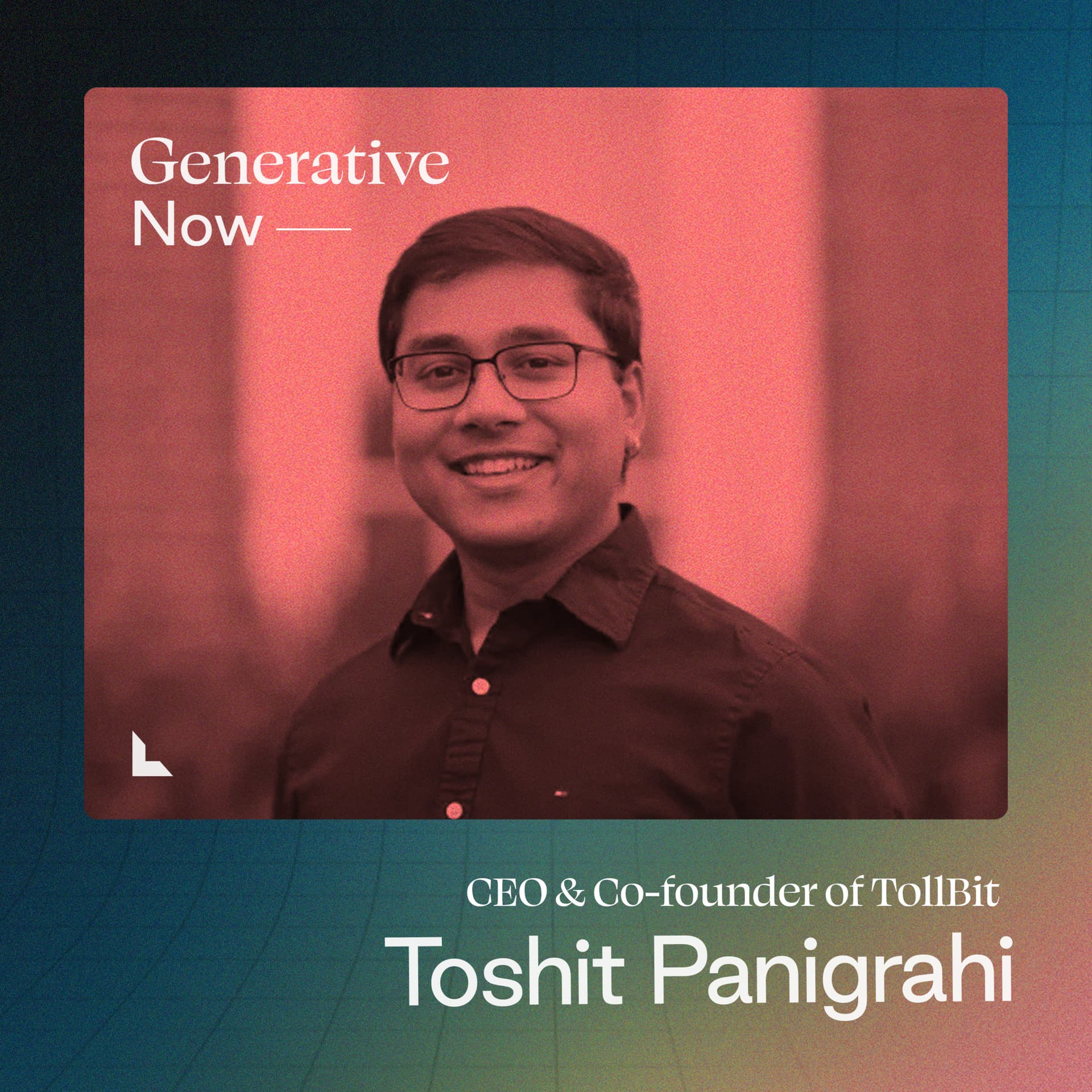
Toshit Panigrahi: Navigating the Future of Content Monetization
Episode Overview In this episode of "Generative Now," host Michael Mignano interviews Toshit Panigrahi, CEO and co-founder of TollBit, a platform enabling publishers and content creators to monetize their data through AI companies. The conversation revolves around the evolving landscape of content monetization in the age of AI, the innovative solutions TollBit offers, and the broader implications for publishers and the internet as a whole.
---
Key Topics Discussed
- Toshit's Background
- Previous Experience: Toshit worked at Toast for nearly a decade, contributing to consumer products and heading an advertising business.
- Insight into Advertising: Discussed the shift in advertising strategies due to third-party cookie deprecation, which led to the development of contextual advertising based on first-party data.
- Impact of AI on Content Monetization
- AI’s Role: Discussed how AI is reshaping the economics of the internet and affecting traditional advertising models.
- Data Scraping and Value Extraction: The necessity for AI applications to access real-time content raises questions about the value of publishers' data.
- Introduction of TollBit
- Purpose: TollBit allows publishers to set up licensing deals with AI companies, ensuring they are compensated for their content.
- Bot Paywall: A key feature allowing developers to pay for accessing content rather than relying on ad revenue.
- Challenges for Publishers
- Economic Viability: Explores what happens to content creation if traditional monetization strategies fail, emphasizing the importance of finding new revenue models.
- Market Dynamics vs. Regulation: Advocates for a market-driven approach rather than relying on regulations that may lag behind technological advancements.
- Future of Content Creation
- Unique Content’s Value: Emphasizes the importance of unique and timely content in a saturated market, suggesting that this will dictate its economic value.
- Infrastructure for AI Agents: Discusses the role of TollBit in enabling AI agents to access and utilize data effectively to support content creation and delivery.
- Current Collaborations and Future Prospects
- Publisher Partnerships: TollBit currently collaborates with over 160 publishers, providing various services, including analytics and monetization frameworks.
- Future of Advertising: Speculates on the potential evolution of advertising in light of declining website traffic and the rise of AI, suggesting that advertising spend might shift away from traditional web models.
---
Key Takeaways
- Content as Data: Publishers need to transition from viewing themselves merely as content providers to data suppliers to adapt to the changing landscape.
- AI’s Necessity for Real-time Content: AI models require access to live data, reinforcing the need for a system that rewards publishers for their contributions.
- Market-Driven Solutions: Solutions like TollBit's bot paywall offer a new avenue for monetization that aligns with the realities of AI's capabilities and market demand.
---
Conclusion The conversation underscores the pressing need for publishers to adapt to the rapidly changing digital landscape shaped by AI technologies. As traditional revenue streams decline, platforms like TollBit emerge as critical enablers of a new economy that respects and compensates content creators for their valuable data.
---
Stay Connected
- Website: [Lightspeed](http://www.lsvp.com/)
- Social Media:
- [Twitter](https://twitter.com/lightspeedvp)
- [LinkedIn](https://www.linkedin.com/company/lightspeed-venture-partners/)
- [Instagram](https://www.instagram.com/lightspeedventurepartners/)
- Podcast Subscription: [Generative Now](http://generativenow.co/)
---
For a deeper dive into the future of AI and content monetization, tune in to the full episode of "Generative Now."
Written by AI. May contain mistakes. Listen to the episode to check what was said.
Transcript
Automatic transcript. May contain errors.0:05Hey everyone, welcome to Generative Now. I am Michael Magnano. I am a partner at Lightspeed. AI is changing the economics of the internet. Without a major paradigm shift, the free ad-supported internet that has thrived for nearly three decades may come to an end. And so this week, I'm sitting down with Tosit Panagrahi, CEO and co-founder of Tolbit, a company that promises to be that shift. Tolbit allows publishers and quality content creators to automatically set up licensing deals with AI companies in order to ensure that creators are paid for their work. The company recently announced a$24 million Series A actually led by us at Lightspeed.
0:42And so I sat down to talk to Tosit about why publishers should think of themselves as a source of data, who are the winners and losers in this new economic structure, and how they determine the value of content. Take a listen to this conversation with Tosit Panagrahi. Hey, Tosit. Hey, how's it going? Good. Good to see you. Likewise. Thanks for doing this. I know you've had a busy, busy couple of weeks. Congrats on the Series A raise. Thank you so much. And yeah, thank you for having me, Joe. Yeah, of course. It's definitely been fun to get to know you and the team. But always fun to have a conversation live for the rest of the world to hear.
1:26And I thought it'd be fun to talk about Tolbit. Obviously, you and the team are coming off the heels of a Series A fundraise, which, you know, for the audience that isn't aware, which we at Lightspeed led, obviously very, very excited about that. But it feels like, you know, perfect time to talk about what's going on and dig into the sort of nuts and bolts of kind of the future of AI and content and publishers and maybe the fate of the open web more broadly. Maybe before we do that, for the audience's sake, I think it'd be awesome for people to hear your story. It's pretty incredible. It's pretty inspiring.
2:02how you got to Tolbit, what you did before that with Toast. Tell us a little bit about your journey. I started at Toast, I want to say like 10 years ago, right? I joined as one of the first designers, got to, made the jump over to software engineering. And then I was, I think, employee number 30 over there. And so I got to see that roller coaster, right? And the Boston the ecosystem happened. That was quite a wild ride. Got to build and lead some of their consumer facing applications. So their food ordering apps, ordering at the table, those sorts of products. And then for the last three years of my time at Toast, I was heading up an advertising business.
2:46So it was a retail ad network with closed loop measurement. And the reason we did that was because of third-party cookie application, right? And Toast obviously has a lot of first-party data. So I was heading up that business and it was around spring of 2023, GPT-4 had just come out, right? And GPT-4 was the first time one of these, you know, LLMs was connected to the internet. It didn't have a knowledge cutoff, right? If you remember that, there was a big deal around that. Oh yeah, connected to Bing, right? That was like a big deal when they partnered with Bing. Yeah, yeah. Right. And so when you asked questions to the ChatGPT, it could now go out because of being connect to the internet, go access content.
3:32And it was in that spring of 23 that we started seeing something, you know, I was just doing some ancillary research, right? You know, my brother's in college at Purdue. So I was just doing research with ChatGPT and I was like, I wonder how this changes things, right? So I was doing, you know, Googling, hey, what is rent like in West Lafayette Indiana, what is housing like in West Lafayette? And the most astonishing thing was happening on ChatGPT because it was saying, you know, this is the query I'm doing, searching, you know, rent prices near Purdue, searching rent prices near, well, real estate near Lafayette, right?
4:08And it would then access realtor.com. It was accessing Zillow. It was accessing apartments.com, you know reading page one of five reading page two of five and that was the moment i think we i called up martin who would become our cto and olivia would become my co-founder and i was sort of like in a frenzy and we were like wait a second we thought it was trained on on a lot of things but when you ask it questions you know that are sort of uh that are changing dynamic that it might not be an expert on, it goes out and fetches content live, scrapes sites. So it didn't matter how much content this thing was trained on.
4:48It still needed to go out and fetch content. Now, today, fast forward, a year and a half later, we know that's called retrieval augmented generation or grounding. But I think that was one of the first moments we realized that it didn't matter how much content these models are trained on. They still need access to real-time information. Maybe taking a step back, you know, when I think of Toast, I think of paying for my bill at a restaurant, right, through my phone or something like that. And I think they have lots of other products and tools that are maybe more for like the back office of restaurants.
5:21But tell us, what does it mean to be an ads business for Toast? You said you were building an ads business for Toast. Like, I don't think of advertising when I think of Toast. That's a good thing. Yeah. That means it's working. Yeah. So it was actually very subtle how we did this, right? Like I said, a lot of my background at Toast was building consumer products, right? So their food ordering apps, you know, scan to pay. If you ever scan a QR code at a restaurant to pay your check, right? That was actually a product Olivia and I built together and we took to GA. If you've ever scanned a QR code to go order your food, right?
5:55So what we did was we revisited a lot of these services and we said, well, let's try to start an ads business here by influencing consumer behavior in some way. What can we show them to influence behavior? And one of the most, you know, natural things that we could have done, right, that just fits right into the experience. You're on the toast takeout food ordering app and you're on the checkout screen and we were partnering with folks like, you know, American Express or Apple, right, where we could show you an ad and say, hey, you could get$10 in Toast Cash if you use your American Express, for example, right?
6:33Or set up Apple Pay and get, you know, $5 off your next meal, right? And so we would try to nudge consumer behavior by showing them these very contextual ads, right? I think one of my favorite ones is there's a guest-facing display that some bakeries might have. We turned that into a very subtle ad placement because it has, for example, a phone with Google Pay on it tapping the card reader and we're trying to nudge you to use Google Pay there, right? So we're promoting Google Pay there. So it's very in context. It's very, you're looking at a menu. We surface the, you know, certain beverage at the top, for example, right?
7:08Things that fit in and make sense in the experience so that it's not intrusive. So it might not register as an ad. Got it. So, okay, fascinating. So Toast has all these different services, which, you know, when building ad products, it sounds like those are impressions in your mind, right? Impressions of a potential, potential impressions of an ad to put in front of a human being. Now fast forward to GBT4 and you've connected to the internet and you're seeing that GBT4 is out there going to these websites for you. Light bulb moment, you think to yourself, wow, that's a lot fewer impressions that would normally be delivered to me, a human.
7:41They're now being delivered to ChatGPT, to OpenAI. Was that sort of the thing that you called up Martin and Olivia about? Yes. And this is where we said, well, you know, I think the question I was asking them was, hey guys, if this is the future, right? Let's suspend disbelief. Again, it had just come out. There is, you know, the public reception is not, it's not clear at the moment. The developer reception is not clear. The APIs don't exist. We looked at that and we said, you know, the case I was making was like, if this is the future, right? Let's extrapolate for a second. If this is the future, we might not need to visit a website.
8:15All of the information I need can be brought to me by these AI applications. And, you know, we have friends who are, you know, at Anthropik. We have friends who are at, you know, Google, right? And we know that they're, you know, we called them up and they told us that new tools are about to be coming out by all of these other companies as well. And so we thought, wait, wait a second. It seems like, you know, this retrieval piece, this rag piece is not going to go away. We didn't have a name for it at the time, right? So we just called it web scraping. This web scraping wasn't going to go away.
8:42And I think what we realized was that this was a different flavor of web scraping, right? Then, you know, I think we're familiar with web scraping. and when you think of that, you really think of that as the domain of white-collar professionals in select roles. Maybe, you know, think data science, business intelligence, maybe computer science, and you needed specialized tools to do it. What happens when anyone with access to the internet can just search on one of these online connected LLM tools, right, and fetch answers, right? And the answers are just brought to them. This is actually a lot of the debate around AI overviews in Google right now.
9:25What happens when every single Google query can just be reduced to, you know, a blue box at the top, right? Or, you know, take your pick of any search provider that's doing this. Yeah, I just had this happen to me, actually. It was kind of startling. I was speaking with somebody and they were asking me about a topic that I had previously written a blog post about. And so I just went to Google and Googled the title of the blog post and it's called the standards innovation paradox. It's a sort of like term I defined for product development and building on standards. And it was so funny. Google just explained like through the AI answers, it just explained the paradox, like the actual definition that I had created.
10:03And I was like, wait a minute, where's my link? Like the link is gone. Google has just co-opted the content. So yeah, this just happened to me. I think you're so right. This is happening in real time and sort of like actively and I'm sure increasingly disintermediating publishers of content with human beings that want to consume it. So let's take that a step further, right? So we thought about, you know, you thought about this and your GPT-4 just comes out. We're having this conversation, right? And now you can begin to see you close a loop with advertising, right? And then we realize what's at stake.
10:37Because if you think about how the internet monetizes, right? It's largely through advertising, right? What happens when you suddenly can't do that anymore, right? What is the incentive to create content anymore? That starts disappearing. That's when we realized, wait, there's actually a big business to be made here. Now, there was a pause though, right? Between when we started Tolbit in April, right? Because I think at that time in April, it still wasn't clear how the world was going to shake out. It wasn't clear if GPT-4 was going to take out. It's silly in hindsight, but it wasn't clear if it was just going to be, you know, this explosive success.
11:11And Martin also rightly had thoughts about this. You know, is this going to be available via an API? What is this actually going to look like at implementation, right? What is the competitive landscape going to look like, right, with other AI companies coming up with similar tools? There were too many unknowns in April to say, well, where do you even create a business, right, out of this? Like, the problem is clear, but imagine going to realtor.com and saying, hey, guys, like, you know, this thing that just came out is starting to scrape your content. You should try to, you know, pay attention.
11:37It was just way too early to be thinking about that. And that's like kind of the initial, I think, opportunity for Tolbit, right? And maybe that was the thing you first started building to basically block that traffic. Was that is that the initial idea? It was like, hey, let's let's like first just stop this or at least slow it down. So I think where it clicked for everyone suddenly of where you make a business out of this was exactly where you said. Let's forward a few fast forward a few months, right? One year ago, right? October of last year. Like we you had seen enough of these headlines about, you know, the news media alliance is upset and medium is upset over AI training on their content.
12:13Right. or New York Times is now going to sue OpenAI. And that was actually the moment because of the thinking we had done months prior. That was the moment where we said, wait a second. Remember that problem we were talking about, about web scraping? This is the first symptom of that problem. This is the first industry that is feeling that problem now, right? And we looked at that and said, yes, they're talking about a lot of the discourse was around fair use and copyright infringement and IP theft, but it was a monetization issue. We knew that, right? The question was, if that happens, if everyone's allowed to disintermediate them from their visitors, people don't need to visit websites, how does anyone make money?
12:50And that's where we said, this is the entry point to the market. And it was very interesting because one of the things that we think about quite frequently as we work with publishers quite a bit, to your point, right? First, blocking and analyzing and showing you what that traffic looks like, right? And I think it was exciting because in many ways, if you look at disruptive technologies, disruptions and distribution that have happened over the years, you think about the transition from print to radio, from radio to TV, from TV to the internet, internet to social and mobile. Publishers were in many ways the first to raise the alarms about major disruptions in tech.
13:34Right. Yeah. And this is where I think when we first met, we met, you know, I think the first conversation we had was this is not just a publisher problem. This is a Internet wide problem. This was a disruption in distribution and publishers were simply the first to raise the alarms. And if we can figure out the new business of the future, that's a big opportunity. Yeah, publishers, I think, are definitely the canary in the coal mine here, right? And they're probably going to be the ones to have their businesses disrupted the quickest because the monetization happens sort of at the application layer, right?
14:07At the presentation layer, right? Like literally when I'm viewing this website. But if you think about maybe like going a layer down and thinking about the data or the services that some of these companies provide, to me, that feels like that's almost like one of the next dominoes to fall. Like, you know, to go back to Realtor.com, I don't know. I'm guessing they have all this data around real estate listings and real-time, you know, market intelligence around home prices and mortgages and whatever. How do they protect that information? or how do they, maybe to flip it, where's the opportunity in that information for them to potentially monetize it in a new way, not at the presentation layer.
14:47I'm guessing that's kind of what you're talking about now is like what comes next after this, after publishers. I think there's an entire vertical after publishers, but I think that's sort of the new tech that we're building at Tolbit, right? How do you start making this data and content available at scale, right? Because what you're actually touching on is if you look at this as a macro trend, what is, and you try to, you know, If you look at those headlines, you look at that realization, you take a step back and you think, well, what is really happening in the industry right now? Right. What is everyone up in arms about?
15:18If you think about what LLM technology really unlocked, right, it's this ability to process unstructured information or semi-structured information in a way that's not bounded by human capital. it's a fancy way of saying that our ability to process information just is was just uh uh is about to explode right because for almost all if you needed to do this before it was all almost always you required a human in the loop a human yeah right you don't need that anymore right right if i want to just get an answer about any topic i can ask that on on chat gpt or search gpt or you know you.com and i can get that answer and it knows how to make sense of the data and information it's looking at.
16:04We can just throw processing power to synthesize information. And that was where we saw the opportunity to say that our ability to access and process information was about to explode. And there's no rails for that. So how do you go and actually execute on this? What you're describing is basically a new type of market, right? Where it's not just about publishers and advertisers. It's about publishers of content and effectively buyers of that content, right? In this case, like OpenAI being a supplier of content, a buyer of content. Suppliers or publishers in this case, maybe starting in the supply side, how do you go and do this?
16:42There are probably, I don't know, billions of websites on the internet. How do you go and protect that data, that information as a first step? Yeah. So when we talk about publishers, I think the first vertical, the first folks that we talked to were largely digital media publishers, right? Think of all the digital news sites on the planet that are generating content, doing fantastic reporting, you know, producing content on a daily basis. That's the place we started first, right? We didn't go to the, you know, to your point earlier, right? Sites like if you think about realtor.com or CarGurus or Autotrader, they're a little bit more removed from the problem because they have a little bit more of a technical note because, and Michael, you said this exactly right before, right?
17:24For most news sites, for example, right? Content publishers, you have it right there. You have it on the page. It's a read-only interface, we call it, right? Versus some of these other more technical sites, like, for example, Realtor or Autotrader, there's a read and write component. You have to take actions. You have to, you know, you have to interact with the page to get more information, right? So they have a little bit more of a moat before this disruptor reaches them, but it's coming for them. So publishers, where we start today, are definitely the sort of news sites, the places you go to to get your content information.
17:55Okay, so how do you go, like, how do you go and do this? So you show them the information, Right. We have to show them the magnitude of the problem. Yeah. Right. And so this is where we set up Tobit Analytics and we were able to show them that, you know, these AI crawlers were coming and accessing, scraping their site, sometimes thousands of times a day, running up their server costs. Right. It's literally costing them money. It's not only like taking away revenue, it's costing them expense. Absolutely. Right. And I think that was startling to them. Right. Because in some cases they thought that they had, they might have been blocking these bots on that robots.txt file.
18:27And that actually wasn't true. Right. there are new companies coming out with new crawlers all the time old crawlers are changing updating their their names and and still coming and accessing the content and this is where we said that it was actually important for two reasons i think on a positive side it started you know these are analytics tools like that like a club analytics we essentially called it the google analytics of ai bot traffic right olivia likes calling it that which i think is a neat name because one of the things that it did was it started showing publishers how to inform content strategy, perhaps, in this new world, which was, I think, the most fascinating thing for me, right?
19:07What kinds of articles are getting picked up more than other articles on a daily basis? How soon after you publish an article does it start showing up in one of these systems, right? And I think that was an interesting learning. And the second thing that came out of it was when publishers realized that, you know, folks might be still accessing their content, And like I said, thousands of times a day, I think that showed them that it didn't matter how much content you were trained on. It showed that there was still value and value to be captured in that ongoing access to that content. Right. And who's accessing it?
19:41I mean, it's the ChatGBTs of the world, Perplexities, Google's. I mean, it's every single AI application out there, right? If you think about, as the other macro trend that we're seeing is, there's this sort of thing that we talk about in the tech industry that in five years, every company needs to be an AI company. Whether it's for just productivity gains or because you have to integrate into your products. Let's think about a great example of this is, I mentioned my background was at Toast and setting up that ads business and the potential disruption. Olivia was at Terramark. right a procurement automation company and she when i described this problem she was like oh yeah i know this because she was actually building uh automation tools right on top of gpt that was going out and scraping vendor and supply information from the web right and so you start thinking about this and you're thinking like wait a second this you know if you think about it through the lens of our ability to process information is about to explode every company out there is going to be embedding, you know, these sort of automation products into their organizations.
20:52So I think the point you're making is like every company is going to be crawling the web for AI bots, right? Like every company is going to be doing this. And in many cases, every person might be doing this in the future, right? Like you're going to be getting, you as a human being, you're going to be getting leverage out of AI to do things for you. It might be help me find a house, right? With a realtor.com example. It might be help me book some travel, right? It might be help me do some research for this work assignment. I don't know. So there could be, I mean, there could be billions of these things running around the internet at any given moment.
21:24My favorite examples I like using on calls with publishers is, you know, you pull up any one of these tools and you ask them, you know, let's observe the difference between a human and one of these AI applications, right? Humans, we will Google something. We will click that first link. We'll click that second link. And then what happens? We get bored and move on to the next thing, right? SEO is super important in that world. Now, use any of these AI applications and they will go out and they will read 10, 20 articles if they have to answer your question, right? They are these incredible like processors of information.
22:02Yeah, yeah. So, okay, so the analytics is kind of the wedge. You go to the publishers, you go to these news media websites, you say, hey, let's show you how this works. How do you go from there to then now, you know, throttling this AI traffic or even charging for it? Yeah, so this is where now, you know, we set up really what we get excited about at Dolbit, right? Which is, we call it the bot paywall, right? So it is a way for, you know, publishers install our SDK, install us on their platform and give anyone who's trying to scrape their content a way to actually pay them for it, right? We call it a way to have an autonomous exchange of value, right?
22:44But all it is is a fancy way of saying it allows someone, a developer to sign up and pay for the disintermediation they might be causing and compensate that publisher in some way. In a way that doesn't require a one-on-one deal. Because one of the most startling things that has happened over and over again is as we talk to these AI companies, it's not that there is an unwillingness to pay. there is an unwillingness to maybe do partnerships because partnerships are actually a very human intensive protracted one-on-one conversation with a lot of you know cost and legal effort that people go back and forth on right um and what we need is actually a framework that allows a frictionless exchange of value that is actually what we're unlocking because if we can do that we think that the rate at which we can consume information and information is shared will actually explode.
23:45Got it. So, I mean, I think what you're saying though is like they're not going to pay because of a legal construct or a legal framework. It's really a market-driven motivation. If a publisher can block their content and can monetize their content, they will do that, right? Rather than just giving it away for free, especially if they're foregoing advertising revenue due to the disintermediation. Is that how you think about it? Or are you trying to lean on like a legal framework? No, I think we have to lean on market dynamics, right? We don't want to lean on regulation and regulation is going to be too diverse and it'll take some time to catch up.
24:22I think if you look at what Elizabeth Warren has been pushing for recently, right, with investigating like summarization, for example, right? It might be the first time someone's talked about at inference time, we need to examine these AI tools and should we regulate it, right? So we think regulation is going to take too long. We have to instead rely on market dynamics first to solve interesting problems. And, you know, one of the things that we tell publishers when we meet with them is what we're doing with you, right? What Tolbit does with you is turn you from a content house to a supplier of data.
24:58That's how you should be thinking about yourself because that's how these AI companies are thinking of you. How do you do, you know, it strikes me that only today, well, today, I guess like only probably the biggest companies are paying for this content, right? OpenAI, you know, you hear about some of these deals, you see them in the news. OpenAI does deal with Hearst, but most, I imagine most AI companies are not yet paying for content in this way. How do you handle that sort of chicken and egg problem where you want to go get a publisher signed up, you want them to do this work to integrate Tolbit, get them on board with this future, but the future hasn't really arrived yet, right?
Read the full transcript
25:35Like how do you just like manage expectations and get people actually willing to engage in this future before it actually shows up? So we have to solve problems for folks where they're having it today, right? So, I mean, we've talked to enough AI companies that we sort of are starting to, there's patterns that emerge, right, of problems that they need solving. Even on the licensing side, right? So even the ones who are doing licensing, right? It is increasingly becoming tricky and there's regulation, for example, across the world that you have to stay ahead of, right? There's problems we solve for them on that front.
26:05There are, for example, existing licensing deals that need help, right? Because this world that's emerging is so new, right? There's a lot of problems that we found that we're solving for on the licensing side, even between deals that are being struck by an AI company and a publisher, right? Tolbit is actually the licensing infrastructure for a handful of them, right? Because like we said, we get the publisher thinking about themselves as a source of data, not just content. The other side is we have to solve and get data for them, for AI companies, that is actually harder to get, right? For example, we're working with an AI company right now for the upcoming election, right?
26:41And we are their source of data. And this is where election data and content is flowing through the Tolbit platform for this AI company to use, right? and they didn't have to do a one-on-one deal, a one-off deal with this publisher. That's really interesting. So they're looking for election data and that's sort of like a timely thing, right? It may not be data that they need post the election. Rather than invest all this efforts, like spin up these deals, do a partnership on their own manually, they can just like turn on Tolbit for whatever, a three-month period or less, I guess. And they just get it.
27:14They just get the data. Exactly. That's really, really cool. Let's play this forward a little bit. Like, how does this all shake out? I mean, you said it earlier in the conversation. I mean, in this future, like, what is the incentive for you to make content if you're just going to get disintermediated by the Googles and the open AIs of the world? Like, it almost leads to like a new economic structure of the internet, right? Both in terms of like the winners and losers. Like, what does the distribution curve look like between, you know, between the different players? and also like what are you creating as a supplier, as a publisher?
27:53Like do websites even matter in this future? Or are we just basically, you know, coming up with some way to distribute the data to the AI agents? There is so much to unpack in that question. Yeah, yeah, sorry. Some of that, oh no, we'll go through all of it. But I think some of it also, it depends on the time horizon we're talking about, right? I think in the short term, there's a lot of conversation. And, you know, this is a lot of what we do with publishers as well, right? I think there's a lot of conversation about, I think you mentioned OpenAI and Google, right? A lot of time is spent with them showing them other examples that are out there saying that, you know, it's not just the big companies.
28:32Like everyone's coming out with an AI tool. Every Fortune 500 company is building some sort of GPT-powered tool right now, right? And it's like there's going to be a real long tail that you need to think about. but it's not just the big companies that come to mind. I think those are the easiest ones to think of. But then when you show them more nuanced examples, I think it's mind-blowing to them sometimes, right? And then when we think about how this unfolds, right? You asked earlier, like, are we depending on regulation? Are you depending on market dynamics, right? What we have seen from especially the biggest AI companies, and I think this has been the thing that gives us the most sort of hope, is that there is an incentive to figure it out, right?
29:16On that side. Because if you play this out and there is no incentive to create content, people will just not create content and content will die. Publishers, you know, that have existed for over 100 years will cease to exist. Local media is already harmed. We actually love working with local media because they have unique content and data that you can't get elsewhere, right? Which is valuable to these AI partners as well, right? you know, delivering it in a neat, timely manner. So this is where we think that if we don't solve for it, there is a very dystopian future where content creation is not incentivized because there's no way to monetize it.
29:54And there's a lot of knock-on effects that happen from there, right? You know, we can be dramatic and say, you know, it is risking the freedom of information and democracy itself by doing that, right? So we bet on the fact that the world will not let that outcome happen. And if that doesn't happen, what is the alternative? Which is you need a framework to actually create that value exchange, which is what we're creating. How will content be valued in this world? How do you value random person's blog posts versus story in the New York Times, you know, story in the front page of the New York Times?
30:27So I think that's something we think about a lot at Tollbit, right? We also love partnering with researchers, right? So economists, for example, are very taken with this problem, right, of how do you start valuing content in the market, right? I was talking to this one gentleman about the same problem. And he, back when he was at MIT doing research, he said that, you know, one of the things that one of the, this reminded me of him of a challenge where they were trying to figure out what the value of Wikipedia was. And the way they did this was Tay bringing in, you know, various focus groups of individuals and then asking them how much they would need to pay them for them not to use Wikipedia for the next month.
31:10Oh, interesting. And through this, they were actually able to come out and find what a value of Wikipedia would be, right? Now, the reason I say this is because I think there's been a lot of academic thinking about this space in different terms, right? Maybe not in exactly the toilet terms, but we see this fascination from academia to actually try to figure out and answer some of this problem. There's also a supply and demand dynamic to it, right? I think I mentioned local news earlier, right? Local news actually has a lot of unique content that no one else is writing about. That should command a premium.
31:42So uniqueness will definitely be a factor into that algorithm as well. And of course, demand, right? If suddenly something happens and, you know, Tiger King is blowing up and there's only one, you know, news station in Oklahoma writing about this, that content is suddenly more valuable. Yeah, I guess like the content that is most valuable is the content that is most in demand, but also the most unique, right? Like thinking back to my question about the New York Times, now that I'm thinking about it a little more, that may actually not be the most valuable content because the moment it's published, there are going to be 10 other sources covering the same exact story.
32:24an AI agent may not value the original source the way maybe we value it today. Or maybe it will because maybe immediacy is what's most important, depending on whatever this AI agent does and the value that it brings to the user. So you brought up another two factors, immediacy. So there might be more value to be captured in the first, if you break that story, right? In that first hour, right? Then the rest of the market will capture from it. Or it could also be, you mentioned the other thing, which is brand equity, that New York Times brand actually has value, that it imparts on that content as well.
32:58The user might ask directly, hey, what does like New York Times think about this? Right. Right. Or give me the updates of the election from the New York Times, for example, in which case you have no choice. So we talked a little bit about like the first layer and we're talking a lot about now around sort of the economics of content, but like take us a layer deeper. Like what does this look like when we start going below content, we start getting into data or actually, you know, the performing of a service, what can Tolbit do for that next, that layer down of the internet and sort of how it exists today versus how it's going to exist in the future when my agent, you know, wants to go out and book a trip on my behalf?
33:35I think one of the, you know, most exciting initiatives that, you know, we're working on at Tolbit, obviously there's the enterprise side of Tolbit, right? We work with publishers, we help them prepare and help them with these licensing deals. we help these AI companies stay above board with regulation and managing these deals. If you look at what's interesting in AI right now, it's around agents. How do you unlock agents, right? Now, I know there's been a lot of hype around agents in the workplace, right? And I think the reason for that is because it's in some ways low-hanging fruit. because you can deploy an AI agent for automation within your firewall, say, of your company, right?
34:19And it can have access to whatever data it needs, right? I mean, obviously, Glean is doing some fantastic things in that space. And it can automate things by using your internal APIs. But where the big unlock for agents will happen, right, is when they can go out beyond the confines of that one space, right? And I think what we're excited about at Tolbin and what we actively think about unlocking is how do you make agents useful beyond just this like work use case, right? I'm going to geek out for a second, right? But like one of the things that we think about is and we get excited about is that we 100 % think like, you know, you remember Jarvis from Iron Man?
35:00Of course. Yeah. We think Jarvis should exist. There's no reason it shouldn't exist, right? But if you think about that, there is, and in fact, when we were first raising our pre-seed for Tolbit, that was a slide that we had was the UI from Jarvis. And we pointed out and we said, you know, to power this UI, you need content from LAX.com for the flight landings. You need content from FlightRadar24 for where the flights are in the sky. You need content from Audi for the parts of the Audi R8. All of that exists on websites, not accessible by, you can only scrape so much, right? Right. So in order to get this information, you actually need a better way to access it, right?
35:44You need a way to expose that data better. And that's what, you know, the exciting sort of new frontier that we're building at Tolbit. How do you enable AI agents to get access to data that they might have previously had a hard time getting? Or to take actions where today the only alternative is spinning up a headless browser and trying to click. And that's, you know, that's not a stable integration by any means. I don't know how much of this you've shared publicly, but what can you share about like the publishers you're working with today? Just to give people a sense of who's currently using the, at least the analytics.
36:16Yeah, I think we have over 160, 170 sites across all of our products, right? So we're talking from, you know, Magic Search, the Bot Paywall, to the Toolbit Analytics tool, right, to the licensing infrastructure. I mean, this goes from, you know, sites that have 500 million monthly active users all the way down to sites that have, that are local news sites like the Gazette in Iowa, right? I think where we see this sort of like interesting evolution happening, right? We are bringing to our partners, right? The first, some of the first AI pilots, right? So they might have deals of their own. And obviously, we facilitate that with our infrastructure.
37:00But monetization has already started happening on the platform. We have AI companies coming to us, right, that are transacting. I mentioned election content, right? We have another company that is paying for publisher content, right? So as they, you know, you ask the mechanics about is monetization work, for example, right? So publishers come in, they set their prices. And these AI partners don't need to do one-on-one deals. They don't need to do the negotiation as they use that content. As we collaborated with AI companies, with publishers, with folks at the News Media Alliance, for example, right?
37:33And came up with an industry-first RAG license, right? A license that lets you summarize, cite, ground on information, right? Everything short of, and the only two things that it doesn't allow are, for example, like full display, because that's just syndication, right? and it doesn't allow foundational model training, right? But this supports that notion that, hey, there's a lot of applications that will need to make use of this content. How do we allow it? How do we create language around that? And we are issuing those licenses and these AI partners, every time they use that content, summarize that content, cite that content, they pay out to the publishers in our platform.
38:16How do they know it's a charge? Like, are you advising them on that or are they just picking the rates out of thin air? Like, how does that work? I think the publishers do some ballpark estimation on their part. We're actually kind of guarded about how we figure out pricing. We give them tools to do it on the platform as well. You know, I think we had talked about some of the inputs that we had talked about earlier, right? You know, demand, uniqueness, brand equity, things like that. And then, you know, what we're, again, pioneering now is like, how do you move to a programmatic model? How do you move to a world where you can actually adjust that based on supply and demand because you don't want there to be an arbitrage either.
38:53Right. It's going to eventually, this eventually becomes like the new form of advertising. It's auction-based, it's real-time, it's dynamic. Yes. Assuming you have enough supply and demand on each side. Yeah. What about other forms of content? So we're talking a lot about right now about sort of written words, text, right? News, et cetera. But I have to imagine, I mean, the entire internet is sort of being ingested by models right now. And so like, do you imagine a world in which you're also helping generate revenue for publishers of video, of audio, of, you know, you name it. Actually, some pretty cool things.
39:29I think we'll have some case studies pretty soon with what we did with the, I think the election is another good example, right? Because it's not just enough to get the data, right? With the election, you still have to display the results in some way. You still have to show live TV maybe to a user, right? You know, these tools are only as good as, you know, as the UI in certain ways, right? Like you're not going to use chat GPT to get live election coverage because blobs of text only go so far, right? Yeah. You want to be able to see that video, right? So we're actually building interesting distribution mechanisms from publishers to share, you know, that type of content, right?
40:07Whether it's watch a video, whether it's, you know, watch election coverage, for example, right? So there's going to be some case studies around the election that are coming out. And I think the other interesting side is we're at least helping unlock a couple interesting innovative business models too, right? So we have this interesting use case of a publisher that is licensing their video to an AI model provider, right? And actually both parties were sort of the AI company was ready to take the video as is, right? and the publisher was understandably a little hesitant about it, right? And the model that they were trying to get to was, I will give you the video content, but I'll let you fine-tune a specific model on it.
40:56And what we're working out and enabling on the platform is allowing them to license out the video to the AI company through us, where the model company now also uses us almost as a ledger to keep count of how much that model is used, how much computer it uses, how many videos it generates, right? How many minutes of videos it generates. And then we can do that rev share back and we're a neutral third party to that. That's awesome. That makes so much sense. Really, really smart. If we were to fast forward a couple of years, like, you know, we talked about the premise at the beginning of this conversation about, you know, publishers, visitors of websites, the advertising, you know, that happens between those two being the thing that funds the content?
41:41What are the incentives for content over time? If we were to fast forward, like what happens to advertising on the internet? Like what happens to this economic engine that powers the whole thing right now? Like, does it just go away? Does it become the new version of it? What does the future look like five to 10 years from now? So it's interesting because I think if you were to look at like why we started Tolbit in the first place, right? Like why was it that Olivia and I stumbled on this problem? And let's take it back to Toast advertising per second. As an example, why were we able to build that business?
42:17We were able to build that business because of third-party cookie deprecation. We could actually, as a retail, and it wasn't unique to Toast. DoorDash did it, Instacart did it, Walmart did it. These are retail ad networks. We have first-party data. We know what the person is looking at. And we can actually track conversion. We know if someone used an Amex card, right? and that data is very valuable, right? We saw this enormous shift in ad spend, right? After Google announced they were deprecating those third-party cookies and all of these advertisers now, right? We think of it as it's a zero-sum game, right?
42:55In the sense that marketing budgets at the beginning of the year is ad spend at the end of the year, right? It has to go somewhere. And if you can't spend on digital services, digital ads anymore because, or just generic web ads anymore, because you don't, you can't measure return on ad spend anymore, right? You can't measure ROAS anymore. What happens? You're going to ship that ad budget to a place where you can better measure conversion. And that's what happened with, you know, these retail ad networks, the rise of retail ad networks, right? And in fact, also why Instagram ads, for example, work really well, right?
43:31You can actually track pretty well. So what's going to happen here is what we realized was if this is true, if this thesis is true, that website traffic as a macro trend is declining across the board. It has been happening even before AI. As a macro trend, it's a given. Pair that with for the traffic that is making its way through, right? It's going to become harder and harder to tell apart who is AI and who is human anymore, right? If you keep throwing up cybersecurity walls, the tools to scrape it are simply going to keep getting better and better, and you won't be able to tell them apart. And so imagine what happens to the disruption in ad spend when you no longer know whether it's a human on the other side.
44:16You can't even advertise on websites because there's not even enough valid impressions to go around what happens. We think that there's going to be a massive shift in ad spend. might not be going to publishers anymore, might not be going to web advertising anymore. And actually what we're building is the funnel so that some of that ad spend can make its way back to the publishers, right? We're building the pipelines to share back some of that revenue in some ways. Yeah, super fascinating. Tosa, thank you so much. As always, when I talk to you, I learned a lot and I'm sure the audience did as well.
44:49So really, really appreciate the time. No, thank you for having me. I'm super excited. We work with the whole entire Lightspeak team. Yes, yeah. Yeah, we're thrilled to be partnering with you. Thanks so much. Thanks so much for listening to Generative Now. If you liked what you heard, please rate and review the podcast. That really does help. And if you want to learn more, just follow Lightspeed at LightspeedVP on YouTube, X, or LinkedIn. Generative Now is produced by Lightspeed in partnership with Pod People. I'm Michael McDaniel, and we will be back soon. See you then.
From the publisher
Toshit Panigrahi, CEO and co-founder of TollBit, joins Lightspeed Partner and host Michael Mignano for this week’s episode of Generative Now. TollBit is a platform that enables publishers and content creators to extract revenue from AI companies that use their data. Toshit and Michael discuss how advancements in AI are already reshaping the economics of the internet, TollBit’s innovative “bot paywall” for publishers, and how to incentivize content creation in this constantly evolving landscape.
Toshit previously spent nearly a decade at restaurant software company Toast, where he helped build many consumer products as well as Toast’s contextual ad business. Toshit earned a bachelor’s degree in computer science and minored in business administration at Boston University.
Episode Chapters:
(00:00) Introduction
(01:40) Toshit’s Background at Toast
(05:08) Building an Ads Business at Toast
(07:15) AI and Content Monetization
(10:52) The Birth of TollBit
(12:53) Opportunities and Challenges for Publishers
(16:17) The Role of AI in Content Strategy
(20:52) The Importance of SEO in the Age of AI
(22:04) Introducing the Bot Paywall
(23:45) Market Dynamics vs. Regulation
(25:03) Challenges in AI Licensing
(27:28) The Future of Content Creation and Monetization
(33:18) Unlocking the Full Potential of AI Agents
(36:15) Current Publisher Collaborations with TollBit
(41:38) The Future of Advertising and Content Valuation
(44:55) Conclusion and Final Thoughts
Stay in touch:
LinkedIn: https://www.linkedin.com/company/lightspeed-venture-partners/
Instagram: https://www.instagram.com/lightspeedventurepartners/
Subscribe on your favorite podcast app: generativenow.co
Email: generativenow@lsvp.com
The content here does not constitute tax, legal, business or investment advice or an offer to provide such advice, should not be construed as advocating the purchase or sale of any security or investment or a recommendation of any company, and is not an offer, or solicitation of an offer, for the purchase or sale of any security or investment product. For more details please see lsvp.com/legal.


