
In short
The episode is a BBC Global News roundup plus several features. Main topics: wildfires in southern Spain (at least 12 dead, including 4 believed British tourists; 19 still unaccounted for), with officials citing heatwave conditions, dry forests, high winds, and a suspected power-cable spark; a deadly earthquake in Venezuela (over 3,800 killed, tens of thousands missing) with Disasters Emergency Committee CEO Salah Saeed describing catastrophic homelessness and urgent needs for clean water, hygiene, shelter, and mental health; a Ryanair incident where a window detached and a passenger was partially sucked out after depressurization, with Theo Leggett noting possible engine-debris cause and comparing to a 2018 Southwest case. Guests/featured people: Asma Khalid and Tristan Redman (Global Story hosts, CIA series); Guy Hedgko (Spain wildfire correspondent); Chris Fawkes (BBC Weather); Salah Saeed (DEC CEO); Tim Franks (interviewer); Theo Leggett (transport correspondent); Katie Razzle (Bayeux Tapestry); Dr Millie Horton-Inch (curator); Lord Peter Ricketts (envoy); Didier Reikner (art critic); Kurumi Mori (Japan correspondent); Professor Christophe Lees (twin-to-twin transfusion ultrasound trial); Bryony Garrett (patient); Celestine Caroni (sports reporter); George Lusolo, Deji, Anthony Fiore, Todd Pomelo, Joel Andres (Kennedy Park football community).
Notable examples
evacuations to sports halls in Spain; families in Venezuela living in street tents; oxygen masks dropping in the Ryanair case; Bayeux Tapestry loan debate; ultrasound replacing laser surgery; football community support after ICE raids.
Written by AI. May contain mistakes. Listen to the episode to check what was said.
Chapters
Tap a time to open that second in VOMain Stories Overview
1:38 to 1:50
Overview of the main news stories covered in the episode.
“This is the Global News Podcast from the BBC World Service.”
Wildfires in Spain
1:50 to 2:14
Discussion on the wildfires in Spain that have resulted in casualties.
“Wildfires in Spain kill at least 12 people as the heatwave continues across much of Europe.”
Details on the Spanish Wildfires
2:14 to 4:32
In-depth reporting on the wildfires, victims, and firefighting efforts.
“Also in this podcast, how high-powered sound waves can help save identical twins affected by a rare pregnancy condition.”
Cause and Reaction to the Fires
4:32 to 6:06
Analysis of the causes of the wildfires and public reaction.
“I know there's a lot of consequences regarding the heat waves which are blazing across Europe at the moment.”
Venezuela Earthquake Aftermath
6:06 to 7:18
Report on the devastation caused by recent earthquakes in Venezuela.
“Chris Falks from BBC Weather says there were particular conditions that made the spread of this wildfire so fast.”
Humanitarian Crisis in Venezuela
7:18 to 10:58
Details on the humanitarian needs and response efforts in Venezuela.
“struck Venezuela's capital, Caracas, and the northern coastal town of La Guayra, killing more than 3 ,800 people.”
Ryanair Flight Incident
10:58 to 11:40
Report on a terrifying incident involving a Ryanair flight.
“But are you hearing some expressions of that frustration?”
Bayeux Tapestry Returns to Britain
11:40 to 14:00
Discussion on the historical significance of the Bayeux Tapestry's return.
“The man was reportedly partially sucked out of a window and needed medical attention.”
The Bayeux Tapestry's Historic Return
14:00 to 18:31
Learn about the significance of the Bayeux Tapestry's exhibition in Britain and the historical context behind it.
“The air pressure differential wasn't so great, so he survived.”
Upcoming Global Story Podcast
18:31 to 19:29
Discover the upcoming Global Story podcast series exploring the CIA's hidden history.
“I've always played soccer since I was a kid in the streets of Kinshasa.”
Show all 14 chapters
Japan's Imperial Family Crisis
19:30 to 22:16
Understand the challenges facing Japan's imperial family and the proposed reforms to address the lack of male heirs.
“It's running out of male heirs currently.”
Innovative Treatment for Twin-to-Twin Transfusion Syndrome
22:16 to 24:35
Explore a groundbreaking non-invasive procedure developed in Britain for treating a condition affecting identical twins.
“Scientists in Britain have developed a new non-invasive procedure to treat a serious condition which can affect identical twins during pregnancy.”
Soccer as a Refuge for Immigrants
24:35 to 28:02
Hear how soccer serves as a vital connection for immigrants and refugees in Portland, Maine amidst community challenges.
“the game can change lives far away from the spotlight.”
Joel's Journey and the Impact of Detention
28:02 to 29:26
Learn about Joel's experiences in detention and the community's response to his story.
“and that the experience has had a lasting impact on the aspiring footballer.”
Transcript
Automatic transcript. May contain errors.0:00This BBC podcast is supported by ads outside the UK.
0:30Come on! Get a load of this guy. Ketchup. On a dog. Yeah, we've got thoughts. Too loud? In Chicago, you're gonna hear it. Because nothing here gets built without conversation. Nothing moves without connection. So, if you think you know AT &T, it might be time to rethink that. Because their network has improved, like, a lot. So Chicago can keep speaking its mind with AT &T Wireless and AT &T Fiber. Chicago won't stop talking. Our improved network backs it up. AT &T, connecting changes everything. AT &T Fiber, limited availability in select areas. The CIA has been carrying out covert operations around the world for decades.
1:09How has it shaped how people feel about the U.S.? I'm Asma Khalid. And I'm Tristan Redman. And together, we host the Global Story podcast from the BBC. As part of our series to mark the United States' 250th birthday, we're exploring the CIA's hidden history. Do you think the word of the United States will be trusted in years to come? For more, check out the global story on BBC.com or wherever you get your podcasts. This is the Global News Podcast from the BBC World Service. Hello, I'm Ankur Desai and at 15 Hours GMT on Friday the 10th of July, these are our main stories. Wildfires in Spain kill at least 12 people as the heatwave continues across much of Europe.
1:55One of Europe's biggest airlines, Ryanair, confirms that a passenger on one of its flights needed medical attention after he was partially sucked out of a window. And Japan's Lower House of Parliament passes a bill aimed at averting a succession crisis in the imperial family. Also in this podcast, how high-powered sound waves can help save identical twins affected by a rare pregnancy condition. and back in Britain for the first time in nearly a thousand years. I did well up a little bit seeing it taken off the lorry, so I imagine I'll probably be in floods of tears when I actually see it. The Bay of Tapestry arrives in London for an exhibition at the British Museum.
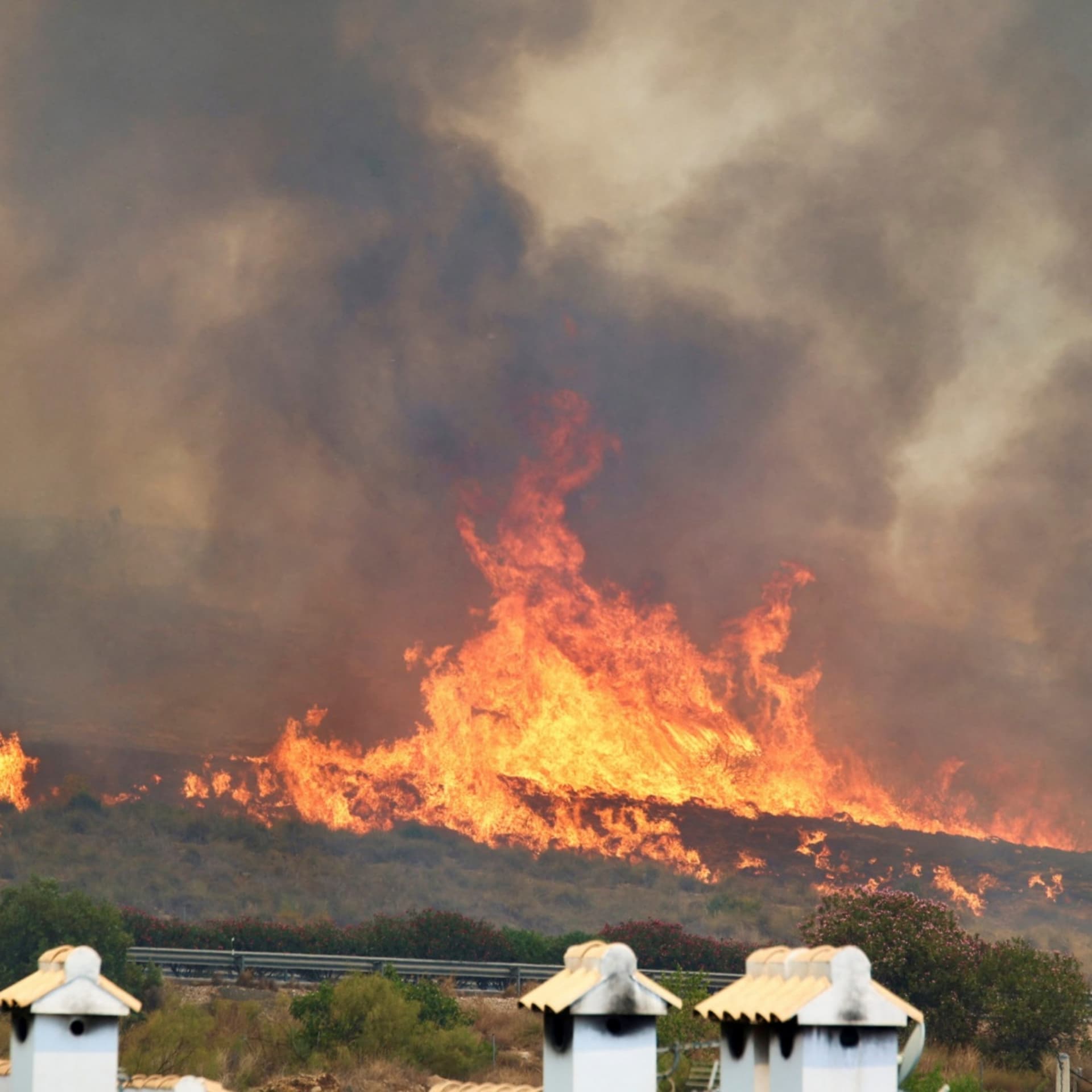
2:41At least 12 people have died in a wildfire in southern Spain, where fire crews are working to bring one of the country's deadliest blazes under control. The authorities have said most of the victims appeared to be foreign tourists. The fire spread rapidly in a wooded area around the town of Los Calados in the province of Almería. Its mayor, Francisco Reyes, said the authorities were working hard to get people in areas still at risk to safety. The fire started and has spread very quickly. We have had to evacuate residents from Almucaizar and residents from Beda. and now we are heading towards the campsite because the wind is blowing from the west and it's going to reach the campsite where we also have 400 to 500 people.
3:29We are very concerned because houses are burning. Our correspondent Guy Hedgko gave us this update. As we heard there, that firefighters are struggling to deal with this fire in what are very hot and dry conditions and also with high winds as well, which make it extremely difficult. but there are concerns that the death toll could increase further, potentially quite substantially further, because there are still 19 people unaccounted for, we're told, by the authorities. Of those who've been confirmed to have died in the fire, four are believed to be British, people who are travelling in a British car and seem to have been trapped by the flames last night.
4:11There are another seven who died when they were trying to escape the flames on foot. So there are concerns that the death toll might increase further. But several hundred people have been evacuated, taken to local sports halls, and the firefighters are battling the flames alongside members of the military as well. And do we know much about the cause of this? I know there's a lot of consequences regarding the heat waves which are blazing across Europe at the moment. Well, yes. I mean, of course, the very hot, dry conditions that we've been seeing across southern Europe, particularly across Spain over the last few days, will have contributed to this.
4:52And there has been a heatwave over the last few days. We're told by eyewitnesses and the authorities who believe that the cause of this may have been a power cable that fell near a road and then that sparked a fire next to a forested area. And then with the high winds and the dry conditions, it just spread extremely quickly. That was yesterday afternoon. So that's the theory at the moment as to the cause of the fire. And what's the reaction been as well? We heard just briefly there from the mayor. Anybody else? We've heard from officials. We've heard from Prime Minister Pedro Sánchez and the king and queen of Spain that they've all expressed condolences and their sadness at this tragedy.
5:32I think across Spain there is shock because Spain is very used to wildfires at this time of year. I mean, last year we saw a record-breaking year in terms of the amount of land that was burned. But what people are not used to seeing here in the summer is people dying because of fires. That's relatively unusual, certainly in these kinds of numbers, you know, 11 people dead. That has really stunned people here, I think, not just in the south of the country, but right across Spain. As we've been hearing, conditions in southern Europe have been particularly hot so far this summer. Chris Falks from BBC Weather says there were particular conditions that made the spread of this wildfire so fast.
6:12I was looking at the satellite picture and you can pick up thermal anomalies. You can pick up a heat source on these. And what I see is that we start to see a wildfire erupting across this part of Spain at about 2.40 Spanish time, about 3.40 British summer time. And we had south-easterly winds gusting at about 25-odd miles an hour. So that's just been fanning the flames. Now, where that wildfire started, you had hills to the west. and so those southeasterly winds would have not only fanned the flames but actually, worse still, pushed the wildfires up the hills which would have burnt things a lot more quickly.
6:50So we see a very, very rapid spread of this fire and we see into the evening time that thermal anomaly, that heat signal that I picked up on satellite pitch is becoming much more extensive and much stronger. It shows that this wildfire not only spread very rapidly but it also became much, much more intense as we headed into the evening time yesterday. Chris Fawkes of BBC Weather. It's been over two weeks since two consecutive earthquakes struck Venezuela's capital, Caracas, and the northern coastal town of La Guayra, killing more than 3 ,800 people. Tens of thousands of people are still unaccounted for and responders are continuing to dig bodies out from beneath the rubble.
7:33Health officials have warned that displaced survivors are at risk from overcrowding, a lack of drinking water, and disruptions to healthcare. Salah Saeed is CEO of the Disasters Emergency Committee and spoke to Tim Franks from the Venezuelan capital, Caracas. The level of destruction is just immense. It's catastrophic. People are having to live in the streets. I've witnessed myself an informal shelter of very small camping tents that were camped outside apartment buildings that were simply just not safe for people to return to. And these families, in order to keep dry from the rains, were putting their tiny mattresses on pallets.
8:18They just lost absolutely everything. They weren't allowed even to go back into their buildings to collect their belongings. So they're reliant on humanitarian assistance, the very basics. We're talking about access to clean water in order to prevent disease. hygiene kits so the simple things like soap and toothpaste sanitary towels and the like and also of course shelter the the tents may be okay to keep them in the shade and so forth but this is no way for anybody here to live and then and then finally mental health support in particular for the children they've gone through unbearable trauma many of course lost family and there are tens of thousands of people still missing and you know many still have hope that they will find their loved ones but we all know that the search and rescue is is more or less effectively over and it won't be long now before that's called to an end so the focus right now is clearly about ensuring that those thousands of families that have been made homeless get the urgent humanitarian support they need.
9:34There has been a lot of criticism, I mean, right from the get go about the level of response from the state. It's always a challenge for states to, you know, ensure that somehow they meet the tremendous need in such short order. But there has been real criticism for the state in terms of how much it's been able to muster. What's your impression of the sort of job they've been doing? This is a hugely immense earthquake that's impacted tens of thousands of people and two million people in the worst affected areas. So for any government, any state, this is always going to be a mammoth task. But really what I want to acknowledge is the first responders, the people, the communities here, just incredible spirit, incredible resilience despite obviously that many of their families and their friends some are still buried under the rubble and you know hopefully that they will be able to evacuate those corpses but it's just really hard for people just to now survive the current conditions and that's where the focus lies not just for organizations like the Disasters and Emergency Committee but the first responders here, the national organisations, the local charities and so forth.
10:52And that's where we want to focus our attention to ensure they have the resources to help these people survive. But are you hearing some expressions of that frustration? We're certainly seeing people who are clearly very upset, not just as a consequence of the conditions they find themselves in and the loss they've experienced, but the needs are immense. Charities alone and national organisations or international organisations alone cannot simply meet the immense needs out there. And that's why it's important for us as the Disaster Dements Committee to raise as much money as possible in order to try to fill that gap and meet as much of those needs as possible.
11:32Salah Saeed in Caracas. Next to a story that must have been pretty terrifying for a passenger on a Ryanair flight. The man was reportedly partially sucked out of a window and needed medical attention. I've got more details from our transport correspondent Theo Leggett. We mainly know what we know from local media reports. Ryanair has confirmed that a window on an aircraft that was travelling from Thessaloniki in Greece to Memmingham in Germany had an incident early in the flight and one of the windows became detached. Now, that's as much as the rather dry statement from Ryanair will tell us. but local media have been speaking to people who are on the plane and their reports are that there was a loud bang shortly after takeoff when the plane was traveling at about 15 ,000 feet 5 ,000 meters the oxygen masks came down and a man sitting near the window was as they put it partially sucked out of the plane his head and shoulders were out now this was what would happen when the plane depressurizes because the air pressure inside the plane would be higher than the pressure outside.
12:34So effectively, it's all that outrushing air pushing him out. Fortunately, he doesn't appear to have been seriously injured. Reports state that he's in hospital with friction burns. Ryanair says that he requested and was given medical attention. But it does seem to be a very worrying incident. We don't know why the window was broken. Local reports again suggest that there was an engine failure on the aircraft, that it was hit by debris from the engine, which caused it to break. And there are precedents for that having happened in the past. Have you had a response from Ryanair? Well, Ryanair has simply confirmed the fact that there was an incident, a window became detached, the plane returned to Thessaloniki, a passenger was given medical treatment.
13:13There are images circulating on social media of the aftermath, a broken window, oxygen devices coming down from the ceiling, and so on. It's worth bearing in mind that, you know, these incidents are rare, but it has happened before. There was an incident, for example, with a Boeing 737 operated by Southwest Airlines in the United States in 2018. There was what was called an uncontained engine failure on that aircraft. That's where the engine not only fails, but bits of it escape from the shrouding and can penetrate the aircraft or bits of the aircraft. On that occasion, it broke a window and unfortunately, a woman was partially sucked out and she died.
13:50This seems to have been a much more positive outcome. And I think that the fact it occurred early in the flight, about six minutes into the flight, it looks like, The plane was not higher, so the passenger was still wearing his seatbelt. The air pressure differential wasn't so great, so he survived. It must have been tremendously shocking, quite a horrible experience, but fortunately nobody seems to have been seriously injured. Theo Leggett. A special piece of artwork has come back to Britain for the first time since it is believed to have been created here nearly 1 ,000 years ago. The Bayeux Tapestry depicting the moment in 1066 when William the Conqueror from France conquered England at the Battle of Hastings and has arrived now back on British soil.
14:33It was embroidered in the southern city of Canterbury, or so it's believed, and then taken to Bayeux in northern France. It's being loaned to Britain in a historic agreement signed by the British and the French governments. The tapestry, all 70 metres of it, will be on display at the British Museum from September to July. The museum expects a million visitors during a 10-month run, which would make this one of its most popular exhibitions ever. Our culture and media editor, Katie Razzle, spoke to us from outside the British Museum, where she saw the lorry with the tapestry arrive overnight. It's here for nine months.
15:10The reason, the practical reason why it's come here at this point is because the Bear Museum, where it is housed, well, that is being renovated, so it's shut down. The tapestry had to come down and it had to go somewhere. But actually, this idea of a loan was first mooted when Theresa May was our prime minister back in 2018. Then Covid hit. Then after Theresa May, during the Boris Johnson years, relationships between Britain and France weren't perhaps as cordial as they are now. And so finally, all these years on, it has happened. But there was some disquiet in France, in parts of France, amongst certain people about it moving.
15:50But they made absolute care of this item and all the security protocols and all the dry runs that they did to make sure it was going to be here safely. But, you know, they've taken it inside there. It's going to sit there for a few days. Then they're going to open it out and take a look at it. And obviously, I think after that, once they discover there is no damage, if they do, that is when people will really be able to relax. Dr Millie Horton-Inch is the project curator for the Bayeux Tapestry exhibition. She was also there. It probably sounds a bit strange to be that excited about just seeing a lorry reverse into a loading bay and a box removed.
16:25But when you consider the object within it, how old it was, how close to the events it depicts it was made, and by people who lived through those events, it's really profound. I did well up a little bit seeing it taken off the lorry, so I imagine I'll probably be in floods of tears when I actually see it. Lord Peter Ricketts is the British envoy for the loan of the Bayeux Tapestry and a former British ambassador to France. He thinks it's an important moment in the sometimes difficult relationship between Britain and France. This reminds us that we are two old nations who have come together to share a history together that binds us together.
17:02And it's a more iconic object in the UK than it is in France, because for us it's the foundation story of our modern history. You know, the Normans arrived, they changed our language, our food, our architecture, our sovereign. In France, it wasn't the same impact at all. So I think Emmanuel Macron understood that by lending it to the UK, it would be very, very powerful here. Thousands and thousands of children would learn, which they probably don't now, about the history of that period. And therefore, it's a way of expanding the relationship beyond the ups and downs of the day-to-day. Didier Reikner, who's the editor of an online magazine about art and heritage, is totally against the whole project.
17:44I am against this decision, you know. We are gambling with a work of art which is 1 ,000 years old and there is no equivalent anywhere in the world. So it's a gambling and I don't think you can gamble with such a work. The point is they don't know how the tapestry, which is an embroidery actually, they don't know what will happen when they unpack it and after a while there is a return back. And they did all they could, But they didn't study the way the tapestry react with the vibrations. They don't know at all. So they did what they could. But I repeat, it's a grumbling. And just a reminder, if you're passing through London, you have from September until July to go and check it out.
18:32Still to come in this podcast. Soccer is my therapy. I've always played soccer since I was a kid in the streets of Kinshasa. Because when I come here, I see people like me. I see people from my country. I feel home. I feel that instant connection. The football pitch in Maine in the U.S. that welcomes immigrants and refugees from around the world.
18:58The CIA has been carrying out covert operations around the world for decades. How has it shaped how people feel about the U.S.? I'm Asma Khalid. And I'm Tristan Redman, and together we host the Global Story podcast from the BBC. As part of our series to mark the United States' 250th birthday, we're exploring the CIA's hidden history. Do you think the word of the United States will be trusted in years to come? For more, check out the Global Story on BBC.com or wherever you get your podcasts.
19:33This is the Global News Podcast. Japan's imperial family is in crisis. It's running out of male heirs currently. There are only three, the emperor's younger brother and his son, and the emperor's uncle, who is 90 years old. And women aren't allowed to accede to the chrysanthemum throne, which is why parliament has been debating a reform of the law. So why the crisis? I asked our Japan correspondent, Kurumi Mori. The crisis really stems from the lack of male heirs. This really speaks to the broader demographic picture of Japan. We're having a crisis of the aging population with a shrinking population.
20:13And it's being reflected here also with the imperial family. Under Japan's 1947 imperial household law, only men in the male bloodline can inherit the throne and take over. But as you said, there's only one young heir, which is Prince Hisahito. He's 19 years old. So this bill, they're hoping to try to widen who may be able to join as a member of the imperial family, not necessarily to take the throne, but to help perform some of the duties. There are a lot of duties that the imperial family have to perform, a lot of attendances, a lot of public events. And so this is their way of hopefully kind of expanding the number of people who could take on a role as a representative of the imperial family.
20:59Who could be eligible for that then? Yeah, so this bill, hopefully, they want to make two important changes. First, to allow the imperial family to adopt men from former imperial branch families. There's about 11 imperial branch families, and that would really help widen this pool. it also would allow female members of the imperial family to stay royals and keep their title after marrying a commoner instead of automatically leaving the family we saw a few years ago a princess leave the imperial family after she married a lawyer a commoner and moved to new york city so we lost her entirely after she got married and they're hoping that this bill will help keep more members in the family we have a woman prime minister in japan so is it inconceivable there could be a woman emperor one day?
21:47Why is there not that confidence? Never say never. I would think it's entirely possible, but politically it's very difficult. We've had about eight female emperors historically, but now that we're seeing a female prime minister elected, there's a lot of hope that we could have a female emperor, but there's a lot of conservatives, especially within the ruling LDP party, they're saying the male line is essential to the monarchy's tradition, which makes it very hard to have a woman emperor at the moment. Karumi Mori reporting from Tokyo. Scientists in Britain have developed a new non-invasive procedure to treat a serious condition which can affect identical twins during pregnancy.
22:28Twin-to-twin transfusion syndrome can happen when babies share a placenta, with one receiving more nutrients than the other, putting the life of both at risk. With the potential new treatment, high-powered ultrasound waves are fired into the placenta to seal the blood vessels instead of laser surgery. Bryony Garrett's identical girls were saved during this treatment. She told us how she felt when she was first given the diagnosis of her twin's condition. It was devastating. It was awful. It was the worst moment of my life, to be honest with you. And being diagnosed, we were only at 12 weeks and we were already at stage three.
23:04So it was very dire. And the conversations were really directed towards elective abortion and all these things that just to me sounded horrific and just not something that I was really wanting to go through at all. And the laser treatment was also unavailable to me and I was very blessed that the consultant I saw in Bristol was aware of Dr Lees and the trial and put me forward and thank God that he did. You know, the risks were low. The worst risk was that nothing was going to work and I was already in that place. So for me, there was nothing to lose. Professor Christophe Lees, who Bryony mentioned there, is the head of fetal medicine at Imperial College.
23:41We've shown that we can target the blood vessels in the placenta that cause the condition, and we can do that safely. We haven't yet shown that in all cases it's a treatment that can work, so that's the next phase. This was a very early phase treatment, and in Brani's case, as she said, there were clear signs that it worked after we were able to use it. But, you know, we need to do a much bigger study to see that it is clinically effective. The other treatment is a laser treatment, which of course is invasive. So it's a little telescope that pierces into the mother's womb, into the amniotic sac.
24:15But fortunately, with this treatment, we don't have to do that. So it's very, very high power focused sound waves, ultrasound waves rather, that can manage to stop blood flow in a little blood vessel. Professor Christoph Lys. As the FIFA World Cup brings together nations from across the world, one football pitch in New England is proving how the game can change lives far away from the spotlight. For the immigrants and refugees who make up the Kennedy Park team in Portland and Maine, football is the common bond. But that bond has been tested recently, as BBC Sport Africa's Celestine Caroni reports.
24:56On an asphalt court in Kennedy Park in Portland, Maine, the sound of an evening kickabout fills the air. To most, it's just another game. But for the immigrants who gather here every day, it's much more than football. George Lusolo arrived from the Democratic Republic of Congo in 2018. He says football was the only familiar thing in a country that wasn't. I really didn't know the language. I didn't know the people. I was still a kid. So everything was really difficult for me and my mom. Soccer is my therapy. I've always played soccer since I was a kid in the streets of Kinshasa. Because when I come here, I see people like me.
25:36I see people from my country. I feel home. I feel that instant connection. After spending time in a detention center in Texas and later a shelter in New York, George and his mother arrived in Portland while their asylum claim was being processed. It was here that he discovered football at Kennedy Park through social media. So what was really exciting to me was like, wow, there's people like me playing in this field. I have to go check it out. And I was like, mom, today I will not go to church. It was Sunday, I remember that day. And she was, no, you have to come to church. I said, no, I will not go to church.
26:07Then I came here, I played, it was really fun. What began as an informal gathering in Kennedy Park in 2021 has grown into a community where people from dozens of countries share a love of the game. And according to Deji, another Congolese immigrant who arrived in the US via Angola, they find their feet through the international language of football. Everybody does not need to speak one language. Just point to your feet at some part in your body and ask for the ball. It's a really cool thing. These players have taken different paths to get here. Some arrived seeking safety, others opportunity. But the connections built on this pitch extend well beyond the beautiful game.
26:50That sense of community was put to the test last year when immigrant communities across Maine were shaken by raids carried out by U.S. Immigration and Customs Enforcement, better known as ICE. Since President Trump returned to office in 2025, immigration enforcement has increased across the United States, prompting protests in several cities. The Department of Homeland Security, which oversees ICE, told the BBC that people in the country legally have nothing to worry about. But Anthony Fiore, who organizes the Kennedy Park football games, says many players and their families felt otherwise. ICE just created a lot of fear.
27:28They were doing a lot of harm here to the community. And a lot of people were just too afraid to leave their homes. So a lot of students, they missed a couple weeks of school because of it. And so in terms of support that we provided is we organized 71 different grocery deliveries to players and their families who were too afraid to leave their homes because of the danger that ICE created for them. When 17-year-old Joel Andres suddenly stopped attending school and his friends could no longer reach him by phone, The community discovered he and his family had been detained and helped lead a campaign for their release.
Read the full transcript
28:01Joel's lawyer, Todd Pomelo, says the family were held in poor conditions and that the experience has had a lasting impact on the aspiring footballer. They're in a facility where the food is inadequate. You know, some of the rooms are ice cold. Joel is a soccer star. He has a lot of hope for his future. But you can tell he'll never be the same. I don't think anyone that goes through this is ever the same. Joel was released after four months in detention. His family's initial asylum application from DRC was denied by the U.S. The case is currently with the Federal Appeals Court. Back at Kennedy Park, teammates have rallied around him, something Deji believes is changing how Portland sees its immigrant communities.
28:40Some people just see immigrants as these kind of people that have nowhere else to be and don't do anything. People that watch us here, people just passing by, and then seeing immigrants that talk and be happy. I feel like it just paints different pictures about immigrants in their mind. The American dream might not be exactly as they hoped, but with the World Cup being held here, some are still allowing themselves to dream big. I've never experienced something like this before, and there's fire in me, just burning. That's one of my dreams, just to be on a war stage. The World Cup may be about finding the world's best football team, But here in Portland, the game's greatest victory is measured differently.
29:22In friendships, belonging and the chance to build a new life. Celestine Caroni. And if you want more on football and the World Cup, do listen to the latest episode of the BBC World Service's sports podcast. It's called More Than The Score. In it, Manny Jasmi looks at the effect a good World Cup can have on a player's transfer value and how an influencer made New Zealand's Tim Payne famous. And that's all from us for now. If you want to get in touch, you can. Just email us at globalpodcast at bbc.co.uk. You can also find us on X at BBC World Service. Use the hashtag Global News Pod. And don't forget our sister podcast, The Global Story, which goes in-depth and beyond the headlines on One Big Story.
30:07This edition of the Global News Podcast was mixed by Jonathan Greer, and the producers were Judy Frankel and Oliver Berlau. The editor is Karen Martin, and I'm Ankur Desai. Until next time, goodbye.
30:46Do you think the word of the United States will be trusted in years to come? For more, check out The Global Story on BBC.com or wherever you get your podcasts.
From the publisher
Fire crews in Almeria battle one of Spain's deadliest blazes where several tourists, unable to flee from the rapidly spreading fire, have been among the victims. Hot conditions in Southern Europe are making the situation worse. Also, Japan is running out of male heirs to the Imperial throne, a woman clings to her husband to stop him being sucked out of the window of a Ryanair plane, and the 900-year-old Bayeux Tapestry, depicting one of the most defining moments in English history, returns to the UK from France.
The Global News Podcast brings you the breaking news you need to hear, as it happens. Listen for the latest headlines and current affairs from around the world. Politics, economics, climate, business, technology, health – we cover it all with expert analysis and insight. Get the news that matters, delivered twice a day on weekdays and daily at weekends, plus special bonus episodes reacting to urgent breaking stories. Follow or subscribe now and never miss a moment. Get in touch: globalpodcast@bbc.co.uk
Photo: Wildfire near Los Gallardos, Almeria, Spain. Credit: Reuters