
In short
This BBC Global News episode covers multiple stories. Indonesia: a court convicted 19 people of trafficking at least 34 babies, allegedly selling them for adoption in Indonesia and Singapore. The ring operated since 2023, led by a 70-year-old woman who recruited brokers and posed as biological mothers; jail terms were 3–7 years. Key claims include social-media/WhatsApp recruitment, “proper” documents masking false information, and compensation reportedly far lower than revealed (a Singapore-bound child allegedly bought for nearly $14,000, with most money staying with middlemen). A major unresolved question is whether adopted children will be returned to biological families.
Guests
none. The episode uses BBC correspondents/interviewees: Lisa Tambunan (Indonesia), Mark Dow (Lebanese Druze MP), Karine Torby (Lebanon), Yolande Nel (Jerusalem), Richard Kagoy (DRC/Ebola), Richard Hamilton (Trent Park House museum), Joost Kobusch (mountaineering), Martin Hackett (Gambia special prosecutor), Thomas Nardi (Gambia), Emma Simpson (TikTok live shopping).
Written by AI. May contain mistakes. Listen to the episode to check what was said.
Chapters
Tap a time to open that second in VOChild Trafficking Convictions in Indonesia
1:07 to 2:55
Overview of the high-profile child trafficking case in Indonesia.
“I'm Alex Ritson and on Tuesday the 21st of July, these are our main stories.”
Inside the Trafficking Operations
2:55 to 5:36
Details on how the trafficking ring operated and the implications.
“Our correspondent Lisa Tambunan told me more about the case.”
Lebanon's Political Landscape
5:36 to 9:03
Discussion on the political situation and negotiations involving Hezbollah.
“in which the children have been adopted into families in Singapore.”
US-Iran Conflict and Maritime Challenges
9:03 to 13:46
Examination of the ongoing US-Iran conflict and its impact on shipping.
“and the framework agreement is one of those outcomes.”
New Museum on WWII Intelligence
13:46 to 14:01
Introduction to Trent Park House, a new museum revealing WWII intelligence tactics.
“A mansion in North London which provided vital intelligence during the Second World War is opening to the public for the first time as a new museum.”
Trent Park House: A Historical Insight
14:01 to 16:22
Discover the hidden espionage history of Trent Park House during WWII.
“Trent Park House was originally built in the late 18th century for King George III.”
Social Media Shopping Boom
16:22 to 16:55
Learn about the rise of TikTok Live as a new shopping platform.
“Still to come in this podcast, social media shopping channels.”
Ebola Outbreak in the Democratic Republic of Congo
17:08 to 19:37
Examine the ongoing Ebola outbreak and its impacts.
“The outbreak is continuing to spread, affecting provinces across the country.”
Mountaineering Challenges Due to Climate Change
19:37 to 22:08
Understand how climate change is affecting mountaineering in Mont Blanc.
“Every year, around 20 ,000 mountaineers try to climb Mont Blanc, Western Europe's highest mountain.”
Justice for Gambia's Abuse Victims
22:08 to 25:57
Learn about the quest for justice for victims of Yaya Jammeh's regime.
“Nearly 10 years after Yaya Jamey's brutal rule of the Gambia in West Africa came to an end, victims who survived his widespread abuses and the relatives of those who died are still seeking justice.”
Show all 13 chapters
The Rise of TikTok Live Shopping
25:57 to 28:03
Explore how TikTok Live shopping is transforming retail experiences.
“It works absolutely perfect for me as a mum.”
The Rise of TikTok Shopping
28:03 to 29:49
Explore how TikTok is transforming retail through live selling.
“It was a TikTok event to show off the variety of sellers who were selling to the general public, but they all had their mobile phones and tripods, some of them with a ring light.”
Sponsor: Good Bad Billionaire
30:42 to 31:13
Discover the story of Mr Beast and his impact on the attention economy.
“On Good Bad Billionaire, we're going to find out how the world's most popular YouTuber, Mr Beast, made his fortune.”
Transcript
Automatic transcript. May contain errors.0:00This BBC podcast is supported by ads outside the UK. Decisions made in Washington can affect your portfolio every day. But what policy changes should investors be watching? Washington Wise is an original podcast from Charles Schwab that unpacks the stories making news in Washington right now and how they may affect your finances and portfolio. Listen at schwab.com slash Washington Wise. That's schwab.com slash Washington Wise.
1:01Listen on bbc.com or wherever you get your podcasts. This is the Global News Podcast from the BBC World Service. I'm Alex Ritson and on Tuesday the 21st of July, these are our main stories. A court in Indonesia has convicted 19 people of trafficking at least 34 babies by selling them for adoption in Indonesia and Singapore. Lebanon's president is due to meet Donald Trump as so-called pilot safe zones come into force in southern Lebanon with the support of Israel and enforced by Lebanese troops. Health officials in the Democratic Republic of Congo say the Ebola outbreak is spreading further after a new affected health zone was confirmed in Eturi province.
1:51Also in this podcast... Trent Park House was prison for captured German generals, but microphones were hidden inside skirting boards, window ledges, garden benches and even the billiard table. What does a new London museum tell us about surveillance during World War II?
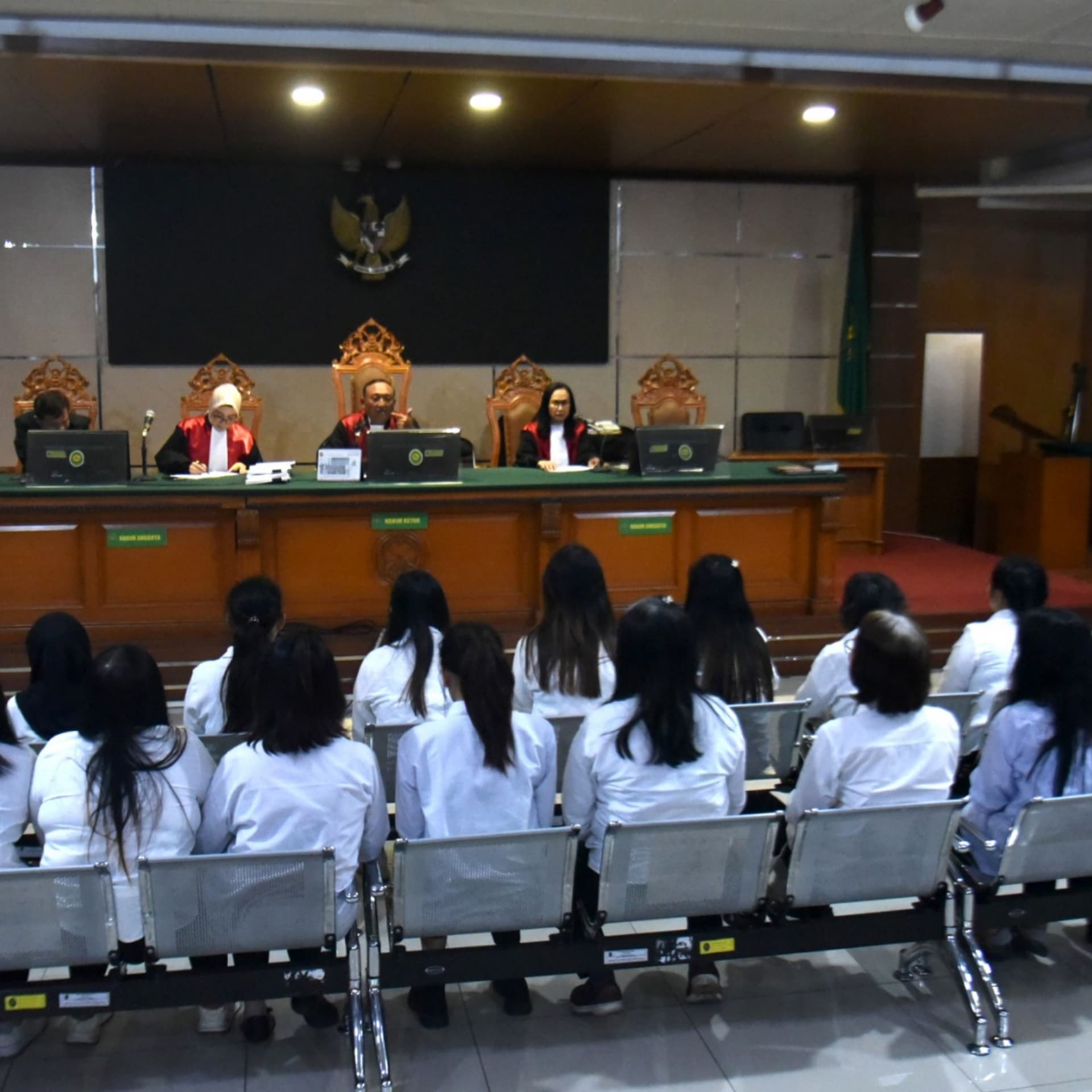
2:13We begin in Indonesia, where in a high-profile court case, 19 people have been convicted of illegally buying and selling children for adoption. The child trafficking ring, which has been operating since 2023, illegally bought babies in West Java and sold them for adoption in both Indonesia and Singapore. It was led by a 70-year-old woman who recruited others to broker deals and pose as the children's biological mothers. All were handed jail terms, ranging from three to seven years. But the verdict leaves many questions unanswered, particularly whether the adopted babies will be taken back to their biological families.
2:55Our correspondent Lisa Tambunan told me more about the case. This had been going on for years and it was revealed in court that the way that the trafficking ring operated was reaching out to parents via social media and even WhatsApp with an excuse of wanting to adopt their child. And later, it was actually found out that they were essentially selling these babies. And some of the people in Singapore who adopted them were actually not aware of the circumstances surrounding this because from the Indonesian side, it was found out that there were legal documents and these legal documents were actually proper, but what was not proper was the information that was stipulated in these documents.
3:45The birth parents, did they realise that they were selling their children? This is also another complexity with the case because, as it is understood, that some of the parents who gave up their children in these adoption processes, they are facing economic hardship. So they were aware that they were getting some monetary compensation. However, as it is understood, the compensation was actually much smaller than what was later revealed in the investigation, where a child that was sent to Singapore could have been bought for almost$14 ,000. And it is known that most of this money stayed within the middlemen.
4:24What are people making of this in Singapore and in Indonesia? There's now very serious concern regarding child protection in Indonesia. However, on one hand, in Indonesia, it is not uncommon to, quote unquote, give your child to perhaps a better off relative or friend who could take better care of your child. But these are not legal adoption processes. And in this case, the fact that so many nuances to this case also brought out the complexities of parents who don't have another choice or other opportunities to improve the welfare of their family or their children. This has been going on for a long time.
5:10What's going to happen to those children who've been perhaps living with families for some time? That is one of the main concerns because as far as it is understood, the parents who adopted them went through legal means. So there are complexities in ways of handling this post-verdict. We have not gotten an explanation from officials overseeing those cases in which the children have been adopted into families in Singapore. Liza Tambunan. A deal to secure an Israeli withdrawal from southern Lebanon and the disarmament of the Iranian-backed Hezbollah is facing its first test on the ground. The Lebanese military is beginning to take charge of security in three southern villages.
5:57under the US brokered plan, Israel is to hand over control of some areas it occupies in Lebanon. So how much will this help? Mark Dow is a Lebanese Druze MP who's described as an independent reformist and is opposed to Hezbollah's armed status. Most of the villages that the Lebanese army is moving into today are villages that are not under occupation, but are part of an agreement to de-escalate the conflict in certain areas. So the way things are going now, this is a trust-building factor that will help and contribute positively to ending the conflict. When the war between the US and Iran began in February, Hezbollah fired missiles at Israel in support of Tehran, leading Israel to launch a major air and ground offensive in Lebanon.
6:45As part of the plan to disarm Hezbollah, the president of Lebanon is due to meet Donald Trump at the White House on Tuesday. The pilot zones are a critical feature of the temporary truce. So where are they and what do they do? Our correspondent Karine Torby is in the Lebanese capital, Beirut. This is an idea that was agreed upon in a framework agreement between Lebanon, Israel and the US back in June. And the idea is basically to test areas where the Israelis would withdraw from territory that is occupied within Lebanon. And then the Lebanese forces will come and take over that area and they will have full control of it and obviously as well dismantle any infrastructure for Hezbollah.
7:33The problem is that basically there doesn't seem to be much of an agreement over the parameters of what can be considered as a pilot area. Lebanon wants these areas to be occupied areas from where the Israeli forces will withdraw. But Israel and the U.S. have agreed on three areas. Two of them are not occupied at all, and the Lebanese army is already there. And the third one is occupied at the outskirts of it, with the Israelis having some sporadic incursions every now and then. This is where the army today is getting in. But the whole point is basically that there is so much confusion about it.
8:14And even though it is considered and it is labeled as a milestone, a big achievement, there are lots of questions about how it's going to be implemented, where, and what is exactly that the army is supposed to do there, the Lebanese army, and whether there will be a ceasefire that is fully respected by Israel, why this is happening or not. So it's a long way ahead, a bumpy road, and today is just the very, very first phase of it. Yeah, so it's an agreement between Israel and the Lebanese military. But one of the big questions is where's Hezbollah in this because it totally rejects these pilot zones?
8:53Absolutely. Hezbollah says that it basically regrets anything that comes out from any direct negotiations between Lebanon and Israel. Therefore, it rejects any outcome from these negotiations. and the framework agreement is one of those outcomes. It says it is not ready to dismantle as part of this agreement and any talk about its weapons outside the south of the Litani River should be a matter to be discussed internally and not something that is dictated by foreign forces or foreign countries. Briefly, the Lebanese president is due to meet Donald Trump in Washington later. Is that helpful? Well, the government hopes that the president will be able to advocate for the case of Lebanon as Lebanon perceives it, for Lebanon to convince the president, American president, to put more pressure on Israel, first to abide, to fully abide by the ceasefire, second to withdraw from Lebanon.
9:52But also there is as much as there is anticipation about this meeting, there is so much apprehension, first because of the nature of meetings with Donald Trump that is known to be, he is very unpredictable, so it can go in any direction in terms of style and of outcome. Karin Torby. The US-Iran war shows no sign of ending with both sides continuing to exchange fire to try to gain control of shipping in the critical oil waterway, the Strait of Hormuz. The United States military said that overnight it had struck at Iran's ability to launch attacks into the strait. It was the 10th night in a row of US attacks.
10:32And while Washington and Tehran said that they remained open to peace talks, the escalating conflict shows that their ceasefire is now in the past. Today, Iran attacked US air and radar defence installations in Bahrain and Kuwait and warned that more powerful attacks would follow. Our correspondent in Jerusalem, Yolande Nel, told me there were other targets. So the Iranian Revolutionary Guard claims that there are massive fires on two tankers in the Strait of Hormuz, saying that these were non-compliant with the rules it's imposing for transiting this critical waterway. We have got multiple reports of one tanker having been hit by a projectile overnight, the crew having disembarked to a lifeboat with no environmental consequences reported, and at least two other vessels since late on Sunday.
11:19and that really just showing how Iran is still not loosening its grip on the Strait of Hormuz, despite there having been now 10 nights of US strikes. And the US military says the point of its strikes, which have attacked multiple Iranian cities overnight, according to the reports we're seeing, the point of these is to degrade Iran's ability to attack maritime civilian traffic. The US saying that there's still commercial ships transiting the strait, But of course, this is a very reduced number from what we saw prior to the Iran war. And, you know, that is where we do seem to be at this impasse, where the US is reaching the sort of limits of what it can achieve with these airstrikes.
11:58It says that it has been attacking different military command posts inside. Iran has put out a press statement that is quite similar to those that we've seen on previous nights. And Iran's allies in Yemen, the Houthis, becoming involved once again. and this too could have enormous economic consequences. It really could. So the Houthis say they're going to now block shipping for Saudi Arabia on this other critical maritime choke point, the Bab al-Mandab, which is between the Red Sea and the Gulf of Aden, and saying that's in response to an attack on Sanaa International Airport last week, which they're blaming on Saudi Arabia.
12:33Now, with the Strait of Hormuz blocked, Saudi Arabia has been using a pipeline that it has, which goes to the Red Sea, to get millions of barrels of oil out onto the global market. and we already know that the Houthis really can disrupt commercial shipping. They did that very successfully during the Gaza war between Israel and Hamas and at that time more than 100 vessels were attacked. Now the Saudi Arabian military says that it is going to keep this waterway open but it's another spot to watch. Presumably though everyone loses from this. The Iranians are not getting their tankers through either.
13:08That hurts their ability to keep going. surely it's in everyone's interests for the peace talks to get back on track, not least the rest of the world. Indeed, and the US has said, the Secretary of State Marco Rubio, a day ago that Washington is open to diplomacy. Qatar has put forward, we understand, this 10-day ceasefire. Iran's interior minister has gone off to Pakistan to meet the prime minister there. Pakistan has been another mediator, but it's just not clear how they'll revive that peace deal from last month that was supposed to end the fighting an open 60 days of negotiations on the critical issues like Iran's nuclear programme.
13:43Yoland Nell in Jerusalem. A mansion in North London which provided vital intelligence during the Second World War is opening to the public for the first time as a new museum. Trent Park House contained listening stations where the conversations of German generals who were held prisoner there were monitored. Richard Hamilton reports. Trent Park House was originally built in the late 18th century for King George III. In the 1920s, it became a luxury weekend retreat, belonging to a British MP, Sir Philip Sassoon. He hosted parties for the rich and famous, including Winston Churchill, Edward VIII and Wallace Simpson, Charlie Chaplin and Noel Coward.
14:27In the winter of 1939-40, it was used as a prison for captured German generals, who were encouraged to relax in the comfort of its elegant staterooms and lush grounds. But microphones were hidden inside skirting boards, window ledges, garden benches and even the billiard table. In the basement below were listening stations known as M-rooms. Here, teams of agents, many of them German-speaking Jewish refugees, eavesdropped on the Germans' conversations. The British comedian Helen Lederer remembered when she found out that her grandfather, Ernst, had been one of those listening in. When I actually was told for the first time, you can imagine it just doesn't make sense.
15:18The historian led me into the M room and he produced the letter from MI9 that demonstrated the work that Ernst Lederer had done. We called him Big Bubba. And the thing is, in those days with all the secret, but it's very rare for a letter to even be written, so it was quite oblique in itself. Undercover interrogators posing as captured German officers also lived in Trent Park House and gently encouraged the real prisoners to spill the beans. In total, around 3 ,000 conversations were bugged. Among the successes of the operation was finding out how the German Enigma cipher machines sent coded instructions to U-boats in the Atlantic.
16:06Later, the mission led to the discovery of the Nazis' secret rocket programme, allowing the British to attack a site in Germany where they were testing the V-1 flying bomb, delaying its deployment by several months. Richard Hamilton. Still to come in this podcast, social media shopping channels. The last TikTok Live he'd done, he'd sold around$11 ,000 worth of steaks in three hours. It would have taken him three to four days to sell that amount in his shop. Why not using them could be a big missed steak.
16:55This is the Global News Podcast. Since the middle of May, the Democratic Republic of Congo has been battling an outbreak of a rare strain of the Ebola virus. More than 950 people have died, and there are around 2 ,400 confirmed cases. The outbreak is continuing to spread, affecting provinces across the country. Health officials say 47 health zones are now affected. Our global affairs reporter, Richard Kagoy, is monitoring events from Nairobi. The authorities are saying that more cases have been detected in the eastern province of Ituri. It's a northeastern region which is rich in minerals. You've got many mining sites across the expansive province.
17:39What they're saying is that cases have been detected because the outbreak seems to be spreading rapidly across the province itself. It does account for about 80 % of the confirmed cases and fatalities. And what has happened is that increasingly we're seeing more cases as well being reported in the neighboring North Gevo province. Because as we've been reporting is that the outbreak has spread across five eastern provinces. But Ituri is currently the center of the outbreak. And now more cases being reported in neighboring North Gevo province. Now these are provinces which border, you know, South Sudan, Central Africa Republic.
18:21They border Uganda and also Rwanda as well. So there have been a lot of cross-border movements. And I think it's because of the difficulties that the authorities have been having in terms of verifying the actual true toll, especially from the deaths and even from people who have been confirmed with cases, because of the complex nature of the entire response in this region, which has really also been complicated by insecurity. Yeah, tell me a bit more about the efforts to try and contain the outbreak and in particular the efforts to develop a vaccine. Currently, the experiments that are taking place, which two of them were launched earlier last week, two of them.
19:04And we've got several people, especially those who have been infected, who are currently going through the trial. So we haven't quite received any updates in terms of beyond the launch of that. But hopefully maybe we might be getting a briefing later this week from the World Health Organization that has been working closely with the authorities in the DRC in this regard. But also what you have seen is that health officials have stepped up surveillance, increased screening and also at the same time increased laboratory and bed capacity in Abida to contain the outbreak. Richard Kagoy. Every year, around 20 ,000 mountaineers try to climb Mont Blanc, Western Europe's highest mountain.
19:45The ascent mostly takes place from the French side of Mont Blanc, as the Italian route is regarded as more challenging. But this week, no Italian tour guides will be taking visitors up the mountain because heat waves have been melting glaciers and causing crevasses to appear, making trips too dangerous. Joost Kobush is a famous alpine mountaineer who lives at the foot of Mont Blanc. But when he joined us, he was 7 ,000 meters up a mountain in Kyrgyzstan. It's been warm here as well. And from year to year that I'm here, I can see crevasses opening up way more than before. It is challenging. we actually have a spot here at 5 500 meters which we call the frying pan it's so hot there you can only pass it at night it's unbearable and if you were in camp there you are literally laying on the tent floor on the snow without your man to just cool down a bit mont blanc is right in front of my door i can literally go out and go up there and that's what I do a lot for training, but in the summer months, I'm not going there anymore.
20:57It's too crumbly, there's too much rock fall, and therefore the seasons are moving. I'm going there way more in the autumn now. The autumn is the new summer, and yes, there are crevasses. In my opinion, the crevasses are not the major problem for me. For me, it's really about the instability, rock roots becoming very crumbly and loose, and ugly and you don't want to go there anymore. Many routes that we used to climb there aren't climbed anymore. And interestingly, since the glacier is melting, sometimes it adds some extra meters to a climb that can be very, very challenging that usually were covered by the glacier and not often of the best rock quality.
21:41And seeing these changes, of course, I realized that within a few years of my lifetime, I can witness the glacier melting and walking way, way further down to the glacier than before. And it's alarming. It's something that I can visibly see in a few years. So imagine the impact that it has over a longer time. Alpine mountaineer Joost Kobusch. Nearly 10 years after Yaya Jamey's brutal rule of the Gambia in West Africa came to an end, victims who survived his widespread abuses and the relatives of those who died are still seeking justice. Torture, murder, rape and forced disappearances were commonplace between 1996 and 2017 when Mr Jamey, who is now in exile in Equatorial Guinea, was president.
22:34A British legal expert, Martin Hackett, has been appointed by the Gambian authorities as the first special prosecutor to investigate those crimes. But victims have criticised the slow pace of bringing anyone to justice, despite an approval from the Economic Community of West African States, ECHOAS, for a court to hear testimony and evidence. Thomas Nardi reports from The Gambia. You know, for him, really, it's like he was a friend. Fatou Su's husband was a military officer. He was killed by Jamez hate squad in 1994 over an alleged counter-coup plot. She still has found memories of him as she glances through his old photos.
23:16My loving husband, Fafanyang, with the smile and the nice face. The body of Sergeant Fafanyang was never released for burial. Fatou says it's hard to forgive the soldier who confessed to killing her husband. Yes, he apologized to us at that place. But we did not accept that apology. It has been a very difficult moment because if we think of him, we did not know where to go. Was there any particular name that was given to this group that was deployed to Kanila? Fatou's story is one of several heard by the Truth Reconciliation and Reparations Commission, which recommended prosecution for the most serious crimes after hearing harrowing testimony from victims, former security operatives and witnesses.
24:06She later received compensation under a scheme introduced by the Gambian government. But she remains frustrated by delays in implementing another key recommendation, the establishment of the ECOWAS Hybrid Court, a special tribunal proposed by the commission. The delaying of the special court shows that the government is not caring about the victims. Some of the victims, even some have died, some of them are very sick and tired of this thing that even if they call them, they are not happy to go. But there's a glimmer of hope. The government recently appointed a British legal expert, Martin Hackett, as the country's first ever special prosecutor to bring those responsible for human rights abuses and the former President Yai Jame to justice.
24:53In this memorial centre, Pa Osman Njai reflects on his painful past. He was arrested during a protest and tortured by security forces. I don't support Jami to be prosecuted and sentenced abroad because the prisons are very nice, but in my two years, horrible. The BBC asked the Gambian government about the delay in establishing the Equal-Rest Hybrid Court, but it did not respond to our inquiries. For now, the government is supporting victims with reparations, starting with 1994 to 1996 victims because of financial constraints. Former President Jame is exiled in Equitou Real Guinea after reluctantly handing over power to President Adama Barro.
25:40Victims of his alleged brutal 22-year rule are holding on to hope that one day even the most powerful will be held accountable and justice will finally prevail. Thomas Nardi in the Gambia. And we end this podcast with a new trend in the retail world. I can go live whenever I want. It works absolutely perfect for me as a mum. I can put my daughter to sleep and I can just hit go live and do a couple of sales. Before TikTok shop it was around maybe 50 orders a month and now since starting TikTok shop it's like 500 orders a week. It's known as live shopping on TikTok and some people are making a lot of money from it.
26:22It's an interactive feature on an increasing number of social media and shopping apps which let creators and brands showcase and sell products during real-time live stream events. Viewers can also chat with the sellers, ask questions and purchase products instantly without ever leaving their platforms. I spoke to our business correspondent, Emma Simpson, who's been following the success of live shopping on TikTok here in the UK. I asked her about its booming popularity. It is a thing and it's growing fast. It's a bit like live shopping on the TV. This is live shopping for the modern digital age and TikTok UK shop in particular.
27:08they tell me that they now have 6 ,000 of these live streams or live shopping events every day. It's remarkable and it's grown really quickly because TikTok UK shop only started in 2021. So clearly there are a lot of people out there, especially younger people, who perhaps are a bit bored by traditional e-commerce sites. It's a bit transactional and they are browsing and looking to buy products through a live shopping event. And I guess part of the appeal is that you can set one of these shops up without all the hassle of going out and renting premises. None of that. You can just go live. Exactly.
27:56It's a very low barrier to entry. So I watched this event at London's Covent Garden Market. It was a TikTok event to show off the variety of sellers who were selling to the general public, but they all had their mobile phones and tripods, some of them with a ring light. So at the same time as selling to punters walking through, they were broadcasting live to consumers all over the country. And one of them said, it's a bit like having 500 people in your shop at any one time. If I had taken on a shop here in Covent Garden, the cost would be astronomical. I'd maybe get ten shoppers an hour, but I can have hundreds in my shop at any one time.
28:39You won't have to be paying rents or business rates, but you will, if you open one of these things, have to be paying someone, a platform, presumably quite a lot of money. Oh yes, it comes at a cost. And I was talking about this to one of the most amazing businesses I met that day. It was a halal butcher who had a physical store, but they've also been selling on TikTok Shop UK and going live. And I watched them in action. So he told me the last TikTok live he'd done, he'd sold around$11 ,000 worth of steaks in three hours. It would have taken him three to four days to sell that amount in his shop.
29:20And I said, but are you making any money out of this? Because TikTok will be taking 9 % of the value of your total orders. And he said, yes, it's chunky, but it's really helped the expansion of our business. So I was sort of blown away by the small butchers now selling UK wide. And I watched them in action and I could see on the app, you had about 200 customers. Incredible. Our business correspondent, Emma Simpson.
Read the full transcript
30:19story. This edition of the Global News Podcast was mixed by Hannah Montgomery and the producers were Alfie Habershon and Abbey Ackerman. The editor is Karen Martin. I'm Alex Ritson. Until next time, goodbye.
30:41How did a boycott Jimmy become a billionaire from posting videos? On Good Bad Billionaire, we're going to find out how the world's most popular YouTuber, Mr Beast, made his fortune. He's buried himself in a coffin for days. Counted to 100 ,000 on camera. And even recreated Squid Games, all in an attempt to go viral on the internet. But it all started when he gave a homeless man$10 ,000. So is he a philanthropist reshaping capitalism? Or is he just the king of the attention economy? Find out on Good Bad Billionaire. Listen on BBC.com or wherever you get your podcasts.
From the publisher
In Indonesia, 19 people are convicted of trafficking at least 34 babies. The leader of the group, a 70 year-old woman, was sentenced to seven years in prison. The trafficking ring illegally bought babies in West Java and sold them for adoption in Indonesia and Singapore. Also: a deal to secure an Israeli withdrawal from southern Lebanon and the disarmament of the Iranian-backed Hezbollah faces its first test on the ground. US military says it struck at Iran's ability to launch attacks into the Strait of Hormuz, on the tenth night in a row of US strikes. A mansion in north London, which provided vital intelligence during the Second World War, opens to the public for the first time. The deadly Ebola outbreak continues to spread in the Democratic Republic of Congo, affecting several provinces across the country. Why no Italian tour guides will be taking visitors up Mont Blanc this week. And we look at the rise of live shopping on TikTok.
The Global News Podcast brings you the breaking news you need to hear, as it happens. Listen for the latest headlines and current affairs from around the world. Politics, economics, climate, business, technology, health – we cover it all with expert analysis and insight. Get the news that matters, delivered twice a day on weekdays and daily at weekends, plus special bonus episodes reacting to urgent breaking stories. Follow or subscribe now and never miss a moment. Get in touch: globalpodcast@bbc.co.uk
Photo: Indonesia sentences members of a baby trafficking syndicate up to 7 years in prison, Bandung - 21 Jul 2026 Credit: EPA/Shutterstock