
In short
The episode is the BBC Global News Podcast episode covering Myanmar’s civil war and rebel fighters, plus other world news and a science segment. Topic: Inside Myanmar’s Karen state, BBC reports on resistance fighters’ field hospital operations, landmine injuries, drone warfare, forced conscription, and battlefield setbacks for rebels.
Guest backgrounds
No podcast “guests” are interviewed in the Myanmar segment; it features reporter Quentin Somerville. Other interviewees elsewhere include Darren Selnick (former US Defense Department deputy chief of staff), Hamid Reza Golamzadeh (head of UN-Iran diplomatic house, Tehran), and Dr Hassan al-Hassan (International Institute for Strategic Studies, Bahrain).
Key claims
the military regained initiative via tens of thousands of forced recruits and new drones; rebels face heavy casualties and struggle with recruitment; drone threats are escalating.
Notable examples
Jazu’s landmine leg injury at a solar-powered clinic; captured junta base patrol with suspected drone-down; deserters describing being grabbed from streets and sent to front lines; a pregnant fighter’s baby delivery.
Written by AI. May contain mistakes. Listen to the episode to check what was said.
Chapters
Tap a time to open that second in VOCurrent Situation in Myanmar
1:26 to 2:42
Learn about the ongoing conflict and military situation in Myanmar.
“You're listening to the Global News Podcast from the BBC World Service.”
Inside a Field Hospital in Myanmar
2:42 to 4:16
Discover the conditions and challenges faced by medical staff treating injured fighters.
“Quentin Somerville reports from inside Myanmar.”
Rebel Fighters' Dilemma
4:16 to 5:48
Hear from rebel fighters about their struggles and the impact of forced recruitment.
“then this cycle of revolution and resistance in our country will just continue, repeating itself endlessly.”
Casualties and Sacrifices
5:48 to 8:00
Explore the heavy toll of the conflict and the personal reflections of fighters.
“And that's exactly what's happening here in Myanmar.”
The Birth Amidst Conflict
8:00 to 8:57
Witness the birth of a baby and the hopes of parents for peace in Myanmar.
“I'll return to fight one way or another.”
Iran-US Tensions Rise
8:57 to 11:08
Understand the latest developments in the tension between Iran and the US.
“Overnight, Iran and the US traded the heaviest attack since they agreed a ceasefire in April.”
Regional Responses to Iran
11:08 to 14:03
Examine how neighboring countries are reacting to the ongoing tensions and military actions.
“So Iran is responding to all the violations that is happening.”
Gulf Cooperation Council Response to Iran
14:03 to 19:03
Explore the complexities of the GCC's military and political stance against Iran.
“So it does not have the independent sort of national military capability to launch retaliatory strikes.”
Conflict Between Afghanistan and Pakistan
19:03 to 24:21
Overview of the escalating violence and border tensions between Afghanistan and Pakistan.
“Still to come on the podcast, police in South Africa launch a manhunt after 12 people are shot dead.”
Shooting Rampage in South Africa
24:21 to 28:01
Details on a recent mass shooting incident in Johannesburg and its implications.
“after 12 people were shot dead in a suburb of Johannesburg.”
Show all 11 chapters
Understanding Dog Behavior Through Testing
28:01 to 28:56
Learn about locomotion-based tests to understand dog behavior better.
“Other steps include getting your dog to sit alone at the top of the stairs, if you can persuade it to do that.”
Transcript
Automatic transcript. May contain errors.0:00This BBC podcast is supported by ads outside the UK.
0:30The new tropical butterfly refresher from Starbucks. Guava and passion fruit flavors with mango pineapple flavored pearls. Yeah, that feels like summer before you even taste it. Funny how one small stop becomes the best part of the day. Start your summer rhythm with Starbucks. Try the new tropical butterfly refresher from Starbucks.
0:55Yep, he's planning another project. So, this Father's Day at Lowe's, tap into free gifts for Dad. Get a free Select Craftsman power tool when you buy a Craftsman V20 charger with 2-amp-hour and 4-amp-hour batteries. Plus, get a free DeWalt power tool when you buy a Select 20-volt Max XR 4-amp-hour battery kit. Dad knows our best lineup is here at Lowe's. Valid through 714, while supplies last. Selection varies by location. You're listening to the Global News Podcast from the BBC World Service. Hello, I'm Oliver Conway. We're recording this at 15 hours GMT on Wednesday the 10th of June. Rebels in Myanmar tell the BBC they're losing ground as the military forces thousands of men to join the army.
1:44After exchanging attacks overnight, the US and Iran accuse each other of damaging negotiations. And Afghanistan says Pakistan killed 13 civilians in cross-border airstrikes. Also in this podcast... Paw preference is task-dependent. There are different ways to measure paw preference and this could lead to different results. A new test to find out if dogs are right or left-handed.
2:17In the five years since a coup brought the armed forces to power in Myanmar, civil war has raged, leaving almost 100 ,000 people dead. Until recently, the military has been losing ground to rebel and ethnic groups. But the forced recruitment of tens of thousands of conscripts and the use of new drone technology has changed that. And now the armed opposition is on the back foot. Quentin Somerville reports from inside Myanmar. Hidden deep, under forest cover in Myanmar's Karen state, is a field hospital. A jumble of bamboo and wooden buildings that treats resistance fighters injured in their battles to set Myanmar free from military rule.
3:04So we're in the operating theatre. It's running off solar power and generator. It is quite hot in here. Jazu is on the table, still awake. Jazu has a long gash at the top of his leg. They're trying to save his leg, which was injured as a result of him stepping on a landmine. He was on his way back from a military assault. As they turn him over, you can see that the back of his heel is all gone. It's just raw flesh. People sustain injuries from landmines every single day here. Dr Song is the surgeon here. They say they carry operations every day in this operating theatre. It never stops in terms of casualties.
3:53There were days during the five years that I had been here when I couldn't describe the sorrow with words anymore. There's not just bomi, later kamikaze drones and artillery as well. What do you say to young people in Yangon and Mandalay today who say, ah, the coup was five years ago, this is all over. If young people choose not to oppose the dictatorship now, then this cycle of revolution and resistance in our country will just continue, repeating itself endlessly. There's about 10 rebel militia fighters who are heading to a base called Papon. Now, they have that hunter base surrounded, but it's heavily armed.
4:36They have artillery, they have the ability to call in airstrikes, they have mortals. But they are surrounded on all three sides by the rebels. We're on a rare thing here, an asphalt road. And that means we're a big target. These men are listening out for drones. Commanders here tell us that Myanmar's military has the edge in terms of quantity and technology. Strikes come almost daily, they say. Commander Koh Kong of the People's Defence Force takes me on patrol to a captured junta base. The danger from drones is definitely increasing. It would be easier for us if we also had jammers. So there was a drone overhead and we just had to take cover.
5:28But we can't hear it now. And the PDF forces think they might have brought it down. But they can't confirm that. In any case, we have to wait at this position. Just like the conflict in Ukraine, like the conflict in Lebanon, drones are everywhere now, and very quickly drone warfare adapts and escalates. And that's exactly what's happening here in Myanmar. This resistance base is hidden deep in the forest. Time and time again we hear from resistance fighters that one of the reasons that Myanmar's military, the junta, has regained the initiative on the battlefield is because of thousands of new recruits, forced conscripts, some of whom never wanted to fight.
6:19Well, here at this HQ, there are four deserters from the junta forces and they've agreed to speak to us. How did you escape from the army? From the military outpost, we planned to escape from the bathing place. Two of us went down to the bathing spot first, while the other two stayed behind to keep watch. Once all four of us had gathered there, we waited for the right moment and slipped away as soon as we could. Did any of you want to join the army or were you forced to do so? We were forcibly recruited against our will. They began grabbing people from their homes, seizing people they found on the streets.
7:01even taking people in broad daylight. Before we even understood what was happening, we were sent to the front lines. They treated us terribly from the beginning to the end. We couldn't endure it anymore. The junta's new recruits may not be willing, but they've revived the military's fortune. Once on the defensive, they're now mounting offensive operations across the country and attempting to take back border posts that fell to the resistance. Although the military still controls less than half of the territory in the country.
7:37The rebels, for their part, five years after the coup, are struggling with recruitment. Back at the clinic, I asked Jazu, now in a recovery ward, if the heavy casualties suffered by the rebels has been worth it.
7:53No, it's not worth it. If we compare material gains against a life sacrificed, then no, it's not worth it. The lives of our comrades can never be exchanged for anything. I'll return to fight one way or another. I will fight until the end for the future of our children.
8:12It's not all, just battlefield injuries here. The wife of one of the fighters is heavily pregnant and the contractions have just started. So they're going to deliver the baby. So Mei-jean-mo is pretty close now. This is her first baby.
8:32The baby girl they call Su Pei. It translates roughly to fulfilled wish. Her parents say that all they want for her is a peaceful and democratic Myanmar. But after five years of hard fighting, that dream of these young revolutionaries still seems far beyond their grasp. Quentin Somerville with that report from Myanmar. Overnight, Iran and the US traded the heaviest attack since they agreed a ceasefire in April. The Americans said they launched their strikes after an Iranian drone downed a US helicopter on Monday. Iran then responded by firing missiles and drones at US bases in Bahrain, Jordan and Kuwait.
9:16A couple of hours later, President Trump posted that Iran had been completely defeated. But he went on to say the Iranians had taken too long to agree a deal and would now have to, quote, pay the price. So what might the US do now? Darren Selnick is a former deputy chief of staff to the American Defence Secretary. I think the president is being tested with his patience and I think his patience is running out. I don't think the Iranians are serious about a deal. I think they're playing what we would call rope-a-dope, drawing it out. The thing we don't know, and having been deputy chief of staff at the Pentagon is we don't know all the information he has.
9:54We don't know the private conversations he's had with our Arab regional allies. We don't know what sort of deal. He may be trying to make a bigger deal beyond Iran. I don't think that deal is possible. I think you have to take care of Iran first. And so I think as Iran continues to take patience for weakness, I think the president eventually is going to do a much bigger kinetic military strike. But that's going to be his option, we shall see. The Iranians insist they are responding to US aggression. Hamid Reza Golamzadeh is head of the UN-Iran diplomatic house in Tehran. We are in the middle of war with the United States and any threats and any operations need to be responded by the Iranian side in order to defend itself.
10:37And that is the Iranian policy right now. Even if this leads to an all-out war, still Iran goes to the battleground and would defend itself to the maximum necessary level. The correct question is actually why Americans are still attacking Iran or why Israelis are still attacking Lebanon. Despite the ceasefire and the agreement that they had made, they have imposed a blockade against Iran, which is an act of war and it's a violation of the ceasefire. They are attacking Iranian assets and Iranian bases and Iranian forces. in the sea, in the land. So Iran is responding to all the violations that is happening.
11:17So have the tit-for-tat exchanges now stopped? I asked our correspondent in Jerusalem, Yolande Nell. Things have calmed down for the moment, but this is definitely looking like one of the most serious flare-ups there's been between the US and Iran since the ceasefire came into effect two months ago. And of course, it's just a day after President Trump suggested again He was days away from a deal with Iran, having put significant pressure on Israel to stop its first confrontation with Iran in the last two months. And it's brought U.S.-Arab allies back under attack once again. We've been getting some more details with a U.S.
11:53official now saying that the U.S. struck nearly 20 targets in Iran. These air defences, ground control stations, surveillance radar sort of around the Strait of Hormuz area. Iranian state media had been reporting explosions in the south, not giving much information about damage on their side, apart from saying that in one location two water reservoirs had been affected and that was going to have an impact on the drinking water supply. The US insisted that this was a proportional response to Iran's aggression and Iran's own response came very swiftly. and it said it was really attacking the sites that had been used to carry out attacks on its territory.
12:33So Bahrain, that's where the US Naval Fifth Fleet is based. You've got Kuwait, sirens were going off there. It said that it intercepted hostile aerial attacks. Iran saying that it targeted a US airbase in Kuwait. Longer range missiles were launched at Jordan, where there's a US airbase in the east, with the Jordanian armed forces saying that five missiles were successfully intercepted. Iran also says it shot down a US drone over its air space. And this US official has been saying that nearly all the missiles and drones launched by Iran were intercepted, that they're not aware of any harm to US personnel or damage to US locations.
13:11But Iran is insisting that it destroyed four of its targets. We haven't got a way of verifying any of that information. Yolanel in Jerusalem. In Bahrain, it's still not clear what targets were hit as Dr. Hassan al-Hassan at the International Institute for Strategic Studies in the capital Manama told Sean Lay. Preliminary reports suggest that the overwhelming majority of Iranian projectiles, whether missiles or drones, were intercepted. But there are early reports that some targets that have yet to be formally identified have been struck. Now, the Iranians claim that they've been after the US fleet headquarters in Bahrain.
13:53But it's not entirely clear yet whether they've been able to strike it or not. Now, in terms of a response, Bahrain is a very small state. It's just over a million people. So it does not have the independent sort of national military capability to launch retaliatory strikes. What Bahrain has been doing is working closely with its allies and partners, including its fellow members of the Gulf Cooperation Council, so other Arab Gulf countries. But there isn't a unified Arab Gulf position on how to respond to the attacks by Iran. There have been individual retaliatory strikes by Saudi Arabia, by the United Arab Emirates, but those have been carried out individually, not as a group.
14:41So without the unified Arab Gulf umbrella, it's unlikely that Bahrain will resort to military retaliation against those Iranian attacks. Is that lack of a coherent position agreed by all GCC members, do you think weakening their influence on Washington, on getting Washington to do what they would like to do, what is in the interest of the Gulf in terms of either ending or prosecuting a war with Iran? Obviously, the Gulf states, they run up against Israel's influence over Washington. As a matter of fact, the Arab Gulf states were unified in not wanting the United States to begin this war in the first place.
15:22But it's quite clear that Benjamin Netanyahu had the upper hand there in pushing the Trump administration to do so under the pretext that this would be a short and sweet war that would end up toppling the Iranian regime quite quickly. Now, we know that this is not how things turned out. As it so happens right now, I think there is a unified Arab Gulf desire in seeing the United States bring an end to this war through a negotiated settlement with Iran. So perhaps the Arab Gulf states might not be working in close coordination with one another to influence the Trump administration in that direction.
16:01But at the very least, I do think they are united in this broad desire to see a quick end to the swore through negotiations. Dr Hassan al-Hassan in Bahrain. Afghanistan has accused Pakistan of killing at least 13 civilians, including children, and injuring dozens more in airstrikes along their shared border. Pakistan says the strikes were in response to a spate of attacks by militants crossing from Afghanistan. Violence between the two nations has claimed hundreds of lives this year. Our global affairs reporter Anbarasan Eti Rajan told me about the latest attacks. There are competing versions of what really happened along the border between Afghanistan and Pakistan.
16:43As you said earlier, the Taliban rulers in Kabul, they say that 13 civilians and many of them were children, were killed along the border in Afghanistan due to these strikes by Pakistani military. On the other hand, the Pakistani government says that they targeted militant hideouts along the border in which 26 militants were killed. Now, these latest strikes come a day after suspected Islamist insurgents carried out attack on a security forces check post in Peshawar in Pakistan that killed at least six paramilitary troops. And then there were reports of the militants claimed that they had also abducted some soldiers that we could not confirm.
17:28But what it shows that the volatile nature along the border between these two countries Why these tensions? Because Pakistan accuses Kabul of providing safe haven to some of these insurgents who carry out attacks on Pakistani forces. Yeah, and of course, it's the people who get caught in the middle of it. The people, especially along the border areas on both sides, they are the ones who are suffering. If you go by the United Nations report, what it says that in the first three months of this year alone, more than nearly 300 people, civilians were killed and another 400 injured because of this ongoing conflict.
18:08Now, Pakistan has an overwhelming air superiority over Taliban militants because it has got the latest fighter jets and drones using which it attacks. So the UN says many civilians were victims. However, these accusations were denied by Pakistan. And there was a ceasefire attempt negotiated by China in March when both sides were asked to come to China for meetings, where there have also been attempts earlier by Saudi Arabia and Qatar. Hundreds of people have died. And the tragedy is that the civilians are bearing the brunt of these increasing tensions between these two countries. However, the other countries are also trying to broker another round of ceasefire to bring down the tensions between two countries.
18:52But this is one reminder that how a normal attack or a regular attack by any militant group can trigger much more violence along the border between the two countries. Anbarasan Atirajan. Still to come on the podcast, police in South Africa launch a manhunt after 12 people are shot dead. It's a trend that's been on the rise in recent years of mass shootings, and usually it is between rival gangs or interpersonal conflicts. We'll hear from our correspondent in Johannesburg.
19:32You're listening to the Global News Podcast. A model who appeared on the set of a music video with Kanye West says he choked her and put his fingers in her mouth without warning or consent. Jennifer Arne says the incident happened in 2010. She's now filed a civil lawsuit against him. Known as Ye, the rapper doesn't deny the contact took place but argues it was part of an artistic performance that she did not object to. Jennifer Arne has been speaking to Anoushka Mutanda Doherty. In 2010, model and aspiring actress Jennifer Arne was on the set of a music video for LaRue's song In For The Kill. I was so excited.
20:11I was so excited because every single job was a step closer to where I was going. Yeah, I loved it. As part of an exclusive interview with me for the Fame Under Fire podcast, Jen says that West arrived on set then selected her for a scene. You're about to hear her describe what she claims happens next with some sexual content, some of which may be distressing. I was given no direction. I was just told to sit in this chair. And then playback started. And then all of a sudden he just reaches a hand out and starts like choking me. And I'm just not sure what's happening. And then he pulled his other hand out and starts choking me with both hands and then starts smearing my makeup all over my face and sticking his hands inside of my mouth, which I think, I mean, it simulated like oral sex.
21:06It started where he went up to my face and he was smearing my makeup on my face.
21:25Okay, do you need a minute? Yeah, sorry. It's okay.
21:32he was smearing the makeup on my face in a way that felt like he was trying to I don't know smearing the makeup all over my face in a way that just felt
21:45wrong uh he started sticking his fingers in my mouth and I feel like he was like trying to touch as much as he could. And I was actively, my tongue was like, like hiding from him. And he just like found everything. We approached Wes for a response to the allegations, but haven't had a reply. In Kanye's legal filings, his lawyers don't deny the action took place, but say it was part of an artistic performance that Jen did not object to. Jen told me that although she remembers there being a full set of people, no one stepped in. I just started looking around the room like someone. It was a room full of people.
22:25And I was looking around, like, hoping that someone would see me and be like, hey, like, maybe we should stop. Jen filed her lawsuit in 2024, 14 years after the alleged incident, under the Gender Motivated Violence Act in New York, which temporarily extends the statute of limitations for sexual assault survivors. I asked her why she didn't go to the police at the time. I didn't consider going to the police because I was in a room full of people when it happened. So I guess I felt like what recourse could there be and why would I put myself through that when nothing is going to happen to him? Why did you think nothing would happen to him?
23:11Because it was 2010. Not enough people were concerned about protecting women and sexual assault. and the accountability of those perpetrators. So, yeah. Kanye's lawyers have said that, quote, Ye staged an intense and provocative theatrical performance consistent with the homage and that the production paralleled scenes in American Psycho, which included actions to emulate forced oral sex and other physical contact, which incidentally may have caused plaintiff to have difficulty breathing. In response to that, Jen's lawyer told me that it would set a dangerous precedent if this case is thrown out.
23:46I think this allows creators to basically do whatever they want to whomever they want in creative spaces and get away with it as long as they call it art. And I think that that's a really, really dangerous precedent to set. Fame Under Fire approached LaRue's label Universal Music Group for comment and offered Weston interview or to respond to these claims. But we haven't had a reply. It's now up to a judge to decide if this case will proceed to court. And you can find the full interview on the Fame Under Fire podcast. Listen, wherever you get your BBC podcasts. Police in South Africa have launched a manhunt after 12 people were shot dead in a suburb of Johannesburg.
24:27The police say around 10 suspects entered an informal settlement in Cleveland late on Tuesday and opened fire at multiple locations before fleeing. I heard more from our correspondent in Johannesburg, Pumza Fihlani. The police have held a press briefing saying that they are following all leads but would not give more detail on it. But we do know from community members at this stage is that one of the suspected motives has been linked to illegal mining activity in the area. The informal settlement sits not too far from old disused mines. And in the last few months, there's been rival activity there between groups of people that are mining illegally.
Read the full transcript
25:09So this is people who go into the disused mines and try to salvage whatever little gold nuggets they can find and sell those in the black market. So community members believe that this was one of the reasons that this community was targeted, because a lot of those miners are known to live in the area. The police have said to us they do not discount this as a possibility, but at this stage they are considering all options. They've launch their manhunt and hope to be able to bring some people to justice soon. It's a trend that's been on the rise in recent years of mass shootings. And usually it is between rival gangs or interpersonal conflicts as a way of bringing an end to that.
25:50It is still something that is widely shocking for a lot of South Africans. Although there's a high murder rate here, mass shootings are not as common as you would think. Yeah, as you say, South Africa dogged by violence for years, but this sounds like a particularly brutal incident. It was from what the police tell us. This group was heavily armed with rifles. Now, these are not arms. These are not weapons that are readily available. There is a belief that a lot of resources would be involved in sourcing these arms, but also keeping them functioning. So we're starting to get a little bit of a sense that this might be something linked to some organised crime element.
26:26Pumse Friklani in Johannesburg. Dogs tend to favour one paw over another in the same way that their owners are right or left-handed. But how can you tell which? Well, Italian scientists say they've come up with a new test to find out. We sent our news hound Alfie Habershon to investigate. We know that most dogs, like people, have a favourite side or paw, and apparently it can tell you quite a lot about them. Lots of different methods for determining this have been tried over the years, including offering them a handshake to see which paw they put on your palm but finding a reliable test has proven to be elusive.
27:05The problem is that paw preference is task dependent. So it means that there are different ways to measure paw preference and this could lead to different results. Dr Marcello Siniskalki of the University of Bari makes the point that we need to be careful about what exactly we observe the dog doing. For example, I may flick a light switch on with my left hand even though I'm actually right-handed. But after studying dogs for over 20 years, he's come up with a list of four demanding dog tasks that he says will reveal the answer. You can test using manipulative tasks, using the food reaching on the bed or some books.
27:45You can just use your imagination to create something that dogs have to fight and just to try to use one paw to catch the food. Another recommended task is to give a dog a bull-shaped toy stuffed with food and monitor which paw it's using to hold it still whilst it tries to eat the contents. Other steps include getting your dog to sit alone at the top of the stairs, if you can persuade it to do that. We use also locomotion-based tests. So for example, the paw, which is used to stepping on stairs or during walking to step off for a transitional platform. And for the owners, it's a chance to understand their pet a little better.
28:26Right-poll dogs tend to be less fearful, and researchers have discovered that left-poll dogs are more or less to approach ambiguous stimulus, so what is called pessimistic cognitive bias. Dr Siniskalki and others from the University of Bari are now hoping to collect a large database of poor activity from the owners who are willing to try at home. Alfie Habershon. And that's all from us for now, but the Global News Podcast will be back very soon. This edition was mixed by David Evans and produced by Alfie Habershon and Stephen Jensen. Our editors, Karen Martin. I'm Oliver Conway. Until next time, goodbye.
29:17Ten hours on my feet. Traffic, noise. Everybody needs something from me. My head is spinning. I just need the world to stop for one second. But then I get home, shoes off, phone out, and I open Modo Casino. Hundreds of slots, classic table games. It's my instant reset. The variety I want and the quiet I need. Modo Casino is a social casino. We're prohibited. No purchase necessary. Visit Modo.us for more details. Download the Modo Casino app today. Must be 21 plus. Modo Casino. American social casino. This is Ashley Akinetti from the Ben and Ashley I Almost Famous podcast. You know that moment when you're in your stylist chair and you're describing your dream hair like it's a Pinterest board come to life, but you have zero idea how to make it happen at home?
30:02That is my Roman Empire. But Amiga totally gets it. Their clean, vegan, cruelty-free, clinically proven formulas are why stylists swear by them. I'm obsessed with the wizard detangling primer. It's like a magic spell for my hair. For a limited time, save 15 % off your order with code FAMOUS15 on loveamika.com. Restrictions may apply.
30:48Orders only. Restrictions apply. See the website for full terms and conditions. Hey, it's Ryan Seacrest for Jewel Ausco. Now through June 23rd, shop for you save days and get great savings on all your favorite personal care essentials and earn four times points. Shop in-store or online and save on items like head and shoulder shampoo, Pantene shampoo, Trace-A-Mai conditioner, L 'Oreal hair dye, Trace-A-Mai hairspray, and Aussie Miracle Curls and earn four times points to use for future savings on groceries or gas. Offer ends June 23rd. Restrictions apply. Offers may vary. Visit Jewelosco.com for more details.
31:22The people who seem to get more done than everyone else, they're not working longer hours or running on more caffeine. They've just stopped wasting time on the stuff that doesn't move work forward. Switching apps, re-explaining context, hunting for files, those aren't small inefficiencies. They're hours wasted every week. Superhuman Go gives you those hours back. From the makers of Grammarly, Go is an AI chat that sits inside every tab and tool you already use. Always available and ready to help you with what you're working on. Ask it to draft something, summarize a long thread, pull up a file, or prep you for a meeting.
31:58Go handles it without you ever leaving the page you're on. This is what it looks like when AI actually fits into your work, instead of adding to it. It's like having a teammate whose only job is to help you be better at yours. Go keeps up so you can move forward. And with Go working with you, you can show off what you do best. See what Superhuman Go can do at superhuman.com. That's superhuman.com.
From the publisher
Rebels fighting the military government in Myanmar have told the BBC they're losing ground because of a shortage of manpower and equipment. Also: after exchanging attacks overnight, the US and Iran accuse each other of damaging negotiations; Afghanistan says Pakistan killed 13 civilians in cross-border air strikes; police in South Africa launch a manhunt after 12 people are shot dead; and how you can tell if your dog favours using one paw over another.
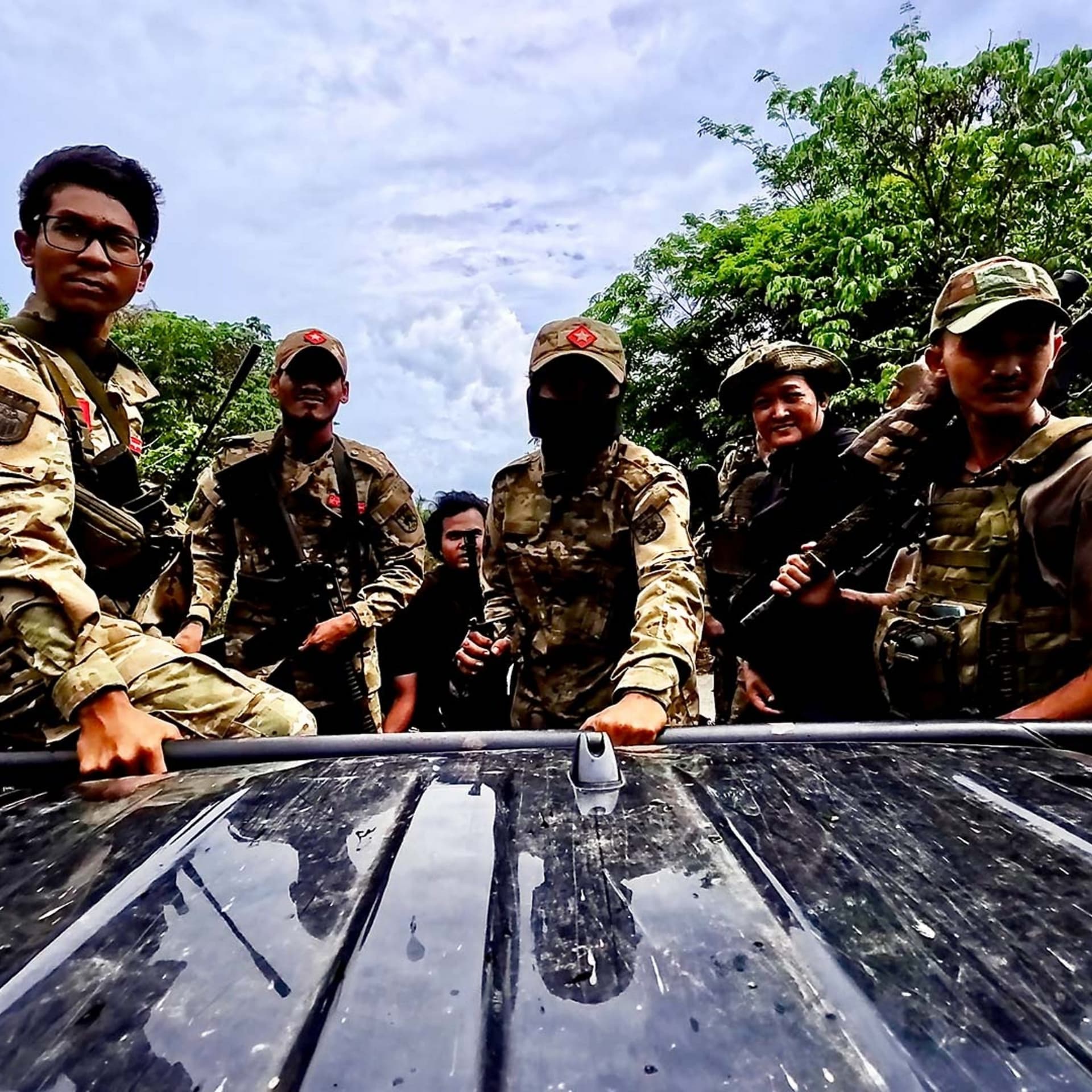
The Global News Podcast brings you the breaking news you need to hear, as it happens. Listen for the latest headlines and current affairs from around the world. Politics, economics, climate, business, technology, health – we cover it all with expert analysis and insight. Get the news that matters, delivered twice a day on weekdays and daily at weekends, plus special bonus episodes reacting to urgent breaking stories. Follow or subscribe now and never miss a moment. Get in touch: globalpodcast@bbc.co.uk Photo: Myanmar rebels in a pickup truck Credit: BBC/Darren Conway