In short
This BBC Global News Podcast episode covers: (1) Venezuela’s earthquake aftermath, with survivors criticizing government handling of rescue efforts; (2) Israel’s recognition of the 1915–17 Armenian killings as genocide and Turkey’s angry response; (3) Gaza’s post–Israel-Hamas war displacement and stalled reconstruction; (4) CERN’s Large Hadron Collider shutdown for a four-year upgrade; (5) Canada reaching the World Cup last 16 after a late win over South Africa; (6) Uganda’s media crackdown after soldiers shut down the Daily Monitor and related TV/radio operations; (7) a deadly French skydiving crash killing 11; (8) romance-fraud investigations in Lagos, Nigeria; (9) Mexico’s “Batman” vigilante duct-taping alleged motorbike thieves.
Guests/people featured
Nick Miles (host); Will Grant (Venezuela correspondent); Ambrasan Itarajan (global affairs reporter); Rob Young (Gaza report); Sascha Slichter (CERN report); Gary Rose (Canada match coverage); Alex Atahir (Uganda media freedom reaction); Richard Kagoy (Uganda updates); Nick Johnson (France crash); Roz Atkins (interviewer); Carlos Barragan (romance fraud investigation); Carla Conte (Mexico vigilante report).
Key claims and examples
Venezuela’s streets were closed, delaying permissions for rescuers; families in Catia la Mar shelter in stadium tents and fear unsafe buildings; La Guaira is militarised with ~14,000 troops, with complaints troops mainly direct traffic. Armenia: genocide recognition is symbolic; Turkey says it’s a political cover-up; deportations and mass killings of Armenians are described, with estimates “more than a million” killed. Gaza: nearly 1.5 million displaced; rebuilding estimated at $70B+; Israel blocks construction materials until armed groups disarm; examples include people charging laptops via solar and earthmovers hauling rubble. CERN: LHC upgrade aims for 100x more data and 380 million Higgs bosons; hopes to produce two Higgs simultaneously. Canada: Stefan Oistokio scored a 90-second stoppage-time winner; fans celebrate Canada’s first last-16 appearance. Uganda: Daily Monitor offices sealed off; TV stations went off air; shutdown reasons unclear, regulator investigating. France: plane came down shortly after take-off near a road; families witnessed the crash; psychological support provided. Romance fraud: Barragan traced a scammer’s IP to Lagos; example “Chibuke” allegedly scammed an Irish woman out of 80,000 euros over four years. Mexico: “El Batman de Lagos de Moreno” allegedly tied thieves to lampposts with industrial duct tape and wrote “ratero/rata”; authorities treat them as victims and investigate.
Written by AI. May contain mistakes. Listen to the episode to check what was said.
Chapters
Tap a time to open that second in VOVenezuela Earthquake Aftermath
0:30 to 1:03
Exploration of the ongoing rescue efforts and challenges faced by survivors.
“Imagine buying a toy for your kid, but it doesn't come with batteries.”
Venezuela Earthquake Aftermath
2:07 to 5:33
Exploration of the ongoing rescue efforts and challenges faced by survivors.
“where people can be found alive after last week's earthquakes.”
Recognition of Armenian Genocide
5:43 to 9:19
Discussion on Israel's recognition of the Armenian Genocide and its implications.
“The term genocide has a very specific and chilling definition in international criminal law.”
Life in Gaza Post-War
9:21 to 12:51
Insight into the struggles of Gazans during ongoing reconstruction efforts.
“Ambrasan mentioned Israel's war against Hamas.”
Large Hadron Collider Upgrade
12:52 to 14:00
Details about the upgrade of the Large Hadron Collider and its significance.
“is shutting down for a four-year upgrade.”
Canada's World Cup Success and Fan Reactions
14:00 to 17:20
Discussion on Canada's thrilling win in the World Cup and the fan enthusiasm surrounding it.
“with the new accelerator expected to produce around 380 million Higgs bosons over its lifetime.”
Media Crackdown in Uganda
19:12 to 22:42
Report on the shutdown of Uganda's biggest independent media group and its implications.
“Listen on BBC.com or wherever you get your podcasts.”
Tragic Skydiving Accident in France
22:42 to 24:49
Coverage of the deadly plane crash during a skydiving event in France, highlighting witness reactions.
“A small plane carrying skydivers crashed in the town of Tamblay in eastern France on Sunday, killing all 11 people on board.”
Investigating Romance Scams in Nigeria
24:49 to 28:00
Insight into Carlos Barragan's investigation of romance scams and the complexities behind them.
“That is what happened to Carlos Barragan when his divorce mother entered a relationship with a man who claimed to be a US soldier on mission in Syria.”
Unveiling Truths in Survivor Stories
28:00 to 28:34
Learn how fact-checking is crucial in understanding survivor narratives.
“and they might have amazing stories which actually are completely false given who they are.”
Show all 11 chapters
The Rise of Vigilante Justice in Mexico
28:36 to 31:00
Explore the phenomenon of vigilante groups in Mexico and their implications.
“And we end the podcast in Mexico, where a rise in motorcycle thefts in the state of Jalisco has led an unidentified individual to take matters into their own hands in a rather unusual way.”
Transcript
Automatic transcript. May contain errors.0:00This BBC podcast is supported by ads outside the UK.
0:29Snapdragon. That's how. Imagine buying a toy for your kid, but it doesn't come with batteries. That sucks. But honestly, it's even worse when you buy business software. You end up with fragmented, disconnected systems that cost a fortune and don't talk to each other. Odoo completely changes that. Odoo comes fully complete, with all your business apps perfectly integrated and working together seamlessly. It's everything your business needs in one place, saving you time, headaches and serious money. Stop paying for missing pieces. Go to odoo.com. That's O-D-O-O dot com to learn more. This is the Global News Podcast from the BBC World Service.
1:16I'm Nick Miles and in the early hours of Monday the 29th of June, these are our main stories. The survivors, who have lost everything in Venezuela's earthquakes, criticise the government's response. Turkey lashes out at Israel's government for recognising the massacre of Armenians more than a century ago as genocide. Eleven skydivers are killed in a crash. The deadliest private plane accident in France is history.
1:43Also in this podcast... Oh, amazing! That was awesome! What a shot! We're going to take down whoever's in front of us. Let's go Canada. Incredible. We're going to win the next one too. It's going to be great. A World Cup host is first into the last 16. And we find out what Mexico's motorbike vigilante is doing with lots of adhesive tape.
2:06Rescue workers in Venezuela are still in the critical stage where people can be found alive after last week's earthquakes. But as more international teams arrive in the worst hit areas to help, they know time is running out for the tens of thousands of people who are still unaccounted for. There have been rare moments of hope, though.
2:29What you're hearing there are rescuers pulling a man and his teenage son alive from the rubble on Sunday. But there's also growing frustration among some Venezuelans about the way the authorities are handling the rescue operation.
2:46On top of everything, the government decided to close the streets, making it harder to bring help. Yesterday we waited from 6am to 4pm to get a permission to come here. We wasted hours. Listen to me. I don't like to make comments that I know might have consequences later. I survived and I am still here, all by the will of God. But I am surprised that our governor hasn't shown his face around here.
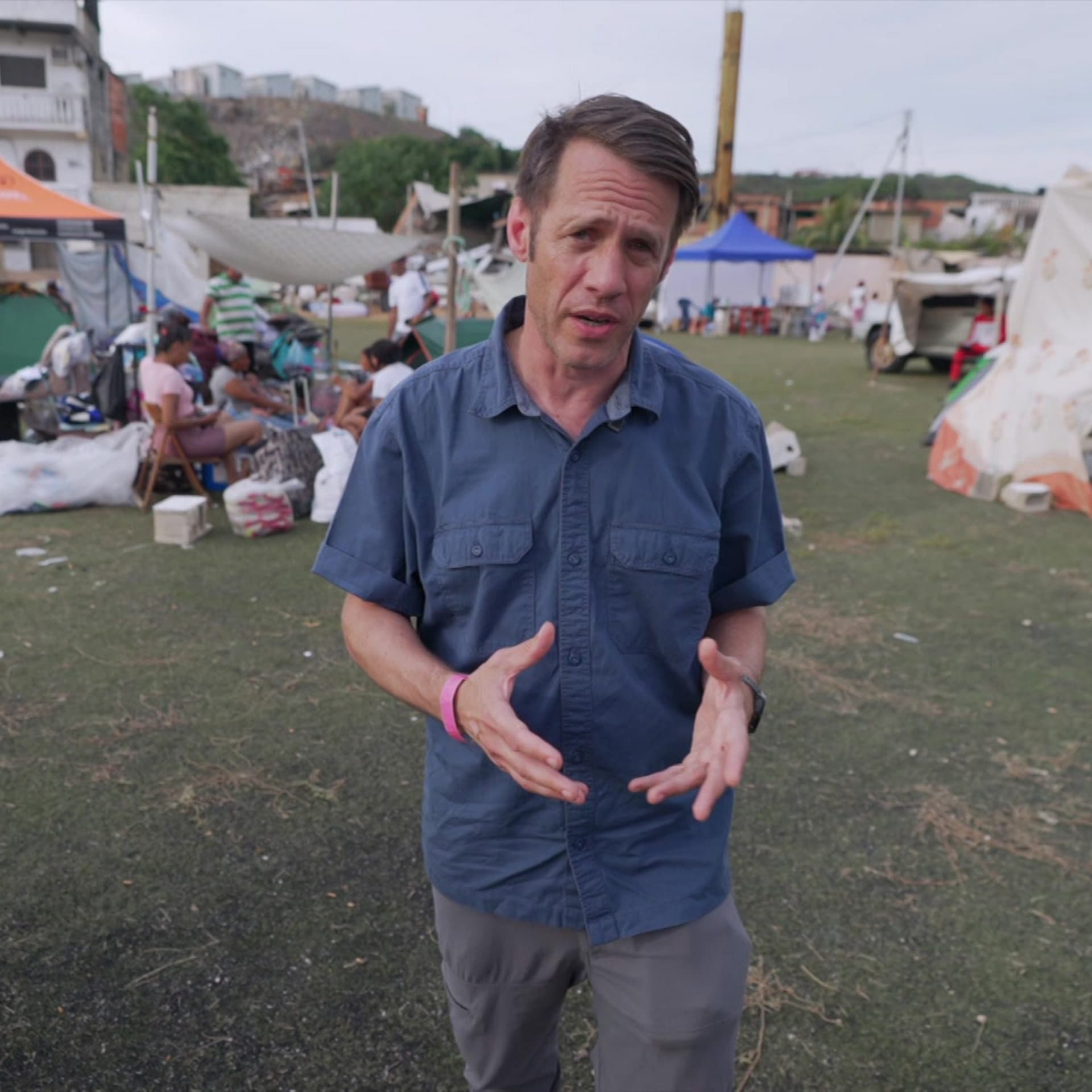
3:21Meanwhile, thousands of Venezuelans suddenly left homeless are sleeping in tents, parks and other makeshift shelters. Entire neighbourhoods have been flattened. Our correspondent Will Grant has been speaking to some residents who say they're too afraid to return to damaged buildings that could be unsafe. The destruction along Venezuela's northern coastline has been so severe that tens of thousands, perhaps hundreds of thousands of families have been left homeless. Here in this small town of Catia la Mar, a lot of the families have come to the local baseball stadium. It is at least outdoors, so they're protected from any aftershocks, but they're not protected from the elements.
4:00They've had to make shelters out of cheap nylon tents, out of structures made from blankets and sheets and pieces of wood and tarpaulin. They're dependent on donated food, donated clothing. It is a very, very bleak picture. I've been speaking to residents, some of whom were living in social housing up on the hillside that has completely collapsed. Not only did it collapse, there were fires after gas explosions following the earthquake. The families here simply don't know how long they're going to be in these sorts of conditions. One man said to me he thinks it could be as many as three or four years.
4:42He's hopeful, of course, that the authorities will find some kind of temporary accommodation during that time before they can rebuild not just this city, but the entire state. La Guaida, this state, is now completely militarised. There are some 14 ,000 troops here. And you can see that the need is extreme. Some streets, there are more buildings collapsed than there are still standing. The complaint of some people is that the military who are here aren't pitching in sufficiently with the search and rescue teams, that they're more directing traffic than anything else. We've been past one business where the neighbours, the residents, are doing all of the work trying to reach the bodies that are still inside the building to pull them out and give them dignified funerals.
5:33It is an extremely tough and dire situation, not just here in Katia Lamar, but all along this coastline. Will Grant. The term genocide has a very specific and chilling definition in international criminal law. It implies a crime committed with the intent to destroy a national, ethnic, racial or religious group. Now, Israel has joined more than 30 other nations that described the deaths of more than a million Armenians at the hands of the Ottoman Turks during the First World War as genocide. Turkish officials admit atrocities did take place, but deny it was genocide. Israel's decision has been roundly condemned by Turkey, as I heard from our global affairs reporter Amrassan Itirajan.
6:20Turkey has reacted angrily, as expected. Now, they termed it as a political decision to cover up what they call Israel's crimes. This is regarding what happened in Gaza in the past few years. But these allegations are strongly denied by Israel. Now, the Israeli decision also came as a surprise because even though the tensions have been building up between the two countries, especially with regard to what's happening in the Palestinian territories, The Israeli cabinet approved this proposal to recognize the killings of Armenians in the First World War between 1915 and 1917 in Turkey, in the dying days of the Ottoman Empire, as genocide.
7:02For a long time, Israel was hesitating to recognize, even though more than 30 countries around the world, including US, France and Germany, have recognized it. Not to upset Ankara, given the state of relations in the particular region, but off late in the past few years, the Turkish government was calling what's happening in Gaza as a genocide, an allegation denied by Israel. So that was angering. So the tension was building up. And then you see that Israel today recognising the killings as a genocide. And then Turkish angry reaction came. Regardless of the reason for this, this will be a significant day for Armenians because more than 100 years after those killings, it is still extremely raw, isn't it?
7:50So they have been campaigning. They have been trying to bring the attention of the world to these killings. what happened during the First World War in eastern Anatolia, where many Christian Armenians lived. And after the war with Russia ended in a disaster, the Ottoman Empire led by the Young Turk movement. So they blamed it on the Armenians and they were targeted because they thought they sided with the Russians around that time. And that is when the killing spree started. And then many of them were deported, made to walk in a desert and sent to Syria at that time. So several estimates talk about more than a million Armenians were killed.
8:32However, Turkish officials at that time were saying the number was 300 ,000. But many scholars, they broadly agree that more than a million Armenians were killed because they were forced to leave their territory. So it is a big emotional issue because they wanted it to be recognised as a genocide by the world community. Even for a long time, the US was hesitating because Turkey is one of the biggest member states of NATO military alliance. And Turkey's role is seen as very vital when you want to counter Russia. Just to clarify, recognition of a genocide doesn't necessarily imply any practical steps that will now be taken, does it?
9:10It is more of symbolic in nature, and it is also recognition of what the Armenians have been campaigning, talking about this happened. Ambrasan Itarajan. Ambrasan mentioned Israel's war against Hamas. The US brokered ceasefire between the two sides, talked of reconstructing Gaza, but eight months on, most of the territory is still just rubble. Despite facing extreme difficulties, Palestinians are trying to return to some kind of normality and make a living. Our reporter Rob Young sent this report.
9:45Akram crouches over a makeshift stove, brewing tea in the tent he now calls home. He's one of nearly one and a half million people still displaced by the war between Israel and Hamas. As Akram sips his tea, he and his grandchildren stare at a photo of the house they lost, now just rubble.
10:12This was approximately my 21st displacement during the war. I spent 58 years working, building it brick by brick and getting the house ready so I could feel settled when I got old, owning a whole property, only to find out that the house was gone, reduced to rubble. Others have been trying to reinvent their livelihoods. Ahmad used to travel the region as an e-sports commentator, but once the borders shut and internet access became very unreliable he had to adapt fast imagine i need to go to saudi arabia but there is no crossing i obtained the visa but i couldn't go out so i tried to go back to content writing and i thankfully i was able to work even from tents i bring my laptop to charge it with solar powered systems i needed to walk like seven kilometers a day.
11:04Then I come back and do the daily chores from making fire to making food to getting to the markets, blah, blah, blah. Why do I have to live under those conditions? Like, why can't I just live normally like the other eight billion around the world? Well, for many Gazans, that hardest of questions is whether to stay or go. Omaya, a graphic designer, has been weighing that choice. In Gaza, everything is destroyed. They need 10 years or 15 years to rebuild Gaza. So maybe I will return after that.
11:39Across Gaza City, earthmovers grind through piles of waste, loading it onto trucks bound for a new landfill in the south. In neighbourhood after neighbourhood, rubble stretches into the distance. Rebuilding will take years and cost billions. Into this devastation, amid a fragile ceasefire, come competing visions for Gaza's future, including one floated in January by Donald Trump's son-in-law, Jared Kushner, imagining skyscrapers in a new Gaza. Let's just plan for catastrophic success. We, Hamas, signed a deal demilitarized. That is what we're going to enforce. People ask us what our plan B is.
12:18We do not have a plan B. We have a plan. We signed an agreement. We are all committed to making that agreement work. No rebuilding work under President Trump's Board of Peace plan has been started since the ceasefire began eight months ago. Aid agencies say they're doing what they can. The United Nations estimates reconstruction will cost over$70 billion. Israel says no reconstruction can take place until armed groups, including Hamas, disarm, and for now doesn't allow construction materials into the less than half of Gaza that it doesn't control. Rob Young. The world's most powerful particle accelerator, the Large Hadron Collider, is shutting down for a four-year upgrade.
12:59with scientists hoping that this will help the hunt for dark matter, one of the greatest mysteries of space and time. Its invisible does not emit, absorb or reflect light, but is believed to make up about a quarter of the universe. Sascha Slichter reports. Inside the Large Hadron Collider, a nearly 30-kilometre circular tunnel deep below the French-Swiss border, superconducting magnets and accelerating structures propel particles to extreme energies and then smashed them together at phenomenal speeds. The LHC was most famously used to prove the existence of the Higgs boson, dubbed the God Particle.
13:40But from today, activity will stop as the extraordinary device undergoes upgrades to further increase the precision and intensity of particle collisions. This will provide 100 times more data. It's thought the CERN lab upgrade will cost$1.5 billion. Once the upgrade is completed, CERN hopes to dramatically expand its understanding of how the God particle works, with the new accelerator expected to produce around 380 million Higgs bosons over its lifetime. The lab's main hope is to produce two Higgs bosons simultaneously and see them interact. Scientists hope this may provide clues about how our universe evolved shortly after the Big Bang.
14:28Sasha Schlichter. There's been a big sigh of relief across Canada as one of the three hosts of the Football World Cup. Canadians were holding their breath for much of their match with South Africa. At stake was a place in the last 16 of the competition. And then two minutes into stoppage time, a winner. Oh, amazing. That was awesome. What a shot. We're going to take down whoever's in front of us. Let's go, Canada. Incredible. We're going to win the next one too. It's going to be great. I'm just so proud of Canada. I can't believe the result. just incredibly joy-filled. I can't wait to see them in Houston.
15:00I just can't wait to see what happens. For it to come to stoppage time and to score the winning goal and make the first round of 16 ever for a country, we're super excited. Go Canada! Go Canada! Our sports reporter Gary Rose was watching the match in Los Angeles. A 90-second minute winner from Stefan Oistokio sort of delivered the moments of quality which prompted lots of wild scenes of celebration at the end. It came after a match that I wouldn't say was the highest quality. South Africa sort of came with the intention quite clearly early on to slow things down. The goalkeeper held onto the ball quite a lot in possession and that prompted quite a few loud boos from all the Canadian fans that travelled in numbers to the game.
15:39It looked like it was going to be destined for extra time and probably penalties, to be honest, with the way it was going. There weren't many clear-cut chances, really. But, yeah, that last-minute goal and the celebrations it sparked were certainly a memorable way to start the knockout stages. Indeed. And, Gary, we heard from one fan there saying that we are going to take down anyone in front of us. Do you think they're right to feel that confident? Yeah, I mean, it's great confidence. And then I think Jesse Marsh, the Canada manager, has been careful to sort of play, not play up expectations too much because next up is going to be either the Netherlands or Morocco, which is incredibly tough for their two top 10 teams.
16:16So it is going to be tough. He's kind of called it a free hit. But what I think it does and what that fan's opinion shows is that they have a real belief now. and whatever sort of happens with the result-wise, I think this whole tournament's been a bit transformative for Canadian football. They're even referring to it, to be honest, as rather than soccer. When I was speaking to fans before the match, they're saying, yeah, this is, you know, we're football fans now. I don't think it's too sort of much of an exaggeration to say that it'll really change the face of football in Canada. You know, there's been a lot more fans that have been getting behind it.
16:45There's pictures of fan parks in Vancouver with thousands there that have been really getting swept up in it. And yeah, what Marsh does is really just brings this sense of belief among the players and it clearly goes into the fans that yeah, why not us? We can go toe-to-toe with anyone and I think belief and that level of support goes a long way. So yeah, it will be tough in the next game. I think this will be seen as a success whatever happens next. You just never know. No one probably expects them to go outside of their own country here and win and they've done just that. So who knows what could happen next.
17:17Gary Rose.
17:21Still to come in this podcast. Sometimes they were scamming people in real time. Chibuke, for example, he's a young scammer in Lagos, scamming an Irish woman. He gets 80 ,000 euros from her. She is losing everything. The multi-billion dollar world of romance fraudsters.
17:44Take the leash off your laptop with the processor that gives you long battery life. Work on the go. Jump between back-to-back calls. Stay locked in from brewing morning coffee to burning the midnight oil. Get maximum performance, even when unplugged. Finally, the freedom to move across the room or across the world is here. Snapdragon, that's how. The biggest men's football World Cup in history is here. 48 teams and a record 104 games being played across the United States, Canada and Mexico.
18:25And the More Than The Score podcast is bringing you more than just the latest results, stats and fixtures. We're taking a closer look at the new teams competing, the Cups standout stars and the fans who are shaping the tournament. More Than The Score from the BBC World Service. Listen now, wherever you get your BBC podcasts.
19:12of the attention economy. Find out on Good Bad Billionaire. Listen on BBC.com or wherever you get your podcasts.
19:22There's been an outcry in Uganda after its biggest independent media group was ordered to close. Armed soldiers are stationed outside some media offices and Uganda's Broadcasters Association says it's a violation of the constitution. Alex Atahir, a former editor of the Daily Monitor and an executive member of the Uganda Editors Guild gave us his reaction to what's happened. This is a direct attack on the freedom of expression and freedom of the media as guaranteed under the first of all the Ugandan constitution article 29 also the African Charter on Human Rights guarantees freedom of the media so this is unprecedented the military has before not directly attacked in a media house.
20:10So does this mean independent radio, TV and newspapers are not producing anything? My colleague Valerie Sanderson spoke to Richard Kagoy, who's following developments from Nairobi. It's caused widespread disruptions because the TV stations, actually two TV stations owned by the group, went off air. The offices of the Daily Monitor, the newspaper division, have been sort of like sealed off by armed soldiers around the premises. So staff are not able to enter or leave the compound. Yeah, so that's basically the situation there. So if you try and get a program on the radio or on television or to buy a paper, you won't be able to?
20:50Not at all. They are off air. So basically what happens for newspaper, lots of people are now accessing information online. So they're basically posting them on their website and their social media pages. Why has this happened? Well, it's difficult because there's no specific reason that the Army Chief General Kaneirogaba gave specifically for this shutdown. We've just heard from the Uganda Communications Commission, that's the regulator, saying they're investigating the circumstances that's surrounding this shutdown. And basically what they're doing is consulting relevant government agencies before they give us further updates.
21:28And broadcasters presumably want clarification. Are they meeting the government? Well, the Association of Broadcasters saying that they're consulting the Ministry of Information, the regulator, and also they're reaching out to the army chief just to get a clarification about the reasons that really led to the shutdown. So basically what they're saying is they want answers from the government about this because they're really concerned. They're saying the disruptions are really going to significantly impact the media industry in Uganda. You said that it wasn't clear why there was this action. Anything beforehand in the history of the government or the tradition of the country?
22:08You know, is there a clue as to why this has happened now? Well, based on previous incidents, it's what the government has said has been, you know, criticizing the coverage of a nation media group, saying that it's been covering, you know, the country negatively. And we have seen instances in the past where the Daily Monitor has been shut down twice. And also NTV, Uganda has also been shut down in 2007 for the reason that the coverage has largely been seen to be critical and also negative about the country. Richard Cagoy. A small plane carrying skydivers crashed in the town of Tamblay in eastern France on Sunday, killing all 11 people on board.
22:51They were the pilot, five instructors and five first-time jumpers. Officials say it's the deadliest private plane accident in France's history. Here's the interior minister, Laurent Nunez, speaking through a translator. I would like to say that in addition to this drama, another drama took place, which is that some of the families of the victims were present at the airport because it was a first sky dive. And they witnessed the falling of the aircraft, which was created a shock and a psychological trauma for them. Our reporter Nick Johnson has more. Absolutely horrific, isn't it, that we've had the people who were families of those on board who wanted to watch their first skydive.
23:33and they were at the airport doing so. The mayor of the nearby city of Nancy said the victims died in full view of their loved ones who were preparing to film those tandem skydives. So just horrific for everyone who was there. And the mayor went on to say that not only medical teams, but psychological support teams were looking after the relatives of the victims as well as other witnesses who saw what unfolded right in front of them. We've heard from a local nursing council in the nearby area and they say that the five students on board who lost their lives were all nurses, they were all colleagues, and that they'd organised this skydiving trip as it appears to be a team-building event.
Read the full transcript
24:11One official said no doubt to unwind as the country had been going through that heatwave over the last couple of days. Now, according to a number of witnesses in the area, the plane came straight down just after take-off. It's a German-registered plane which had been used previously for skydiving and this sort of event. Now the plane came down near a main road between the airfield and a housing estate itself so a number of people have said that it is actually a miracle that there weren't more casualties on the ground in those houses but an investigation is underway and we understand that those investigators are in the area at the moment.
24:47Nick Johnson. Now what would you do if your parent fell victim to a romance scam? That is what happened to Carlos Barragan when his divorce mother entered a relationship with a man who claimed to be a US soldier on mission in Syria. Well, Carlos, who's a New York Times reporter, traced the man's IP address to Lagos in Nigeria and then ended up moving there to expose the cybercrime network that is part of a multi-billion dollar industry that defrauds people around the world. What he found was a much more complicated story about the social and economic forces that drive people to commit these crimes.
25:23Roz Atkins spoke to Carlos about his investigation. At the beginning, they were very suspicious of me. They thought I might be an FBI agent, but they kept seeing me show up in Lagos. There was no reason for me to ask them about their lives if I was a police officer, if I was an FBI agent, but I was very keen on understanding the lives behind the scams as well, the socioeconomic conditions that drove them. I was very struck by what I found, the kind of people who were behind these scams. I was imagining something more sophisticated than what I saw. What were the ethical considerations you were having to go through as you went about your journalism?
25:58Because you must have been tempted to tell the police about them. You must have been tempted to tell their victims about them. Did you do either? Well, for sure, not the police. As a reporter, my ethical guidelines are that I protect my sources. It was harder with the victims because sometimes they were scamming people in real time. And I thought if I just told them, in the case of Chibuke, for example, he's a young scammer in Lagos, scamming an Irish woman. And for four years, he gets 80 ,000 euros from her. She is losing everything. It's a hard choice. But if I told the victims, why would the scammers share their stories with me?
26:36Did you have any concerns as you wrote the book, though, that in your efforts to humanize those carrying out these crimes, that you were in some way giving the impression there was a justification for it? Totally. I had to walk a very fine line. At the beginning, I was scared that I was going to fall into the stereotype of the so-called Nigerian scammer, as if there is something particularly Nigerian about this scam, when actually it's not, and this scam also happens in other parts of the world. But after spending so much time with them, you create a familiar bond with them. I started laughing with them at their jokes.
27:11And when those things started happening, I felt I had to connect with the victims. I need to step out because I wanted to humanize both sides, not just one side. When you were laughing with them, were there sometimes you thought, no, I shouldn't be doing this? Well, these guys lie for a living and some of them were pretty manipulative. and I realized how easy it was to get into their world of lies and fabrications. And I guess that it was also a reflection on how these boys are able to convince people of what they are doing. Did they try and get money out of you? Of course. But we always told them the same thing, that I would never pay for access or testimony because sometimes scammers had amazing stories, but they would only share them with us if we paid.
28:00and they might have amazing stories which actually are completely false given who they are. Was that, that must have been a cause for concern for you. Many of the things that I heard didn't make it to the book because I couldn't fact check it. And the way I did it was not only by interviewing them for hours and for days and for years, but also talking to their friends, their family, people in their community. And of course, it was very important for me that they would give me access to the conversations with the victims because obviously I knew that sometimes they were lying to me and they were also lying to themselves as well.
28:35Carlos Barragan speaking to Ros Atkins. And we end the podcast in Mexico, where a rise in motorcycle thefts in the state of Jalisco has led an unidentified individual to take matters into their own hands in a rather unusual way. Carla Conte reports. There is a new superhero in Lagos de Moreno. Armed with heavy-duty duct tape and a marker pen, a faceless vigilante has been roaming the streets of Mexico's Jalisco state, hunting down motorbike thieves in the dead of night. The mysterious figure has been dubbed the Mexican Batman, or El Batman de Lagos de Moreno, on social media, after five alleged thieves were found tied to public lampposts with copious amounts of industrial tape around their bodies, and the words ratero and rata, meaning thief in Spanish, scribbled across their foreheads.
29:29Photos circulating online show some of the restrained men with bruises on their faces and right next to them, the motorcycles they were reportedly accused of stealing. According to the Mexican newspaper Vanguardia, so-called Mexican Batman also drew whiskers on a couple of the alleged robbers, likely in a nod to the word rata, which literally translates to rat. The authorities in Jalisco say they are currently treating the duct-taped men as victims and that an investigation has been launched to find the mystery suspect. But for Mexico, a Batman-like figure patrolling the streets and fighting crime is nothing new.
30:06Vigilante groups, often called autodefensas, have proliferated in the past decade due to what many describe as the failure of local police to protect citizens from powerful drug cartels. In the nearby Michoacan state, also known as the birthplace of Mexico's self-defense movement, an all-female group of vigilantes carry assault rifles and set up roadblocks to fend off members of the notorious Jalisco New Generation Cartel. And in the state of Morelos, an anonymous individual known as El Limpiador, or The Cleaner, gained notoriety for carrying out targeted executions against suspected sex offenders and those who harm women and children.
30:46Many are now debating whether El Batman de Lagos is a lone individual or a group of angry vigilantes responding to a surge in motorcycle thefts in the area. But the question remains, will Mexico's Batman strike again? Carla Conte. And that's all from us for now. But if you want to get in touch, you can email us at globalpodcast.bbc.co.uk. You can also find us on X at BBC World Service. Use the hashtag Global News Pod. And don't forget our sister podcast, The Global Story, which goes in-depth and beyond the headlines on One Big Story. This edition of the Global News podcast was mixed by Zabihullah Korush and the producer was Stephanie Zacherson.
31:31The editor is Karen Martin. I'm Nick Miles and until next time, goodbye.
31:42Take the leash off your laptop with the processor that gives you long battery life. Work on the go. Jump between back-to-back calls. Stay locked in from brewing morning coffee to burning the midnight oil. Get maximum performance, even when unplugged. Finally, the freedom to move across the room or across the world is here. Snapdragon. That's how.
From the publisher
In Venezuela, rescue teams are searching through collapsed buildings for survivors after last week’s devastating earthquakes, with international help now reaching some of the worst-hit areas. The BBC hears from people who have been left with nothing, as thousands sleep outdoors or in makeshift shelters.
Also: Israel’s recognition of the mass killing of Armenians by the Ottoman Empire as genocide prompts a furious reaction from Turkey. Gazans try to rebuild lives and livelihoods, despite much of the Palestinian territory still lying in ruins. Uganda’s biggest independent media group is ordered to close, raising fears over press freedom. Eleven people die in a plane crash in eastern France. A journalist investigates the Nigerian cybercrime network behind a romance scam that targeted his mother. Canada reaches the last 16 of the men's football World Cup after a dramatic win against South Africa. The Large Hadron Collider - the world's most powerful particle accelerator - shuts down for a four-year upgrade. And a vigilante nicknamed Mexico’s Batman goes viral after catching alleged motorcycle thieves.
The Global News Podcast brings you the breaking news you need to hear, as it happens. Listen for the latest headlines and current affairs from around the world. Politics, economics, climate, business, technology, health – we cover it all with expert analysis and insight. Get the news that matters, delivered twice a day on weekdays and daily at weekends, plus special bonus episodes reacting to urgent breaking stories. Follow or subscribe now and never miss a moment. Get in touch: globalpodcast@bbc.co.uk
Photo: BBC correspondent Will Grant at a baseball stadium in Venezuela where displaced families have come to shelter after the earthquakes Credit: BBC