
In short
This BBC Global News Podcast episode covers multiple stories, led by an exclusive report on Ukraine’s battle with Russia in the Black Sea. It says Ukraine is striking Russian energy sites and supply routes, while Russia increasingly targets Ukrainian civilian ports; a Russian strike on Odessa damaged a Guinea-Bissau-flagged wheat ship, killing one crew member. With rare access to the Ukrainian navy, correspondent Paul Adams describes patrols in waters made dangerous by attacks and ports that are “virtually empty” as vessels fear being hit.
Guests
none. Other segments include Jonathan Head in Bangkok on Thailand hosting Myanmar’s junta leader Min Aung Lai despite ASEAN criticism; Richard Kogoi on Uganda football captain David Awari’s fatal street-gang attack; Laura Foster on wildfire smoke (PM2.5) linked to more ER migraines; and additional reporters on Fauci contempt vote, Hiroshima commemorations, Indonesia’s endangered macaque exports, Disney/TikTok deals, and a 97-year-old wing-walker record.
Written by AI. May contain mistakes. Listen to the episode to check what was said.
Chapters
Tap a time to open that second in VOUkraine's Naval Conflict
0:37 to 1:37
Exploring Ukraine's ongoing battle with Russia in the Black Sea.
“We're recording this at 15 Hours GMT on Thursday the 6th of August.”
Inside the Ukrainian Ports
1:37 to 4:23
A rare look into the empty ports affected by the ongoing conflict.
“to try to drive home to people there the true cost of President Putin's invasion.”
Voices from the Frontline
4:23 to 6:31
Personal accounts of the challenges faced by those in war-torn Ukraine.
“I meet Svetlana, a warehouse shift manager at Odessa's main port.”
Myanmar's Diplomatic Isolation
6:31 to 10:05
Discussion on Myanmar's military ruler's recent visit to Thailand.
“Next to a warm welcome in Bangkok for a military ruler seen elsewhere as an international pariah.”
Violent Crime in Uganda
10:05 to 13:21
The impact of violent crime on Uganda's society, highlighted by a recent tragedy.
“The captain of one of Uganda's biggest football teams has died after being attacked near his home in the capital Kampala.”
Health Risks of Wildfires
13:21 to 14:01
Examining the health implications of wildfires, particularly migraines.
“Richard Kogoi talking to me from Nairobi.”
Impact of PM2.5 from Wildfires
14:01 to 15:07
Learn how tiny particles from wildfires can affect health and cause migraines.
“and they're called that because they're less than 2.5 micrometres wide.”
Civilian Casualties in U.S.-Israel War
15:39 to 16:04
Explore the recent civilian casualties in the U.S.-Israel conflict and its implications.
“Experts say the evidence indicates it was American forces that hit the school, but the U.S.”
Fauci's Legislative Controversy
16:04 to 16:48
Discuss the Senate committee's actions against Dr. Fauci over his COVID testimony.
“In the United States, Anthony Fauci was the face of the COVID pandemic, standing alongside Donald Trump and looking on quizzically as the US president gave his take on how to tackle the virus.”
Japan's Nuclear Commemoration
16:48 to 18:50
Learn about Japan's commemorative events for Hiroshima and its implications for policy.
“and it all stems from a separate hearing that had taken place last week in which Dr Fauci was called in to answer questions about his experience during the COVID pandemic.”
Show all 13 chapters
Export of Long-Tailed Macaques Resumes
18:50 to 22:38
Examine Indonesia's decision to resume monkey exports and the ethical concerns involved.
“Here's our Tokyo correspondent, Kurumi Mori.”
Disney's TikTok Strategy
22:38 to 25:34
Analyze Disney's new partnership with TikTok and its effect on storytelling.
“Our correspondent in Indonesia, Lisa Tambunan.”
97-Year-Old Wing Walker Breaks Record
25:34 to 28:00
Hear the inspiring story of Betty Bromage, a 97-year-old who sets a new wing walking record.
“Finally, a 97-year-old woman here in the UK has broken her own Guinness World Record to become the oldest person to complete a wing walk.”
Transcript
Automatic transcript. May contain errors.0:00This BBC podcast is supported by ads outside the UK. President Trump has described the surge of migrants into Spain as an invasion. But what really happened in the tiny Spanish enclave known as Ceuta? I'm Asma Khaled and I host the Global Story podcast on the BBC. Last week, tens of thousands of migrants from Morocco streamed into Ceuta. It ignited a political storm in Europe and even here in the US. But who's really to blame? For more, listen to The Global Story on BBC.com or wherever you get your podcasts. This is the Global News Podcast from the BBC World Service. Hello, I'm Oliver Conway. We're recording this at 15 Hours GMT on Thursday the 6th of August.
0:47Today we have an exclusive report on Ukraine's battle with Russia in the Black Sea. Myanmar's military ruler emerges from diplomatic isolation with a visit to Thailand. And after a four-year break, Indonesia resumes exports of endangered monkeys to the US for lab testing. Also in the podcast, why wildfires can give us migraines and... I just get bored with life otherwise. When you get old, you can't go here, you can't do this, you can't drive, you can't see. I can't see very well. and I get a bit frustrated. So I want to do the things that I can do. The 97-year-old wing walker who's just broken her own record.
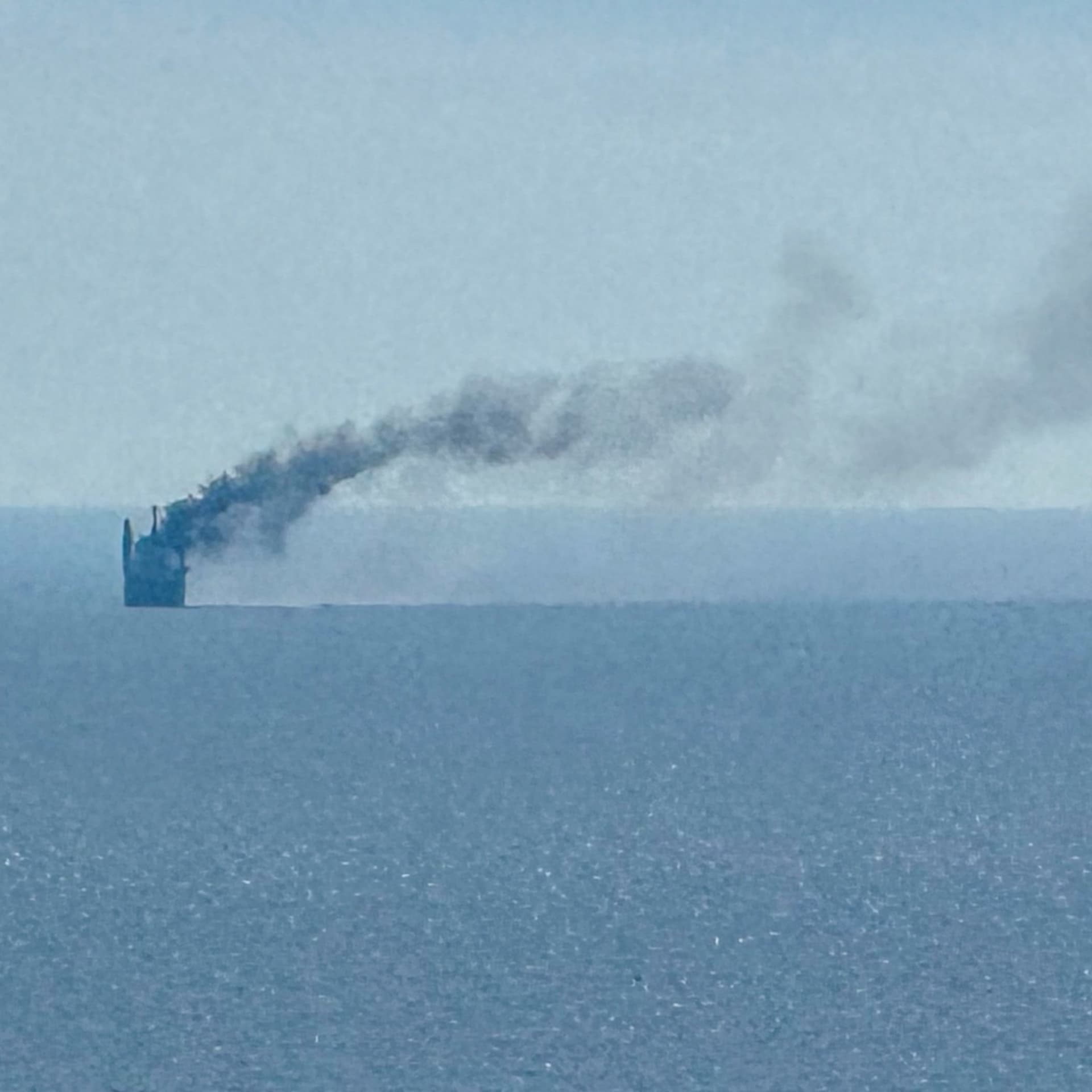
1:37For months, Ukraine has been hitting Russia's energy sites, warehouses and supply routes to try to drive home to people there the true cost of President Putin's invasion. In the latest attack, Ukraine struck two Russian oil refineries, sending plumes of black smoke into the atmosphere. But along with the air war, Russia and Ukraine have also been battling it out at sea. Ukrainian officials say a Russian strike on the Black Sea port of Odessa overnight damaged a Guinea-Bissau-flagged ship loaded with wheat. One crew member was killed. Our diplomatic correspondent, Paul Adams, has been given rare access to the Ukrainian navy.
2:16We're going on patrol with the Ukrainian navy. out into waters made increasingly dangerous by Russian attacks. In a part of the country where a drone or ballistic missile can arrive with little warning. Everyone is focused, on alert. They fire their guns every day. This morning it looks deceptively calm. With its guns, its netting and some of the other equipment on board, this vessel can look after itself more or less. But what it can't do is to stop Russia attacking civilian ships coming in and out of Ukraine's ports. Those attacks are increasing, and it's a major problem. There's a war out at sea.
2:58Russia and Ukraine hitting each other's ships, hundreds of them. Normally, all of them are crowded by vessels. Now you can see how many vessels. All we can see moving are a couple of tugboats, nothing else. Tugboats, nothing else. I'm being shown round one of Ukraine's biggest Black Sea ports. For security reasons, I'm not allowed to say which. And I'm going to call my guide, Dmitry. It's not his real name. He's worked here for 20 years. The port is virtually empty. Dmitry's never seen it like this. Officially, ports are not closed, but vessels are not coming. They are scared of being hit like it was this morning in Odessa.
3:42Starting July, they hit trade vessels as a primary target. Why do you think this changed? It's better to ask them. Because the main thing, they want to make a blockade of the Ukrainian ports because of the economy. Yeah, this is a really quite strange experience. Driving under these enormous gantries and cranes and the pipes and the buckets and everything that you need for a busy port, and none of it, none of it is working.
4:22At the offices of Ukraine's Transport Workers' Union, I meet Svetlana, a warehouse shift manager at Odessa's main port. She's limping, fragments of a Russian ballistic missile still stuck in her leg and back following an explosion at the port a year ago. She fights back tears as she talks, and her hands shake as she describes what life is like now. It's very difficult. A lot of sirens, a lot of drones, a lot of hits. And for morale, it's even more difficult. People are very tense. What can I say? Look at my hands. Back at Dimitro's port, the air raid siren sounds.
5:13We head for the nearest bomb shelter, soon joined by port workers, all scanning their phones for updates. Is that the drone or is that a Ukrainian Air Force? That's the drone.
5:31OK. Yeah, OK.
5:36So, you can feel by yourself. How does it look working during the war? Yes. On the port. Unfortunately, it became typical for our life. We're told that two jet-powered drones landed in the area, so we go looking for the scene of one of the explosions. eventually several miles from the port we find 83 year old andre dudik surveying the shattered ruins of his house and garden somehow he escaped without a scratch and i was planning what i would do after my lunch but now i understand what i will be doing you seem to have a sense of humor about this whole incident.
6:27If we start crying, it will not lead to anything. Yes, this is true. Paul Adams reporting from Ukraine. Next to a warm welcome in Bangkok for a military ruler seen elsewhere as an international pariah.
6:50Thailand rolled out the red carpet for Min Ong Lai, leader of neighbouring Myanmar, despite his refusal to end the five years of violence sparked by his coup against the government of Aung San Suu Kyi. For more on the visit of the Burmese strongman, I spoke to our Southeast Asia correspondent Jonathan Head in Bangkok. It's a surprise to most of us here that the ties have escalated it to what looks like a state visit. It's not a state visit, but Minong Line has been given all of the honours and trappings that go with a big official visit. This is a man who's not been able to travel to fellow Southeast Asian countries since he overthrew Aung San Suu Kyi's government.
7:31He's been an international pariah, only really travelling to Russia and most recently to China. But the Southeast Asian governments have kept him at arm's length because he's caused a real crisis for them. Thailand's got a two and a half thousand kilometer long border. A lot of the civil war that was ignited by the coup is spilling over that border. And Min Online has point blank refused to honor the promises he made after the coup that he would deescalate violence and start negotiating with the opposition. But I think there's been a growing sense in several countries, particularly in Thailand, that Min-a-Liang is not going anywhere.
8:07His military regime has regained a lot of the territory that it lost over the last year, thanks in large part to support from China. and his regime is not going to crumble. And having held this much-criticised election earlier this year and turned himself into a notionally civilian president, he's really cemented his hold on power. And I think the Thai calculus is we have to deal with him at some point. You know, we are neighbours. We have a lot of issues to share. We may as well do it now. When we say roll out the red carpet, there was an awful lot of red carpet at Government House. There was a full military band and an honour guard and a lot of meetings, a lot of business meetings as well, trying to build up the economic ties between the two countries.
8:48It feels like business as usual between Thailand and Myanmar after five years of the civil war. And what will other members of the regional body ASEAN, what will they make of it? Some are unhappy. Governments like Singapore have held out saying, look, we need to get concessions from Myanmar. We need to see them doing what they promised five years ago and genuinely trying to de-escalate this war and just talking to their opponents. They've gone to war with their own people. There are thousands of volunteer armed groups who've taken extraordinary risks to fight the military, but thousands of civilians as well.
9:20Many have fled to the Thai side. This is a military government, essentially, despite the election, which is against its own people. And other Southeast Asian countries really want to see some kind of signs of compromise, and the military isn't giving that. So I think there's some dismay that Thailand has jumped so quickly to embrace Myanmar's coup leader rather than trying to extract more concessions from him. But, you know, the military is extremely stubborn in its mindset. Min Ong Lai has expressed a lot of indignation. He says he feels Myanmar's been treated differently from other members of the Association of Southeast Asian Nations, and he hasn't made any concessions in five years of this gruesome civil war.
9:59So I think Thailand's calculation is he's probably never going to do it. We've got to deal with him now. Jonathan Head in Bangkok. The captain of one of Uganda's biggest football teams has died after being attacked near his home in the capital Kampala. Police said David Awari was fatally assaulted by a street gang. His death has prompted an outpouring of grief and renewed anger over violent crime in Uganda. Our global affairs reporter Richard Kogoi told me more. The police are saying that Awari had resisted attempts by a group of robbers. So they're describing them as a street gang operating in a suburb in Kampala, just close to his home.
10:39So what happened is that he resisted an attempt to steal his mobile phone and other belongings. And as a result of that, he was fatally assaulted. So we don't quite really have the details in terms of really how that transpired. But then what they say is that he was later found by passers-by. He was lying unconscious. And they took him to a clinic which was nearby. but then they say that they didn't have the capacity to treat him so he was transferred to a nearby hospital and unfortunately he died from his injuries. And tell us more about David Awari's sporting prowess and the reaction to his death.
11:20Well, Awari was a renowned footballer, a very promising star there. He began his career about a decade ago, really starting off from the grassroots level and now rising up even to playing for SC Villa, which is where he was the captain. He also featured in the national team, that is the Uganda and Ukraine in the 2021 Africa Cup of Nations. And he was also known to be a very prolific defender, you know, playing across the midfield thereabout. And there has been really lots of tributes that have been pouring in. We've heard even from his football club, SC Villa, saying that he was indeed not just a player, but they saw him as a leader, they saw him as a brother, and also the national team saying that he was sort of like an inspiration to a new generation of footballers across Uganda.
12:11And it's interesting that even the national parliament yesterday, during one of its sessions, observed a minute's silence just in his honour. So he was somebody who sort of like captured the imagination of Uganda, especially the sporting scene. And a lot of people really are expressing, you know, anger at just, you know, his death and what really happened to him. Yeah, I mean, it comes not long after a rugby player was killed there. How bad is violent crime in Uganda? It's really been a major concern. And it's something that has repeatedly featured in most conversations because you'd have lots of young people, unfortunately, who have not been able to secure gainful employment.
12:54And so a lot of them are really resorting to street and violent crime. And so this just happening two months after the famous Ugandan rugby player who was killed, it's really raised concern that, I mean, if notable prominent people can really also fall victim to this, it's not just the ordinary Ugandan who's going through this. And that's why even the deputy speaker and the National Assembly really called on the police to address the wider security challenges in the capital Kampala and even just across other countries. Richard Kogoi talking to me from Nairobi. With wildfires still raging in Western Europe, North Africa and Canada, a new study has highlighted the dangers to human health.
13:33As well as the immediate risk to life from flames and smoke inhalation, Canadian researchers say they can also cause migraine headaches. Our health reporter Laura Foster has been looking at the findings. They took various bits of satellite and weather data from Canada, looking at where fires were, how plumes of smoke were travelling during the wildfire season, and they put it all into a computer which worked out how much the air was filled with very small particles. These are called PM2.5s, and they're called that because they're less than 2.5 micrometres wide. To give you some context, if you take a strand of your hair or if you look at a hair on your arm, that's like 1 30th the width of a human hair.
14:14So it really shows how small they are and how they can get into your system. And what they did is they compared all that data from wildfire seasons and looked at admissions to emergency departments in Ontario and Alberta. The researchers found at the same time, there was also an increase of more than 6 % to emergency departments for headaches and migraines. Because of these tiny PM 2.5s, they're so small they can get into our lungs. And they contain these toxic compounds that can trigger various stress and inflammation in blood vessels. And that can carry around our systems. It can activate the nerve pathways.
14:49And it leads to these migraines that require emergency care. But then there's the second effect of wildfires in that the stress and anxiety and sleep disruption and behavioural changes that come about because you're caught up in a wildfire that also can lead to increase in migraines and headaches. Our health reporter, Laura Foster. And still to come on this podcast. Truth media companies must make this change. It is an absolute imperative. They have to be where the audience is. Short form storytelling is the coin of the realm for younger audiences and those same audiences as they become older.
15:27Why Disney is giving TikTok users access to its films and TV.
15:38It's been five months since the deadliest civilian strike of the U.S.-Israel war in Iran. 120 children killed at a school. Experts say the evidence indicates it was American forces that hit the school, but the U.S. government has not admitted responsibility. I'm Asma Khalid, and I host the Global Story podcast on the BBC. The BBC has now visited the site of the school and spoken to Iranians about what they saw. For more, listen to The Global Story on BBC.com or wherever you get your podcasts.
16:11In the United States, Anthony Fauci was the face of the COVID pandemic, standing alongside Donald Trump and looking on quizzically as the US president gave his take on how to tackle the virus. The chief medical advisor later became the bete noire of lockdown and vaccine sceptics. Now, a Senate committee has voted on party lines to put him in contempt of Congress. The hearing was called after Mr Fauci refused to answer questions at a hearing on COVID-19. Our White House correspondent, Bernda Boosman, is covering the story. He spoke to Tim Franks. This vote was from the Senate Homeland Security and Governmental Affairs Committee, and it all stems from a separate hearing that had taken place last week in which Dr Fauci was called in to answer questions about his experience during the COVID pandemic.
17:02And specifically, many of these lawmakers wanted to drill down on the origins of COVID and how it was handled afterwards. But during that hearing last week, Dr. Fauci invoked his constitutional right against self-incrimination more than 100 times. Essentially, he didn't answer any questions, And he sat quite still and just declined to answer questions for hours, including questions, for example, what color tie are you wearing? Now, the senator who led that effort, Senator Rand Paul from Kentucky, he's held this vote to hold him in contempt, which means that now that case will be referred to the Justice Department.
17:39And it's up to them whether they actually want to prosecute that case. If they do, it would be a misdemeanor with fines. And in extreme cases in the past, they've sentenced people to brief jail sentences of several months. Right. And just in terms of process, is it now completely in the hands of the Justice Department? Will they sort of refer it back to a full vote of the Senate? Well, in normal cases, it would go to a full vote of the Senate where it would require 60 of 100 votes to pass. At the moment, there are 53 Republicans in the Senate, which would make that unlikely. So Rand Paul, who's again leading this effort, has decided to circumvent that effort, and he's going directly to the Justice Department.
18:20But at the moment, it's not at all clear that the Justice Department will opt to prosecute Dr. Fauci for this. Japan's Prime Minister, Sanei Takeuchi, has led commemorations in Hiroshima on the 81st anniversary of the world's first use of nuclear weapons. 140 ,000 people died when the US dropped an atomic bomb on the city as part of efforts to end the Second World War. In her address, Ms. Takeichi reaffirmed Japan's non-nuclear principles. So how significant is that? Here's our Tokyo correspondent, Kurumi Mori. This message carried particular weight this year. Japan is set to revise its key national security strategy later this year, and that's prompting questions over whether it's long-standing commitment to those principles could face new pressure at a time when forcing East Asia rapidly changing with its security environment.
19:13And Takaichi did not address those concerns directly in her speech. And instead, she stressed Japan's responsibility as the only country to have suffered atomic bombings in war and renew that commitment to pursue a world with no nuclear weapons. But the issue has become increasingly sensitive in Japan. Online, some questions whether Takaichi, who is widely regarded as having a more hawkish national security stance, will maintain that pledge as the regional tensions just grow further and defense spending here continues to rise. You know, for many in Hiroshima, this ceremony is less about politics than about remembrance.
19:54As the number of atomic bomb survivors continues to decline in Japan, And there's this growing urgency to preserve their testimony and endure that lessons of Hiroshima and make sure that they are not forgotten. Kurumi Mori in Tokyo. Indonesia is resuming the export of long-tailed macaques for use in laboratory experiments after a four-year pause. Animal welfare groups have strongly condemned the move, saying it threatens the monkey's survival. Our correspondent in Jakarta, Lisa Tambunan, told me more. If we go back to 2022, the IUCN updated the status of the long-tailed macaques from vulnerable to endangered.
20:34And in Indonesia, there was growing pressure from animal welfare groups campaigning against the capture and live export of these macaques. This pressure prompts the Indonesian authorities to pause wild captured quarters and also halt export permits in order to align with international compliance and prevent further depletion of wild monkeys. Since then, there have been discussions with CITS, which is the International Regulator of Trade in Endangered Species. And this year, Indonesia was allocated by CATS almost 2 ,000 monkeys for export. OK, why are these creatures in demand for testing? There are two sides to this.
21:20On one side is the medical one. So long-tailed macaques are the most widely used non-human primates in biomedical research globally. And with past research showing their immune system reacts similarly to a human immune system, making these monkeys what researchers say ideal models for testing vaccines and treatments for viruses. On the other side is a financial one. Indonesian officials justify the trade by highlighting lucrative research demand from the US, especially as one of its biggest markets. And there is also ongoing negotiations with China, where, according to Indonesian officials, the demand is double the US for its potential market value, with demands estimated to reach up to 20 ,000 macaques annually at prices between 3 ,000 and 4 ,000 US dollars per animal.
22:17And briefly, is there any opposition in Indonesia to this export trade? Yes, animal welfare groups strongly condemn this move. They warn it threatens the species' survival, as you said earlier. Indonesian authorities insist the process is strictly regulated, but animal welfare groups are saying this is a setback for the protection of long-tailed macaques, which are native to Indonesia. These groups are now urging Indonesia to suspend exports and shift toward modern non-animal testing alternatives. Our correspondent in Indonesia, Lisa Tambunan. Disney characters could soon become official TikTok stars after what's been called a first-of-its-kind deal between the Hollywood studio and the video-sharing platform.
23:22The story has just begun. Under the agreement, characters like Darth Vader, Spider-Man and Moana from Disney films and its subsidiaries will be allowed in TikTok videos, which will in turn be shared on the Disney Plus app. Disney said the move reflects how fans are engaging with its stories in, quote, entirely new ways. Kevin Mayer is a former senior Disney executive who also once served as the boss of TikTok. I think that Disney has seen the light, I know they have actually, about the permanence and the importance of this cradle-led economy and the vertical video that comes from that. So they have to find a way to combine these experiences.
24:05And look, Disney Plus is the way to do it. I don't think Disney Plus is going to end up being a social media storytelling operation. It's still going to be based on and focused on the storytelling that they've been doing for decades. But this new component will open up a different avenue, different use case. The change in consumer behavior is impossible to overstate. For users that are 13 and younger, 75 % of their usage of media is on social media platforms, YouTube and TikTok especially, and video games. I should throw that in there too. Only 25 % of those young person's time is spent with TV shows that are either streamed or on a TV channel, more and more streaming obviously, and movies, including theatrical releases.
24:41So there's been a dramatic shift in where their audience wants to be and where their audience wants to interact with not only Disney programming, but all programming. Traditional media companies must make this change. It is an absolute imperative. They have to be where the audience is, they have to tell stories in a way that this new audience likes those stories being told. And this extends to sports and ESPN as well. Short form storytelling is the coin of the realm for younger audiences and those same audiences as they become older. That math has already shown that audiences hang on to this usage paradigm as they get older.
25:14So Disney has to do it. And could it fall flat? Certainly possible. Could they iterate a bunch of times and see what works and what doesn't and ultimately come up with a product that doesn't fall flat, that takes advantage of this interaction with their creators in a very robust and fan-friendly way. Likely, I think Disney is really good about this. The biggest risk there is, is not doing this. Entertainment analyst Kevin Mayer. Finally, a 97-year-old woman here in the UK has broken her own Guinness World Record to become the oldest person to complete a wing walk. Betty Bromage started doing the stunts a decade ago.
25:47Steve Nibbs has the story.
Read the full transcript
25:52betty's back 97 years young and taking to the skies again i just get bored with life otherwise when you get old you can't go here you can't do this you can't drive you can't see i can't see very well and i get a bit frustrated so i want to do the things that i can do up in the air betty's at home in her element on the ground her friends and neighbors from her retirement village in Cheltenham, watch on nervously. Oh, Betty! What was it like watching her doing those loopy loops in there? Awful. I was here four years ago. Awful. Makes you want to cry, but yeah, she got on fantastic. Yeah, so proud of her.
26:34It's incredible. I mean, she's partially sighted, in fact, almost blind, and yet she can do this. This isn't the first time she's done something like this, but at her age, it's just amazing, isn't it? So, no, she's a wonder. Betty started all this 10 years ago at the age of 87. She's since abseiled down a tower in Cheltenham and took on a zip wire in Snowdonia. And today she pushed the envelope even further, asking the pilot to throw in a barrel roll.
27:04She just explains to me inside that it's something that she really is keen to do, even at her age. So I just think it's absolutely fantastic. And for me, it's such a privilege to be able to do that. All of this was done to raise money for the stroke unit in Cheltenham. They helped Betty when she had a stroke last year. So kind to me and straight away the treatment I got. It affects my words. I go to say a word and it doesn't always come out. But the rest of me, I'm fit as a fit. Well, for a 97-year-old. Today the staff sent her a good luck message, grateful for the support. Thank you, Betty. Good luck.
27:46Back on the ground, Betty took it all in her stride, with confirmation that she broke her own world record yet again as the oldest female wing walker. Steve Nibs reporting. And that is all from us for now, but the Global News Podcast will be back very soon. This edition was mixed by Jack Wilfan and produced by Alfie Habershon and Stephanie Zacherson. Our editor is Karen Martin. I'm Oliver Conway. Until next time, goodbye.
28:20President Trump has described the surge of migrants into Spain as an invasion. But what really happened in the tiny Spanish enclave known as Ceuta? I'm Asma Khaled, and I host the Global Story podcast on the BBC. Last week, tens of thousands of migrants from Morocco streamed into Ceuta. It ignited a political storm in Europe and even here in the U.S. But who's really to blame? For more, listen to The Global Story on BBC.com or wherever you get your podcasts.
From the publisher
The BBC's Diplomatic Correspondent, Paul Adams, has been given rare access to a Ukrainian naval ship and a visit to one of the main ports in the Black Sea. He reports on the naval battle taking place at sea, as Russian attacks on Ukrainian vessels are increasing.
Also: a warm welcome in Bangkok for the Myanmar military ruler seen elsewhere as an international pariah. David Owori, the captain of one of Uganda's biggest football teams has died after being attacked near his home in the capital, Kampala. As wildfires continue to rage, a new study highlights how they can cause migraine headaches. A US Senate committee has voted to hold the former top health official Anthony Fauci in contempt of Congress after he refused to answer questions during a hearing on the Covid-19 pandemic. Japan's Prime Minister Sanae Takaichi leads commemorations in Hiroshima on the 81st anniversary of the world's first use of nuclear weapons. Indonesia resumes the export of long-tailed macaques for use in laboratory experiments after a four year pause. Disney characters could become official TikTok stars after what's been called a “first of its kind” deal between the Hollywood studio and the video platform. And a 97-year-old woman in the UK has broken the Guinness World Record for being the oldest female wing walker.
The Global News Podcast brings you the breaking news you need to hear, as it happens. Listen for the latest headlines and current affairs from around the world. Politics, economics, climate, business, technology, health – we cover it all with expert analysis and insight. Get the news that matters, delivered twice a day on weekdays and daily at weekends, plus special bonus episodes reacting to urgent breaking stories. Follow or subscribe now and never miss a moment. Get in touch: globalpodcast@bbc.co.uk Photo: A civilian vessel on fire as Ukraine's navy spokesman reported a Russian military strike near the Black Sea port of Odesa, Ukraine July 2026. Credit: REUTERS/Victor Sayenko