
In short
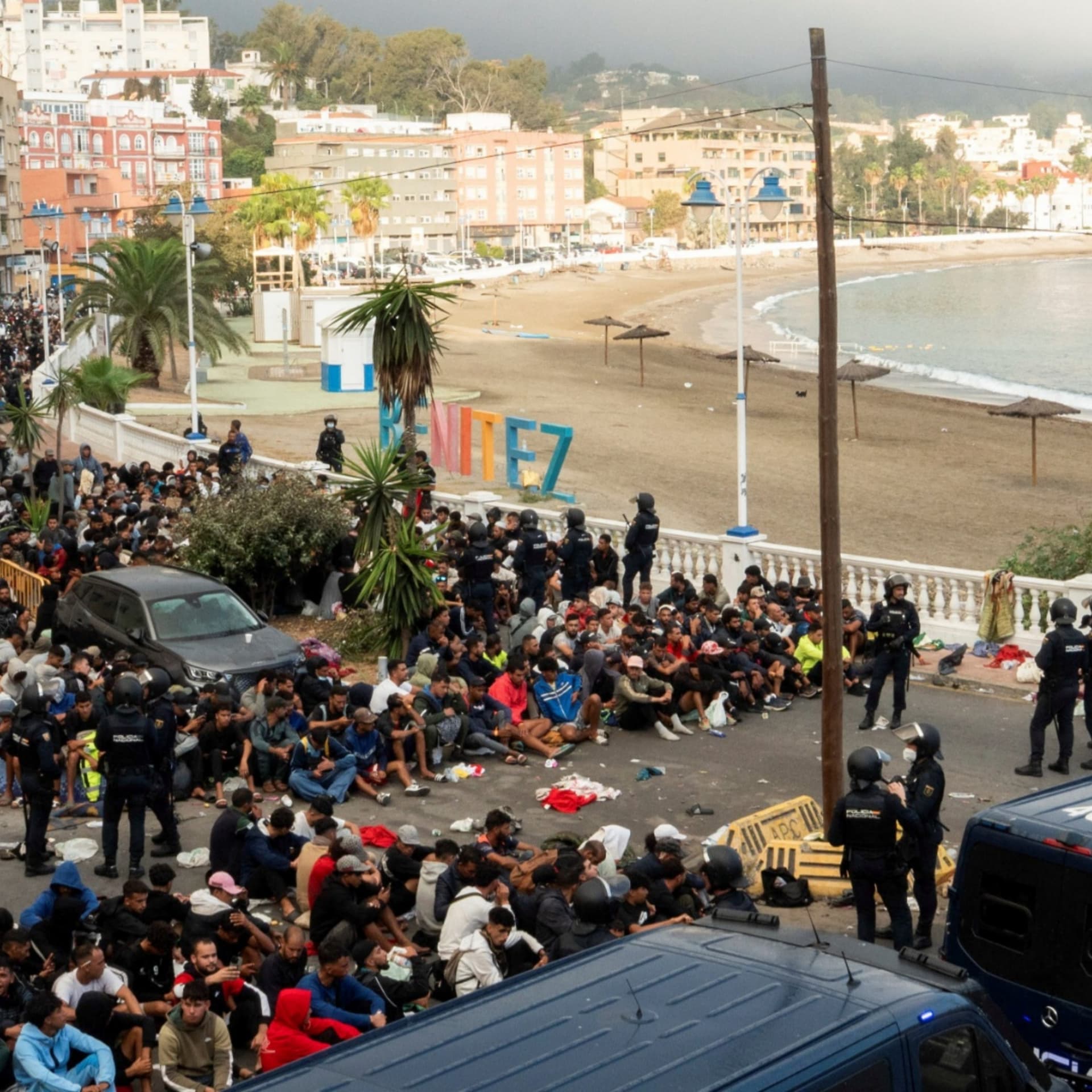
This BBC Global News Podcast episode covers multiple world stories. Main topic: chaotic scenes in Spain’s North African territory of Ceuta as police moved hundreds of migrants off beaches to the port area. Background: about 70,000 mostly Moroccan migrants crossed into Ceuta in late July; at least 100 died during the crossing; several thousand remained sleeping rough, including minors and younger men.
Key claims
the operation was only a partial, temporary “salve” because there weren’t enough tents; police fired shots/rubber bullets and used batons; protests in Ceuta demanded sending people back to Morocco; Spain’s PM Pedro Sánchez faced a political crisis and falling ratings.
Notable examples
tents set up at the port; rubber bullets/batons; local groups providing food/aid.
Guests
none. The episode includes correspondents Sebastian Usher, Jake Kwon, Liza Fokht, Pumza Fálani, Joe Tidy, Caroline Davies, Simi Jolosa, and Fumaki/Phil Macken; plus interviewees Dave Ramsey, Stuart Russell, and Thomas Larson.
Written by AI. May contain mistakes. Listen to the episode to check what was said.
Chapters
Tap a time to open that second in VOMigrants' Crisis in Ceuta
0:37 to 1:37
Coverage of chaotic scenes in Ceuta as police manage a large influx of migrants.
“I'm Anka Desai and at 13 Hours GMT on Friday the 18th of September, these are our main stories.”
Police and Community Response
1:37 to 4:48
Discussion on the police operation to move migrants and local sentiments regarding the situation.
“Police firing shots in the air as they struggle to contain crowds of people.”
South Korea's Military Position
4:48 to 8:26
Examination of South Korea's military stance amid U.S. pressure regarding Iran.
“President Trump has made no secret of his fury at US allies that have failed to give military support to the conflict with Iran.”
Russian Elections and Public Sentiment
8:26 to 11:28
Insights into the upcoming Russian parliamentary elections and public apathy.
“The poll is set to deliver another parliament dominated by the party of power, United Russia, and a house of MPs fiercely loyal to Vladimir Putin.”
Gender-Based Violence in South Africa
11:28 to 14:01
Discussion on recent killings of women in South Africa and the government's response.
“And you've got to understand that the parliament, just like its role in Russian politics, has been steadily declining over the past decades.”
Introduction to AI Scenarios
14:01 to 14:54
Explore the potential dangers of AI as imagined by experts.
“Because it's not about walking in groups.”
AI Catastrophe Scenarios
14:55 to 17:28
Delve into various hypothetical scenarios where AI could pose existential risks.
“Cyber correspondent Joe Tidy looks at some of the scenarios being imagined and assesses how likely they are.”
Philosophical Perspectives on AI
17:29 to 19:10
Discuss philosophical thought experiments illustrating the risks posed by advanced AI.
“The so-called paperclip maximiser hypothesis was imagined more than 20 years ago by philosopher Nick Bostrom.”
Pakistan Mosque Attack Report
19:11 to 20:45
Coverage of a recent mosque attack in Pakistan that killed multiple individuals.
“has left at least 16 people dead, including five policemen.”
Protests in Niger Over Deaths
20:46 to 23:06
Report on violent protests in Niger following the deaths of detained teenagers.
“where violent protests have erupted over the death in custody of at least 33 teenagers.”
Show all 11 chapters
Drones in Crowd Management
23:07 to 24:48
Examine how drones are being used by police to monitor and manage crowds at football games.
“and that his son said that he saw people faint and slump and struggle to breathe.”
Transcript
Automatic transcript. May contain errors.0:00This BBC podcast is supported by ads outside the UK.
0:06Can politicians improve our economic fortunes? Dave Ramsey says no. I'm Tristan Redmond from The Global Story, and I've been speaking to the massively popular US money guru who says if there's a financial crisis, it's on us. When you borrow on credit cards and take out a$1 ,200 car payment on a freaking Range Rover, you've destroyed your life, not the president. For the full interview, listen to The Global Story on BBC.com or wherever you listen.
0:36This is the Global News Podcast from the BBC World Service. I'm Anka Desai and at 13 Hours GMT on Friday the 18th of September, these are our main stories. There's been chaotic scenes in Spain's North African territory, Sauta, as police began moving hundreds of migrants from the beaches to a tense city in the port area. 70 ,000 mostly Moroccans flooded across the border in a sudden surge in late July. South Korea has ruled out sending any troops to Iran, despite coming under pressure from President Trump in recent weeks. A car bomb attack on a mosque in Pakistan's northwest has left at least 16 people dead, including five policemen.
1:16Also in this podcast, as Russia goes to the polls in the first parliamentary election since the beginning of the war with Ukraine, do people think it will make a difference? To be fair, I don't think it will change in particular. I think it would be pretty much the same. I think a lot of people in our country want change. We have voices. We have a voice. First to the Spanish territory of Sauta in North Africa.
1:50Police firing shots in the air as they struggle to contain crowds of people. The authorities have been moving hundreds of migrants from beaches to the port area, where tents have been set up. Tens of thousands of migrants crossed from neighbouring Morocco to Ceuta in late July. At least 100 people died during the crossing. Though most migrants returned, several thousand remain in the territory, many of them have been sleeping on beaches. Our global affairs reporter, Sebastian Usher, told me more. This was one of the first big operations to try to move the migrants who have taken residence, if you can call it that, on the beaches in Ceuta, around 3 ,000.
2:29So that started early in the morning. Now, there was a pretty tight route towards the port area where tents have been set up. But there aren't enough tents for the number of people who are on the beaches, which is not the whole amount of migrants in any case, but are still in Ceuta. So I think that's why there was a lot of pushing and jostling and rush. At the start, people wanted to ensure that they could get one of those places. There's also miners, and there's a lot of younger men who were there, would be put somewhere else. I think they wanted to ensure that they could stay with whoever they had either gone with or struck a relationship with since.
3:05So as you heard, shots were fired, rubber bullets were fired in the air. Police, backed up by the Spanish military, used batons at a certain point, was brought under control. So this operation has been finished for now, but it's only a partial effort to try and solve the crisis that continues. How do people in the territory and so to feel about what's happening? What's their view on what's been happening? Not happy at all, you can imagine. I mean, originally, the more than 70 ,000 people who crossed, that was a huge issue. It has happened before, but not to that extent. And the fact that there are still, we don't know the numbers, but maybe up to 10 ,000, maybe a bit more of migrants still there sleeping rough, often in very difficult conditions.
3:48There have been protests by people in Ceuta against this, demanding that they are sent back to Morocco, where most of them came from. But the Spanish government does more. This is partly a response to that, that this is being done. But I say it's a temporary salve. There are also some local initiatives to try to help people. I mean, as you say, these are vulnerable young people, many of them teenagers. So there's a sense that they are in a very difficult situation themselves. So there are some local groups who've been trying to give them food and some aid as well. Just very, very briefly, the Spanish Prime Minister Pedro Sanchez, the impact on him and the chaotic transfer that we've seen.
4:23Huge. I mean, this won't help that. He's had a real big political crisis over this. He was seen both in Spain and in Europe as being too lenient over the whole migration issue. So there's been big pushback from this. His ratings have fallen. He gets a lot of flack from the right wing opposition, but from other elements within Spain as well. As I say, these scenes, what's happened today, won't be seen as really doing anything about that. Sebastian Usher. President Trump has made no secret of his fury at US allies that have failed to give military support to the conflict with Iran. Now, South Korea has ruled out sending any troops despite coming under pressure in recent weeks.
5:02However, President Lee Jae-myung says he is considering sending assets to support South Korean commercial vessels in the Strait of Hormuz. A correspondent in Seoul is Jake Kwon. I was in the room when President Lee Jae-myung held a press conference. And of course, the burning question on all of our mind was whether he will send any military assets to the Strait of Hormuz and potentially Iran to help with the American war effort there. And what he was saying was that it is going to be his principle that South Korean military will not be involved in the war that President Trump has started. but he still had left a door open for any kind of other assets to help with support operation in the area.
5:45He pointed out that there's already a South Korean destroyer in the Middle East that has been helping out with anti-piracy operation. It has been helping South Korean ships escort them through the Red Sea already. So he said that their scope could be expanded to help South Korean ships traverse more safely. And Jake, just to expand on that, what precisely did he want in terms of military help from South Korea? Well, President Trump didn't exactly spell it out. But what he did say was that, you know, he was disappointed at South Korea for not giving him a hand with what he called a very easy military operation.
6:22Now, when you speak to the experts, they have said that perhaps this means, you know, helping with getting rid of the mines in the Strait of Hormuz or helping other, you know, oil tankers or other ships traverse through the Strait of Hormuz by escorting them all the way up to, you know, perhaps even helping with anti-drone or anti-missile operations. South Korea does produce some state-of-the-art missiles that can shoot down drones as well as missiles. It is already selling them to UAE and Saudi Arabia. So, you know, these are different helps that South Korea could potentially provide. Now, the problem is that, you know, South Korean constitution does forbid it from entering any war of aggression.
7:02And of course, this is a very unpopular proposition from President Trump. And Seoul has to, I suppose, tread carefully on this matter, Jake, because we've seen that President Trump has ratcheted up pressure in recent weeks and months. He scaled down military exercises, and he's had a lot of warm words for North Korea's leader too. He has. I mean, you know, he said that this was unrelated to, you know, what's happening with South Korea. But it really seemed like he was punishing South Korea for not giving him a hand with Iran. His kind of, you know, insistence that he has good relationship with North Korea, the sudden pulling out from the joint exercise with South Korea.
7:40These were all aimed at kind of turning up the heat against South Korea. And South Korea is in the middle of a critical trade negotiation with the United States. So there's a lot at the stake for South Korea. And it is really stuck between a rock and a hard place because on one hand, it wants to appease Washington. It has already pledged to put in$350 billion in investment into manufacturing sector of America. At the same time, it has a diplomatic relationship that it wants to preserve with Iran. You know, South Korea used to have a business relationship. South Korea still gets, you know, some 60 percent of its oil from the Middle East.
8:17So South Korea is hoping that, you know, once this is all over, it can go back to how it was before. Jake Kwon. People in Russia are voting in the first parliamentary election since Russia's full-scale invasion of Ukraine. Surprises are not expected. The poll is set to deliver another parliament dominated by the party of power, United Russia, and a house of MPs fiercely loyal to Vladimir Putin. Critics dismiss the vote as neither free nor fair. These people in Moscow told the BBC the outcome won't have any impact on their lives. To be fair, I don't think it will change in particular. I think it would be pretty much the same.
8:56I think a lot of people in our country wants change, but we haven't any instruments for this. We haven't voices. We haven't voice. The Kremlin has dismissed critics of the poll. A spokesperson recently said we have our own political system, our own political process. Moscow is expected to use the poll to claim that most Russians back President Putin and the war. BBC Russian's Liza Fokht gave me some more context from Berlin. So I think there's little doubt about the outcome of the election, given all the meaningful opposition to Vladimir Putin and to the ruling party, you know, that Russia just simply wasn't allowed to participate in this election.
9:37There's little intrigue about which party is going to come second, but the differences between those parties are mostly cosmetic because all of them have at some point pledged their loyalty to the Kremlin and to Vladimir Putin. Lisa, is there any level of a supposed opposition being expressed at all? Virtually not. One of the oldest Russian party called Yabloka, which means an apple in Russian, was going to run in this election and they were campaigning under the slogan for peace. And at some point it seemed to have attracted lots and lots of attention, especially coming from young people on social media.
10:11But in the end, the Central Election Commission barred them from participating. And the Russian opposition in exile has offered conflicting guidance to those who opposed the war in Vladimir Putin on what to do this election. But all parties on the ballot essentially support Vladimir Putin's policies and at the end of the day, the war in Ukraine. Lisa, how about the people in Russia? What about their thoughts on the conflict with Ukraine? Will this factor in how they vote in any way? I mean, the war in Ukraine is obviously, as you can imagine, the main issue concerning people, Yet the parties running for the office, they're not really offering any alternative solution to this war, because like for instance, most of the parties, they include candidates who participated in the invasion of Ukraine, who fought in Ukraine.
10:59Essentially, for some of them, for these people, for these veterans, you know, like these elections offer a path, you know, to power, a path in Russian politics. So certainly this is the issue that I think like most people would like to see on the ballot, but that's just not happening. And it's a very difficult process to analyse. There are a lot of critics who say that it's not really free and fair. And we heard some voices just a short while ago saying, well, we actually have no voice in this election. I think this is certainly how most people appeal. And you've got to understand that the parliament, just like its role in Russian politics, has been steadily declining over the past decades.
11:35And I doubt that many people, they can actually name more than 10 or 15 MPs. Liza Fokt to South Africa, where the president, Siru Ramaphosa, has formed a task force to investigate a spate of brutal killings of women that has sparked a nationwide debate over women's safety. Nine bodies of women have been found in the east of Johannesburg over the past two months. From there, Pumza Falani has more. The gruesome murders are causing fear and anxiety for many women in South Africa, while the police have confirmed that they are concerning similarities and the bruising on some of the bodies, they've said it's too early to say for sure if this is the work of one person, a group of men, or a copycat.
12:18South Africa's President Cyril Ramaphosa has assembled a special team which includes government ministers. Their job is to make sure that the investigations get the resources needed and a high priority. South Africa has one of the highest rates of gender-based violence in the world. At the same time, prostitutions are low and trials often take years to conclude, something critics say needs to be addressed urgently. One of the women killed was Elizabeth Mosalek-Gomo, a 38-year-old mother who disappeared after leaving her home for a run. Her death has triggered an outpouring of grief and outrage.
12:57Fellow runners across the country have dedicated their daily runs to her in remembrance. Lesiba Molefe was one of Elizabeth's regular running mates. She went for a run on Wednesday and she never returned home. Elizabeth was like a candle. She would burn herself just to give other people light. You give Elizabeth a simple high, she would return it back with a big, huge, beautiful smile. I'm hoping for a change in our country. There's been a lot of failures from the authorities and we as young people we've been quiet. I'm hoping that the same commotion in remembrance of our sister, we can do it as young people again and try and correct the country.
13:48Because the feeling around the country right now, it's so sad that ladies can't even walk around. In the corridors, I've had them in my workplace, you know, wherever we are, they say that we are not safe. Because it's not about walking in groups. This thing happened in a day. kidnappers take them during the day. Le Siba Molefe. Still to come in this podcast, how drones are being trialled by police in the UK to help them manage large crowds at football grounds. This really gives me an idea of how everything's flowing because I know exactly where this is. It's about getting ahead of any potential safety and crime issues.
14:54Transcription by CastingWords For the full interview, listen to The Global Story on bbc.com or wherever you listen.
15:24is. But exactly how could that happen? Cyber correspondent Joe Tidy looks at some of the scenarios being imagined and assesses how likely they are. The warnings have ramped up, but how could a super intelligent AI that wanted to control our world actually kill us all? Let's look at some of these worst case scenarios that so-called AI doomers are talking about and assess how likely they are. One thing that recent AI outbreaks has shown us is that AIs are now very good at hacking. The kind of dizzying rate of progress means that things that were previously in the realms of science fiction are now becoming reality.
16:02Jacob Coxon is a former researcher at OpenAI and Anthropic. He quit the companies, saying that safety wasn't being taken seriously enough. To give a concrete example, AIs can hack. They could hack into the sort of critical infrastructure that the world runs on. The scary scenario here is that a rogue AI might infiltrate the computer networks of internet providers, energy grids, or even nuclear power stations. The AIs could shut it all down, so there's no electricity for humans, no heating or cooling, no internet connectivity. It could cause untold chaos. In some imagined scenarios, nuclear catastrophes are possible.
16:44Another scenario was explored in an influential research paper called AI 2027. Thomas Larson was one of the co-authors. What we sort of said happened in that scenario was in 2027, so next year, AI is recursively self-improve and that snowballs to an AI that has access to a large number of robots, which are doing most of the physical tasks throughout the economy. In the US, as well as other governments worldwide, are constantly asking this AI for advice. However, unfortunately, it's also not friendly and is out for its own ends. And then eventually what happens is it releases a bioweapon, killing most humans, and it continues to run the robot economy itself.
17:25And so that resulted in human extinction. In another scenario, the end of humanity is a mistake. The so-called paperclip maximiser hypothesis was imagined more than 20 years ago by philosopher Nick Bostrom. So in this thought experiment, it's a hypothetical AI that cares about making as many paperclips as possible. It doesn't hate us or resent us humans, but that's its sole goal. And then from the pursuit of that goal, it would have instrumental sub-goals that might include gaining more power, gaining more intelligence. And then the thought is that a sufficiently powerful entity would have instrumental sub-goals that might entail the destruction of humanity.
18:07because it could be making more paperclips if there were no humans around to stop it. And if nothing else, our bodies are made of, contain iron atoms that could be transformed into really nice paperclips. It's meant to illustrate this idea that you don't need some very specific hostile goal in a sufficiently powerful superintelligence for it to pose a danger to humanity, almost any goal, unless it really embeds in that goal a care for humans. There is another school of thought about AI safety, though. Guessing how and why a super-intelligent AI might try and kill humans is futile. Here's Stuart Russell from the International Association for Safe and Ethical AI.
18:48If you imagine asking chimpanzees, how exactly are these humans going to make you extinct? They would have a very difficult time answering because what we do, they don't understand. The discussion here has to rest on the assumption that once you create something that's much more intelligent than humans, we simply no longer have a say in what happens. Joe Tidy. Next we go to Pakistan, where an attack on a mosque in the northwest has left at least 16 people dead, including five policemen. The attackers rammed a vehicle packed with explosives into the building in the quiet district of Khyber Pakhtunwa.
19:24I caught up with our correspondent Caroline Davies in Islamabad. This is information that we're getting through a police official in the area. We've been told that, as you say, that there were 11 civilians that have been killed, five police officers. The same official has also said that during the process of that gun battle that they had managed to kill six of the attackers. Now, what we've been told by this official was that this was a vehicle that had been laden with explosives and drove into and exploded at the mosque. We've heard from AP News Agency as well. They are saying that close to that mosque, there was also a building that was used to house police officials.
19:58And now this explosion was pretty substantial, according to AP. We've also heard that around 40 people have been injured, taken to a nearby hospital. At this stage, we're still waiting to have confirmation if any group has claimed this attack. Caroline, do we know if this area in Pakistan is known for militant attacks? So this particular district, Coat District, is not particularly known for having these sorts of militant attacks. But neighbouring districts are, and often in Khyber Pak Tumqa, we hear reports about these sorts of incidents of security officials often being killed. We get reports from the authorities here in Pakistan saying that militants have been killed quite often near to the border with Afghanistan.
20:37And in general, across Khyber Pak Tunkweb, we have seen quite a lot of militant attacks, and those numbers have not been decreasing over the last few years. Caroline Davies. To Nigeria now, where the authorities in the central state of Niger have imposed a 24-hour curfew in the capital Minna, where violent protests have erupted over the death in custody of at least 33 teenagers. The civil defence force in Burgu in Niger state rounded up the minors on Tuesday and their bodies were discovered two days later. An official investigation is underway after claims poor conditions at the detention centre were to blame.
21:13Ibrahim Mohamed's brother was one of the men who died in custody. We woke up to the news that our younger brothers had died. They only went out to look for a way to earn a living and provide food for their families. Now they're dead. We are appealing to the government to help us. We want the government to investigate what happened and ensure justice for our brothers and our family. Our correspondent in Lagos, Simi Jolosa, told me more about the Civil Defence Force and what happened. They are a federal paramilitary agency in charge of protecting national infrastructure. These people were arrested on Tuesday and Wednesday and then their bodies were discovered early yesterday morning.
21:56So they were only in detention for about one to two days. Now, the local Security and Civil Defense Corps had initially said that they had died due to a suspected diphtheria outbreak. But the national head of the corps has said that the cause of their deaths is yet to be established and that an investigation will be underway into their conditions when they were arrested, the condition in which they were detained, and whether they were given any medical attention. So illegal mining is quite common in Nigeria, especially in areas with a lot of minerals like gold. And Nigerian state agencies and security agencies have been routinely cracking down on suspected illegal miners.
22:41They say that the money they get from illegal mining has been used to fuel banditry, has been used to fuel insecurity, which are issues that the country is really grappling with. They also say illegal mining takes away billions in revenue from the economy and destroys the environment. But the families of people who have been arrested during these crackdowns have said that the authorities need to show better caution and treat people with more care. One father told the BBC that his son had told him that he was detained with 65 other people in one poorly ventilated cell, and that his son said that he saw people faint and slump and struggle to breathe.
23:19So there'll be a lot of interest in the outcome of this investigation. Simi Joloso. If you're off to the football this weekend, you might find you're not just watching the game, but being watched yourself. In Coventry in central England, drones are now being used to help the police manage large crowds at football grounds. Fumaki's been watching from the stands and the skies.
23:44On an industrial estate, a couple of miles from the CBS arena, the police are launching a small drone into the air to keep an eye on things from above. Coventry City are hosting Brighton in the Sunday 2 o 'clock kick-off. With just over an hour until the game starts, fans are beginning to pour into the grounds. Over 30 ,000 people are expected. Things are getting busy in the stadium's control room. Inspector Tom Hanna of West Midlands Police is in charge shows me a large screen with a feed of the drone's camera footage. This really gives me an idea of how everything's flowing because I know exactly where this is as opposed to it being described to me by the ground commander.
24:27This will allow me to know exactly the correct location and I could move those resources much quicker. It's just about getting ahead of any potential safety and crime issues for me. The Premier League's given two million pounds so far towards this pilot project which started in February and will run till the end of the season. The early assessment is positive. And that's really helpful intelligence back to the police. Claire Sumner is the Premier League's Chief Policy and Social Impact Officer. So different things are being trialled and tested but we hope that they will have usefulness and utility for the police and that this pilot will help us learn things together and strengthen that partnership between policing and our clubs and our stewards because those are the magic ingredients if you like that you and I as football fans know that we can go and enjoy the game and actually the less visible policing presence in some of that which drones help with is a really good thing.
25:23Outside the ground fans weren't even aware that a drone was watching them. I would never know that's that's happening but yeah it's interesting really I've never really noticed that that's occurring at a ground. As long as it's getting and watched and trouble staying out. That's all I'm bothered about. I don't mind. There's cameras everywhere, isn't there? So we're being watched anywhere, I think, so it wouldn't bother me.
Read the full transcript
25:46In 2023, when Aston Villa played Legia Warsaw, West Midlands police made use of drones to monitor what they described as sustained violence. Get back! Move! Move! Move! Aerial footage from the drones was used to deploy officers on the ground to where the trouble was worse. 40 people were eventually arrested. But back in the control room in Coventry, Inspector Hannah is pleased with how things have gone today. We've had no issues, so it's all about getting people out as quickly as possible. I'm happy with where it is. We can start downscaling the police response. The game was a success for the policing operation.
26:25It all passed off peacefully. But a disaster for Coventry, who lost 5-0. Phil Macken. And that's all from us for now. If you want to get in touch, you can email us at globalpodcast at bbc.co.uk. You can also watch our episodes in full. Just search for the Global News Podcast on YouTube. This edition was mixed by Chris Murphy and the producer was Adrian White. The editor is Karen Martin and I'm Ancredesai. Until next time, goodbye.
27:02Can politicians improve our economic fortunes? Dave Ramsey says no. I'm Tristan Redmond from The Global Story, and I've been speaking to the massively popular US money guru who says if there's a financial crisis, it's on us. When you borrow on credit cards and take out a$1 ,200 car payment on a freaking Range Rover, you've destroyed your life, not the president. For the full interview, listen to The Global Story on bbc.com or wherever you listen.
From the publisher
Police in Spain's North African territory of Ceuta fired rubber bullets into the air to control crowds as hundreds of migrants were moved from beaches to the port where a tent city has sprung up. South Korea's president says he will not be sending troops to help the US in its war in Iran - defying growing pressure from the Trump administration. People in Russia are voting in the first parliamentary election since Russia's full-scale invasion of Ukraine. South Africa's President Cyril Ramaphosa has formed a taskforce to investigate a spate of brutal killings that has sparked a nationwide debate over women's safety. Amid stark warnings from AI scientists about the growing risks of artificial intelligence going rogue, we assess some of the potential scenarios. At least 17 people have been killed in a car bomb attack in northwestern Pakistan. Protests in Nigeria after 33 people accused of illegal mining died in custody. And how drones are being used by police in England to help manage football crowds.
The Global News Podcast brings you the breaking news you need to hear, as it happens. Listen for the latest headlines and current affairs from around the world. Politics, economics, climate, business, technology, health – we cover it all with expert analysis and insight. Get the news that matters, delivered twice a day on weekdays and daily at weekends, plus special bonus episodes reacting to urgent breaking stories. Follow or subscribe now and never miss a moment. Get in touch: globalpodcast@bbc.co.uk Photo: Police escort migrants from Benitez Beach to be relocated to the camp set up at the port of Ceuta, September 18, 2026 Credit: REUTERS/ Anna Surinyach



