
In short
Global News Podcast - Episode Summary: Deadly Train Crash in Spain
Episode Overview In this episode of the Global News Podcast, host Alex Ritson provides a report on various significant global events, with a focus on the deadly train crash in Spain. The episode covers pivotal news in politics, sports, environmental issues, and social crises, offering expert analysis and insights.
Main Stories
- Train Crash in Spain
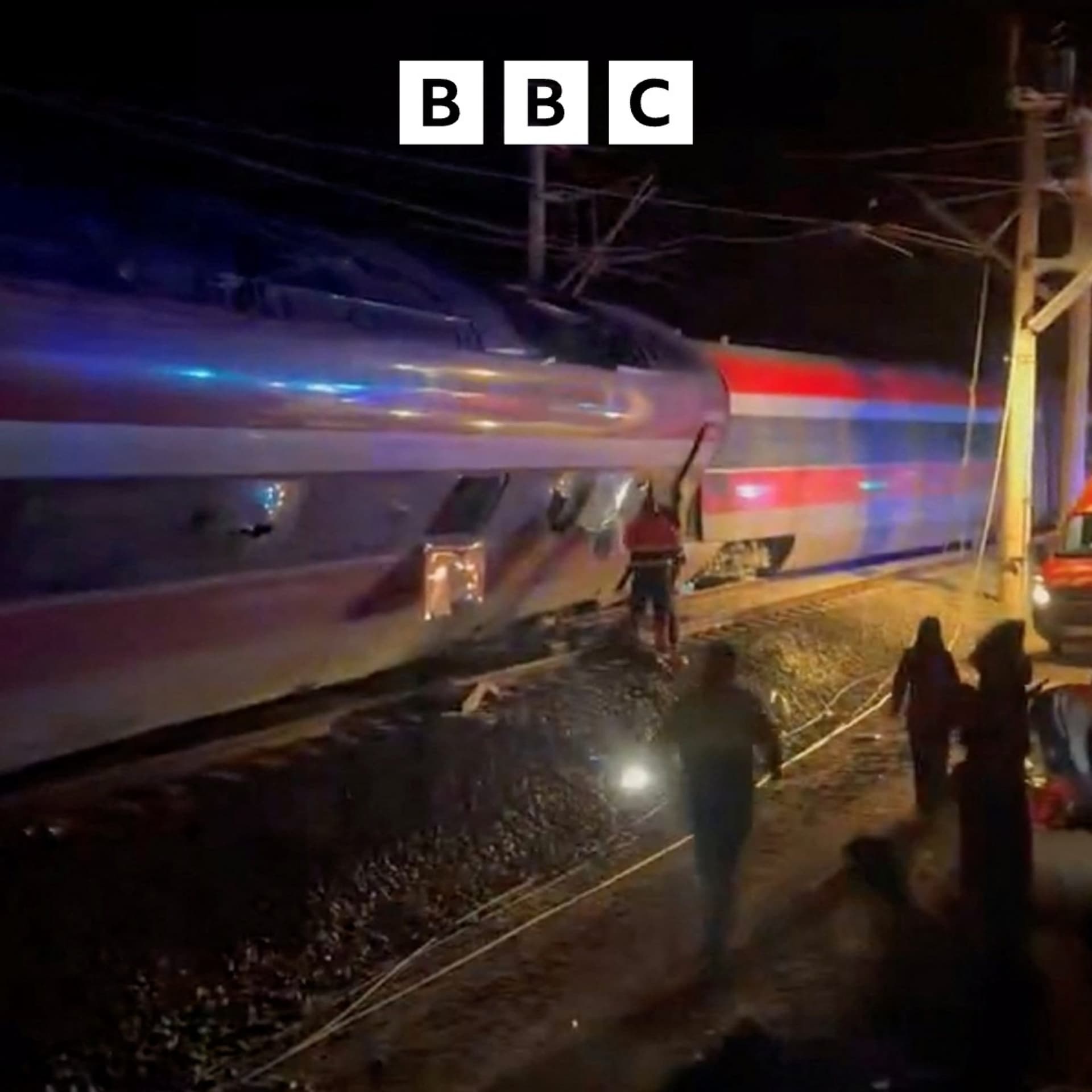
- Incident Summary: At least 21 people were killed when two high-speed trains collided near Adamuz, Andalusia, as one train derailed.
- Details of the Crash:
- One train was traveling from Malaga to Madrid when it derailed.
- Eyewitness accounts likened the impact to an earthquake.
- Emergency workers were deployed to rescue trapped passengers, and military assistance was requested.
- Government Response:
- Prime Minister Pedro Sánchez described the incident as a "night of pain."
- The Transport Minister stated it was too early to determine the cause of the derailment.
- The crash marks the most significant incident on Spain's high-speed rail network since a 2013 accident that resulted in 80 fatalities.
- Escalating Dispute Over Greenland
- Context: The conflict between European countries and the U.S. over President Trump’s proposal to annex Greenland is intensifying.
- Current Actions:
- The EU is convening a summit to discuss the situation.
- European nations are considering a diplomatic response to avoid a trade war.
- Some German legislators suggested boycotting the upcoming Football World Cup in the U.S. as a protest.
- International Reactions:
- Norway expressed solidarity with Denmark regarding its sovereignty over Greenland.
- U.S. Treasury Secretary expressed confidence that European leaders will acquiesce to U.S. demands.
- Ceasefire in Syria
- Agreement Details: The Syrian government and Kurdish-led forces have agreed on an immediate ceasefire after intense fighting.
- Implications: This ceasefire marks a significant shift in control and could impact Kurdish autonomy in the region.
- Africa Cup of Nations
- Final Match Highlights:
- Senegal won their second Africa Cup of Nations title, defeating Morocco 1-0 after extra time.
- Controversial moments included a protest from Senegalese players over refereeing decisions.
- Despite the victory, there were chaotic scenes involving fans, raising concerns about the final's aftermath.
- Economic Update on China
- Growth Figures: China achieved a 5% growth rate last year, but faces challenges like a weak housing market and a shrinking population.
- Economic Concerns:
- Domestic consumption is low due to economic pressures.
- The government may need to implement stimulus measures to boost the economy.
- Wildfires in Chile
- State of Emergency: President Gabriel Boric declared an emergency in southern regions due to wildfires causing significant damage and displacement of residents.
- Current Situation: Firefighters are battling multiple active fires exacerbated by extreme weather conditions.
- Human Trafficking in Sierra Leone
- Issue Overview: Thousands are lured into human trafficking networks with false job promises.
- Police Operations: Recent raids by police and Interpol revealed dire conditions for victims, many of whom are young and vulnerable.
- Kakapo Conservation in New Zealand
- Positive Update: The Kakapo, a critically endangered parrot species, is experiencing a resurgence due to successful conservation efforts.
- Breeding Season: A bumper fruit crop is expected to enhance breeding success for this unique species.
Conclusion The episode highlights pressing global issues from a tragic train accident to international political tensions, showcasing the interconnectedness of current events. The Global News Podcast continues to provide insightful analysis on breaking news, reflecting the changing landscape of global affairs.
Contact Information
- For feedback or comments, listeners can reach out at [globalpodcast@bbc.co.uk](mailto:globalpodcast@bbc.co.uk) or on X at BBC World Service using the hashtag #GlobalNewsPod.
---
This summary encapsulates the key discussions presented in the podcast, making it accessible for those seeking to understand significant global events and their implications.
Written by AI. May contain mistakes. Listen to the episode to check what was said.
Chapters
Tap a time to open that second in VOTrain Crash in Spain: Overview
0:42 to 1:10
Details about the deadly train crash in Spain and its aftermath.
“I'm Alex Ritson and in the early hours of Monday the 19th of January, these are our main stories.”
Survivor Accounts and Rescue Efforts
1:10 to 1:54
Survivor accounts of the train crash and ongoing rescue operations.
“The BBC joins a police raid in Sierra Leone on a suspected people-trafficking network.”
Details of the Train Collision
1:54 to 2:51
In-depth information about the collision and derailment of the trains.
“Our Madrid correspondent Guy Hedgecoe is following developments.”
Government and Local Reactions
2:51 to 4:20
Reactions from government officials and local eyewitnesses after the crash.
“So there's not been a sort of an obvious reason for the derailment to happen.”
US-EU Tensions Over Greenland
4:20 to 8:00
Discussion on the escalating tensions between the US and Europe over Greenland.
“The dispute between European countries and the United States over Donald Trump's determination to annex Greenland continues to escalate.”
Implications for NATO and Global Politics
8:00 to 8:36
Exploration of the implications for NATO and global politics amid US threats.
“probably with a big box of popcorn, because in their eyes, that concept of the West that's dominated global politics for decades, with Europe and the United States tightly knitted its core, they think that's crumbling.”
Ceasefire Agreement in Syria
8:36 to 9:08
Overview of the ceasefire agreement between the Syrian government and Kurdish forces.
“That's why European leaders don't want to jump to any action.”
Analysis of Kurdish Influence Following Ceasefire
9:08 to 12:16
Analysis of the potential impacts on Kurdish influence in Syria post-ceasefire.
“The Syrian government has agreed an immediate ceasefire with the Kurdish-led Syrian Democratic Forces.”
Africa Cup of Nations: Senegal's Victory
12:16 to 14:00
Coverage of Senegal's controversial victory in the Africa Cup of Nations final.
“Senegal have won the Africa Cup of Nations in men's football for the second time after an amazing, and sometimes chaotic, final.”
Controversial Tournament Finale
14:00 to 16:19
Discussion of the chaotic scenes at the recent football tournament final.
“and with angry, violent confrontations with the security personnel and police here.”
Show all 15 chapters
Wildfires in Southern Chile
16:40 to 19:14
Report on the state of emergency declared due to devastating wildfires.
“If journalism is the first draft of history, what happens if that draft is flawed?”
Human Trafficking in Sierra Leone
19:14 to 23:11
A report on the human trafficking crisis affecting young people in Sierra Leone.
“The problem is rife in Sierra Leone where about two-thirds of young people are unemployed.”
China's Economic Challenges
23:11 to 26:38
Analysis of China's economic growth and the challenges it faces.
“New data shows that China's economy grew by 5 % last year.”
Kākāpō Conservation Success
26:38 to 28:02
Overview of the conservation efforts leading to the kākāpō's comeback.
“Now, some good news from the natural world.”
Kākāpō Conservation Efforts
28:02 to 28:57
Learn about the challenges and successes in conserving the kākāpō population.
“but they've got very strong, sturdy feet, and they can climb right up into the tops of the canopies.”
Transcript
Automatic transcript. May contain errors.0:00This BBC podcast is supported by ads outside the UK. If journalism is the first draft of history, what happens if that draft is flawed? In 1999, four Russian apartment buildings were bombed, hundreds killed. But even now, we still don't know for sure who did it. It's a mystery that sparked chilling theories. I'm Helena Merriman, and in a new BBC series, I'm talking to the reporters who first covered this story. What did they miss the first time? The History Bureau. Putin and the apartment bombs. Listen on BBC.com or wherever you get your podcasts. This is the Global News Podcast from the BBC World Service.
0:47I'm Alex Ritson and in the early hours of Monday the 19th of January, these are our main stories. At least 21 people are killed in a high-speed train crash in Spain. Europe weighs up retaliatory measures against the United States as their dispute over Greenland continues, and the Syrian government agrees a ceasefire with Kurdish-led forces. Also in this podcast... The BBC joins a police raid in Sierra Leone on a suspected people-trafficking network. And there's a dramatic end in men's football to the Africa Cup of Nations. As we record this podcast, at least 21 people have been killed and dozens injured after two high-speed trains collided in Spain.
1:38One survivor described the moment of impact as feeling like an earthquake. Emergency workers were trying to rescue those trapped inside carriages. Footage shows people being pulled through smashed train windows. The Prime Minister, Pedro Sánchez, said the country was enduring a night of pain. Our Madrid correspondent Guy Hedgecoe is following developments. We know that one of these trains which crashed was heading from the city of Malaga in the south of Spain up towards Madrid, where I am in the centre of the country. And about an hour into its journey, it derailed, or some of its carriages derailed, crashing into another oncoming train that was heading in the opposite direction down to the south of the country.
2:25Now, we've been told that there were victims on both of those trains and we understand that the emergency workers have managed to pull all the survivors out of one of the trains, but they're still working to pull survivors out of the other one and the military has been deployed to help them. Because these were both high-speed trains and they go at an incredible rate, don't they? Yes, both high-speed trains and Spain has a vast high-speed rail network, one of the largest in the world. The strange thing about the accident seems to be the thing that seems to be mystifying the authorities is that the train that derailed did not seem to be going around a corner, going around a bend rather, or certainly a steep bend when the accident happened.
3:14So there's not been a sort of an obvious reason for the derailment to happen. We haven't had an accident like this on the high-speed rail network since 2013, when 80 people were killed up in the northwest of the country. And the king and queen speaking out. Yes. King Felipe is following events very closely. After the news came out, we heard that the royal household was following this closely. Obviously, the government is following this. We've heard from the transport minister who has said that it's too early to know about causes and we're not going to know more, certainly for several weeks. Someone else we have heard from was the mayor of Adamuth, which is the town right next to where the accident happened, down in the region of Andalusia in the south of the country, Rafael Moreno.
4:06He was one of the very first people on the scene after the accident happened. And he said there was twisted metal all over the place, these two trains sort of intertwined, and he described it as being like a nightmare. Guy Hedgecoe. The dispute between European countries and the United States over Donald Trump's determination to annex Greenland continues to escalate. A full EU summit will be convened on Thursday to consider a collective response. That after an emergency summit of European ambassadors on Sunday. They decided it would be best to continue to pursue a diplomatic solution with the US.
4:44They don't want to get involved in a trade war with Washington. President Trump has threatened to impose tariffs on European allies from February the 1st to force Denmark to hand over Greenland. The foreign ministers of Denmark and Norway have also held talks in Oslo to discuss the crisis. Afterwards, the Norwegian foreign minister, Espen Barth-Eide, was anxious to stress European unity. Norway, like all other Nordic countries, European countries and Canada, stands fully behind the sovereignty and territorial integrity of Denmark. But we are also communicating very clearly that if there are security concerns in Greenland or anywhere else in the Arctic, we stand ready to work together in the NATO alliance to deal with those issues.
5:31Some European voices want tougher action. One German lawmaker even raised the possibility of boycotting the Football World Cup finals later this year in the United States. Despite all this, the US Secretary of the Treasury, Scott Besant, told NBC News he remained confident President Trump would get his way. The European leaders will come around and they will understand that they need to be under the US security umbrella. What would happen in Ukraine if the US pulled its support out? The whole thing would collapse. And that's regardless of what people think in Greenland itself. Here are the thoughts of some people in the capital, Nuke.
6:12I think he has lost his mind. I hope that there soon will be some clever people in the States who will tell him, no, no, no, it's not going to work. We can't scare Greenlanders. We're not scared. We'll fight them to the end. We'll never give in. And we are so happy we have so good allies. I think the man is out of reach. It's ridiculous. We have a lot of allies and now they are stepping up. There's no doubt that President Trump's threats have given European leaders a huge headache. Our Europe editor Katja Adler reflects on the febrile mood in Brussels and how the collective leadership should respond.
6:57They're so concerned that EU leaders have announced this evening they're going to be holding an emergency summit here in Brussels on Thursday. There's all sorts of back-channel conversations going on about what action to take or not to take, because there's a feeling in Europe that they're damned if they take action, they're damned if they don't. If they get more confrontational with Donald Trump over the proposed Greenland tariffs, France wants to do that. Other member states of the EU have said, no, no, we want to hold fire for now, because what they worry is that could alienate the United States even further.
7:29And the brutal truth is Europe needs Donald Trump for now. They need him to get a sustainable peace deal in Ukraine. They need the United States for their own security. But if Europe continues to play it softly, softly to try and manage Donald Trump, as it has done pretty much since he returned to the White House, then it risks looking extremely weak with the sovereignty of an EU member state, and NATO member state, and in this case, Denmark, and being threatened. And watching, of course, from the sidelines, Russia and China, probably with a big box of popcorn, because in their eyes, that concept of the West that's dominated global politics for decades, with Europe and the United States tightly knitted its core, they think that's crumbling.
8:13This is the biggest crisis in the Defence Alliance NATO's history. What you have here is the biggest, most powerful member of NATO, going up against so many of the other member states, the UK, France, Germany. Western Europe has relied on NATO since the Second World War for its security here. What you're looking at is potentially the whole thing crumbling. That's why European leaders don't want to jump to any action. What else are we looking at? We're looking at potentially a full-blown transatlantic trade war. That would affect all of us. And that will happen if Donald Trump goes ahead with his Greenland tariffs and if the EU, for example, retaliates strongly against the United States.
8:54So we're so much at stake. That's why you're hearing strong pronouncements from European leaders, but they're really worrying about what actions should they take. That's why there's going to be this emergency summit of EU leaders here on Thursday. Our Europe editor, Katya Abla. The Syrian government has agreed an immediate ceasefire with the Kurdish-led Syrian Democratic Forces. It follows nearly two weeks of fighting that have seen the military advance into Kurdish-held areas. The peace agreement would also see Kurdish troops integrated into the National Army and the government take responsibility for prisons where Islamic State militants are held.
9:33My colleague Paul Henley spoke to Ambarin Zaman, who's chief correspondent for the Arab-American news website Al-Monitor, and has recently returned from Syria. She said the president has now gained more control of the country. It's a huge win for Ahmed al-Shara as he seeks to consolidate his rule over Syria, because you know he got off to a very shaky start back in December 2024 when he first took charge and ran into quite a bit of trouble with various ethnic minorities, notably the Druze and the Alawites. And his forces have been accused of committing huge massacres of both those ethnic groups.
10:14And for a long time, it seemed like he wouldn't last. And there was a lot of international outrage and all of that. But now what we're witnessing is something quite extraordinary, because the group with which he signed this ceasefire, and I would qualify this as more of a capitulation, are the Syrian Kurds, who for the longest time were the biggest allies of the United States in the fight against the Islamic State. And what we've witnessed now is a lot of US pressure being brought to bear on the Kurds to basically just cave to all of Asshara's demands. And that's what they did. Is this the end of the Kurds as an influential force inside Syria?
10:59I think it would be premature to say that. But what we can say is that it appears to be an end to their autonomous administration, to their independent military entity, which is now going to be collapsed. And a big success, as you say, for the president. How does he capitalise on that going forward, finally? Well, obviously, if he can market this as a very, you know, peaceful, good agreement with the Kurds, and he was very clever. On Friday, he signed this decree under which the Kurdish language is now recognized, not as an official language, but a national one, saying that it can be taught in government and private schools, that the Kurdish New Year that's celebrated on March 21st is now an official holiday, a lot of sort of cosmetic stuff that really falls way short of the Kurds' real demands, which is for a decentralized form of government, which they say is the only formula for Syria where you have not just the Kurds, but as I mentioned previously, many other ethnic groups who are also calling for autonomy.
12:15Amberin Zaman. Senegal have won the Africa Cup of Nations in men's football for the second time after an amazing, and sometimes chaotic, final. They beat Morocco 1-0 in extra time, but not before the match was interrupted when the Senegalese players walked off in protest at two decisions in favour of the host nation. For Morocco, the defeat couldn't have been more bitter, after so much money had been invested in staging the tournament. Lee James from the BBC World Service's Sports World programme was at the game and spoke to me just after the final whistle. Plenty of controversy, one of the most controversial finals in African Cup of Nations history.
12:59The reason we got to that situation with the Senegal players leaving the field, encouraged to do so by their coach, Pap Chial, is because of the controversy late on in this game. Senegal had a goal disallowed. Idrissi Gueye's header against the post with Ismail Assar putting in the rebound. But the whistle had gone before the ball hit the net. With Idrissi Gueye having a judge to have brought down Hakimi. That stirred up the controversy. And then, to compound Senegal's frustration, Morocco were awarded a penalty after a VAR check. El-Hajimalik Jouf appearing to drag Brahim Diaz to the ground by his neck.
13:39both those decisions on review and we've seen the replays a number of times feel like they were fair ones but that didn't mean the Senegal coaching staff agreed with that it was Pap Chow who was encouraging his players to leave the field of play we then Alex saw some very ugly scenes with the small group of Senegalese supporters that are here inside the stadium a number of them spilling out onto the pitch and with angry, violent confrontations with the security personnel and police here. It took a very lengthy delay, over 10 minutes before they returned to the field of play, encouraged to do so by Sadio Mane.
14:17And then the penalty, Alex. Well, a remarkable one from Brahim Diaz. He attempted the panenka, where you try and deceive the goalkeeper into making a dive before you chip it down the middle of the goal. But Edouard Mendy didn't move at all. It was a comfortable catch and yet incredible scenes even before Senegal scored their goal in extra time. Is that chaos a bit of a sad end to what has been an amazing tournament? It really has been. We've been praising the organisation of the tournament, certainly the infrastructure, the stadium where this final was played, the Prince Moulet Abdallah, is state-of-the-art, one of the finest stadiums in world football.
14:57It will host World Cup matches here in 2013. but yes I think the controversial scenes do leave a very sour taste and for the organisers they will be the images that will inevitably be remembered from this tournament it took several minutes to get control from the fans from Senegal who were causing those problems away to our left it actually took the actions of Sadio Mane to try and restore some calm he was the one that was encouraging his players not to walk down the tunnel he was telling them to come back onto the field of play and then he went over to the Senegal fans after the full-time whistle begging them to calm down so the match could resume in in extra time so he deserves great credit for that but with a World Cup in four years time certainly not the scenes that the organizers here would have wanted from this final so the long wait continues for Morocco but Senegal worthy winners?
15:54Yes, absolutely. I think with the goal that was scored in extra time from Pratial because it was a stunning strike, hammered into the top corner just off the bar and yes, that long wait goes on. It's been over 50 years now for Morocco. They've spent so much here. They've invested so much in football. They wanted a return with a trophy. It is not to be, but Alex will be talking about this final for a long, long time to come. Lee James. Coming up later, the sound almost lost to extinction.
16:30Conservationists celebrate the Karkapu parrots' comeback.
16:40If journalism is the first draft of history, what happens if that draft is flawed? In 1999, four Russian apartment buildings were bombed, hundreds killed. But even now, we still don't know for sure who did it. It's a mystery that sparked chilling theories. I'm Helena Merriman, and in a new BBC series, I'm talking to the reporters who first covered this story. What did they miss the first time? The History Bureau, Putin and the apartment bombs. Listen on BBC.com or wherever you get your podcasts.
17:18The Chilean president, Gabriel Boric, has declared a state of emergency in two southern regions where wildfires have forced 50 ,000 people to leave their homes. At least 19 deaths have been confirmed in Nublé and Biobio regions. Bernadette Keogh has the latest. The regions worst affected, with fires blazing for two days, are about 500 kilometres south of the capital, Santiago. Fire crews are contending with flames fuelled by gusting winds. Images on local television showed widespread gutted buildings, charred cars and hospital evacuations. The most ferocious blaze, which is burning across more than 20 kilometres, has raged through dry forests and plantations bordering the coastal city of Concepcion.
18:09The declaration of emergency means the armed forces will now get involved. A forestry official, Norma Perez, urged extreme caution. We are working with all the resources we have available, deployed in all the advancing zones of this fire, to try to stop it as soon as possible. And we're trying to contain this emergency with the numerous fires across the region. and I want to reiterate the call to people to take extreme precautionary measures. The authorities said firefighters were battling 24 active fires across the country early on Sunday, with most areas under extreme heat alerts. Chile has experienced a series of devastating fires in recent years, worsened by long-term drought and climate patterns, with similar fires breaking out in Argentina's Patagonia earlier this month.
19:04Bernadette Keogh. Thousands of people across West Africa are being lured by the promise of a job abroad only to find themselves being held captive and pushed into forced labour and exploitation. The problem is rife in Sierra Leone where about two-thirds of young people are unemployed. Women and children from poor communities are most vulnerable. Our reporter Seydou Barr was given exclusive access to a raid by Sierra Leone police and Interpol's anti-trafficking unit in the city of Makini.
19:39This is Makini in the north of Sierra Leone. Police officers raid a concrete building where dozens of young people are held captive. Some of the captives are as young as 14. Held in poor conditions, cloths and suitcases thrown all over the floor, the human traffickers who trapped them here appear to have fled. Young people are tricked into paying money with the promise of a job abroad. The traffickers use the name of a legitimate wellness and lifestyle company called QNET to offer work opportunities as a front for their illegal activities. A friend introduced me to this program, QNET.
20:49the extra mile to survive. You have to sell your body and go to sleep with men so that you can get money. Victims like her are often pushed to recruit more people in the scam. So if you call... When you call and try to convince your friends to join, the traffickers will give you an international number. Then they take you to the airport. They give you a passport, give you fake travel papers. Then they take your photos so you can send them to your friends and family and persuade them to come. The name, QNET, has become a byword for this type of trafficking in West Africa, prompting the community to publicly distance itself from these activities.
21:34Meanwhile, one of the trafficking bosses has been in contact over the phone with the police. A member of a trafficking gang was arrested in an earlier raid and they want to secure his release. Let's find a way to cool this thing down. Maybe leave something in the envelope and we can put this police thing on hold. I don't have the power to do that. I have to call somebody. You say you don't have the money, but... What I can do is call one or two people. Whatever they tell me, I will tell you. We can give you one or two million. No problem. I listen to you from now to morning. Thank you. The police tells me that they will not accept money from the traffickers and that this is just a tactic.
22:25Yes, this is just a method we are using to get in. So it's like a bait. It's a bait. But it is still shocking to me to see how easy it is for them to negotiate in this way. The police say they have conducted over 20 raids in the last year, rescuing hundreds of victims of human trafficking. but many of the victims find it difficult to return home. I was scared to go back home. I had told my friends I had travelled abroad. I had told my family the same. I was thinking about all the money they had given me to get there. So when I pray, I pray to forget about what happened. That report from BBC Africa Eye's Seydou Bar.
23:12New data shows that China's economy grew by 5 % last year. Despite it being in line with government predictions, it's not anywhere near the stellar growth figures China has had over years past and the economy faces a number of problems, not least a continually weak housing market. The population also fell by just over 3 million last year. I asked our Asia business correspondent, Nick Marsh, to put these numbers into context. 5 % is one of the slowest rates of growth that China has seen in a long, long time. We're used to spectacular growth from this very fast-growing economy. But you compare it to the 1%, 2 % rates of growth, if that, that we see in most developed Western democracies, and it suddenly looks really, really big, doesn't it?
24:04Another reason that China's government will be happy with these figures is basically the year that China had last year. When you think about the Trump administration's campaign of tariffs, of tariff threats, of trade tensions and so on. And in the face of all of that, Chinese exports still continued to explode. They announced a trade surplus of$1.2 trillion last week,$1.2 trillion more goods and services sold than were imported in China. So, yes, trade with the United States was down, but China found customers in places like Southeast Asia, Latin America and Africa to sell to. And it actually accounted for a third of China's GDP growth.
24:46So in spite of all these pressures from the outside, Chinese exports go from strength to strength, and they are the main contributing factor to this 5 % growth. And yet the compilation of these figures, it's not done quite as independently as in some other countries, is it? Can we trust them? It's a very difficult question to answer, Alex, to be perfectly honest. I think the broad direction of the numbers, the sort of broad picture they paint, I think are widely respected and recognised by economists in and outside of China. When you dive down into the nitty-gritty details, yeah, it becomes more difficult because we know China's a one-party state and all institutions are ultimately controlled by the Communist Party.
25:32China's never missed a growth target, you know, put it that way. But that doesn't mean that there aren't problems with the Chinese economy at the moment and that policymakers, they're not hiding the fact that China is facing challenges economically, domestically. Yeah, and the population shrinking, that's a significant item, isn't it? The population shrinking is a long-term problem that China is going to have to deal with. It's not the only Asian nation that's going to have to deal with that. Right now, the biggest problems really are to do with domestic consumption. So basically households not feeling like they have much money to spend.
26:07That's been really exacerbated, created actually by a property crisis in which property prices have plummeted. Lots of Chinese people have their money in property invested. So people aren't spending as much as they want to. So even though China's selling a lot abroad, people domestically aren't spending. There's a graduate jobs crisis as well with high unemployment there. So this year, expect growth to be lower than 5 % and expect the government to actually start intervening with some stimulus packages and maybe even lowering interest rates as well. Nick Marsh. Now, some good news from the natural world.
26:42People in parts of New Zealand can hear more of this distinctive sound.
26:52That's the mating call of the kakapu, an intriguing species that's been brought back from the brink of extinction over the past three decades. They are the world's fattest parrots. Bright green, flightless and nocturnal, and a bumper fruit crop this year means they're gearing up for a hefty breeding season. Conservationist Deirdre Verko says it could lead to the biggest boom in chicks yet. Kākāpō are a really unusual parrot. They're the only lek-breeding parrot in the world. So they don't form peer bonds, but the males advertise and compete for females and they do that with that beautiful booming sound that you just heard.
27:33And they're making that sound from some thoracic air sacs that are kind of inflated in their chest. So they've got this big spongy boom sac and it has the most beautiful whiskers. They're the best-dressed bird in the forest in New Zealand, I think. They're exactly like a dappled forest light, so they're very camouflaged. It's very hard to see them when you're in the forest, but yet they have very forward-facing eyes. They've got kind of that wise owl look to them, big beak, beautiful whiskers. They do have reasonably big wings, even though they can't fly, but they've got very strong, sturdy feet, and they can climb right up into the tops of the canopies.
28:11And then they're very agile, actually, once they're up there, 20, 30 metres off the ground, moving through the trees at speed. There are quite a few things out there that could bring kākāpō to harm and definitely drove them to that brink of extinction. So stoats are enemy number one. Feral cats, rats potentially could take young chicks or eggs from nests. So we've been able to double the population over the last 10 years and we're heading in the right direction, 236 kākāpō as of today, which is still a critically small number, but some quite good population growth. So that does bring a few challenges and one of those challenges is where to put them next.
Read the full transcript
28:48We're actually running out of predator-free real estate here in New Zealand that's suitable for kākāpō. That's our kind of challenge for the next five to ten years. Deirdre Verko from the New Zealand Department of Conservation. And that's all from us. For now, but there'll be a new edition of the Global News podcast later. If you want to comment on this podcast or the topics covered in it, you can send us an email. The address is globalpodcast at bbc.co.uk. You can also find us on X at BBC World Service. Use the hashtag Global News Pod. This edition was mixed by Pat Sissons. The editor is Karen Martin.
29:32I'm Alex Ritson. Until next time, goodbye.
29:42If journalism is the first draft of history, what happens if that draft is flawed? In 1999, four Russian apartment buildings were bombed, hundreds killed. But even now, we still don't know for sure who did it. It's a mystery that sparked chilling theories. I'm Helena Merriman, and in a new BBC series, I'm talking to the reporters who first covered this story. What did they miss the first time? The History Bureau. Putin and the apartment bombs. Listen on BBC.com or wherever you get your podcasts.
From the publisher
At least twenty-one people are killed in Spain after two high-speed trains collide. The accident occurred when a train travelling from Malaga to Madrid derailed near Adamuz in Andalusia, crossing on to another track. Also: the dispute between European countries and the United States - over Donald Trump's determination to annex Greenland - continues to escalate; Senegal wins the Africa Cup of Nations in men's football for the second time after an enthralling - and sometimes chaotic - final; China meets its economic growth target - but there are problems ahead; and a bumper fruit crop in New Zealand means they're preparing for a stellar breeding season for the world's fattest parrot - the Kakapo.
The Global News Podcast brings you the breaking news you need to hear, as it happens. Listen for the latest headlines and current affairs from around the world. Politics, economics, climate, business, technology, health – we cover it all with expert analysis and insight.
Get the news that matters, delivered twice a day on weekdays and daily at weekends, plus special bonus episodes reacting to urgent breaking stories.
Follow or subscribe now and never miss a moment.
Get in touch: globalpodcast@bbc.co.uk