
In short
Global News Podcast: Episode Summary
Episode Title
Dozens Killed in Swiss Ski Resort Fire
Date
January 1, 2023
Episode Overview This episode of the Global News Podcast reports on a tragic fire at a ski resort in Switzerland that resulted in numerous fatalities and injuries. The podcast also covers a range of other significant global news events, including new U.S. travel restrictions, the inauguration of New York City's new mayor, and the lantern-making tradition in China.
---
Key Topics Discussed
- Swiss Ski Resort Fire
- Incident Details:
- Location: Crans-Montana, Switzerland.
- Time: Fire erupted at approximately 1:30 AM during New Year celebrations.
- Casualties: Estimates suggest around 40 fatalities and over 100 injuries, with many in serious condition.
- Eyewitness Accounts: Descriptions of chaos with people panicking and seeking safety. Some individuals were reportedly seen breaking windows to escape.
- Authorities' Response:
- Ongoing investigation into the cause of the fire; initial reports indicate it is not linked to terrorism.
- Casualties involve multiple nationalities due to the bar's popularity among tourists.
- Emergency services have a significant presence at the scene, focusing on identification of victims and assessing the fire's cause.
- U.S. Travel Restrictions
- New Policy Implementation:
- New restrictions affect travelers from nearly 40 countries, primarily in Africa.
- Justification for the ban includes concerns over weak vetting systems and high visa overstays.
- Reactions:
- Outrage and disappointment from affected nations, with some considering diplomatic resolutions.
- Countries like Mali and Niger have reciprocated with bans on U.S. citizens.
- New York City's New Mayor
- Inauguration of Zohran Mamdani:
- Date: Sworn in at midnight in the historic City Hall subway station.
- Significance: First Muslim and South Asian mayor of New York City.
- Focus: His campaign promises centered on affordability and improving living conditions in the city.
- Challenges Ahead:
- High expectations from supporters and critics alike.
- Necessity for political skill to navigate state-level approvals for funding social programs.
- Unrest in Iran
- Protests:
- Ongoing demonstrations related to economic dissatisfaction.
- Violence reported, with a security forces member killed during clashes.
- Initial protests began among shopkeepers over economic issues, expanding to broader political discontent.
- Lantern Production in China
- Cultural Significance:
- A village in Hebei province produces 80% of China's red lanterns for New Year celebrations.
- The craft of lantern-making is integral to the community, with skills passed down through generations.
- The production process and community pride in maintaining this cultural heritage were highlighted.
---
Key Takeaways
- The Swiss ski resort fire highlights the fragility of celebratory moments, turning a joyous occasion into a tragedy with international implications.
- U.S. travel restrictions reflect ongoing tensions with several nations, emphasizing the complex interplay of immigration policy and national security.
- The inauguration of New York's mayor represents a significant milestone in the city’s political landscape, as he faces the immediate pressures of governance and community expectations.
- Protests in Iran underscore the intersection of economic struggles and political dissent, indicating potential for further civil unrest.
- The lantern-making tradition in China illustrates the importance of cultural heritage and community identity, offering a glimpse into local craftsmanship that supports festive celebrations.
---
Conclusion The episode encapsulates a wide range of pressing global issues, from tragic accidents to political upheaval, reflecting the interconnected nature of current affairs in our world. The insights provided by experts and correspondents add depth to understanding these events and their repercussions.
Contact Information
For more updates, contact
globalpodcast@bbc.co.uk
---
*This summary aims to encapsulate the key discussions and insights from the episode, providing a clear and comprehensive overview for listeners and readers alike.*
Written by AI. May contain mistakes. Listen to the episode to check what was said.
Chapters
Tap a time to open that second in VOTragic Fire at Swiss Ski Resort
0:42 to 1:40
Discussion on the fire in Switzerland during New Year's celebrations and its casualties.
“We're recording this at 14 hours GMT on Thursday the 1st of January.”
Eyewitness Accounts and Reactions
1:40 to 4:52
Eyewitnesses share their experiences and the panic during the incident.
“I thought it was just fireworks like they do on the 31st, but people were screaming a lot.”
Emergency Response and Casualty Updates
4:52 to 7:18
Updates on emergency responses and details about the casualties and injuries.
“Well, at a news conference this morning, the local police chief said dozens of people had been killed without specifying a number.”
International Reactions and Travel Ban
7:18 to 11:49
Discussion on US travel restrictions and international reactions to the fire incident.
“And even in a country with as modern a health service and generous a health service as Switzerland, the beds in specialist burns units are limited.”
Legal Changes in Scotland
11:49 to 13:06
Exploration of the abolition of the 'not proven' verdict in Scotland's legal system.
“Campaigners welcome its removal, arguing not proven was confusing and unclear.”
Overview of Ongoing Protests in Iran
14:00 to 16:01
Learn about the current protests in Iran, their origins, and implications.
“but has spread to a number of other cities.”
New York City's First Muslim Mayor
16:01 to 20:14
Discover the challenges and expectations facing New York City's new mayor.
“Our Chief International Correspondent, Lise Doucette.”
NASA's Artemis II Mission: A Step Toward Mars
20:14 to 22:34
Get insights into NASA's Artemis II mission and its objectives for lunar exploration.
“That was Anthony Zerka and Joe Anuta talking to my colleague Simon Jack.”
Cultural Significance of Lantern-Making in China
22:34 to 28:02
Explore the tradition of lantern-making in a Chinese village and its importance for New Year celebrations.
“We will not be landing on the moon on this mission.”
Lanterns in Tuntou: A Cultural Symbol
28:02 to 28:44
Learn about the traditional lantern production in Tuntou and its significance during the New Year.
“We also hang lanterns in ordinary times, but, of course, the atmosphere is better during the New Year period, with more people out and about.”
Transcript
Automatic transcript. May contain errors.0:00This BBC podcast is supported by ads outside the UK. If journalism is the first draft of history, what happens if that draft is flawed? In 1999, four Russian apartment buildings were bombed, hundreds killed. But even now, we still don't know for sure who did it. It's a mystery that sparked chilling theories. I'm Helena Merriman, and in a new BBC series, I'm talking to the reporters who first covered this story. What did they miss the first time? The History Bureau. Putin and the apartment bombs. Listen on BBC.com or wherever you get your podcasts. You're listening to the Global News Podcast from the BBC World Service.
0:46Hello, I'm Oliver Conway. We're recording this at 14 hours GMT on Thursday the 1st of January. As many as 40 people have died in a fire during New Year's celebrations at a ski resort in Switzerland. I thought it was just fireworks like they do on the 31st, but people were screaming a lot. There was panic. We went onto the terrace and then we really saw people screaming. 100 others were injured in the blaze at a bar in Cran, Montana. The authorities say there are casualties from several different countries. We have the latest. Also in the podcast, a US travel ban on dozens of countries comes into force.
1:26protesters take to the streets in Iran, and why China is ramping up production of Red Lanterns.
1:36But we begin in the Swiss ski resort of Kram, Montana, where as many as 40 people are dead after a fire broke out in a bar during New Year celebrations.
1:48I thought it was just fireworks like they do on the 31st, but people were screaming a lot. There was panic. We went onto the terrace and then we really saw people screaming. There was smoke in the elevator. With the help of the concierge, I crossed the balcony to the fifth floor and went to the Etoile Hotel. From there, I got out. The blaze started at 1.30 in the morning. Police are still investigating the cause. This man, Adrien, told the French channel BFMTV what happened.
2:27There were people who didn't know if their loved ones were inside, I think. Seeing parents arrive in cars at full speed, worried about where their children were, it was like a horror movie. Very worried people and total chaos in the town. We left before the firefighters arrived. We left after just 10 minutes. For the first 10 minutes, we saw about 20 people on the other side of the street, in front of the nightclub. What's worrying is, seeing 20, and those were just the first 20, and they were already badly injured, so for the others, it must have been terrible inside. We didn't see the flames at first, just thick white smoke.
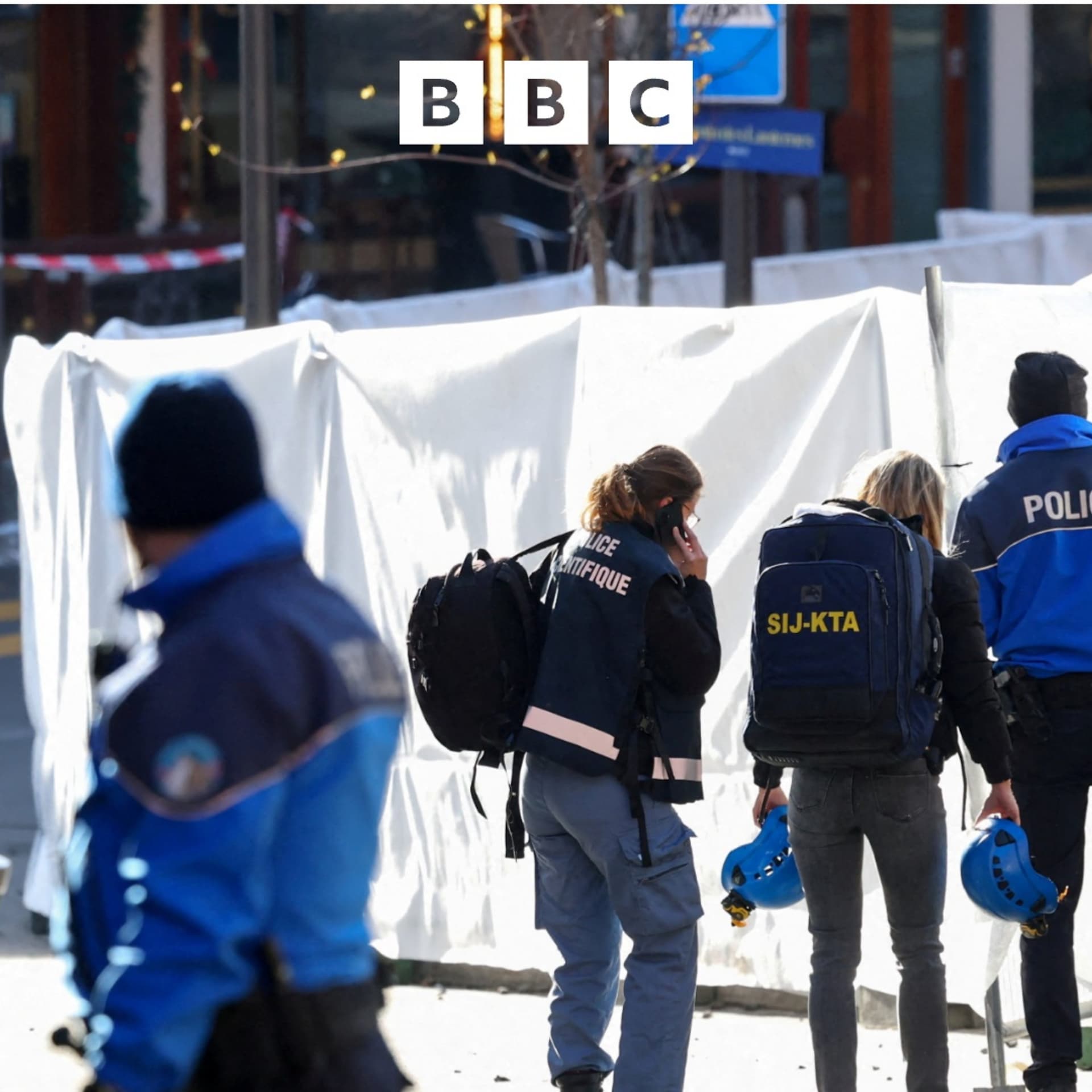
3:04We saw the flames after five or ten minutes, and we saw people rushing out, breaking windows, men in terrible pain. Well, Sylvia Costolo, a BBC journalist who is in Crown Montana, told us more about the bar and the scene today. The police have been putting up these white screens as they continue working their forensic work at the Constellacion. It's just a real atmosphere of shock here today. So the Constellacion Bar is a real institution here. It's been around since I was a teenager for at least 40 years. It's a big bar and it's not posh. This is quite a nice sort of posh ski resort. There's quite a lot of luxury.
3:47It was famous in the 80s for hosting the World Cup skiing and it's coming back next year. So it's a really sort of happening place. But it is quite luxury. A lot of the bars are quite luxury. But the Consolacion was not like that. It's a really big bar. It's got an upstairs with TV screens where people go and watch football matches. I was talking to an English tourist earlier who said, you know, I go there and I watch, you know, I just watch the football here, the footy, you know, when it comes on. And downstairs, it just had a big kind of bar and space where I suppose yesterday people would have been dancing and drinking.
4:25You go there for beers. It's just a very kind of young bar. It would have been a mixture of young people. It would have been Swiss people. It would have been people coming up from the valleys to celebrate here in Cranes, Montana, which is just such a lovely, fun ski resort. But there would have been obviously a mixture of nationalities as well. One would think it would be celebrating there last night. The BBC's Silvio Costolo. Well, at a news conference this morning, the local police chief said dozens of people had been killed without specifying a number. But the Italian foreign ministry said it had been told by Swiss police that around 40 people had died and 100 more been injured.
5:07Mattias Renard is leader of the local state council. His words are spoken by a translator. We share our sincere condolences to the grieving families impacted by this event. This evening should have been a moment of celebration, of coming together and it turned to a nightmare that was marked by a tragic event which injured seriously and cost the lives of many people. A short while ago we got the latest about the casualties from our correspondent in Switzerland, Imogen Folks. I mean we know that this is a very popular bar with young people. It looks like, you know, the ages between 16 and the age of 25 is the kind of people who go there.
5:57We have heard just from the Helicopter Air Ambulance Service in Zurich who flew, they flew more than 20 people to Specialist Burns units in Geneva, Lausanne, and also Zurich and one of them to the Zurich Specialist Children's Burns Unit. And the spokesperson for the Air Ambulance Service did say, we are dealing with young people here. So not just, you know, a tragedy on a very special day of the year, but really for such young people to be involved, there is really shock right across the country. We don't know the nationalities, as the authorities have been saying, but they do expect that there will have been people potentially, as you point out, from other countries.
6:48It's a hugely popular place to be at this time of year. Huge sporting opportunities for people as well. And now Italy offering access to some of its healthcare facilities too. Well, that's right. In fact, we did also just hear the air ambulance unit say that one person had been flown to Stuttgart to be offered care, also, I believe, in a burns unit. Because, I mean, clearly more than 100 people injured and some of them clearly have very serious burn injuries. And even in a country with as modern a health service and generous a health service as Switzerland, the beds in specialist burns units are limited.
7:28And it does look as if some patients may well be flown abroad to make sure, as the Air Ambulance Service just said, that they can get the very best possible care. They've also expressed that it's going to take some time for people to be identified. And just looking at what's happening in the town today, there's still a very big presence of emergency services there. Big presence of emergency services, huge forensic team, the specialist forensic fire forensic unit, also from Zurich, is in Kran, Montana already because there are two urgencies here. If you like, first to identify the people who have lost their lives.
8:15The authorities are talking about dozens and to make sure that their families are informed as fast as possible. The other urgency, of course, is to find out exactly how this fire started, why it appears to have spread so quickly and why so many people, apparently young people, lost their lives. Imogen folks talking to Martin Croxall. Other news now. And at midnight, a local time in Washington, new US travel restrictions came into force for people from nearly 40 countries, more than half of them in Africa. The Trump administration said the measures were needed because of concerns over weak vetting systems and high rates of citizens from those nations overstaying their visas.
8:56Richard Kagoy in Nairobi gave us more details. Majority of the countries, as you did mention, are currently in Africa. So those are ones that are subjected to an outright ban and are also partial restrictions. So just a quick description. So it's basically countries where there have been reported cases of the nationals having overstayed their visas in the U.S. These are countries also that are grappling with issues to do with crime, kidnapping, terrorism, and a general state of security that's really concerned. The U.S. authorities will say that they're really coming up with this policy because they wanted to protect U.S.
9:35citizens and just reinforce the national security. And what's been the reaction to these restrictions? Generally say that there's been outrage. There's a lot of disappointment amongst other countries that have been affected by this policy. Some of them have said that they're going to pursue diplomatic resolutions with the US government, seeing how they can be able to address their major areas of concern, because what they're saying is the challenge has been cooperation with US immigration authorities, authorities, you know, vetting of persons and also information sharing. So that's really been critical.
10:09So they're saying they're going to use diplomatic channels to see how they're going to resolve this. But then, of course, we have seen countries like Mali, Burkina Faso, Niger and Chad, you know, responding by saying that they're going to impose a ban on US citizens entering their country in response. Richard Kagoy in Nairobi. For anyone who has watched a courtroom drama. The big reveal comes when the jury announces its verdict, guilty or not guilty. But in Scotland, there's long been a third option, not proven, which has been around since the 17th century. Now, though, the not proven verdict is being abolished, though it will still be in place for trials currently underway.
10:49Our Scotland correspondent Lorna Gordon has the details. It's 10 years since the man who raped this woman during her university freshers week walked free from a criminal court. The jury deciding the case against her attacker was not proven. I think the not proven verdict, it left me confused, it left me angry. Everyone thought I was going to return to the person I was before and just go back and do my university exams a few weeks later. But for me, I didn't see a future. There was no ending, there was no closure. And for me, it took several years going through a civil rape case to get that closure.
11:23After her attacker, Stephen Coxon, was cleared in a criminal court, Miss M raised and won a civil case, which is judged on the balance of probabilities, against him. She's been at the heart of a campaign to change the law on Scotland's three verdicts ever since. This is a fundamental change to Scotland's criminal justice system. Going forward, jurors will have to choose guilty or not guilty. Scotland's unique third verdict of not proven, which has the same effect as not guilty, has gone. Campaigners welcome its removal, arguing not proven was confusing and unclear. But there are concerns, some worried an important safeguard is being lost.
12:06Other parts of this bill also proved controversial. Scottish ministers dropped a pilot scheme for juryless rape trials after criticism from judges and lawyers. But the changes that start coming in from today are profound and abolishing the not proven verdict is a major milestone in Scotland's distinctive legal history. Our Scotland correspondent Lorna Gordon. And still to come. I, Zohran Kwame Mamdani, do solemnly swear, that I will support the Constitution of the United States. that I will support the Constitution of the United States. A new mayor is sworn in in New York, but what are the challenges facing Zoran Mamdani?
12:58If journalism is the first draft of history, what happens if that draft is flawed? In 1999, four Russian apartment buildings were bombed, hundreds killed. But even now, we still don't know for sure who did it. It's a mystery that sparked chilling theories. I'm Helena Merriman, and in a new BBC series, I'm talking to the reporters who first covered this story. What did they miss the first time? The History Bureau, Putin and the apartment bombs. Listen on BBC.com or wherever you get your podcasts.
13:36This is the Global News Podcast. Now, a member of the security forces in Iran is reported to have died in clashes with protesters, as unrest over the failing economy continues for a fifth day. Iranian state TV said a 21-year-old member of the Basij militia had been killed on Wednesday night in the city of Kudasht. The unrest started a few days ago among shopkeepers and traders in Tehran, but has spread to a number of other cities. Our chief international correspondent, Lise Doucette, has this assessment of where it could go. It's just starting. The protests have been going on since Sunday. They've expanded and intensified by the day.
14:15It's very hard now to say how far they will go and how fast they will spread. Yesterday was suddenly declared a holiday, officially to save energy in the midst of cold winter weather. But it was widely seen as an effort by the authorities to take some steam out of the protests. The president had been quick to say, we hear you, we know you have legitimate demands. But we've also seen security tightened in many parts of Tehran and other cities where the protests have spread. It started with economic and financial discontent, with a strike in a mall in Tehran by the traders over the collapse of the currency.
14:54It spread to universities and other cities. And there were suddenly then in the midst of the real discontent over the hardship to slogans, political slogans like death to the dictator, down with the mullahs. the kind of slogans that very much dominated the last major protest of 2022 and 23. And I have to say that when I was in Tehran in July, I was really struck by the lingering impact of those last major protests where the rallying cry was women, life and freedom, and women of all generations were no longer wearing, many of them were not wearing head coverings and long coats and breaking the morality laws with this quiet but confident courage.
15:40So every time there is another round of protests, the authorities have to deal with a population which is being battered on every front, economic, financial, political discontent, environmental hardship, and of course, external pressure with threats of yet another war erupting with Israel. Our Chief International Correspondent, Lise Doucette. As of today, New York City has its first Muslim and South Asian mayor. I, Zohran Kwame Mamdani, do solemnly swear that I will support the Constitution of the United States. Zohran Mamdani was sworn in at midnight in the historic City Hall subway station. Symbolic, he said, because it was a physical monument to a city that dared to be both beautiful and build great things to transform working people's lives.
16:37More or less unknown until a year ago, he won a decisive electoral victory in November with a campaign focused on affordability. Here's what he said after being sworn in. Thank you so much for everyone for being here. Happy New Year to New Yorkers. and I cannot wait to see everyone tomorrow as we begin our term. This is truly the honour and the privilege of a lifetime. Our North America correspondent Anthony Zerka and Joe Anuta, a senior reporter at Politico, spoke to us about the expectations for the mayor and the obstacles he may face. I would say expectations are sky high at this point. And I think not only his supporters are expecting him to deliver on this, But, you know, he has a lot of critics who essentially are waiting for him to fail.
17:25So the stakes are very high, not just for him, but I think for the democratic socialist movement and its sort of future in local governments in America, which, you know, are very hands on the ground. They're filling potholes, doing all sorts of day to day activities. You know, a lot of his stuff, unfortunately for him, is decided in the state. So it's really this is going to come down to how good his politics are dealing with the governor and the state legislature. And he's got to do this immediately. The budget starts this spring. And if he doesn't get some sort of chunk of success, he's going to wait a whole year for another bite at it.
18:01And Anthony, it's it's that's an important point. It's worth laying out what is in his power and what isn't in the way government in the U.S. works. Federal government, the state, the city. What can he do? What can't he do? Well, there's some things locally that he can do. He can address public transit, for instance, but a lot of the money for programs will come from the state. If he wants to fund, say, a child care program from zero to five years old, he's got to find funding for that. And he says he wants to do it by taxing the rich. But if he's going to tax the wealthy in New York City, he's going to have to get approval from the state government to do that.
18:40And so, as was earlier mentioned, it's going to require political skill because the levers that he is going to have to use in order to get these programs through, they're not all within his reach. He's going to have to be able to convince people, some people who may benefit from seeing him struggle, convince them to be on board to help him push these policies forward. And Anthony, one person who has been a foe, but there seemed to be a bit of a makeup session, is Donald Trump himself. Where is that relationship right now? When that face-to-face meeting happened between Donald Trump and Mamdani in the Oval Office, a lot of people were expecting fireworks, that this was going to be a big clash.
19:20And Donald Trump was going to give it to this upstart young socialist who was going to turn New York City into some sort of a hellscape that was falling apart around his ears. And that's not what happened at all. Donald Trump was very friendly, lavish Mamdani with praise, diffused some of the potential. sticking points, points of contention between the two men. They both focused on issues of affordability and of making New York City a more livable place, which I guess in hindsight, maybe not all that surprising because Donald Trump did campaign on economic issues in the same way that Momdani did.
19:57But the fears among some that Donald Trump was going to use the powers of the federal government, cut off funding to New York City or put National Guard on the streets early in Mamdani's administration. Those fears do not, at least at the moment, seem to be realised. That was Anthony Zerka and Joe Anuta talking to my colleague Simon Jack. Later this year, four astronauts will head off towards the moon in the first manned mission there for half a century, though they won't land on it. It's part of NASA's plan to establish a long-term presence on the lunar surface and then travel onto Mars. The 10-day flight around the moon using Artemis 2 could take place within the next few weeks.
20:38Matthew Ramsey is the mission manager. We are proceeding according to plan. The plan is to launch at the open of the launch window February the 6th and we're currently on plan to meet that date. What are the main concerns and worries as you get closer to launch? Yeah so schedule is always a worry of course when you do when you're dealing with anything this complicated. We were very successful with Artemis I. That was a test the hardware without humans on board. That was really to test out the rocket, the SLS rocket, the ground systems, the comms, the control teams, and the Orion spacecraft without human interaction piece parts that we will be testing out for Artemis II.
21:26All of the human systems are being tested for Artemis II. So we have environmental control and life support. So this will remove CO2 from the cabin. We also have water, potable water that we're taking along and all of the food and all of the equipment that's necessary for the crew to do their job in space. And then, of course, all the ground systems to support the environmental control and life support and crew as they are loaded onto the vehicle and launch. So very exciting. This will be a step towards a permanent moon base, but it will not be the construction of a moon base, will it? What important things will you get out of this mission, this sort of loop around the moon?
22:11This is a relatively short mission. The way the mission is designed versus where we were with Artemis 1, the SLS rocket put us in a TLI, translunar injection state. For this mission, we have the SLS rocket putting us in a 24-hour highly elliptical orbit, and then the Orion spacecraft performing the translunar injection. So the mission itself is pretty different, but the intent is to check out all the life support systems relatively close to home to make sure that the environmental control and life support's working and all of the crew systems are working before we go to the moon. We will not be landing on the moon on this mission.
22:50That's for Artemis 3. The lander is currently in development. I'm sure you're probably following all the SpaceX activities for Starship that we're shooting for for Artemis 3 as they are loaded onto the vehicle and launch. So very exciting. There is an astonishing number of people working at sort of ground level to get a very small number of people into space. You are one of those who will be left behind. Do you ever sort of think, darn it, I wish I was with them? I mean, do you get space envy? Not really. I think it would be a really big honor to go up, but that's not really my training. I'm an engineer by trade, and I really enjoy the preparations and the design and the testing and getting the spacecraft ready for folks that are trained to go do that.
23:40So while I'm a little jealous, those guys are way more prepared and way more capable. When there is a permanent settlement, what will it look like? I mean, it will be the most extraordinary moment, won't it, when mankind leaves Earth and lives somewhere else? That is a fascinating question that you've asked. Of course, we'll have to have surface power. We'll have to take all the consumables with us at first. We'd have to have some sort of habitation module where the lunar landers will deposit our astronauts where they can go and do daily extravehicular activities. So those are the main pieces, power, consumables and habitation.
24:24Do you feel the weight of history on you? It's every day. The folks that designed and operated Apollo, there's still some folks with us, but it's dwindling. So it's good to have those folks around to give you insight into the lessons that they learned. You can read on paper all day, but when someone tells you, oh, you need to think about this, this, this and this, it's super helpful. Artemis II Mission Manager Matthew Ramsey talking to Johnny Diamond. Although New Year celebrations are now over for most of the world, China is still looking ahead to its festival. And even though it's still five weeks away, preparations are already well underway.
25:05For one village in northern China, that means production is being stepped up to supply shops, restaurants and millions of people with one of the most important New Year items, red lanterns. Our China correspondent Stephen MacDonald travelled to Tuntou to find out more. Walking around the streets of Tuntou you see evidence of lantern making wherever you look. A view through an open door into a courtyard might reveal a small group of villagers making them by hand. Down the main street the red lanterns are piled up on top of one another. Nobody seems to know just how many hundreds of years ago the craft started in this part of northern China.
25:45But this one village produces a remarkable 80 % of the country's lanterns. In fact, if you're born in this part of Hebei province, you're immersed in lantern making from a very young age. Su Cui Jun runs one of the many family businesses here with her husband. When you see others in your family doing it every day, you get the hang of it quickly.
26:11I asked how old villagers are when they start making lanterns.
Read the full transcript
26:18Kids here can pick it up at from around 10 years old. The fabric for the lanterns being used here has been prepared by another family business down the road. They've already put the symbols on there. They could be fish or Chinese characters or whatever. Then, after the fabric's delivered here, the workers will take these metal rods, which have plastic circles attached to either end, and they'll expand the rods with the fabric over the top to form a lantern shape. then they're using a kind of glue gun to add gold trimmings. Once the lantern takes shape, the workers will walk outside where I am here and place the lanterns in the sun to dry.
27:04Now, after they've spent a couple of hours out in the street, they're ready to then be collapsed again to be placed in boxes by the dozen to be sent all over the country. Trucks come through to pick up lanterns for delivery, which range from the size of a basketball to a small caravan. We can make lanterns up to 20 metres tall without any problem. 72-year-old Bai Junping told us he switched from carpentry to lantern-making as a young man because the pay was better. Our village is indeed famous. We're known as the Palace Lantern Village. I asked how they felt about dedicating their lives to this.
27:50Of course I feel proud of my work. Our lanterns can even, at times, be shipped overseas. Chinese New Year isn't till February, but the presence of street lanterns is already building up to it, according to one man who'd come to see the lantern show. We also hang lanterns in ordinary times, but, of course, the atmosphere is better during the New Year period, with more people out and about. Back in Tuntou, lantern production is in full swing to meet the New Year orders. In the future, modern production may find a way to match what this village can do by hand, offering the same diversity of options at a cheaper price.
28:32But for now, it's this village which supplies China with its lanterns, keeping an important cultural symbol alive.
28:44Stephen McDonnell in Tonto. And that's all from us for now, but the Global News podcast will be back very soon. This edition was mixed by Darcy O 'Brie and produced by Rebecca Wood and David Lewis. Our editor is Karen Martin. I'm Oliver Conway. Until next time, goodbye.
29:08If journalism is the first draft of history, what happens if that draft is flawed? In 1999, four Russian apartment buildings were bombed, hundreds killed. But even now, we still don't know for sure who did it. It's a mystery that sparked chilling theories. I'm Helena Merriman, and in a new BBC series, I'm talking to the reporters who first covered this story. What did they miss the first time? The History Bureau Putin and the Apartment Bombs Listen on BBC.com or wherever you get your podcasts
From the publisher
Swiss police say dozens of people have died in a fire at the ski resort of Crans-Montana. They say more than 100 others were injured, many of them seriously. The fire broke out early in the morning in a bar packed with people celebrating the New Year. The cause is still under investigation, but the authorities don't think it was a terror attack. Also: New US travel restrictions have come into force for people from dozens of countries; more than half of them in Africa. New York City has its first Muslim and South Asian mayor as Zoran Mamdani was sworn in at midnight in the historic City Hall subway station, and how one village in China makes 80 per cent of all red lanterns for New Year celebrations.
The Global News Podcast brings you the breaking news you need to hear, as it happens. Listen for the latest headlines and current affairs from around the world. Politics, economics, climate, business, technology, health – we cover it all with expert analysis and insight. Get the news that matters, delivered twice a day on weekdays and daily at weekends, plus special bonus episodes reacting to urgent breaking stories. Follow or subscribe now and never miss a moment. Get in touch: globalpodcast@bbc.co.uk