
In short
This episode of the BBC Global News Podcast is a roundup of major stories. Topic 1: Gloria Steinem’s death at 92.
Guest
Judy Frankel, a writer/historian who “looks back” on Steinem’s life.
Key claims
Steinem helped lead the US women’s liberation movement, campaigning for gender equality and reproductive rights; she became prominent after going undercover as a Playboy bunny; her 1969 New York magazine reporting on women discussing abortion “revolutionized” her and led her to question why abortion was illegal.
Notable examples
co-founding Ms. magazine (women-owned/operated), testifying for the Equal Rights Amendment, co-founding the National Women’s Political Caucus and Women’s Action Alliance, and marrying David Bale in a Cherokee wedding in 2000. Topic 2: UN warns of a “super-sized” El Niño; guest: none named. Topic 3: BBC investigation of people smugglers using “mega dinghies”; guest: none named. Topic 4: dark matter study; guest: Georgina Rannard (reporter). Topic 5: US Open tennis; guest: Abigail Johnson (reporter).
Written by AI. May contain mistakes. Listen to the episode to check what was said.
Chapters
Tap a time to open that second in VOTribute to Gloria Steinem
1:20 to 2:28
A look back at the life and influence of feminist pioneer Gloria Steinem.
“Gloria Steinem, a pioneer of the women's liberation movement in the US, has died at the age of 92.”
Steinem's Activism and Personal Journey
2:28 to 4:02
Exploring Steinem's fearless advocacy for women's rights and her personal experiences.
“For the first time in my life ever, I heard women stand up and tell the truth, tragic, funny, personal, about being one of every three American women who has needed an abortion at some time in her lifetime.”
Steinem's Legacy and Philosophy
4:02 to 5:48
Discussion on Steinem's views on feminism and societal transformation.
“With her long, streaked blonde hair, middle parting and trademark aviator glasses, she soon became the face of feminism.”
El Niño's Impact and Climate Change
5:48 to 8:01
Explaining the potential effects of a super-sized El Niño and its connection to climate change.
“the father of the actor Christian Bale, in a Cherokee wedding ceremony.”
Global Trade Disruption Due to Weather
8:01 to 10:59
Examination of how El Niño and other factors are disrupting global shipping.
“Because El Nino is a natural weather pattern, but is climate change also causing El Nino to get stronger?”
Tapestry Loan and Political Commentary
13:10 to 14:00
Discussion of France's loan of a tapestry to Britain and its political implications.
“we told you how France has loaned a nearly thousand-year-old tapestry to Britain in a gesture of post-Brexit reconciliation.”
Challenges of Small Boat Crossings
14:00 to 16:12
Exploring the ongoing issue of migrant boat crossings from France to the UK.
“political correspondent Rob Watson explains the small boats carrying migrants that continually arrive in Britain from France despite the authorities efforts to stop them.”
Adapting Smuggler Tactics
16:12 to 21:02
Insight into how smuggling operations are changing amidst increased law enforcement.
“Well, as Rob was saying, one of the issues being discussed by the two leaders is the daily crossing by small boats across the Channel.”
Migrant Crossings to the Canary Islands
21:02 to 24:26
Details on the perilous journey migrants take to reach the Canary Islands.
“Let's turn now to the issue of migrant crossings further south in the Atlantic Ocean.”
Detecting Dark Matter Breakthrough
24:26 to 26:30
A new step in the search for dark matter and its implications.
“A team of international scientists say they may be one step closer to detecting dark matter, the elusive substance that binds galaxies together.”
Show all 12 chapters
Tennis Update on Irina Sabalenka
26:30 to 28:00
Recap of Irina Sabalenka's performance and her response to criticism.
“Open and has booked her place in the third round.”
Analyzing Grand Slam Performances
28:00 to 29:08
A discussion on the performance of top female tennis players leading up to major tournaments.
“But it's hard to ignore that she has dropped off in form compared to her usual high standards of late.”
Transcript
Automatic transcript. May contain errors.0:00This BBC podcast is supported by ads outside the UK.
0:30and more options to their lineup can shop at machinefinder.com. Booyah! Cha-ching! That's the sound of Lowe's Labor Day Savings. Get up to 45 % off select major appliances and save up to an additional$100 on select laundry pairs. Plus, get three bags of Miracle-Gro.75 cubic foot garden soil for just$10. Labor Day deals are on now at Lowe's, in-store and online. Valid through 9-9, while supplies last. Selection varies by location. See Lowes.com for more details. Soil Offer excludes Alaska and Hawaii. This is the Global News Podcast from the BBC World Service. I'm Janet Jaleel, and at 14 hours GMT on Thursday, the 3rd of September, these are our main stories.
1:20Gloria Steinem, a pioneer of the women's liberation movement in the US, has died at the age of 92. We look back at her life and her influence on generations of women. The UN warns of a super-sized El Nino, potentially the strongest for more than 70 years, which is expected to continue until at least next February. The BBC investigates how people smugglers are using mega dinghies to bring migrants to the UK from France. Also in this podcast... You guys are like a joke. Party is fun. Like, why would you even say that? Why would you even think about that? Like, what kind of question is that? Why tennis number one, Irina Sabalenka, pushed back at reporters at the US Open.
2:12The US feminist writer and activist Gloria Steinem has died at the age of 92. In the late 1960s and early 70s, she was one of the most prominent leaders of the American women's movement, campaigning for gender equality and reproductive rights. She was also a trailblazing journalist who gained recognition after going undercover as a Playboy bunny. In a statement on social media, her team announced that Steinem had passed away peacefully at her home in New York, saying her near century on Earth were years well lived and she continued working for equality until the very end. Judy Frankel looks back at her life.
2:52Gloria Steinem never craved the limelight she said she hated public speaking and was afraid of conflict and yet she became one of the most visible figures in the women's movement leading marches and arguing passionately to give women equal rights in law, politics, education and the home Her feminist awakening came in 1969 when, as co-founder of the New York magazine she went to cover a hearing of young women talking about their own experiences of having an abortion. For the first time in my life ever, I heard women stand up and tell the truth, tragic, funny, personal, about being one of every three American women who has needed an abortion at some time in her lifetime.
3:40And it revolutionized me sitting there listening. And that's what made me start to ask questions. If this is necessary for so many of us, why is it illegal. Why is it criminal? Gloria herself had had an abortion 13 years earlier at the age of 22, but had never told anyone about it until then. That meeting changed her life. She got involved in grassroots organizing, and in the years that followed, she testified in the Senate on behalf of the Equal Rights Amendment and co-founded the National Women's Political Caucus, the Women's Action Alliance and Ms Magazine, the first periodical ever to be created, owned and operated entirely by women.
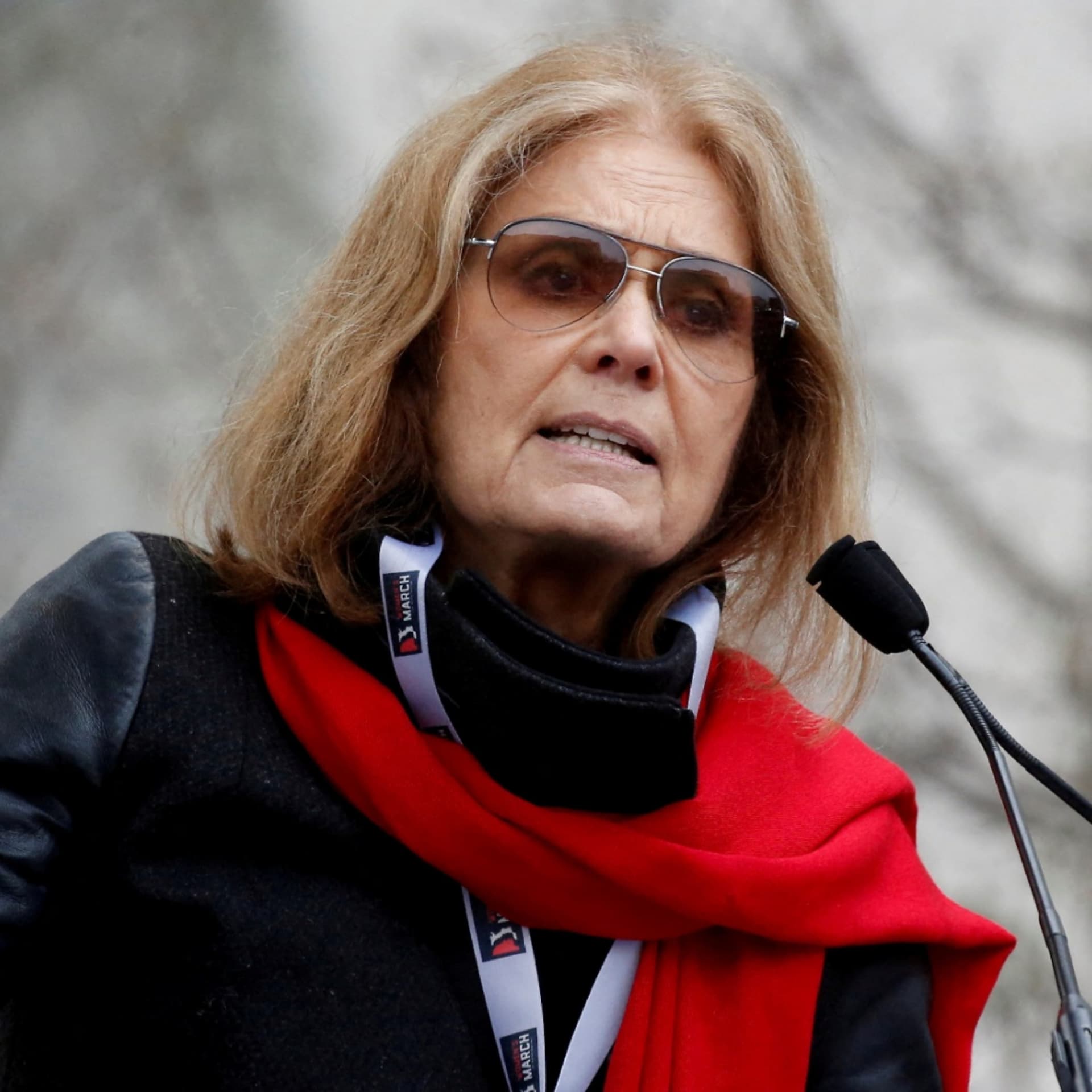
4:22With her long, streaked blonde hair, middle parting and trademark aviator glasses, she soon became the face of feminism. She'd come a long way from her roots. Born in Ohio in 1934, she had a poor and itinerant childhood. Her father took his family on the road for months at a time, selling antiques from their trailer. Her mother suffered from mental illness and addiction. When her parents separated, Gloria became her mother's sole carer aged just 10 and only then did she spend her first full year at school. For Steinem, finding feminism was like finding a family and she continued to champion women's rights for the rest of her life.
5:05I think my dreams at that point were not big enough. You know, I think I was looking at equality, not transformation. And I think it's even more important to make a society in which the paradigm is the circle, not a pyramid. And we understand we are linked. We are not ranked. On the other hand, I realized what a huge victory it is just to know we're not crazy. Gloria Steinem never had children of her own, saying feminism had taught her it was possible for women not to conform to gender stereotypes and still be happy. But in the year 2000, she surprised everyone, including herself, when she decided to marry David Bale, the father of the actor Christian Bale, in a Cherokee wedding ceremony.
5:53Judy Frankel, looking back on the life of Gloria Steinem, who has died at the age of 92. Our planet is already experiencing frequent record heatwaves, droughts and floods because of man-made climate change. Now scientists say they think that will be exacerbated even further by a natural recurring weather pattern, El Niño, that causes surface temperatures to rise in the Pacific Ocean. The latest data shows it could be the strongest for more than 70 years and last until at least February next year. The head of the UN, Antonio Guterres, said that El Niño was being supersized before our eyes, with the world in the danger zone of even more extreme weather.
6:35The data was released by the World Meteorological Organization. Its Secretary General is Professor Celeste Saulo. Because we live in a globalised world with a globalised economy, this El Niño will affect the food you take every day, the water you have access to and the prices you pay for everything. And that is why we are not only warning but calling to action in advance. Our climate and science reporter Esme Stallard told me more about this stark warning. This was a very clear direction from the WMO, a group of scientists from around the world that study our weather patterns, saying that governments need to prepare for these extreme weather events.
7:18There are some countries that are already starting to feel the effects. So wetter season within China, more typhoons, they've already had four this year, which have left nearly 200 dead. And Peru has already declared an emergency across 40 % of its area. And we know the US has sent down a military aid vessel to Peru to provide additional technical equipment and medical assistance. And as of today, the Panama Canal Authority has reduced the number of ships passing through the area over concerns about lower rainfall, which could drop water levels. And of course, as we heard there from Professor Salau, the impact of that, even if you're not within that region, is that it can disrupt global trade.
7:57She's talking about El Nino being the strongest in 70 years. Is that partly because of man-made climate change? Are the two fueling each other? Because El Nino is a natural weather pattern, but is climate change also causing El Nino to get stronger? This is a really good question. At the moment, the science is very uncertain on this. There is not clear evidence that climate change is driving El Ninos, but that is something that is being looked at because, as you say, this is one of the strongest that we've seen since records have began. And just to put that into context, El Nino will be declared when the average temperatures in a specific part of the Pacific are half a degree higher than normal over an extended period.
8:35We're already at more than two degrees and the models are off the charts. They're predicting potentially four degrees out to February next year. And so that is why there is such intense concern. And obviously, that is on top of the background heating that we're getting. So if you are in a part of the world where El Nino will dry up temperatures, I'm thinking India, for example, this is just another battle to be facing on top of climate change. But that link between them isn't quite clear yet. And scientists are asking governments to prepare. How? So a number of different methods. WMO have said this is their biggest or one of their biggest mobilisations of their members.
9:13So WMO is made up of lots of different meteorological organisations. So they are ramping up the amount of funding and also the amount of output they're doing. So they're giving clearer forecasts about potentially extreme weather events and also encouraging governments to put aside funding and technical assistance to help those communities that will be most affected by these extreme weather events. Esme Stallard. Well, the consequences of the El Niño phenomenon are being felt in many parts of the world. The authorities at the Panama Canal, the crucial man-made waterway connecting the Atlantic and Pacific Oceans, are reducing the number of ships allowed to pass through from today because of severe droughts, with officials having to safeguard water resources after low rainfall caused by the weather pattern.
9:57Around 5 % of global trade normally passes through the canal. So how much of an impact will this have on global shipping? Richard Meade is editor-in-chief at Maritime Journal, Lloyd's List. It's already having an impact. We've got ships waiting for around a week, a ship's queue to get through. We've got some ships paying up to around$4.5 million in order to jump that queue for high-value cargoes. So there is disruption, but this disruption is coming on disruption on disruption. In the Strait of Hormuz, we're already dealing with the energy impact of that. Black Sea is currently the most dangerous trading environment for ships since World War II.
10:38Red Sea is still largely rerouting due to Houthi threats and the Babel Mendeb is very dangerous. There are a lot of choke point problems. So this is a sort of compound interest of disruption on maritime trade that's already disrupted and has been since COVID, effectively. This is the worst, most disrupted trading environment in living memory for the shipping industry. Freight rates are at an all-time high. Disruption and inefficiency is an all-time high and there are very few signs that there is much relief around the corner. Richard Mead. Still to come in this podcast... A flash of light or a collection of flashes of light which are consistent with what we'd expect dark matter to look like and doesn't look like anything else.
11:21A new scientific study appears to shine a light on the mystery of dark matter.
11:34John Deere is putting in work and putting up highlights. Oh man, look at those passes. Tillage, planting, harvesting. Three years in and these pre-owned machines are still at the top of their game. We're talking reliability, performance and long-term potential. And get this, these veteran machines can pick up the latest precision tech with ease. You know it and fans ready to add John Deere certified pre-owned equipment and more options to their lineup, can shop at machinefinder.com. Booyah! Chicago talks a lot. Hold on, let me step over here. People are talking too much. We debate about food, deep dish, tavern style, who's got the best beef.
12:13We yell across rooms, across blocks, across generations. Yes, nice earrings, Grammy. And now we're doing it on our phones, too. Video calls from the L train, group chats that never shut up. Neighbors texting you the score before your TV catches up. Come on! Get a load of this guy. Ketchup. On a dog. Yeah, we've got thoughts. Too loud? In Chicago, you're gonna hear it. Because nothing here gets built without conversation. Nothing moves without connection. So, if you think you know AT &T, it might be time to rethink that. Because their network has improved, like, a lot. So Chicago can keep speaking its mind with AT &T Wireless and AT &T Fiber.
12:53Chicago won't stop talking. Our improved network backs it up. AT &T, connecting changes everything. AT &T Fibre, limited availability in select areas.
13:07In an earlier edition of this podcast, we told you how France has loaned a nearly thousand-year-old tapestry to Britain in a gesture of post-Brexit reconciliation. The new UK Prime Minister, Andy Burnham, thanked France for the loan of the Bayer tapestry, which depicts a French leader, William, who was of Nordic descent, seizing the English crown in a historic battle in 1066, and he jokingly compared it to his own ascent to power as a former mayor in northern England. A tapestry that shows a new leader emerging from a northern territory, travelling to the south of England in search of the crown.
13:50Something clearly that couldn't happen today. France's President Macron is the first foreign leader to be welcomed to Britain by Mr Burnham. The two men discussed a range of issues including Ukraine, the Middle East and as our UK political correspondent Rob Watson explains the small boats carrying migrants that continually arrive in Britain from France despite the authorities efforts to stop them. The main issue on the agenda certainly for Britain is this issue of boat crossings because opinion polling here suggests it is a massive issue for British people. They just don't like the idea that people could come over in boats.
14:28You don't know who they are, how many they are. And so this is something that Britain has long wanted France to take action over. Now, the current government says it's getting excellent cooperation from France and that boat crossings are down from nearly 50 ,000 to below 20 ,000 so far this year. But it is a very important issue for Britain. But this is also a big diplomatic test for Mr. Burnham because he's been rather focused on domestic affairs rather than international ones. He did visit Ukraine in his first visit abroad as prime minister. So that is another big issue. But it will also be a test for him to see how he gets on with President Macron, given all those tensions post Brexit.
15:10it? Yes, I mean, one of the doubts that had been raised about Andy Burnham is that he was very much a domestic politician, that he'd never shown much interest in diplomacy and international affairs, and that most recently, he's been the champion of Manchester for 10 years as the mayor of Greater Manchester. So making that step up to looking at statecraft, looking at international relations was seen very much as a challenge. And look, it's worth pointing out, of course, this will be the sixth, I mean, can you believe it, the sixth British prime minister that President Macron will have met, saying something about the political turbulence to the side of the channel.
15:48But I guess the good news for Mr Burnham is that on issues like the Middle East, on issues like Ukraine, which are massively important to both France and to Britain, there'll be a considerable agreement. Some tension, perhaps, on Britain's desire to get closer to the European Union without actually rejoining it. that will of course continue to be a source of friction between the two countries. Rob Watson. Well, as Rob was saying, one of the issues being discussed by the two leaders is the daily crossing by small boats across the Channel. A BBC investigation has found criminal groups who illegally smuggle people to the UK from France are running low on small boats.
16:27Gang members have told BBC sources that rival factions are now having to work together to load migrants onto fewer, larger vessels. They're also charging them more. With the number of crossings currently at a six-year low, British ministers have credited the French police for intercepting more attempts. Our correspondent in France, James Waterhouse, looks at how the people smugglers are being forced to adapt. The sense we're getting is that officers have become more efficient in preventing launches, but that hasn't quashed the desires of migrants still wanting to make this journey and the motivations of the gangs looking to help them across this dangerous waterway.
17:13During a low morning tide on the deep beach at Gravelin near Dunkirk, a group of a dozen or so migrants emerge from the dunes and walk, not run, towards the warm shallows of the English Channel. A taxi boat, a small boat that's departed from Belgium, then approaches them, as do we. Where are you from? Afghanistan. Afghanistan. Why are you going to the UK? Why UK? Why not go legally? Why do it like this? It's very dangerous.
17:44The boat is looking quite overloaded now. Its black sides are becoming increasingly submerged in the water. They're now trying to inch back to my right to pick up another group of people. Good morning. Where are you from? Afghanistan. Afghanistan. Are you waiting for another boat? No. Was that the boat you were hoping? Yeah. Is it going to come back for you? We don't know. You don't know? Yeah, we don't know nothing. Why are you making such a dangerous journey? Punjabi, Punjabi. Punjabi, young man? Yeah, Punjabi. What do you want to do in the UK? Work? I mean, we know a few of the guys speak English.
18:25I think they're choosing not to engage. And if you pan along the beach, you can see the shoreline scramble. There are NGOs, humanitarian groups, who have rushed here. There are police looking on. Officers here argue they are prevented from intervening once boats are in the water over fears of people drowning, but claim they're now intercepting two-thirds of them before that point. although British officials have long been frustrated with this French reluctance and would like their neighbours to at least adopt a more case-by-case approach. The belief from people you speak to in the camps is that they want to get a job, they want to get employment and they want to apply for asylum and get it.
19:10They want the means to work and live and I think that is one of the big pulls for the UK but also a shared language and also people already having friends and family in the UK. After three hours, five collections and zero police interventions, the small boat ventures out into the world's busiest shipping lane. All 82 people on board make it to the UK. But the people smugglers are frustrated. Some have told our sources that they're running low on boats. At the largest migrant camp further up coast, it's emptier. More people are staying closer to the beach to boost their chances of crossing, which means, according to charity worker Angel Vettorello, they can't access humanitarian aid.
19:56I don't think that people are understanding what is really happening here, which means hundreds of families of children living outside, far away from help from the state, facing dangers obviously from the gangs but also from the police and what they wanted to cross to find a new life. We've been to the camp on several occasions but this time there was a perceptible unease. That discomfort would turn into confrontation when one gang member started repeatedly throwing rocks at us from close range. We got away sharpish in the car. We've just had to drive to the hospital because Paul, our cameraman, got hit by a rock.
20:38There was a man who was in what looked like a new tracksuit. We think he was one of the smugglers who didn't like us having a camera. Paul got hit just above his eyebrow. It's left quite a nasty dent. Paul would end up having stitches, but we left northern France in no doubt of the still strong motivations to reach the UK illegally. And for the people smuggling gangs, that still means money and a need to evolve.
21:09James Waterhouse reporting. Let's turn now to the issue of migrant crossings further south in the Atlantic Ocean. Many people board boats from Africa's northern or western coasts to try to reach the Canary Islands, which are Spanish. Now Spanish maritime rescue teams say they've located a vessel south of the island of Gran Canaria, which has been adrift for four weeks, where they found five dead bodies and 44 survivors. It's feared that dozens of people, including a baby, died. I got more details from our Madrid correspondent Guy Hedgeco. The people who were found alive, the 44 survivors, we're told, were all sub-Saharan African men.
21:54But in total, we're told that 128 people did leave Gambia in West Africa in this boat in early or the first week of August. And we know that there were some women on board who clearly perished during the journey. And we know that there was, you mentioned a baby there, at least one baby on board as well, who also perished. The survivors have been taken in in the Canary Islands or undergoing medical treatment, and that's prior to undergoing some legal procedures that they would normally undergo on arrival in a European port. And how will they be processed? Will they be processed to the Canaries or will they be taken to mainland Spain?
22:39Well, there are temporary migrant stay centres, as they're known, on the Canary Islands, because so many migrants try and reach the Canary Islands from North and West Africa. We have these migrant centres on the islands, and so they would stay in those stay centres, in theory, as long as it takes to get them processed legally. legally. Now, that can be quite a long procedure. It can take several months, obviously, to the frustration of the migrants themselves. They arrive on the islands and they think they're in Europe and that's that. But if they want to go to mainland Spain, it can take quite a long time.
23:19And in many cases, they do actually get repatriated to their own countries if there are agreements with their countries of origin. And this is quite an ordeal for them because Because this route from West Africa to the Canary Islands is one of the deadliest crossings in the world. It really is. I mean, if you look at the map, travelling from Gambia in West Africa all the way to the Canary Islands is an enormous trip. I mean, in a way, it's a miracle they reached the Canary Islands. Of course, there was a massive loss of life. More than 80 people appear to have died on the way. But it's a huge journey.
23:53But many people try and make it. Now, so far this year, we've had more than 5 ,000 migrants have made the journey from Africa to the Canary Islands successfully. That sounds like a lot, but actually it's about or less than half the number that made the journey over the same period last year. And there are many migrants who are seeking alternative routes, for example, to the Balearic Islands in the Mediterranean. But nonetheless, this very perilous, very dangerous route to the Canary Islands does remain quite popular with many migrants. Guy Hedgeco. A team of international scientists say they may be one step closer to detecting dark matter, the elusive substance that binds galaxies together.
24:36Using an ultra-sensitive detector, below ground in an abandoned gold mine in the US state of South Dakota, the researchers recorded a collision between an atom and a mystery particle. Georgina Rannard reports. A particle unknown to science. An intriguing particle interaction. When phrases like these are used, it's hard not to feel excited. Dark matter is one of the biggest remaining unsolved puzzles. Scientists do know it is invisible, that it is the fabric holding our universe together, and that it forms about 85 % of total matter. But in a century of searching, no one has ever actually seen it.
25:19Like an animal leaving footprints in the snow, dark matter is detected only by its gravitational pull on visible objects like stars. So when scientists announced that they may have finally detected dark matter, it generated huge excitement. Dr Sam Erickson of Bristol University led the research. What we've actually observed is a flash of light or a collection of flashes of light which are consistent with what we'd expect dark matter to look like and doesn't look like anything else that interacts. All of the properties of this particular interaction are so different compared to all of the backgrounds that we know and this event remains an outlier and that's really why we're excited about it.
26:05But be wary, a tantalising promise does not always deliver good science. True breakthroughs are made of more than good vibes. The research has yet to be reviewed by independent scientists, and the findings have been rated 2.6 sigma, the system that marks the statistical significance of discoveries. The normal threshold is five. Georgina Ranard. Two-time defending champion Irina Savlyenka is on a winning streak at the Open and has booked her place in the third round. The world number one only needed 53 minutes to beat debutante Polina Iachenko. But in her post-match news conference, Sabalienka hit back at what she perceived to be a suggestion from a reporter that she had been attending, quotes, lots of parties in the build-up to the tournament.
Read the full transcript
26:55I'm sort of curious, how are you finding like your mood once now that the tournament has started? Obviously last week it's lots of parties and fun and stuff like that um are you you guys are like a joke party is fun like like why would you even say that why would you even think about that like what kind of question is that like just because i posted like some activities with brands and you think that i've been fighting not training i'm not suggesting that you're partying no like the question like what is that I'm saying that there are a lot of events and things like that. I'm not saying you go to the parties and that you're...
27:36You literally said that. Excuse me? Well, whatever she's been doing, it's clearly working. She's one of the favourites to take the title this year. Here's our reporter, Abigail Johnson. She's the two-time defending champion and she's targeting a fourth consecutive final at this tournament. So I think history does come into the equation with some weight when you've had that level of dominance. But it's hard to ignore that she has dropped off in form compared to her usual high standards of late. For the second straight year, she's coming into the final major of the season without a Grand Slam title this year.
28:15But more than that, she did lose in the fourth round at Wimbledon. And that ended a streak of 15 consecutive quarterfinals reached at Grand Slam tournaments. She's lost in the fourth round of her last three tournaments. So I think you'd edge it in her direction because of the history. But really, it is very hard to say that she's head and shoulders above the field the way that she has been in the past. It's actually Elena Rabakina who has the best chance of finishing the tournament as world number one. Sabalenka would need to win the title and would require the number two seed to lose before the semifinals in order to maintain that top ranking.
28:52Coco Goff always gets an extra boost from the electric New York crowd. And Jessica Pagula, who made the final in 2024, she's always been a strong contender as well. So it's really very fascinating on the women's side. Abigail Johnson. And that's all from us for now. If you want to get in touch, you can email us at globalpodcast at bbc.co.uk. You can also now watch our episodes in full. Just search for the Global News Podcast on YouTube. This edition was mixed by Mark Pickett and the producers were Arian Kochi and Stephanie Zacherson. The editor is Karen Martin. I'm Janet Jalil. Until next time, goodbye.
29:50You can also enjoy a range of our podcasts ad-free with an Amazon Music subscription.
From the publisher
Gloria Steinem, a leader of the women's liberation movement in the US, has died at the age of 92. During the 1960s and 1970s, she campaigned for women’s reproductive rights and equal pay laws. She also co-founded the Ms. magazine - one of the first feminist publications in the US - and advocated for the legalisation of same-sex marriage. Steinem died peacefully at her home in New York.
Also: the United Nations warns of a "supersized" El Niño as countries prepare for the impact of the severe weather event. Britain's Prime Minister, Andy Burnham, meets President Emmanuel Macron in London, with irregular migration high on the agenda. France is deploying a new team of police officers to its western beaches to try to stop migrants on large, overcrowded vessels from crossing the English Channel. Are we one step closer to discovering dark matter - the substance that binds galaxies together? And women's tennis world number one, Aryna Sabalenka, hits back at suggestions she had been attending 'lots of parties' in the build-up to the US Open.
The Global News Podcast brings you the breaking news you need to hear, as it happens. Listen for the latest headlines and current affairs from around the world. Politics, economics, climate, business, technology, health - we cover it all with expert analysis and insight. Get the news that matters, delivered twice a day on weekdays and daily at weekends, plus special bonus episodes reacting to urgent breaking stories. Follow or subscribe now and never miss a moment. Get in touch: globalpodcast@bbc.co.uk
Photo: Gloria Steinem speaks at a women's march in Washington, US., January 21, 2017. Credit: Reuters