
In short
The episode is about multiple global news stories. Main topic: the first human trial dose of an experimental Ebola vaccine targeting the Bundibugyo (Bundibujo) species, in the Democratic Republic of Congo where over 1,000 have died and no approved vaccine exists.
Guest
Fergus Walsh, BBC medical editor (in Oxford for the event).
Guest background
medical editor reporting on health and science.
Key claims
37-year-old volunteer Ed Hunt received the first dose; 50 healthy Oxford volunteers (18–55) will get one dose; if successful, a small Uganda trial will assess safety before expanding in DRC; strong immune responses could protect Ebola contacts within months; Serum Institute has 600,000 doses ready; funding includes CEPI and Moderna is also developing an mRNA Ebola vaccine.
Notable examples
Ed Hunt’s prior interest in COVID trials; targeting Bundibugyo; Zaire Ebola already has an effective vaccine.
Written by AI. May contain mistakes. Listen to the episode to check what was said.
Chapters
Tap a time to open that second in VOFirst Human Trial of Ebola Vaccine
0:11 to 0:41
Discussion on the first administration of an experimental Ebola vaccine.
“An experimental vaccine against the Ebola virus ravaging Central Africa has been administered to a volunteer for the first time.”
Details of the Trial
0:41 to 1:17
Insights into the volunteers and the specifics of the vaccine trial.
“The latest Ebola outbreak in the Democratic Republic of Congo has killed more than 1 ,000 people.”
Vaccine Development and Safety Monitoring
1:17 to 3:18
Exploration of the vaccine development process and safety measures in place.
“The BBC's medical editor, Fergus Walsh, was in Oxford for the event.”
Funding and Global Response to Ebola
3:18 to 4:33
Discussion on the funding of the vaccine trials and the global response to the outbreak.
“And there's a lot of optimism that this vaccine could be effective.”
Escalating Conflict in Iran
4:33 to 8:20
Overview of the ongoing conflict between the US and Iran and its implications.
“The fighting that started up nearly two weeks ago between the US and Iran shows no sign of stopping anytime soon.”
Forest Fires in France and Spain
8:20 to 10:34
Report on the devastating forest fires affecting France and Spain.
“Tens of thousands of people are fleeing one of France's most popular holiday areas on the Atlantic coast, hundreds of them by boat, as forest fires continue to burn.”
Historic Divorce Settlement in South Korea
10:34 to 13:05
Details of a significant divorce settlement involving a tech billionaire.
“We're going to South Korea for this next story, where a court has ordered the tech billionaire to pay more than$640 million to his former wife.”
Youth Protests in India
13:05 to 14:00
Coverage of the youth-led protests in India and their impact on the government.
“The people were so, so very happy to see us.”
India's Youth Protests and Government Negotiations
14:00 to 16:06
Learn about the ongoing youth protests in India and the government's response.
“would be discussed on the floor of the Indian Parliament.”
Japan's Prime Minister on Sleep Deprivation
16:07 to 17:04
Discover the implications of Japan's Prime Minister's sleep habits on work culture.
“We've got lots more on this story on our YouTube channel.”
Show all 12 chapters
Andy Burnham's Political Strategy in Britain
17:05 to 20:38
Understand Andy Burnham's approach to governance and regional representation.
“Supporters say she's just showing the reality of what it's like to work in public service.”
Ghetto Kids: A Dance Journey from Uganda
20:39 to 24:24
Hear the inspiring stories of the Ghetto Kids and their journey to perform globally.
“but undoubtedly huge challenges ahead, Will.”
Transcript
Automatic transcript. May contain errors.0:00This is the Global News Podcast from the BBC World Service. I'm Will Chalk and in the afternoon of Friday the 24th of July these are our main stories. An experimental vaccine against the Ebola virus ravaging Central Africa has been administered to a volunteer for the first time. There have been more strikes and counter-strikes across Iran and the Gulf. Also in this podcast India's massive youth movement the Cockroach Janter Party has been putting its case to government ministers. We will get this to the end. We will finish what we started.
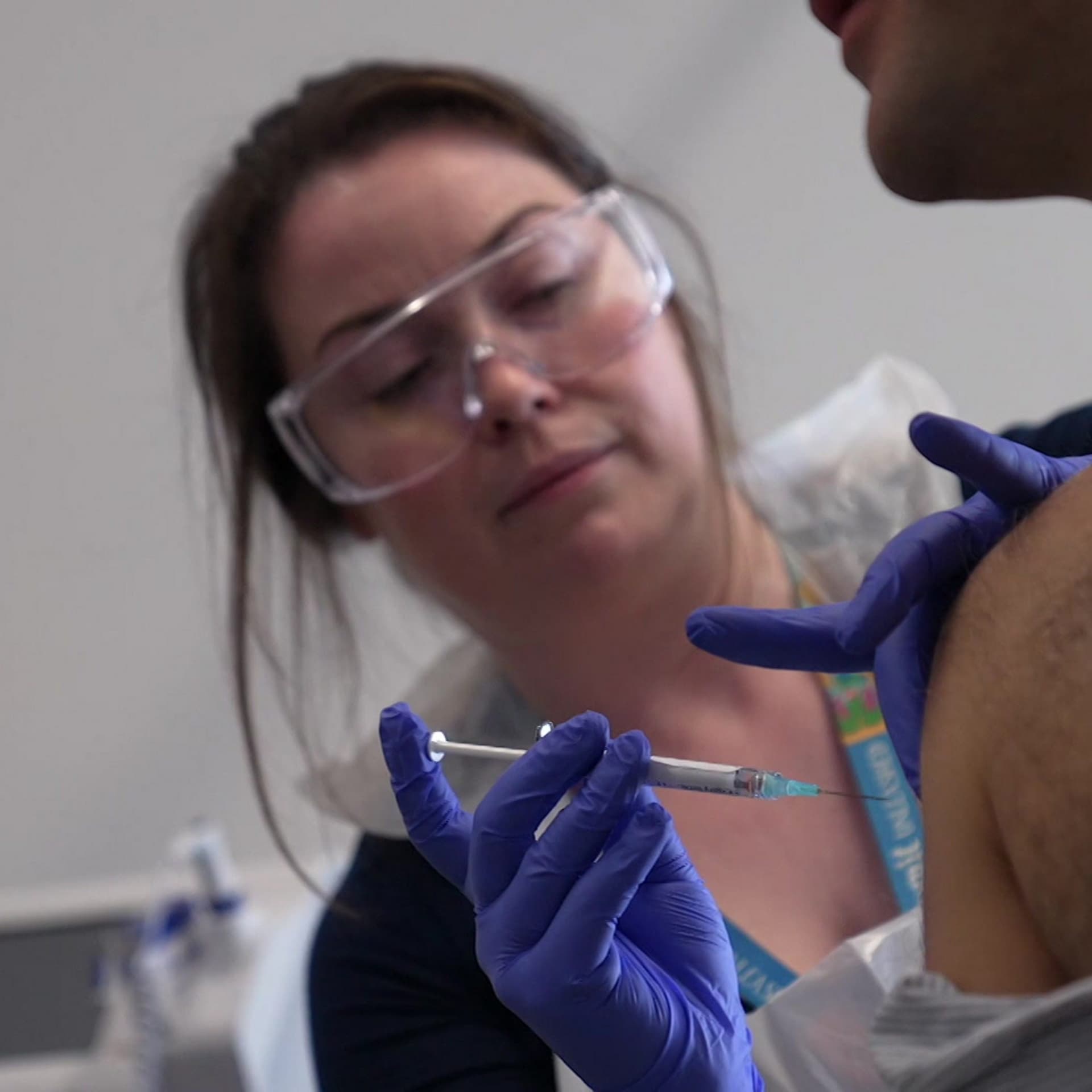
0:41The latest Ebola outbreak in the Democratic Republic of Congo has killed more than 1 ,000 people. And this particular strain, or species, known as the Bundibujo, has no approved vaccine. But there is hope. Several are currently being trialled. One of them being developed by the Oxford Vaccine Group part of Oxford University, has taken a major step forward. Today, someone had the first ever dose of the experimental vaccine. OK, so I'm just going to administer the injection here. Sometimes it can be a bit stinging when it goes in, but be able to with quite quick link. That's fine. And just relax as much as you possibly can.
1:16Thank you. The BBC's medical editor, Fergus Walsh, was in Oxford for the event. He began by telling me about that first volunteer, who we just heard in that clip. So the volunteer is a man called Ed Hunt. He's 37. and he volunteered after he saw news reports of what's happening in the Democratic Republic of Congo. In fact, he told me he'd wanted to volunteer for the COVID vaccine trials, but he wasn't able to at the time, so he's had his name down, as it were. And he's one of 50 healthy volunteers, aged 18 to 55, who are currently being recruited for this trial in Oxford. They'll all receive one dose of the experimental Ebola vaccine, which is against the Bundibujo species of Ebola, for which there is no vaccine at the moment.
2:06If it works then, and if this is successful, how quickly can the help then get to the people who need it in the DRC? So what will happen pretty soon is a similar, smallish trial will begin in Uganda, where people will be immunised. And those vaccine trials currently are to look primarily at safety. But if they're successful, they will then expand the trial in DR Congo and that will be in the affected areas. Now, what they're doing as well as monitoring the safety of the vaccine is they're checking for immune responses. Obviously, none of the volunteers will be given Ebola. But if the jab produces a very strong immune response, which they're hoping it will, then it can be used actually to protect people who may be contacts of Ebola patients within a matter of months.
2:59And indeed, the Serum Institute, the biggest vaccine manufacturer in the world, has produced 600 ,000 doses of this Oxford Ebola vaccine, which are waiting in the wings should the trials prove successful. So they will have the doses they need. There is already a successful and a very effective vaccine against the Zaire species of Ebola. And there's a lot of optimism that this vaccine could be effective. And it's actually one of four vaccines that have been developed against the Bundibudosh species. But it's the first one to go into human trials. And of course, it is desperately needed. These vaccines can cost millions, if not tens of millions to develop.
3:45how is this all going to be paid for ultimately in the long run? It's actually getting funding from a variety of sources including CEPI which is the Coalition of Pandemic Preparedness and there's no money going to be made here it's not a money-making venture and indeed the big vaccine company Moderna is also producing an mRNA vaccine against Ebola mRNA vaccines first came to the fore during Covid So it's really not being seen about making money. There's a recognition in the global scientific community that this is a terrible outbreak, which is producing a high level of risk in Central Africa, particularly in DR Congo.
4:29And so it's about being prepared for these outbreaks. Fergus Walsh there. The fighting that started up nearly two weeks ago between the US and Iran shows no sign of stopping anytime soon. The Iranians say the United States targeted commercial and military sites overnight with at least four people killed. Tehran says it carried out drone strikes on US military facilities and bases in Jordan and Bahrain. It's the 13th consecutive night this has happened. But President Trump is threatening to escalate even further and launch what he's calling a massive attack on Iran. The war also seems to be widening.
5:07On Thursday, the Houthis in Yemen, who were backed by Iran, said they'd attacked two tankers in the Red Sea transporting oil from Saudi Arabia. And that sent the price of oil shooting up to over$100 a barrel. Our Middle East correspondent in Jerusalem, Yolan Nel, told me about the latest developments. There appears to have been about two hours of US strikes on Iran, with explosions reported in Iranian media in several of Iran's southern coastal cities. places like Bandar Abbas and Qersham Island that have been targeted before, places with naval facilities, but also strikes being reported in the west, the centre of the country, even in the north on a revolutionary guards base.
5:46And the Iranians saying at least four people have been killed. There's also activation of air defences in Tehran. And we've now had the Iranians saying that they launched drone attacks in the last few hours on US military bases in retaliation in Jordan and Bahrain. Sirens reported in Bahrain, the Jordanians saying they intercepted missiles. And there are now reports coming that there has been smoke and explosions heard near to Abil International Airport in the north of Iraq, which hosts US-led coalition troops for Iraq. It said that air defences were activated there. That's all very much a continuation of what we've been seeing.
6:24But then we've got these Houthi attacks on the Saudi oil tankers. So how have they complicated this even further? They have complicated things with their big impact immediately on global energy markets and on the global economy. The price of Brent crude, a barrel of oil, which is the kind of international standard, spiked overnight, went up by more than 6 % to about$100 a barrel. That's the highest level it's been since May. So you're going back well before the interim peace deal that was signed by both the US and Iran last month, which helped bring prices back down, led to some stabilisation.
7:00But now, of course, it seems to have basically collapsed. Now, when this fighting resumed a couple of weeks ago, I think people were maybe hoping it was a blip and then it would be back to peace talks. But it doesn't feel like that, does it? It feels like it's going in the opposite direction. Yeah, there's a lot of inflammatory rhetoric around as well. And so President Trump has talked about how he's weighing up a massive attack on Iran because, in his words, it's not received enough pain yet. The New York Times has a report that a ceasefire proposal that was presented by the Iraqi Prime Minister to Tehran on his recent visit was turned down.
7:37And that rhetoric coming from the Iranians to Iran's Foreign Minister Abbas Arachis appeared to criticise President Trump. He said that damage to the cargo and ships that Iran has caused in the Strait of Hormuz and the Gulf will be paid with Iranian money that is under US control. Those frozen assets have been held for decades in the US. It's not clear legally how that would happen, but Abbas had actually said that this would set an incendiary precedent. And there were also those threats in the past day from the Iranians when it comes to the UK, because it's saying that British bases have been used in some of the latest attacks on Iran.
8:15For the Iranians, well, they are suggesting that this makes the UK party to the campaign. Yola Nel. Tens of thousands of people are fleeing one of France's most popular holiday areas on the Atlantic coast, hundreds of them by boat, as forest fires continue to burn. Spain has appealed for assistance to tackle fires outside the capital Madrid, where two major wildfires west of the city have merged. A national emergency has been declared there. Hugh Schofield reports from Paris. Overnight, things took a turn for the worse. The forest fire just north of the holiday resorts around the bay of Arcachon leapt forward.
8:51Homes suddenly were under threat. Driven by winds from the northeast, the fire risked cutting off the exclusive Cap Ferret Peninsula. Early this morning, orders were given to evacuate. Some 40 ,000 residents and holidaymakers left their homes and campsites. Most came by car. Others were taken out by boat across the bay to the town of Arcachon. We were on holiday for the week in Cap Ferret. We got the evacuation alert at 6am, so without really knowing what to do, we just took the boat straight to Arcachon. It all went really very smoothly. The area west of Bordeaux is one of the most popular for summer visitors on France's Atlantic coast.
9:35Firefighting reinforcements have been drafted in from across France and also from other European countries. They're sending extra planes for dropping water and flame retardant. But the outlook is not optimistic. The winds are shifting and unpredictable, and months of heat and drought have created alarmingly dangerous conditions. Around 80 kilometres to the south, there's a second fire raging. This one has destroyed homes around the town of Biscaros, from where some 20 ,000 people have been evacuated. Here, they're having to share firefighting resources with the bigger blaze up the coast. In Spain too, the government has asked for European help to tackle wildfires that are out of control near Madrid.
10:20It's already been a terrible year for forest fires, but in France these are the most severe yet. The great fear is that the worst is yet to come. There's no prospect of rain, and for the next week at least it's more very high temperatures. That was Hugh Schofield. We're going to South Korea for this next story, where a court has ordered the tech billionaire to pay more than$640 million to his former wife. Unsurprisingly, it's the largest divorce settlement in the country's history. Che Taiwon's marriage to No So Young, the daughter of a former president, broke down after he publicly admitted to having an extramarital affair.
10:57And the legal battle over how much he should pay her has been running for a decade. Mr Che is the chairman of the South Korean semiconductor maker SK Hynix. He's thought to have a fortune of$5.6 billion. Our correspondent in Seoul, Jake Kwon, told us about what's been called the divorce of the century. It's called the divorce of the century because it was previously called the marriage of the century. It was a real fairy tale wedding one might see in a K-drama. Che was the heir to the major corporation and Ngo was the daughter of the country's leader. And the story is that they met while studying in Chicago.
11:32They marry in the presidential palace. the prime minister is officiating the wedding. This was South Korea's royal wedding. Now, that was 1988. Fast forward to 2015. After years of rumor that the marriage was shaky, Choi finally announces that he has a mistress and that he has a child with her. And a couple of years later, he files for divorce. At first, Noh refuses to sign the papers, but gives in when Choi does the unthinkable, showing up to public events with his mistress. But then Noh demands that Choi give her not only the alimony, but nearly half of the business empire. In terms of that ultimate figure, how did the court wrangling go over that?
12:10Because it's so much money, isn't it? It is. And this is where it gets interesting. Normally, the court would deny any claim of assets held before the marriage. So Noah was really fighting uphill when she demanded half of the company. But she gives evidence that her father, the president, had secretly funded Che's company using slush fund back in 1991. But the court eventually denies that she has any claim to it because it was illegal fund. But it does acknowledge that the company had really grown in value. So she is entitled to one third of the company's value. And is this all over done and dusted?
12:42Or could there be more to come? Well, the case can still go to the Supreme Court if any side appeals against the ruling. And Che Taewon might as well do that. He has to now come up with$640 million in cash to pay his ex-wife. I think the reason many people are suddenly paying a lot more attention is because SK Group has really shot up in fortune, but this is going to be a divorce that we need to watch until the end. Jake Kwan there. Still to come in this podcast. The people were so, so very happy to see us. They were shouting. I wasn't nervous at all. I was smiling. How it feels to dance alongside Shakira and Burner Boy at a World Cup final.
13:31The huge youth-led protests that have been taking place across India have become one of the biggest challenges for the government of Prime Minister Narendra Modi. The demonstrations began over an exam paper scandal, but the protest movement, led by the Cockroach Janta Party, or CJP, has evolved to include other concerns facing young people, such as unemployment. Now a prominent supporter of the CJP has ended his hunger strike after receiving assurances from the government that the issue of accountability in the failing exam system would be discussed on the floor of the Indian Parliament. But leaders of the movement still called for nationwide protests to take place.
14:11Swarov Das is a spokesperson for the CJP. It was about time that he broke his fast and we are all very happy that he did. However, we will not let his hunger strike go to waste. We will get this to the end. we will finish what we started. After a meeting with the authorities on Friday, leaders of India's youth protest movement say further talks with the government are due in the next 24 hours. Our correspondent Arunide Mukherjee spoke to us from a demonstration in the capital. Representatives of this protest movement held another meeting with senior members of the Indian government earlier in the day.
14:48It was the second meeting in five days between both sides indicating that there is growing pressure on Prime Minister Narendra Modi's government to try and find some sort of a way out of this ongoing impasse. The minister in charge of negotiations after the talks said that the talks went on for about two hours. They were held in a cordial atmosphere and they will continue the conversations on Saturday as well as they also need time to discuss internally with other cabinet members on their next course of action. The students who continue to gather here in hundreds have been very clear about their demands.
15:18They say they will settle for nothing else but the resignation of India's federal education minister who they say has to go because he holds moral responsibility for everything that has happened. The students here have also given a call to others in other parts of the country to come out in large numbers and protest in a peaceful manner to try and draw attention to their demands. Prime Minister Narendra Modi earlier in the day made another appeal to the protesting students through his social media handle saying that he is looking at this as a serious problem and he wants to solve it in a way in which he is proposing to bring in legislation as well next week in Parliament, which will address the critical concern of examination paper leaks.
15:55But the message from all those gathered here continues to be that they are undeterred and they will carry on. And all of this means the pressure will continue to grow on Prime Minister Narendra Modi's government. Arunadeh Mukherjee there. We've got lots more on this story on our YouTube channel. You can search for BBC News on YouTube and you'll find Global News Podcast in the podcast section. There's a new story available every weekday. Now, if I had something important to do, like, say, I don't know, running a country, I'd probably make sure I got a good night's sleep in before I started. Not so Japan's Prime Minister, Sanayi Takeichi.
16:32She's revealed in a post on X that she usually gets between zero and three hours sleep each night. The BBC's Tokyo correspondent, Kurumi Mori, explains how this has sparked a conversation about Japan's work culture. Imagine running an entire country on just a few hours of sleep. Japan's prime minister says she survives on zero to three hours a night, and people are reacting. Prime Minister Sanai Takaichi revealed on X that she recently got five hours of sleep for the first time in a while since taking office. She says she normally works through weekends, reviewing policy, answering thousands of emails, and handles some household chores too.
17:10Supporters say she's just showing the reality of what it's like to work in public service. But critics warned that chronic sleep deprivation can impair judgment, with some questioning whether a leader should be working this much. Others also pointed to Japan's long-standing culture of overwork, including the issue of karoshi, which means death from overwork. So instead of praise, Takaichi's sleep schedule has ignited a conversation about work-life balance. Kurumi Mori there. Well, to another prime minister now, the new one in Britain. His dilemma isn't sleep, well, as far as we know. It's this.
17:47How do you stop people who live hundreds of kilometres from your seat of power from feeling separate or alienated from the process of government? Well, Andy Burnham thinks he's got a solution, a second seat of power. He's been holding his first meetings today in what he's dubbed Number 10 North, an office designed to run alongside the other Number 10 in London, but based in the city of Manchester in the north of England. So is this an unrivalled piece of political genius, a massive gimmick or something in between? Our correspondent Rob Watson told me more. It's been a historic problem in Britain, going back actually to Roman times, even before I joined the BBC.
18:26In practical terms, yeah, there will be a difference. I mean, the long-term ambition is to have something like 300 senior officials working in number 10 north with the more kind of rather sort of difficult to pin down idea that decisions about economy, what sort of development to have, the idea would be to spread it out from London, which is where most big decisions are taken now, to number 10 in the north, but also to other local areas. And, you know, there is an argument to be said for that, because Britain is a very centralised state. I mean, the counter arguments are, what is the guarantee that local government would do any better at central government?
19:06And And isn't there a danger, some fear, that you just essentially have bureaucratic duplication? This caps off, though, isn't it? A busy few days for Andy Burnham. And I think like this, there have been a lot of eye-catching announcements, things that grab headlines. Does that equal a good first week? Good, I think, in the sense that he's been setting the agenda. I mean, albeit with small, as you say, eye-catching measures designed to help ordinary people in certain businesses. And I think that's a reminder, Will, that while Andy Burnham likes to play the outsider card, I'm a working class northerner, he's also been a professional politician almost his entire adult life.
19:46That's 30 plus years, unlike Keir Starmer, and is therefore a better politician than his predecessor and has been pretty slick in his first week. Looking ahead then, I mean, he came in with a big speech on the steps of Downing Street, didn't he? Promising big change. How are his chances of keeping those promises, do you think? Well, I guess that's what we'll find out in the next one to three years. And you're right in the sense that we have been big promises, but we still know remarkably little about Burnham's sort of longer term vision and how on earth he will square his particular promise to honour the rather modest manifesto of policies that Labour was elected on two years ago with that rather extraordinary pledge to carry out the biggest change in Britain in 40 years.
20:28as he said on the steps of Downing Street earlier, as you said, that he promised he would publish a 10-year plan later this year. So I guess maybe we'll find out then, but undoubtedly huge challenges ahead, Will. Rob Watson. Now, if you watch the Football World Cup final, you may well have seen the next people we're going to hear from. They're called Sierra and Josephine, and they're part of a dance group formed more than 10 years ago in Kampala in Uganda called the Ghetto Kids. You'd have seen them in the halftime show. They were dancing alongside Megastars Shakira and Burner Boy. No big deal, I know.
21:04My colleague Ansoy first asked Sierra how it felt being on the pitch. I was feeling good. The people were so, so very happy to see us. They were shouting. I wasn't nervous at all. I was smiling. Mm-hmm. And after all, people, they said us, congratulations. Were you excited? Yes. And what about you, Josephine? How did it feel in that moment, performing and knowing that so many people were watching you in the stadium and around the world? We went to the stadium. I was so happy. I was so messy. And La Nina Mar. I was so good. happy to see messy and people watching us. Yeah, I felt so excited and I was smiling and a little bit nervous.
22:04When I went back to the hotel, I was celebrating how I was dancing and smiling. Tell me about how you came to join the Ghetto Kids and started this journey of dancing. And you have been traveling quite a lot internationally now. I was still young. Dancing changed my life. I went to school because of dance. Josephine, tell me your story. Do you remember when you started dancing and why you fell in love with dancing? What I remember, I had the talent of dance. And dance is what I know. And that makes me happy because that's my talent. It means a lot, dancing and people watching us dancing. And then when Shakira reached out and you were told that Shakira wants you to dance with her, tell me about that moment, how you felt.
23:07We felt so good. We were training and then we were so happy. We jumped, shout and do everything. Did you know Shakira before then? Yes. You had danced to Waka Waka? Yeah. Yeah. And Sierra, tell me how it was meeting Shakira, getting to dance with her. How did you feel? I was very good. I was happy. Shakira, she's very kind. How was it meeting her, practicing with her, and finally being on the pitch with her? That was very, very, very, very, very good. And did you know that President Donald Trump was watching you? Yeah. How did that feel? That felt very good. What about Josephine? Yes. What's your message to other children who are talented but come from disadvantaged backgrounds like you and Sierra did?
24:12to love themselves believe in God and pray to be with their talents they don't deny them and we love them that's a feel good way to end the podcast and that's Sierra and Josephine from The Ghetto Kits that's all from us for now if you want to get in touch you can email us at globalpodcast at bbc.co.uk we're also on x at bbcworldservice we have a sister podcast to The Global Story. Be sure to check that out. This edition of the Global News Podcast was mixed by Craig Kingham. The producer was Stephanie Tillotson. The editor is Karen Martin. And I'm Will Chalk. Until next time, goodbye.
From the publisher
Oxford University conducts the first human trial of an Ebola vaccine for the Bundibugyo strain, which has already killed more than 1,000 people in the Democratic Republic of Congo. If successful, immunisations could take place within months. Also: tens of thousands of people flee popular tourist areas in France to escape wildfires. A court rules on what has been called the "divorce of the century" in South Korea. The British prime minister tries a novel way to overcome the country's north/south divide, and we speak to the children who danced with Shakira during the World Cup final.
The Global News Podcast brings you the breaking news you need to hear, as it happens. Listen for the latest headlines and current affairs from around the world. Politics, economics, climate, business, technology, health – we cover it all with expert analysis and insight. Get the news that matters, delivered twice a day on weekdays and daily at weekends, plus special bonus episodes reacting to urgent breaking stories. Follow or subscribe now and never miss a moment. Credit: Credit BBC News Photo: Volunteer vaccinated in the world's first Bundibugyo Ebola virus vaccine trial