
In short
BBC World Service Global News episode covering a total solar eclipse in Europe/UK and several major news stories: Colombia’s 7.4 quake rescue, US presidential flight security controversy, a Canada–Toronto flight cancellation over an unrestrained child, Syria death sentences for former regime officials, BBC vs Donald Trump defamation lawsuit update, office-to-housing conversions in post–work-from-home Europe, curling’s popularity in Rome, and Hallmark movie appeal.
Guests (named)
Palab Ghosh (BBC science correspondent); Dr Martin Griffiths (astronomer/eclipse guide); Dr Tim Revel (New Scientist executive editor); José Carlos Cueto López (BBC reporter in Cali); Annie Correa (New York Times Latin America correspondent); Alex Brandon (Associated Press photographer); Paul Eklhoff (former Secret Service agent); Katie Razzle (BBC media editor); John Lawrenson (BBC reporter); Jan Dodds (British medal-winning curler); Siobhan Sinnott (film/TV critic).
Key claims/examples
Eclipse safety—glasses needed until totality; partial eclipse darkening/crescent shadows. Colombia: airports closed, water/electricity disrupted; president Abelardo de la Espriella personally leads. US: Trump reportedly moved off Air Force One; Secret Service tactics allegedly disclosed. Porter flight canceled due to child not securing seatbelt; experts say kids under 7 should be in car seats. Syria: Assad and others sentenced to death; court verdict described as symbolic for Assad in Russia. BBC lawsuit: Trump amended claims to focus on personal harm. Offices: La Défense vacancy ~14–15%, potential conversion to housing. Curling in Rome uses synthetic 12m “shortened” play. Hallmark: “comfort” and predictable romance appeal.
Written by AI. May contain mistakes. Listen to the episode to check what was said.
Chapters
Tap a time to open that second in VOEclipse of the Sun
1:02 to 1:54
A total solar eclipse is approaching, affecting parts of Europe and the UK.
“Skywatchers prepare for an eclipse of the sun, with sunset to be treated to that rare spectacle of a total solar blackout.”
Witnessing the Eclipse in Spain
1:54 to 4:10
Palab Ghosh reports from Burgos, Spain, about the excitement around the eclipse.
“Across large parts of Europe, including Spain and Iceland, the sun will be completely blocked out by the moon.”
Astronomical Insights on Eclipses
4:10 to 5:38
Dr. Tim Revel explains the stages of a partial eclipse and its phenomena.
“who are putting on shows so that people can come along and see things properly through properly filtered telescopes.”
Earthquake in Colombia
5:38 to 7:42
Describing the aftermath of a severe earthquake in Colombia and ongoing rescue efforts.
“A rescue worker in the Colombian city of Cali described the scene there succinctly.”
Colombia's New Leadership Challenges
7:42 to 9:24
The new president addresses the earthquake disaster and his leadership challenges.
“has chosen to make it a personal one, announcing he was taking personal charge of the rescue.”
Security Concerns During Presidential Travel
9:24 to 14:00
Discussion of security measures surrounding President Trump's travel after a NATO summit.
“He has made inroads not just with President Trump, but with the U.S.”
Assessing Presidential Protection Risks
14:00 to 16:44
Learn about the implications of disclosing details on presidential security and potential threats.
“I'm more interested in who benefits from revealing how the Presidential Protection Division responds to a credible threat.”
Flight Cancellation Due to Safety Concerns
16:44 to 17:03
Understand the reasons behind the cancellation of a flight involving a child’s safety issue.
“This expert I was talking to, she's adamant that no child should be unrestrained on a plane, that it's very unsafe.”
Flight Cancellation Due to Safety Concerns
17:04 to 17:41
Understand the reasons behind the cancellation of a flight involving a child’s safety issue.
“The ones outside the Colosseum, they're 12 metres, so you're kind of throwing it a lot closer to the target, what we call the house.”
Verdict in Syria: War Crimes Sentencing
17:44 to 19:41
Discover the details and reactions surrounding the death sentences for Syrian war crimes.
“of extraordinary love stories from all around the world.”
Show all 17 chapters
Trump's Legal Battle with the BBC
19:41 to 23:29
Explore Donald Trump's amended lawsuit against the BBC related to a documentary and its implications.
“who died at the hands of the security branch personnel in Dar 'a government.”
Transforming Office Space Post-Pandemic
23:29 to 26:07
Learn about the challenges and opportunities in converting office spaces to housing.
“It's one of the more marked legacies of the Covid pandemic.”
The Rise of Curling in Rome
26:07 to 28:00
Find out how curling is gaining popularity in Rome and its adaptation away from ice.
“Jan Dodds is a British medal-winning curler.”
The Challenges of Curling on Ice
28:00 to 28:46
Learn about the complexities of playing curling on ice and its accessibility for beginners.
“So I would say on ice is a lot harder, but I think it gives a really good insight to what we do on ice.”
The Formula of Hallmark Movies
28:46 to 30:00
Explore the classic narrative structure of Hallmark movies and their anniversary celebration.
“A career-orientated woman from a big US city visits her small hometown over Christmas and falls in love with a ruggedly handsome yet sensitive guy.”
The Appeal of Hallmark Films
30:00 to 31:17
Understand the reasons behind the enduring popularity of Hallmark films in modern society.
“In Hallmark films, you know there's not going to be any jump scares.”
Listener Feedback and Show Wrap-Up
31:17 to 32:15
Hear listener feedback about the Global News podcast and details on how to connect with the show.
“Gives people something warm, gives people something familiar, gives people something that's easy to love.”
Transcript
Automatic transcript. May contain errors.0:00This BBC podcast is supported by ads outside the UK.
0:30How to Change, as she shares true stories from Nobel laureates, authors, athletes and everyday people about why we make the choices we do and how to make better ones to help avoid costly mistakes. Listen to choiceology at schwab.com slash podcast or wherever you listen.
0:50This is the Global News Podcast from the BBC World Service. I'm Paul Moss and in the early hours of Wednesday 12th August, these are our main stories. Skywatchers prepare for an eclipse of the sun, with sunset to be treated to that rare spectacle of a total solar blackout. And desperate efforts continue to rescue survivors of Colombia's earthquake as the number of dead rises. Also in this podcast, what to do with empty offices when so many now work from home and stick with me kid I'll show you around. Well I'm planning on it. Merry Christmas Jack. Oh Merry Christmas Lucy. It's happy birthday to the happy ever after world of Hallmark TV.
1:43It's time for the daytime sky to go dark, the temperature to suddenly drop, and for millions of people to gaze up at the sky and marvel at that rare phenomenon, a total eclipse. Across large parts of Europe, including Spain and Iceland, the sun will be completely blocked out by the moon. Here in the UK, there'll be a partial eclipse, and also in northwest Africa and parts of the US, with Alaska seeing about a third of the sun cut off. Our science correspondent, Palab Ghosh, is in the northern Spanish city of Burgos to witness the event. The cathedral bells of the picturesque medieval city of Burgos call the faithful to prayer.
2:23It's done so for centuries, but now it's a magnet for pilgrims of a different sort. Visitors are flocking here to witness a total solar eclipse. I've travelled from Canada to come to the eclipse. Last time there was an eclipse in Mouroud, it was in 1905, so we've been waiting for this for 121 years. Very excited to see it. I've seen one. It was beautiful, it was amazing, and I'm so happy to have the chance to see one again. In a total eclipse, the moon completely covers the sun's bright disk, revealing its shimmering atmosphere. It hangs in the sky like a gigantic shimmering black pearl. For a few moments, day turns to night and reality into a dream as we witness the sun's hidden beauty.
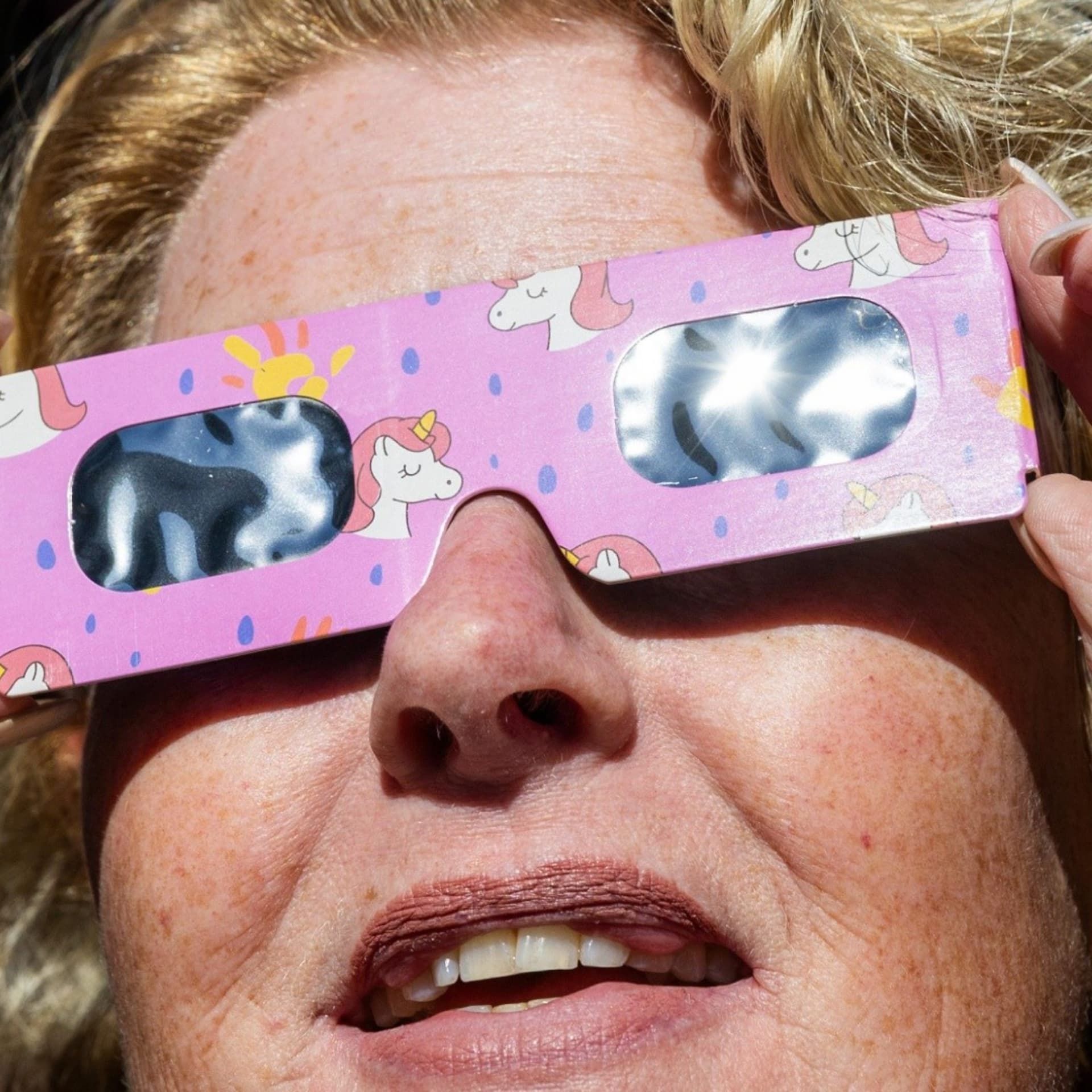
3:11It's quite magical. It's very otherworldly. Once people have seen one, many follow them all over the world such as Paul and Julie Lee who've travelled here from Henley-on-Thames in southern England. This one is in a beautiful country in the middle of the summer. what's not to like, it's going to be a very different eclipse, I think, from the ones that I've seen before, because it's very low on the horizon. The shared experience part of it is truly remarkable, and I think people who don't get underneath the totality don't ever appreciate that. Eclipse glasses are essential when looking at the sun.
3:44Dr Martin Griffiths, an astronomer turned eclipse guide, briefs his party on the risks. It's so bright, so strong, that you could end up damaging your eyesight. But he tells me the glasses can be taken off once the moon completely covers the sun's bright disk. So wait until totality to look at it with the naked eye. But also remember that there are lots and lots of astronomical societies across Spain, across the UK, who are putting on shows so that people can come along and see things properly through properly filtered telescopes. And of course, they'll all have eclipse glasses as well. The total eclipse begins over northern Siberia at sunrise, crosses the Arctic Ocean, Greenland, Iceland, and then sweeps across the North Atlantic and the northern half of Spain, clipping a corner of Portugal, before ending near the Balearic Islands at sunset.
4:37But many others in Europe, including the UK, will see a partial eclipse, where the moon covers more than 90 % of the sun, according to Dr Tim Revel, who's executive editor of New Scientist. So with a partial eclipse, it begins with the moon slowly starting to move in front of the sun. And over the course of about an hour or so, it will take progressively bigger chunks out of the sun as it slowly moves across. And you'll notice the sky starts to get a bit darker. You start to see crescent shadows on the floor, and eventually it will reach the maximum. And then the same thing will happen in the reverse again over the course of an hour.
5:13And you'll see the skies go darker. It might become a little bit colder, the birds might become a little bit quieter, and then that will be the kind of full experience of the partial eclipse. Those gathered here will witness one of the great natural wonders of the universe. Whether it's total or partial, it's a moment that moves us all, reminding us of the wonder of the universe and our place in it. Palab Ghosh with that report. A rescue worker in the Colombian city of Cali described the scene there succinctly. It is, he said, like the end of the world. And you could see what he meant. Not just buildings collapsed around him with people buried alive, but the chaos which so often follows this kind of natural disaster.
5:57People trying desperately to retrieve survivors from the rubble when just reaching the afflicted areas is a challenge. Regional airports near the earthquake have been forced to close. Water and electricity supplies have been disrupted, meaning that coordination of the rescue effort becomes a logistical nightmare. The BBC's José Carlos Cueto López has been on the ground in Kali. Daybreak in Kali. One of the hardest areas hit by yesterday's 7.4 magnitude quake. Residents and rescue teams are working together around the clock, searching collapsed buildings and flattened homes for survivors. Local resident Saul Pass spoke of the devastation that took place close to his home.
6:41This community was formed by several blocks of houses. This was blocky here. All houses were destroyed. This is a total loss. Thank God so many people managed to leave before the houses collapsed. Children and teachers faced falling debris as they made it down the stairwells of this school. Luckily, no one was badly hurt Emergency workers made this dramatic rescue of a woman who was trapped on the rubble of a semi-collapsed building lifting her to safety Behind me there is a totally collapsed building with the rescue teams hoping to find survivors It's a picture familiar where I am just south of Cali which is one of the worst hit areas in this disaster Colombia's new president who has only been in the job since Friday has declared a state of emergency.
7:33However, he now faces up to leading the country through his worst earthquake in a decade. José Carlos Cueto López. It may be a challenge, but Colombia's new president has chosen to make it a personal one, announcing he was taking personal charge of the rescue. Ebolado de la Esprea has been to sea rescue efforts in one of the worst affected areas, Pereira. But according to Annie Correa, Latin America correspondent for the New York Times, the days ahead will be a challenge for a man with such limited experience of governing, as she told my colleague Paul Henley. He was a criminal justice lawyer working from Colombia and from Miami, and he ran businesses, launched brands, had a piano bar, had a gelato shop.
8:20Now he's at the helm of a very large country and of managing a disaster that has spanned a huge swath of that country. So I think he's going to be tested in the sense of his ability to manage the response. He has said that he is personally taking the lead. And he immediately flew to the worst hit areas to speak with people, to get an assessment of damage from local authorities. And he has actually made a tour of some of the cities that have seen the worst damage just like going from one to the next. It almost seems like he's still campaigning as he visits these places. His wife has gone with him and he really seems to be sending a message of confidence and competence that he has got this, that he's going to be able to do it.
9:16It's a big test, isn't it, of his diplomatic strategy. He does have a friend in President Trump and that surely will prove useful. He has made inroads not just with President Trump, but with the U.S. State Department, with Pentagon officials. One of the main promises of Abelardo de los Espriera's campaign was to come down hard on criminals and on armed trafficking groups. So with that promise, it's music to Trump's ears. And the U.S. is offering Colombia$1 billion in assistance for this security cooperation. And so when this disaster hit, Secretary of State Marco Rubio and others immediately voiced their support for Colombia.
10:02Today,$15 million in emergency disaster relief were added to that sum. And the US said that it was going to send a special team to help with disaster response. Not necessarily an advantage when he's in areas controlled by militias and armed gangs, very briefly, that he's the sworn enemy of at the moment. It's true. I think what's extraordinary is that while this disaster hit just yesterday morning, He has continued with his plans, seemingly, to come down on these groups, as he said, with the wrath of God. Annie Corral speaking to Paul Henley. President Trump has confirmed reports that he was taken off his official plane and transferred to another aircraft on his way home from a NATO summit in Turkey last month.
10:51A number of US media outlets said it was because of fears that Air Force One might be attacked by Iran. Here's what the president had to say at a noisy airbase in Maryland. Well, it's only up to Secret Service. I just follow what they'd like to do. They wanted me to go on a different flight, a different plane. They wanted me to do it, so I do it. I do what they say. The whole episode has left those who remained on board Air Force One rather angry, to put it mildly, wondering whether they were in effect acting as decoys. Alex Brandon is a photographer for Associated Press who is covering Mr Trump's visit.
11:26As a veteran of presidential flights, he says he knew immediately something odd was going on. As we arrive at Air Force One in the motorcade, and I look up and I see those catering trucks, I've been covering the president in Washington for 20 years, and presidents going back to Reagan for 20 years before that. I've never seen that before. I immediately started taking pictures, alerting my editors that this was unusual, that that's real unusual for Air Force One. We get to the plane, stop, get out, and the president has already exited the limousine and is already up the stairs and on the aircraft.
12:03That happens. We typically go underneath the wing of the aircraft and photograph, and sometimes the journalists will shout questions and try to get the president to come over and talk to us. So that wasn't unusual that he was already on the plane. And then we board the plane like normal. I get in my seat, which happens to be a window seat. I immediately lift the blind, which is shut, and a flight attendant, which is a U.S. Air Force enlisted officer, comes over and says, blinds have to be kept down. And I say, why? And she says, Secret Service says so. And so, of course, I shut my blind. We had been told that we were switching from the Qatar-donated Air Force One to the legacy original Air Force One.
12:46And so I thought maybe there was a little bit of enhanced security or something like that that they wanted to observe. That's the only indication I got whatsoever. One of my biggest concerns is if, God forbid, the plane that we are on is taken out of the sky and the president continues on, the world thinks that the president is dead. And in that moment, the world needs an independent journalist to say, hey, I'm here. I'm with the president. Everything's fine. It is critically important to have that independent verification. And that's why we do what we do, so that the world knows that, yes, the president is safe in this moment.
13:23Alex Brandon. You mentioned they're the secret service, the people responsible for U.S. president's safety. Although, despite the name, they're not completely secret, as you'll see them on just about every public appearance he makes, usually wearing dark glasses and glancing around nervously to spot any potential attackers. Paul Eklhoff served as a Secret Service agent and says the decision to swap the president's flight raises many concerns, not least that this strategy has now become public knowledge. Everyone is fascinated by the airplane, the catering truck, the alleged deception, which I can neither confirm nor deny that it occurred.
14:00I'm more interested in who benefits from revealing how the Presidential Protection Division responds to a credible threat. Every disclosed detail potentially helps an adversary understand our capabilities contingencies and decision making. There are two limousines in the motorcade. You don't know which one he's in or if he's even in one of those. When the president travels to war zones, there are frequently tactics and techniques that are used to create doubt in an adversary of which aircraft or which movement he's going to make. What concerns me is if sensitive operational information and materials were disclosed by someone with privileged access, the Iranian threat may have ended a month ago when the president left Turkey.
14:39But the threat posed by someone willing to disclose how we protected him may have traveled home with him. Threats to Air Force One have been persisted. They even changed the call sign many years ago after Air Force One when intelligence revealed that adversaries knew the call sign for Air Force One. If the reporting is accurate, those journalists weren't left sitting in an unprotected airplane somewhere. They were aboard Air Force One, one of the most sophisticated and protected aircraft in the world. Paul Ekloth. And we go from one flight story to another, this one involving what should have been a routine plane trip between the Canadian cities of Victoria and Toronto.
15:15But that wasn't how it worked out. Our reporter in Seattle, Max Matzer, told us more about what happened and why the flight was cancelled. This was a Porter Airlines flight. Their statement says that a young child was standing in their seat and would not secure their seatbelt. Attempts by the accompanying parent and crew to address this were unsuccessful. The aircraft could not take off in this unsafe condition. So the crew decided to turn around and actually cancel the flight because at that point, it was after midnight and the runway was about to close. So all of those passengers had to depart the plane and stay in hotels or go back home and come back to the airport the following day.
15:53Just this summer, there's been three viral Reddit posts about really similar circumstances, except in those cases, the flights were only delayed. In this case, the flight was actually canceled, but that's because it got so late in the day and after the passengers had to be removed from the plane, at that point, it had gotten too late. So this seems to be the only case that I could find of a flight actually being canceled because of a toddler refusing to sit. Mostly it's airline policy, according to the experts I talked to, that kids under two sit on their parents' laps. The kid is not strapped in.
16:26It's not only a danger to the child, But it's also a danger to other passengers because that kid who is not restrained in the event of turbulence or any other kind of incident, they could become a projectile that bashes into other people on the plane. Same reason why you have to secure your luggage for takeoff and departure. This expert I was talking to, she's adamant that no child should be unrestrained on a plane, that it's very unsafe. In her opinion, anyone under seven years old should be in a car seat. If you use a car seat when you're in a car, you should use the same car seat when you're on a plane.
16:59Max Matzer. Still to come in this podcast. The ones outside the Colosseum, they're 12 metres, so you're kind of throwing it a lot closer to the target, what we call the house. How the winter sport of curling is wowing fans in hot, sunny Rome.
17:26With the new Schwab Teen Investor account, teens can gain hands-on investing experience and build positive money habits. It's an account co-owned by you and your teen, so you can monitor and engage with the account while your teen learns how to invest and manage money. Learn more at schwab.com. Lives Less Ordinary is bringing you a special series of extraordinary love stories from all around the world. In India, love at first sight feels more psychotic than arranged marriage. Love stories that break all the rules. We came into our relationship with a lot of complicated pieces. Stories that show that sometimes love is all you need.
18:03Lives Less Ordinary love stories from the BBC World Service. Listen now. Search for Lives Less Ordinary wherever you get your BBC podcasts.
18:18This is the Global News Podcast. He was found guilty of war crimes and crimes against humanity, and Syria's ousted dictator Bashar al-Assad has been sentenced to death for these offences, committed during Syria's brutal civil war, which cost about half a million lives. It's the first conviction against Assad, who fled with his family to Russia after his regime was overthrown in 2024, and who remains there. But in court for the verdict was his cousin, who was also sentenced to death, Atif Najib was the head of political security in southern Syria's Deirah province. Outside the courthouse, people chanted and celebrated the verdict.
18:59Celia Hatton got more reaction from Heber Othman, Damascus correspondent for the BBC's Arabic service. I was outside the Palace of Justice in Damascus when the court issued a death sentence against the former Syrian regime, among them Bashar al-Assad and Maher al-Assad and Atif Najib, the material cousin of Shah al-Assad and the former head of the political security branch in government. Outside the Palace of Justice in Damascus, I noticed a kind of joy and happiness among a number of victims' family who gathered to celebrate the verdicts, while some families were holding pictures of victims who died at the hands of the security branch personnel in Dar 'a government.
19:49The families of victims commented on the ruling as a new victory for the Syrian revolution and as a victory for the transitional justice here in Syria. Hebar, in the crowd was Nayef Abidzai, who was detained by the Assad regime in 2011. He gave his reaction to the verdict. I was detained by the Assad regime. They took me from my school when I was 13 years old. Thank God Assad fell and his cousin, Atif Najib, will be executed. And God willing, it will be Bashar Assad's turn to be executed. Heber, Bashar al-Assad fled to Russia in 2024. how will these sentences, the sentence against him and also his younger brother, be implemented?
20:39The court also issued an absentia death sentence against Bashar al-Assad and his brother on charges relating to committing war crimes and crimes against humanity. But I think this is something symbolic. I don't think that Moscow will hand over Bashar al-Assad to the new Syrian government. So this is something symbolic. They will only charge Atif Najib right now. Should we expect more sentences to be handed out? A death of sentence against Atif Najib and Bashar al-Assad and Mahal al-Assad and many people from the last Syrian regime. It's enough to ensure the stability in whole Syria. During this month, also the fourth court here in Damascus, they will continue the trial of Ahmed Hassoun, the last mufti of Syria.
21:31Also, Wassim al-Assad, the cousin of Bashar al-Assad, the last Syrian president. So they will continue the charges against many of the last former regime in this month. Hebar Othman from the BBC's Arabic service in the Syrian capital, Damascus. New court documents show Donald Trump has amended his legal case against the BBC. The president is suing the corporation for$10 billion over a documentary, which sliced together two parts of a speech he made on the day of the Capitol Hill riots in 2021. Mr Trump's amended lawsuit now focuses on the harm he claims he suffered personally, as our media editor Katie Razzle explains.
22:13The Panorama programme was, according to this latest court filing, a brazen attempt to influence the outcome of the 2024 election, and the BBC caused overwhelming reputational harm to the president personally, it says. But his legal team has removed claims made in previous documents that his business and professional interests have also suffered direct harm. The BBC had sought access to Mr Trump's financial records. It argued it needed evidence that his businesses and brands had suffered. But his team pushed back, saying disclosure would cause him harm. Now the president's team has removed that element of his case.
22:52Mr Trump is still suing the BBC for at least$10 billion. The document suggests it's reasonably certain the programme could have been viewed in Florida, where the president is bringing his case. The BBC has apologised for an editing error that it says gave the mistaken impression that President Trump had made a direct call for violent action. But it has previously said the programme didn't meet the legal criteria for defamation and wasn't made available on US platforms. The next stage is for the BBC to respond to Donald Trump's latest legal filing, with the case due to come to court in February.
23:28Katie Razzle. It's one of the more marked legacies of the Covid pandemic. People who were forced to work from home, deciding they actually rather like avoiding the daily commute and have continued to stay away from the office. But that's left many offices partially or maybe largely empty. So what to do with all the unused space? Our reporter John Lawrenson has been investigating. I'm standing in the middle of Europe's biggest business district, La Défense, just west of Paris. I'm here with Pierre-Yves Guisse, the head of Paris La Défense, the public company that runs this district. The vacancy rate is around 14-15 % at the moment.
24:10Around 400 ,000 square metres of existing offices might have to be transformed in the next 5 to 10 years into mostly housing, but also higher education facilities or entertainment facilities, shops, restaurants. So here you are in the office, and there are desks and screens. Tomorrow you are in an apartment. Roland Cubain, deputy CEO of the Group Arma real estate management company, shows me around La Tour Diamant, the diamond tower, which has office space for 1 ,800 workers. He doesn't want it to disappear exactly, but he does want to convert it. Here there will be two bedrooms. One of the challenges when you're converting office blocks into flats is the width of the buildings.
24:55Generally, they're much wider than residential ones, so you have a lot of windowless space in the middle that it's difficult to know what to do with. There won't be any rooms there. No, it's only the access. But even for the most suitable buildings, Roland Cuban says office-to-housing conversions are not going to happen at scale in France unless the authorities remove some obstacles. At the moment, as soon as you transform a building in a way that changes its function, it is classed not as an old building that's been changed, but as a new building with all the regulatory demands that go with new buildings regarding car parking spaces, wheelchair access, fire safety and so on.
25:40Is it economically viable to convert offices into housing? Ludovic Deles is CEO of the French arm of the Canadian real estate services company Colliers. Yes, but in most cases only on the condition that the building can be acquired at a low price. It's offered a better proposition economically to build hotels or student accommodation because you can be certain of the demand. For office conversions at scale, the best examples are in the United States, in New York and also Washington DC. They found it's generally easier to convert steel frame buildings than concrete ones, although the structural problems uncovered during the conversion of New York's former Pfizer headquarters are a reminder that such projects can involve significant engineering challenges.
26:30John Lawrenson. The winter sport of curling is one of those which tends to capture people's attention, with the distinctive sight of competitors frantically scrubbing at the ice to make sure the stone, as it's called, glides as close as possible to its target. Now, curling is obviously associated with colder climates, but would you believe it's become popular in Rome, though only by replacing the ice with a surface more suited to a city where temperatures regularly reach the mid-30s. Jan Dodds is a British medal-winning curler. She explained to Nick Erdly that Italy's newfound affection for the sport stems from the national team winning a medal of its own at the last Winter Olympics.
Read the full transcript
27:11Italy obviously helps the Olympics and they got a bronze medal in the mixed doubles and obviously winning the gold in Beijing as well. So they've had a lot of success and I think with success it breeds interest in the game. Curling is quite a long sport so you can dip in and out of it as well and it's always on the TV. So it's been really good for the sport, I think. Tell me a bit about the actual practicalities though, because this isn't ice. It's a synthetic surface. It looks a bit like it's not proper curling. It's almost throwing mini stones in the hope that they land in the right place. Yeah, it's, let's say, a shortened game.
27:50So the ones outside the Coliseum, they're 12 metres. So you're kind of throwing it a lot closer to the target, at what we call the house it probably does make it a lot easier if you can imagine if you're trying to throw a ball at something it's a lot easier when it's closer to you than further away but they don't have sweepers or anything like that because it's synthetic the sweepings i suspect doesn't really do much you still need to have the feel you still need to throw it into the rings to the closest to the center but i would say on ice it's still harder because you've got so many other things to think about obviously you need to keep your balance you've got the sweeping and that affects the line of the curl as well.
28:30So I would say on ice is a lot harder, but I think it gives a really good insight to what we do on ice. It's kind of a good beginner step and I feel it can get people more interested in curling as well and it's more accessible. So it's a really good beginner step, I would say. Jan Dodds. A career-orientated woman from a big US city visits her small hometown over Christmas and falls in love with a ruggedly handsome yet sensitive guy. That is the kind of tried and tested formula for Hallmark's TV movies, which have charmed audiences over the years. The American Channel is celebrating its 25th anniversary.
29:07Here's a look back at some of its classic moments. You were there for all those crazy early Christmases, and you've been there ever since. And I always will be. I'm going to show you that the story of the Christmas hat isn't over. It's kind of different ending. I used to dream about a moment like this. I even asked for one just like it for Christmas. Rule number 56. Never let a mistletoe moment go to waste. Stick with me, kid. I'll show you around. Well, I'm planning on it. Merry Christmas, Jack. Merry Christmas, Lucy. Merry Christmas, Lucy. Happy ever after endings all round, but with such predictable conclusions.
29:48What explains Hallmark movie's enduring appeal? Siobhan Sinnott is a film and television critic. She thinks she knows the answer. When modern life seems loud, chaotic, overloaded, I think people crave something soft, predictable and emotionally safe. In Hallmark films, you know there's not going to be any jump scares. There's not going to be any maniacs in a cupboard. There's no bleak twists. There's no existential dread. It's just gentler man, small town charm and somebody trying to save a bakery. To be fair to Hallmark, they have evolved. and part of that evolution has been pushed on by streaming services.
30:23Hallmark's looked at Netflix and Prime Video and Disney crowding out particularly the holiday space and said, right, we're not competing on size, but we are competing on comfort. So there has been a strategic shift in Hallmark towards better cinematography, more polished sets, stronger casting, bigger location shoots. These films may still feel cosy, but they look less like they were shot in somebody's redecorated gift shop. And the storylines have also changed. I mean, yes, there is a lot of the templates are big city girl returning home or a royal romance with a prince in disguise. But we also see more LGBTQ plus storylines.
31:03We see more diversity in the storylines, both racially and in terms of religion. I mean, it's definitely afternoon viewing, but they are, I think, more self-aware now. In a world of endless choice, Hallmark's strategy still works. Gives people something warm, gives people something familiar, gives people something that's easy to love. Siobhan Sinnott. That's all from us for now. If you want to get in touch, you can email us at globalpodcast at bbc.co.uk. That is exactly what John Hammar from Shediac in New Brunswick, Canada did, describing the Global News podcast as decisive, to the point, short and sweet and his go-to news channel for the truth on world matters.
31:51John, thank you very much. You can also find us on X at BBC World Service. Use the hashtag hashglobalnewspod. And don't forget our sister podcast, The Global Story, which goes in-depth and beyond the headlines on one big story. This edition of the Global News podcast was mixed by Zabihullah Kurush and the producer was Emma Joseph. The editor is Karen Martin. I'm Paul Moss. Until next time, goodbye.
From the publisher
People across the world are eagerly awaiting a solar eclipse, with the Moon set to block out our view of the Sun. The BBC's science correspondent reports from northern Spain - one of the areas expecting a rare total eclipse. Also: rescue efforts continue after the earthquake in Colombia; a Syrian court sentences the ousted president, Bashar al-Assad, to death for crimes against humanity; Donald Trump defends swapping planes due to a reported security threat, despite anger from journalists left on Air Force One; the Winter Olympics sport of curling finds new fans in sunny Italy; and the American TV channel Hallmark celebrates its 25th anniversary.
The Global News Podcast brings you the breaking news you need to hear, as it happens. Listen for the latest headlines and current affairs from around the world. Politics, economics, climate, business, technology, health – we cover it all with expert analysis and insight. Get the news that matters, delivered twice a day on weekdays and daily at weekends, plus special bonus episodes reacting to urgent breaking stories. Follow or subscribe now and never miss a moment. Get in touch: globalpodcast@bbc.co.uk
Photo: Solar eclipse viewing preparations in the Netherlands. A woman wears eclipse glasses in Almelo. 11 August 2026. Credit: Vincent Jannink. EPA/Shutterstock