In short
Global News roundup plus a behavioral-science promo. Main news includes: a Guinea landfill collapse in Conakry killing at least 30; Ukraine’s sacked defence minister calling for elections during wartime; a fast-moving Nevada wildfire forcing mass evacuations; Maradona’s “Hand of God” ball selling for $3.3m; US-Iran sanctions; an IndyCar race through Washington DC; and Erling Haaland debuting a new crew cut.
Guests/backgrounds
No named “guests” in the usual sense; interviewees include Nobel/behavioral-science author promo voice (unnamed), BBC reporters Makawachi Okafor, Valerie Sanderson, Dan Johnson, David Willis, Tim Vickery, Paul Henley, and economist Prof. Dejaved Salehi Isfahani; plus Shane Ackerson (Nevada incident commander) and Mikhailo Fedorov (former Ukraine defence minister).
Key claims
Guinea’s collapse followed heavy rain; warnings were sent months earlier; death toll may rise. Fedorov insists elections must be discussed despite war; Zelensky rejects wartime elections as too risky. Nevada’s “Hawk Fire” spread rapidly due to dry brush and high winds; cause possibly human activity. Maradona ball expected to sell higher but reached $3.3m. US plans secondary sanctions; Iran says they’ll fail and cites inflation/currency strain.
Notable examples
survivors describing the collapse at 2–3am; Ukraine drone attack on a shopping centre where sirens sounded but it wasn’t evacuated; Reno Convention Centre shelter; Maradona’s 1986 England-Argentina quarterfinal ball; IndyCar 250th anniversary race at 300 km/h; Haaland’s “new season, new trim” crew cut.
Written by AI. May contain mistakes. Listen to the episode to check what was said.
Chapters
Tap a time to open that second in VOGuinea Rubbish Landfill Collapse
1:03 to 1:50
Discussion about the recent landfill collapse in Guinea that killed 30.
“A landslide caused by a mountain of rubbish collapsing at a waste site in Guinea kills at least 30 people.”
Eyewitness Accounts of the Disaster
1:50 to 2:21
Eyewitnesses recount their experiences during the landfill collapse.
“It really was the day that Maradona stopped being considered an ordinary mortal by Argentine society and started to be considered a god.”
Background on Waste Management Issues
2:21 to 4:24
Exploration of Guinea's ongoing waste management problems and previous incidents.
“the authorities said it happened early on sunday morning following heavy rain days after officials were planning to close the site because of the danger these two men were among the survivors.”
Preventing Future Incidents
4:24 to 6:06
Discussion on potential measures to prevent future landfill collapses.
“Unfortunately, now there's been 30 deaths.”
Ukraine's Political Landscape
6:06 to 8:37
Examination of calls for elections in Ukraine amid ongoing conflict.
“Ukraine's former Defence Minister Mikhailo Fyodorov has told the BBC that he stands by his call for nationwide elections, even though the country is at war.”
Corruption Allegations and Governance
8:37 to 11:02
Discussion on corruption allegations within the Ukrainian government.
“But, of course, it's also in the interest of all Ukrainians.”
Nevada Wildfires: Current Situation
11:02 to 13:28
Update on the fast-moving wildfires affecting Nevada.
“about what level of disruption they put up with and react to, what level of risk they are willing personally to take.”
Firefighters' Efforts and Challenges
13:28 to 14:00
Insight into the challenges faced by firefighters in battling the Nevada wildfires.
“David, do we know the cause of the fire?”
Firefighting Efforts and Challenges
14:00 to 15:06
Learn about the challenges faced by firefighters battling a blaze near an evacuation zone.
“they are just outside the evacuation zone, very close to it.”
Diego Maradona's Iconic Goal Ball Auction
15:09 to 16:50
Discover the story behind the auction of the ball used in Maradona's infamous goal.
“The football that Diego Maradona punched into the net for his infamous hand-of-God goal has sold for$3.3 million at auction in the US.”
Show all 14 chapters
Maradona's Legacy and Impact
16:50 to 17:11
Explore Maradona's lasting impact on Argentine society and football culture.
“about the wonderful second goal that he scored there on the BBC radio.”
US Sanctions and the Impact on Iran
18:11 to 22:09
Examine the effects of US sanctions on Iran's economy and citizens' lives.
“The United States' sustained bombing campaign has failed to defeat Iran militarily.”
IndyCar Grand Prix Celebrating US Independence
22:11 to 24:42
Experience the thrill of the IndyCar Grand Prix in Washington D.C.
“for an IndyCar Grand Prix to celebrate the 250th anniversary of American independence.”
Erling Haaland's New Look and Reactions
24:42 to 27:52
Hear about footballer Erling Haaland's drastic hairstyle change and reactions.
“As the English Premier League kicked off this weekend, there was one story away from the football on the pitch that grabbed plenty of the headlines.”
Transcript
Automatic transcript. May contain errors.0:00This BBC podcast is supported by ads outside the UK.
0:30an award-winning behavioral scientist and author of the best-selling book, How to Change, as she shares true stories from Nobel laureates, authors, athletes, and everyday people about why we do the things we do and how to make better choices to help avoid costly mistakes. Each episode covers the latest research in behavioral science and dives into themes like the power of self-control, shaping your mindset for success, navigating new beginnings, and why starting over can feel so hard. Listen to choiceology at schwab.com slash podcast, or wherever you listen.
1:24stories. A landslide caused by a mountain of rubbish collapsing at a waste site in Guinea kills at least 30 people. In Ukraine, the sacked defence minister tells the BBC he stands by his call for elections despite the war. 90 ,000 people are ordered to flee their homes in the US state of Nevada due to a fast-moving wildfire. Also in this podcast... It really was the day that Maradona stopped being considered an ordinary mortal by Argentine society and started to be considered a god. The football Maradona punched into the net with the hand of God has sold for millions of dollars.
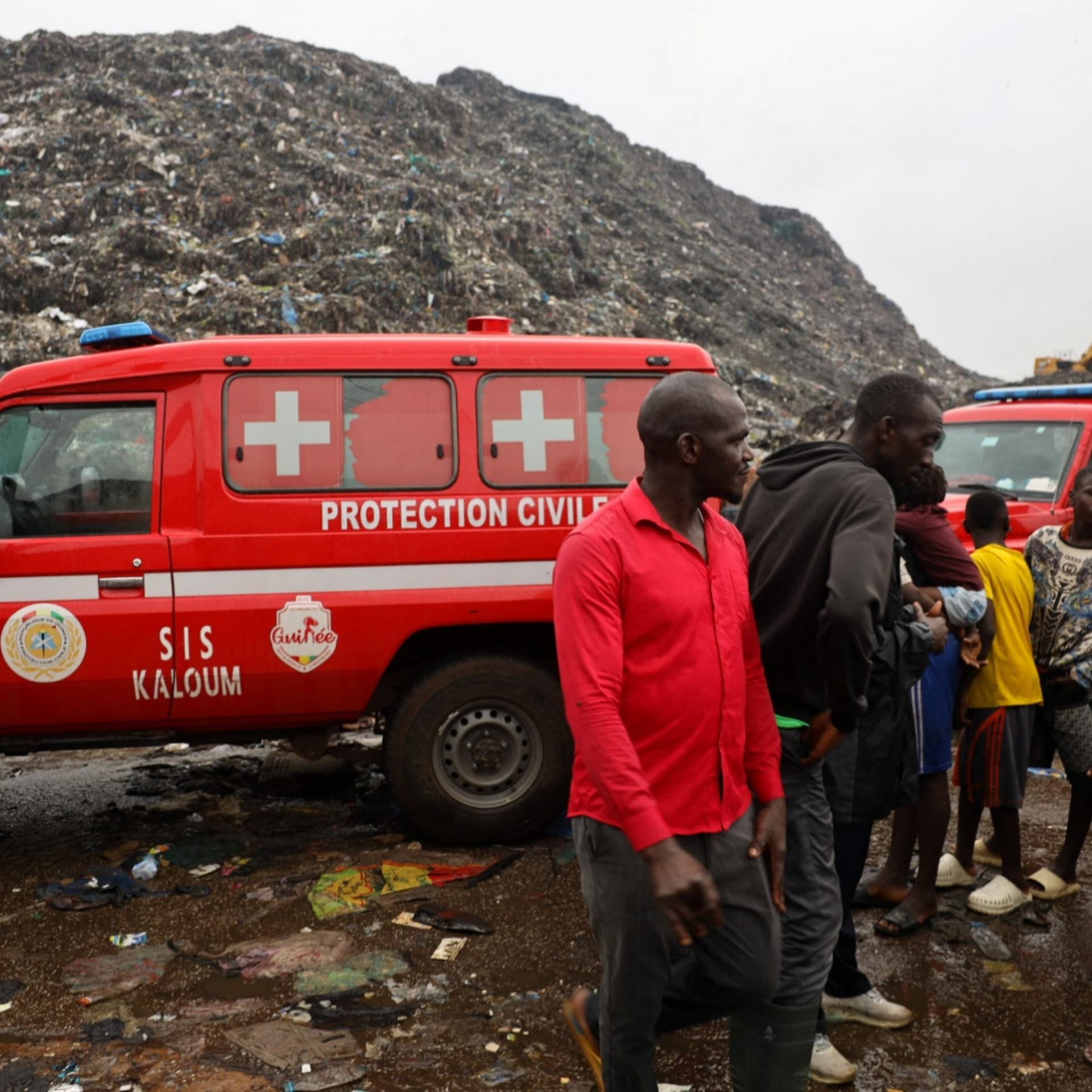
2:11at least 30 people have been killed and six injured in the west african state of guinea after a large pile of rubbish collapsed at one of the biggest landfill sites in the capital conakry the authorities said it happened early on sunday morning following heavy rain days after officials were planning to close the site because of the danger these two men were among the survivors.
2:36At around two or three in the morning, we heard something sliding, a scream outside. Everyone was shouting. I then called to my wife, we can't stay in the house, people are screaming outside, let's go. By the time we got outside, not even two or three minutes had passed. I was sleeping with my little brother, my two brothers. I was sleeping, there were strange noises behind me. Then I saw it collapse. So there were two of us, my little brother. The other one died in it and we got the other one out. I went to call people to come and help me and get my mother out. Oliver Conway heard more about the accident from the BBC's Makawachi Okafor, who's in the region.
3:16Authorities in Guinea have said, following some heavy rainfalls, because currently now it's rainy season in the country, a huge part of a landfill in the Isalam area collapsed into people's homes. And now six people were injured. Also about 15, over 15 more people sustained minor injuries. Several homes around that area got destroyed. Such a rescue operations are still going on because they suspect some bodies are perhaps trapped under the rubble of what has happened. So that sort of means that this death toll of 30, they're saying that there's potential that it might rise. Now, a bit of background, Guinea has had huge waste management problem for the longest time.
4:01In the past, there's been incidents similar to this in 2019 and 2017, still around the same area where this was reported. And the country has been making efforts to manage waste a lot better. In fact, they tried to close this particular dump site that has collapsed and, you know, explore new places. But that seems not to have just worked out. Unfortunately, now there's been 30 deaths. And do we know what was being dumped in this landfill site? Was it household waste or something from industry? It's more of household waste, plastics, clothes, you know, regular dump sites, not like on an industrial level.
4:43And that's sort of also now become quite a huge issue because people live around here. I mean, the country's population is growing. Urbanization is happening. People don't have so much space in the newer urban areas. And these are low-income families kind of forced to live close to this dump site that have this sort of rubbish from homes, you know, food decaying, food materials, clothes and plastic and all that. And that's sort of what just collapsed and, you know, into some people's homes following the rains and led to this unfortunate and tragic incident. And what can be done to prevent this kind of thing happening again?
5:21I mean, authorities say they've been first sending warning signs to people living there up on like as way back as six months ago that have been raising awareness. But people seem not to have heeded to that. maybe stronger enforcement perhaps would have helped in getting people out of there early enough, strong early warning signs, and also even considering recycling, because that has also been one of the ideas the country has been looking at exploring, recycling waste. But that seemed not just to have happened as smoothly as they have planned through the years. And, you know, it has now led to this.
5:57Now they are closing the site where this happened. So there's potential that new sites could be opened and better ways of managing the waste could be explored. Makyochi Okofor. Ukraine's former Defence Minister Mikhailo Fyodorov has told the BBC that he stands by his call for nationwide elections, even though the country is at war. But he stopped short of saying that he would stand as a candidate. Mr Fyodorov, who was sacked last month, is the first high-profile politician to call for elections which have been delayed for two years. Valerie Sanderson heard more from our Ukraine correspondent Dan Johnson in Kyiv.
6:33Well he has called for widespread political reform. He highlighted corruption and inefficiency and a number of issues throughout the way that government is run here in a video statement that he posted saying the country was going through a crisis of governance and that that's why he felt it was right to confront the question of Ukraine's elections. He told me he wasn't necessarily insisting on that right now, but that he thought it was his moral right to at least start the conversation about the practicalities of holding an election. He said it was inevitable that an election would have to come sooner or later.
7:11But his call largely felt flat. There was very little support for it because most Ukrainians see the difficulty, the risk of Russian interference in that election, the complication of how to actually involve and engage people in a free and unfair vote at a time of war when there were so many people displaced and fighting, people who are living under occupation. So with all these considerations, I asked if he regretted the call that he made. He's been accused of destabilizing the country and opening up splits in Ukrainian society. I put to him that some Ukrainians think he has, by doing this, given a gift to the Kremlin and to Vladimir Putin.
7:51A huge number of people started talking and supporting the idea of coming back to the democratic cycle. And I believe that neither Putin nor the president of any other country can speak about our own democracy. We are the only ones who will decide what we do going forward. That's what democracy is all about. If I cannot share my ideas and be open about them, then what are we fighting for? You really believe an election would be in the interests of Ukraine and not in your personal interests? It's definitely in my vested interests, because I want this war to be over and Ukraine to become a successful country.
8:33So, yeah, this is in my interest for sure. But, of course, it's also in the interest of all Ukrainians. But if you're asking whether it will be useful for my political future, if I were thinking about this, I would not have made the statement. So Dan, what about President Zelensky's response to all this? Because, you know, he'd accused Mr. Fedorov of being corruption, hadn't he, within President Zelensky's government? Yes, he raised the question of corruption. On elections, we have a fresh response from President Zelensky saying, I believe that if we want to destroy the country, then during a war like this, we can move towards elections.
9:14He said he believed that during a war, elections involved enormous risks and that right now an election would be a tsunami for the state that would divide Ukraine. So he's holding firm on that. On corruption, I asked Mikhailo Fedorov whether he thought President Zelensky should have been aware of the allegations that have now come closer and closer to his inner circle. A deputy head of the presidential office was sacked amidst new allegations of money laundering. Mikhailo Fedorov said he thought the president should answer questions about his awareness and what he knew. There's been an angry response from the president's office to that, saying that Mikhailo Fedorov was part of that government for the last seven years and they never heard him raising concerns about corruption then.
9:56And all this is happening, isn't it, as an investigation is underway into suspected criminal negligence, into the managers of a shopping centre where 16 people died in a Russian attack on Friday. What can you tell us about that? Yes, this was a shopping mall in Krivirii, closer to the eastern front lines. A double Russian drone attack, a double tap, half an hour apart. So one drone hit the shopping centre and exploded. And then as emergency responders were dealing with the casualties there, a second drone hit. It emerged that although air raid sirens had sounded across that region warning of incoming attack.
10:34The shopping centre had not been evacuated and many people were not in the bomb shelter, hence why there were so many deaths and injuries there. There is now an investigation into why people were not told to take shelter or why they ignored those warnings. It is an issue right across Ukraine, four and a half years into this war. The sirens are so regular, so frequent, that not everybody does react as seriously as perhaps they should. This is a difficult issue of everyday life for Ukrainians about what level of disruption they put up with and react to, what level of risk they are willing personally to take.
11:08Dan Johnson. Firefighters in the US state of Nevada are battling fast-moving wildfires. They've reached the outskirts of the city of Reno where tens of thousands of people have been told to leave their homes. Shane Ackerson is a local commander leading fire and rescue operations. Fire is currently sitting at approximately 13 ,000 acres. We have 800 personnel working on the incident, and we are working and engaged 24 hours a day with both ground and aviation resources. Currently, we have 42 ,000 individuals who are displaced and on an active evacuation, with approximately 45 ,000 individuals that are in the set status to be prepared to evacuate.
11:51I got this update from our North America correspondent, David Willis, who's in Los Angeles. Well, what surprised firefighters with this particular blaze in mind, Alex, is the speed at which the flames have started to spread. Saturday night, there was, I think, very little to suggest that this would move at quite this speed. But there is dry brush and very high winds. And that, of course, is a potent cocktail. It's now covered this. It's called the Hawk Fire. 13 ,000 acres of land. That's more than 50 square kilometers. and officials have urged a total of more than 90 ,000 people to evacuate from their homes and they include some residents near the state borders with Oregon and California and several homes in the north of Nevada, northwest of Reno, that's a gambling town, are thought to have been destroyed and at least six people, officials say, have been injured.
12:52Nevada's governor, Joe Lombardo, has declared a state of emergency and he's bringing in the National Guard to support aerial firefighting efforts to also safeguard evacuated neighborhoods. But Reno is a gambling town and casinos there are even offering discounts on hotel rooms to those who've been forced to flee those flames. And indeed, more than 400 people spent the night at the Reno Convention Centre, which has been turned into a shelter for evacuees. David, do we know the cause of the fire? Well, officials haven't pinpointed a precise cause, Alex, but they say, perhaps cryptically, that human activity in the area is thought to be to blame for the fire.
13:42Now, that, of course, could include a number of different things. And we'll wait for more details, perhaps, before speculating on that. But it's a major concern because the University of Nevada's Reno campus, where many of the 20 ,000 undergraduates have arrived in the last few days in order to begin their new terms, they are just outside the evacuation zone, very close to it. and university officials have said they're monitoring the fire's progress and that an evacuation plan has been prepared in case it becomes necessary. What are the chances of bringing this under control quickly and with minimal disruption and death?
14:27Well, bringing it under control they will. The speed at which they do that I think very much depends as ever on the elements. They are the firefighters trying to battle this one, as I mentioned, from the air. They're using helicopters, and that's more or less the most effective and only hope that they can of getting a march on these sort of blazes. We've seen it ourselves here in California, and those helicopters have often been used very effectively in these sort of instances. But it's very unpredictable, this blaze, Alex, and it could, who knows, take days, maybe even weeks, to put it out completely.
15:06David Willis in Los Angeles. The football that Diego Maradona punched into the net for his infamous hand-of-God goal has sold for$3.3 million at auction in the US. The ball was used during the 1986 World Cup quarterfinal between England and Argentina. Maradona scored two goals to give Argentina a controversial 2-1 victory just four years after the war in the Falkland Islands, self-governing British overseas territory in the South Atlantic, which Argentina claims was its own and invaded in 1982. Britain sent a naval task force and defeated the Argentinians, who call the islands the Malvinas. The South American football journalist, Tim Vickery, told us more about the sale of the football.
15:57Well, there was an expectation, a hope, that the price would be far, far higher, maybe even 10 million. Maradona's shirts that he wore in that game sold in England for 9.3 million some four years ago. So there was hope and expectation that there will be more money. But the money isn't in Argentina, is it? And it's Argentines who would be most disposed to own these artefacts because these are such important artefacts in Argentine society. The day that Diego Maradona scored those two goals against England, the nature of the two goals that he scored and the opponent against whom he scored them, it really was the day that Maradona stopped being considered an ordinary mortal by Argentine society and started to be considered a god with disastrous consequences for the rest of his life.
16:49So Diego Maradona, I remember that marvellous radio commentary about the wonderful second goal that he scored there on the BBC radio. It was Brian Butler, Maradona, stocky little man, wriggling like a little eel. And even beyond the grave, Diego Maradona continues to wriggle like a little eel. Tim Vickery. Still to come in this podcast. The season starts now, so it's time to get a fresh start and everything. I'm a bit nervous. I want buzz cuts like I've been in military. The most famous golden locks in football are no more.
17:32with the new Schwab teen investor account teens can gain hands-on investing experience and build positive money habits it's an account co-owned by you and your teen so you can monitor and engage with the account while your teen learns how to invest and manage money learn more at schwab.com get more with bbc podcasts wherever you listen be the first to listen to your favorite shows like evil genius good bad billionaire and you're dead to me with a subscription to bbc Podcasts Premium on Apple Podcasts. You can also enjoy a range of our podcasts ad-free with an Amazon Music subscription.
18:10This is the Global News Podcast. The United States' sustained bombing campaign has failed to defeat Iran militarily. Now President Trump is planning further financial pressure against Tehran. The US Treasury Secretary Scott Besant is going to outline a new series of economic penalties. Under the measures to be announced on Monday, it's expected that the US could threaten secondary sanctions on any entity doing even limited business with Iran. Tehran has dismissed the new sanctions as doomed to fail. But Iran's economy is really struggling. Inflation has rocketed and its currency has hit a record low against the US dollar.
18:50Paul Henley spoke to Professor Dejaved Salehi Isfahani, an Iranian economist at Virginia Tech University in the US, and began by asking how everyday lives are being affected by the war and sanctions. Prices are rising very fast and maybe the larger problem is that the rate at which prices increase is changing. So people who last month knew how to spend money the first week of the month, so they would have enough for food for the last week of the month. They're not sure if the same applies to this month. So inflation rates can change from one month to another and that uncertainty more than anything is putting pressure on low-income families.
19:36What are the sanctions at the moment and how much worse can they get? The then Vice President Biden said in 2012 that US sanctions on Iran were the most crippling ones in the history of sanctions, period. Yes, that's the trouble with those announcements. They don't leave much room for later increasing or making people think that they're ratcheting up the sanctions. I don't really know what they're talking about in terms of the D-Day and finishing off the regime. Iran has borders with at least six countries that can supply food to it. And if you just focus on that, Iran is mostly self-sufficient for its food.
20:19They were planning to import about a billion dollars worth of wheat, which can probably come easily from the northern borders. And I don't see a food shortage or hunger becoming an issue. But industrial inputs, yes. A lot of those come through the Persian Gulf, through the sea. And I think the blockade is causing a lot of damage that sanctions never did. What are Iranians, what are Iranian citizens saying about the situation at the moment? Can you give us a feeling, a sample? Well, it depends who you talk to. The interesting conversations I had was with people who were previously anti-regime. A year ago, they might have been complaining a lot and saying they're corrupt, they're mismanaging the economy.
21:05This time, they were talking with some pride and surprise that they didn't think that the Revolutionary Guards would be able to hold the line and prevent U.S. and Israel from actually entering the country to land and then control the government. They were very proud that what happened in Venezuela is not happening to Iran. I think there is that on one side, and then there is these pressures of daily life, the economic misery that we were talking about earlier. And these two are kind of two very different emotions that Iranians are dealing with every day. The desire to defend this long, several millennia old civilization against these forces that don't seem to really appreciate the country and just want it to surrender.
21:52And also they find their government, so sections of the government is playing very hard line and maybe is not allowing some decent, respectable peace from prevailing. Professor Dejaved Salehi Isfahani. The streets of Washington DC were turned into a racetrack on Sunday for an IndyCar Grand Prix to celebrate the 250th anniversary of American independence. Drivers sped past famous lambarks including the National Mall and the Capitol Building at more than 300 kilometres an hour. President Trump and the First Lady Melania Trump were watching on as was our correspondent Helena Humphrey. A city used to races for power, but none quite like this.
22:41President Trump waved the green flag and then they were off. 25 drivers roaring through the capital streets. Do I hold on? The car will hold on to you. Before the race got underway, I strapped in for a taste of the track.
23:04Seven tight turns on a circuit never raced before. We were just going 119 miles per hour around this track, flying past some of the most iconic sights in Washington, D.C., and those drivers are going to be going even faster than that. This track, a new thrill even for the drivers. Super unique. You might never see this again. So I think certainly as an American driver, it's very special celebrating the 250th anniversary of the country to race in our nation's capital. It's such a beautiful city. It's very surreal to get to drive an IndyCar around this place. With tens of thousands of spectators lining the circuit, President Trump took a victory lap in the beast before the race had even begun, his new Air Force One completing a flyover above.
23:52His close association with the event led some to question whether it was truly a bipartisan celebration. For those attending, though, a party atmosphere largely drowned out any political noise. Cheers! I love open-wheel racing, and we've been doing every America 250 event we could all year, so this is our last one for the year, and we're excited about it. I've never been to one of these races before, so this is a first-time event for me. I've never seen a car go over 200 miles an hour, so I just want to see how that looks and just the sheer power of these engines and stuff. After 147 laps, or 250 miles, Kyle Kirkwood took the chequered flag, an American victory for America's 250th birthday.
24:39Helena Humphrey in Washington. As the English Premier League kicked off this weekend, there was one story away from the football on the pitch that grabbed plenty of the headlines. The Norwegian star Erling Haaland is beginning the season with a new look. The Manchester City player was one of the standout strikers at the recent World Cup where he scored seven goals. But he became almost as well known for his long blonde hair, tied up at the back in a bun. Now, Haaland has revealed on social media a crew cut with the caption, new season, new trim. Pete Ross told me more about Haaland and other hairdos.
25:18Football has not lacked for standout hairstyles over the years. Consider the original Ronaldo, the Brazilian striker, who sported his iconic haircut in the 2002 World Cup. It was all shaved off. a triangular tuft at the front. It grabbed lots of headlines. He said years later that it was to distract the media from his ongoing injury troubles and to take some of the pressure off his Brazil side. There's also one of Italy's most famous players, Roberto Baggio, El Divino Codino, the divine ponytail. So well known was he for his preferred do, which he sported out throughout his long and illustrious career.
25:52And that's before we even start considering England's David Beckham, who at the height of his career seemed to change his hairdo almost every week from cornrows to the shaggy mohawk. But amongst all the hairstyles, perhaps the man bun, as you described, long hair pulled up onto the top of the head and onto a bun, has been adopted by some of the Graham's greatest and most famous players. Gareth Bale, Zlatan Ibrahimovic, David Beckham again. But perhaps one man has become more synonymous than any other in the last few years with that haircut. And as the aforementioned Erling Haaland, who became almost, as you say, as well known for a striking look at the recent World Cup than the number of goals he scored, and he scores an awful lot of goals.
26:33So when he announced on social media he was having it all cut off, it caused a bit of a stir. And here's the man himself explaining why he was cutting off his long locks. This beautiful blonde hair, time to let it go. I was thinking about doing it straight after the World Cup, but it was so busy, so I didn't do it. Season starts now, so it's time to get a fresh start and everything. The only thing is, Zlatan told me, never cut your hair because your strength is in your hair. I'm a bit nervous. I want bus cuts like I've been in military. Yeah, so biblical references there. What's the reaction been?
27:06Well, on the video, which has already racked up a couple of million views in just a few hours on his YouTube channel, he looked pretty nervous before it all got cut off. And then he decided to phone up some of his famous pals and show off his new look. He had his teammate, Jack Grealish. He said he looked about 10 years old. And here's the reaction of his old boss, former Manchester City boss, Pep Guardiola.
Read the full transcript
27:29You are lucky you have her. I would love to have you.
27:35Do you like it? Yeah, it's OK. Listen, listen, if you don't like it, he'll grow up. So don't worry. Thank you so much. Back to Zlatan. Maybe he was right because he showed off his haircut, but Man City, although they won the game, Haaland failed to score. Hair today, gone tomorrow. Pete Ross. And that's all from us. For now, if you want to get in touch, you can email us at globalpodcast at bbc.co.uk. You can also find us on X at BBC World Service. Use the hashtag Global News Pod. And don't forget our sister podcast, The Global Story, which goes in-depth and beyond the headlines on one big story.
28:18This edition of The Global News Podcast was mixed by Chris Lovelock. The editor is Karen Martin. I'm Alex Ritson. And until next time, goodbye.
From the publisher
Rescue operations are continuing in the Guinean capital, Conakry, where 30 people are known to have died following the collapse of a mountain of waste. Witnesses say the landfill has buried an apartment building along with informal dwellings. Also: Ukraine's sacked defence minister, Mikhailo Fedorov, has told the BBC he stands by his call for nationwide elections, even though the country is at war. More than 90,000 people have now been told to evacuate their homes in the US state of Nevada due to a fast-moving wildfire. Iran's currency, the Rial, has hit a record low. Washington DC has hosted an IndyCar race, in the final event celebrating 250 years of American independence. And a star of the recent football World Cup, Erling Haaland, cuts off his trademark long blond hair.
The Global News Podcast brings you the breaking news you need to hear, as it happens. Listen for the latest headlines and current affairs from around the world. Politics, economics, climate, business, technology, health – we cover it all with expert analysis and insight. Get the news that matters, delivered twice a day on weekdays and daily at weekends, plus special bonus episodes reacting to urgent breaking stories. Follow or subscribe now and never miss a moment. Get in touch: globalpodcast@bbc.co.uk
Photo: People gather near an ambulance at the site of a landfill landslide in Conakry, Guinea. Credit: Reuters