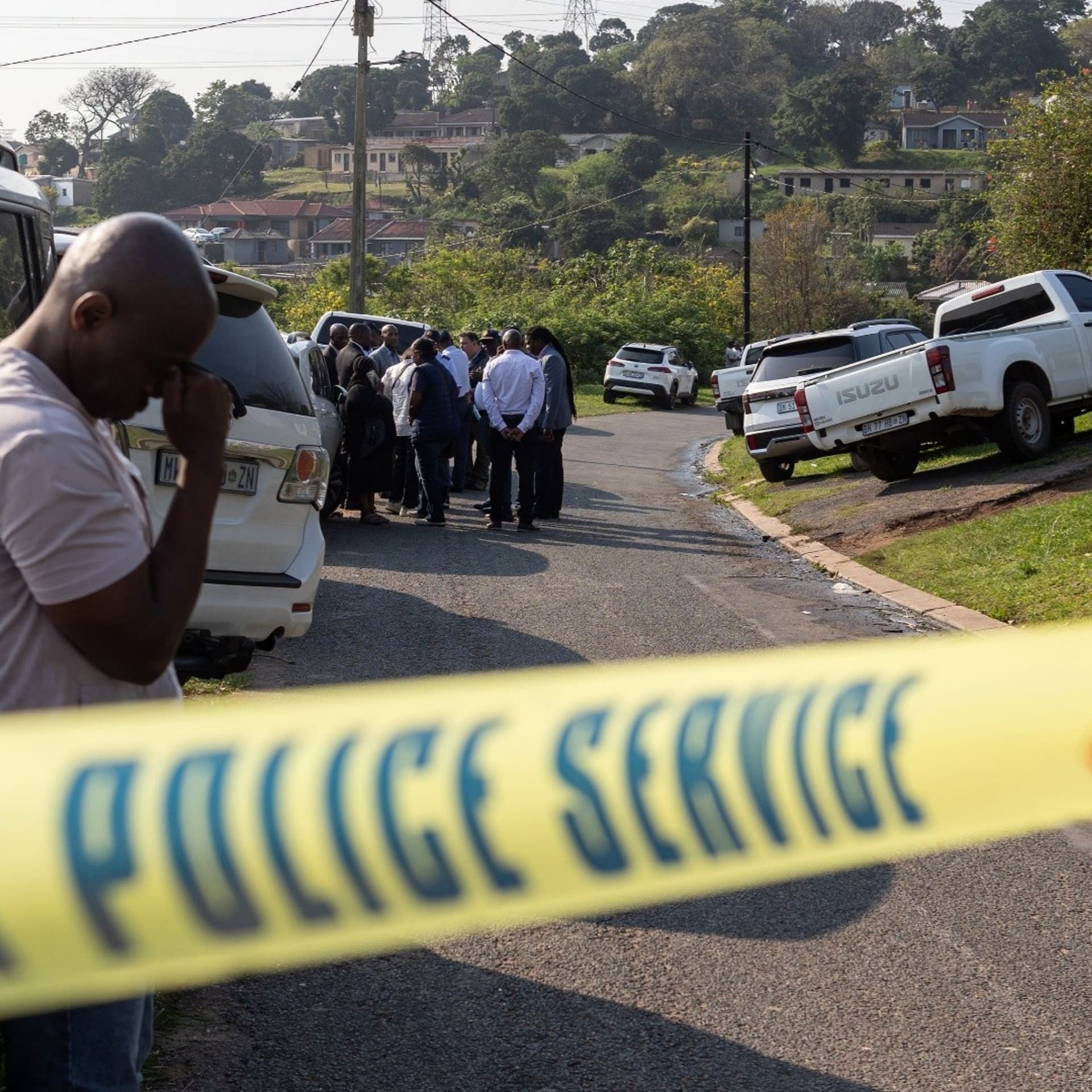

In short
A BBC Global News episode covering (1) a deadly South African house-party shooting, (2) IMF warnings on advanced-economy debt and borrowing costs, (3) China’s rapid AI data-centre buildout, (4) film-industry research on women screenwriters, (5) Egyptology plans to probe Tutankhamun’s tomb for Queen Nefertiti, plus additional world stories (Ethiopia/Tigray escalation, South Sudan political crisis, Dolly Parton estate dispute, and discovery of a very young exoplanet).
Guests (and backgrounds)
Pumza Fikhlani (BBC Johannesburg correspondent); Faisal Islam (BBC economics editor, interviews IMF head Kristalina Georgieva); Ijeoma Ndukwe (BBC business reporter); Laura Bicker (BBC China correspondent); Bethany Hughes (Egypt historian/author); Sarah Montague (BBC interviewer); Catherine Biaru-Hanga (BBC correspondent); Kalkidan Yibaltal (former Ethiopia correspondent); Daniel Akech Thiong (International Crisis Group analyst); Mark Savage (BBC music correspondent); Sarah Casewell (astronomer, Leicester University).
Key claims + examples
South Africa’s police say the Durban-area attack killed 11 (including a pregnant woman) and may involve a “rival feud” and “murder for hire,” with victims linked to a crime-watch list. Georgieva urges fiscal consolidation and lower borrowing, citing interest-cost spikes tied to inflation and oil-supply disruption (Strait of Hormuz/war in Iran). China is “not slowing” AI, building data centres in Inner Mongolia for firms like Huawei; AI is used in everyday life (e.g., police patrol). Mainz University research: films with female screenwriters earned 34% higher median profit; Barbie is cited. Egypt: thermal imaging/GPR suggest chambers behind Tutankhamun’s tomb; non-invasive techniques could remotely examine mummies/amulets.
Written by AI. May contain mistakes. Listen to the episode to check what was said.
Chapters
Tap a time to open that second in VOSouth Africa House Party Attack
1:08 to 2:15
Report on a deadly attack at a house party in South Africa, resulting in 11 deaths.
“And the head of the IMF warns advanced economies to reduce their debt burdens.”
Investigative Insights on Violence
2:15 to 4:10
Discussion on the police investigation and context of violent crime in South Africa.
“house party in a township outside Durban, killing 11 people, including a pregnant woman.”
IMF's Warning on Debt
4:10 to 6:36
IMF head warns advanced economies about rising debt and necessary fiscal actions.
“So that should tell you how serious of a problem it is.”
Impact of Global Events on Debt
6:36 to 8:30
Analysis of factors driving up government borrowing costs and inflation.
“I asked her first why debt costs were so high at the moment.”
China's AI Development
8:30 to 13:44
Exploration of China's rapid AI development and infrastructure building.
“The IMF boss also warned about AI, huge amounts of investments going in, the possible disruption it can cause.”
Women's Representation in Film
13:44 to 14:03
Study reveals financial impact of female screenwriters in the film industry.
“A study analysing almost 200 ,000 films across three decades has found that productions with female screenwriters made higher profits.”
Gender Disparity in Film Industry
14:03 to 15:28
Explore the ongoing gender disparity in film directing and screenwriting.
“Frozen, Avatar, Way of the Water and Mamma Mia, blockbuster films with one thing in common.”
Exciting Discoveries Near Tutankhamun's Tomb
15:30 to 19:13
Learn about new archaeological techniques revealing hidden structures by Tutankhamun's tomb.
“after new surveys suggested there may be other structures hidden behind it.”
Exciting Discoveries Near Tutankhamun's Tomb
19:18 to 19:39
Learn about new archaeological techniques revealing hidden structures by Tutankhamun's tomb.
“We normally can't see planets until they're about 10 million years old.”
Exciting Discoveries Near Tutankhamun's Tomb
20:09 to 21:25
Learn about new archaeological techniques revealing hidden structures by Tutankhamun's tomb.
“And it makes so much sense because every one of these players out there has serious skin in the game, so it makes sense to take care of it.”
Show all 16 chapters
Detoxing Myths and Realities
21:27 to 22:24
Discuss the misconceptions about detoxing and natural body functions.
“This product is not intended to diagnose, treat, cure, or prevent any disease.”
Tensions Rising in Ethiopia and South Sudan
23:37 to 28:00
Analyze the escalating conflicts in Ethiopia and South Sudan due to political instability.
“Reports from Ethiopia say local forces in the northern region of Tigray have seized the airport in the regional capital Mekele.”
Political Control and Elections in South Africa
28:00 to 28:50
Discussion on the implications of political control and election processes in South Africa.
“First is that the caretaker trap we are seeing now, it is a brilliantly engineered trap.”
Dolly Parton's Family Dispute After Her Death
28:50 to 31:34
Exploration of the family conflict arising from Dolly Parton's estate after her passing.
“So that could lead to a return to more violence.”
Discovery of the Youngest Planet
31:34 to 34:24
Insights into the discovery of a young planet and its implications for understanding planet formation.
“She left a lot of her properties and a lot of her business interests and trusts, which makes the likelihood of legal action much, much less than if she had died in probate.”
Discovery of the Youngest Planet
35:04 to 35:38
Insights into the discovery of a young planet and its implications for understanding planet formation.
“I grew up learning about finance and investing myself and realizing that I needed to reinvest dividends and rebalance my portfolio and if there was an opportunity to tax loss over time.”
Transcript
Automatic transcript. May contain errors.0:00This BBC podcast is supported by ads outside the UK.
0:30Listen to Choiceology at schwab.com slash podcast or wherever you listen.
1:07This is the Global News Podcast from the BBC World Service.
1:30battle government forces. And the head of the IMF warns advanced economies to reduce their debt burdens. Also in this podcast... China is growing. We are now leading the world. This is no longer the China from the 1960s. No sign of a slowdown on AI in China. We report on the new data centres being built in remote areas. And the archaeologists hoping to search for the tomb of Egyptian Queen Nefertiti.
2:05South Africa has one of the highest murder rates in the world, with around 60 people killed every day. In one particularly deadly incident on Tuesday night, gunmen attacked a house party in a township outside Durban, killing 11 people, including a pregnant woman. I heard more from our correspondent in Johannesburg, Pumza Fikhlani. The police have said, Oliver, that it's still very early in their investigation, but they are also following a lead where some of the victims, they say, had been on their crime watch list. They are saying this may mean that there was a rival feud involved that was behind the killing.
2:41It's something that's not that widely common in South Africa, mass shootings. Although the murder rate is high, it is something that does still shock a lot of people in this country to see mass shootings happen anywhere. But Kezren, Gaziru Natal, that area where that happened in, there's just another insight that's important to share there. It's a place where murder for hire is rife, the police have said. So they're also looking at whether that was behind the motive, whether somebody paid these gunmen to carry out the shooting last night. Yeah. And tell us more about the high levels of violent crime that are affecting South Africa at the moment.
3:17Certainly it's one of the highest across violent crime in the world with the murder rate continuing to be something that's very difficult for the authorities from the government to the police to get a handle on. It's something that South Africans are widely concerned about and that persecution rate they've said isn't as high as it can be. It takes very long for cases to get through the courts and some instances for even arrests to happen. But it is something that is front of mind for a lot of South Africans because of how prevalent it is and just how widespread. There isn't one specific area, Oliver, that you can zero in on and say, if we solve it here, it goes away everywhere.
3:56It happens in each province and for various reasons. But the police have said that they are trying their level best in terms of renewing their training and getting as much resources as needed so they can get a handle on the situation. The government even sent in the army earlier this year. Is there anything more they can do? So that should tell you how serious of a problem it is. We don't see the army on the streets of South Africa often. They only are ever called in when there's been a spike, really. And they're there to help the police effect arrests. So they don't effect arrests themselves, but they're there as extra backup because there are certain parts of the country where even the police themselves cannot just willingly go in.
4:37they need that added support in terms of gunfire. And we see in areas where that does happen, there is temporarily a reduction of violent crime. Humza Fikhlani in Johannesburg. The head of the International Monetary Fund has warned advanced economies to cut their borrowing. Kristalina Georgieva said debt levels had been pushed up by global shocks, but governments hadn't done enough to tackle the spiralling cost of interest. She spoke to our economics editor Faisal Islam at the UN General Assembly. Our message to everybody is you cannot control exogenous factors, but you have control over your domestic policies.
5:18So make sure you stay ahead of inflation, keep inflation back, and to governments, get on top of your debt issue. I have seen shock after shock pushing debt levels up like a staircase not to heaven and no action to contain the debt service costs. So time to take that action. You are the world's financial and fiscal watchdog. You mark the homework, if you like, of entire governments, especially at times like this. There's been a government bond market, borrowing market shock, frankly, over the summer, affecting the biggest nations in the world. The policy advice you're saying quite clearly is to respond to this shock with lower borrowing, potentially lower spending, potentially tax rises.
6:13So there are these two things that must be done. Bring debt levels down, put fiscal consolidation as a priority, and make sure that the central banks deliver on their mandate for price stability. IMF boss Kristalina Gourieva. Listening to that was our business reporter Ijeoma Ndukwe. I asked her first why debt costs were so high at the moment. The war in Iran has certainly exacerbated this issue because it's disrupted the supply of oil. Of course, we've been hearing so much about the Strait of Hormuz and its blockade. And because it's restricted the flow of oil that's reaching the international markets, that in turn has fuelled inflation, which means government borrowing costs have gone up as the government uses tools to bring down inflation.
7:09And one key tool to bring down inflation is raising interest rates. And that makes it more expensive to borrow. And that in turn makes it more expensive for governments to service their debt. So here in the UK, for example, the interest on government debt in August, it was the highest figure since monthly records began in 1997. And just looking at the US, another advanced economy, their borrowing costs pushed up debt to more than 40 trillion dollars, which has doubled in the space of a decade. OK, so a lot of interest that has to be paid. How can governments bring that down and will they take action?
7:49I think one of the things that Ms. Gorgie ever alluded to is this difficulty politically with trying to cut spending. I mean, what do governments cut? Here in the UK, we're expecting Prime Minister Andy Burnham's first budget next month. And speculation is already building over his tax policy and what spending policies will be. I mean, the key thing here is that governments need to bring down their debt levels. And to do that, they have to cut government spending. She also talked about central banks stabilising prices, which could mean raising interest even further, which isn't popular. That means mortgage rates going up even more.
8:29Another mechanism is policy reform that encourages the private sector to come in and invest because governments simply don't have the cash to boost economic growth. The IMF boss also warned about AI, huge amounts of investments going in, the possible disruption it can cause. How worried should we be that a possible AI bubble could burst? There are still concerns that companies might not, you know, investors might not realise the returns expected from investment in artificial intelligence, because we've been seeing so much money funneled into developing the infrastructure, building things like data centres.
9:13So there are concerns that perhaps the industry has exaggerated their abilities to boost their performance and profit. That's something we'll have to wait and see. Business reporter Ijeoma Ndukwe. Well, AI is one of the issues likely to be on the agenda when the US and Chinese presidents meet at the White House on Thursday. There have been calls from inside the industry for a slowdown, but both Donald Trump and Xi Jinping are keen to push on. The US president says whoever wins AI wins overall, while China is investing heavily to build the computing power it needs to compete in the AI race. Much of that construction is far from China's major cities, as Laura Bicker now reports.
9:55I'm wandering through the grasslands of Inner Mongolia. This is a land of extraordinary scale. In front of me, I have towering wind turbines, endless rows of solar panels, and of course, beautiful horses rambling beneath them. To build the infrastructure that is desperately needed for AI, in Mongolia is key because it has vast amounts of wind and solar resources. And that's why China has chosen to build its AI data centres here. At remarkable speed. Buildings have risen out of the farmland in a matter of months. This country has fewer data centres than the US for now. But this hub is a way of catching up.
10:45If China is going to lead the world in artificial intelligence development, this is where it is building the engine room that will drive that change. Just a few months ago, this corner of Inner Mongolia was farmland. Now, thousands of data centres have sprung up for the likes of Huawei and others. There is no sign that China is slowing down on this technology. Across China, AI is becoming part of everyday life. From programming robot deliveries to aiding police on patrol. It's all part of Beijing's ambition to embed AI in its economy. Officials have bristled at any mention of a slowdown. Jingyang is Asia bureau chief of the business and tech media outlet The Information.
11:35The S4 countries really have kneecapped China's AI development in the last several years. And in spite of that, Chinese labs have managed to catch up. Why would China be incentivized to collaborate with America, which in Beijing's view has been kneecapping China's technological development, unless there is something that Washington can offer to threaten the deal? But others do see the urgency. David Finkelstown from the Centre for Naval Analysis told a defence forum in Beijing that it was time for the two leaders to talk. I'm not sure they're going to come to any agreements any time soon, but there's a lot of motivation to talk about these things.
12:15The use of AI in command and control and warfare, who's using it in their nuclear chain of command, this is scary stuff. Back in Inner Mongolia, the building work continues while farm workers gather up rows of plump potatoes for market. There has been little opposition to data centres here, unlike in the West. But there are still some quiet sceptics. If they demolish the village for a data centre, it won't be good. I prefer living by the farmland. Away from the microphones, perhaps fearing reprisals, a few farmers told us they saw no benefits and feared for their land and their way of life. Others were keen to praise the country's leadership.
13:02Of course the data centre brings us benefits. It creates jobs. President Xi is raising living standards for the Chinese people. China is growing. We are now leading the world. This is no longer the China from the 1960s.
13:23President Xi has set the direction and will feel that in the long term, China can compete with the US on this technology. His government is focused on securing an AI-powered future, even as some of its people wonder whether they'll be part of it. That report by our China correspondent, Laura Bicker. Barbie, Saltburn and Thelma and Louise, all successful films, all written by women. A study analysing almost 200 ,000 films across three decades has found that productions with female screenwriters made higher profits. And yet women remain underrepresented among filmmakers. Ella Bicknell has the details.
14:04Frozen, Avatar, Way of the Water and Mamma Mia, blockbuster films with one thing in common. They were written or directed by women. But such films remain a minority. Just 27 % of those made over the past 30 years had a female director or screenwriter. Researchers at the University of Mainz in Germany analysed earnings from the internet movie database known as IMDB and concluded there was no financial logic to the disparity. Among films with similar budgets, those written by women generated 34 % higher median profit than those with all-male writing and directing teams. Greta Gerwig's Barbie is one example, taking almost$1.5 billion at the global box office, 2023's highest grossing film.
14:51If I may be so honoured to have all the female nominees in every category stand with me in this room tonight. The filmmakers, the producers... At the 2018 Oscars, Frances McDormand used her Best Actress speech to call for greater inclusion. Look around, ladies and gentlemen, because we all have stories to tell and projects we need financed. The number of female directors and writers has grown in recent decades. But the researchers behind this latest analysis says risk-averse studio financing is enforcing the status quo, even when there's more money to be made. Hello, Bicknell. Archaeologists are trying to get permission to drill into the rock next to the tomb of Tutankhamun, after new surveys suggested there may be other structures hidden behind it.
15:39They hope the chambers may house the tomb of the Egyptian queen Nefertiti. When Tutankhamun's tomb was found more than a century ago, it contained remarkable treasures. The archaeologist Howard Carter described the moment of discovery to the BBC. Light shone into the sarcophagus. A gasp of wonderment escaped our lips. So gorgeous was the sight that met our eyes. This was but the lid of a series of three coffins, nested one within the other, enclosing the mortal remains of the young king Dudank Amun. Howard Carter in 1936. Bethany Hughes is a historian and author of a new book about Egypt called A History of Egypt in Seven Treasures.
16:27Sarah Montague asked her if she was excited about this new endeavour. I have to say I'm constantly excited when it comes to ancient Egypt. there is definitely something interesting going on here at the back of Tutankhamun's tomb. I really just want to qualify, we have no idea whether or not it's Queen Nefertiti. That was something that was posited around 10 years ago. It's not impossible, but what is more exciting is that it looks like there are chambers and corridors behind Tutankhamun's resting place. And did we not know that before? No, we didn't. We didn't. I mean, this is as a result of lots of very cutting-edge techniques.
17:06So it's thermal imaging, ground penetrating radar, geological mapping, tomography. So that means that the team working in the tomb have worked out it's not sheer breadrock behind the west wall of the tomb, but there is some kind of ancient structure there. And what's brilliant now is that because we can use all these new techniques you can do this kind of work in a completely non-invasive way so you're not like chiseling through the back of the his the beautiful decorations you know surrounding his sarcophagus so there is something interesting there you know surely ultimately you do need to sort of make a hole and go in not you know this is the genius area you don't need to now so we can now unwrap whole mummified bodies and look at the amulets left inside the bodies without raising a single bandage.
17:57So it's the polar opposite of dear Howard Carter and Lord Carnarvon when they did their work 100 years ago, who were basically kind of ripping it all apart. So no, no, no, we actually, that is what's truly exciting. You've just been talking about artificial intelligence, and this is a way that, you know, we can use artificial intelligence to uncover ancestral intelligence in these tombs. So it really could be possible that this is discovered completely remotely without moving a single brick. OK. And you might think this is a bit cheap, but Tutankhamun's tomb, didn't it have an enormous amount of gold treasures inside it?
18:35And aren't people going to be excited at that prospect? 100%. I mean, Tutankhamun's tomb had, at the latest count, 5 ,398 treasures within it. So there was exquisite gold, there were beautiful games that he used to play with as a child. incredibly touching, his little socks with toes stitched in, duck lunch boxes in case he needed a snack on his way to the afterlife. So, I mean, it was, you know, it was the most astonishing find. And of course, if there is something new in the Valley of the Kings, it will be game-changing and history-making. We just don't know whether it's Nefertiti. That's Annie Hughes talking to Sarah Montague.
19:18And still to come on this podcast... This planet has literally just formed. We normally can't see planets until they're about 10 million years old. It tells us so much about planet formation. The youngest planet ever discovered.
19:39And now a quick vital break from our sponsor, Vital Proteins. The US Open is so exciting, but it's also pretty stressful for the players. I mean, it's their whole job. But also for us, the spectators, we get invested. Not for nothing, stress is not great for your skin. Which brings me back around to Vital Proteins, which is putting skin in the game, see what I did there? As the official collagen partner of the U.S. Open and presenting sponsor of the Mixed Doubles Championship. This is their second year of a new multi-year partnership, so they're in for the long haul. And it makes so much sense because every one of these players out there has serious skin in the game, so it makes sense to take care of it.
20:22And Vital Proteins Collagen Peptides helps support healthy skin as well as hair, nails, bones, and joints. And whether you're one of the best players in the world or just someone who likes to watch the best players in the world, you can benefit. Because we all have skin, hair, nails, bones, and joints, and we all start producing less collagen around 30. Supplementing with vital proteins, collagen, peptides can help you look, move, and feel your best. Plus, it fits right into your life. You can add a serving to your morning coffee, tea, smoothies, or oatmeal. It can go into whatever you're already having, and it dissolves easily with no weird taste and no extra steps.
21:00Then you can sit down for a day of watching the U.S. Open. Like I said, it fits right into your life. So when your favorite player is facing a final set tiebreak in the quarterfinals and feeling the pressure, and you're feeling the pressure too, you can rest comfortably in the knowledge that your skin looks fabulous. Thanks again to Vital Proteins for sponsoring us. Learn more about collagen peptides by going to vitalproteins.com. These statements have not been evaluated by the Food and Drug Administration. This product is not intended to diagnose, treat, cure, or prevent any disease. Do we all need to be detoxing ourselves?
21:36Before I go asking, how can I detox? I have to look inward. Okay, what am I doing? Can I identify at least three ways that my body detoxes and ways to support that? I promise if my message was more dramatic like that, I would have millions of followers and make millions of dollars. But I cannot sleep at night trying to sell someone something that their body already does naturally. We're living in a crazy world now. I think it's a lot of people fear a lack of control. And as a result of this, this is the way of them trying to make sense of the world and try to take control over their own bodies.
22:09So by actively doing something, I'm going to detoxify things. Therefore, I'm going to feel better, I think, is absolutely one of the reasons that, you know, detoxifying has become so popular. Listen to the full episode of Health vs. Hype with the American Medical Association on the iHeartRadio app, Apple Podcasts or wherever you get your podcasts.
22:35Everybody wants a shot. A chance to show the world what they got. Nick Cannon presents Wildin' Out Live, the next generation tour. Bringing back the all-star cast you know and love. And introducing the next generation of rookies. Featuring the famous Wildin' Out roast battles. Plus your chance to get on stage and be part of the action. Live across North America. Get tickets Thursday, September 24th at LiveNation.com. Hey, it's Ryan Seacrest for Jewel Osco. Fall is coming, which means cough and cold season is almost here. Get ahead by stocking up on all your favorite cough and cold essentials now through September 29th.
23:13Shop in-store and online to save on products like Allegra tablets, Hulls Drops, Mucinex Kickstart, Zyrtec Allergy Relief Tablets, Tylenol Liquid Gels, One-A-Day Men's Health, and Vicks Dayquil and Nyquil Combo Packs. Offer ends September 29th. Restrictions apply. Offers may vary. Visit Jewelosco.com for more details.
23:36This is the Global News Podcast. Reports from Ethiopia say local forces in the northern region of Tigray have seized the airport in the regional capital Mekele. The Tigrayan rebels said they were combating an invasion by federal forces, raising fears of a resumption of the two-year civil war in the area, which left as many as 600 ,000 people dead. Catherine Biaru-Hanga got the latest from our former Ethiopia correspondent, Kalkidan Yibaltal. All flights to and from Tigrayan cities have been suspended. The flag carrier Ethiopian Airlines announced this morning that they have suspended all flights to the three major airports in the Tigray region.
24:14And, you know, local sources and residents in the city told us that Tigrayan forces have entered into the main airport in Makale City and, you know, taking control of it. That airport had been under the control of a few federal police forces. And it's not clear what happened to these federal police forces. But this signals a major escalation and it's coming in the backdrop of recent weeks of increasing tensions and increasing instances of drone strikes in Tigray and around Tigray region. And also it happens a few days after seven rebel and armed groups have announced that they're forming an alliance in an effort to try to overthrow the government of Prime Minister Abiy Ahmed.
24:55And just give us the context to this and why it's so worrying, because this comes some four years after the civil war in Tigray, where hundreds of thousands of people were killed. This was a brutal conflict. Yes, it was indeed a brutal conflict. And it's one of the most devastating and the deadliest conflicts this century anywhere. Some estimates put the number of people who were killed in the region of 600 ,000. That was the civil war in Tigray between 2020 and 2022. but at late 2022 there was a peace deal signed between the Grand Forces and the government, the federal government, that silenced the guns.
25:31And normal activities have resumed to the region and it seems that things were returning back to normality. However, tensions remained and there were so many unresolved issues. In other parts of Ethiopia there are other conflicts and it seems now that we're seeing all these are converging. converging. The Tigrayan forces have repeatedly accused the federal government of breaching that peace deal, while the federal government says that they are the ones who are breaching the peace deal by trying to forge an alliance with other armed actors, as well as foreign countries, particularly the northern neighbour Eritrea.
Read the full transcript
26:05And that was, as you said, very devastating. The humanitarian crisis was very consequential. And if another war of a similar scale were to break out, it's going to be very destabilising, not only for Ethiopia, but for the Horn of Africa region, which, as you know, is still plagued by other conflicts, including in neighbouring Sudan. Our former Ethiopia correspondent, Kalkadan Yibel Tal, talking to Catherine Biaru-Hanga. The civil war that Kalkadan mentioned in Sudan has also affected South Sudan, which split off 15 years ago. But since it gained independence, South Sudan has also suffered its own civil conflict, as well as widespread corruption and high levels of hunger.
26:45Now there is a political row in South Sudan after President Salva Keir dissolved the government and removed all the vice presidents ahead of the country's first ever elections. His actions have been condemned by the opposition. South Sudan analyst Daniel Akech Thiong spoke to James Copnell. We are watching July 2013 repeat itself. At that time, the president dissolved the whole cabinet And within a few months, exchanging hot words between him and his rivals, the country went into civil war. The 2018 peace agreement was the only guardrail against the absolute presidential powers hidden in the transitional constitutions of 2011.
27:26So the parliament just stripped those guardrails away and allowing the president to legally patch his rivals and install a critical government of strict loyalties in a badly divided country. So is that the concern then, a return to outright war? Because there have been successive waves of conflict, power dynamics have shifted. You could argue that the rebels are not as militarily strong as they were before and that people are fed up with fighting and the need for more conflict. You though seem to think that South Sudan could be heading back down that path. Yes, but that needs to be nuanced. First is that the caretaker trap we are seeing now, it is a brilliantly engineered trap.
28:08That's how the opposition and civil actors would look at it. With absolute control over the state apparatus, the president's faction cannot lose, even if they go for elections. and I will say momentarily like why that election might not be possible. And they will either push through entirely controlled elections and win it. So that leaves no rooms for the oppositions and other groups that want to participate in the process, in the democratic process. They could also cite logistical failures, which are known to everyone, to indefinitely extend this new loyalist mandate. It is a win-win for the executive and a disaster for the transitions because it would exacerbate conflicts that were already happening in the country or it could even get worse.
28:50So that could lead to a return to more violence. Daniel Akech Thiong of the International Crisis Group. When Dolly Parton died last month at the age of 80, the news was announced by her nephew, Brian Seaver. He worked as the singer's head of security for more than two decades, taking over from his father. But now Dolly Parton's long-time manager has requested a restraining order against him in a growing row over the estate. Our music correspondent Mark Savage told us more. These were court papers filed in Nashville yesterday and they accused Brian Seaver, Dolly Parton's nephew, of what they call an intense and escalating campaign of threats against the estate.
29:30There are emails and text messages included in the court papers which appear to show him threatening the people who are looking after Dolly Parton's legacy. he says he will launch a podcast dedicated to ruining Dolly's brand. He calls himself the hand of retribution for the Parton family. And he says everyone needs to be worried. Now, he has disputed his characterisation in the lawsuit. He says that these messages were taken out of context and nothing that he said was a threat. In a statement to TMZ, he said a lot of the messages are two guys rage talking and crying on the phone together while they were grieving.
30:09So what happens next? So Danny Nazel, who was Dolly Parton's manager for more than 20 years, has asked for a civil restraining order against Brian Seaver, her nephew. They've also requested a jury trial after the temporary restraining order is made in order to extend it. That is, of course, if the restraining order is made. And they say, you know, this has affected their business already. They have lost lawyers and other employees as a result of what they call Seaver's threats. And they also say that some members of the company have had to take out private security because they're worried about their own safety.
30:45And again, I would have to say that Brian Seaver does deny that he poses a threat to these people. Of course, there was a huge outpouring of emotion when Dolly Parton died. Is this at risk of souring her legacy somewhat? I mean, I think, you know, obviously everybody loved Dolly Parton because she was so serene and peaceful and generous. And the kind of ugliness of a family and an estate fighting over her$450 million fortune is bound to sour people's opinions of those who are left to look after her legacy. But I don't think it will make people think any worse of her. I think, you know, when money comes into families, it often turns pretty nasty.
31:26But by all accounts, Dolly did leave her estate in such a way that there won't be a huge ongoing rye. She left a lot of her properties and a lot of her business interests and trusts, which makes the likelihood of legal action much, much less than if she had died in probate. BBC Music correspondent Mark Savage. Astronomers have discovered the youngest planet on record. 450 light-years from Earth, Elias 2-24b is less than a million years old. Newborn planets can be difficult to find, as stars which provide the building materials are themselves born inside clouds of gas and dust. This one could give scientists a way of studying what our own solar system may have been like billions of years ago.
32:10Astronomer Sarah Casewell spoke to Rick Edwards. The original discovery of this planet was done through looking at the disk around this very young star. It's got a big disk. and we looked at the disk and we saw there were gaps in the disk and those gaps are likely to be caused by a planet that's forming and now people have used a technique called coronography. They've covered up the star so they can see something that's very faint nearby and they've seen the planet exactly where people predicted it to be. This planet has literally just formed. We normally can't see planets until they're about 10 million years old and all that disk has been got rid of and it tells us so much about planet formation and our model whether our models were right.
33:00How long does it take for a planet to kind of like reach maturity like is it fully developed at this point or is it still going to be evolving? At this point it's still very hot and it possibly is still grabbing all the dust and gas that it can and after about 10 million years the big disk around the star will disappear and we'll be left with the star and the planet. And just to give us a kind of a benchmark, what's the oldest planet that we've identified? Oh my goodness, that's a question and a half. So most planets that we tend to look at are about the same age as our sun, maybe a little bit older.
33:39So they're between five and 10 billion years old. And does this help us then understand more about the early stages of planet formation? It really does. Finding objects within these gaps in the rings where we can see them really allows us to understand whether our theory of planet formation is correct. And in this case, it looks like this planet is doing exactly what it should be doing at this age. All of why a lot of us do this is to understand how unique our solar system is and whether there are other solar systems out there that look like ours. And trying to understand the early stages of planet formation is a big part of that.
34:23Sarah Casewell, astronomer and lecturer at Leicester University. And that is all from us for now. But if you want to get in touch, you can email us at global podcast at bbc.co.uk. You can also watch our episodes in full by searching for the Global News Podcast on YouTube. This edition was mixed by Jack Wilfern and produced by Alice Adderley. Our editor is Karen Martin. I'm Oliver Conway. Until next time, goodbye.
35:03how Betterment takes the time-consuming work out of smart investing. I grew up learning about finance and investing myself and realizing that I needed to reinvest dividends and rebalance my portfolio and if there was an opportunity to tax loss over time. And then I realized that I was doing all of these things that were pretty straightforward to implement. I just needed to spend my time doing them. Betterment automates the same good practices so that I know I'm doing portfolio management and goal-based planning in a way that makes sense and is responsible without me having to spend hours of my life doing it.
35:38Learn more at Betterment.com. Investing involves risk, performance not guaranteed. Betterment does not offer tax advice. TLH may not be suitable for all customers. Learn more at Betterment.com slash TLH dash terms.
From the publisher
Gunmen kill 11 people after storming a house in KwaMakhutha township near Durban in South Africa. Police are investigating links to a feud between rival groups, as the nation grapples with sky-high murder rates and violence. Also: the IMF warns that record global debt requires urgent fiscal action, urging economies such as the US and UK to reduce borrowing. China's plans for the future of AI. The family feud over Dolly Parton's estate involving the country music star's nephew Bryan Seaver. Astronomers discover the youngest planet on record, Elias 2-24 b, about 450 light years from Earth. And could the lost hidden tomb of Egyptian queen Nefertiti finally be found?
The Global News Podcast brings you the breaking news you need to hear, as it happens. Listen for the latest headlines and current affairs from around the world. Politics, economics, climate, business, technology, health – we cover it all with expert analysis and insight. Get the news that matters, delivered twice a day on weekdays and daily at weekends, plus special bonus episodes reacting to urgent breaking stories. Follow or subscribe now and never miss a moment. Get in touch: globalpodcast@bbc.co.uk
Photo: Mass shooting in KwaMakhutha, South Africa, Durban - 23 Sep 2026 Credit: EPA