
In short
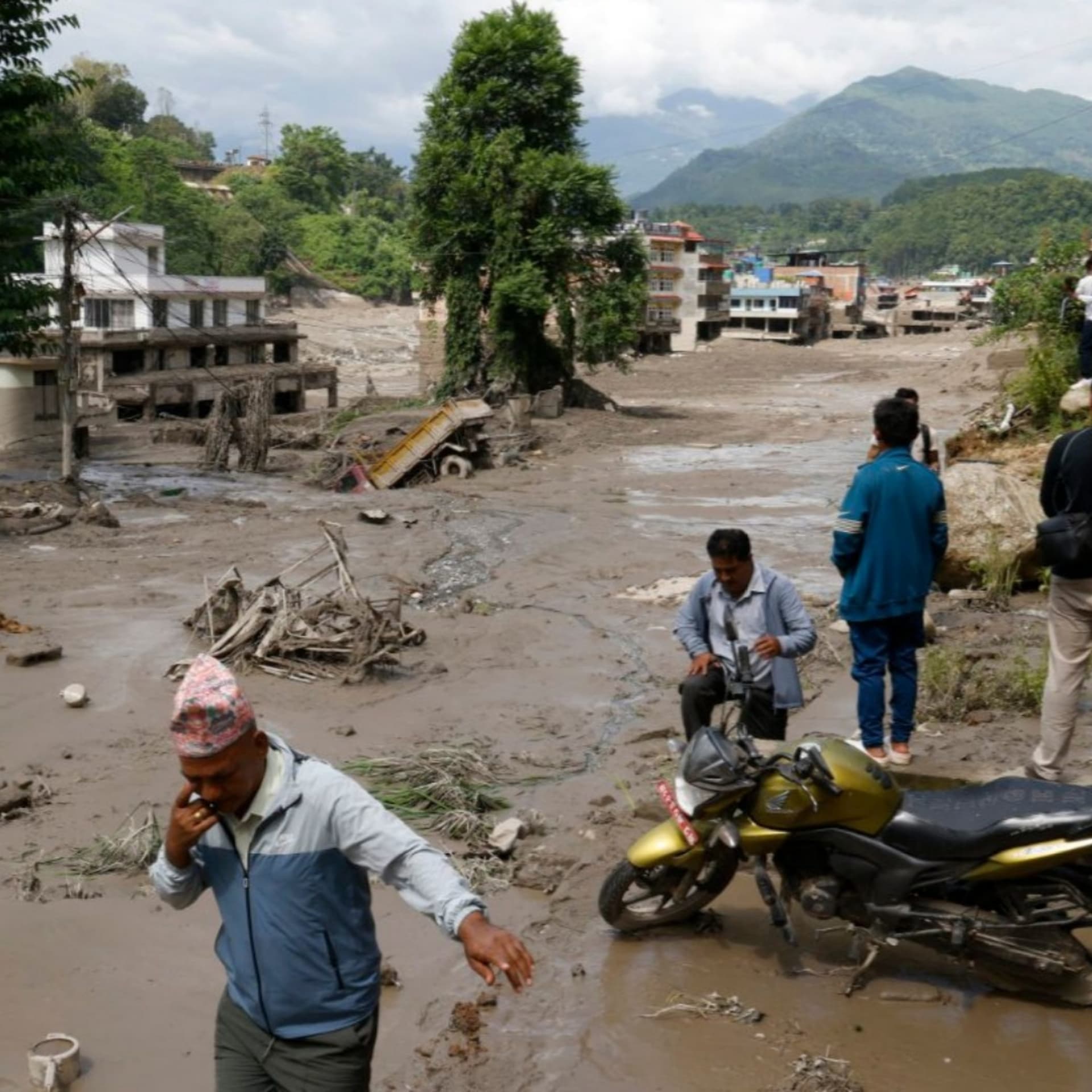
The episode covers multiple global news stories. Topic 1: Flash floods on the China–Nepal border. Hundreds are missing after a sudden flood tore through villages in northern Nepal’s Rasuwa near Tibet, sweeping away homes and infrastructure. Nepal police confirm at least 31 deaths so far; at least 300 foreign tourists are among those out of contact. Possible causes are disputed: mudslide vs rock-ice avalanche blocking a river vs glacial lakes; experts cite climate-change glacier melt and earthquake-prone terrain. Notable examples include damaged hydropower stations and trucks swept away. Topic 2: Pakistan hospital fire. A fire at Islamabad’s Pakistan Institute of Medical Sciences maternity ward killed at least 14 newborns; officials cite an air-conditioning unit explosion/short-circuiting near oxygen equipment; families question locked ward doors and rescue timing. Topic 3: Vaping for quitting smoking. Cochrane review of ~30,000 participants finds nicotine vaping (10 in 100 quit) outperforms gum/patches/pouches (6 in 100). Topic 4: Russia strikes Ukrainian petrol stations. Over 200 forecourts hit; authorities dispense fuel from mobile road tankers and use anti-drone nets. Topic 5: China prescription drug misuse among teens. Narcotics Commission warns of minors overdosing to cope with exam pressure. Topic 6: Dolly Parton tributes. Topic 7: Dolly Parton death reaction.
Guests
No named podcast guests; it’s a BBC Global News Podcast with correspondents and experts quoted: Azadeh Mishiri (China-Nepal flood correspondent), Navin Singh Khadka (environment correspondent), Navin Singh Khadka and glaciology sources; Caroline Davies (Pakistan correspondent), Hugh Pym (health editor), Vitaly Shevchenko (Ukraine correspondent), Laura Bicker (China correspondent), Helena Humphrey (Nashville correspondent).
Written by AI. May contain mistakes. Listen to the episode to check what was said.
Chapters
Tap a time to open that second in VODevastating Floods on Nepal-China Border
0:27 to 2:21
Discussion on the flash floods affecting villages along the Nepal-China border, with eyewitness accounts.
“Hello, I'm Ankar Desai and at 1400 GMT on Wednesday 26th August, these are our main stories.”
Rescue Operations and Casualty Updates
2:21 to 4:33
Updates on the ongoing rescue operations and confirmed casualties from the floods.
“with villages as well as roads, bridges and power stations swept away.”
Analyzing Causes of the Flood
4:33 to 7:33
Exploration of the possible causes of the disaster, including climate change and geological factors.
“They have said that they're worried about all the workers they have operating in some of these hydropower plants, for example.”
Tragic Hospital Fire in Pakistan
7:33 to 11:52
Details about a tragic fire at a maternity ward in Islamabad resulting in the loss of newborns.
“We are also hearing that, you know, authorities are trying to secure the whereabouts of these people.”
Vaping as a Smoking Cessation Tool
11:52 to 14:00
Analysis of a study suggesting vaping may be more effective for quitting smoking than traditional methods.
“Next, new analysis suggests smokers wanting to quit their habit have a better chance if they use nicotine vapes rather than patches or gums.”
Dolly Parton Tribute Begins
14:00 to 14:38
Listeners hear heartfelt tributes to the late Dolly Parton.
“and that vaping is, in their view, a lot less damaging than continuing to smoke tobacco smoke would be for somebody who carries on with it.”
Fuel Crisis in Ukraine
14:38 to 18:35
Discussion on the impact of Russian strikes on petrol stations in Ukraine.
“Russia is waging a campaign to destroy petrol stations in Ukraine.”
Stress and Drug Use Among Chinese Youth
18:35 to 21:28
Exploration of the pressures faced by Chinese teenagers and their reliance on prescription drugs.
“This year in China, nearly 13 million teenagers sat their university entrance exams.”
Nashville Remembers Dolly Parton
21:28 to 25:42
A report from Nashville as locals gather to memorialize Dolly Parton.
“Tributes from across the world have been paid to Dolly Parton, who's died at the age of 80.”
Transcript
Automatic transcript. May contain errors.0:00This BBC podcast is supported by ads outside the UK. Get more with BBC Podcasts wherever you listen. Be the first to listen to your favourite shows like Evil Genius, Good Bad Billionaire and You're Dead to Me with a subscription to BBC Podcasts Premium on Apple Podcasts. You can also enjoy a range of our podcasts ad-free with an Amazon Music subscription. This is the Global News Podcast from the BBC World Service. Hello, I'm Ankar Desai and at 1400 GMT on Wednesday 26th August, these are our main stories. Hundreds are missing after a flash flood tears through villages around the Nepal-China border.
0:45I saw around nine trucks and people being swept away by the floods. It's a heartbreaking incident. I've never seen anything like this here before. Nearly 300 of those out of contact are foreign tourists. At least 14 newborn babies are killed in a fire in a maternity ward of a hospital in Pakistan. And China's Narcotics Commission warns a growing number of teenagers are misusing prescription drugs to cope with exam pressure. Also in this podcast, Russia targets Ukrainian petrol stations along the front line. And new research suggests vaping may be a better way to quit smoking than using nicotine gum or patches.
1:30It all came suddenly. We heard a loud sound like a volcano erupting. That's how one person from northern Nepal described the moment a flash flood ripped through his village. Hundreds of others had similar experiences. I saw around nine trucks and people being swept away by the floods. It's a heartbreaking incident. I've been teaching here for 18 years and I've never seen anything like this here before. My brother-in-law had a liquor store here. I got a call from him this morning and they were crying and said their entire house had been swept away. Three family members were rescued, but his brother is still missing.
2:15Hundreds of people are missing, including around 300 foreign tourists who are out of contact. Police in Nepal say they anticipate what they described as huge-scale loss of life, with villages as well as roads, bridges and power stations swept away. The authorities say at least 31 people have been confirmed dead so far. Rescue operations are underway on both sides of the border that Nepal shares with the Tibetan region of China. Azadeh Mishiri is our correspondent in the region. The flood tore through homes. It damaged infrastructure early on Wednesday. but we likely won't know the true scale of the disaster, the true figure of the casualties for the next hours or even the coming days.
2:57Right now, we know that 17 people are confirmed to have died. That's according to Nepal's police. But especially when it comes to an area like this that is remote, it's in northern Nepal, in Rasuha, which is near the border with Tibet. It's very hard to access. And so information keeps coming out hour by hour and the true casualty figures could be much higher. We know that at this point they believe more than at least 10 hydropower stations have been damaged. Police have said that they're struggling to get in touch with dozens of their own police officers. And officials believe the cause is excessive snow melting into the Bhutekusi River, which flows from Tibet to Nepal.
3:41And so rescue operations are ongoing. Unfortunately, Nepal is no stranger to deadly flooding. Last year, 18 people died because of a glacial outburst on the Chinese border. But again, officials are saying this time they believe that the casualties could be much higher. And Azadeh, some of the footage that's emerging, we can see some devastating pictures and videos. And it truly is quite a shocking state of affairs there. It is. And here at the BBC, we're continuing to verify a lot of the videos because there is a lot that's coming out on social media. Some of it is true. Some of it needs to be verified.
4:18But of the ones that we have verified, you're seeing mudslide. These brown waters just engulf villages, sweep them away. And when we've spoken to some of the industry bodies, our Nepali service there has spoken to the president of the private electricity generation industry group there in Nepal. They have said that they're worried about all the workers they have operating in some of these hydropower plants, for example. There are lots of companies who transport a lot of goods through that area as well, trucks that are located, hundreds of trucks that are located and pass through that area. People are still trying to get in touch with their workers there as well.
4:59So again, we're trying to piece together as much information as we can. But when you look at those pictures that you're referring to, that's why people are so worried. How's the day, Mishiri? Our environment correspondent, Navin Singh Khadka, told me more about the possible causes of the disaster. There are conflicting claims and counterclaims. For example, you know, the Zinhua News Agency is calling it mudslide. Whereas when I'm checking with other glaciologists and other experts, some are saying it could be a case of rock ice avalanche that blocked a river downstream. And that river, after a certain level, an impounded river burst out.
5:35And that's why. But then there are also now some others saying that there might also be some glacial lakes involved. So we are getting all these different kind of versions. But yes, we do have the context of climate change, accelerating the melting of the glaciers and glacier lakes rapidly filling up. But let's not forget, this is also a very, very earthquake prone zone. And there are reports that this region did see around four Richter scale of earthquake just before this flood happened. When it comes to mitigating for something like this, what is being done? For example, relocating village roads, things like that?
6:11So you see, this is an ongoing thing. So we all know that in the Himalayan region is prone to things like this. If it was indeed glaciers or glacier lakes involved, you know, all those glaciers collapsing or glacier lakes bursting out and things like that. Now, that context is already there. We all know that this is the region that's warming up and that's accelerating the melting. And therefore, all these hazards are there. Now, the question is, what is being done then? Now, my own past investigations, we have showed that there is a gap of communication. For example, this place is in Tibet where it might have originated.
6:46It might have been also in the Nepali side, but mind you that these are bordering areas. So the river is crisscross, yeah? So, you know, so the communication gap, we exposed the communication gap back then. This was in 2016. So yes, these hazards are there. The question is, are they being monitored or not properly? And is it being communicated downstream? the stream. And the answer when I check with officials is a big no. With your knowledge of the region as well, finally, can you just tell us what this region is like? A lot of tourists do tend to flock to this area in particular. Yes. So in this particular, for example, this river basin, this is very nearby Kathmandu to the north.
7:22Yeah, this is called the Langtang region where, you know, you see a lot of trekkers going up. And also in adjoining areas, there are some religious sites where Nepalese or Hindu Indian pilgrims also go. Now, as of now, We are also hearing that, you know, authorities are trying to secure the whereabouts of these people. We don't know what's happened, but there are worries. Yes. Navin Singh Kharka. Now to a tragic incident in Pakistan. A fire at a maternity ward at a hospital in Islamabad has killed at least 14 newborn babies. The blaze started on the third floor of the Pakistan Institute of Medical Sciences.
7:57One newborn was rescued. A spokesperson for the hospital told the BBC the fire was caused by an air conditioning unit that exploded. In the aftermath, families gathered outside the building with many of its windows shattered by the blaze. A mother of one of the victims said little was done to save the newborn babies.
8:19I have a three-day-old son. They said we have to save the adults first. Why were they saving adults? They could have gotten out on foot. why didn't they save the children first and why was the children's ward locked after two hours the rescue team finally arrived and after four hours the police came why i got the latest from our pakistan correspondent caroline davies who was at the scene i think it's been truly shocking and this incident has really really struck so many people here in islamabad to have something like this happen in such a major hospital in the heart of pakistan's capital is is fairly incredible So we were at the scene earlier and we spoke to numerous families.
8:59As soon as we arrived, we were able to see that there were still families there who were grieving. It was only hours after this fire had been got under control. We have now heard from the officials that they have said that the bodies of all 14 babies that died in this fire have now been given back to their families. They've continued to talk about the fact that there will be an ongoing investigation into what happened here. But there have been lots of questions that have been raised about this. Of course, we heard from a father there talking about concerns about fire escapes, of being able to move out of the building, about how quickly as well rescue services have been able to reach the site.
9:38Now, the authorities have said that the rescue services arrived very quickly. Their timing seemed to be slightly different to the timings that we were told by some people on the scene, so I'm sure that the investigation will be looking further into that. And there are questions, too, about the doors being locked. So one of the women who lost her three-day-old child said that the doors to the ward had been locked. Now, I spoke to the chief executive of the hospital who said that the doors of that ward were not locked, but that they were manned, and that that was because there had been previous instances in government hospitals of babies being stolen from the ward, which is why they had these security measures in place.
10:16But still a huge number of questions, too, about the safety and how something like this could happen. As you say, the officials have said that there seems to be some form of short-circuiting that has then led to a spark, and the federal minister who was down at the scene and spoke to media said that this spark had happened and had been spread because there was oxygen pipes and oxygen cylinders in this particular unit in this ward. When I asked could there not have been more checks to make sure that any sort of flammable material was nowhere near something that could potentially cause a spark, He said if you have some form of short-circuiting and there are these things nearby, that there's not much more that they could do, that they did the things that they could do.
10:56But of course many of the families feel that there are many, many more measures that could have been put in place to have kept their very, very young baby safe. And Caroline, just very briefly, you've been speaking to some of the parents who tragically lost their newborns. We were able to speak to a few. Many didn't really want to go on camera. One man told us about the fact that his daughter had died again only three days old. We spoke to an uncle of one man as well. He'd lost his niece, who was also three days old, that she had been born but needed oxygen, and that was why she was in that particular ward.
11:29And again, we also spoke to a woman who, by sheer chance, happened to have been in a separate ward with her sister-in-law's baby and her. And again, the sense of shock and the chance that by simply being in a different ward that they had been able to survive, that they'd been able to get the baby and run out as soon as they saw smoke. I think they were still reeling and fully trying to understand what had happened. Caroline Davies in Islamabad. Next, new analysis suggests smokers wanting to quit their habit have a better chance if they use nicotine vapes rather than patches or gums. The review by an international group of experts also found that use of e-cigarettes was more successful than support programmes.
12:10I heard more from our health editor, Hugh Pym. It's the Cochrane Group. That's an international group of experts, and their role is to review the latest evidence in a number of different fields, which are considered important. And in this case, they looked at the impact of vaping on helping adult smokers give up the habit. They looked at trials involving 30 ,000 participants internationally with 80 different individual pieces of research. And the key bit of evidence and conclusion they came up with is that whereas 6 in 100 smokers who were trying to quit did so with nicotine pouches and gum, they succeeded 6 in 100.
12:51It was 10 in 100 for those who'd used vaping with nicotine as a way of quitting their habit. And actually, vaping was ahead also of conventional support programs that might be offered to smokers trying to give up. And the authors also said there was no evidence of any serious safety issue around vaping compared with continuing to smoke. So they are also making the point that smoking remains very bad for the health of an individual and that vaping will be a lot less unhealthy for someone who wants to give up smoking. But Hugh, is it fair to say that we don't currently know what the long-term health risks of vaping are?
13:32Well, that's right. And actually, the authors say they've looked at licensed vaping products with regulators. There are some on the market that are not licensed out there available on the streets, which may have toxic substances, so they can't speak for the health impact of those. They're also saying, yes, longer term research is needed. You can never, ever say anything is 100 % safe. But they are keen to emphasise that it is very much a smoker wanting to give up is more likely to succeed with vaping and that vaping is, in their view, a lot less damaging than continuing to smoke tobacco smoke would be for somebody who carries on with it.
14:11Our health editor, Hugh Pym. Still to come in this podcast. Dolly was everything to me. Everybody was calling me when she passed away. My sisters and my best friend. She was like an angel of earth. She was too good for this world. Reaction from Nashville, Tennessee's tributes continue to pour in for the country music legend Dolly Parton.
14:38This is the Global News Podcast. Russia is waging a campaign to destroy petrol stations in Ukraine. More than 200 of them have been hit so far and the strikes are getting worse, especially in villages close to the front line. In response, local authorities started dispensing fuel straight from road tankers that changed locations to minimise getting hit. Vitaly Shevchenko reports. Filling up your car with fuel can be a dangerous endeavour in Ukraine.
15:10and the authorities are urging drivers to be extremely careful when pulling up to the pump. Igor Terekov, the mayor of Ukraine's second largest city, Kharkiv, wrote on social media warning people to fill up quickly and move on to avoid becoming targets. attacks come both in the form of smaller drones and much bigger and more expensive shahed drones the ukrainian government says four percent of the country's petrol stations have been damaged or destroyed olexander syrenko an analyst with the ukrainian energy think tank Naftorynok says 246 so far.
15:56From April we have been seen a concerted campaign to implement orders or intentions to destroy frontline petrol stations. Not just vehicles that turn up for refueling, but actual petrol stations in five regions closest to the frontline. Such attacks are getting more frequent. The Centre for Information Resilience, an non-profit organization based in London, says the number jumped by 72 % in July. However, Ukraine has so many petrol stations to start with, that there are still ways of getting fuel in the affected areas if you're willing to drive a bit further and take the risk of pulling up at the pump.
16:37Ukrainian soldier Andrey Kabanok says it's still possible to get fuel even right next to the front line.
16:47All petrol stations here in Donbass have been hit, but some have been partly repaired by operators who try to keep them going so that people can fill up. Everyone knows which petrol stations to go to. I can go get fuel now, be it petrol, diesel or LPG, here in Slovyansk. Logistics got a bit more complicated, but I wouldn't say it's a catastrophe. But still, Russian strikes targeting forecourts have caused major issues locally. Some key roads have no functioning petrol stations left. After all filling stations were destroyed in one town in northeastern Ukraine, the local authorities started dispensing fuel straight from road tankers.
17:31They keep changing their location to minimise the chances of being hit. And petrol station owners are also taking steps to protect their customers. Here's Oleksandr Melnychuk, an executive from a Ukrainian chain of petrol stations called BRSM Nafta.
17:52The first thing we started doing is protecting fuel tanks that are not underground. Liquefied petroleum gas tanks are usually located on the ground, and that's what they are trying to hit. If they do, the explosion is going to be much bigger. That's why we're using sandbags or concrete blocks to cover such tanks. We are also using anti-drone nets in all the cities near the front line. It will help against smaller drones, but it's useless against the heavy ones such as Shahids. Russian airstrikes against Ukrainian petrol stations have so far failed to cause fuel shortages. But they are yet another way of increasing pressure on the embattled country.
18:33Vitaly Shevchenko with that report. This year in China, nearly 13 million teenagers sat their university entrance exams. It's an education system that is competitive, gruelling and pressurised. Now the country's Narcotics Control Commission has warned a growing number of young people are turning to large doses of prescription drugs to help them manage the stress. Our China correspondent Laura Bicker told us more. So there are a couple of problems with regards to young people in China and the isolation and the pressure that they're facing. One, we've been speaking to many of them to get an idea of this.
19:06But when we've spoken to experts, what they're telling us is that the situation that's unique here is, first of all, the one child policy. That was decades of family planning where people here were told they could only have one child, which means that the hopes of an entire family is on the shoulders of one young person. And secondly, you know, the exam system here is like a pressure cooker. You have two main exams, getting into high school and then getting into university. your entire future depends on how you do in those exams and a lot of pressure is put on you leading up to it and I think the third thing that's happening here in China that makes it a bit more unique is in the past their parents followed a script set by the Communist Party they were told to work hard they were told they would be rewarded for that now youth unemployment has surged around one in five young people are struggling to get a job which makes that competition even harder which means that entire pressure is growing So the Narcotics Control Commission I mentioned earlier, what are they saying and what kind of prescription drugs are some of these teenagers taking?
20:08Well, we first started noticing this appearing on social media. A lot of young people sharing on chat groups their experiences not just with self-harm, but then taking large doses of what are drugs usually prescribed by a doctor. What we saw from the Narcotics Control Division is that they're saying that this is surging among minors, which gave us an indication because there are no official figures. Then we started to speak to young people. And in these chat groups, and there are dozens of them on various platforms, they share information about how they feel when they take large doses of drugs.
20:41These are drugs that are usually prescribed for a cough. Maybe you would take two tablets. Well, they're taking five, ten. In some cases, we heard of people taking up to 50. Other drugs that they're taking regularly are drugs usually used for epilepsy to control seizures. We spoke to one young girl who, for the last two years, has taken various numbers of prescription drugs and she turned to that one and took 50 of them just months before her exam and really overdosed and was rushed to hospital. She now has had a conversation with her parents. She says she feels better and she says she now understands that she can deal with her stress in other ways.
21:18But the one thing many of these young people told us is that they did this to relieve pressure and to escape from reality. Laura Bickup in Beijing. Tributes from across the world have been paid to Dolly Parton, who's died at the age of 80. During her career, she released nearly 50 albums and sold more than 100 million records over more than six decades. Elton John said she was a giant of an artist, unique and irreplaceable with the kindest heart. Taylor Swift praised Dolly Parton's generosity and said she'd changed countless lives for the better as a singer and philanthropist. Fans gathered at her star on Hollywood Boulevard.
21:57This was a devastating loss. Dolly Parton truly is an important person and will forever be in our hearts, definitely. Dolly was everything to me. Everybody was calling me when she passed away. My sisters and my best friend. She was like an angel of earth. She was too good for this world. She taught me how just to be myself. how to just have fun and don't care what people think. Fellow Tennessee singer and rapper Jelly Roll also paid tribute to Dolly Parton, saying she might be the last American everyone liked. La Correspondent Helena Humphrey is in Dolly Parton's home state of Tennessee, from where she gave us this update.
22:40We've been here since yesterday evening. Locals, tourists alike coming here to Nashville. This is the city where Dolly Parton arrived at the tender age of 18 one day after graduating from high school to make her name in the music industry here. We're just a stone's throw away from the honky-tonk bars, but, you know, away from that kind of noise of the music scene. Here, a sense of quiet reflection. I'm outside the Country Music Hall of Fame. Dolly Parton's star is just behind me. Around it, flowers, candles in tribute. Her star right at the centre, surrounded by other country music stars who have been inducted into the Hall of Fame.
23:28And in terms of who's been coming down here, what's so striking is that she has reached across generations, across political divides. Last night when we arrived, we found seven-year-old Nash. He had his violin with him, or as he refers to it, his fiddle, and he wanted to play her song Coat of Many Colours. That's the song about growing up poor in rural Tennessee that she wrote. And it spoke to, it speaks to so many people here in Tennessee. People mention Jolene. They mention I Will Always Love You. But that's the one that they keep coming back to. I also met teenagers wearing their sparkly rhinestone cowboy boots.
24:05The kind of boots, of course, that Dolly had worn. Just so many people coming out, paying tribute, not just to her music and those brilliant words, But beyond that, the brilliant deeds as well, the fact that she was a philanthropist as well and gave back so much to her community, you know, just a taste of the memorial that's going on here today. And she'd always been so proud to come from Tennessee. And I think this state today is so proud to be remembering her, someone who achieved so much and did it with such kindness and grace. and Helena I guess there will be a lot of sadness but also will there be people celebrating Dolly's life and and and really wanting to share wonderful memories of her and her achievements absolutely so many people I have met here have been sad of course but they have these wonderful memories of her I met one local journalist on the music scene last night and said look I met her once and I had a chat with her about my daughter Charlotte I bumped into her a year later the first thing she said to me was how's your daughter Charlotte she touched so many people with that personal warm approach and I think people are celebrating people have been playing her music as you can imagine coming past with boom boxes with country music as I said that little boy Nash with his fiddle so I think it will be a moment of reflection but also great celebration as well to be memorialising a daughter of Tennessee who went on to accomplish so much on a global stage.
25:42Helen Humphrey in Nashville. And that's all from us for now. If you want to get in touch, you can email us at globalpodcast at bbc.co.uk and you can also watch our episodes in full. Just search for the Global News Podcast on YouTube. This edition was mixed by Sid Dundon and the producer was Alfie Habishan. The editor is Karen Martin and I'm Ankur Desai. Until next time, goodbye.
Read the full transcript
26:32more with BBC Podcasts, wherever you listen. Be the first to listen to your favourite shows, like Evil Genius, Good Bad Billionaire and You're Dead to Me, with a subscription to BBC Podcasts Premium on Apple Podcasts. You can also enjoy a range of our podcasts ad-free with an Amazon Music subscription.
From the publisher
Hundreds of people, including nearly 300 foreign tourists, are missing after devastating floods swept through northern Nepal and across the border in Tibet, China. In Nepal entire villages as well as roads, bridges and power stations have been swept away. At least 31 people have been confirmed dead in Nepal, while the Chinese authorities in Tibet are reporting major casualties there too. Also: a fire at a maternity ward at a hospital in Islamabad has killed at least 14 newborn babies. China's Narcotics Control Commission says a growing number of young people are turning to large doses of prescription drugs to help them manage exam related stress. Tributes from music stars, actors and beyond pour in for the country music star Dolly Parton who's died at the age of 80. And new analysis suggests smokers wanting to quit their habit have a better chance if they use nicotine vapes rather than patches or gums.
The Global News Podcast brings you the breaking news you need to hear, as it happens. Listen for the latest headlines and current affairs from around the world. Politics, economics, climate, business, technology, health – we cover it all with expert analysis and insight. Get the news that matters, delivered twice a day on weekdays and daily at weekends, plus special bonus episodes reacting to urgent breaking stories. Follow or subscribe now and never miss a moment. Get in touch: globalpodcast@bbc.co.uk
Photo: Villagers wade through flooded streets following a flash flood in Trishuli Bazar, Nuwakot district, Nepal, 26 August 2026. Credit: Narendra Shrestha: EPA/Shutterstock



