
In short
The episode covers (1) the ICC’s claim of concrete evidence that Sudan’s Rapid Support Forces committed crimes against humanity in Darfur during the civil war, including targeting civilians and non-Arab Darfuri communities and widespread sexual violence; (2) renewed US-Iran escalation after US strikes on Iranian targets and Iran firing missiles/drones at Gulf states, raising fears about the Strait of Hormuz and the US-Iran memorandum; (3) Bangladesh’s measles outbreak and accusations of vaccine procurement delays; (4) research suggesting a long-term decline in male testosterone; (5) King Charles’s posthumous pardon for Ruth Ellis; (6) Wimbledon: Arthur Fery’s surprise run to the men’s semifinals.
Guests and backgrounds
Nazat Shamim Khan, ICC deputy prosecutor (speaks from Chad); Thomas McQuanna, BBC Africa correspondent; Peter Bowes, BBC North America correspondent; Jeremy Bowen, BBC international editor; Frank Gardner, BBC security correspondent; Azadeh Mishiri, BBC South Asia correspondent; Miguel Mateos Munoz, UNICEF official; Sayyidur Rahman, health ministry official; Dr. Chana Jayasena, Imperial College London reproductive endocrinology professor; Laura Enston, Ruth Ellis’s granddaughter; Russell Fuller, BBC tennis correspondent.
Key claims and notable examples
ICC says it has “breakthrough” evidence using videos/photos/forensics linking RSF leadership to atrocities in Al-Janeena and Al-Fasha; RSF admits some abuses but disputes scale. US says strikes aim to degrade Iran’s Strait of Hormuz threat; Trump claims “20 to one” retaliation and says war isn’t restarting. Bangladesh: nearly 750 deaths since March; UNICEF calls it a “perfect storm” including vaccine ordering delays; a baby’s vaccine shortage is described. Testosterone: study author Hagai Levine reports >50% decline since the 1960s to 2019; possible causes include pollution, obesity, desk work, ultra-processed foods. Ruth Ellis: pardon replaces execution with life imprisonment; family says abuse wasn’t properly presented at trial. Wimbledon: Arthur Fery, ranked 114, reaches semis as a wildcard after beating Flavio Coboli; will face Alexander Sverev.
Written by AI. May contain mistakes. Listen to the episode to check what was said.
Chapters
Tap a time to open that second in VOCrimes Against Humanity in Sudan
1:12 to 1:30
Discussion on the ICC's findings of war crimes in Sudan.
Crimes Against Humanity in Sudan
2:30 to 4:00
Discussion on the ICC's findings of war crimes in Sudan.
“The deputy prosecutor, Nazat Shamim Khan, said the paramilitary rapid support forces perpetuated atrocities in two cities while fighting government forces.”
Update on ICC Investigations
4:00 to 6:10
ICC's deputy prosecutor discusses evidence and investigations.
“when this situation was first referred to us by the Security Council.”
US-Iran Military Tensions
6:10 to 8:00
Overview of escalating tensions between the US and Iran.
“and that's what we're seeing in a second wave of mass strikes on Iranian targets.”
Impact on Global Markets
8:00 to 9:30
Discussion on how military actions affect US markets and oil prices.
“on Air Force One, where he said, amongst other things, we've just hit them very hard.”
Prospects for US-Iran Peace Talks
9:30 to 12:00
Analysis of ongoing peace talks and the situation in the Strait of Hormuz.
“Shortly before recording this podcast, several Gulf nations reported that Iran has fired missiles at them.”
Trump's NATO Summit Remarks
12:00 to 14:01
Discussion of Trump's comments at the NATO summit and reactions.
“It would from the Iranian perspective, as long as it's on their terms, because what's been going on is that the main shipping lane through the center of the strait, which historically has been used, has been mined.”
NATO's Unity and Challenges
14:01 to 15:50
Discussion on NATO's unity and the complexities of geopolitical relationships.
“our security correspondent Frank Gardner.”
Introduction to Upcoming Topics
15:50 to 16:42
Preview of upcoming discussions regarding testosterone levels and CIA history.
“Similarly aged men through different points in history over the last 50 years have had decreasing levels of testosterone.”
Introduction to Upcoming Topics
16:47 to 17:15
Preview of upcoming discussions regarding testosterone levels and CIA history.
“You can fill your reusable tote with a bit of everything.”
Show all 16 chapters
Measles Outbreak in Bangladesh
17:23 to 21:12
Report on the severe measles outbreak in Bangladesh and its implications.
“with nearly 750 people dying of confirmed and suspected cases since March, most of them children.”
Declining Testosterone Levels
21:14 to 24:13
Exploration of research findings on declining testosterone levels among men.
“A report on testosterone levels among men is attracting attention at a medical conference here in London with convincing evidence of a major decline in male testosterone.”
Ruth Ellis Posthumous Pardon
24:17 to 28:03
Discussion on Ruth Ellis's case and the impact of domestic abuse on her trial.
“She'd been found guilty of murdering her lover, David Blakely, and she was hanged at London's Holloway Prison in 1955.”
Arthur Ferry's Wimbledon Journey
28:03 to 28:32
Learn about Arthur Ferry's surprising performance in Wimbledon and its implications.
“She should never have been executed for what she did.”
Analysis of Ferry's Performance
28:32 to 30:08
Discover expert insights on Arthur Ferry's exceptional gameplay and strategy.
“Our tennis correspondent, Russell Fuller, is at Wimbledon and was commentating on Ferry's game.”
Podcast Wrap-Up and Contact Info
30:08 to 30:29
Find out how to connect with the podcast and learn about its sister show.
“And Arthur Ferry faces the world number three, Alexander Sverev, in the semifinal.”
Transcript
Automatic transcript. May contain errors.0:00This BBC podcast is supported by ads outside the UK.
0:30business needs in one place, saving you time, headaches, and serious money. Stop paying for missing pieces. Go to odoo.com. That's O-D-O-O dot com to learn more. Self-directed investing, trading, full-service wealth management, automated investing, financial planning, thematic investing, retirement planning. Phew. And to think, that's just a small taste of what Schwab offers. Because Schwab knows that when it comes to your finances, choice matters. No matter your goals, investing style, life stage or experience, Schwab has everything you need, all in one place, so you can invest your way. Visit schwab.com to learn more.
1:30concrete evidence that crimes against humanity have been committed in Darfur during Sudan's civil war. A second night of heavy American strikes on Iran. We ask our international editor how close we are to war breaking out again. And we have a special report on a measles outbreak that has killed hundreds of children in Bangladesh. Also in this podcast, King Charles pardons the last woman to die by execution more than seven decades ago after recognizing she was an abuse victim. Ruth was portrayed at the time of the execution to be this cold-blooded killer looking at her behavior through a modern day lens.
2:11We now realize that was a traumatized woman. And a surprising winner at Wimbledon. Stay tuned to find out who. The International Criminal Court has told the BBC that it's found concrete evidence of crimes against humanity committed in Darfur during Sudan's civil war. The deputy prosecutor, Nazat Shamim Khan, said the paramilitary rapid support forces perpetuated atrocities in two cities while fighting government forces. The RSF has admitted some abuses took place, but says they were not as widespread as some have alleged. The BBC's Africa correspondent Thomas McQuanna spoke with Ms Khan while she was in Chad and asked her for an update on the ICC investigation.
2:59We saw that in this conflict, in the context of Al-Janeena and Al-Fasha, we considered that war crimes and crimes against humanity had been committed. And in the ongoing investigations that we are conducting, we are sure that that is exactly what is happening. that we have now found concrete evidence that links what is happening on the ground through linkage evidence to specific persons in leadership mode. We cannot say any more than that. We've been following that strategy now for months, certainly with a focus on Algenena and Al-Fasher. And we have now reached a point where we consider that we have achieved a breakthrough in the evidence that we have obtained, not just testimonial evidence, but also corroborative evidence in the form of videos and photographs and forensic evidence, which give us a great deal of hope that the strategy we adopted is bearing fruit.
3:55What we see is patterns of offending that, in fact, were the same patterns of offending 20 years ago when this situation was first referred to us by the Security Council. This targeting of civilians, and we do see the targeting of non-Arab and other targeted Darfuri communities. We also see this inherent presence of sexual violence, both of men and women, but largely of women. And we consider that that overall picture of persecution, of torture, of rape, of killing, we see that is very much reflective of the overall offending. The people that you spoke to, what do they say about the alleged perpetrators?
4:37Well, they've given us a great deal of detail. As I said earlier, we do not share the names of the perpetrators. We really need to protect the way that our investigations have been conducted so that our evidence is sufficient and protected for the court and confidentiality is always protected. But they have been very forthright in the evidence and the identification evidence that they have given us. The ICC has been through this before. Omar Arbashir has never been brought to justice years after what happened in Darfur. Why should this be any different? I think that there is now a greater focus on the way that we gather evidence, that we have got better at using technology in innovative ways to gather evidence.
5:23I think we've done very well in building cooperation with states, not just in the region, but everywhere. Having said that, we do not have a police force. We do not have an army. So the surrender of suspects to the ICC always depends on state action and state willingness. We have a very active and a very capable tracking unit which tracks where suspects are. And we know where these suspects are in the context of the old arrest warrants, including Mr Bashir. And we have on many occasions said at the Security Council that we asked Sutan to surrender these suspects to us. And I don't think that there is any doubt in anyone's mind about our wish to have them in the court.
6:04Nizat Shamim Khan speaking to Thomas McWhorne. Donald Trump threatened to hit Iran hard, and that's what we're seeing in a second wave of mass strikes on Iranian targets. In the last few hours, Iran's state media is reporting explosions in multiple locations along the country's coastline, including in a string of port cities.
6:29This report said at least eight explosions were heard in the southern port of Bandar Abbas. Violence between the U.S. and Iran erupted on Tuesday night. The U.S. accused Tehran of attacking commercial ships transiting through the Strait of Hormuz. American forces then responded by hitting 80 Iranian targets, and Iranian missiles attacked U.S. bases in Bahrain and Kuwait. We don't know if anyone was killed or injured in those tit-for-tat assaults. But the U.S. president also told reporters at a NATO summit in Turkey that the war in Iran was not restarting. We'll hear from our international editor on what this means for the wider conflict shortly.
7:10But first, for the latest on the US and Iranian military action, here's our North America correspondent Peter Bowes. The US Central Command confirmed that these strikes were taking place. This just hours after President Trump had threatened to attack again, Iranian state television saying that the disputed Abu Musa Island had been hit along with Sirik Island. And as we've just heard, explosions also heard east of Banda Abbas, that's the port city on the south coast of the country. In a social media post, the US said the goal was to further degrade Tehran's ability to threaten freedom of navigation in the Strait of Hormuz.
7:48The statement added that America was holding Iran accountable for recent unjustified aggression against commercial shipping, navigating the international waterway. And as Donald Trump is returning to Washington now, he has been speaking on Air Force One, where he said, amongst other things, we've just hit them very hard. And I say we hit them 20 to one. He added that every time they hit us, we're going to hit them 20, as he put it. And he also claimed that Iran had called a little while ago saying that they wanted to make a deal badly. He said, I just don't know if they're worthy of making a deal.
8:26So we've been hearing a lot from President Trump, but how are these fresh strikes playing out in the US? Where is public opinion on this? Well, the immediate effect has been jitters on the markets. This is not the kind of stability that investors here or indeed anywhere around the world want to say. So the cost of Brent crude has risen about 5%. The Dow fell about, as did the S &P 500. Just small drops, but significant all the same. I think the real fear is, amongst Americans and others, is the Strait of Hormuz. If shipping is seriously disrupted again, oil prices will continue to rise. And for most Americans, the immediate impact is likely to be gas prices, which many had hoped were finally coming down.
9:10And poll after poll here shows that Americans want this war to end as soon as possible. And if it doesn't, there could be political consequences potentially damaging for Donald Trump and the Republicans if they are blamed by voters for what's happening when they vote in the midterm elections, which are now just four months away. Peter Bowes in Washington. Shortly before recording this podcast, several Gulf nations reported that Iran has fired missiles at them. Explosions were reported in the Bahraini capital, Manama, while in Kuwait, the military said its air defences had intercepted missiles and drones.
9:47The latest military action has increased worries that the memorandum of understanding signed between the US and Iran last month might collapse before negotiations can yield a more permanent peace deal. So is this a return to war? Our international editor is Jeremy Bowen. Not quite yet, at least not according to Donald Trump, because he was actually explicitly asked this before he boarded Air Force One to leave Turkey at the NATO summit. One of the journalists said to him, does this mean the war's on again? He said no. You know, in a sense, it was a classic day of Trumpian diplomacy. Don't forget, three or four weeks ago, he was saying, you know, these are reasonable guys.
10:27We're dealing with very reasonable guys here. And now he's saying they're scum and liars and cheats and America is going to hit them again and hit them hard. Key question, in what sense will these airstrikes break the will of the regime in Tehran in a way that the other airstrikes, many, many more actually, didn't do? The answer is I don't think they will. You mentioned Trumpian diplomacy. Donald Trump has poured cold water on the peace talks process, even though he says that the war is not going to erupt again. But does he really have the bandwidth to walk away from them? I think we've learned by now with Trump that you can guess almost anything and it may come true.
11:10So where does this leave? The talks, and don't forget, they are not peace talks. They're talks about the agenda of peace talks. This memorandum of understanding, 14 points, something less than two pages when it's printed out. That's what they're wrangling about. And they haven't even gone on to a lot of the substance of that. What is driving all of this is the fact that the Iranian regime in Tehran has a heck of a weapon. in being able to close the strait of Hormuz, they can put the global economy in days in a chokehold. So that's where we're at. So I think what we're going to see is a lot of these ups and downs, probably more escalations, more oscillations, some more talks.
11:49Sources very adjacent to the talks have said to me that neither side is trying to walk away from the talks, but equally it's taking, quote, a lot of heavy lifting to try to get them back to talking. If the status of the strait has become effectively the key issue, if the two sides could come to some agreement allowing ships to make safe passage through the strait, do you think that would effectively bring the temperature down a lot? Is that really where we are right now? It would from the Iranian perspective, as long as it's on their terms, because what's been going on is that the main shipping lane through the center of the strait, which historically has been used, has been mined.
12:32So that's not usable. There are two alternatives. One goes along the coast of Iran. One goes on the coast of Oman, which is the country facing the other side of the strait. The Americans have been encouraging shipping to use the Omani route. The Iranians don't want that. They want those ships to go near their coast. They want to be the people who give them permission to do it. You know, what I've been told is that they don't necessarily even want money in return for that. There's been talk of a toll booth. But what they want is recognition of their right to control navigation in the strait, which is something that Gulf countries be pretty horrified about.
13:08and the Americans would, you know, you can add that to the negative list on the upsum of this war, because let's not forget, on the 27th of February, before the Israelis and the Americans attacked Iran, killed the supreme leader, that strait was open. Our international editor, Jeremy Bowen. Iran isn't the only country that's angered President Trump over recent days. He had harsh words for NATO allies at the organization's summit That's just wrapped up in Turkey. Mr. Trump repeated his desire to take over the Danish territory of Greenland. He also lashed out at Spain, saying he wanted to cut off all trade relations with Madrid and threatened to remove all American troops from Europe.
13:50The NATO Secretary General Mark Rutze has been labeled the Trump whisperer for his ability to maintain friendly relations with Mr. Trump. What did he think of the summit? He spoke to our security correspondent Frank Gardner. In one word unity if it would have a sentence it is delivery on what we decided in The Hague last year so it was great what we did in The Hague this five percent spend and the defense industry etc but today we took stock and a quarter of a trillion extra spent by Canadians and Europeans in two years it's staggering so we are delivering and now we have to ramp up the defense industrial production even further making progress and maintain a support for Ukraine, but in one word, it will be unity.
14:32So I tell you what's difficult for us in the media is that when we talk to officials, not just NATO officials, but ministers, leaders even, they put a very positive spin. They like what you're doing. And then you get President Trump coming in, throwing hand grenades, as it were, verbally, saying, I want to take, the US needs to take control of Greenland. It's a big problem for us. Spain is a terrible partner. Whatever is said behind closed doors, the impression that the outside world gets is that the unity isn't there. But it's a bit like in a family. You have families where you never quarrel and then it bursts out completely.
15:10You get a sort of volcano and the whole thing is done. Or you have families like where I come from, where we love to sometimes fight each other a bit, not put it under the carpet, get the issues on the table and then reunite because you know you stick together. Trump, for example, is completely committed to NATO. I know Trump 45, I was prime minister, Trump 47, now as Secretary General of NATO. He is completely committed. But he has this one big issue where he is completely right, which is, hey, Mark, is it fair that we spend so much more on this whole thing than the Europeans and the Canadians?
15:44And we are now solving that. So commitment, yes, but also clear expectation. NATO Secretary General Mark Rutte. Still to come in this podcast. Similarly aged men through different points in history over the last 50 years have had decreasing levels of testosterone. New research on plummeting levels of testosterone in men. But why is it happening?
16:16The CIA has been carrying out covert operations around the world for decades. How has it shaped how people feel about the U.S.? I'm Asma Khalid. And I'm Tristan Redman. And together we host the Global Story podcast from the BBC. As part of our series to mark the United States' 250th birthday, we're exploring the CIA's hidden history. Do you think the word of the United States will be trusted in years to come? For more, check out the Global Story on BBC.com or wherever you get your podcasts. Investing with Schwab is like spending a Saturday at a great farmer's market. You can fill your reusable tote with a bit of everything.
16:53Maybe you go for some free-range self-directed investing. Or perhaps you pick up a few farm-fresh trades while you peruse. You can even get help from a dedicated advisor. That's full-service wealth management. Mix, match and change your mind whenever you want. Because at Schwab, you can invest your way. No matter your goals or appetite for investing, Schwab has everything you need all in one place. Visit schwab.com to learn more. This is the Global News Podcast. Bangladesh has been gripped by a severe measles outbreak, with nearly 750 people dying of confirmed and suspected cases since March, most of them children.
17:33There are accusations that there were delays in ordering the vaccines, leaving many unprotected. Before this surge, the World Health Organization had said Bangladesh made substantial progress towards eliminating the disease. The BBC South Asia correspondent Azadeh Mishiri reports from the heart of the outbreak. We've reached the top floor of this hospital and have put our masks on because we're in a specialist measles ward. All around us there are dozens of families with their babies. Some of them are rocking their children to calm them down. Others are fanning them because it's so hot and humid.
18:12Hospital officials have told us this ward has more than double the amount of patients it can handle and they've run out of beds. It took more than nine hours for Alamir to reach here with his son Arafat, his first child and just four months old. Arafat is having trouble breathing and has heart failure. He's lying on a bed between his parents, hooked up to an IV. When we first heard that a new disease had broken out, people in our village were crying in panic. I've cried so much that tears won't even come to my eyes anymore.
18:54We've reached Ashulia. It's an industrial city here in Bangladesh. Many people here work in textiles factories, including Mahfuz. He shares a one-bedroom apartment with his wife, Neela Akhtar. and earlier this year they tried to vaccinate their daughter, 11-month-old Malija. But when they turned up at the clinic, the doctor told them there weren't any vaccines left. Now all they have left of her are bits of clothing, including the one vest she was wearing when she was on life support at the hospital. Everything about her was wonderful. The doctor asked, why did you make such a big mistake? We explained we couldn't get the vaccine.
19:35He said, look, now it's all up to Allah. We've just reached a vaccination centre. Just 11 months old, K-Nut was asleep in her mother's arms and now she's wide awake after the nurse's jab. That vaccine has likely saved her life amid this surge in Mesut's cases. The UN's Children's Agency says there were delays in ordering vaccines under the interim government. Miguel Mateos Munoz, who works for UNICEF, has said what's been happening here in Bangladesh was the perfect storm. The only thing that UNICEF expressed strongly was whatever you are going to do, give yourself time enough to make the changes in the procurement mechanisms.
20:16We are speaking of a very highly dense populated country in which there were a huge movement of population at the same time. So it is many factors. So we're back from our trip and we've just received a message from baby Arafat's parents. Arafat has died just days after we left the hospital. We've also heard from a senior health ministry official under the former interim government. Sayyidur Rahman has denied there was any vaccine shortage and claims while UNICEF had raised concerns about delaying vaccine orders, there was never any specific warning about a potential measles outbreak. Speaking to experts the past few weeks, they say the lesson here is vaccines work.
20:55The hope is now that a mass vaccination campaign has been completed, the rate of cases and deaths will keep slowing. But there are still nearly 1 ,000 new cases every day. And Arafat's death is a reminder that children are still dying from a preventable disease. Azadeh Mishiri reporting from Bangladesh. A report on testosterone levels among men is attracting attention at a medical conference here in London with convincing evidence of a major decline in male testosterone. The paper's author, Hagai Levine, reveals that over the last five decades leading up to 2019, there was more than a 50 % decline in testosterone levels.
21:36So what's going on? Dr. Chanat Jayasena is a professor of reproductive endocrinology at Imperial College London. He told Evan Davis more about what's already known and what this new research reveals. We know that testosterone, particularly in middle-aged and older men, is really a marker of a man's health. And we've known for some time that as we get older and as we get less fit, things like obesity, diabetes and activity can lower our testosterone levels. What this study adds is something that we've really never noticed before, which is by piecing together information from lots of studies around the world and critically correcting for age, similarly aged men through different points in history over the last 50 years have had decreasing levels of testosterone.
22:32and that really opens a box of possibilities as to what may be going on and these are really all important for us to consider. The 50 % or sort of 1 % a year just sounds staggeringly high. I mean that sounds kind of species extinction if you only project another half century, you know, that really sounds serious. I mean the good news is that probably most of us have more than enough so we do have a reserve level. So I don't think 50 % of us are going to be having testosterone and efficiency. But what it does mean at a population level is that certainly it could mean that more people will reach the level at which it starts to impact their health.
23:08Yeah. What is the kind of main candidate cause for this? They suspect that environmental factors like pollution could be a cause. Now, that is a cause. But one other thing could be rising levels of obesity and also shifts in the type of work we do. People, particularly men, were doing very manual work several decades ago, and we switched to more desk-based jobs and many of us are now working from home and also important dietary shifts towards ultra-processed food. So actually it raises lots of important questions which I think it's important to actually investigate because if we don't understand the causes then we won't be able to develop better treatments for men.
23:49How worried should we be? I think it's a cause of concern particularly if we can't confirm it particularly in UK-based studies. This was done all over the world, but also identify exactly what was the cause. And this study is great for having established that something is going on, but I think it really needs to be followed up by research that actually can give us the answers. Dr. Chana Jayasena speaking to Evan Davis. Before the death penalty was abolished in the UK, Ruth Ellis was the last woman to be executed under the old capital punishment laws. She'd been found guilty of murdering her lover, David Blakely, and she was hanged at London's Holloway Prison in 1955.
24:33But her family has long campaigned to have the conviction overturned, arguing Ruth was a victim of domestic abuse. Now, King Charles has granted Ruth Ellis a posthumous pardon, replacing the death penalty with a sentence of life imprisonment. Ruth's granddaughter, Laura Enston, was in Parliament when the pardon was announced. She told Jane Hill it was a surreal and profound moment. This whole thing has cast a long shadow over our family. Ultimately, when Ruth was executed, she had two young children. She had a 10-year-old, my uncle, and she had a three-year-old daughter, my mother, Georgina. You can't even begin to imagine what those two children must have gone through and the impact it had on their mental health.
25:18and ultimately my uncle committed suicide and my mother led a life of chaos. She died at the age of 50. And the ripple effect is still being felt today. It's been two generations. We are still feeling the impact of the shame and embarrassment that ultimately we all grew up with. And ultimately that shame and embarrassment was all based on a fictitious character. Ruth was portrayed at the time of the execution to be this cold-blooded killer, social climber, all these crazy headlines. and I spent 40-something years distancing myself from the story. When the narrative changed and I felt completely re-educated, I had to go around to people I've known for 25 years to say, you know, we've been friends a long time, but I've got something I need to tell you.
26:01So some of your friends didn't know? The longest friends had no idea because I just didn't want to be tarnished with the same brush. What we now know is Ruth was on trial for so much more than just murder. She was on trial for her morality. She was really portrayed in a very sort of sordid light. She represented change. You know, she was a single mother. She was a nightclub hostess, but ultimately she was doing incredibly well in the face of adversity. She'd been abused by every significant man in her life. You know, she'd achieved so much. And don't forget, this is post-war Britain, so women were really being encouraged to go back to their home and be good old housewives, and Ruth was the antithesis of that, and also how she looked.
26:42She was very glamorous, very sort of Marilyn Monroe-esque. The government at the time wanted to appear tough on crime. There was a real movement towards the abolition of the death penalty. And they used her as an example. And there will be people listening to you who have absolute sympathy for you. Why should you suffer? Why should your siblings suffer for something that's nothing to do with you? But they will also be thinking a man did die. He was shot dead. Correct. She killed somebody, fact. And she admitted it. But what we now know is that in her trial, none of the trauma, none of the abuse that she suffered was presented properly in court.
Read the full transcript
27:21You know, her trial lasted just over a day. The jury took, I think, 14 minutes to find her guilty. She was executed three weeks later. Looking at Ruth and how she behaved during her trial, she was very cold, shut down. But that added up to that cold-blooded killer narrative that had been portrayed of her at the time. looking at her behaviour through a modern day lens, we now realise that was a traumad woman on the stand. She'd recently suffered a miscarriage. He'd beaten her so badly. And it is incredibly tragic that he lost his life too, but we now understand the full context. And I think as a society, we have a much better understanding of the impact of long-term domestic abuse and coercive control.
28:03She should never have been executed for what she did. Ruth Ellis's granddaughter, Laura Enston. Let's end with the tennis at Wimbledon. Less than two weeks ago, almost nobody had heard of Arthur Ferry, but the 23-year-olds now made headlines by becoming only the second wildcard player in the tournament's history to reach the semifinals. Some are calling it a fairytale moment when he beat the world number 10, Flavio Coboli, in straight sets. Our tennis correspondent, Russell Fuller, is at Wimbledon and was commentating on Ferry's game. We asked him, how unusual is it to see a lower-ranked player like Ferry make such waves at a tennis grand slam?
28:43Well, we do have a precedent in British tennis quite recently when Emma Raducanu, who wasn't a wild card but was a qualifier, won the US Open title in 2021 without dropping a set. But in terms of wild cards at Wimbledon, the second wild card to reach the last four of the men's singles in the Open era, which dates back to 1968. Goran Ivanishvich, though, when he did it, and yes, he went on to win the title, had been in three previous finals. And if you look at the men who've managed to do that at other Grand Slams, there are only two others. Jimmy Connors did it in the 1991 US Open, right at the back end of his career.
29:20And Henri Leconte of France did it on home soil at the French Open of 1992. But then he'd been in the final a couple of years earlier. So this, for a player 114 in the world who'd only won two Grand Slam matches before this year's Wimbledon to go all the way to the semifinals is remarkable. I have been blown over by how well he handled his centre-court debut against Grigol Dimitrov in the last round and again today. And he said he felt nervous before the match, perhaps especially nervous, because he really thought that he had a chance of winning this. And he just played superbly well. He's not a tall man.
29:54He's 5 '9", tall, but that serve is still very, very impressive. He's as aggressive as he can be from the baseline. He's a phenomenal mover and defensively as well. Quite incredible the number of balls he got back in play today. Russell Fuller. And Arthur Ferry faces the world number three, Alexander Sverev, in the semifinal. He claimed his first major title by winning the French Open just a few weeks ago. And that's all from us for now. If you want to get in touch, you can email us at globalpodcast at bbc.co.uk. You can also find us on X at BBC World Service. use the hashtag GlobalNewsPod. And don't forget our sister podcast, The Global Story, which goes in-depth and beyond the headlines on one big story.
30:39This edition of The Global News Podcast was mixed by Philip Bull, and the producer was Emma Joseph. The editor is Karen Martin. I'm Celia Hatton. Until next time, goodbye.
From the publisher
The International Criminal Court says it has "concrete evidence" the paramilitary Rapid Support Forces committed crimes against humanity in Darfur during Sudan's civil war. The RSF says the scale of the atrocities in el-Fasher and el-Geneina has been exaggerated. Also: Iran attacks Gulf nations in response to a new wave of US strikes; Bangladesh battles a deadly measles outbreak; scientists warn that men's testosterone levels are declining; the last woman hanged in the UK gets a posthumous pardon; and the Wimbledon Fery tale continues.
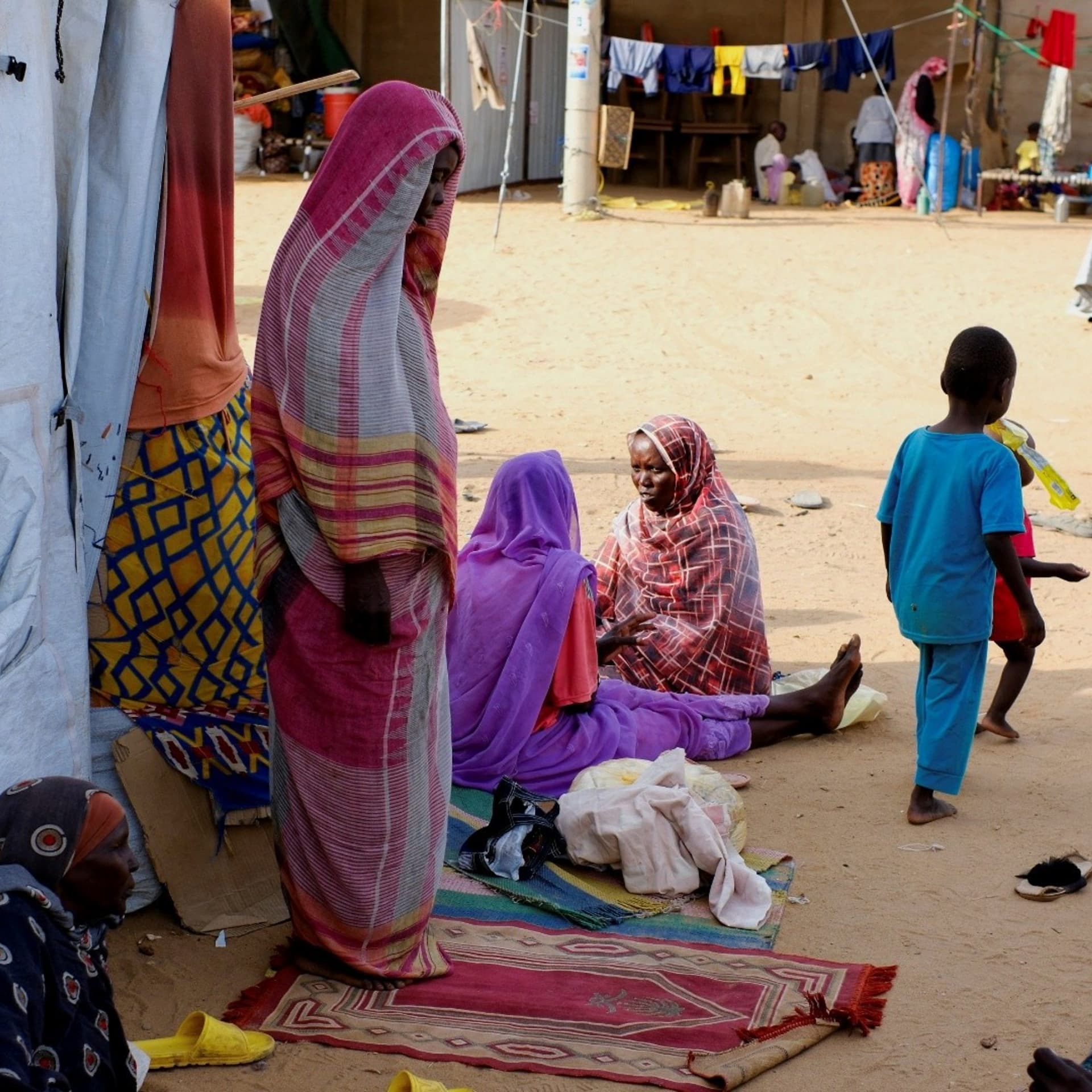
The Global News Podcast brings you the breaking news you need to hear, as it happens. Listen for the latest headlines and current affairs from around the world. Politics, economics, climate, business, technology, health – we cover it all with expert analysis and insight. Get the news that matters, delivered twice a day on weekdays and daily at weekends, plus special bonus episodes reacting to urgent breaking stories. Follow or subscribe now and never miss a moment. Get in touch: globalpodcast@bbc.co.uk Photo: A woman from El Fasher prays surrounded by displaced women, in a camp in Al-Dabbah, Sudan, November 3, 2025. Credit: REUTERS/El Tayeb Siddig