
In short
The episode covers: (1) Middle East ceasefire tensions after Israel strikes Hezbollah in Lebanon. Iran’s president Masoud Pezeshkin calls the bombardment a “grave violation” of a ceasefire and says US-led talks will be meaningless if attacks continue; Iran’s deputy foreign minister Saeed Hatibzadeh argues Washington can’t demand a ceasefire while Israel “accepts” it and then massacres Lebanon. Israel’s PM Benjamin Netanyahu pledges continued strikes on Hezbollah and says Israel will stop attacks on Iran but not Hezbollah. Examples: over 200 killed in Wednesday’s strikes; claims of residential-area hits and “no warning”; Netanyahu says he targeted Hezbollah leader Naim Qasem’s nephew. US pressure centers on opening the Strait of Hormuz.
Guests/featured people
Lise Doucette (chief international correspondent); Lina Sinjab (BBC Beirut reporter); Dr. Katherine Hansen (wife of Artemis II astronaut Jeremy Hansen); Mimi Swaybe (Latin America specialist); Ambarasan Atarajan (global affairs reporter); Dr. Thomas Clements (University of Reading paleontologist); Daniela Ralph (royal correspondent); Samira Hussein (reporter at Chevron refinery); Tim Potter (Chevron refinery director); Dr. Anwar Gargash (UAE presidential diplomatic adviser).
Written by AI. May contain mistakes. Listen to the episode to check what was said.
Chapters
Tap a time to open that second in VOEscalating Tensions in the Middle East
0:45 to 1:44
Discussion of Iran's accusations against Israel and the ongoing conflict.
“Iran's president accuses Israel of violating the ceasefire deal with its deadly bombardment of Lebanon and warns negotiations with the United States on ending the war will be meaningless if attacks continue.”
Responses to the Conflict and U.S. Involvement
1:44 to 4:05
Exploration of U.S. foreign policy and responses from Iran and Israel.
“The Iranian president, Masoud Pezeshkin, has said negotiations with the United States on ending the war will be meaningless if Israel maintains its attacks on Lebanon.”
The Complexity of the Middle East Conflict
4:05 to 5:49
Analysis of the multifaceted players involved in the ongoing conflict.
“and to bring down the global price of oil, to keep this ceasefire in place?”
Impact of Bombardments on Lebanese Civilians
5:49 to 8:12
Personal stories and updates from Lebanon following the attacks.
“Now, listening to you talk, Liz, it just underlines the fact for me how many players we have involved in this conflict.”
Energy Crisis Amidst Conflict
8:12 to 10:30
Discussion on how the Middle East conflict affects global oil supplies.
“The people have not started to bury their dead yet, as they are still looking for who is missing.”
Venezuelan Oil Imports to the U.S.
10:30 to 12:11
Insight into how Venezuelan oil is affecting U.S. markets and prices.
“sanctions, companies like Chevron are bringing in that oil from Venezuela by the shipload.”
NASA's Artemis II Mission Update
12:11 to 14:02
Updates on the Artemis II mission and the experiences of astronauts.
“People on the ground are still paying really high prices at the gas pump.”
Family Connections During Space Missions
14:02 to 16:36
Learn about the emotional connections astronauts maintain with their families during missions.
“So tell me a bit about that communication.”
Teaser for Upcoming Segment on Fossil Discovery
16:36 to 16:54
Discover the surprising truth behind the world's oldest octopus fossil.
“And then we will absolutely celebrate with the world.”
Argentina's Glacier Law Controversy
17:43 to 20:04
Understand the implications of changes to Argentina's glacier protection laws.
“When Argentina introduced a law 15 years ago to protect glaciers from the effects of the mining industry, environmentalists celebrated it as a landmark achievement.”
Show all 14 chapters
India's Crucial State Elections
20:04 to 24:05
Explore the significance of the ongoing state elections in India and their impact.
“So changes to the glacier law basically allow provinces to decide how they're going to use their own resources.”
Reclassification of Ancient Fossil
24:05 to 27:04
Learn about the reclassification of a fossil once thought to be an octopus.
“A 300 million year old fossil, long described as the remains of the world's oldest octopus, has been on display in a museum in the American city of Chicago for more than two decades.”
Queen Elizabeth II's Fashion Exhibition
27:04 to 28:03
Discover the display of Queen Elizabeth II's iconic outfits and their significance.
“And if you want to see an artist's impression of what the ancient Nautilus would have looked like, have a look at the BBC News website.”
Queen Elizabeth II's Fashion Legacy
28:03 to 29:10
Explore the distinct style and fashion choices of Queen Elizabeth II.
“who was her body double to parachute into the stadium.”
Transcript
Automatic transcript. May contain errors.0:00This BBC podcast is supported by ads outside the UK.
0:30to bbc.com and the BBC app. Find out more at bbc.com slash unlimited. This is the Global News Podcast from the BBC World Service. I'm Celia Hatton and we're recording this edition at 15 GMT on Thursday, the 9th of April. Iran's president accuses Israel of violating the ceasefire deal with its deadly bombardment of Lebanon and warns negotiations with the United States on ending the war will be meaningless if attacks continue. But Israel pledges to keep striking Hezbollah targets. Also in this podcast, Argentina approves a law making it easier to mine in glacier regions, but campaigners say it threatens crucial water sources.
1:17And what's it like to watch your husband blast off into space. A lot of excitement, a lot of anxiety, but we are just so, so happy to see him living his dreams. So we're having the time of our lives watching him. We'll hear from Dr. Katherine Hansen, wife of the Artemis II Canadian astronaut Jeremy Hansen.
1:43Starting in the Middle East, the world takes a collective inhale of breath as we wait to see if the U.S. ceasefire with Iran will collapse. The Iranian president, Masoud Pezeshkin, has said negotiations with the United States on ending the war will be meaningless if Israel maintains its attacks on Lebanon. He vowed that Tehran would not abandon the Lebanese people. Iran's deputy foreign minister, Saeed Hatibzadeh, told the BBC the strikes on Lebanon were a grave violation. You cannot have a cake and eat it at the same time. That was the message that Iran sent quite clearly, crystal clearly, to Washington and to the Oval Office last night.
2:23And our foreign minister also said that you cannot ask for a ceasefire and then accept, you know, the areas that, you know, ceasefire is applied to and name Lebanon, exactly Lebanon in that, and then your ally just start a massacre. Actually, it was a sort of genocide, you know, by the regime of Israel in Lebanon just immediately after the ceasefire was accepted. More than 200 were killed in Wednesday's strikes, and the Israeli Prime Minister Benjamin Netanyahu has pledged to keep attacking the Iran-backed group Hezbollah wherever necessary. Meanwhile, Donald Trump says U.S. forces will remain in the region until Tehran complies with what he described as the real agreement.
3:05He's pushing for Iran to allow ships through the Strait of Hormuz, a move which would allow a significant portion of the world's oil to flow again. At this rate, well, the US and Iran make it to Saturday when they're scheduled to sit down for talks in Pakistan. Let's hear from our chief international correspondent, Lise Doucette. Israel now says it has killed the nephew of Naim Qasem. He's the leader of Hezbollah in Lebanon. He's the personal secretary as well in the organization. To Iran, this will again emphasize that this ceasefire is being violated. And it will again test just how committed it is to at least keeping the pretense of a ceasefire alive, that it can continue with what are expected to be talks with the United States at a high level in Islamabad over the weekend.
4:02How much pressure are the Americans? Is Donald Trump under at the moment to open the Strait of Hormuz and to bring down the global price of oil, to keep this ceasefire in place? Well, first of all, on J.D. Vance, he said that this is a misunderstanding of Iran. Lebanon was never part of the deal. But yet if you go back to that post on social media of the Pakistani Prime Minister, Shabazz Sharif, and it has emerged that the United States played a role, it seems, in drafting a tweet which was very much in the style of President Trump. It talked about an immediate ceasefire everywhere, including Lebanon and elsewhere, and in capital letters, effective immediately.
4:41So it wasn't the original announcement. Secondly, J.D. Vann says, well, why is Iran making such a fuss about Lebanon? That has nothing to do with Iran. But of course, it has everything to do with Iran. It cannot be seen to be abandoning a key ally, which it drew into this war to help it in the war against Israel and the United States. It's said to be one of the points in that plan, that 10-point plan that President Trump says is a good basis for negotiations. And yes, the Strait of Hormuz, you heard, and our listeners may have heard parts of that interview with Saib Khatib Sadeh, the deputy foreign minister.
5:17Iran is making it absolutely clear this is a red line for them. This is not just an issue for the United States. Yvette Cooper, the British Secretary of State, will now call on Iran to open the Strait of Hormuz. I spoke to the diplomatic advisor to the UAE president, Dr. Anwar Gargash, yesterday. He said this was totally unacceptable for Iran to control the Strait of Hormuz. So, Celia, just underlines that if and when those talks do take place, there is an ocean to swim before they get anywhere close to an agreement. Now, listening to you talk, Liz, it just underlines the fact for me how many players we have involved in this conflict.
5:55I mean, just to focus on Israel for a moment, will Israel listen to the Americans if the U.S. wants the Israelis to stop airstrikes on Lebanon? Well, Prime Minister Netanyahu, in his first response to the ceasefire announcement, said that Israel agreed to cease its attacks against Iran, but not against Hezbollah. But he also added, we're not done yet with Iran. And this is the point that Iran keeps making and why initially it didn't agree to a ceasefire, because it doesn't want to keep going back and forth. It doesn't want the kind of ceasefire that was in Lebanon, which was then immediately violated, the ceasefire in Gaza, which was then immediately violated.
6:34It wants a permanent end to this war. And whether or not President Trump will do as he did ending the 12-day war against Iran in 2025, he said to Prime Minister Netanyahu, stop, this war has now ended. Will he do it again? He hasn't yet, but he could. Lise Doucette, let's get a better sense of what's happening inside Lebanon after yesterday's bombardment. Many of the Israeli strikes hit residential areas that were packed with people. Some there say they had no warning. The BBC spoke to one man helping with the search and recovery operations in Beirut, who said this was becoming the new normal for Lebanon.
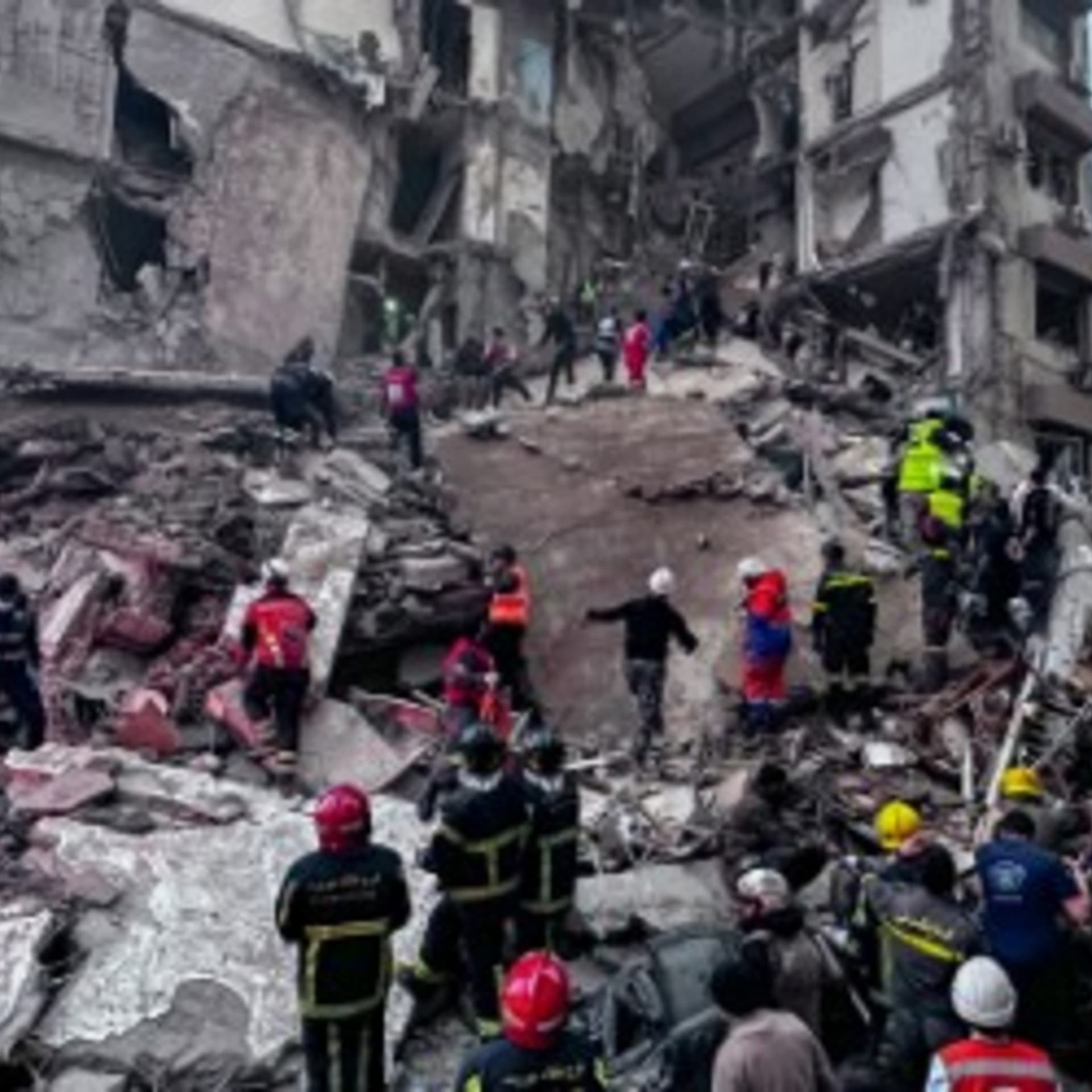
7:16For us, this is something like normal, a civil difference. But for other people, it's not normal. I'm sad, like everybody. We are here to do this job. And we hope that we find peace all over the world, not only in Lebanon. We got this update from the BBC's Lina Sinjab in Beirut. People are still counting the dead, looking for the missing and hoping that some would still appear. There are calls for children missing, families missing. And the government has announced that over 1 ,000 injured and 203 killed so far. But we understand that rescue operations are still trying to find people under rubbles.
8:04The health system is completely strained with all the influx of injured people to hospitals across Lebanon. The people have not started to bury their dead yet, as they are still looking for who is missing. for many people here in Lebanon. When you talk to them, they say that Hezbollah is taking the country as a hostage to serve Iranian interests. But if you look at the scale of the attacks, the wide range of attacks on civilian areas, you know, 100 airstrikes within the course of 10 minutes in residential areas, many people in Lebanon would argue that this is not an attack on Hezbollah. This is an attack on Lebanon, on the people.
8:46This is an attempt by Israel to occupy south of Lebanon. They see Israel as the power in the region that no one is able to stop, whether or not they are on the right side or wrong side. Lina Sinjab. And as we're recording this podcast, residents of southern Beirut have been told to evacuate as Israel says it's preparing to strike more Hezbollah targets. We have more on how Israel and its Prime Minister Benjamin Netanyahu is responding to the ceasefire on our YouTube channel. Search for BBC News on YouTube and you'll find the Global News podcast in the podcast section. There's a new story available every weekday.
9:24As the world reels from the impact on energy supplies caused by the conflict in the Middle East and the closure of the Strait of Hormuz, Donald Trump has said the US doesn't need to worry. His rationale? The US is a net exporter of energy. It has enough for its own huge domestic supply and then some. It also now has a steadily increasing supply of oil from Venezuela after ousting its leader, Nicolas Maduro, four months ago. But Americans are angry that gas prices continue to climb. So how helpful is that extra energy supply now? Samira Hussein has been to the Mississippi refinery, which is receiving most of the new Venezuelan oil.
10:06I'm standing on a wharf. To the left of me is the Gulf of Mexico. And in front of me is an enormous ship. It's about 250 meters long. It's called the Minerva Gloria. On this ship is more than 400 ,000 barrels of crude oil. Where is it coming from? Venezuela. Now that the Trump administration has lifted their own sanctions, companies like Chevron are bringing in that oil from Venezuela by the shipload. Tim Potter is the refinery director here for the Pascagoula site in Mississippi. We just saw a big ship that was carrying Venezuelan oil. How significant are those shipments right now for Chevron and what are you expecting in the future?
10:57It's a big deal for not only Chevron, but also the entire Gulf region prior to a few months ago running about 30 ,000 to 40 ,000 barrels a day. And we're ramping that up to 100 ,000 barrels a day here at the Pasco Gula Refinery. Under my leadership, we are number one producer of oil and gas on the planet without even discussing the millions of barrels that we're getting from Venezuela. President Trump, in his address to the nation last week, talked about America's energy independence. We're in great shape for the future. The United States imports almost no oil through the Hormo Strait. The U.S.
11:34has more oil at its fingertips. Even being just down the road from Chevron's massive refinery, well, it makes no difference to the prices that people pay at the pump. It went up. I know they can put 10 and then they fill it up. Now they don't do that. Now they Driving less and spending less on other things to make up the difference. I hate it. Somebody needs to do something before I step in there. Because the price has got to go down, because I'm going down with it. Here's Tim Potter again from Chevron. People on the ground are still paying really high prices at the gas pump. Why? In the current situation that's happening in the Persian Gulf, they've taken about 20 % of the world oil supply off the market.
12:24And so the demand is still there and it's driving the overall prices up. The overall pricing of that crude has gone up because it's based off of world markets. Chevron believes Venezuelan oil will eventually make it cheaper for American consumers. But it has no control of what happens on global oil markets. Samira Hussain, an update on NASA's lunar journey now. As the Artemis II mission enters its final stage, the astronauts on the Orion spacecraft have been reflecting on their extraordinary path around the moon. The crew have traveled deeper into space than any humans have before. Astronaut Christina Cook said she would miss the camaraderie, adding that they'd become like brothers and sisters.
13:09And the team say they have many more pictures and stories to share with the world as they prepare to return to Earth on Friday evening, local time. and few will be happier to see them than their families. Dr. Catherine Hansen is the wife of the Canadian astronaut Jeremy Hansen. My colleague Emilio Cricchio asked her how she was feeling as her husband hurdles home. Thoughts and feelings are all over the place. There has been a lot of excitement, a lot of, I would say, anxiety and fear. But in addition to that, we are just so, so happy to see him living his dreams. We're so happy to see him in zero gravity, batting shrimp into his mouth, talking about all the things that he does on Earth that he gets to do in space that are a lot more fun.
13:58He says he feels like a kid. So we're having the time of our lives watching him. So tell me a bit about that communication. Do you get to communicate with your husband, do his colleagues? It's so remarkable that we can do that. Absolutely. We had our second private family conference last night and we have two girls in Canada. My son was here in Houston with me and all of us around, just like having a family FaceTime conversation. It was absolutely remarkable to see him, to watch him. Of course, they're in a very small space. So he got to show us his crewmates and we got to wave at Victor, Reed and Christina as well.
14:34And we've even had some emails back and forth. They get email syncs a couple times a day and he's asked for us to send him some messages from Earth. You mentioned three kids. What do the kids say about all this? Yeah, the kids are so, so excited to see their dad living his dream. So we've been waiting for this a long time. They were really little when he was first recruited and now they're young adults off at university. They couldn't be happier. They're really managing this very well, all things considered. This has been years in the making. Is it fair to say the families of the astronauts have also been heavily involved in this mission?
15:11Oh, without question. And I think one of the most heartwarming things that I am noticing out of this mission and this live feed is the way the crew is bringing their families into the conversation. The way every chance they get, they're talking about how much they miss their families, how much they love it up there. and we've seen some very heartwarming conversations around different crew members family. I think it's been for us as family on the ground we truly feel like we're along for this ride. We've supported the training in many many ways and we are there in the hearts hearts and minds of our loved ones that are on their way back from the moon as we speak.
15:57And finally, Dr. Hansen, when the family is all back together, all reunited, will there be a sort of celebration almost? Yes, we certainly had a celebration after the launch was successful. And that was a beautiful experience for us to really get excited about the fact that they were going to the moon. We were together for TLI and we watched that successful translunar injection. And when Jeremy's back safely, we will absolutely come together. First, just the five of us, you know, in a very quiet environment to see how he's doing and to hear some of those more intimate, private stories. And then we will absolutely celebrate with the world.
16:39Dr. Catherine Hansen, the wife of the Canadian astronaut Jeremy Hansen. Still to come in this podcast, what happened when scientists took a closer look at the world's oldest octopus fossil? We were able to identify these tiny little teeth and these teeth tell us that it isn't an octopus. So what is it? We'll have the answer for you in a few minutes time.
17:25We'll see you next time.
17:32It all starts with a subscription to bbc.com and the BBC app. Find out more at bbc.com slash unlimited.
17:43This is the Global News Podcast. When Argentina introduced a law 15 years ago to protect glaciers from the effects of the mining industry, environmentalists celebrated it as a landmark achievement. But lawmakers there have just voted to basically rip up that law and allow local provinces to decide whether mining can go ahead in ecologically sensitive areas. This is the latest action by the country's president, Javier Mille, to undo environmental protections. Speaking ahead of the debate, these people outside the parliament in Buenos Aires said they were worried any change to the law would threaten Argentina's water.
18:26How much is the water that we want to drink going to cost so that it doesn't poison us? Not to mention the water that we need for cooking. This is why we say no.
18:40Honestly, it really hurts me a lot because it's unconstitutional to even be debating this when we have a constitution, a law that protects our glaciers, that protects our land. Our Latin America specialist Mimi Swaybe told me more about the importance of these glaciers. There are a lot of glaciers in Argentina. According to an inventory in 2018, there are about 17 ,000 bodies of ice. And that's the equivalent roughly to about 41 times the size of the city of Buenos Aires. So put it introspective, there are many glaciers running along the Andes mountain region along the spine of Argentina. And they're incredibly rich in minerals and metals such such as gold, copper, silver and lithium.
19:23And these are huge, huge structures. You stand in front of them and all you can see is blue and white. You've been to them, right? I have. I've been to a couple, one in El Calafate in Patagonia called Porito Moreno. It's a very famous one. And you stand there and you can hear these oars and creaking of the ice really slowly moving. It's really magical. But they are also very important from a water perspective. glaciers are thought to contain about 70 % of Argentina's water and it releases or they release water throughout the year from the Andes regions into areas which can often be arid and very dry.
19:58So as well as being magnificent and beautiful they're also incredibly valuable assets to the country. Okay so what will change under this new law and why are environmentalists so upset? So changes to the glacier law basically allow provinces to decide how they're going to use their own resources. So they will now determine which ice bodies should be protected and which shouldn't. And this new criteria, which is basically opened up, there's very little criteria now essentially, will grant mining companies access to areas previously off limits, specifically in the Andes region. If a glacier is deemed effective hydrological function, so basically if it has a key water function, it will remain protected.
20:39Otherwise, it will be exposed to mining activities to extract copper and silver and gold. And that, along with it, comes risk of water pollution and those chemicals used in the mining process seeping into the wider region. So activists and environmentalists are very concerned about the water security as well as it affecting especially fresh reservoirs. So there is lots of concern here. There have been many protests across the country and there has been a lot of people concerned that this is not just a matter for now but also will affect climate change going forward. Mimi Swaby. Now to India, where millions of people are voting in state elections, seen as a test for the Prime Minister Narendra Modi's Hindu Nationalist Party.
21:24According to India's election commission, the five regions where polls are taking place have a combined 174 million voters, or about 18 % of the country's electorate. Our global affairs reporter, Ambarasan Atarajan, told me what's at stake in these elections. Elections are quite huge in India, both conducted at federal level and the state level. Now, these elections are to four states, state assemblies, and one federally administered territory. So what happens in the outcome of these elections is not going to have an impact on the party of Prime Minister Narendra Modi at the federal level. So what is at stake here is for the regional political parties.
22:04So three of the states now are ruled by regional parties and they are opposed to the BJP. And for them, for the survival, winning these elections are very crucial for these opposition alliance. And for Prime Minister Narendra Modi's party, whether they can extend their influence in these different states like in West Bengal, in Tamil Nadu and in Kerala, or they can retain power in the state of Assam. So that's why it becomes like a staging post for the next federal level elections. Now, if you win this one, then you are in power. It becomes easier for you. You have the advantage when you go for the national elections.
22:42OK, that explanation makes sense. But it's not just what's happening during this election. There's been controversy around who's allowed to vote. Now, the Election Commission of India announced what they call special intensive revision. The whole idea was to remove the names of those who have migrated from the state, from one state to another. And second, those who passed away who died. And some names are duplicated. So that intention looks very good on paper. But what the opposition parties are saying is that, for example, in the state of West Bengal, nine million voters have been left out of the list.
23:17And what they say accused the Election Commission of dropping names of especially Muslim, the minority Muslim community. Now, they say because mostly Muslim tend to vote for and against the BJP because of the Hindu nationalist policy and they support the regional party. So this is in a way it is affecting the democratic process. However, the Election Commission and the BJP deny these charges. What they say, we want to remove those duplications, but this has caused a huge amount of controversy. Now, why the voter ID is important, why your name should be there, because people living in border areas, for example, like in West Bengal and Assam, they think if they don't have this voter ID, they won't be considered as a national, they will be treated as an illegal immigrant, and they will be deprived of many government welfare projects.
24:04Embarrassing atarajan. A 300 million year old fossil, long described as the remains of the world's oldest octopus, has been on display in a museum in the American city of Chicago for more than two decades. The fossil was also featured in the Guinness Book of Records. But it turns out the octopus preserved in the fossilized remains is not an octopus. Paleontologists, including Dr. Thomas Clements from the University of Reading, had long doubted the original scientific classification. He told the BBC's Rich Clark what the fossil looks like. This is a tiny fossil. It's about the size of your palm.
24:43And it was found in North America, just south of Chicago. And it was described in the year 2000 by a team of researchers based in the US. And it was described as the world's oldest octopus. It's sort of a selection of arms at the bottom. It has two eyes. It also has a pair of fins on top of its head, which look very similar to modern deep water octopuses. So that's why the authors originally described it as that. So what actually was it? When most people think of fossils, they think of the hard parts of animals. So bones, teeth and shells. And that's because when an organism dies, it decays and the hard parts of what remain.
25:22And over millions of years, those turn to stone. And in some very exceptional environments in the past, decay gets disrupted and soft tissues can actually turn into rock. So in this example, an animal that has no hard parts, very few hard parts, in fact, just sort of a few like a beak and a few little hooks and things like that. The soft tissues themselves turn to stone and then basically preserved in the rock for 300 million years, which is what we identified. You can forgive the original assessment that it was an octopus, can you? Yeah, absolutely. I totally get it. So what is it? So basically, working on this organism is really, really hard because the soft parts are quite ambiguous.
Read the full transcript
26:01And in fact, we had to use a very fancy piece of equipment the size of a football field. And basically, it's a large tube, and it fires electrons around it at nearly the speed of light. And then eventually, the electrons travel so fast, and then they deviate the electron path, and that generates a very bright light. And that light generates X-rays, which are very, very powerful, and can be used to scan things like fossils to look at the chemistry. It's complicated, isn't it? It's very complicated. So what is it? So basically, these X-rays are so powerful that we were able to look just under the surface of the rock and we were able to identify these tiny little teeth.
26:38And these teeth tell us that it isn't an octopus, but it's actually a nautilus. A modern nautilus is a cephalopod that has an external shell. They live in fairly deep water. You can find them around Mauritius. They're very, very rare and they're very threatened at the moment. But these animals have been around for 400 million years. And Falsipia, this ancient 300 million year old potential octopus, is actually one of these animals that's lost its shell because it decayed before it turned into a fossil. Dr Thomas Clemens. And if you want to see an artist's impression of what the ancient Nautilus would have looked like, have a look at the BBC News website.
27:14And last, the late British monarch, Queen Elizabeth II, would have been 100 years old later this month. To mark the occasion, some of her most recognisable outfits are going on public display at the King's Gallery at Buckingham Palace. The exhibition includes everything from her wedding and coronation gowns in her early years to the favourite tartans and tweeds she wore in more recent decades. Our royal correspondent, Daniela Ralph, has been taking a look. Across the gallery, mannequin after mannequin is dressed in some of the most memorable outfits of the Queen's life. Throughout nearly 10 decades, most of her clothes were bespoke.
27:52Her wedding dress has been painstakingly restored. Also on display, her peach-coloured dress from the opening ceremony of the 2012 London Olympics. Alongside it is a replica created for the stuntman, who was her body double to parachute into the stadium. This black velvet evening dress is from 1956. But the next star the Queen meets Marilyn Monroe. It was for when two of the most famous women in the world first met. The red wool dress and coat were the cut and look of many of the Queen's choices in the later part of her life. Vivid colour featured strongly. She wore the outfit on one of the most public days of the year, Christmas at Sandringham in 2015.
28:37A lot of them would have been double wool crepe. It was created by Stuart Parvin, a favoured designer. You always knew that she would love any shade of bright green and bright yellow, premier's yellow. Any shade of yellow would be a popular choice. The late Queen had a distinct style, comfortable, practical, British designed and often colourful. The exhibition includes accessories and raincoats too. Each item tells a story. Many mark significant events in British history. Others show the more private, dressed down moments of a monarch who was an early fashion influencer. Daniela Relf. And that's all from us for now.
29:17If you want to get in touch, you can email us at globalpodcast at bbc.co.uk. You can also find us on X at BBC World Service. Use the hashtag Global News Pod. And don't forget our sister podcast, The Global Story, which goes in-depth and beyond the headlines on one big story. This edition of The Global News Podcast was mixed by Jack Wilfen. and the producers were Stephanie Zacherson and Chantal Hartle. The editor is Karen Martin. I'm Celia Hatton. Until next time, goodbye.
30:09From less than a dollar a week for your first year, read, watch and listen to trusted, independent journalism and storytelling. It all starts with a subscription to bbc.com and the BBC app. Find out more at bbc.com slash unlimited.
From the publisher
The Iranian President Masoud Pezeshkian says Israel's attacks on Lebanon violate the ceasefire agreement with the United States, and warns that upcoming negotiations will be meaningless if strikes continue. In Beirut, rescue workers are searching through rubble for people missing after Wednesday's bombardments. The Israeli Prime Minister Benjamin Netanyahu has pledged to keep attacking the Iran-backed group Hezbollah "wherever necessary". Where does this leave peace talks, currently planned for Saturday in Pakistan?
Also: millions of people are voting in India's state elections, seen as a test for the Hindu nationalist party of Prime Minister Narendra Modi. Congress in Argentina passes a bill allowing mining in areas where glaciers had been protected. We hear from the family of one of Nasa's Artemis II astronauts, as they prepare their return to Earth. A 300 million year old fossil, described as the remains of the world's oldest octopus, turns out not to be an octopus. And outfits belonging to the late British monarch, Queen Elizabeth II - including her wedding and coronation gown - go on display at Buckingham Palace.
The Global News Podcast brings you the breaking news you need to hear, as it happens. Listen for the latest headlines and current affairs from around the world. Politics, economics, climate, business, technology, health – we cover it all with expert analysis and insight. Get the news that matters, delivered twice a day on weekdays and daily at weekends, plus special bonus episodes reacting to urgent breaking stories. Follow or subscribe now and never miss a moment. Get in touch: globalpodcast@bbc.co.uk