
In short
The episode centers on NATO and Ukraine after Russia’s attack on a railway station near the Polish border, killing or targeting European-linked passengers. The Institute for the Study of War (US-based, non-profit, non-partisan) urges NATO to consider intercepting Russian drones inside Ukrainian airspace, potentially via a buffer zone; NATO Secretary-General Mark Rutte calls the attack reckless. A former Ukrainian Ministry of Defence adviser, Yorizak, doubts NATO can do it directly and instead backs closer NATO-Ukraine cooperation to mass-produce drone interceptors. Donbass coverage highlights rising Russian glide-bomb attacks on Kramatorsk and Slovyansk, with civilians and volunteers describing night-time bombardment and evacuations.
Guests
James Landale (BBC diplomatic correspondent in Kyiv); Vitaly Shevchenko (Donbass reporter); Simi Jolle Oso (Lagos correspondent); Richard Hamilton (Buckingham Palace reporter); Maura Fogarty (Canada-EU trade reporter); Hugh Pym (health editor on The Pit); Nicola Stanbridge (interview with Andrew Davis).
Notable examples
whist-drive ticket and other finds from Buckingham Palace; Dangote’s Africa’s largest share sale; doctors praising TV drama The Pit; Andrew Davis “sexed up” Jane Austen.
Written by AI. May contain mistakes. Listen to the episode to check what was said.
Chapters
Tap a time to open that second in VODevelopments in Ukraine
1:07 to 2:08
Discussion on NATO's potential action regarding Russian drone threats.
“I'm Charlotte Gallagher and at 14 hours GMT on Monday the 14th of September, these are our main stories.”
Response to Russian Attacks
2:08 to 4:00
Analysis of Russia's attacks on Ukraine and NATO's stance.
“As a US-based research group, the Institute for the Study of War says NATO should consider intercepting Russian drones in Ukrainian airspace.”
Debate on NATO Involvement
4:00 to 5:48
Exploring the arguments for and against NATO's intervention in Ukraine.
“Of course, NATO should get involved in our view.”
Intensified Attacks in Donbass
5:48 to 7:24
Reports on the severe situation in the Donbass region amidst ongoing conflict.
“It's probing NATO, not just on the border, you know, in this conflict in Ukraine and the border with Poland, but also in other areas with its hybrid activities, its grey zone activities, as they're known.”
Impact of Warfare on Civilians
7:24 to 11:15
Firsthand accounts of the devastation and fear faced by civilians in Donbass.
“and one of the regions taking the biggest hit is the Donbass in the east of the country.”
Africa's Largest Share Sale
11:15 to 13:17
Overview of Aliko Dangote's groundbreaking share sale and its implications.
“man with an estimated net worth of around$35 billion.”
Curious Finds at Buckingham Palace
13:17 to 14:00
Discovery of historical items during Buckingham Palace renovations.
“Extensive restoration work on Buckingham Palace has uncovered a cluster of curious historical items.”
Royal Palace Time Capsule Discovery
14:00 to 15:39
Explore the unexpected historical items found in the royal palace's refurbishment.
“These provide glimpses of behind-the-scenes life inside the palace.”
Canada's Unique Alliance with the EU
15:39 to 17:51
Learn about Canada's strategy to strengthen ties with the EU amid trade tensions.
“Still to come in this podcast, the US medical drama The Pit is up for 25 Emmys, but its biggest fans are real-life doctors.”
Challenges of Canada-EU Relations
17:51 to 19:15
Understand the political and economic hurdles in Canada's relationship with the EU.
“And so the EU is the second largest trading partner with Canada.”
Show all 12 chapters
The Pit: A Medical Drama Phenomenon
19:15 to 23:20
Discover how the medical drama 'The Pit' resonates with real doctors and healthcare issues.
“The 78th annual Emmy Awards are taking place in LA, and this year's most nominated programme is the medical drama The Pit, with 25 in total.”
Andrew Davis: A Screenwriting Legend
23:20 to 27:41
Delve into the life and works of Andrew Davis, renowned screenwriter and author.
“Finally, Andrew Davis has long been regarded as the master of the screenplay, the writer behind House of Cards, Pride and Prejudice, Bridget Jones's Diary and many more.”
Transcript
Automatic transcript. May contain errors.0:00This BBC podcast is supported by ads outside the UK.
0:30and more options to their lineup, can shop at machinefinder.com. Booyah!
1:00For the full story, listen to The Global Story on bbc.com or wherever you get your podcasts. This is the Global News Podcast from the BBC World Service. I'm Charlotte Gallagher and at 14 hours GMT on Monday the 14th of September, these are our main stories. As Moscow attacks a train station near the Polish border, there's a call for NATO to shoot down Russian drones over Ukraine. We hear about Africa's biggest ever share sale, with thousands of Nigerians expected to invest. And as Canada's trade war with the US intensifies, Prime Minister Mark Carney says he wants to form a special alliance with the EU.
1:47Also in this podcast, the trove of historical artefacts found in Buckingham Palace, and the man who made Jane Austen raunchy. Are you content to be known as the man who sexed up Jane Austen? Yeah, I don't mind it at all.
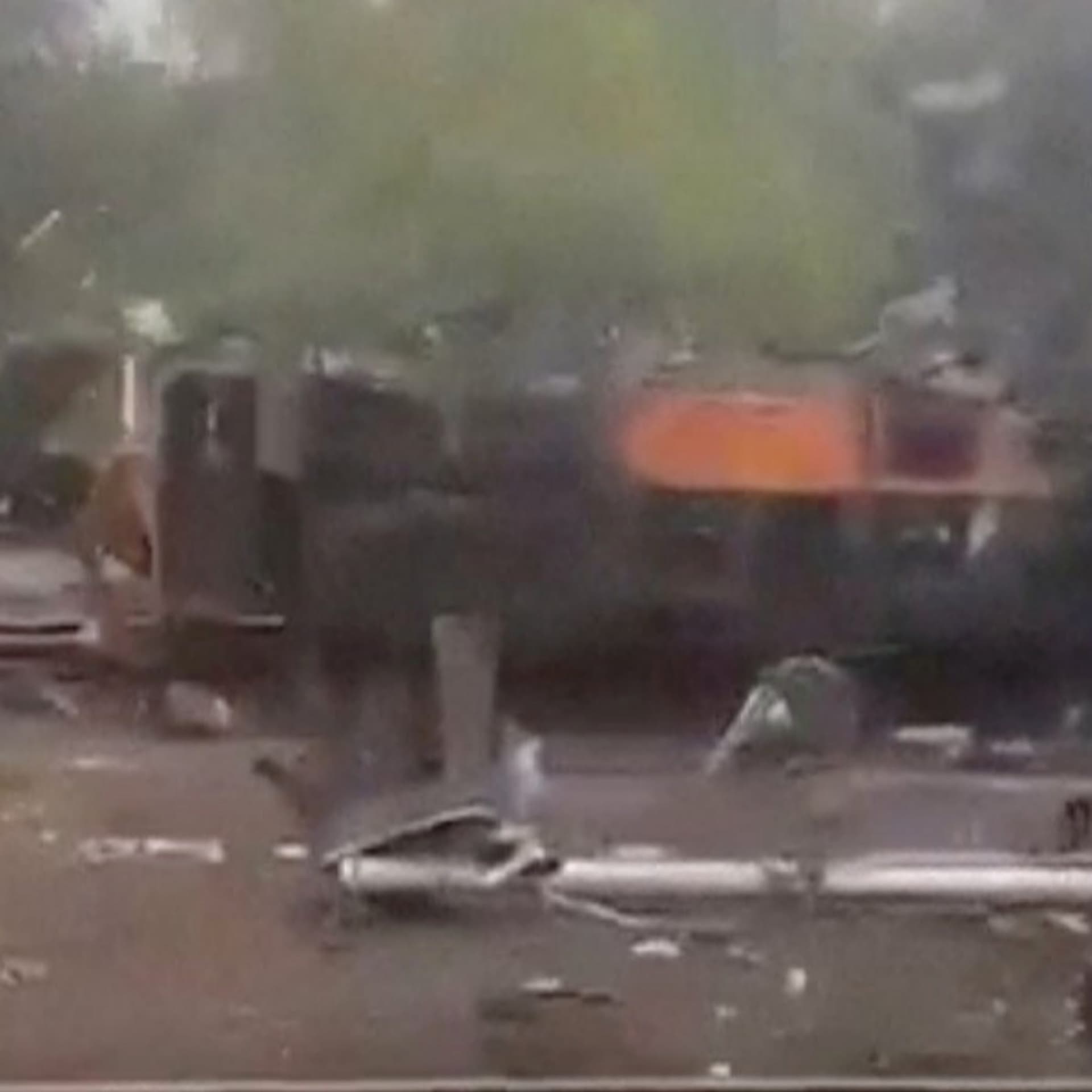
2:08We start with developments in Ukraine. As a US-based research group, the Institute for the Study of War says NATO should consider intercepting Russian drones in Ukrainian airspace. The call comes a day after Russia attacked a railway station near the Polish border. There were senior European officials on the trains who had just passed through the same area, including the former British Prime Minister Boris Johnson. The EU foreign policy chief, Kaya Callas, said the attack was aimed at frightening Western countries. It is clearly meant to scare Western countries from supporting Ukraine, from going to Ukraine.
2:45It was clearly a message to the Western world. I think we should act the opposite. We should show that we are there for Ukraine and we are not scared off because otherwise, you know, Russia will just achieve what they want. And NATO's Secretary General Mark Rutte called the attack on the Ukrainian train reckless. Russia is struggling in Ukraine and continues to lash out with reckless and dangerous attacks, including on civilian infrastructure close to NATO territory. The strike on a peasant train in Ukraine yesterday shows how desperate Putin has become. He thinks that he can stop us from supporting Ukraine and that he can undermine our unity.
3:31He is wrong. Our answer is to increase support to Ukraine so it has what it needs to defend itself. And our commitment to NATO's collective defense is ironclad. We will always do what is necessary to protect every inch of Allied territory. As for NATO intercepting Russian drones in Ukraine, Yorizak, a former advisor to the Ministry of Defense in Ukraine, said he didn't think that would be possible. Of course, NATO should get involved in our view. But at this stage, I don't think NATO has the capacity or capability to actually deal with these kind of threats. And what is more possible and plausible is for NATO countries to closer cooperate with Ukraine with a view to findings and beginning mass production of interceptors that will allow us to deal with this new threat of jet-powered drones.
4:22So how influential is the Institute for the Study of War, which released the report? I've been speaking to our diplomatic correspondent, James Landale, who's in Kyiv. This institute is a respected body. It's non-partisan. It's a non-profit. It's based in the US and it has studied this war in minute forensic detail since the full-scale invasion four and a half years ago. So its reports and its analysis are respected. Now, when it makes a policy recommendation or suggestion like this, it is just another voice in the debate that is taking place. But it is a debate that is definitely happening here in Kiev and other European capitals.
5:02And the argument is essentially like this, that Russia is targeting increasingly Ukraine's borders, particularly with Poland. and there is an argument for NATO to change its rules, to relax its rules, so that NATO forces can operate in some kind of buffer zone just inside Ukrainian territory to bring down Russian drones before they come close to NATO borders. Now, that is something that's supported by the Institute. It's supported by some Polish politicians. But the counter-argument put by other members is that there's a risk, and that's a risk of escalation. there's a risk of NATO on Russia, direct confrontation.
5:41And not all NATO members would agree on this. Well, look, there is a broader argument here, which is that Russia is testing NATO at the moment. It's probing NATO, not just on the border, you know, in this conflict in Ukraine and the border with Poland, but also in other areas with its hybrid activities, its grey zone activities, as they're known. We're talking threatening undersea cables. We're talking cyber attacks. We're talking unexpected explosions in distribution warehouses, targeting of individuals, assassination attempts, all of that. Within that debate, there is an argument that actually NATO should be more proactive in pushing back on Russia.
6:21But yes, there are definitely concerns about it. How likely do you think it is that NATO would get involved at this stage? Well, the thing about NATO is it sort of has to act in concert, largely through unanimity. There are 32 members. Obviously, the United States is a key player in that. And you have a US president at the moment who has declared that he is the peace president. He's going to end wars. However, he started a big one in the Middle East. And I think his administration would be very cautious before getting into any kind of direct NATO-Russia combat over Ukraine. The counter argument that others put is saying, well, look, you know, All you're talking about is bringing down unmanned drones a few miles over Polish territory.
7:05The advantage of that is it better defends NATO. It also frees up Ukrainian air defences that can be used elsewhere. It also, they say, would put Russia back in its box. If NATO doesn't draw a red line like this, then Russia will continue pushing ever further. That was James Landale in Kiev. Well, as we've been hearing, Russia has been stepping up its attacks on Ukraine and one of the regions taking the biggest hit is the Donbass in the east of the country. The area has been a major stumbling block in talks on ending the war spearheaded by the US. Vitaly Shevchenko reports. Kramatorsk and Slovensk are the biggest two cities still under Ukrainian control in Donbass and they are pounded relentlessly daily by Russia.
7:58Data studied by the BBC shows that the number of glide bombs launched at them by Russia has more than doubled over the summer, while the number of wounded civilians has tripled. Pavlov Yechenko, a spokesman for local police, says the devastation is immense.
8:22It's the same tactic. Whenever Russians approach a settlement, wherever they can hit it with such weapons, they raise it to the ground. Their tactic is to destroy everything they see. Destruction is significant. Glide bombs are a powerful weapon. We're calling on families with children, everyone, to evacuate. This is the best way to protect yourself, to save your life. Currently, Russia occupies almost 80 % of Donbass and wants Ukraine to withdraw from the rest, including Kramatorsk and Slavyansk. American negotiators who visited Moscow and Kyiv recently seem to favour the idea, but President Zelensky is refusing to abandon the territory which Russia has been unable to take by force, and it has been using a lot of force.
9:13John Auckland Abbey is a British volunteer who's just delivered medical aid to Slovyansk. The level of attacks have definitely increased from the last time I was there. And I've been all over Ukraine and I've never experienced the constant fear that one has at night time in Slovyansk. Daytime you can kind of survive it and it's manageable, but at night when it's pitch black and it is pitch black because no lights are on anywhere, that's when the Russians begin their bombardment of the city and that is normally with live bombs drones and other rockets and missiles as well. You are woken up every night about three o 'clock or 3.30 in the morning to the whole building shaking.
10:01That's my experience and 100 meters away from where I was staying an apartment block was hit and half of it was demolished. Lala Tarapakina is a Ukrainian volunteer who evacuates animals from frontline areas. She says staying in Kramatorsk means dicing with death. It hurts when you visit somewhere like a shopping centre where you knew every saleswoman, where you used to shop for food or say shampoo, and then you find out that it's been attacked with glide bombs and that the people you knew are buried under the rubble. People you've seen and hugged. They were killed or wounded. It's a pile of bricks now.
10:45You may be alive and well today, but you can be dead tomorrow. Kramatorsk and Slavyansk are a key part of Ukraine's so-called fortress belt, a system of heavily reinforced defence lines in the east. Losing them would make it much easier for Russia to advance westward. As one general told Ukrainian TV, this isn't just a battle for Donbass. It's probably the main battle for Ukraine this year and next. Vitaly Shevchenko. The Nigerian businessman Aliko Dangote is Africa's richest man with an estimated net worth of around$35 billion. Now he's launched Africa's largest ever share sale with the initial public offering of his oil refinery.
11:30Our correspondent in Lagos, Simi Jolle Oso, told me more. This is pretty significant because this is the biggest public share sale that Africa has ever seen. They are offering around 4 billion shares at around 525 naira each. That's around 40 cents. And this could raise$1.6 billion, but this would value the company at$47 billion. So this is quite a small portion of the company. But Dangote has said that he really wants to encourage ordinary Nigerians to buy into the company and own part of the refinery. And what is he planning to do with this money that's raised? Well, the big ambition here is expansion.
12:13So currently, the refinery processes around 700 ,000 barrels of crude a day. Dangote has said he hopes to double that to 1.4 million barrels of crude a day. And he plans to spend around$14 billion doing so. And if they were to achieve that, this would make his refinery one of the biggest refineries in the world. Does the growth of this refinery mean cheaper fuel for ordinary Nigerians? Well, not necessarily. For years, Nigeria has exported its crude and then spent foreign currency buying back processed fuels. So being able to get rid of that cost and to produce more fuel at home may at least remove those import costs, may bring fuel prices down here.
13:03But there's still a lot of factors that come into how much ordinary Nigerians pay at the pump for fuel, including distribution costs. the global price of crude as well, as well as the value of the local currency. Extensive restoration work on Buckingham Palace has uncovered a cluster of curious historical items. Among the finds is a ticket to a social event for royal household staff. Richard Hamilton reports.
13:36A special ceremony of the changing of the guard outside Buckingham Palace on Friday to commemorate the 9-11 attacks in the US. But behind the walls of the palace and under the floorboards, a quirky collection has been uncovered. The misplaced items are thought to belong to staff who worked at the palace decades ago and were found by workers carrying out the$500 million refurbishment. These provide glimpses of behind-the-scenes life inside the palace. Embedded in a lump of brick was a ticket to an evening of playing cards, or whist drive, run by the Royal Household Social Club from nearly 80 years ago.
14:21Other items in this unexpected time capsule include betting slips for the football pools from 1957, a pair of battered black hobnail boots, an empty silk-cut cigarette packet, as well as theatre listings from the standard newspaper in 1889. There's also a schedule detailing Queen Elizabeth II's plans for a diplomatic reception in 1977, revealing that the monarch would work the room in a clockwise direction. Also discovered were pages from the Daily Express newspaper in 1966 describing conditions in the maximum security prison where the great train robbers were incarcerated. Until now, many of the items have remained hidden within the building's infrastructure.
15:15Ageing cables, lead pipes, wiring and boilers are set to be replaced because of concerns about fire risks and water damage. King Charles and Queen Camilla are currently living in neighbouring Clarence House and will not be back in the official residence until the 10-year refurbishment is completed next March. That was Richard Hamilton. Still to come in this podcast, the US medical drama The Pit is up for 25 Emmys, but its biggest fans are real-life doctors. What they've created with the pit is more than just about a good TV show. We finally feel validated for everything that we do and everything that we go through every day.
16:09This is the Global News Podcast. As the trade war with the US intensifies, the Canadian Prime Minister, Mark Carney, says he wants a unique alliance with the European Union, but is not seeking membership of the bloc. He says Canada and the EU share common values and interests and should work more closely together. I asked the BBC's Maura Fogarty what sort of alliance Mark Carney had in mind. He specifically refers to the fact that Canada is not looking to become a member of the European Union and instead wants this unique alliance, or in some ways better trade, special access perhaps to certain types of industries.
16:48And it comes after a report in the Wall Street Journal that used the word associate member status in referring to how Canada is holding talks with the European Union to become much closer to that huge trading and political bloc. Now, a few areas in which he's looking to enhance cooperation and collaboration with the EU are across several strategic key industries, include energy, for example, artificial intelligence, also in defence. And finally, in that critical supply chain of those minerals that go into making semiconductor chips as well as batteries. And is it the relationship, the strained relationship with the US that's driving Canada further towards the EU?
17:28It definitely is the escalating trade war with the United States that's causing Canada to strategically pivot to look towards other partners around the world. And look, the EU is just one of them. All right. But we do know, for example, that Mr. Carney has longstanding ties with the European Union because he was the Bank of England governor previous to his entry into politics. We also know that, you know, if you have been a trading partner with the U.S., which Canada has been, and trade is worth about eight hundred and seventy billion dollars with your southern neighbor, you're starting to think about how do I diversify my trading partners around the world?
18:05And so the EU is the second largest trading partner with Canada. That figure, though, is much lower at about$178 billion between these two trading blocs, Canada and the EU. But clearly he's looking to diversify and to deepen and also kind of strengthen his allies and friends around the world, again, because of this escalating trade war with the United States. I was wondering how then the US would see this if Canada started moving closer towards the European Union. Well, you know, it's not necessarily a done deal. So the Wall Street Journal reporting and Mr. Carney's comments point to the fact that he is keen on developing much closer ties with the European Union.
18:42But don't forget, the EU is very rules bound. If you become a full member, for example, you've got to pay into the EU budget. You have to follow all the EU regulations and to some extent give up some measure of political decision making, I should say, over to the EU body. That's not exactly what Mr. Carney is looking for. but there are hurdles for him to developing the kinds of ties that he wants to. Don't forget, too, that about nine years ago, Canada did sign a trade agreement with the European Union, but that deal has not been ratified by about 10 member states of the EU. That was Maura Fogarty.
19:16The 78th annual Emmy Awards are taking place in LA, and this year's most nominated programme is the medical drama The Pit, with 25 in total. But as well as the critical pull audits, the programme has been so well received by some doctors that the lead actor and executive producer, Noah Wiley, has been invited to a medical conference in the US. Our health editor, Hugh Pym, has been finding out more. Hey, Nat, South 19 got their head CT before he went down. No results yet. All right, let's send the reminder. Hey, Dana. Hang on. A crowded waiting room, trolleys in corridors, highly stressed staff.
19:53But this isn't a typical NHS A &E unit. It's a Hollywood set with actors recreating the pressure cooker atmosphere of an emergency department. Hey Dana, Chem 7's not back on trauma too yet. Let me see the chart. And what's more, doctors love watching it. The most important things I've ever done in my life have been in this hospital. The lead part in The Pit, Dr Michael Rabinovich, known as Dr Robbie, is an experienced emergency medicine consultant. He's played by Noah Wiley, previously in the cast of the earlier medical drama ER. He's also an executive producer and part of the writing team, which includes several doctors.
20:32And I've seen so many people die that I feel like it's leeching something for my soul. So impressed are the US medical profession that they invited him to take part in a platform discussion at a prestigious conference with more than 6 ,000 emergency medicine experts in the audience. Dr. Tony Cirillo is president of the American College of Emergency Physicians. People came up and just said thank you to him. And that was not lost on him, that what he does and what they've created with the pit is more than just about a good TV show. It's about, the term I use is validation. And we finally feel validated for everything that we do and everything that we go through every day.
21:18I don't care. Get someone out of here now. No. You expect us to treat your officers as soon as they come in? You get a detective to pick these kits up, ASAP. I gotta go. Complex procedures and life-saving interventions are shown in graphic detail and social and ethical issues are aired, such as lack of social care and end-of-life decisions. Professor Damien Rowland of the University of Leicester says it puts the problems of the NHS in perspective. Virtually every emergency department in the world at the moment has not enough space to see patients and flow through the hospital. It's a very common theme in the pit about the central character arguing with the hospital management about saying I need more flow.
22:01You can't just leave these patients here. That's a very common problem around the world so we can all relate to that. One of the stars of the pit is Geron Howell, born and brought up in South Wales. With other actors, he was put through a medical boot camp for speed learning of medical techniques and jargon. He was in the hall when he had a cardiac arrest. I couldn't save him. In a BBC Wales interview, he was asked if he'd like to train to be a doctor. I have such a newfound respect for the medical profession, but, yeah, it's maybe made me more, you know, realising that, yeah, I don't know how I do this.
22:42I'll stick to acting. And we do the best we can, but people die. You ever get used to that? No. Some doctors note that each episode compresses into an hour a number of serious trauma cases, which would normally happen over 24 hours or more. Some viewers might find repeated hospital scenes and seriously ill patients off-putting. But as drama reflecting reality, it at least has the thumbs up from medics and TV critics. That was Hugh Pym. Finally, Andrew Davis has long been regarded as the master of the screenplay, the writer behind House of Cards, Pride and Prejudice, Bridget Jones's Diary and many more.
23:30He'll be 90 this week. He's just written his autobiography and has still got several projects on the go. Nicola Stanbridge went to meet him at his home. The opening scene is, of course, very calm, very peaceful. The educated English countryside. A few gentle chords of music tell us that everything is in its proper place in the Andrew Davis household. Could you take us inside your writing room? Yes, the dining room. I can see people going past in the street. I just feel more at home here, which was where I started in 1970. You call your autobiography an unsuitable boy. Explain. Growing up, I was a bit awkward squad.
24:22I must have been terrible to teach, really. I wanted to be a writer like Dylan Thomas, very funny and very detailed and accurate and is still there in a lot of things that I write. This is also where you wrote your 1995 screenplay for Jane Austen's Pride and Prejudice. That's right, yes. We can say that you modernised British period drama, for instance, with Darcy taking a swim in a lake, emerging with a wet shirt, encountering Elizabeth Bennet. Mr Doss? The comedy of embarrassment. Miss Bennet? Hi, here. I did not expect to see you, sir. Are you content to be known as the man who sexed up Jane Austen?
25:11Yeah, I don't mind it at all. I was just bringing out the sex that's inherent in it. The other thing, they're all funny. That's inherently there as well. What are you working on at the moment? An adaptation of The Watsons, which is a Jane Austen fragment. You're also working on a piece about Guy Burgess of the Cambridge Spies, is that right? Yes, it's true. So sort of echoes of power and betrayal there from House of Cards a little bit. A little bit, but I've gone really mostly for the outrageous comedy of it. And in a way, a very puzzling character because this communist conviction that he had when he went to Russia, I don't think he actually liked it very much when he got there.
25:57With Burgess, I thought I'd like to have known him. Francis Urquhart was a horrible person who was great fun to write. You might think that, Matty. I'm afraid I couldn't possibly comment. There have been hints of an upcoming slate of dark Austen projects. You've already alluded to that a little. Slavery in Mansfield Park. It's crazy these days to do an adaptation of Mansfield Park without going and seeing what the plantation was like, which means, of course, inventing scenes. And of course, a lot of people are not going to like that. Another version of Emma who might die in childbirth. I just wanted to write the Jane Fairfax story in Emma.
26:47I just put in a postscript, really. After a year or two, Emma dies in childbirth, Mr Knightley goes up to Yorkshire, brings back Jane Fairfax. This is the second time you've adapted Emma, but yet you're still finding more things to do with it. Yeah, it's a bit of an anti-Emma, Emma. Austin is inexhaustible, really.
27:16That was Nicola Stambridge reporting. And that's all from us for now. If you want to get in touch, you can email us at globalpodcast at bbc.co.uk. You can also watch our episodes in full. Just search for the Global News Podcast on YouTube. This edition was mixed by Chris Ablakwa and the producer was Judy Frankel. The editor is Karen Martin. I'm Charlotte Gallagher. Until next time, goodbye.
From the publisher
A US think tank says NATO should consider intercepting Russian drones in Ukrainian airspace, after a drone struck a train near the Polish border. The strike happened soon after a train carrying senior European officials had passed through the same station. The NATO chief, Mark Rutte, says the attack shows how "desperate" President Vladimir Putin has become. Also: Africa’s biggest ever share sale is launched in Nigeria by the billionaire Aliko Dangote. His oil refinery is offering more than 4bn shares. Extensive restoration work at Buckingham Palace uncovers a cluster of curious historical items. And Andrew Davies, the screenwriter behind House of Cards, Pride and Prejudice and Bridget Jones’s Diary brings out an autobiography as he turns 90 this week.
The Global News Podcast brings you the breaking news you need to hear, as it happens. Listen for the latest headlines and current affairs from around the world. Politics, economics, climate, business, technology, health – we cover it all with expert analysis and insight. Get the news that matters, delivered twice a day on weekdays and daily at weekends, plus special bonus episodes reacting to urgent breaking stories. Follow or subscribe now and never miss a moment. Get in touch: globalpodcast@bbc.co.uk
Photo: Wreckage of passenger train following a Russian drone strike near Ukraine's border with Poland. Credit: Telegram/Reuters