
In short
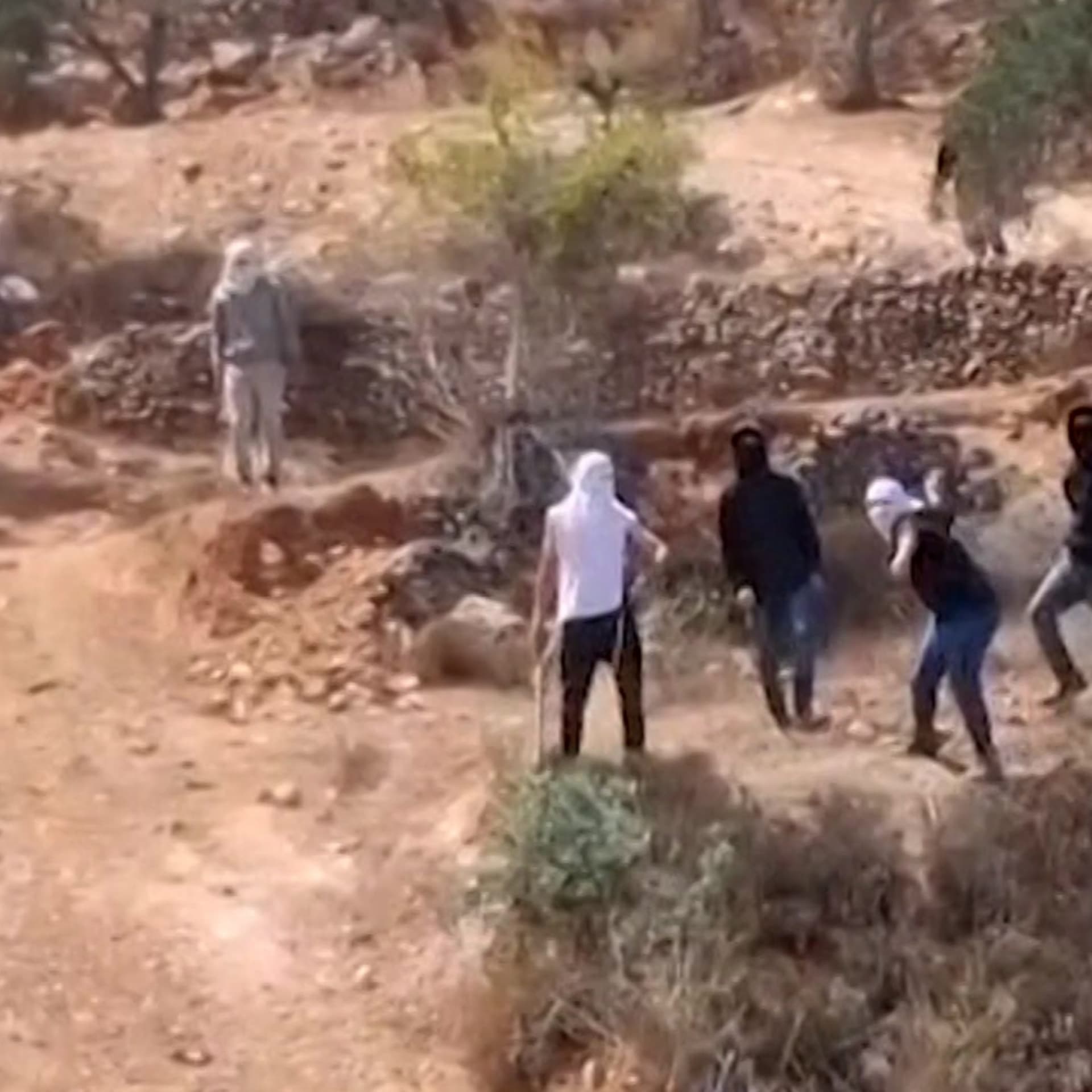
This BBC Global News Podcast episode leads with rare Israeli government condemnation of settler violence in the occupied West Bank. It describes a video of settlers throwing stones at a Palestinian home in Khusra, where residents say the Israeli army detained them instead of stopping the attackers; it also mentions masked settlers injuring foreign journalists in Jalud. Netanyahu’s spokesman Doran Spielman says the acts were by a small group, violate law, endanger Jews and Arabs, interfere with IDF security missions, and harm Israel’s international legitimacy; President Herzog also condemned them. Correspondent Katie Watson adds that settlement outposts are illegal under international law and that condemnation is uncommon.
Guests
none. The episode includes named figures (Netanyahu, Herzog, Zelensky, Norway’s King Haakon VIII, etc.) but no podcast interview guests.
Written by AI. May contain mistakes. Listen to the episode to check what was said.
Chapters
Tap a time to open that second in VOViolence in the West Bank: Settler Attacks
1:55 to 6:12
Discussion on recent attacks by settlers in the West Bank and Israeli government responses.
“Their actions violate the law, they endanger both Jews and Arabs, and they interfere with the Israel defence forces as they carry out vital security missions, and of course, they harm Israel's international legitimacy.”
International Response and Legal Context
6:12 to 7:42
Exploration of international law regarding settlements and Israeli political pressures.
“who said that he condemned these incidents that were in complete violation of the laws and values of the state of Israel.”
Nepal and Tibet Flood Disasters
7:44 to 10:27
Report on the aftermath of catastrophic floods in Nepal and Tibet.
“As rescue efforts continue to find survivors of the catastrophic floods in Nepal and Tibet, relatives are struggling to identify the victims of the disaster.”
Russian Drone Strike in Ukraine
10:29 to 13:19
Details of a drone strike in Ukraine causing significant casualties and destruction.
“ammunition near a residential area on the outskirts of Kiev.”
Norway's New King: Horkon VIII
13:20 to 14:03
Coverage of the new king's first speech addressing the nation after his ascension.
“His father, King Harald, died on Friday after reigning for more than 35 years.”
Norway's Monarchy and Public Sentiment
14:03 to 15:14
Learn about the current state of Norway's monarchy and public attitudes toward it.
“Norway's royal family doesn't have any political power.”
Upcoming Stories Teaser
15:20 to 15:54
A quick preview of what's coming next in the podcast.
“They will derail the rest of his season, but I hope that they won't have much further consequences other than that.”
Emily in Paris: Escapism or Harm?
15:57 to 16:44
Explore the debate surrounding the impact of 'Emily in Paris' on Parisian culture.
“I'm Asma Khalid and I host the Global Story podcast from the BBC.”
Canada and US Trade Relations
17:40 to 21:08
An analysis of the ongoing trade tensions between Canada and the US.
“The Premier of the Canadian province of Ontario, Doug Ford, had this message.”
Japan's Politeness in Emergencies
21:08 to 24:24
The cultural implications of shoe etiquette in Japan during emergencies.
“So there are no talks actively taking place.”
Show all 13 chapters
Tadej Pogacar's Injury Update
24:24 to 27:23
Insights into Tadej Pogacar's recent injuries and their impact on his career.
“And one of the most successful cyclists of his generation, the Savinian Tadej Pogacar, has been forced to pull out of the Vuelta a España, the annual three-week Spanish road race.”
Young Boxer Moses Itauma's Fight Analysis
27:23 to 28:00
A detailed look at the recent boxing match involving Moses Itauma and its implications for his career.
“Finally, Croatia has a new heavyweight boxing world champion after Filip Higovic knocked out his British challenger, Moses Itauma, at London's O2 Arena.”
Boxing Match Analysis and Fighter Insights
28:00 to 30:49
Explore the dynamics of a recent boxing match and the fighter's potential.
“cut him and was really giving him quite a beating.”
Transcript
Automatic transcript. May contain errors.0:00This BBC podcast is supported by ads outside the UK.
0:30No bouncing between tabs. And best of all, no spreadsheets. Stop managing software and start managing your business with one unified system. Try for free today at odoo.com. That's O-D-O-O dot com. Ever wonder why we make the choices we do? And how to make smarter ones? Introducing Choiceology, an original podcast from Charles Schwab. Join Wharton Professor Katie Milkman, an award-winning behavioral scientist and author of the best-selling book, How to Change, as she shares true stories from Nobel laureates, authors, athletes, and everyday people about why we do the things we do and how to make better choices to help avoid costly mistakes.
1:14Each episode covers the latest research in behavioral science and dives into themes like the power of self-control, shaping your mindset for success, navigating new beginnings, and why starting over can feel so hard. Listen to choiceology at schwab.com slash podcast or wherever you listen.
1:37This is the Global News Podcast from the BBC World Service. I'm Charlotte Gallagher and in the early hours of Sunday 30th August, these are our main stories. a rare criticism of some Jewish settlers in the occupied West Bank from the Israeli government. Their actions violate the law, they endanger both Jews and Arabs, and they interfere with the Israel defence forces as they carry out vital security missions, and of course, they harm Israel's international legitimacy. We're in Ukraine after 37 civilians were killed in a Russian drone strike on an arms depot. Who do you hold responsible for this?
2:17Russia. Who? Russia. their government, the people, Russians themselves. Also in this podcast, why Japanese paramedics are asking people to be less polite and... It took a dip around February when it really came quite clear the extent of the now Queen Metamari's relationship with Jeffrey Epstein. As the new king begins his reign, we assess the popularity of Norway's royal family.
2:51We begin the podcast in the occupied West Bank.
3:02That's from a video recorded by a Palestinian man of a crowd throwing stones at them. You can hear him say in Arabic that settlers have surrounded their home. Dozens of settlers attacked two Palestinian villages, including Kusra, where they've also been stopping supplies from reaching some villages for weeks. Luey Beiruti said his family was under siege by the settlers and the Israeli army. The settlers attacked us and we were trapped inside my house. There were more than 70 people hurling stones at us. The army fired tear gas, so we climbed on the roof where the group continued throwing stones.
3:44We called the police, but they never arrived. The army didn't stop the settlers. They instead detained us with handcuffs and blindfolds, as if we were the terrorists. Then they kept us in a military vehicle for 40 minutes and beat anyone who spoke out. The ferocity of Saturday's attacks prompted rare condemnation from Prime Minister Benjamin Netanyahu. Doran Spielman is his spokesman. These acts were committed by a small group of rioters. They do not represent the law-abiding Jewish community in Judea and Samaria. On the contrary, they cause that community a grave injustice. Their actions violate the law, the endangerable Jews and Arabs, and they interfere with the Israel Defense Forces as they carry out vital security missions.
4:35And of course, they harm Israel's international legitimacy. Our correspondent in Jerusalem, Katie Watson, told me more about the latest violence. There were two particular areas that kind of came under scrutiny. The village of Khusra, and that has been in the spotlight in the last month. But what we saw earlier today were dozens of settlers that were attacking the village of Khusra. I spoke to a resident there, Louis Riddie, an American-Palestinian who earlier this month actually kind of made headlines. He flew back from the US to protect his house. And he was telling me that this incident happened close to his house.
5:13He reckoned around 40 settlers had started throwing rocks. He did alert the Israel Defense Force who dispatched vehicles and tear gas. And the IDF has said that they were dispatched after there were violent clashes that had occurred. And security forces also identified rioters, some who'd barricaded themselves inside a Palestinian home while some residents were inside. But there was also a separate incident in the town of Jalud, where there were some foreign journalists who were injured after some masked settlers attacked them as well. And what's really rare about this is that there has been condemnation of the settlers by the Prime Minister of Israel.
5:56Yeah, that's right. So the Prime Minister Benjamin Netanyahu said that he has strongly condemned these acts. It was a handful of rioters who said were violating the law, causing a grave injustice to law-abiding Jewish community. That was also followed by President Herzog, who said that he condemned these incidents that were in complete violation of the laws and values of the state of Israel. So, you know, all settlements are illegal under international law. These outposts, they're also illegal under Israeli law. But quite often they're also supported by state services and funding. And kind of this condemnation certainly is not something that we see all the time.
6:44Do you think it's international pressure as well, Given that the US ambassador to Israel, Mike Huckabee, had even been critical of these settlers, who's been very supportive of Israel, do you think Mr Netanyahu is worried about how the international community is viewing Israel? Yeah, I mean, you know, given that there's been this sharp rise in the expansion of settlements, we've definitely seen, you know, a huge rise, especially since the attack from Hamas on Israel in October 2023. You know, the number of settlements has definitely increased. There has been a condemnation. There's, you know, Benjamin Netanyahu facing elections in the next month or so, clearly under pressure.
7:26and it's given that they are illegal under international law, it certainly doesn't make Israel look very good, especially right now. So there has been a condemnation pretty broadly, but the fact that it's been seen here in Israel as well, which is not so common, I think says a lot. Katie Watson in Jerusalem. As rescue efforts continue to find survivors of the catastrophic floods in Nepal and Tibet, relatives are struggling to identify the victims of the disaster. Nearly 700 bodies have been recovered so far, but more than 3 ,000 people are still missing. Severe weather is making it difficult for helicopters to reach survivors, and emergency services are struggling to reach mountain communities by land.
8:12Families are gathering at morgues, hospitals and army bases across the region in the hope of hearing news of their loved ones. Our correspondent Azadeh Mishiri reports from Kathmandu. an agonizing search for answers on a mortuary wall pictures of the bodies that have been recovered men women infants the injury is so graphic some of the faces are unrecognizable poster to poster motiraj tries to find his uncle police believe they've matched him to a photo He says with little information from the authorities he took the search into his own hands 66 year old Ram Bahadur was a British army officer The bus he was travelling on washed away in the flood Murtiraj gave police the last known location of his mobile phone They told him it matches the area where that body was found So he was working in a hydro tunnel?
9:16Yes he was working in hydro Others have no word from the authorities. They've come here desperate for news. Ashok's brother Harish is one of the hundreds of people trapped in tunnels. There's no information on how many people are still alive there or what state they are in. There is no credible information. All they tell us is that rescue is continuing.
9:44Small cries beneath the rubble. Amid the devastation, hope still surfaces.
9:55Child, don't be scared, the rescuers say.
10:01For days, Manisha has been lying here. She is now recovering in hospital, according to the police. Manisha is just one of the thousands who've been saved. While emergency operations continue, Nepal is on high alert, wary of more flooding and grappling with the chaos of the aftermath. Azadeh Mishiri in Nepal. 37 people have been killed in Ukraine after a Russian drone strike hit a warehouse storing ammunition near a residential area on the outskirts of Kiev. More than 100 houses were damaged and 400 families evacuated. President Zelensky said it was horrific negligence to store deadly explosives near civilians.
10:48Our Ukraine correspondent Dan Johnson reports from the village of Myla. Emergency teams spent the day searching for casualties and dealing with unexploded munitions scattered across the neighbourhood. The Pavlenko family home is just 200 metres from the ammunition warehouse that they had no idea. In the pumpkin patch here, there's a magazine of bullet casings. This looks like a whole stash that have been blown with the force of these explosions from this warehouse into the garden, and that's perhaps what started the fire that has destroyed the outhouse and caused so much damage to this home.
11:33Lyubov showed me around the ruined remains of their home, covered with shattered glass and splintered wood. I'm still kind of numb. I don't know. Once I come around a little tomorrow, I'll probably have an even bigger breakdown. Who do you hold responsible for this? Who? Russia, their government, the people, Russians themselves.
11:58A Russian drone hit the warehouse, detonating stacks of ammunition and damaging 130 nearby homes. President Zelensky said munitions should never be stored in residential areas, but he referenced a similar incident last month which killed seven people. Two defence company bosses are being questioned. The president said another such crime was unacceptable and allegations of criminal negligence are being investigated. The first strike hit an ammunition storage facility, one that definitely shouldn't have been there, belonging to the defence forces. It detonated shells, mines, other ammunition and drones.
12:35The scale is significant. And here there is anger. We met Boris Daniliuk, whose home was hit. Why weren't precautions taken here? Why? What were they thinking? The authorities, the Ministry of Defence, why was this allowed at the warehouse in a place where they used to store food? Did you have any idea you were living so close to an ammunition store? There was no information at all, none, whatsoever. 400 families have been moved from their homes as the clear-up continues. Kiev has come under relentless Russian attack over the past 48 hours, but this incident leaves people questioning Ukraine's responsibility for keeping its people safe.
13:18Dan Johnson. The new king of Norway, Horkon VIII, has given his first public speech since taking the throne. His father, King Harald, died on Friday after reigning for more than 35 years. The new monarch paid tribute to his father, describing him as generous and kind, and also praised Norway's welfare state. But he warned that uncertain times lie ahead. The world today has become more unstable and unpredictable than it was during most of King Harold's reign. This affects us here in Norway as well, and has brought a new uncertainty to our lives. Now that my father has passed away, a huge task awaits me.
14:03Norway's royal family doesn't have any political power. However, they're seen as an important symbol of national unity. King Harald's final years, though, were often overshadowed by controversies involving members of the wider royal family, as Norwegian journalist Lars Bavanger explains. The support for the monarchy is pretty solid. It took a dip around February when it really came quite clear the extent of the now Queen Metamaris' relationship with deceased financier Geoffrey Epstein at the same time as the trial against her son from a previous relationship, Magnus Hobie, also started. Support for the monarch, the late king, was never in question.
14:46That never really dipped. And the new king has also enjoyed quite a lot of sympathy. So I don't think we're looking at a sort of a push for a constitutional change away from a monarchy in Norway. But again, who knows what the future brings? Things change quickly sometimes. So I think the royals are aware of this and then they will have to work with the time. And of course, they will have to do what the people through Parliament decides in the end. Lars Bavanger in Oslo. Still to come in this podcast. It appears that he's injured a vertebra and a collarbone. They will derail the rest of his season, but I hope that they won't have much further consequences other than that.
15:29How a stone on the road derailed a cycling champion.
15:49monitor and engage with the account while your teen learns how to invest and manage money. Learn more at schwab.com. Is the hit Netflix show Emily in Paris just harmless escapist TV or is Emily ruining Paris? I'm Asma Khalid and I host the Global Story podcast from the BBC. The president of France has described the show as super positive for his country, soft power through cinema. But is TV tourism good for a city? For more, listen to The Global Story on BBC.com or wherever you get your podcasts.
16:44from Nobel laureates, authors, athletes, and everyday people about why we do the things we do and how to make better choices to help avoid costly mistakes. Each episode covers the latest research in behavioral science and dives into themes like the power of self-control, shaping your mindset for success, navigating new beginnings, and why starting over can feel so hard. Listen to choiceology at schwab.com slash podcast or wherever you listen.
17:39renaming it Lake America, apparently in retaliation for Canada's walkout in failed trade negotiations. The Premier of the Canadian province of Ontario, Doug Ford, had this message. It's always going to be Lake Ontario, now and forever. President Trump can call it whatever he wants, but I can tell you the rest of the world will always call it Lake Ontario. And obviously Canada is always going to call it Lake Ontario. So that's our message to President Trump, we're resilient and we're strong Canadians. We're always going to protect our sovereignty, always. And we'll never, ever back down from a bully, ever.
18:18I've been hearing more from our North America correspondent, Peter Bowes. It is something of a sideshow when you think that the main issue here is the tariffs between the two countries and those trade negotiations that have, at least for the time being, completely collapsed. Many people around America, especially, I think, are quite bemused by certainly the action of President Trump. And it is true that this edict, this order of the president, only applies to America in much the same way as the president renamed the Gulf of Mexico, the Gulf of America. So it may be referred to as Lake America within these shores, but as we've just heard, it certainly won't be elsewhere.
19:01Whether it makes any difference to the issue at stake, and that is trying to resolve the, I think, now wide differences between the two countries, I think it seems extremely unlikely. And the Canadian Prime Minister, Mark Carney, determined to stand up to Donald Trump. It is a high-risk policy because I think if you look at this on paper, the United States has an advantage because Canada is profoundly reliant on this country and its marketplace. The US, I think, does have something to lose as well, especially those states that rely heavily on Canada for trade. So this is, to some extent, a power struggle.
19:41It's a political struggle, a war of words. And yes, these political gestures that we've just been seeing unfold over the last few hours are happening. But I think at the heart of this, the politics are really going to test the nerve of both countries' leaders. You mentioned there the Gulf of Mexico and Trump calling it the Gulf of America. Now, do Americans, do they call it the Gulf of America? And will they say Lake America? Well, ordinary Americans and politicians to a large extent, I think their views that I've heard are largely divided down party lines. Although I think it is also fair to say that many of the president's own party members have criticised him for this.
20:20On the Democratic side, there's been some quite intense pushback. For example, we've got the governor of New York, the only US state that borders Lake Ontario, firmly saying that her administration, the New York administration, will not recognize the name change and will continue calling it Lake Ontario. We've had other high-profile politicians like Bernie Sanders saying that Americans are really focused on affordable housing and health care rather than renaming of landmarks. And just one other quote from Mark Kelly, another senator, another Democrat from Arizona. He just asked the question, how does changing the name of a lake help the American people?
21:00They can't afford their lives right now, he said. And where are we with any kind of negotiations between the two countries? The negotiations are completely deadlocked and they are currently suspended. So there are no talks actively taking place. And effective from a week or so's time, September 8th, Canada will be hitting over 700 American products with tariffs ranging from 15 to 50%. Peter Bowes. In Japan, visitors are expected to remove their footwear when entering someone's home. and hosts will then often turn guest shoes towards the doorway out of politeness. But paramedics in the city of Kanazawa say Japan's etiquette culture has gone a step too far.
21:48Officials have released a video urging residents not to rearrange shoes of emergency responders when they arrive at their homes, insisting it's not helpful. Helena Burke gave me the background. The video was posted on Instagram by the Kanazawa Fire Department, which is in charge of emergency services in this city in central Japan and it shows four paramedics entering someone's apartment. They take their shoes off at the front door and then the homeowner tidies them up and puts them in a nice straight line. The video explains that although this is the norm in Japan, it's actually unhelpful for the paramedics to do this.
22:22When they're trying to carry someone out of the house on a stretcher and get out of the house quickly, putting their shoes in a certain way can actually make it more difficult for them to get to them and to get out quickly. The video says residents need to resist the urge to be polite and leave the shoes alone because actually paramedics do put them in specific positions that make them easier for them to slip on and get out. And this has sparked a debate about Japanese culture, particularly how polite people are in Japan. And I found it quite strange that paramedics take their shoes off because in the UK, if you call for an ambulance, you call for the police, they come in, they're in a hurry and I don't think they think to take their shoes off.
22:59It has. And that specific point has been brought up that how interesting is that even in an emergency situation, they're still so polite and so respectful of the cleanliness and sanctuary of someone's house that they're still taking their shoes off. The video has been viewed over half a million times now, and there are lots of comments of people kind of debating the merits and maybe some of the drawbacks of this politeness. For a lot of Japanese people, though, this is just part of the concept of omotenashi, which roughly translates to hospitality. and it's this value that says that when someone is a guest in your home you need to treat them with a lot of care a lot of respect and really anticipate their needs and tidying up their shoes is part of that.
23:39Brigitte Steger is a professor of Japanese studies at Cambridge University and she says that's part of the reason that this practice has become so common. If there are many people coming to the house of course then there are lots of shoes outside and they are kind of disorderly. And that's our newer etiquette, I think, that has to do with hospitality, that people then create an order also of the shoes so that if you go out of the house, then you can slip into the shoes easily and get off. Because being barefoot inside your house is so common in Japan, the country's Fire and Disaster Management Agency website actually advises people to have their shoes ready to go when there's an ambulance on the way.
24:20So really, the message from paramedics is simple. Grab your own shoes, but please don't touch ours. Helena Burke, to cycling now. And one of the most successful cyclists of his generation, the Savinian Tadej Pogacar, has been forced to pull out of the Vuelta a España, the annual three-week Spanish road race. The five-time Tour de France champion appeared to have badly hurt his shoulder in a collision involving several other racers. He'd been favourite to take the title this year, which he'd never won before. The cycling broadcaster and author, Ned Boulding, told us about his injuries. It appears that he's injured a vertebra and a collarbone.
24:59These are bad injuries. They're nothing completely out of the normal for cycling because it's a brutal sport. And hopefully they will derail the rest of his season. But I hope that they won't have much further consequences other than that. But they will certainly derail his hopes of winning this race for the first time. Yeah, no, absolutely. He's had to abandon this race. It's a race that he hasn't won. And there aren't very many races that he hasn't won. You know, this is a guy who's won the Tour de France five times, which is as much as anyone's won the bike race. He's still only 27 years of age.
Read the full transcript
25:32But he's won almost every other single accolade that is possible to achieve in cycling. And he's on an absolute kind of career path that is going to obliterate anything that we've known in history. This was one big objective that remained unachieved. So he's going to have to come back and do it again in the future. Yeah, and this is the first time he's abandoned a grand tour, isn't it? I mean, can you just fill us in on what exactly happened, how the crash occurred? It's just a risky business. There was no fault on his part. It was a very fast and hot part of the race where he was being led into the foot of a climb towards the business end of the race where it does get much faster.
26:11and he hit a stone and there was you know a stone was on the road seemingly and it just you know his front wheel went out from under him and he went down hard so he suffered from a bit of concussion i understand as well but it's just one of those things but the thing about hogar is i mean the many things to say about him but he has been apart from utterly brilliant and you know brilliant in ways that none of us could have anticipated a few years ago he's also been incredibly lucky luck is a big part of being of sustaining a prolonged and brilliant cycling yeah i was i was wondering as you said that how many stones he must have cycled overall very close to in the thousands and thousands of miles that he's cycled over the years right and on those occasions really when he has come a cropper because you know every rider will crash repeatedly every year he's weirdly been able to get up bounce back and do amazing things as a result but you know ultimately you You run out of luck.
27:03You run out of cat's lives, if you like. Cyclist's lives. Well, I mean, you're saying he'll bounce back, but it might take a bit longer than usual. Is that right? Yeah, he had some major objectives still to go this year. He was hoping to win, in a few weeks' time, the World Championships for the third successive time. I think that's very, very doubtful now. Ned Bolting speaking to James Kumrasamy. Finally, Croatia has a new heavyweight boxing world champion after Filip Higovic knocked out his British challenger, Moses Itauma, at London's O2 Arena. The 21-year-old Briton had won all 14 of his previous professional fights, and victory would have made him the youngest world champion since Mike Tyson 40 years ago.
27:48Boxing expert at Roundtable Yusuf Anani was watching. Well, the problem, I think, was his stamina. So he was levels above the Croatian Higovic. winning every round. He had Hergovic on the canvas, cut him and was really giving him quite a beating. But people said that before the fight that they wondered how Itama would fare if it went late, you know, because normally he's so used to blowing out his opponents in the first round or two and he's never actually been beyond six rounds. And they were worried that a man who's as durable as Hergovic could extend him into the second half of the fight. And they were worried about Moses' stamina because he just doesn't have the experience of long fights.
28:36And that was a very legitimate worry. And I think it was a big step up in quality of opposition for Moses. But he was still, he was absolutely dominating the fight. I mean, it's extraordinary to see a fight like that where one boxer is so dominant and then he just falls apart. I suppose on the positives, he's only 21. So he can learn from this. You bet. Yeah, he can. I mean, he's such an enormous talent. I mean, this will be a massive blow to his pride. But he didn't really take a beating in the fight. He just kind of, I mean, he did take a few shots towards the end. But it looked to me like he simply ran out of gas.
29:17I mean, he was swaying around like a reed at the end. And I'm not even sure it was a punch particularly that put him over at the end. I think he just couldn't stand up anymore. He was so exhausted. But you're absolutely right. Moses Zitalma can come back as long as he gets his training right. So some big changes need to be made behind the scenes. But in terms of talent, I think he's one of the most talented heavyweights in the world. There's the Ukrainian who's, even though he doesn't have any belts, Oleksandr Usyk is still regarded as the real champion out there. Hergovich, for him to win in London at the O2 Arena, when pretty much everyone in the crowd would have been rooting for his opponent, that's a big win for him.
30:06It's a fantastic win for him. I mean, he wanted it so badly. I actually spoke to him a couple of days ago. and it's an obsession for him to be the first world champion from Croatia and he doesn't really talk about money or fame. For him, it's about pride. He wants his little daughter to know that her father's a heavyweight champion and he also wants to do it for his departed father. You know, he's a big, brawny, scary man But when he talks about his daughter and his father, he becomes very emotional. So that's really what makes him tick. It's pride. Youssef Anani. And that's all from us for now.
30:55If you want to get in touch, you can email us at globalpodcast at bbc.co.uk. You can also find us on X at BBC World Service. Use the hashtag Global News Pod. This edition of the Global News Podcast was mixed by Stephen Bailey. The editor is Karen Martin and I'm Charlotte Gallagher. Until next time, goodbye.
From the publisher
The Israeli prime minister has condemned Jewish settlers who attacked two Palestinian villages in the occupied West Bank including Qusra where an earlier siege by settlers sparked an international outcry. Benjamin Netanyahu called the settlers rioters who violated the law and harmed Israel's standing in the world. Also: A Russian drone strike on an ammunition store in Ukraine kills 37 civilians in a residential area of Kyiv. Lake Ontario gets a new sign - the latest salvo in the ongoing trade war between Canada and the United States. The world's number one cyclist Tadej Pogačar requires surgery after crashing out of La Vuelta in Spain, and why the Japanese custom of removing and tidying shoes is causing problems for emergency services.
The Global News Podcast brings you the breaking news you need to hear, as it happens. Listen for the latest headlines and current affairs from around the world. Politics, economics, climate, business, technology, health – we cover it all with expert analysis and insight. Get the news that matters, delivered twice a day on weekdays and daily at weekends, plus special bonus episodes reacting to urgent breaking stories. Follow or subscribe now and never miss a moment. Get in touch: globalpodcast@bbc.co.uk Photo: Settlers throwing stones at a house in the Palestinian village of Qusra in the Israeli-occupied West Bank Credit: Reuters



