
In short
The episode is a BBC Global News roundup covering: Russia’s large-scale missile/drone attacks across Ukraine (including Kyiv), escalating US-Iran tensions amid Israel-Hezbollah fighting in Lebanon, early-stage Ebola vaccine development in DR Congo/Uganda, Florida’s lawsuit against OpenAI/ChatGPT, Italy’s migrant-work visa push and precarious conditions in Calabria, Serena Williams’ return to tennis at 44, and a theatre etiquette incident involving Rosamund Pike.
Guests
No named podcast guests; reporting is by BBC correspondents and journalists (Oliver Conway; Vitaly Shevchenko; James Landale; Peter Bowes; James Gallagher; Wendy Urquhart; Lily Jamali; Lizzie McNeill; Ben Rothenberg; Tony Livesey; Colin Patterson; plus Serena Williams mentioned).
Key claims/examples
Kyiv sheltering in metro/bunkers; apartment buildings and a hospital hit; Russia says attacks are retribution for strikes in occupied areas. US-Iran “ceasefire” exchanges continue; Iran suspends indirect talks (per state media) while Trump claims talks continue. Ebola vaccines must be species-specific; clinical trials could start in 2–3 months (optimistic). Florida alleges ChatGPT endangers children and aids mass shootings/suicide; OpenAI denies. Calabria harvest workers face extreme poverty and lack drinking water; legal precarity enables mafia control. Williams gets a Queen’s Club wild card; motivations/success unclear. Pike asks texting audience to stop, calling it selfish and performance-disrupting.
Written by AI. May contain mistakes. Listen to the episode to check what was said.
Chapters
Tap a time to open that second in VOMajor Russian Attacks in Ukraine
1:05 to 2:08
Discussion of the latest Russian attacks across Ukraine.
“You're listening to the Global News Podcast from the BBC World Service.”
Details on the Recent Attacks
2:08 to 3:52
Reports on the impact of attacks on civilians and infrastructure.
“After recent warnings to diplomats and foreign nationals to leave the Ukrainian capital, Russia has carried out a huge attack on Kiev as well as on other cities.”
Russia's Motivations and Reactions
3:52 to 4:40
Insight into why Russia has targeted Ukraine again.
“such as in Starobilsk in Luhansk region, where there was a Ukrainian strike last month resulting in the death of at least 21 people.”
U.S.-Iran Negotiations and Tensions
4:40 to 5:32
Exploring the complicated dynamics between the U.S. and Iran.
“The Israeli Prime Minister Benjamin Netanyahu is widely reported to have convinced President Trump to start the war on Iran.”
Escalating Military Activity in the Gulf
5:32 to 7:40
Discussion on increased military actions and their implications.
“In this war, a ceasefire is fast becoming an exchange of fire.”
Trump's Role in Negotiations
7:40 to 9:12
Analysis of Trump's involvement in the U.S.-Iran agreement talks.
“But a new ceasefire deal would need trust and calm, and for now, both seem thin on the ground.”
Developing Ebola Vaccines
9:12 to 10:33
An overview of new Ebola vaccines being developed.
“Now, Israel and the US have different objectives, particularly with regard to Lebanon.”
Challenges in Vaccine Development
10:33 to 13:00
Discussion on the process and time needed to roll out Ebola vaccines.
“Around 1 ,000 people are now thought to have been infected.”
Marilyn Monroe's Legacy
13:00 to 14:00
Celebration of Marilyn Monroe's life and impact on culture.
“Marilyn Monroe was born a century ago and there have been celebrations around the world as well as exhibitions and film screenings to mark what would have been her 100th birthday.”
Marilyn Monroe's Complex Legacy
14:00 to 16:15
Explore the multifaceted life of Marilyn Monroe beyond her sex symbol status.
“A kiss on the hand may be quite continental, but diamonds are a girl's best friend.”
Show all 16 chapters
The Impact of Texting in Theatres
16:15 to 17:17
Discuss the etiquette and disruptions caused by texting during performances.
“It's an act of such extreme selfishness in a way.”
Florida's Legal Action Against OpenAI
17:20 to 21:30
Examine the lawsuit filed by Florida against OpenAI over chatbot misuse.
“The sweeping lawsuit alleges that the firm's chatbot, ChatGPT, is endangering children, aiding and abetting mass shootings and giving advice on suicide.”
Migrant Workers in Calabria
21:30 to 25:16
Investigate the living conditions and challenges faced by migrant workers in Italy.
“Indeed, the Prime Minister, Giorgio Maloney, was elected partly because of her tough stance on the issue.”
Serena Williams' Tennis Comeback
25:16 to 27:44
Discuss Serena Williams' return to tennis and the motivations behind it.
“many remain stuck between legality and illegality, in a system that depends on them, yet so often fails to support them.”
Rosamund Pike's Theatrical Stand
27:44 to 28:00
Learn about Rosamund Pike's confrontation with a disruptive audience member.
“Our entertainment correspondent Colin Patterson has the story.”
Rosamund Pike's Theatre Etiquette Stand
28:00 to 29:51
Learn about Rosamund Pike's advocacy for phone-free performances and the impact of audience behavior on actors.
“Rosamund Pike in Inter Alia, a performance for which she won Best Actress at this year's Laurence Olivier Theatre Awards.”
Transcript
Automatic transcript. May contain errors.0:00This BBC podcast is supported by ads outside the UK. Summer adventures are better with Minky Couture. From road trips to ball games, beach nights to backyard movies, Minky has you covered. Don't miss the Everywhere Blanket. Water-resistant, ultra-soft, and made for life on the go. Wherever summer takes you, bring comfort along. MinkyCouture.com, the original best blanket ever.
0:36Every story is a technology story in one way or another. And on the Interface podcast, we decode the tech that's rewiring your week and your world. On this week's episode, we'll look at whether or not Google is about to destroy the Internet. Can the Pope save us from AI? And is Roblox finally facing a reckoning? Listen on BBC.com or wherever you get your podcasts.
1:05You're listening to the Global News Podcast from the BBC World Service. Hello, I'm Oliver Conway. We're recording this in the early hours of Tuesday, the 2nd of June. Russia hits Ukraine with a major attack. Seven people are reported dead. We hear from our correspondent sheltering in a bunker in Kiev. President Trump says he's persuaded Israel and Hezbollah to stop attacking each other. Will that make any difference to Iran-US talks? and why Florida is suing the maker of ChatGPT. Also in the podcast, Serena Williams announces her return to tennis at the age of 44. She really hasn't talked yet about what her motivations are, what she'll consider success, so we don't really know quite yet how she's going to frame this.
1:52And... I feel like she never left us. She's here with us in spirit. It's like she never died. Fans celebrate 100 years since Marilyn Monroe was born.
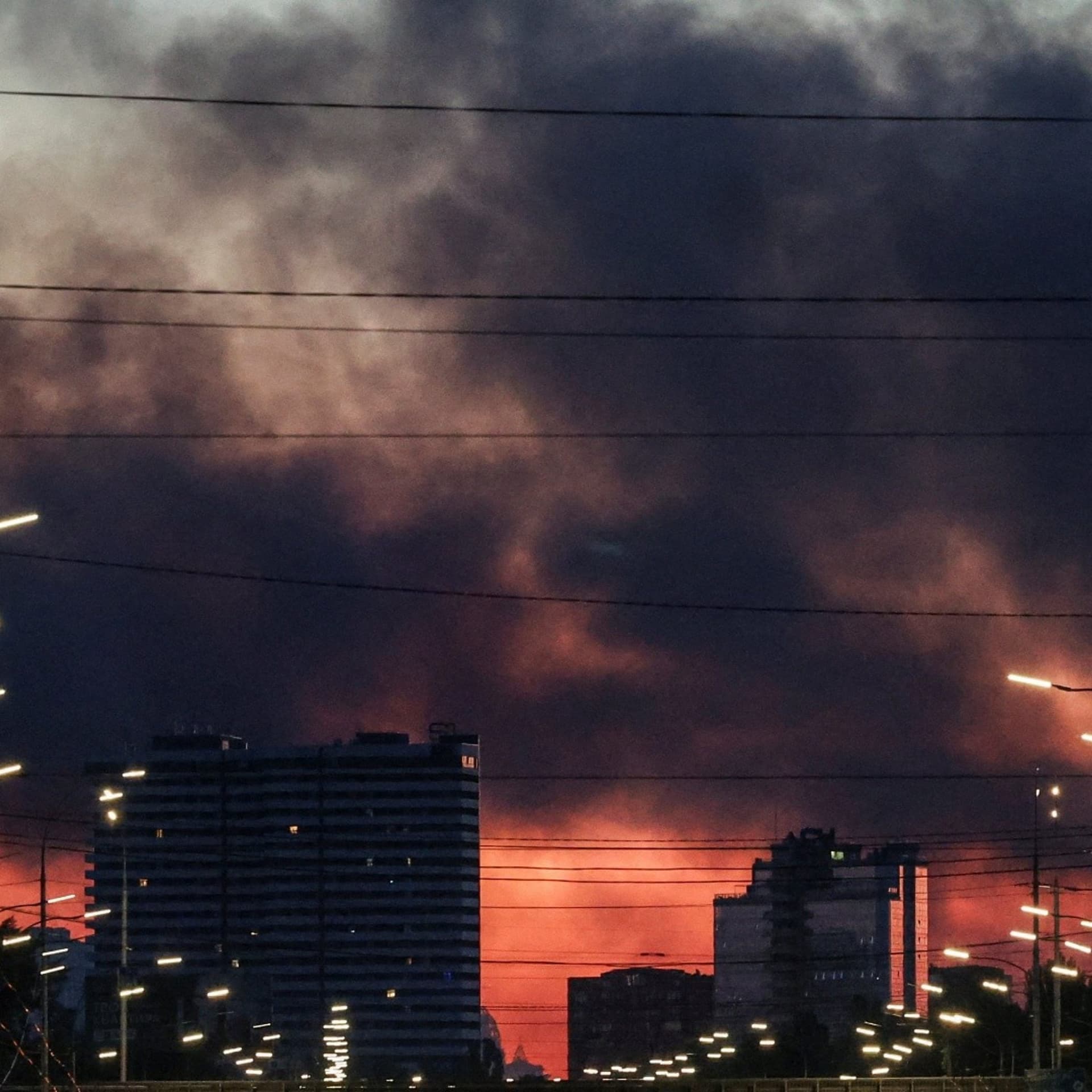
2:08After recent warnings to diplomats and foreign nationals to leave the Ukrainian capital, Russia has carried out a huge attack on Kiev as well as on other cities. Several apartment buildings were hit and at least three people were killed. Elsewhere, four people were reported dead in Dnepro. The airstrikes have left many homes across Ukraine without power. Our correspondent in Kiev, Vitaly Shevchenko, told me the latest. Several cities across Ukraine were attacked. Here in Kiev, we're getting reports of two high-rise apartment buildings hit. It's not clear whether by missiles or drones. The Kiev mayor, Vitaly Kalichko, is also saying that a hospital was hit and that strike caused two floors to collapse.
2:59Two civilian apartment blocks were hit. There are also reports of an industrial facility being targeted in Zaporizhia in southeastern Ukraine. There have been strikes in Kharkiv in northeastern Ukraine. It's an attack that Ukrainians, particularly residents of the capital, Kiev, had been expecting ever since Russia threatened to carry out a series of devastating strikes against the Ukrainian capital. And a lot of residents of the Ukrainian capital are sheltering in the metro system here in Kiev and in various shelters across the city. Yeah, and just remind us of why Russia in particular wanted to attack now.
3:42Russia is saying that the latest waiver tax comes as a retribution for Ukraine's strikes against targets in occupied parts of Ukraine, such as in Starobilsk in Luhansk region, where there was a Ukrainian strike last month resulting in the death of at least 21 people. As you can probably hear, we're sheltering in a basement here with some other residents of the Ukrainian capital who are just waiting for this tense night to be over. Yeah, I mean, these attacks have been going on for years in Ukraine. How does this one compare to what's happened during the course of the war? To be honest, it doesn't seem that different from what Kiev has already experienced.
4:25But Russia's rhetoric has become more threatening. Russia is saying that its patience has run out. And now Kiev will be targeted by much harder and much more damaging strikes. Vitaly Shevchenko in Kiev. The Israeli Prime Minister Benjamin Netanyahu is widely reported to have convinced President Trump to start the war on Iran. Now he may be undermining efforts to stop it by stepping up Israel's offensive against Hezbollah in Lebanon. On Monday, there were reports that Iran was planning to pause negotiations with the US after Mr Netanyahu ordered attacks on targets in the Lebanese capital Beirut.
5:07Against that backdrop, President Trump said he spoke to both Mr Netanyahu and representatives of Hezbollah, which would be a first for a US president. He said they had agreed to stop attacking each other, though there were reports of some clashes continuing. But what does it all mean for US-Iran negotiations? Here's our diplomatic correspondent, James Landale. In this war, a ceasefire is fast becoming an exchange of fire. Iran said these missiles were launched at a US base that, it said, had been used to attack Iranian territory. The sirens over Kuwait City suggested their destination. US commanders said they intercepted two Iranian ballistic missiles targeted at American forces in the country.
5:59This followed US strikes on what it said was Iranian radar and command and control sites in the town of Goruk and the island of Keshem. Iran claimed it was acting in self-defence and said the US was the aggressor. Violations of the ceasefire are themselves indicative of US misconduct and bad faith and merely intensify the existing mistrust in any interaction with the American side. Meanwhile, a cargo ship off the coast of Iraq was hit by what UK maritime authorities said was an unknown projectile, causing a large explosion. So is this increased military activity in the Gulf and Lebanon making a deal to open the Strait of Hormuz less likely?
6:45Well, Iran said today the US and Israel would be responsible for the consequences of violating the ceasefire in Lebanon. and state media suggested Tehran had suspended indirect negotiations with the US. But on social media this evening, Donald Trump declared talks are continuing at a rapid pace with the Islamic Republic of Iran. So the tempo of tit-for-tat exchanges in the Gulf is rising. Last week, the US shot down Iranian drones over the strait and hit military targets twice in Bandar Abbas. Iran said it attacked a US base, most likely up in Kuwait. Both sides claim their actions are defensive, but the risk is of escalation back to all-out war.
7:29But both sides still seem keen to find a way out. Here in Tehran, the regime's under economic pressure, and in Washington, the administration's under political pressure. But a new ceasefire deal would need trust and calm, and for now, both seem thin on the ground. Our diplomatic correspondent, James Landale. And as James was saying, over the past few hours, President Trump has issued a flurry of truth social posts on the conflict. So has he managed to get the US-Iran peace process back on track? A question for our North America correspondent, Peter Bowes. Well, it's a precarious situation. It's really far from clear whether it's back on track or not.
8:09The President's statements, as you imply, are increasingly confusing and prone to change at a moment's notice. regarding the slate of talks. They're either on the verge of a breakthrough, potential memo of understanding. We've been hearing that for weeks. But then in the space of a few hours on Monday, there was an interview with CNBC in which he said, I don't care if peace negotiations with Iran are over. He was asked whether the Iranians had told him that they were not going to negotiate further. And he said, no, they haven't. Then there was the post you mentioned, Truth Social. He said talks with Iran were continuing at a rapid pace.
8:46In an interview with ABC News, he said that he thought that there would be an agreement with Iran to extend the ceasefire and reopen the Strait of Hormuz over the next week. All of this, I think, illustrates the very delicate nature of where we are with these talks and why I think the longer it goes on, the more precarious it's going to be for the president, not least in terms of his credibility with his own supporters. Pressure is growing on him by the day at home to end this war. Now, Israel and the US have different objectives, particularly with regard to Lebanon. Is President Trump or Benjamin Netanyahu calling the shots here?
9:26It's a valid question. There are reports here that the call that they had earlier became quite heated, as Donald Trump was clearly pressing the Israeli Prime Minister to scale back his plans for military operations in Lebanon. the White House hasn't commented on that characterisation of the call, which was reported by Axios. Mr Trump wrote on Truth Social after speaking with Mr Netanyahu that it was a productive call and claimed that Israel and Hezbollah would stop attacking each other. But then just hours later, Mr Netanyahu on X said that Israeli military operations would continue as planned if Hezbollah didn't cease attacking Israeli cities and citizens.
10:11So it's clear what his objective is. Donald Trump, though, does need this conflict to end before he can end the war with Iran. Peter Bowes. Three new vaccines are being developed to tackle the relatively uncommon type of Ebola that's killed nearly 250 people in the Democratic Republic of Congo and Uganda. Around 1 ,000 people are now thought to have been infected. In an interview in the newsroom, our health and science correspondent James Gallagher told Priya Rye more about the race for a vaccine. There are three major groups. They're all trying to design something similar but going about it in different ways and they're all at different stages but all very much in the earliest stages of research for a vaccine because what has become clear in this outbreak is that you need a separate Ebola vaccine for each different species of Ebola.
11:04So we often think of Ebola and think it's all the same thing, but there are actually six different species of Ebola. Three of them cause outbreaks and each of those is going to need its own separate vaccine. So while we do have the first Ebola vaccine, it works against what's known as the Zaire species of Ebola. Actually, this is the Bundy-Bujo species of Ebola in this outbreak. And that means at the moment we don't have one. three are in the very earliest stages of development and have been given quite a big funding push to get them into trials as soon as possible okay so i was going to ask you about time scale and what needs to happen or how much needs to happen between now and rollout yeah quite a lot needs to happen so one of the biggest things that you need to do in order to manufacture a vaccine is get it made to basically a clinical standard something that's actually good enough to put into people.
11:56So at the moment when these companies and universities are doing animal-based research, you don't need to make what's known as a clinical grade vaccine. You can do the vaccines with a lower standard, but in order to put something into people that you want to roll out, you have to manufacture to an incredibly high standard. That process takes time. And even once you get to that point, then you can't just use the vaccine because no one knows for sure if it will work. So at the same time, there's lots of animal research taking place. but then once you have that vaccine that is able to be used in people you have to start with clinical trials giving it to people seeing if it makes a difference to their immune system see if it improves survival and then that's its own process before you can actually roll it out more widely we're looking at it taking probably most of this year to get there the most adventurous time scales are hoping that they might be able to start clinical trials in two to three months time but that's like the most optimistic if everything goes well scenario and it's only after that that you start the trials, get the results and can actually roll it out.
13:00James Gallagher. Marilyn Monroe was born a century ago and there have been celebrations around the world as well as exhibitions and film screenings to mark what would have been her 100th birthday. In Palm Springs, a number of fans dressed up as the blonde icon herself. I'm a huge Marilyn Monroe fan so when I heard that there was going to be this many of them here in Palm Springs. I had to come here. I know that she was big on Palm Springs. So that means I'm big on Palm Springs too. And I spent all my money to be here. And it's absolutely been worth it. Oh, it's incredible. Like her fans, they just all came out here.
13:35They love her. And we're celebrating our love from Marilyn. Oh, she just means love and sexiness. And I think that every one of us has that inside of us. We just got to find it. I feel like she never left us. She's here with us in spirit. It's like she never died. Marilyn Monroe was probably best known for a series of hit films in the 1950s, including some like It's Hot, Gentlemen Prefer Blondes and The Seven Year Itch, as Wendy Urquhart reports. A kiss on the hand may be quite continental, but diamonds are a girl's best friend. Marilyn Monroe was the ultimate sex symbol in the 1950s and her films made her one of the most famous women on the planet.
14:20But her early life was anything but glamorous. She was brought up in foster homes and orphanages and was working in a factory when she was discovered by a photographer. A successful modelling career catapulted her from the runway onto the big screen and in the mid-50s she landed leading roles in Gentlemen Prefer Blondes and how to marry a millionaire. But biographer Michelle Morgan says there was a lot more to Marilyn Monroe than just looks. She would talk about her love of art and literature. She had a library of 400 books and they would go all over the place with her. Every time she moved, the books would come.
14:58She wrote poetry, she read poetry, she loved artists. There's a lot of people still out there who think that she was a dumb blonde, but I always think that that says more about them than it does about her, in all honesty. Michelle also says Marilyn hit back at the studios when they tried to typecast her. When it got to the mid-1950s and the studio was trying to give her more dumb blonde parts, she just said, no, I'm not going to do it. And she was suspended and she walked out and she really stuck up for herself when it came to her career and to her life. And I think it shocked a lot of people because it was a very male-oriented existence and for her to be speaking out in the way that she did was quite shocking for some people.
15:42It's no secret that Marilyn had her demons and in 1962 they finally got the better of her. She died of a drugs overdose in August of that year but her legend lives on in her films and in the many exhibitions about her life that continue to pop up all over the world. I wanna be loved by you, just you Nobody else but you I wanna be loved by you Pe-deedly-deedly-deedly-dum Boop-boop-be-doop That report by Wendy Urquhart And still to come on this podcast... It's an act of such extreme selfishness in a way. Not only is your own concentration very disturbed and you're pulled out of the fiction but then you also feel you've got to try and pull the audience back.
16:32Etiquette reminders after a theatre-goer is reprimanded for texting during a key scene.
16:47Every story is a technology story in one way or another. And on The Interface podcast, we decode the tech that's rewiring your week and your world. On this week's episode, we'll look at whether or not Google is about to destroy the internet, can the Pope save us from AI, and is Roblox finally facing a reckoning. Listen on bbc.com or wherever you get your podcasts.
17:16You're listening to the Global News Podcast. The state of Florida has announced it's suing OpenAI and its boss, Sam Altman. The sweeping lawsuit alleges that the firm's chatbot, ChatGPT, is endangering children, aiding and abetting mass shootings and giving advice on suicide. The legal action comes as Florida pursues a separate criminal investigation into whether ChatGPT played a part in the murder of two people last year. Florida's Attorney General, James Uthmeyer, said OpenAI had repeatedly ignored safety warnings. for endangering our kids and deceiving parents into believing that this application is safe for use.
18:01It's clearly not. People are getting hurt, parents are getting deceived, and they need to pay for it. So today we're going to send a message to OpenAI. Get ready for a fight, and there's not one more important than this right now. OpenAI said it had put in place industry-leading protections and policies. I heard more about the case from our North America technology correspondent, Lily Jamali. A range of accusations is leveled against OpenAI in this lawsuit. And it's part of that sweeping nature of it that makes this so stunning. The allegations include endangering and addicting children to Tragi PT, coaxing users into self-harm and even aiding and abetting mass shooters.
18:47And all of this, according to Florida's attorney general, is in the pursuit of profit. So how, you know, does a chatbot aid in a murder, for example, or a mass shooting? You know, you have these examples of people actually asking chatbots how to carry out certain behaviors. And so Florida has an ongoing investigation into whether ChatGPT played a part in one particular mass shooting last year. the perpetrator, the alleged perpetrator there allegedly asked questions about how to dispose of a body. OpenAI responding that they don't buy any of these allegations, that the things that are being told to users on ChatGPT is stuff that's available on the internet.
19:29So it's all out there. They could find it via Google in their view. Meanwhile, the OpenAI boss, Sam Altman, is accused of showing utter disregard for risks to human life. What do they allege that he has done? Yeah, Uthmeyer, the attorney general in Florida, mentioned Mr. Altman a number of times by name in a press conference this morning. So he keeps lumping Altman and ChatGPT together when he speaks. And one of the allegations is that he's endangered kids, deceived parents into believing that their applications are safe for use. And I think he's, to some degree, playing off of Altman's pretty terrible year when it comes to his personal brand.
20:08His reputation has been dragged through the mud in a recent trial in which Elon Musk alleged deception by Altman over keeping OpenAI as a nonprofit. it. Musk lost that case, but we heard witness after witness saying Altman is known for not telling the truth. But at the heart of this case, you have a allegation of deliberate design choices being made. And the claim is that Altman has been complicit in making those choices. And this isn't the only legal action OpenAI is facing. Indeed, many tech companies are facing lawsuits. That's right. And in the AI space, Google is facing one lawsuit in particular that comes to mind in which a Florida man alleges that their AI product fueled delusional thoughts by his son.
20:57So his son ultimately took his own life. But, you know, I think what's also interesting about this case is this idea of creating addictive features, deliberately designing a tech product to be a certain way. This is something we've seen against social media companies like the maker of Instagram, Meta, and Google's YouTube as well. And those types of cases are gaining traction in the courts. It's a really different legal landscape than it was just a couple of years ago. Lily Giamali talking to me from San Francisco. Immigration is a hot topic in Italy. Indeed, the Prime Minister, Giorgio Maloney, was elected partly because of her tough stance on the issue.
21:35But faced with a declining and ageing population and severe labour shortages, she's now promised to issue 500 ,000 temporary work visas to migrants over the next two years. Lizzie McNeill has been to the far south of Italy to find out more. Just across the water from Sicily, Calabria's poverty is visible in its potholed roads and crumbling empty buildings. Yet the region also produces a significant share of the country's citrus fruit and is in urgent need of workers. This region actually produces around 25 % of Italy's citrus, 60 % of its clementines and about 30 % of its oranges. So it is a big agricultural hub.
22:16But despite this, it's actually perhaps more famous for the Ndragada, one of the most famous mafios or organisations in the world. The majority of these migrants are from sub-Saharan Africa and Asia. Many of them end up in informal camps like this one. We're walking past another trash heap, rubbish pile. There's an open fire, people sitting around it, barrels, a sofa. It's all very makeshift. It's just plastic sheeting tied with bungee straps. This is the tent city. The government opened this place in 2017. How many tents are there? During the harvest season, we will find here 500 people or more.
23:02Are they all men here? All men. Mauro is from an NGO called Emergency. These people are here legally. Most of them, they are legally. They are regular. And the government's giving them visas to come here, and yet they're living in very third-world conditions. The problem is when the stay permit is going to expire. And when you have to renew it, you don't have the place, don't have the residence. This is the problem. They are regular, but it's a precarious regularity. Take Lamine. In his mid-30s, he's originally from Gambia. Like many, he crossed the Mediterranean from North Africa on a dangerously overcrowded boat, searching for a better life.
23:47He works in the fruit orchards during the harvest. How is that work? Is it difficult? To be honest, yes. By the time you wake up, sometimes four, eight cassettes, you earn two euros. You earn two euros? For you to have 50 euros a day, you have to minimum 25 cassettes. 25 crates, that sounds really tiring. It's impossible. Long hours, low pay and difficult living conditions. So there's drinking water? There is no drinking water here. There's no drinking water? No, no, no, there is no drinking water here. Critics point to the various legal hurdles put up by the government that make it difficult for migrants to legitimise their status.
24:29And in Calabria, migration is often tied to a deeper system of control. It's so difficult in Italy to be regular as migrants. And then the mafia use the law to blackmail the migrants. Vincenzo Linarello is president of the Goel Cooperative Group, which aims to revitalise this region by wrestling land and the economic system away from organised crime. Ndrangheta mafia families have a long history here, controlling land, farming and labour. The more difficult have the migrants to be regular, the more they depend on the mafia, and the mafia becomes strong. Italy needs migrant workers, but here in Calabria, many remain stuck between legality and illegality, in a system that depends on them, yet so often fails to support them.
25:25Nisi McNeill in southern Italy. The tennis legend Serena Williams has confirmed she will return to the game at the age of 44 The 23-time Grand Slam singles champion hasn't played a professional match since the US Open four years ago She's been given a wild card to play at Queen's Club in London next week and could compete at Wimbledon So why now? Tony Livesey asked tennis writer Ben Rothenberg She's been in the system for drug testing for a while she put herself back in the pool and you have to be in the pool for six months in order to regain eligibility for tennis so we did see this coming from many months away that something was clearly up and i think queen's club for her it's just the earliest possible stop on the grass and the grass has been a great surface for her she's been throwing her best at wimbledon and even though she didn't play a lot of wimbledon warm-up tournaments for most of her career she'd want some preparation before we presume she would be aiming to play that tournament again she wants the all-time Grand Slam record, I think.
26:25Is she capable of winning a slam? You know, I would say no, just as a snap answer. And I'm actually not even sure that's really where she's setting her expectations. I don't know that it's going to make or break for her. That was something that really was very challenging for her, having that record dangling over her in the last phase of her career. When she came back from maternity leave and she went 0-4 in her final four major finals and lost all four of them pretty badly and had a lot of chances to equal that record. So I would hope that she's being gentler to herself for expectation setting, but she really hasn't talked yet about what her motivations are, what she'll consider success.
27:02So we don't really know quite yet how she's going to frame this. She could just be missing the game. It's as simple as that. Yeah, she could be missing the game. She could be saying, oh, you know, I want to see if I have anything left or just enjoy playing and miss it for that reason. She could say, I want my daughters to get the chance to see me play. Her younger daughter was not born during her earlier career. because maybe they can now appreciate this as a family project in a different way. Maybe she wants to come back as part of a farewell for her sister, Venus, who is still also playing, who hasn't formally ever retired.
27:34So there's a few different reasons she could come up with, and I'm not sure it's going to be just, you know, 24th major or bust for her. Tennis journalist Ben Rothenberg. Few theatre-goers are brave or foolhardy enough to call out fellow audience members who use their phones during a performance, But actress Rosamund Pike had no such qualms when someone started texting during the climax of her West End show on Saturday. Our entertainment correspondent Colin Patterson has the story. I am the mother, the judge. Rosamund Pike in Inter Alia, a performance for which she won Best Actress at this year's Laurence Olivier Theatre Awards.
Read the full transcript
28:15In the play, she takes on the role of a Crown Court judge and on Saturday attempted to deliver instant justice of her own in real life. After the performance ended and the curtain calls had concluded, Rosamund Pike came back on stage and asked the audience to sit down and not to record what she was about to say. Gesturing to a section of the stalls, she complained that someone had been texting during the production but added that she would not single them out. She conceded that the message may have been very important and the person could have been a doctor trying to save someone's life, but wanted everyone to know that actors do see it when people get their phones out and it affects their performance.
28:58Fellow Olivier winner Juliet Stevenson backed her up. It's an act of such extreme selfishness in a way. And it's very difficult for the actor because you feel not only is your own concentration very disturbed and you're pulled out of the fiction, but then you also feel you've got to try and pull the audience back. It's the latest theatre etiquette complaint from a big-name actor. Leslie Manville recently asked people not to take pictures during curtain calls. And in 2024, Andrew Scott revealed how he'd once paused Hamlet's To Be or Not To Be soliloquy when an audience member pulled out a laptop.
29:35As for Rosamund Pike, her patients may well be tested. In November, Inter Alia transfers to Broadway, where Leslie Manville says the audience's use of mobile phones is rife. Colin Patterson. And that is all from us for now, but the Global News Podcast will be back very soon. This edition was mixed by Graham White and produced by Paul Day and Nikki Verrico. Our editor is Karen Martin. I'm Oliver Conway. Until next time, goodbye.
30:19we decode the tech that's rewiring your week and your world. On this week's episode, we'll look at whether or not Google is about to destroy the internet, can the Pope save us from AI, and is Roblox finally facing a reckoning. Listen on bbc.com or wherever you get your podcasts.
From the publisher
Russia uses drones and missiles to bombard Kyiv and other Ukrainian cities. A number of people were killed and injured. Kyiv's mayor said two high-rise apartment buildings in the capital had been hit, and people could be trapped under the rubble. President Zelensky had earlier warned that intelligence suggested Russia was preparing for a major attack, and urged people to pay special attention to air raid alerts. Also: President Trump says Israel and Hezbollah have agreed to stop attacking each other; Florida sues the maker of ChatGPT over allegations the chatbot is endangering children, aiding and abetting mass shootings and giving advice on suicide; Serena Williams confirms her return to competitive tennis at the age of 44; and an actress takes a stand against audience members texting in the theatre.
The Global News Podcast brings you the breaking news you need to hear, as it happens. Listen for the latest headlines and current affairs from around the world. Politics, economics, climate, business, technology, health – we cover it all with expert analysis and insight. Get the news that matters, delivered twice a day on weekdays and daily at weekends, plus special bonus episodes reacting to urgent breaking stories. Follow or subscribe now and never miss a moment. Get in touch: globalpodcast@bbc.co.uk