
In short
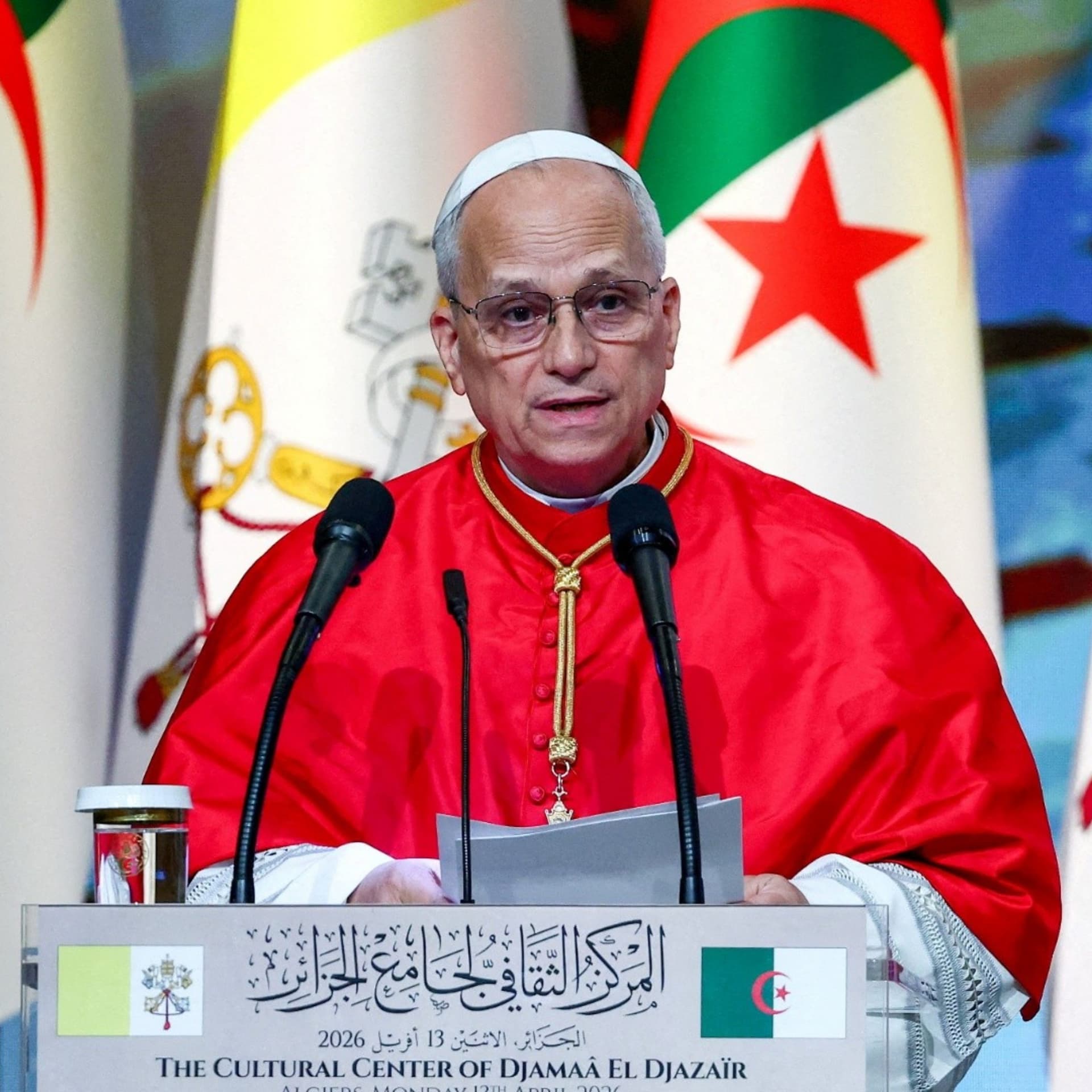
The episode covers a widening US–Vatican dispute, a looming US blockade of Iran’s Strait of Hormuz, Hungary’s political shift after Viktor Orbán, and other global stories. Pope Leo (Pope Francis-like “Pope Leo” in transcript) refuses to debate Donald Trump, but says he will keep speaking against war and nuclear weapons. Trump attacks him over immigration and Iran, including an AI Jesus image; the Pope calls threats to “destroy Iranian civilization” unacceptable and frames his role as gospel-driven peace advocacy.
Guest
Leila Nathu interviews Nicholas Hopton (UK ambassador to Iran, 2016–2018) on how a blockade would work, likely Iranian responses, and risks of escalation.
Guest
Sebastian Usher reports NGOs say Iran executed 1,600+ people in 2025.
Guest
Sarah Rainsford reports on Hungary’s incoming PM Peter Magyar’s EU-democracy message and implications for Ukraine.
Guest
Ambarasan Ejarajan reports Philippines alleges cyanide poisoning by Chinese fishermen near Second Thomas Shoal. Also: Lucas Yeh (8) designed “Rise” plush as a zero-gravity video indicator for Artemis.
Written by AI. May contain mistakes. Listen to the episode to check what was said.
Chapters
Tap a time to open that second in VOPope Leo Responds to Trump
2:02 to 4:23
Pope Leo's reaction to Trump's criticism and his stance on war.
“We need to design something original for the astronauts to use to indicate zero gravity.”
The Background of the Tensions
4:26 to 7:18
Exploring the ongoing tensions between Trump and Pope Leo.
“one of the fastest growing regions for the church and home to a fifth of the world's Catholics.”
US Blockade and Its Implications
7:30 to 11:10
Discussion on the US blockade of the Strait of Hormuz and its effects.
“As we record this podcast, the US is about to launch its own blockade of the crucial oil route in the Middle East, the Strait of Hormuz.”
Executions in Iran
11:14 to 14:01
Analysis of the rising execution rates in Iran amidst political tensions.
“And they are perfectly capable of taking a lot of pain for their people.”
Executions and Protests in 2025
14:01 to 14:40
Learn about the increase in executions related to protests and the ongoing risks faced by detainees.
“but public hangings did also increase in 2025.”
Philippines vs China: Cyanide Controversy
14:40 to 14:58
Explore allegations of China using cyanide to poison waters in the South China Sea.
“There's a new story available every weekday.”
Hungary's Political Shift
16:19 to 18:16
Understand the implications of Peter Mojo's election victory over Viktor Orban.
“Hungary's incoming Prime Minister, Peter Modzio, says Sunday's elections, in which he defeated the populist pro-Kremlin nationalist Viktor Orban, saw history in the making.”
Orban's Influence and Future of Right-Wing Politics
18:16 to 21:30
Examine how Orban's defeat may impact right-wing movements across Europe.
“In that sense, yesterday was a good day.”
Ukraine's Reaction to Hungary's Election
21:30 to 22:58
Learn how Ukraine perceives the change in Hungary's leadership and its implications.
“was radicalise yourselves, don't be afraid of radical nationalism, because, as you can see in my case, it's successful.”
Peter Mojo's Approach to Ukraine
22:58 to 24:22
Assess Peter Mojo's potential shift in Hungary's stance towards Ukraine amidst ongoing conflicts.
“I mean, people here, when I've spoken to them about the relationship, they see Viktor Orban as essentially Putin's man in Europe.”
Show all 15 chapters
Chinese Fishermen and Environmental Concerns
24:22 to 27:34
Investigate the allegations against Chinese fishermen polluting disputed waters in the South China Sea.
“Because it all comes at a very difficult time for Ukraine with more Russian attacks following the end of a Nista truce.”
Zero-Gravity Indicator: A Young Designer's Story
27:34 to 28:00
Meet the boy who designed a zero-gravity indicator for NASA's Artemis mission.
“a small soft toy called Rise also returned with them.”
Designing for Zero Gravity
28:00 to 29:16
Lucas and his mother discuss a unique design project for astronauts.
“He won a competition run by NASA and a crowdsourcing company.”
Experiencing the Artemis II Mission
29:17 to 30:14
Lucas shares his experience attending the Artemis II splashdown.
“Start from, I think, 4.33 of the separation to the re-entry around 4.50-ish.”
Reflecting on the Mission's Outcome
30:15 to 30:34
Lucas discusses the fate of their design and the return of astronauts.
“And a commander named Reed Wise Man arrives to his water bottle.”
Transcript
Automatic transcript. May contain errors.0:00This BBC podcast is supported by ads outside the UK.
0:30on your expert's progress right on your phone while you live your life. Plus, you get unlimited expert help at no extra cost, even on nights and weekends during tax season. Visit TurboTax.com. Only available with TurboTax full-service experts. Real-time updates only on iOS mobile app. Hi, Uncle Lazer here. America's built on fast cars, fast food, and even faster women. Moto Casino's built in America. You know what they're fast at? Fast cash, prize, redemption. You see, only Moto is U.S. owned and operated. Moto. It's American-made. That's who we are. And that's who we care about. Play for free at Moto.us.
1:03Moto Casino is the social casino. Avoid were prohibited. No purchase necessary. Visit Moto.us for more details. Must be 21+.
1:17This is the Global News Podcast from the BBC World Service. I'm Jeanette Jalil and a 15-hour GMT on Monday the 13th of April. Well, these are our main stories. Pope Leo has responded to scathing criticism from Donald Trump by saying he has no intention of debating with the US president, but will continue to speak out against war. A US blockade of the Iranian coastline is coming into force as Tehran warns of retaliation. Hungary's incoming Prime Minister, Peter Mojo, has promised to usher in a new era for the country, which he said had become the poorest and most corrupt in Europe. Also in this podcast...
2:02We need to design something original for the astronauts to use to indicate zero gravity. How a plushy toy designed by an eight-year-old became part of the Artemis moon mission.
2:19In what has turned into an extraordinary spat between the world's most powerful man and the first American head of the Roman Catholic Church, Pope Leo has said he has no fear of the Trump administration and plans to continue speaking out against war. This comes after Donald Trump lashed out at the Pope over his opposition to US immigration policy and the war in Iran. The US president accused the pontiff of being, quote, weak on crime and terrible for foreign policy and uploaded an AI-generated image of himself dressed as Jesus curing the sick, before later telling reporters that he is, quote, not a big fan of the Pope.
3:03We don't like a Pope that's going to say that it's OK to have a nuclear weapon. We don't want a Pope that says crime is OK in our cities. I don't like it. I'm not a big fan of Pope Leo. He's a very liberal person and he's a man that doesn't believe in stopping crime. He's a man that doesn't think that we should be toying with a country that wants a nuclear weapon so they can blow up the world. I'm not a fan of Pope Leo. The Pope has described Mr Trump's threat to destroy Iranian civilization as unacceptable. Speaking en route to another mainly Muslim country, Algeria, a visit that has been described as an attempt to build bridges between the Muslim and Christian world, Hope Leo spoke about why he felt compelled to speak out.
3:51I do not look at my role as being a political politician. I don't want to get into a debate with him. I don't think that the message of the gospel is meant to be abused in the way that some people are doing. and I will continue to speak out loud against war, looking to promote peace, promoting dialogue and multilateral relationships among the states to look for just solutions to the problems. Too many people are suffering in the world today. Too many innocent people are being killed and I think someone has to stand up and say there's a better way to do this. Pope Leo's visit to Algeria kicks off a 10-day tour of Africa, one of the fastest growing regions for the church and home to a fifth of the world's Catholics.
4:35Our global religion correspondent, Lebo Di Seco, told me more about the row that's threatening to overshadow his visit. The tensions between the Trump administration and Pope Leo have been going on for quite some time, but more recently they've centred around the war. And we saw, for example, on Palm Sunday, he was very pointed, didn't name the Trump administration or Donald Trump, but said Jesus does not listen to the prayers of those who wage war, but rejects them. He used his Easter message to urge world leaders not only to work towards peace, but actively pointed out people that prefer conflict to trying to resolve things peacefully.
5:17So this has been coming for quite some time. And I suppose we've seen Donald Trump and his administration really kind of lean into the support of conservative Catholics. There are a number of very high profile conservative Catholics within the administration. J.D. Vance, the vice president, for example. So for Donald Trump, the conservative Catholic vote is an important one. And I guess for him, this is partly why he might be speaking to this at the moment. And a lot of people were very puzzled about President Trump making that expletive laden threat against Iran on Easter Sunday, ending with the words praise be to Allah.
6:02This is alarming Republicans, given that they rely so much on the Christian vote. I think that consistently there have been some Christians that have been able to say, look, we look past some of what Donald Trump says and his behaviour. We're not looking at him to be a priest. We're looking for him to enact the policies that we want. With that said, even for those Christians, conservative Christians, the timing of it, Easter Sunday and the language and that praise be to Allah was very jarring for a number of people. And Lebu, this row is threatening to overshadow Pope Leo's visit to Algeria, the first papal visit to the mainly Muslim nation at the start of an African tour.
6:43Well, ironically, one of the themes of his stop in Algeria is the dialogue with the Islamic world. And he will be visiting the Great Mosque of Algiers. That'll be an important moment. He'll also stop at the Basilica of Our Lady in Africa, which is a place of prayer and pilgrimage for Muslims and Christians. It is a bit of a chicken and egg situation because I suppose the Vatican would say it only will overshadow it if the media keeps giving it the importance that we are giving it. With that said, it is difficult when you have such heated comments from certainly one of the most powerful men in the world and one of the most powerful religious leaders in the world.
7:30As we record this podcast, the US is about to launch its own blockade of the crucial oil route in the Middle East, the Strait of Hormuz. The US military says the blockade will only apply to ships that go through Iranian ports. This has once again led to oil prices rising above$100 a barrel. Tehran has choked off global energy supplies since the start of the US-Israeli war on it by preventing most tankers travelling through the Strait. Its response to the US counter-blockade was to call it piracy and to say it would not surrender to threats. This all comes after direct high-level talks between the US and Iran in Pakistan over the weekend, which ended without any deal being reached, and with just days to run on the two sides' fragile ceasefire.
8:19Leila Nathu spoke to Nicholas Hopton, who was the UK ambassador to Iran from 2016 to 2018. How will President Trump's blockade work? The understanding that I have of the proposal is that the US will stop any ships passing through the Strait of Hormuz that have taken money or paid money to the Iranians. So that will affect a large amount of shipping which might be not directly connected to Iran but has perhaps paid some sort of toll or levy to the Iranians because they are now, of course, de facto in control. And listening to a US admiral retired yesterday, he suggested that it would take a huge amount of US naval assets in order to make an effective blockade.
9:07And generally, it doesn't seem a very clear proposal because it is puzzling how a proposal to close the Strait of Hormuz is meant to open it. What will be the response from Iran to this naval blockade? The initial response was to say that they would not accept a US naval blockade of the straits. The way I think they will be interpreting it, like many, is that the announcement is actually due to the president's frustration that the talks between the US and Iran on Saturday in Pakistan did not produce immediately a deal on the American terms. The hope must be that J.D. Vance and his Iranian interlocutors do manage to return to talks and then in due course to negotiations sooner rather than later, and that this question of a blockade may be just a distraction for a few days.
10:07But equally, it could lead to an escalation and a breakdown in the ceasefire and a return to full-on war. So you think there is still a path towards a negotiated settlement here? There has to be. Before the war, the Strait of Hormuz was not part of such negotiations. Now it will be an essential part of any negotiations because Iran has de facto control over the Strait of Hormuz. But could disruption to Iran's own oil exports cause enough damage to its economy that it feels significantly under pressure to come back to the negotiating table? over time, perhaps, but certainly I don't think it's a short-term silver bullet to get Iran to do exactly what the United States wants.
10:51Iran does rely on its oil exports, mainly to China. The Iranian economy is in a very bad state. But at the same time, I don't think turning off Iran's oil exports through the Strait of Hormuz will immediately cause any significantly different situation. It will just increase hardship for the Iranian people. And the regime is resilient and ruthless. And they are perfectly capable of taking a lot of pain for their people. You mentioned China and the impact of a squeeze on Iran's oil exports on China. Is there a more vocal response now from China if they start to really feel the effects of a US blockade?
11:33Quite possibly. And then the question is, would they put pressure on Iran, I suppose, to comply to the US demands? I can't see that happening. I think Chinese are feeling very comfortable that the US is making a mess of its war with Iran. Also, they are probably quite pleased that the fact that so many US military assets have been taken to the Gulf means that those assets aren't in the South China Sea, which obviously has implications with the question about Taiwan. But I think the Chinese will probably feel the need to get more involved if a blockade actually becomes a reality. And the US Navy does stop pretty much all shipping going through the Strait of Hormuz, which will obviously impact on China, will impact on the United States as well, and on Europe, and particularly on Asian economies.
12:32That was the former British ambassador to Iran, Nicholas Hopton. Well, while the world's eyes are once again focused on the Strait of Hormuz, the number of executions inside Iran is reported to have risen sharply. A joint report by two NGOs says that the Iranian authorities executed more than 1 ,600 people last year, the highest number since 1989. And they warn that the regime may use capital punishment even more extensively this year after its crackdown in January, in which thousands of peaceful protesters were gunned down. Here's our Middle East analyst, Sebastian Usher. Most of the executions last year were for murder or drug offences, as is the usual pattern in Iran.
13:19The Norway-based Iran Human Rights Group says the number was almost 70 % more than for 2024. The figure has been rising significantly in the years since the mass demonstration, sparked by the death of a young Kurdish-Iranian woman, Mas Amini, while in the custody of the Morality Police in 2022. The number of executions is never completely clear as the Iranian authorities don't disclose official figures. A number of Iranian activist organisations keep a tally with the Iran Human Rights Group verifying each death with at least two sources. The group says that the rate of execution goes up when the regime feels under threat and that the aim is to forestall internal opposition by instilling fear in the population.
14:00Almost all executions are carried out inside prisons, but public hangings did also increase in 2025. There were some executions last year for protesters or alleged spies, but that figure could be considerably higher this year in the wake both of the mass anti-government protests in January and the war with the US and Israel. Hundreds of people who were detained during the protests remain at risk of death sentences and execution, activists say. That is, of course, without counting the thousands shot dead by the security forces during the demonstrations themselves. Sebastian Usher. And we have more on this on our YouTube channel.
14:39Just search for BBC News on YouTube and you'll find Global News Podcast in the podcast section. There's a new story available every weekday. Still to come in this podcast, the Philippines accuses China of using cyanide to poison the waters in a contested part of the South China Sea. These Philippine soldiers were not able to catch any fish in case if they catch any fish it could be contaminated and the second reason is also destroying the corals nearby. This is poisoned water.
15:21Hi, Uncle Lazer here. America's built on fast cars, fast food, and even faster women. Moto Casino's built in America. You know what they're fast at? Fast cash, prize, redemption. You see, only Moto is U.S. owned and operated. Moto. It's American-made. That's who we are, and that's who we care about. Play for free at Moto.us. Moto Casino's the social casino board. We're prohibited. No purchase necessary. Visit Moto.us for more details. Must be 21+. Moto Casino. America's social casino.
16:18Find out more at bbc.com slash unlimited.
16:25This is the Global News Podcast. Hungary's incoming Prime Minister, Peter Modzio, says Sunday's elections, in which he defeated the populist pro-Kremlin nationalist Viktor Orban, saw history in the making. He vowed to usher in a new era to draw a line under Mr Orban's 16 years of rule, proclaiming that Hungary's place was in Europe. Saying there was no time to waste, Mr Mojo called on the president to convene the newly elected parliament as soon as possible. Our country has no time to lose. Hungary is in trouble in more than one ways. It's been robbed, it's been betrayed, it's been indebted, it's been devastated.
17:08We became the most impoverished and the most corrupt country in the EU. And I would like to repeat what I said last night, that TISA government will represent every Hungarian. Also those who did not vote for TISA party. We will represent every Hungarian within the country, but also across the borders. Congratulations have poured in from across the European Union after Peter Mojo's landslide victory. The head of the European Commission, Ursula von der Leyen, said Hungary had chosen Europe. Britain's Prime Minister Kirstenmer described it as a historic moment, not only for Hungary, but for European democracy.
17:49And Germany's Chancellor Friedrich Mertz said Mr Modul's victory showed that democratic societies are still resilient against Russian propaganda.
18:02Right-wing populism suffered a major defeat in Hungary yesterday, and this has implications beyond Hungary's borders. Hungary is sending a very clear message against right-wing populism around the world. In that sense, yesterday was a good day. So how was Peter Magyar able to win more than two-thirds of the seats in Parliament given Mr Orban's stranglehold on the media and the political system? A question for our Budapest correspondent Nick Thorpe. I think there are many sort of key explanations, all equally valid for Peter Madja's enormous victory in this election. One was the fact, perhaps the most important of all, was that he's also coming from the centre-right.
18:48Liberals and more left-minded people, whenever they've criticised Viktor Orban in the past, Mr Orban has very skilfully was able to turn that to his own advantage and say, turn around and say to the Hungarian people, look, these foreigners are interfering with us again, we are true patriots. Viktor Orban, in a way, had the monopoly of national feeling until now. And Peter Madhya, coming also from the right, but as a centre-right, rather than a nationalist or a far-right politician, he was able to criticise Mr Orban from a right-wing perspective, from a conservative perspective, from a national perspective.
19:26It was interesting watching him on his endless national tours. He'd always arrive walking through the crowd, carrying a Hungarian tricolour flag in his hand. So he managed to sort of break Mr Orban's monopoly on what it is to be Hungarian, what it is to stand up for national interests, for Hungarian national sovereignty. That's a key issue in all of this. So how will Peter Mojo change Hungary, given the fact that he's had this landslide victory and significantly a two-thirds majority in Parliament? It's very much about the two-thirds, Jeanette. Viktor Orban in the last 16 years has reshaped Hungary in his own image.
20:08He changed the electoral system. He changed the economy. He changed the way that the constitutional court judges are elected. He put his own person at the head of the Supreme Court. And indeed, if Tisir and Peter Madhyar had not won a two-thirds, They would have had to continue to govern in a way inside the house that Viktor Orban built. With this two-thirds majority, they can change different aspects. They can get rid of the very party-loyal main state prosecutor. They could start to restore balance in the judiciary and the political interference in the judiciary. These are all promises that Peter Magyar made in his campaign and in the TISA party programme.
20:57And what does this mean for Hungary's relationship with the rest of the EU? Donald Trump's victory in the US seemed to give the populist right a new momentum. Does Mr Orban's defeat mean the tide is shifting? It could mean that. And certainly the right in Europe have lost an iconic figure in Viktor Orban. Of course, they haven't lost him. He's still around. He's only 62 years old. But I think we could see a change in the right wing, because Viktor Orbán's message to them, the lesson he taught his fellow nationalists across Europe, was radicalise yourselves, don't be afraid of radical nationalism, because, as you can see in my case, it's successful.
21:40So I think we might see those nationalist parties across Europe going more, moving perhaps a bit more to the centre, de-radicalising themselves, because at the end of the day, Viktor Orban's experiment with a liberal democracy or whatever we try to call it has for the time being at least failed. Nick Thorpe in Budapest. Well, the Ukrainian government was one of the first to congratulate Peter Mojo for his election victory. President Zelensky said his country was ready to work with Hungary after a bruising relationship with Mr Orban, who has repeatedly blocked support for Ukraine, including a vital EU aid package.
22:16I asked our correspondent in Kyiv, Sarah Rainsford, if the Ukrainians were hoping this would change. Yeah, they're certainly hoping here that a big block on EU support and speedy EU support Ukraine will be removed. I was speaking to someone last night who was saying that Hungary had basically been a spoke in the wheels of the EU for so long and that was having a direct effect on Ukraine because Viktor Orban had been blocking additional sanctions on Russia. He'd been blocking assistance to Ukraine. So I think people here are under massive illusions. They don't think that suddenly absolutely everything is going to change.
22:49They don't know Peter Madzha very well. They're not entirely sure what he stands for, but they do know that he's not Viktor Orban. And they know precisely what Orban has meant for Ukraine. And it has been problem after problem. I mean, people here, when I've spoken to them about the relationship, they see Viktor Orban as essentially Putin's man in Europe. And they say that, you know, although the real enemy is Vladimir Putin and he's still in place, losing Viktor Orban from the sort of geopolitical stage can only be good news for Hungary. So certainly a lot of relief here today. I won't say they're celebrating, but certainly a lot of relief that as far as Ukraine is concerned, this is a very, very positive result.
23:24As you say, Peter and Roger, still a bit of an unknown quantity for many people. What have you been able to glean about his attitude to the war in Ukraine? Well, I don't think we're going to see a complete reversal in the sense that Hungary is suddenly going to say, sure, we're going to help with military aid. We're going to send troops to some kind of support force, Ukraine. That's a position that would, for example, Italy doesn't do either. So, you know, I don't think we're going to see a massive change on that front. But I do think the mood music will be completely different. I think that the kind of complete block on aid is going to be removed.
23:54I think Petit Maggio has suggested he's going to be far more flexible, far more sympathetic to Ukraine in that sense. And that's what people are looking for. It's interesting to see he has made a few comments already saying that he would be open to dialogue with Russia, but not as friends. And when you talk to Ukrainians, what they see is that they believe Viktor Orban was very, very close to Russia. and that was why he was so detrimental to Ukraine. So essentially, I think the message from people here is things can only get better. They couldn't possibly get worse. Because it all comes at a very difficult time for Ukraine with more Russian attacks following the end of a Nista truce.
24:27We were up in Kharkiv just next to the Russian border as that truce was supposed to be in place. It wasn't very firm. There were violations on both sides. But certainly as it ended, the sirens went off and the drones and the missiles started firing again. So for Ukraine, it is a difficult time and certainly this will be a help, will be a boost. Sarah Rainsford in Kyiv. The Philippines has raised the alarm that Chinese fishermen may be using cyanide to poison the waters around a disputed atoll in the South China Sea, one of the world's most hotly contested regions. As we record this podcast, there's been no reaction yet from China to these claims.
25:03Our global affairs reporter, Ambarasan Itirajan, told us more about them. This is a contested area. Both countries have a claim. And there is a reef over which the Philippines deliberately landed Second World War era ship. And this is where a few of the Filipino troops, they are staying there. The reason why the Philippines did this was to assert their sovereignty. And the second Thomas Shaw, this has been a bone of contention. There have been clashes even before. Now, the Philippines is saying that basically some of these Chinese fishermen who come around, they were pouring cyanide, these are accusations, into the water surrounding the shoal, basically.
25:45So what it means is that these Philippine soldiers were not able to catch any fish in case if they catch any fish, it could be contaminated. And the second reason is also destroying the corals nearby. This is poison water. And in the long run, what the Philippine officials are saying is that the Chinese were hoping that this old ship will corrode and then it will automatically disintegrate. That is one of the reasons why they are pouring these. And they've been noticing this for the last one year. There have been different occasions. They have taken some bottles from water and they've tested these waters surrounding the area and it contains cyanide and it is a very dangerous sign.
Read the full transcript
26:27That is why they had a big announcement today about these efforts by Chinese fishermen, I mean, accusing them of pouring cyanide. If true, that would be devastating for the marine wildlife there, let alone for any humans that tried to eat the fish they caught. What's the Chinese response been, if any? The AFP News Agency and other journalists have tried to contact the embassy in Manila, the Chinese embassy in Manila, who have not, they have not responded. But it is not only this occasion. There have been other clashes in this particular area in the last few years, where it was quite common incident when Chinese Coast Guard vessels ram into the Filipino vessels.
27:07and also resupplying these troops is a big challenge for the Philippines. You know, some of the ships, they have been blocked by the Chinese once they had to deliver food by helicopter. So it is a challenge, but they don't want to give up because giving up that area means then China will take over this reef immediately. And this is a very contested area and a busy shipping lane and that's why the Philippines want to stay there. Ambarasan Ejirajan. When the four Artemis astronauts splashed down this weekend after their trip around the moon, a small soft toy called Rise also returned with them. It's a smiling moon wearing an Earth baseball cap.
27:47But it wasn't up there just to be a mascot or for the astronauts to play with. It was used as a zero-gravity indicator for videos and was designed by an eight-year-old boy from California called Lucas Yeh. He won a competition run by NASA and a crowdsourcing company. Luke Jones had a chat with Lucas and his mother, Clara. We need to design something original for the astronauts to use to indicate zero gravity. Got you. So what did you decide to do? Tell us about your design. It's this little moon plushie that's a rise and is representing Earth by a chicken and Apollo 8. And the visor of the cap is the deep space between Earth and the moon.
28:32The Orion constellation on the visor is representing the Orion. And the rockets on both sides are representing the past and future moon missions. And on the back, there's Neil Armstrong's footprint he made on 1969 on Apollo 11. You guys got to experience a bit more of the Artemis II mission than other people did. You actually got to go and see the astronauts returning. Yeah, we, let's see that I think Thursday morning that we got an invitation from NASA Ames of saying that, hey, we would like you to be part of our VIP to come and watch the flashdown with us. And we're like, oh my goodness, this is, you know, such a surprise and delight.
29:21And so long story short that we got there sitting down with real scientists, aerodynamics, you know, heat shield experts and real engineers who worked on the many aspects about the re-entry and celebrating every single moment. Start from, I think, 4.33 of the separation to the re-entry around 4.50-ish. It's very, very exciting. And Lucas, do you think you maybe have a future working in space? Were you thinking, I'd like to do this as a job one day? Yeah, I would like to work at NASA and probably design a mission to Mars or a man mission even further to one of Jupiter's moons. And we know, actually, of course, that the astronauts came back safe and sound.
30:14But what about Rise? What happened to Rise, Lucas? Do we know where he is? And a commander named Reed Wise Man arrives to his water bottle. Fantastic. So you made it back. Yeah. That was Lucas Ye and his proud mother, Clara. And that's all from us for now. If you want to get in touch, you can email us at globalpodcast at bbc.co.uk. And don't forget our sister podcast, The Global Story, which goes in-depth and beyond the headlines on One Big Story. This edition of the Global News podcast was mixed by Nick Randall. The producers were Mzafa Shakir and Oliver Berlau. The editor is Karen Martin. I'm Janet Jaleel.
30:59Until next time, goodbye.
31:31It all starts with a subscription to bbc.com and the BBC app. Find out more at bbc.com slash unlimited.
From the publisher
Pope Leo has said he has "no intention to debate" Donald Trump, after the US leader criticised the pontiff's comments about the war in the Middle East. The American born Pope said he had no fear of the Trump administration. He said his message remained one of peace. Also, the US military has reportedly sent a note to seafarers saying that it will enforce a blockade of the Strait of Hormuz that will apply to all vessels whatever flag they are sailing under. The note from the US Central Command says that any ship entering or leaving the blockaded area without authorisation will be subject to interception, diversion and capture. Hungary's incoming prime minister, Peter Magyar, has promised to usher in a new era for the country which he said became the poorest and most corrupt in Europe under his predecessor, Viktor Orban. And, how a toy designed by an eight year old boy became part of Nasa's Artemis mission.
The Global News Podcast brings you the breaking news you need to hear, as it happens. Listen for the latest headlines and current affairs from around the world. Politics, economics, climate, business, technology, health – we cover it all with expert analysis and insight. Get the news that matters, delivered twice a day on weekdays and daily at weekends, plus special bonus episodes reacting to urgent breaking stories. Follow or subscribe now and never miss a moment. Get in touch: globalpodcast@bbc.co.uk



