
In short
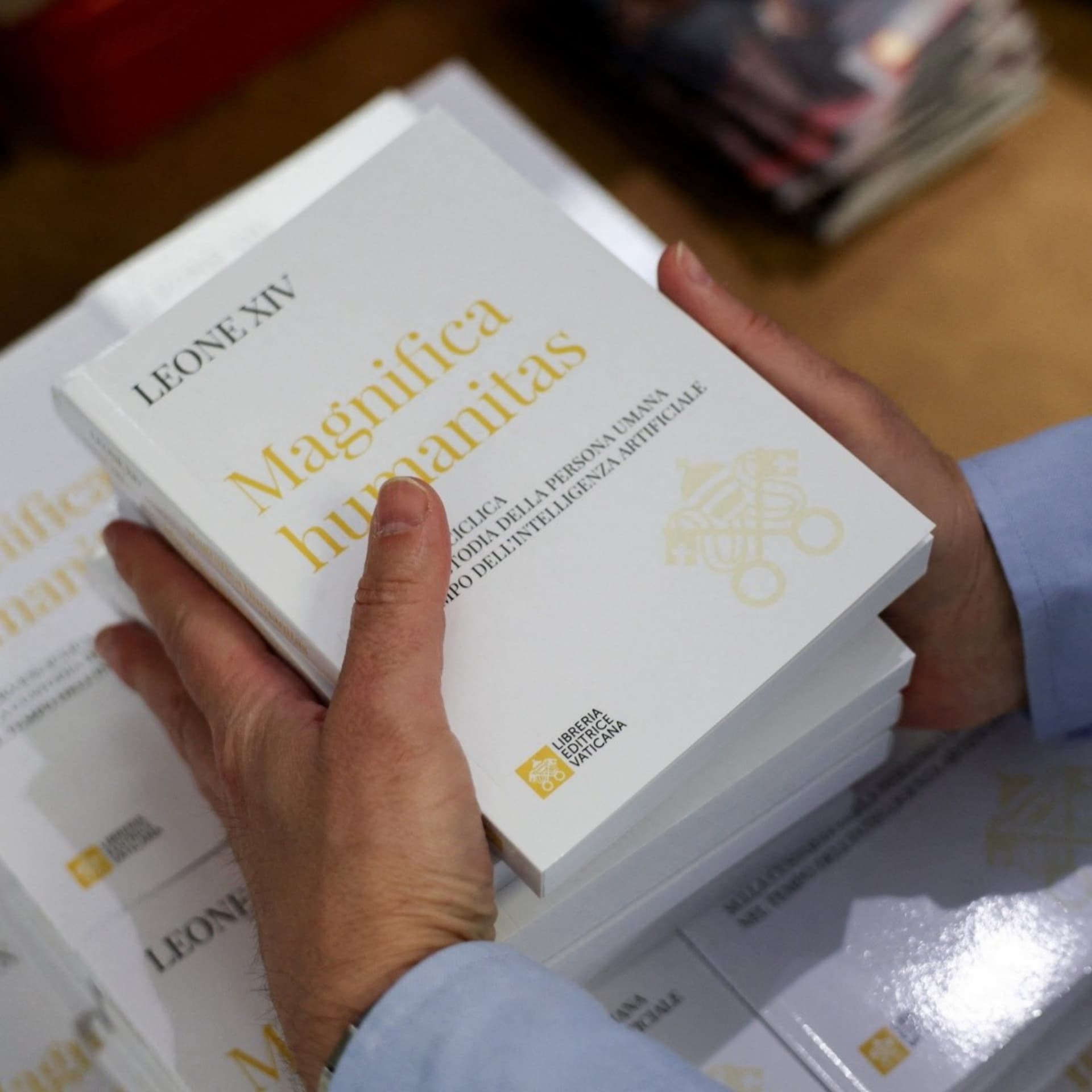
The episode covers multiple news segments. Main topic: Pope Leo (in his first encyclical “Magnifica Humanitas”) warns that artificial intelligence could pose an existential risk, arguing AI shouldn’t concentrate power in a few hands or be used militarily; he calls for AI to be “disarmed” and says “just war” reasoning is outdated.
Guest
Chris Ola, Anthropic co-founder, warns AI questions extend beyond computer science and urges industry not to act alone.
Guest
Elise-Anne Allen, Rome correspondent for Catholic News and biographer of Leo XIV, says the Pope frames AI as enabling domination and “new forms of slavery,” citing online exploitation and child sexual abuse risks.
Notable examples
AI-enabled domination/enslavement; digital-era anonymity. Other segments: Hajj safety amid Iran war; 7-Eleven founder Toshifumi Suzuki; a rare blue deep-sea octopus; gene-editing therapy lowering cholesterol; London “culture tourism” in immigrant enclaves; 98-year-old wing-walk record for children’s cancer charity.
Written by AI. May contain mistakes. Listen to the episode to check what was said.
Chapters
Tap a time to open that second in VOIntroduction to Current News
0:49 to 1:52
Overview of current events related to the Pope's concerns and Hajj pilgrimage.
Pope Leo's AI Warning
1:52 to 4:55
Discussion on Pope Leo's encyclical warning about the risks of artificial intelligence.
“says Hajj pilgrims will be safe despite the war in Iran.”
Elise-Anne Allen on AI and Slavery
4:55 to 6:19
Expert Elise-Anne Allen explains the implications of AI and potential new forms of slavery.
“in which he said the Catholic Church was all too slow in condemning, but suggesting that AI could create new forms of enslavement is a very strong way of trying to impart that message about the potential peril.”
Safety for Hajj Pilgrims
6:19 to 8:12
Analysis of the safety measures for pilgrims traveling to Hajj amidst regional tensions.
“And he said, if we want to avoid having to make a similar apology in the future, we need to get ahead of the curve now.”
Legacy of Toshifumi Suzuki
8:12 to 12:22
Exploring the impact of Toshifumi Suzuki on Japan's convenience store culture.
“If you remember back at the time of Covid, it was down to just a few thousand.”
Discovery of New Octopus Species
12:22 to 14:02
Learn about a newly identified octopus species and its unique characteristics.
“Deep-sea scientists have identified a new species of octopus, the size of a golf ball near the Galapagos Islands in the Pacific Ocean.”
Exploring Oceanic Depths
14:02 to 15:09
Learn about the geographic range of oceanic species and the need for more expeditions.
“I think a big part of this is just that we haven't done that many expeditions in these areas.”
Health Ministers Unite Against Virus
16:10 to 17:16
Discover the joint response plan adopted by health ministers in Africa to combat viral outbreaks.
“Welcome to Stateside with Kai and Carter.”
Coordinating Viral Outbreak Response
17:16 to 19:16
Understand the details of the coordinated plan and its execution amidst a viral outbreak.
“Jean Kaseya, dismissed criticism they had taken too long to coordinate a response.”
Revolutionary Gene Editing for Cholesterol
19:16 to 22:35
Learn about a new gene editing therapy that could permanently lower bad cholesterol.
“Riez Patel is a professor of cardiology at University College London who worked with some of the patients on the study.”
Show all 12 chapters
Cultural Exploration in London
22:35 to 25:31
Follow a journey through London's diverse cultures without leaving the city.
“Riez Patel of University College London.”
Harry Heisman: Age is Just a Number
25:31 to 27:43
Meet a 98-year-old who fulfills a lifelong dream of wing walking, raising funds for charity.
“has proved it's never too late to try something new.”
Transcript
Automatic transcript. May contain errors.0:00This BBC podcast is supported by ads outside the UK.
0:30The new tropical butterfly refresher from Starbucks. Guava and passion fruit flavors with mango pineapple flavored pearls. Yeah, that feels like summer before you even taste it. Funny how one small stop becomes the best part of the day. Start your summer rhythm with Starbucks. Try the new tropical butterfly refresher from Starbucks.
1:21We'll be right back. Denton.
1:52says Hajj pilgrims will be safe despite the war in Iran. Also in the podcast. The idea here is that you could do one treatment once in your life and then hopefully for the rest of your time you won't have to worry about high cholesterol causing heart disease. Could a one-off treatment spell the end of high cholesterol?
2:17The Pope has sounded a warning about the dangers of artificial intelligence, saying it could pose a potentially existential risk to humanity, and calling for more to be done to reduce its impact on the environment. In his first encyclical, or teaching document, entitled Magnifica Humanitas, Leo said that AI shouldn't be allowed to concentrate power in the hands of just a few people, nor used for military purposes. Artificial intelligence needs to be disarmed. The word is strong, I know, but deliberately chosen because this moment needs words capable of attracting attention, awakening consciences and indicating paths forward for humanity.
3:04The pontiff also said that the idea of a just war, which has recently been used by the Trump administration to justify its attacks on Iran, was outdated. Sitting alongside the Pope was Anthropic co-founder Chris Ola, who warned against his own industry acting alone in dictating the development of AI. Some might believe that matters of AI are best handled by computer scientists like myself. They are mistaken. The questions raised by AI are bigger than the AI research community, not just in their implications, but also in their nature. If it helps, one way I sometimes describe this is that it's a little bit like bringing a fictional character to life.
3:43And now we're entering an extraordinary world where those fictional characters speak to us, do work, have jobs. This clearly raises questions beyond computer science. The machinery that makes this possible is the work of math and programming and science. But what character we choose, how it interacts with the world, how it ought to interact with the world. These are more clearly questions for the humanities, for religion, for philosophy, for society at large. Elise-Anne Allen is Rome correspondent for the Catholic news website Crooks and a biographer of Leo XIV. What does she make of the Pope's warning?
4:18It was quite strong. And if you read this document, the language that Pope Leo uses is very forceful, sort of in condemning this culture of power, as he described, in this tendency to domination, you know, and that's the risk of these technologies now. is that they will be used to dominate and ultimately exploit the human person rather than work for their good. So he was very, very firm in his caution in terms of how these technologies are used. So it was quite a strong message from Pope Leo today in the document and in the speech that we just heard. He didn't hold back on either of those occasions.
4:54Comparing it to the potential ghastliness of slavery, in which he said the Catholic Church was all too slow in condemning, but suggesting that AI could create new forms of enslavement is a very strong way of trying to impart that message about the potential peril. I think that this is probably for myself, one of the key aspects of this document is the potential for new forms of slavery in the digital era. This is something that the Catholic Church was talking about even before COVID-19. And then I think they saw a boom in the online exploitation industry where it became much easier for exploitation online, cyberbullying, specifically the online sexual exploitation of children is something that tragically became a more common phenomenon during that time.
5:42And so this is something the church has been concerned about. And I think Leo sees the advent of AI in all of this and sort of the limitless potential that it has and the way that some want to just carry this technology forward without limits as opening all kinds of concerning doors, you know, and the ease with which people can access content and also the anonymity of it all. You know, it's so much easier to create, you know, anonymous profiles and there's no tracking for how these things are paid for. You know, this content is obtained and paid for. So it opens all kinds of questions, you know, and condemning, you know, and he apologized very strong and very potent moment.
6:18He apologized for the church's past support of slavery and its slow condemnation of it. And he said, if we want to avoid having to make a similar apology in the future, we need to get ahead of the curve now. And I think that is one of the most important elements of this document. Elise and Alan talking to Tim Franks. Despite the war in nearby Iran, Muslims from around the world are travelling to Saudi Arabia for the Hajj pilgrimage. Officials say that more than 1.5 million people will be heading to Mecca, more than last year. So will the pilgrims be safe? I asked our Arab Affairs analyst, Sebastian Usher.
6:52The Saudi Defence Ministry has essentially said that they can protect the skies above Mecca and elsewhere where the rituals are going to take place. They posted a video of an air defence battery just on the outskirts of Mecca. I mean, Saudi Arabia was one of the targets for Iran during the height of the war, of course, with the ceasefire. There have been no attacks recently, but it could, of course, erupt again at any moment. So, yeah, there's two different types of heat. There's the customary summer heat. I'm just looking now at my phone. It's around 42 degrees at the moment. The Saudis for years now have introduced all sorts of ways to try to mitigate that with water trucks, mist of water, umbrellas, all sorts of things.
7:38But people will die of heat stroke there. But again, for some of those who come to the pilgrimage, some of those who are older, that isn't something that they particularly mind. You know, this is a summit of their lives. And to die at Hajj, if you've reached that stage of life, isn't actually considered the worst thing to happen. And of course, there's the political heat. There's all the talk of the ceasefire, that it may be extended, that there may be a deal finally on the table. But that uncertainty is certainly coloured the way that the countries from which these people, the pilgrims, have come from, but not so much the pilgrims themselves.
8:10I mean, this is a pretty large number. If you remember back at the time of Covid, it was down to just a few thousand. So there's been a resurgence in the past two or three years and it's continuing. Very important religious event for those pilgrims. But it's also an important, well, it's important for Saudi's economy. It's been trying to diversify, but run into a bit of trouble recently. It has. I mean, massively. You know, there's a thing called Vision 2030, which is where the crown prince, the de facto ruler Mohammed bin Salman V set this up about 10 years ago with hugely ambitious ideas. One of them was about bringing tourism to Saudi Arabia, which really hadn't had tourism beyond religious tourism ever and the expats who go and work there.
8:51So there have been many, many events, all sorts of things to try and bring people towards Saudi Arabia and also massive giga projects, things like the Line, the Cube, development of the Red Sea. But it hasn't so far resulted in any real influx of tourists. Still the largest number by far are the pilgrims who come for Hajj. Arab Affairs analyst Sebastian Usher. In many countries, convenience stores tend to just sell basic snacks and essentials. But in Japan, they're part of the vital social infrastructure, offering all manner of goods and services. The man regarded as the father of the Japanese convenience store industry, Toshifumi Suzuki, has died at the age of 93.
9:33He opened the first 7-Eleven in Japan in 1974 and turned it into the country's largest chain, as I heard from our global affairs reporter, Paul Moss. 7-Eleven sort of sounds to many people like the classic American company, and it does have its origins in the US. But in fact, it's now majority owned by a Japanese company, and that is largely down to Toshisumi Suzuki. He got the first franchise to open 7-Eleven in Japan in the 1970s. It was very successful. So successful that in the 1990s, when the American side of 7-Eleven was having a bit of difficulty, his company bought a majority of the shares and have had them ever since.
10:13So 7-Eleven is majority Japanese owned. But in that way, he sort of embodied Japan's post-war economic success, which saw America push Japan to do capitalism the American way. And Japan not only did it, it did it well and did it in some ways better than America. I mean, we first of all, of course, saw Japanese consumer electronics beating their American competitors. Suzuki took that approach of beating America at its own game, and he applied it to retail. Yeah, and why was 7-Eleven in particular such a success in Japan? Well, I think you've hit the nail on the head describing it as part of the social infrastructure.
10:49I mean, it's not just paying bills. Do you know that when they have an earthquake in Japan, 7-Eleven is very involved in organising the recovery. It's that much part of life. But it's also unusual in that it's a chain, which often means uniformity. You know, you go to a branch of any super, most supermarkets anywhere, that's got the same stuff. For many people, that's the attraction. What Toshumi helped to pioneer was the idea of the hyperlocal, in which any branch knows by its computer records what particular variety of some product is popular locally, and they make sure they have lots of it.
11:22And they then transferred that model to other branches elsewhere in Asia, for example, in Thailand, Taiwan. They know that in this particular town, people like this particular flavor of bubble tea. I should say that also, if you ask Japanese people about it, they'll also start using some traditional Japanese terms, which they say they've applied to business in 7-Eleven. Words like kaizen, striving for continuous improvement, or I think my favourite, kodwari, which is usually translated as the relentless pursuit of perfection. I mean, when you read about 7-Eleven's success in Japan, you might feel like you're reading a manual for how to be a samurai warrior in the 19th century.
12:00In fact, this is just how they do retail. Yeah, very briefly, he ended up resigning. Why was that? Yeah, that was very sad. He was accused in 2016 of trying to get his son installed as the boss, and he resigned, saying, it is my lack of virtue and I'm unbearably ashamed. So ended his career, but he was still a very successful, much-loved man in Japan. Paul Moss on Toshifumi Suzuki, who's died at the age of 93. Deep-sea scientists have identified a new species of octopus, the size of a golf ball near the Galapagos Islands in the Pacific Ocean. The tiny creature stands out for its blue colour, one of the rarest shades in nature, its relatively few armsuckers and lack of an ink sack.
12:43Scientists say related species are usually much larger than normally found in the icy waters of Antarctica. We heard more from Dr Thomas Clements, lecturer in invertebrate zoology at the University of Reading. These animals are so incredibly rare that even if you send an expedition down into the deep water, the chances of coming across one are so unlikely. And I think one thing that sort of typifies that is the reaction of the researchers when they discovered it. You know, they were very excited when they saw it because it's just such a rare thing. From this specimen, we know that this type of cephalopod normally sits quite close to the seafloor and sort of bounces along.
13:20It doesn't swim too much because it wants to conserve energy. But we know from related animals that when they collected them, they dissected them and found that they were full of parasites. And those parasites are actually only really found in crustaceans. So we know that they were eating crustaceans. One thing that I think is such a cool fact, most octopuses can change the color of their skin. They have these things called chromatophores. These deep water octopuses don't need that because they live in the dark. So they're kind of see-through, but they have really pigmented internal organs. And the scientists think that they have these organs to stop bioluminescent crustaceans from glowing inside them and making them potentially eaten by other predators.
14:01They're found normally in very deep waters around the Pacific and around the Atlantic, as you said, close to Antarctica. I think a big part of this is just that we haven't done that many expeditions in these areas. And so the geographic range will grow as we get more data. Dr Thomas Clements. Still to come on this podcast? I don't know if that's an honour or not, you know. If I was back on 70, I'd say, oh, well, I might get there. But I never dreamed I would be doing it. The 98-year-old British man riding on the wing of a biplane.
15:08We'll be right back. America's Social Casino. Download the Moto Casino app today. Hey, it's Ryan Seacrest for Jewel Osco. This spring, sweeten your day one sweet treat at a time. Now through May 26, whether you're shopping for gifts for friends and family or just want to pick me up for yourself, get great deals on your favorite sweet treats. Shop in-store or online and save on items like Reese's Peanut Butter Cups, Trident Sugar-Free Gum, Albanese Gummy Bears, Kinder Wafer Eggs, or Snickers Bars. Get these deals before they're gone. Offer ends May 26. Restrictions apply. Offers may vary. Visit Jewelosco.com for more details.
15:47Spring has sprung and big savings are in full bloom at Menards. Visit Menards Garden Center for everything you need to get your garden growing. Choose from hundreds of beautiful, colorful flowers, lush trees and shrubs, and everything in between. Menards Garden Center is back in bloom. Stop in today to get your garden on. Check out fresh deals happening now at Menards.
16:18I'm Kai Wright. I'm Carter Sherman. Welcome to Stateside with Kai and Carter. We're a new show from The Guardian. We're talking to big thinkers and the best journalists, just trying to understand the world through smart conversation and honest reporting. We don't have billionaires telling us what to say. Stateside with Kai and Carter will come out three times a week, Monday, Wednesday, and Friday, starting May 13th. Subscribe on YouTube or wherever you get your podcasts.
17:07At a meeting in Kampala, health ministers from Congo, Uganda and South Sudan adopted a joint plan to counter the spread of the virus. The head of the Africa Centres for Disease Control and Prevention, Dr. Jean Kaseya, dismissed criticism they had taken too long to coordinate a response. We landed with a joint plan of$319 million to stop this outbreak. And more importantly, we also agreed on a continental mechanism to coordinate this response led by Africa CDC and WHO supported by all other partners. Many who will be listening to you will be wondering how come there wasn't a plan in place already because your organization was created in response to that large outbreak of Ebola in West Africa.
17:55The world must even congratulate Africa CDC because on the 15th of May, Africa CDC declared this outbreak when we got evidence that more than one country was infected. Second, we immediately started to interact with authorities who declared this outbreak the same day and started to work on the plan. And in about three days, all countries had a plan. In about four days, I organized a meeting with all partners and all countries. Now we have the plan ready. We did it quickly, as much as possible we could do. So what are the details of the plan? The plan is articulated around 11 pillars. These 11 pillars will help us to contain the outbreak.
18:43As you know, currently, we don't have vaccines, we don't have medicines, and we are mostly relying on a better coordination, how to bring countries and partners together to avoid wastage. Second, we are mostly targeting the risk communication, and we are targeting how to test, test and test to isolate cases. And you say that your budget is$319 million. How much have you raised so far and what are the priorities?
19:38response. Dr Jean Cassea talking to Anne Soy. Early test results published in the New England Journal of Medicine suggest a single infusion of what's been described as a revolutionary gene editing therapy could lower bad cholesterol by almost two-thirds and do so permanently. Riez Patel is a professor of cardiology at University College London who worked with some of the patients on the study. He spoke to Tim Franks. This is essentially, as you've described, a new gene editing treatment for cholesterol. And the idea is that you give a single treatment, it turns off a very small part of the DNA of a particular protein in the liver.
20:18And that essentially translates to hopefully a very long term reduction in your cholesterol levels, which then in turn leads to lower risk of heart disease and stroke. It sounds fabulous. Presumably, you're going to be trialling on a larger scale now. Lots of people at the moment take statins in order to try and reduce the levels of bad cholesterol. Would that obviate the need for that? It's a good question. I think it's a bit early to say. So we're going to remind ourselves it's still interim early stage results. These are 35 people around the world who have received this therapy. And the exciting thing is that, first of all, it's safe.
20:53It really does work. And the science behind it is truly science fiction-like. and the excitement really in the field is that this will change the paradigm by which we treat a chronic problem like cholesterol because at the moment if someone is at high risk of heart disease or has very high cholesterol we have to give them a pill or a treatment regularly to keep those levels down and when they stop those treatments the levels go up and their heart risk goes up but the idea here is that you could do one treatment once in your life and then hopefully for the rest of your time you won't have to worry about high cholesterol causing heart disease so in theory there will be those questions asked whether we'll replace tablets I do think that this is the future and at some point we'll look back and say did we really need to take pills to suppress cholesterol.
21:35What about the issue of high cholesterol in those who don't necessarily have what might be considered to be a bad diet but just have inherited the predisposition for high cholesterol is this potentially a therapy that could help them as well? Yes so in the study Currently, they're looking at people who have very high cholesterol and who need cholesterol lowering long term. So that includes people who have a genetically high cholesterol who are at risk of future heart disease. There is a number of those patients in the trial at the moment. So this is definitely for those people with a genetic problem.
22:08But more importantly, it's also for people who might, for example, have had an early heart attack in life and need another 30, 40 years of cholesterol lowering in order to stop a second or third heart attack. And for them, this will, again, be potentially transformative. and it opens up the scope for using gene editing, not just for a rare condition, as we've heard in previous gene editing studies, but now for the first time for a very common problem with potentially many, many thousands of heart attacks that could be saved. Riez Patel of University College London. The travel industry has been badly hit by the war on Iran.
22:42With the Strait of Hormuz closed, the cost of jet fuel has soared, meaning airlines have cut flights or raised prices. As a result, travel enthusiasts are trying to find different ways of exploring the world. Isabella Jewell took a walk with social media influencer Samma Speaks to see how to experience different cultures without leaving London. The next station is Shepherd's Bush.
23:11I've been promised a holiday, but I'm in a rather breezy part of West London next to a main road. but a young British Iranian Londoner called Samah Ansari Poore should be waiting somewhere around here to take me on a journey across the world. I'm a culture content creator. It means that I spend a day experiencing the culture of another country in London. So I'm a tourist. I'll go to the supermarket, I'll do the dances, the clubs, the culture activities, restaurants. Anything you do in a foreign country on holiday, I'll do it here. I chose this place because it's got three enclaves. a really big Algerian community, a really big Ethiopian-Eritrean community, and a really big Syrian community.
23:51So, Summer, what's the first stop on our trip? I'll take you to Syria. Right now we're walking past a Syrian restaurant. It's tucked right next to a Syrian supermarket. Let's go inside. Lots of fresh goods around. You can see lots of amazing herbs as well. Lots of mezze. Like you've got vine leaves, moussaka, modamese, garlic sauce, tzatziki. We could go over here. Look. product of cereal it says it in another language yeah oh but this is persian cucumbers i would always eat this as a kid and they're very different to like turkish pickles i think like a really cool side effect of it is well okay you can go to museums for free or galleys for free but oh you can also go to all of these cultural centers and stuff like there's a somali house right across the road even for me because i can't really go back to iran going to places like palestine house where the architecture is just mirrored of my country.
24:41It's just so comforting, and I feel like for the majority of the world, that exists here. A few minutes away, we find one of Samer's favourites, an Ethiopian hardware store. A lot of Ethiopian stores always smell so good because of incense. It's quite big in their culture. But then you have these things over here. So you have these tea cups, these really nice, beautiful, golden, sort of small mirror tables. and it's used for traditional coffee ceremonies. Back at the tube station, Samma told me why she shares these stories online. I really want to make other cultures quite accessible. If we're more exposed to each other and we have more conversations, I really hope that us versus them gets smaller and smaller.
25:26Samma speaks talking to Isabella Jewell. Finally, a man here in the UK has proved it's never too late to try something new. Just days before his 99th birthday, Harry Heisman took to the skies for a wing walk, becoming the oldest person ever to attempt the daring feat. Helena Burke has the details. A year ago, Harry Heisman couldn't climb the stairs and had to enter an old age home. But then the 98-year-old decided he'd like to fulfil a childhood dream. As a teenager during the Second World War, Harry worked in a factory making aircrafts used in the D-Day landings. he wondered what it would be like to fly in one of the planes.
26:07I've been up on the plane once, but I didn't fly. We did everything except take off. On Saturday, after more than eight decades, Harry stopped wandering. The 98-year-old was strapped to the wing of a 1940s biplane as it took to the skies. In doing so, he broke the Guinness World Record for the oldest person ever to complete a wing walk. I don't know if that's an honour or not. If I was back on 70, I'd say, oh, well, I might get there, but I never dreamed I would be doing it. In preparation for the flight, Harry rebuilt his strength with a physiotherapist. He can now walk up the stairs independently again, a feat that came in handy for the wing walk because he had to step up to the top of the plane.
Read the full transcript
26:54But Harry has insisted that the focus of the stunt shouldn't be on him. Instead, he wants to raise awareness about the charity he is fundraising for, the Lennox Children's Cancer Fund. They're a small charity but they do small miracles. As a young lady who was sitting there she had cancer when she was 10. She's 15 now and they've helped her through it and she wanted to be a vet. Now when you hear something like that that gives you a bit of a get up and go and do something. Harry has raised nearly$7 ,000 so far. The 98-year-old plans to continue to work with his physiotherapist, with his sights now set on completing the London Marathon.
27:38Helena Burke. And that is all from us for now, but the Global News Podcast will be back very soon. This edition was mixed by Rosenwinderell and produced by Richard Hamilton. Our editors Karen Martin, I'm Oliver Conway. Until next time, goodbye.
28:04I'm Kai Wright. I'm Carter Sherman. Welcome to Stateside with Kai and Carter. We're a new show from The Guardian. We're talking to big thinkers and the best journalists just trying to understand the world through smart conversation and honest reporting. We don't have billionaires telling us what to say. Stateside with Kai and Carter will come out three times a week, Monday, Wednesday, and Friday starting May 13th. Subscribe on YouTube or wherever you get your podcasts.
28:31Thank you.
From the publisher
In his first teaching document, Pope Leo warns AI risks accelerating war and threatens humanity. It was published at an event in the Vatican attended by AI experts including the co-founder of Anthropic. Also: Muslims begin annual Hajj pilgrimage to Mecca as Saudi city hits 42C; the “revolutionary” gene editing therapy that could lower bad cholesterol by up to 62% for life; a new species of tiny blue octopus found 1,800 metres beneath the Galapagos Islands off Ecuador; the Japanese businessman who transformed the 7-Eleven chain, Toshifumi Suzuki, dies aged 93; and British pensioner, Harry Heasman, becomes world's oldest wing walker.
The Global News Podcast brings you the breaking news you need to hear, as it happens. Listen for the latest headlines and current affairs from around the world. Politics, economics, climate, business, technology, health – we cover it all with expert analysis and insight. Get the news that matters, delivered twice a day on weekdays and daily at weekends, plus special bonus episodes reacting to urgent breaking stories. Follow or subscribe now and never miss a moment. Get in touch: globalpodcast@bbc.co.uk