
In short
The UN and meteorologists warn that El Niño could intensify in 2026, potentially becoming a “super El Niño” and worsening extreme weather worldwide; the episode also covers conflicts (Israel-Hezbollah/Ukraine), a Kenya Ebola-quarantine protest, ship-recycling sanctions risks, Paralympic-to-space plans, and Toy Story 5.
Guests (and backgrounds)
Antonio Guterres (UN Secretary-General); Justin Rowlett (BBC climate editor); Anbarasan Etirajan (BBC global affairs reporter); Lina Sinjab (BBC reporter in Beirut); Paul Adams (BBC diplomatic correspondent); David Waddell (BBC business reporter); Dr. Anil Sharma (GMS founder on ship recycling); Gudrun Janssen (BIMCO ship recycling lead); Mohamed Yacoub Janabi (WHO Africa regional director); John McFall (UK Paralympian and amputee aspiring astronaut); Tom Hanks and Tim Allen (actors voicing Woody/Buzz for Toy Story 5); David Sillitoe (arts correspondent).
Key claims
El Niño has 90% certainty and may drive droughts, wildfires, and monsoon rainfall deficits (India forecast: lowest in 11 years). Ukraine feels “abandoned” amid reduced Western ceasefire efforts. Kenya protests oppose a US-backed Ebola isolation centre; Ebola control depends on community engagement and rapid diagnosis. Sanctions may leave “Shadow Fleet” ships abandoned, increasing environmental catastrophe risk.
Notable examples
Amazon/Australia/SE Asia drought and wildfires; Sri Lanka’s extreme rains; Indonesia’s 2023 wildfire loss (1.16 million hectares); Tyre hospital attack; Exxon Valdez oil spill comparison; specific sanctioned ships (Rantanplan, Bigli, Timon, Yogi); John McFall’s 2008 Paralympic bronze; Toy Story 5’s Jessie story and “technology” as the villain.
Written by AI. May contain mistakes. Listen to the episode to check what was said.
Chapters
Tap a time to open that second in VOProtests in Kenya and Global Context
1:54 to 2:45
Discussion about protests in Kenya and international responses.
“Two people have died in central Kenya during protests against plans to establish a US-backed Ebola isolation centre.”
El Niño's Impending Impact
2:45 to 3:33
Exploration of the upcoming El Niño and its climate implications.
“The World Meteorological Organization says this El Niño is likely to strengthen over the rest of 2026, driving more extreme weather events around much of the globe.”
Understanding El Niño Conditions
3:33 to 5:35
Detailed explanation of how El Niño alters weather patterns globally.
“El Nino conditions will pour fuel on the fire of a warming world.”
Impacts on South Asia and Agriculture
5:35 to 7:50
Analysis of El Niño's effects on monsoons and food production in India.
“Listening to that was our global affairs reporter, Anbarasan Etirajan.”
Conflict Updates: Israel and Lebanon
7:50 to 10:46
Current situation in Lebanon amidst ongoing conflicts and ceasefire talks.
“Despite Israel and Hezbollah accepting a US plan to implement a partial ceasefire, fighting continued in southern Lebanon.”
Ukraine's Ongoing Struggles
10:46 to 14:01
Insight into Ukraine's situation following recent Russian attacks.
“In many parts of Ukraine, a huge clean-up is underway after what was one of the deadliest Russian attacks in recent months.”
Ukraine's Ceasefire Negotiations
14:01 to 15:01
Exploring the complexities of ceasefire negotiations in Ukraine.
“Those negotiations came to an abrupt end.”
Shadow Fleet and Environmental Concerns
15:01 to 17:46
Discussing the environmental risks posed by aging ships in operation.
“The world's largest trader in ships for recycling has told the BBC that hundreds of Shadow Fleet vessels are operating on the high seas beyond their design life with no legal route to be decommissioned.”
Shadow Fleet and Environmental Concerns
20:34 to 21:21
Discussing the environmental risks posed by aging ships in operation.
“Hey, quick question for the parents listening right now.”
Kenya's Protests Against Ebola Center
21:21 to 24:50
Reporting on protests in Kenya against a US-backed Ebola quarantine center.
“At least two people have been killed in Kenya amid protests against a new US-backed Ebola quarantine centre near the town of Nanyuki.”
Show all 15 chapters
WHO's Response to Ebola in DRC
24:50 to 26:18
Examining the WHO's efforts in addressing the Ebola outbreak in the DRC.
“We have discharged six of our health workers who contracted in the early stages.”
John McFall's Journey to Space
26:18 to 28:00
Exploring the journey of John McFall, a Paralympian aiming for space.
“A British man, John McFall, lost a leg at the age of 19.”
Toy Story 5 Promotion and Interviews
28:00 to 29:09
Learn about the promotional efforts and interviews for Toy Story 5.
“and also learn an awful lot of when doing it.”
Voice Acting Dynamics and Technology
29:10 to 31:27
Discover the voice acting dynamics between Tom Hanks and Tim Allen and the impact of technology on animated films.
“Welcome to the bizarre world of conveyor belt journalism.”
Reflecting on Animated Film Experiences
31:28 to 32:26
Tom Hanks and Tim Allen reflect on their experiences in animated films and past interviews.
“Even Toy Story 4 is at a remarkable 97%.”
Transcript
Automatic transcript. May contain errors.0:00This BBC podcast is supported by ads outside the UK.
0:30The new tropical butterfly refresher from Starbucks. Guava and passion fruit flavors with mango pineapple flavored pearls. Yeah, that feels like summer before you even taste it. Funny how one small stop becomes the best part of the day. Start your summer rhythm with Starbucks. Try the new tropical butterfly refresher from Starbucks. Moto Casino. America's social casino. Welcome to Moto Casino, where the excitement never ends. With thousands of the hottest free-to-play social casino games, fastest payouts, and the best promotions in the industry. No tricks or gimmicks. Owned and operated in the USA.
1:10Moto Casino is a free-to-play social casino. No purchase necessary. 21 plus to play. Void or prohibited. Sign up today for a generous welcome bonus. Moto Casino. America's social casino. Download the Moto Casino app today. This is the Global News Podcast from the BBC World Service.
1:53Israel and Hezbollah. Two people have died in central Kenya during protests against plans to establish a US-backed Ebola isolation centre. Also in this podcast... I would be frank with you, we feel abandoned. We will continue to fight, for us it's existential, but I think the world really should step in and stop this suffering and stop these killings. Ukraine remains defiant after one of the deadliest Russian attacks of recent months and our arts correspondent speaks to actors Tom Hanks and Tim Allen ahead of their fifth outing as Woody and Buzz.
2:38A new phase of the natural Anino weather pattern could begin in the next few months, the UN has warned, boosting temperatures on the planet already under strain from climate change. The World Meteorological Organization says this El Niño is likely to strengthen over the rest of 2026, driving more extreme weather events around much of the globe. Several forecasts from national weather agencies suggest it could end up as one of the strongest ever recorded, a possible so-called super El Niño. Here's the Secretary General of the United Nations, Antonio Guterres. I thank the World Meteorological Organization for this vital new update.
3:20The science is clear. El Nino is arriving on our doorstep in the coming months with 90 % certainty. The world must treat it as the urgent climate warning it is. El Nino conditions will pour fuel on the fire of a warming world. impacts will eat even harder, travel even further and cross borders with devastating speeds. I heard more about El Niño from our climate editor Justin Rowlett. It's a change in the pattern of winds in the central, the tropical Pacific Ocean. So the trade winds that normally blow east to west either stop or reverse direction. And that affects the currents of water under the ocean.
4:06So the ocean collects heat from the atmosphere, and instead of that heat traveling towards the west, it begins to travel towards the east. And we've got a series of satellites. There are moored buoys. There are floating buoys in the Pacific that measure water temperatures. And scientists can see this kind of pulse, a kind of wave of undersea heat developing and moving steadily across the ocean towards the west coast of South America, where it upwells and that raises surface temperatures. So the undersea, this water under the water, is up to six degrees Celsius higher than you'd expect at this time of year.
4:47That's a really significant increase in temperature. When it gets to the surface off the coast of South America in the autumn towards the winter, we're expecting surface temperatures to be two degrees Celsius or more than you would normally expect them to be. That is a huge increase in temperature. And that heat obviously is radiated out into the atmosphere. And that's where you get the kind of ripple of consequences on weather patterns around the world. The weather is really all about the transfer of heat from the oceans into the atmosphere and then around the globe. And the more heat you have, it changes weather patterns.
5:21So, for example, we can expect to see things like droughts and wildfires in places like the Amazon, Australia, and then into Southeast Asia, even into India, so it can affect the Indian monsoon with huge consequences there and indeed around the world. Justin Rowlett. Listening to that was our global affairs reporter, Anbarasan Etirajan. So what impact could this have in South Asia and further afield? As Justin was mentioning, the monsoon is going to have an impact because the Indian weather forecasters are saying India is likely to receive the lowest monsoon rainfall in 11 years. Now, why this is important?
5:58Because nearly 70 percent of water resources in India, they get their water mainly from this monsoon rain. And given that more than 50 percent of India's farmlands don't have proper irrigation facility, they depend on rainwater. So if there is any deficiency in rain, that is going to have an impact on food production. In the previous years, for example, India, when they faced this illinear condition, food production went down, the prices shot up. As a result, they stopped grain exports, for example, non-Basmati rice. So India is the largest exporter of rice in the world. So if India stops exporting, then the global prices go up.
6:39And also India is one of the biggest producers of sugar. So it can have an impact, but then again, it can also increase inflation within India as well. And this has real consequences for real people, including a lot of very poor people. First of all, the heat itself is causing a lot of damage. What we are seeing is 45, 46, even up to 47 degrees. A lot of farm laborers and day-to-day workers, migrant workers working in the heat. You know, you usually see thousands of deaths because of the heat stroke and other things. where people are feeling the heat more. But I also have to mention about this heavy rains, a month-long rain coming in within three days, for example, what we saw in Sri Lanka last year that was attributed to the changing weather pattern.
7:23And in countries like in Indonesia, wildfires, that is the main concern because the last time in 2023, in the new effect, they had 1.16 million hectares of forest cover. It was burned down because of wildfires. That is a big concern for Indonesia and also in Australia. So the drought, the extended, the prolonged drought can cause a huge impact on the environment in Southeast Asia as well. Anbarasan Etta Rajan. Despite Israel and Hezbollah accepting a US plan to implement a partial ceasefire, fighting continued in southern Lebanon. But there have been no fresh Israeli attacks on the capital Beirut.
8:04President Trump said he'd spoken to both sides and they had agreed that all shooting will stop, his words, after Iran warned Israeli military actions in Lebanon were a threat to the current U.S.-Iran ceasefire. Lina Sinjab is in Beirut. These talks really saved Beirut an attack, saved Dahyeh an attack, which is the southern part of Beirut, southern suburb, a Hezbollah stronghold that has been targeted in 2024 and continue to be targeted. It's been really a very tense day yesterday with thousands of people fleeing for their safety from Dahye neighborhood who are still stranded. The morning started with an imminent strike expected on Dahye, but it didn't happen.
8:47And that's because of these kind of round of talks that mainly the U.S. president done after Iranian pressure to include Lebanon in a ceasefire deal. This is the first time that the U.S. president talks even indirectly to Hezbollah, which is an organization designated as a terror one, but that spared Beirut a strike. Hezbollah agreed not to target northern Israel, and Israel agreed not to target Beirut. But in between these two, the south is out of the equation where bombardment and airstrikes continued yesterday with more than 20 people killed, including an attack on a hospital in the city of Tyre.
9:29What do Lebanese people think about these promises from the White House and Israel? I think people are really holding hopes to anything that could stop the violence in Lebanon. Even though Beirut is spared this attack, but many parts of Dahi are destroyed. They've been destroyed since 2024 war and now more destruction. Displaced people are scattered in the country, in Beirut, in the north, in the mountains, in shelters, in schools, but even in tents. They're still staying in tents. The greater fear is that the South is now sacrificed, that the Israelis have boots on the ground. They occupy big swathes of land, including a strategic castle, the Beaufort Castle that dates back to 900 years old.
10:17and they feel that this is the Israeli tactics in South Lebanon are similar to Gaza, destruction and occupation. Briefly, is there a way forward? Diplomatic pressure, but we've seen what the diplomatic pressure done to Gaza. There are still attacks in Gaza. There are still daily killing in Gaza. Big swathes destroyed and the Israelis want to expand more. And the fear is that South of Lebanon is going to be the same. Lina Sinjab in Beirut. In many parts of Ukraine, a huge clean-up is underway after what was one of the deadliest Russian attacks in recent months. The eastern cities of Dnipro and Kharkiv were targeted by hundreds of drones and ballistic missiles, as was the capital.
11:03Emergency crews have been out in almost all districts of Kiev, with teams searching for people feared trapped beneath rubble. As we record this podcast, at least 21 are known to have died, including two children. Dozens were injured. Russia said the strikes had been a response to previous Ukrainian attacks and all their objectives had been achieved. The Ukrainian MP Alexei Gonchorenko said the world is distracted by other conflicts and his country was suffering as a result. The United States now definitely completely observed by what's going on in the Middle East and in reality the negotiations which were started by President Trump for last year, they have no result for the moment.
11:46I would be frank with you, we feel abandoned. We will continue to fight, for us it's existential, but I think the world really should step in and stop this suffering and stop these killings and stop this next escalation which is happening right now. The world has means to do this, but unfortunately it looks like it doesn't have the will to do this, at least for the moment. The Kremlin says the war in Ukraine has entered a different paradigm because of what it called inhumane acts of terror carried out by Ukraine. I got this assessment from our diplomatic correspondent Paul Adams. I mean, there seems to be a reference to the Ukrainian attack on eastern Ukraine on a Russian facility in Starobilsk back in towards the end of May, the Russians said that 21 students were killed in a dormitory.
12:40The Ukrainians said it was being used as a headquarters for a drone unit. There's no independent verification either way, but it does seem to have triggered a very strong Russian response. I think the background to this is increasing Russian frustration at the glacial pace of the war and the Kremlin's inability to make significant gains in recent months. And more and more commentators are talking in terms of the war taking a turn now in Ukraine's favour. They see Russia's combat performance waning, Ukraine managing its manpower issues more effectively, a favourable casualty rate, favourable to Ukraine, that is, better tactics being deployed by the Ukrainians.
13:24Obviously, Russia still has an overwhelming advantage in manpower and has shown itself able to adapt. So I don't think anyone's predicting the immediate end of the war. But I think the massive use of drone and missile strikes show that that tactic really is proof that Moscow still believes that it can break Ukraine's will through the use of air power at a time when Ukraine's air defences are severely depleted. Yeah, but for all of that, we heard from the Ukrainian MP Alexei Gonchorenko saying the country feels abandoned. Is that true? What's the West doing to help? Well, you know, before the war with Iran, there were active negotiations going on to try and get a ceasefire in Ukraine.
14:07Those negotiations came to an abrupt end. Donald Trump is clearly distracted. Europe talks up its role as a supporter of Ukraine, but it doesn't represent a viable alternative as an interlocutor with Russia to try and get a ceasefire. And the Russians are certainly absolutely not interested in Europe performing that role. Europe can certainly support Ukraine. You know, it's passed an enormous 90 billion euro loan to Ukraine, but it's no substitute in terms of brokering a ceasefire. Plus, of course, we have a lack of hardware. A lot of the hardware that Ukraine would want to use to defend itself against aerial attacks has been sucked into the conflict in the Gulf.
14:52You know, it's very, very good at shooting down drones. But when it comes to ballistic missiles, you need Patriot missiles, and only the Americans can supply those. Paul Adams. The world's largest trader in ships for recycling has told the BBC that hundreds of Shadow Fleet vessels are operating on the high seas beyond their design life with no legal route to be decommissioned. Industry figures warn this could lead to an environmental disaster. The US sanctions watchdog has now approved a special licence allowing four sanctioned ships to be sold for scrap. Here's our business reporter, David Waddell.
15:29There could be 700 ships operating beyond their design life, according to GMS, which specialises in getting old ships off the sea. This licence covers four ships, So it's a drop in the ocean, if you like, but it's the first license of its kind issued by the Office of Foreign Assets Control. That's an arm of the U.S. Treasury. These are container ships going by the names of Rantanplan, Bigli, Timon and Yogi, all about 20 years old. That's not too old and all sanctioned for trading in Iranian goods. I spoke to Dr. Anil Sharma. He's the founder of GMS. He's been working for seven months to secure these licenses.
16:09So he's celebrating. But his firm's big focus is tankers. When you remove a tanker from the trade, what are you doing? You're reducing that ship's ability to carry two million barrels of oil per trip. And so you're also limiting the ability for the sanctioned oil to move in a cost-effective manner. The old ships can really undercut the market. Safe ships would ask for a higher price, higher freight. The sanctions are designed to sting anyone who deals with them. So many ports won't accept them. Insurance is hard to come by. GMS can't buy them and mainstream recycling facilities can't receive them.
16:50I've been told by the International Shipping Association, BIMCO, that in fact some are being recycled, but it's very much under the radar and in breach of the Hong Kong International Convention for the Safe and Environmentally Sound Recycling of Ships, which is a fairly recent convention. Here's Gudrun Janssen's, the ship recycling lead for BIMCO. Sanctioned ships, the problem is that no one can really touch them. So the moment a recycler enters into a deal that involves a sanctioned ship or a sanctioned company, there is a real risk for the recycler itself of being caught by the sanction regime as well.
17:27So what that means in practice is that more ships risk being abandoned or ending up in unsafe, substandard ship recycling facilities. She told me it's up from 85 in 2020 to over 400 abandoned vessels last year. and yet there are many hundreds of such ships still at sea. Let's look back to the Exxon Valdez disaster in 1989. She ran aground on a reef off the coast of Alaska and spilled 37 ,000 tons of oil. It killed hundreds of thousands of seabirds and thousands of other sea creatures. Exxon Valdez was quite young and went on to operate until 2012 but some of these ships are well beyond their design life.
18:07Their hulls are fragile and as a direct result of sanctions, their engines are often poorly maintained. Should one of these run aground, particularly a very large crude carrier or supertanker, we could be looking at an environmental catastrophe. Our business reporter, David Waddell. Still to come in this podcast. First, a Paralympic medal for sprinting. Now, preparations for blast-off. The reality is we don't know what it is like for someone with a disability. I'm a lower limb amputee. What it's going to be like for someone with a disability like mine living and working in space.
19:05Is U.S. owned and operated? Moto. It's American-made. That's who we are, and that's who we care about. Play for free at Moto.us. Moto Casino is the social casino. Avoid were prohibited. No purchase necessary. Visit Moto.us for more details. Must be 21+. Moto Casino. America's social casino. This is Ashley Akinetti from the Ben and Ashley I Almost Famous podcast. You know that moment when you're in your stylist chair and you're describing your dream hair like it's a Pinterest board come to life, but you have zero idea how to make it happen at home, that is my Roman Empire. But Amiga totally gets it.
19:43Their clean, vegan, cruelty-free, clinically proven formulas are why stylists swear by them. I'm obsessed with the wizard detangling primer. It's like a magic spell for my hair. For a limited time, save 15 % off your order with code FAMOUS15 on loveamica.com. Restrictions may apply. Hey, it's Ryan Seacrest for Jewel Osco. Summer is here and the sun is out. Make sure you take care of your skin this summer, now through June 23rd. Shop for You Save Days and get great savings on all your favorite skincare essentials and earn four times points. Shop in-store or online and save on Sunblock from Neutrogena, Sunbum, Hawaiian Tropic, Banana Boat, and Coppertone and earn four times points to use for future savings on groceries or gas.
20:28Offer ends June 23rd. Restrictions apply. Offers may vary. Visit jewelosco.com for more details. This is Jana Kramer from wind down with Jana Kramer. Hey, quick question for the parents listening right now. When's the last time your kid asked for something and you actually felt good saying yes, because lately a lot of families have been hearing the same thing. Can I have lingo kids, please? And here's the thing. Lingo kids is the number one entertainment platform for young kids with more than 4 ,000 interactive games, songs, and shows astronauts, wild animals, superheroes, dinosaurs. It's literally everything kids love all in one place.
21:03So when they ask for it, you can actually feel good saying yes. Download Lingo Kids for free and start exploring today or unlock even more amazing content with Lingo Kids Plus. And if you go with the yearly plan, you can save up to 60%. Search Lingo Kids in the App Store or Google Play. Lingo Kids, everything kids love.
21:27This is the Global News Podcast. At least two people have been killed in Kenya amid protests against a new US-backed Ebola quarantine centre near the town of Nanyuki. Hundreds of demonstrators marched through the streets on Monday, blocking roads and burning tyres. Police fired tear gas to disperse them. The Kenyan government has defended the construction of the centre by citing a health treaty with the US. The BBC's Thomas Mukwana sent this report from the scene.
22:22and the vandalism of a law court and also a few shops. But police, we've seen a few police vehicles full of anti-riot police officers and also backup from the base to try and stop this protest from happening today. But people still say that they will show up to voice their discontent with what's happening. But there's reports of aircrafts showing up in the facility, aircrafts flying in, big aircrafts that are supposed to construct this facility that is now barred by the courts. It's still ongoing, and the president and the Ministry of Health looks firmly in control of what's happening. And they say that they're going to keep this up because it's good for the Kenyan public.
22:56But the people will show up again. Everything is safe today. But they are saying that they will show up. Protesters from more places outside Manuki will come here to try and bolster the protests that will hopefully not stand violent. But they may occur today and we'll keep briefing you on what happens here. Mohamed Yacoub Janabi is the Africa Regional Director for the World Health Organization. He's just come back from visiting Bunia, the epicentre of the Ebola outbreak in Eastern Democratic Republic of Congo. So what I saw on the ground was humbling and inspiring. I met with health workers, communities and religious leaders, partners, organisation, working day and night under very extreme difficult conditions.
23:40My message to those affected communities was very clear and direct. Ebola can be stopped, but only if we respond quickly together and with trust, because I saw the contact tracing is still around 45 percent. And for our WHO standards, at least 80 percent to reach 95. People, they tell you, they've got their beliefs. Some believe it's poison. Some believe it's a curse and it's a mining area that maybe is a blessing when more people die. One of the efforts, Director General Tedros and myself when we were on the ground, was to engage the community. Because to me, any outbreak, including this one, there are three main things.
24:25One, to engage the community. Two, to protect your frontline health workers. And three, it's a very rapid diagnosis. And you can't get the diagnosis without tracing the people. Communities need a very clear, very accurate information in the languages they use and from voices they trust. Local leaders, faith leaders, women's group, youth leaders. People must understand what is Ebola, how it is spread, the symptoms to look for, and why early care dramatically improves survival. We have discharged six of our health workers who contracted in the early stages. The message should never be do as we say, but rather let us work together to protect your family and your community.
25:15It's starting to get through. Community engagement is not an add-on. It's one of the most powerful tools we have to stop transmission, especially when you are dealing with the bodybuja, which you don't have any validated therapeutics or any vaccine. So it's very important to educate. I'll give you a very living example. When my photos went out there in the social media, a very close family member wrote me, why don't you wear a mask? You are there. This is not an airborne disease. This is a direct contact with a patient, not direct contact to people who are healthy, direct contact with someone who is Ebola positive.
25:57Now, what brings even more challenges now is when borders are closed, When you close the borders, which the borders themselves, they are porous. People will just use illegal entry routes, which it will be very difficult to get the contact. Mohamed Yacoub Janabi from the World Health Organization. A British man, John McFall, lost a leg at the age of 19. It has not held him back. He won a bronze in sprinting at the 2008 Beijing Paralympics. He's worked as an orthopaedic surgeon and he can fly a plane. Now, an agreement has been signed by the UK government with the US commercial space industry known as VAST that could see him go to space.
26:43He told Justin Webb more about it. This particular agreement brings me one step closer to hopefully realising a world's first, which is a professional astronaut in space who happens to have a physical disability, living and working as a professional astronaut. the reality is we don't know what it is like for someone with a disability I'm a lower limb amputee what it's going to be like for someone with a disability like mine living and working in space is missing a leg going to be a hindrance is having wearing a prosthesis going to be of benefit what happens to the physiology of someone with a limb missing in space because I have slightly less lower body volume to start with i.e missing a leg will there be less fluid shift up towards my trunk and my head.
27:28And we know that fluid shift in living and working in microgravity can cause problems with the eyes. So might I be less susceptible to those conditions? There is an awful lot to learn. I mean, those are interesting questions, but the basic fact that you are medically fit to go has already been sorted out. You are, aren't you? Yeah. I've met all the medical requirements to fly to space and technically met the operational requirements. And it's just a question of now realising that opportunity, getting an opportunity to fly in space and demonstrate actually that it is feasible and also learn an awful lot of when doing it.
Read the full transcript
28:04John McFall. And from a hopeful astronaut looking for his place in the history books to another who's already earned his place there, it's now more than 30 years since Buzz Lightyear appeared in the original Toy Story film and he's about to make a return in instalment number five. The animated series have become one of Hollywood's most successful franchises. Now, Tom Hanks and Tim Allen are back as Woody and Buzz, but as our arts correspondent David Sillitoe has been finding out when he spoke to the actors in London, it's a double act where they only actually meet on the interview circuit. What, no dog?
28:47Let me see you, Tom, David. I just need help, medical help after the dog. Wonder what just happened. Hey, hey. Look, it's a human. We're in Claridge's, and you're listening to a very bewildered Tim Allen and Joan Cusack. I walk in here with the dog. Who've just been interviewed by a puppet. Joanie Joan Jones, slap me for it. Blue Peter's Hacker T dog. Have you talked to the dog yet? Huh? The dog. What about the dog? Have you talked to the dog yet? Welcome to the bizarre world of conveyor belt journalism. The Junket Interview. This one promoting Toy Story 5. It's good to be back. Starring as always, Tom Hanks as Woody, the cowboy, and Tim Allen, the space ranger, Buzz Lightyear.
29:29It's been too long, Woody. Taking the lead in this story about female friendship is Joan Cusack as Jessie. Bonnie still needs us. Our time ain't over yet. I'm kind of wondering what these two guys are doing because this is your film, isn't it, Joan? Oh, yeah. It is. It's the Jessie story. for the girls. I think Tom and I should take off. This is good. It's literally... We just back her up. Hi there, I'm Lilypad. Let's play. And the villain? It's technology and how it's affecting both toys and day-to-day human interaction. Bonnie, screen time's over now. Okay. That disinterest of somebody looking down and they're like, what?
30:17My youngest, we've had this conversation. I had a little argument. we do dad daughter movie things and she's in a movie theater in the movie theater and i i just caught her i go by the way that's a thing i know yeah i put the put the phone down they're so used to seven second movies on instagram that she she actually looked at a motion picture and she goes i get it he's gonna be the villain and they're gonna do this and i said from now on if we go to movie theaters we watch the movie and then you can be about it afterwards hello oh yeah And for Tom and Tim, it's a reprise of one of the movie world's most successful double acts.
30:54My ship has crash-landed here by mistake. Yes, it is a mistake, because you see, the bed here is my spot. And ours alone, doing the voiceovers. We don't record together. We have never recorded together. You have never been in the same recording booth together. We are at the cutting edge of all technology as far as movie making, and that they still have not figured out a way in order for us to be in the studio at the same time feeding off each other's energy. Toy Story 1 has a very rare 100 % rating on the Rotten Tomatoes review aggregator. So too does Toy Story 2. Even Toy Story 4 is at a remarkable 97%.
31:35And these days that success means when Toy Story calls, Tom says yes. I haven't really read the full through script after Toy Story 2. Right. Because I just said, I trust you guys implicitly. You're not, what am I going to do, give notes on what I think? No, it's not going to happen. Can I play you something? This is from 1995. Oh, jeez. All of which, on this fifth outing, led me to think, I want to remind Tim Allen of something you once said. And this is from the Junkett interview from 1995. OK. I've always loved animated films, and I've always wondered how the voices get done, and now that I know how they're done, I will never, ever do one of these again.
32:20Tom Hanks and Tim Allen talking to David Sillito. And that's all from us for now. If you want to get in touch, you can email us at globalpodcast at bbc.co.uk. You can also find us on X at BBC World Service. Use the hashtag Global News Pod. And don't forget our sister podcast, The Global Story, which goes in-depth and beyond the headlines on One Big Story. This edition of The Global News Podcast was mixed by Rosenwin Darrell and the producers were Richard Hamilton and Tam Patachaco. The editor is Karen Martin. I'm Alex Ritson. Until next time, goodbye.
33:15I'm Kai Wright. I'm Carter Sherman. Welcome to Stateside with Kai and Carter. We're a new show from The Guardian. We're talking to big thinkers and the best journalists just trying to understand the world through smart conversation and honest reporting. We don't have billionaires telling us what to say. Stateside with Kai and Carter will come out three times a week, Monday, Wednesday, and Friday starting May 13th. Subscribe on YouTube or wherever you get your podcasts.
From the publisher
The Secretary General of the United Nations, Antonio Guterres, says the world must treat the new phase of the weather pattern, El Niño, as an urgent climate warning. He said it would pour fuel on the fire of a warming globe. The World Meteorological Organisation says preparations are needed for a potentially strong El Niño event with an eighty percent chance of conditions developing in the next few months. Also: Israeli forces have continued hitting targets in southern Lebanon after an agreement backed by President Trump stopped them from striking the capital, Beirut. Two people have died in Kenya during protests against plans to establish a US-backed Ebola isolation centre. A British man could become the first astronaut with a disability to live and work in space; and Tom Hanks and Tim Allen are back as Woody and Buzz in Toy Story 5, as they try to make sense of a world dominated by technology.
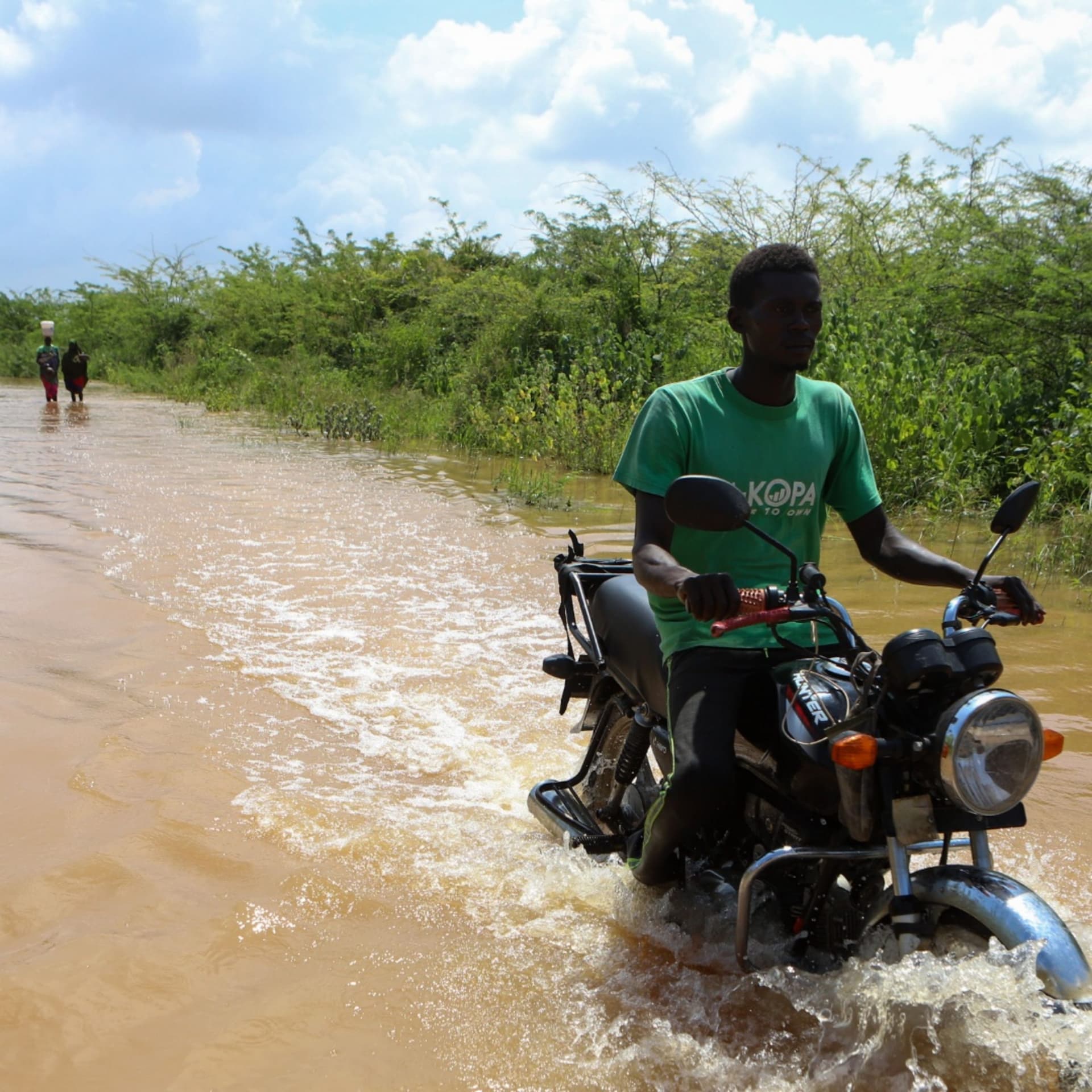
Photo credit: Photo by ANDREW KASUKU/EPA-EFE/REX/Shutterstock (14248301d) A man rides a motorcycle on a flooded road in Chamwanamuma village, Tana Delta region, in Kenya, 07 December 2023.
The Global News Podcast brings you the breaking news you need to hear, as it happens. Listen for the latest headlines and current affairs from around the world. Politics, economics, climate, business, technology, health – we cover it all with expert analysis and insight. Get the news that matters, delivered twice a day on weekdays and daily at weekends, plus special bonus episodes reacting to urgent breaking stories. Follow or subscribe now and never miss a moment. Get in touch: globalpodcast@bbc.co.uk