
In short
The episode is a Global News Podcast roundup. Main story: Colombia’s presidential election first round. A right-wing outsider, Abelardo de la Espriella (“the tiger”), won the most votes and will face Ivan Severa, a philosopher-turned-senator endorsed by outgoing President Gustavo Petro, in a runoff. Key claim: Colombia’s violence from dissident rebel groups and drug gangs is driving the choice between Severa’s continuation of Petro’s failed dialogue approach and de la Espriella’s hard-line law-and-order plan, including military crackdowns and large prisons modeled on El Salvador.
Notable examples
de la Espriella’s Trump-like rhetoric; Petro’s dialogue with Marxist guerrillas and criminal groups. Other segments: Israel’s capture of Beaufort Castle in southern Lebanon; survivors’ accounts of Nigeria’s Biafra civil war; a trial pill targeting KRAS in advanced pancreatic cancer (doubling survival); Australia’s mice plague; John Travolta’s debut film; Stalin’s unsealed Georgian wine cellar; Poland’s revived “666” bus.
Guests
Luis Fajardo (South America analyst); Sebastian Archer (Jerusalem correspondent); Princess Abu Meri (interviewer for Biafra survivors); Dr. Emil Liu (oncologist); James Menendez (interviewer); Lana Lamb (Australia reporter); Tom Brook (Travolta reporter); Irakli Gilauri (winemaker); Wendy Urquhart (Poland reporter).
Written by AI. May contain mistakes. Listen to the episode to check what was said.
Chapters
Tap a time to open that second in VOColombia's Presidential Election
1:16 to 2:15
Discussion on the first round of Colombia's presidential election and its context.
“I'm Nick Mars, and in the early hours of Monday, the 1st of June, these are our main stories.”
Candidates and Their Platforms
2:15 to 4:26
Overview of the two main candidates and their contrasting policies.
“caused by militant groups and drug gangs?”
Visions for Colombia's Future
4:26 to 5:32
Exploring the different visions proposed by the candidates for addressing violence in Colombia.
“And as he says, imposing new hardship on what he calls the left that is that in his words is destroying the country.”
US Influence and Trump's Stance
5:32 to 6:06
Discussion about the potential impact of US politics on Colombia's elections.
“So again, extremely different diagnosis and extremely different solutions proposed for the problem of Colombian violence, which, as you mentioned, has continued all these years.”
Israel's Incursion into Lebanon
6:06 to 6:49
Analysis of Israel's military actions in Lebanon and its implications.
“government would do in the event of a Cepeda administration.”
Strategic Importance of Beaufort Castle
6:49 to 8:02
Exploration of the historical and strategic significance of Beaufort Castle.
“taking over the medieval castle of Beaufort.”
Public Sentiment in Israel
8:02 to 9:10
Discussion on Israeli public opinion regarding military actions and historical context.
“mostly through airstrikes of ever ground operation by Israel, is growing, and on the Hezbollah side by drones.”
The Nigerian Civil War and Biafra
9:10 to 11:28
A recounting of the Nigerian Civil War and its impact on the people.
“And that had a huge effect on public opinion in Israel.”
Survivors' Testimonies from the War
11:28 to 14:00
Sharing personal stories from survivors of the Biafran conflict and its horrors.
“Now, some of the last surviving soldiers from that conflict that followed have been speaking to the BBC's Princess Abu Meri.”
Biafra's Struggle and Surrender
14:00 to 15:40
Learn about the impact of the Nigerian blockade during the Biafra war.
“The Nigerian government did capture the oil-rich industrial hub, Potakot, and they imposed a blockade, Alabi Isama again.”
Show all 18 chapters
Cancer Treatment Breakthrough
15:40 to 16:20
Discover a significant breakthrough in pancreatic cancer treatment.
“You can watch the full documentary, BBC Africa Eye, Surviving Biafra, Voices from the Nigerian Civil War, on the BBC News Africa YouTube channel.”
Hope in Cancer Care
16:20 to 18:58
Hear about the excitement surrounding new cancer therapies.
“This clinical trial evaluated patients who had received treatment for metastatic stage four forms of pancreas cancer, received at least one form of therapy that no longer worked.”
Mouse Plague in Australia
20:41 to 24:59
Examine the ongoing mouse plague and its effects on Australian farmers.
“And that is the sound of hundreds of mice in a frenzy tucking into some cattle feed.”
John Travolta's Directorial Debut
24:59 to 28:00
Learn about John Travolta's new film and his journey in filmmaking.
“John Travolta, best known for his iconic roles in Saturday Night Fever and Pulp Fiction, has now directed his first film with the rather unusual title of Propeller One-Way Night Coach.”
Reflections on the Future and Past
28:00 to 28:34
Discussion about focusing on future projects rather than dwelling on the past.
“I don't think you have time to dwell on the past.”
Stalin's Wine Cellar Discovery
28:34 to 31:21
Exploration of the recent unsealing of Stalin's wine cellar and its historical significance.
“Now, he was one of the 20th century's most brutal dictators, but the Soviet leader Stalin apparently knew a good thing when it came to a bottle of wine.”
Wine Condition and Value
31:21 to 31:56
Insight into the potentially drinkable wines from Stalin's cellar and their historical context.
“But basically, yeah, I mean, him being Georgian, and Georgians know a lot about the wine.”
Resurrection of the Hell Bus Service
31:56 to 34:34
The revival of a controversial bus service to the town of Hell in Poland amid public interest.
“As a final destination, Hell may not be everyone's first choice, but the bus service to Hell, spelt with one L in northern Poland, that's now up and running again, is likely to fill up fast.”
Transcript
Automatic transcript. May contain errors.0:00This BBC podcast is supported by ads outside the UK.
0:30at 1812 Sycamore Road and get a synthetic blend oil change with tire rotation for just$29.99. When your line is down, cost money. In metal fabrication, seized fasteners, rust buildup, and CNC faults don't just slow you down. They stop production cold. WD-40 Specialist Penetrant penetrates at least 50 % faster, reducing unplanned downtime, shortens preventive maintenance cycles, and keeps critical equipment running, from press brakes and laser beds to chains, bearings, and electrical panels. WD-40 specialist products are proven in high-cycle harsh environments. Schedule a WD-40 industrial site visit at WD-40.com slash industrial.
1:10This is the Global News Podcast from the BBC World Service.
1:16I'm Nick Mars, and in the early hours of Monday, the 1st of June, these are our main stories. A right-wing political outsider has won the first round of Colombia's presidential election. Israeli troops have made their deepest incursion into southern Lebanon in a quarter of a century, capturing a strategically located castle. And researchers have developed a pill that can almost double the survival time of patients with advanced pancreatic cancer. Also in this podcast. You wake up in the morning. The first thing you do is you get the dust fan and brush out as you go walking around trying to find the dead mice in your home.
1:55That's not as good as getting a nice cup of coffee, I can assure you. We hear about purgatory in the form of a plague of mice in Australia and in Poland why people will now be able to take the 666 bus again.
2:14Who can save Colombia from the escalating violence caused by militant groups and drug gangs? That was the question voters were grappling with as they went to the polls in the first round of the country's presidential election. It's hardly surprising. Despite a peace agreement with the largest of the country's rebel factions in 2016, dissident groups have made parts of the country almost ungovernable. Already this year, hundreds of people have been killed and hundreds of thousands displaced by fighting. With results in from Sunday's vote, we know that two men will contest a second round in three weeks' time.
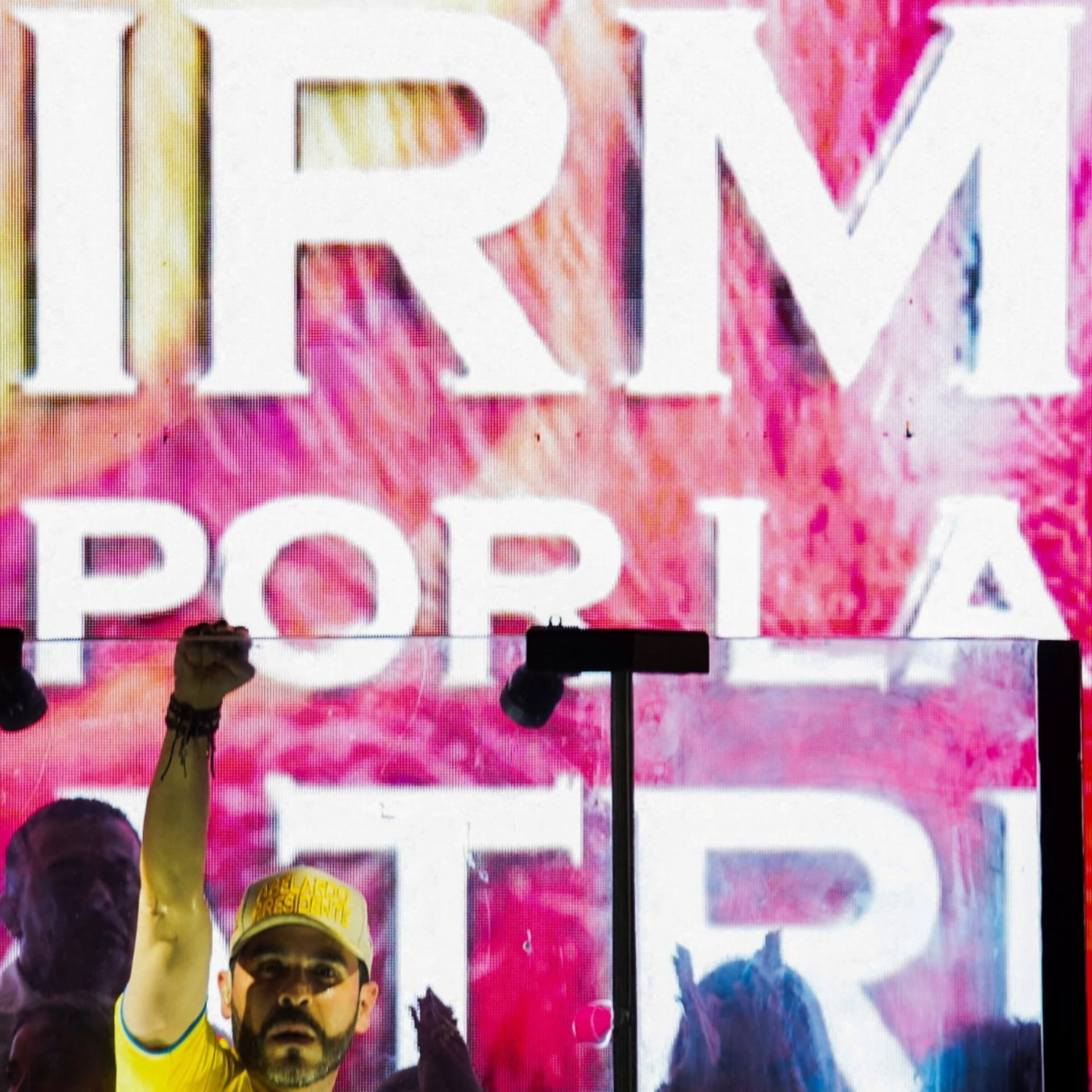
2:50It will be a stark choice. either the philosopher-turned-senator Ivan Severa, who's been endorsed by the outgoing president, or the now front-runner Abelardo de la Espriella, a businessman-cum-lawyer who idolises Donald Trump and calls himself the tiger. Here he is talking to supporters after the results were announced. Here's your tiger.
3:19Let him roar and bite. Thank you, Colombia. My heart goes out to you. Thank you for your passion. We'll confront, defeat and punish Colombia's enemies who seek to destroy our homeland. Petro's out. Don't you dare keep trying to reject the election results because the people will rise up and punish you. I spoke to our South America analyst, Luis Fajardo, about the character of Abelardo de la Espriella. He is a flamboyant, a very, very colorful character, as he has been described. He made a big impact on social media. He was originally a criminal defense lawyer. And he became famous by flaunting both his professional success as a lawyer and his substantial wealth.
4:09He traveled around in private jets. He was very, very outspoken. And he became very well known before finally joining this presidential election, where he campaigns as an outsider under the promise of reforming Colombian politics. And as he says, imposing new hardship on what he calls the left that is that in his words is destroying the country. So his policy and Mr. Cepeda, his contender now in the second round, those two policies, very, very different, distinct in terms of the major problem that Colombia faces, all this violence. How are they going to do it? Extremely different, as you say. Mr.
4:50Cepeda, who's running for the governing historic pact, the pact of the political party of the current president, Gustavo Petro, Mr. Cepeda says he wants to continue with the signature policy of Petro, which was trying to establish dialogue with a number of Colombian illegal armed groups, both Marxist guerrilla groups and criminal organizations. These have not been successful, these talks, during the Petro administration. Instead, Mr. De Las Priegas says he wants a very hard-line law and order approach, which he says is basically going to be a military crackdown on these illegal armed groups and also very harsh criminal policies.
5:31For example, establishing large jails similar to the ones that have been set up in El Salvador to fight the problem of criminality. So again, extremely different diagnosis and extremely different solutions proposed for the problem of Colombian violence, which, as you mentioned, has continued all these years. I mean, Donald Trump has been very critical to date of this softer approach to the rebels and the drug gangs, perhaps in part because cocaine production in Colombia has rocketed over the last year in particular. So he could make life quite difficult for Mr. Cepeda, should he become president?
6:05There's been a lot of discussion about what the U.S. government would do in the event of a Cepeda administration. One of the things that observers have noted, however, is that Mr. Trump has not intervened directly in this election in a way similar to what had happened in other Latin American countries, where the Trump administration definitely took a very, very explicit and also controversial position back in one of the parties. In this specific election, he has not taken a side openly, even though most people would think that Mr de la Sprella would be a lot closer to the Trump administration policies.
6:43Luis Fajardo, Israel has made its deepest incursion into Lebanon in a quarter of a century, taking over the medieval castle of Beaufort. The Israeli Prime Minister, Benjamin Netanyahu, called it a dramatic shift in the campaign against the militant group Hezbollah. Our forces crossed the Litani River. They seized controlled areas. They occupied the Beaufort Ridge. And now my instruction is to deepen and expand our grip on the places that were under Hezbollah's control. The capture of Beaufort is a dramatic stage and a dramatic shift in the policy we're leading. We broke the barrier of fear. The French president Emmanuel Macron said nothing justified what he called Israel's major escalation in southern Lebanon and has requested an emergency meeting of the UN Security Council on Monday.
7:34Our correspondent in Jerusalem, Sebastian Archer, told us more about Belfort Castle and its strategic importance. It's on a high ridge overlooking the Litani Valley, so it's a very commanding position. That's why the Crusaders built it there 900 years ago. If you have that position, you can control the sight lines pretty much of a whole region. As Bula, when it was in control of it, was able to do that to an extent and now Israel believes it will be able to use it in the same way. I mean, you could say the way that the war is being conducted, mostly through airstrikes of ever ground operation by Israel, is growing, and on the Hezbollah side by drones.
8:11It's not as significant as it was maybe 30 or 40 years ago. And that brings me to the second element of what Mr Netanyahu was talking about, symbolic significance. Both he and his defence minister, Israel Katz, when they celebrated the capture of both at Castle, referred back to 44 years ago when the Israeli army captured it during what they call the First Lebanon War here. And after that time, it became really the nexus of Israel's occupation of its so-called buffer zone in the south of Lebanon, which it held right up until 2000. Now Hezbollah, which didn't even exist at the time that the First Lebanon War began, developed from that, and it began essentially a war of attrition against the Israeli troops there.
8:58And those images through the mid to the late 90s of helicopters having to come down to take wounded Israeli soldiers, Israeli soldiers who'd been killed away from there, back to Israel, they were repeated week after week. And that had a huge effect on public opinion in Israel. And essentially, Mr Netanyahu referred to that when he said that it was both a symbol of heroism, Beaufort Castle, that victory 44 years ago, but it was also a symbol of division within Israeli society. Increasingly during that period of occupation of a buffer zone, there was a movement within Israel, a very large movement, that was against it and went out onto the streets.
9:39Peace Now, for example, which was big in those days, calling for Israel to make peace with its neighbors, not to continue to use military means. Now, Mr Netanyahu is comparing that time, at least in his terms, with now, saying that now Israel is united. Now it is coming back with a different sense of purpose. Whether that's true or not, we will have to see. I think it's true to say that just as the Iran war is generally backed in Israel, where people feel that Iran is an existential threat to Israel, and with Lebanon, to a similar, perhaps slightly lesser extent, Hezbollah representing that threat, And that threat, which was meant to have been eliminated in 2024, when Israel launched a major campaign against Hezbollah, which decimated its leadership, it was meant to have curbed the power of Hezbollah, the ability of Hezbollah to stage those attacks.
10:31But that hasn't happened. Hezbollah has, to some extent, been able to rebuild its capabilities. and just in the past week or so it's intensified its attacks both on Israeli troops down in this southern zone and also on the communities in northern Israel, maybe 20, 25 rockets being fired a day. That's led here to new restrictions being brought in in those areas right up close on the border, similar to restrictions during the war. Sebastian Usher. The rapid decolonisation of Africa during the 1960s 60s, brought liberation for many, but it spawned dozens of separatist movements and civil wars as well.
11:11None was as deadly as the Nigerian civil war that began in 1967, lasted for three years and left between half a million and three million people dead. The war started after Nigeria's oil rich eastern region attempted to break away and form a new nation called Biafra, following waves of ethnic violence. Now, some of the last surviving soldiers from that conflict that followed have been speaking to the BBC's Princess Abu Meri. You may find some of their testimony distressing. We are the survivors of the Nigeria-Biafra Civil War. I'm 85 years old only. Godwin Alabi Isama was 27 years old when the war broke out in 1967.
11:55He was fighting on the side of the Nigerian army and became a commander. When the war started, I think the whole Nigerian army was less than 10 ,000. They recruited prisoners. Even if you had only one eye, we just recruited everybody. Sasa Ugumba Ngoke was a teenager in the Biafran army. When I joined the Biafran army, it was excitement in the air. Everybody was involved in the war, the women, the men, the Children! How old are you? I'm 10 years. 10 years old? Do you know why Biafra is fighting? Biafra is fighting for survival. Is it going to win? Yes, sir. Her Royal Highness handed over sovereignty to a new nation.
12:38In 1960, Nigerian gained independence from Britain. The colonial rulers had left a tense group of tribes, the main ones being Houses in the north, Yorubas in the west, and the Igbos in the eastern region. Six years later, following two military coups and widespread political chaos, thousands of Ibus were killed in waves of ethnic violence. Ngwoke witnessed the scenes. I saw a headless man. I thought I was dreaming. I looked again. I saw kids. They chopped off their arms and chopped off their legs. The killing sparked tens of thousands of Ibus to return to their ancestral homeland in the oil rich east of Nigeria, where in 1967 they declared the creation of an independent rebel nation.
13:25It was called Biafra. The Nigerian government then declared war. Martin Bell was a journalist covering the conflict for the BBC. When I think about the geopolitics, the whole colonial apparatus, of course oil played a significant part. We didn't give much coverage to the extent that the federal armed forces were supported by the British. The firepower lay on one side, top of the line, armoured vehicles, and they had the aircraft, and the spirited, improvised guerrilla fighting was on the other side. The Afrans admit it is an oil war. The Nigerian government did capture the oil-rich industrial hub, Potakot, and they imposed a blockade, Alabi Isama again.
14:10The blockade of the Atlantic Ocean, the airports, of the land route, was to make sure they did not get supplies. Supplies included ammunition and their food. Bombs rained down on the people of Biafra, and there were accounts of people fleeing, not knowing where to run. It's the first really nourishing food these refugees have seen. But what impacted the children the most was the famine that came. Constance Nwoke was seven years old then. We, the children, were eating rats, were eating crickets, maggots, all manner of things. The Nigerian government said the blockade was vital to maintain the country's unity.
14:51Obafemi Awolowo was the finance commissioner then. But we are certainly not going to end the war on account of people being stabbed. All is fair in war, so we are told, and that is the position. The number one priority is the unity of the country. After two and a half years under siege, Biafra surrendered on the 15th of January 1970. The Nigerian government claimed there was no victor, no vanquished. For Nwoke and Alabi Isama, though, the war had been a disaster. Victory is usually celebrated. This was the first time in my life I saw victory that turned to tragedy. I prefer peace. We have fought the war.
15:32We gain nothing out of it. Those who benefited did not even step out of their house. That report was by Princess Abu Meri. You can watch the full documentary, BBC Africa Eye, Surviving Biafra, Voices from the Nigerian Civil War, on the BBC News Africa YouTube channel. Pancreatic cancer is one of the most deadly forms of the disease. Just one in 20 people diagnosed with it survive more than five years. The main reason for that is that it's often spotted very late, making it difficult to treat. Now, though, there has been a significant breakthrough. Results of a clinical trial of a daily pill for patients in advanced stages of the disease show that it can double the survival time and has fewer side effects than chemotherapy.
16:18Dr. Emil Liu is an oncologist at the University of Minnesota in the US. He's been speaking to James Menendez. This clinical trial evaluated patients who had received treatment for metastatic stage four forms of pancreas cancer, received at least one form of therapy that no longer worked. But for the results to be as impactful as they are in that setting, when patients have previously received chemotherapy, often treatments don't work more than just a few months. But in this case, it exceeded one year. In layman's terms, how does it work then? It's kind of like an out of control car where the accelerator is constantly on and you can't put on the brakes.
16:53We're trying to slow down the car and drive it maybe at the speed limit. KRAS is the signal. It drives more than 20 % of all cancers, more than 90 % of all pancreas cancers. and it's been very elusive as a drug target. Now the drugs hit the target and this is important because it helps to slow down the car, so to speak. In this clinical trial, approximately 250 patients who received the drug exceeded one year in terms of their survival, nearly 13 months, and that's about six and a half months longer than patients who received standard of care chemotherapy alone. So it slows down the spread of the cancer and you mentioned that this KRAS is present in other forms of cancer.
17:28Does this mean that this drug might be used to treat those too? Absolutely. And I know clinical trials are underway and I think are going to expand at a very accelerated pace in the weeks and months and years to come. This is really the tip of the iceberg that we hope that the learnings of what we've seen here can also be extended to similar types of cancers for individual patients that also have the same signal gone awry in their own tumors. A long time in the making. How quickly might it be available to patients? We're really hopeful that in the coming weeks it will be available. My understanding is it might be more towards end of summer.
18:01But obviously, I hope with the news spreading far and wide today, I hope that I can go back to my clinic in the coming weeks and be able to prescribe this readily under FDA approval and have it more accessible. Are we entering a new era for cancer treatment? I mean, does it feel like the corner has been turned, at least for some forms of cancer? I would say absolutely, yes. It is somewhat revolutionary to say that in some aspects, you can get away from chemotherapy and the targeted therapy even alone. And that magnifies the importance of these results. To achieve that without chemotherapy is really important.
18:33I would support the notion that we've turned a corner and making more inroads and a big advance this year. And as an oncologist, how does that make you feel? Overjoyed, thrilled. We've been waiting so long for this. I'm just thrilled for all the patients I get to go home to to say we have hope on the way. There is real hope. We have proof of it. We have evidence. I'm so excited to be able to do this and to have patients live longer, to enjoy quality of life hand in hand. I'm really thrilled for everyone who will benefit from this. Dr Emil Luh. Still to come in this podcast, a wine cellar that once belonged to Joseph Stalin has been officially unsealed by the Georgian government.
19:11So what did the Soviet dictator favour? He liked the sweet wines, hence why the camps are there and some port is there. Him being Georgian and Georgians know a lot about the wine, so he saw the value there, obviously, and did not destroy this unique collection.
19:47We'll be right back.
19:59flyer on Menards.com for all the great deals happening now. Save big money at Menards. This Father's Day, when you ship UPS Air at the UPS store, your items arrive on time with your money back, guaranteed at no extra cost. It's like the father of all shipping services. It shows up to the airport way too early just to play it safe. It's overprotective about all the things that truly matter, and it's always prompt, especially to be with family. Make it your first choice to celebrate your Dad. Ship UPS Air with our money-back guarantee exclusively at the UPS Store US retail locations. Visit the upsstore.com slash air shipping for full details.
20:35Terms and conditions apply.
20:41This is the Global News Podcast. Now to Australia.
20:49And that is the sound of hundreds of mice in a frenzy tucking into some cattle feed. A plague of the rodents is ravaging large areas of farmland in the country's south and west. It's wreaking havoc on farmers' crops and disturbing people's lives in rural towns. Karen Chappell is a local councillor in the town of Murrowa in Western Australia. It is just absolutely feral and it's just unbelievably horrid to live with. People talk about having mice in their beds. You wake up in the morning, the first thing you do is you get the dust fan and brush out as you go walking around trying to find the dead mice in your home.
21:27That's not as good as getting a nice cup of coffee, I can assure you. You know when you get that bubble wrap and you pop up? When you're driving at night time, that's what it feels like. You're driving over mice that are popping. Australia last faced a major mouse plague back in 2021, which caused hundreds of millions of dollars of agricultural and structural damage. The BBC's Lana Lamb has been following the story from Sydney. I spoke to her about what caused this latest problem. In Western Australia, where the plague is having the greatest impact on farmers, there's a few reasons. So in the past few years, they've had particularly big harvests, so record amounts of grain in the paddocks.
22:05And so when that gets harvested, grain gets spilt and left behind. And so those big crops mean there's a lot of built up food on the ground. In addition to that, over summer, which was December to February here, there was some summer rain, which led to green shoots growing. And so we had one farmer describe it as essentially giving the mice steak, which is the grain, but as well as that salad from the green shoots. And that created this almost perfect breeding ground for the mice. The other reason is mice are very good at breeding. So they can start breeding at just six weeks old and they can have between six to 10 babies basically every 19 to 21 days.
22:48When you get to plague levels of mice, it's typically 800 mice per hectare. And we've had farmers in Western Australia reporting 4 ,000, 8 ,000, up to 10 ,000 mice per hectare. And if you extrapolate up, that's millions of mice. And what impact are they having on the farmer's fields right now? So one farmer I spoke to, Geoff, who has a 14 ,000 hectare farm, He talked about how it's having a huge economic and psychological sort of impact. So the economic impact is that autumn, which we've just come out of, is crucial for farmers because they're planting their crops. And the problem is the mice then are going in and eating these freshly sown seeds.
23:32They then have to bait to try to get rid of the mice. But that costs money and time, which is something that they don't really have during this crucial period. He also talked about how it sort of plays with your mind. When you go to bed at night, you can hear them running around the house. And in particular, he talked about the smell of them. And I asked him to describe what do they smell like. And he said it's a strong and very unique smell. Essentially, he said it smells like a decaying body. And that is all pervasive, all day, every day. Another farmer I spoke to, Belinda, She talked about since February when she saw the mice numbers growing.
Read the full transcript
24:13It also dovetailed into the beginning of the Iran war and then seeing fuel and fertilizer prices go up. With the mouse plague happening, it was just another cost that's going to hit their already tight margins. And from what you're saying, it seems to be something that the farmers are just going to have to put up with for the moment. because baiting and poisoning the mice, it's too late, it's too expensive to do anyway. For months, the farmers have been asking basically to have access to a stronger bait, double the strength of the poison, but they had to wait for the national sort of regulators to approve it.
24:50And finally, it's been approved. So now they have access to this stronger bait, but some of them have spoken about how it's almost come too late. Lana Lamb in Sydney. John Travolta, best known for his iconic roles in Saturday Night Fever and Pulp Fiction, has now directed his first film with the rather unusual title of Propeller One-Way Night Coach. It's an ode to what's known as the golden days of flying in the US in the 1960s. The Hollywood actor has been a lifelong aviation enthusiast and is also a licensed pilot. He's been speaking to the BBC's Tom Brook. In recent days, John Travolta has been back in the spotlight.
25:31At the Cannes Film Festival, he received a surprise honoree Palme d 'Or, the equivalent of a Lifetime Achievement Award. For the two-time Oscar nominee who's appeared in since 70 roles, getting the top French accolade was an emotional moment. I just can't believe it. This is beyond the Oscar, really. Travolta became a major box office drawer in the 1970s with his starring role in Saturday Night Fever, a defining movie of the disco era.
26:02He's also well-remembered for his dance moves opposite Uma Thurman in the 1994 crime thriller Pulp Fiction. But now, at the age of 72, he's moved behind the camera for the first time to make his directorial debut. Welcome aboard. His film is called Propeller, One-Way Night Coach. Travolta is a lifelong aviation enthusiast in the new film charts The Adventures of a Young Boy Flying with His Mother from New York to Los Angeles in the 1960s. The picture is based on a children's short story Travolta wrote in 1997. It draws on some of his childhood experiences. Mum, I don't really like this. Can I have another hot dog?
26:46Travolta told me he felt it was a project only he could direct. I think it was connected to the subject matter. And this is all my visions, my memories, the schedules, the meals. I did every bit of it to satisfy these memories of mine. But it's a passion for me. So could I find another piece of material that would live up to my passion? I don't know. But this film is far from being a major cinematic exercise. It's only one hour long. Some critics in the wake of its world premiere at the Cannes Film Festival expressed a bit of disappointment, among them Nicholas Barber. It's a lovely exercise in nostalgia, but it's so slight, really.
27:29You kind of wonder whether it would have got made if it hadn't had a big name like John Travolta behind it. The voice over the PA system seems so sophisticated. Travolta's narration can be heard throughout the film. He makes a brief on-screen appearance towards the end. The world premiere certainly made clear just how much John Travolta is still revered as a cinema icon after 50 years in the business. But John Travolta isn't preoccupied with his past successes. How much do you dwell on your successes from the past or do you think about the future moving forward? I don't think you have time to dwell on the past.
28:07You mostly dwell on the future, I find. You know, I have three films in the can. This just premiered. We're promoting this. I just got this Palme d 'Or. I have three films that are offered that I probably will do at least two of them. What are you going to think about in the past? You just want to make your creating future to have a past that you like. That report was by Tom Brook. Now, he was one of the 20th century's most brutal dictators, but the Soviet leader Stalin apparently knew a good thing when it came to a bottle of wine. After the Bolsheviks overthrew the Russian Tsar in 1917, they inherited a huge collection of wine, tens of thousands of bottles that belonged to the royal family.
28:55Some of that wine ended up in Georgia, Stalin's birthplace. This week Stalin's cellar was officially unsealed by the government ahead of the process of working out exactly what's there and one day putting some of the bottles up for auction. James Menendez spoke to Iraki Gilauri, a former head of the Bank of Georgia, who's now a winemaker and is working with the government on this project. So what's inside the cellar? Very mystic, emotional. As a friend of mine said, it's like an Indiana Jones movie. You go into a cave and it's very old and very dusty. So it was experience. It was amazing, very mystic.
29:36And full of cobwebs, I imagine. Yes, yes. It's good aura. OK, good aura. How many bottles are there inside? I think it's somewhere between 25 ,000 to 40 ,000, at least 25 ,000. I use 25 ,000 number because it's probably safer. What do you think the cellar contains? What we have, we have a description of what was done in 2003 before it was locked. And it has some chateau de gams. That's a very famous French dessert wine, right? It is, yeah. It has some port, it has some cognac as well. It has a lot of Georgian wines. So it is a kind of a leftover or part of the cellar which was done by the Romanovs, Tsar Romanov in Russia.
30:24So in St. Petersburg, around 200 ,000 bottles stored. And when communists came in 1917, cellar was raided by the communists and they were drinking, etc. But when Stalin came in power, he realized that it's a very valuable piece of wines and he just locked them up. And then when Hitler was marching towards the St. Petersburg, he moved the cellar into three pieces. One went to the Crimea, one went to Georgia and one, we don't know where it is. So the Crimea one was auctioned out in 90s. So this is a kind of only known part of this Romanov cellar, which I guess Stalin was adding more wines. And Stalin was Georgian himself, and he was a big fan of wine.
31:06But these were, as you say, wine bottles that belonged to the Russian royal family. But despite being a communist, he didn't destroy them. He thought that maybe one day, I guess, he wanted to drink some of them. As far as we know, he liked this sweet wine. And hence the White Dicamps are there, and some port is there. But basically, yeah, I mean, him being Georgian, and Georgians know a lot about the wine. So he saw the value there, obviously, and did not destroy this unique collection. Dessert wines and things like port can keep for many decades and maybe even longer. Do you think that many of the wines, though, won't be drinkable, that they will have turned to vinegar?
31:47To be honest, what I have observed there, 80 % of those wines are probably not drinkable, most likely. But there is some which would be drinkable, I think. That was the winemaker, Irakli Gilauri. As a final destination, Hell may not be everyone's first choice, but the bus service to Hell, spelt with one L in northern Poland, that's now up and running again, is likely to fill up fast. That's because it was very popular with tourists, but was scrapped three years ago after complaints from Christian groups about the so-called Highway to Hell bus. This report from the newsroom's Wendy Urquhart.
32:30down. Oh no, this is the road to hell. You may have been tempted to tell someone to go to hell at one time or another, but in Poland it's actually not such a bad thing. That's because hell, with one L, is actually an ancient town in the Gulf of Gdańsk in the north of the country that dates back to 1198. It was once a tiny village with a local church, a hospital, a couple of guest houses and a very small port and was best known for its herring trade. High tides and strong currents in the 15th century caused severe land erosion in the area, forcing the authorities to move the town a little bit further up the coast.
33:15That also led to a growth spurt and the 35-kilometre-long peninsula fast became an important trading post. But business was also booming across the bay in Gdansk, which soon put an end to Hell's desire for economic domination. Hell's sandy beaches, though, began enticing tourists to the region from all over the world. And when the bus route was given the number 666, the so-called devil's number, visitors lapped it up. Unfortunately, religious groups were less than happy. And in 2023, the bus company was forced to change the number to 669. Now the company Flixbus has just announced that it's reviving the 666 bus.
33:58But passengers should be prepared for a bit of a schlep because the new route means the bus will set off from Krakow at 6 o 'clock in the morning and won't arrive in the coastal town until 7 o 'clock in the evening. A devil of a journey lasting around 13 hours.
34:23Oh no, this is the road. This is the road. This is the road to hell. Wendy Urquhart reporting. And that's all from us for now, but if you want to get in touch, you can email us at globalpodcast at bbc.co.uk. You can also find us on X at BBC World Service. Use the hashtag globalnewspod. And don't forget our sister podcast, The Global Story, which goes in depth and beyond the headlines on one big story. This edition of The Global News Podcast was mixed by Zabihullah Korush and produced by Paul Day and Hannah Burke. The editor is Karen Martin. I'm Nick Mars. And until next time, goodbye.
35:18I'm Kai Wright. I'm Carter Sherman. Welcome to Stateside with Kai and Carter. We're a new show from The Guardian. We're talking to big thinkers and the best journalists, just trying to understand the world through smart conversation and honest reporting. We don't have billionaires telling us what to say. Stateside with Kai and Carter will come out three times a week, Monday, Wednesday, and Friday, starting May 13th. Subscribe on YouTube or wherever you get your podcasts.
From the publisher
Abelardo de la Espriella will face left-winger Ivan Cepeda in Colombian presidential run-off in three weeks. The two offer strikingly different visions of how to tackle Colombia's challenges, including violence and drug crime. Also: France and Germany have condemned Israel's deepest incursion into southern Lebanon in a quarter of a century. Berlin said it was a cause for serious concern, while Paris has called for an emergency meeting of the UN Security Council; the new pill that can double the survival rate for patients with advanced pancreatic cancer, one of the world's deadliest forms of the disease; the mice plague that is wreaking havoc on rural Australian farms; and why people will now once again be able to take the 666 bus to Hel in Poland.
The Global News Podcast brings you the breaking news you need to hear, as it happens. Listen for the latest headlines and current affairs from around the world. Politics, economics, climate, business, technology, health – we cover it all with expert analysis and insight. Get the news that matters, delivered twice a day on weekdays and daily at weekends, plus special bonus episodes reacting to urgent breaking stories. Follow or subscribe now and never miss a moment. Get in touch: globalpodcast@bbc.co.uk