
In short
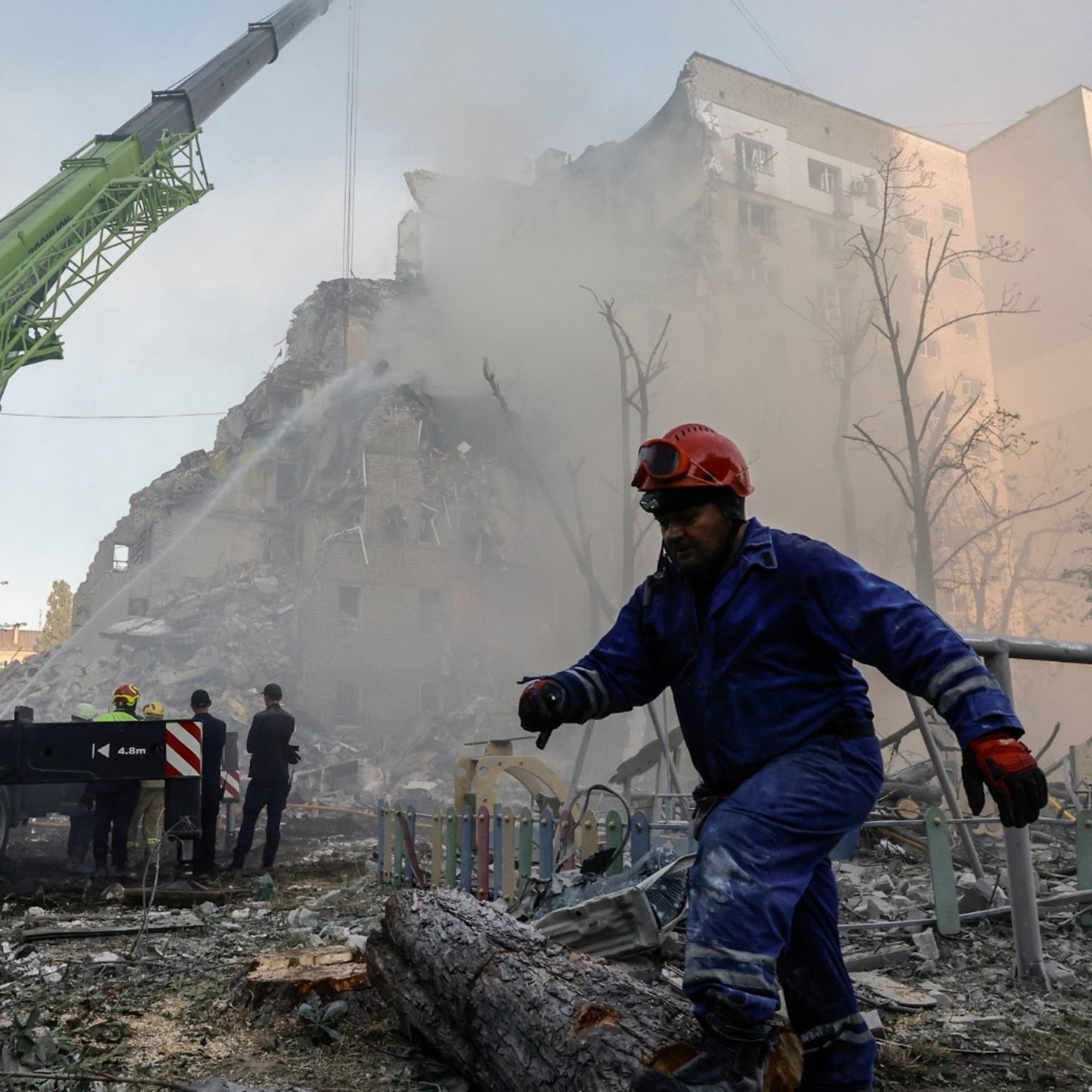
The episode is a BBC Global News roundup plus related segments. Main topic: Russia’s massive attack on Kyiv—an 11-hour barrage of nearly 500 drones and missiles/drones hitting residential apartment blocks, killing at least 20 (including children) and leaving people missing; Russia says it targeted military plants, while Ukraine says air defense shortages make interception difficult. Key claim: ground fighting has largely stalled, so escalation is happening “in the skies,” with Ukraine also striking oil refineries in Russia to pressure Putin for peace talks.
Notable examples
a nine-floor apartment block destroyed; officials say 25 ballistic missiles hit targets. Other segments: Gaza medical evacuation delays—300+ deaths waiting; ICRC says Israel restricts supplies.
Guests
Yuri Sak (former advisor to Ukraine’s defense minister); Sarah Rainsford (BBC correspondent in Kyiv); Lucy Williamson (BBC correspondent in Gaza); Olivier Jainot (ESO astronomer); Amdelika Mandela (Tembakile Mandela Foundation head); Sue Mitchell (BBC reporter on people smuggling); Rob Lurie (researcher used for contacts); Brittany Kuinga (writer on Taylor Swift rumors); James Menendez (interviewer); Pat Griffiths (ICRC spokesman).
Written by AI. May contain mistakes. Listen to the episode to check what was said.
Chapters
Tap a time to open that second in VOMassive Russian Attack on Kyiv
0:00 to 0:37
Details of the Russian bombardment of Kyiv and its impact.
“This BBC podcast is supported by ads outside the UK.”
Massive Russian Attack on Kyiv
1:20 to 2:24
Details of the Russian bombardment of Kyiv and its impact.
“Kiev is hit by an 11-hour Russian bombardment.”
Casualties and Destruction
2:24 to 3:06
The human toll of the attack and the destruction caused in Kyiv.
“Officials say at least 20 people were killed, including children.”
Zelensky's Appeal for Aid
3:06 to 3:26
Ukrainian President Zelensky's call for more air defense supplies.
“Tomorrow is announced already as a day of mourning in Kyiv for those who were killed by today's attack.”
On-the-Ground Report from Kyiv
3:26 to 5:32
Sarah Rainsford reports from Kyiv on the aftermath of the attack.
“The Kremlin has said it will continue to increase pressure on the Kyiv regime in order to achieve its goals.”
Escalation of Attacks by Russia and Ukraine
5:32 to 6:38
Discussion on the aerial attacks and the shifting frontlines in the war.
“and the people who are here yet again picking up the pieces after another attack.”
Medical Crisis in Gaza
6:38 to 10:56
Exploring the healthcare crisis and medical evacuations in Gaza.
“the wider population, but also to cause problems for Russia's military and for the Russian economy too.”
Impact of New Satellites on Astronomy
10:56 to 14:01
Discussion on the challenges posed by an increasing number of satellites.
“Now, is the Earth's orbit about to be overrun with new satellites?”
The Challenges of Satellite Regulations
14:01 to 14:48
Learn about how different countries regulate satellite operations and the implications for space law.
Amdelika Mandela on Immigration Protests
15:10 to 16:05
Amdelika Mandela discusses the protests in South Africa against immigration and the need for compassion.
“Nelson Mandela's granddaughter, Amdelika Mandela, has described the ongoing protests in South Africa against immigration as heartbreaking.”
Show all 15 chapters
Frustration and Leadership in South Africa
16:05 to 18:48
Exploring the frustrations of South Africans regarding leadership and immigration issues.
“At the same time, I also believe that South Africans, we must not allow frustration to become hatred.”
BBC Investigation on People Smuggling
18:48 to 23:22
A detailed investigation into the life of a convicted people smuggler now living in the UK.
“Just surely as I am not free when my freedom is taken from me.”
Taylor Swift's Rumored Wedding
23:31 to 26:38
Latest updates on Taylor Swift's anticipated wedding plans and public reactions.
“If you want to see more on this story, including video of Sue's confrontation with Tawana Jamal, It's there for you on the BBC News website.”
Men's World Cup Reactions
26:38 to 28:02
Fans share their emotions and thoughts after their teams exit the Men's World Cup.
“Senegal and the Democratic Republic of Congo have been packing their backs after knockout matches on Wednesday.”
Reflections on African Football Performance
28:02 to 29:32
Discussion on the disappointing performance of African football teams and coaching issues.
“Well, as I mentioned, Senegal are also going home.”
Transcript
Automatic transcript. May contain errors.0:00This BBC podcast is supported by ads outside the UK.
0:30business needs in one place, saving you time, headaches, and serious money. Stop paying for missing pieces. Go to odoo.com. That's O-D-O-O dot com to learn more. When you hear the phrase made in China, what do you think? I'm Tristan Redman. And I'm Asma Khalid. And together we host the Global Story podcast from the BBC. And today on our show, we look at the origins and evolution of made in China, because it actually wasn't inevitable. What we're talking about is the world's largest communist nation is at the beating heart of the capitalist system. For more, listen to The Global Story on bbc.com or wherever you get your podcasts.
1:14This is the Global News Podcast from the BBC World Service. I'm Celia Hatton and at 15 hours GMT on Thursday, the 2nd of July, these are our main stories. Kiev is hit by an 11-hour Russian bombardment. Our correspondent has been at one of the sites where they're hunting for survivors. A BBC investigation finds a convicted people smuggler working in the UK. Nelson Mandela's granddaughter speaks to the BBC about South Africa's anti-migrant protests. Also in this podcast... I knew that she was going to get married in New York, but I had no idea where. So I can't believe it. I'm actually shook and I'm so excited.
1:55that has to happen. Is Taylor Swift really getting married inside a New York City arena?
2:06We start in the capital of Ukraine, where the mayor says every district was hit in a massive attack by Russia. In an 11-hour assault, a barrage of Russian missiles and drones hit Kyiv through the night.
2:24Officials say at least 20 people were killed, including children. The Russians have been accused of deliberately targeting residential areas. Russia's defense ministry says it hit key military plants in the capital. Yuri Sak is a former advisor to Ukraine's minister of defense. It was one of the largest, if not the largest, attacks carried out by Russia on Ukraine's capital, Kyiv. Russia has launched almost 500 drones. There was also missiles launched at Ukraine. And unfortunately, 25 of these ballistic missiles have hit the targets. And of course, targets, as it always happens, are civilian apartment blocks.
3:03And that's why the number of casualties is so high. Tomorrow is announced already as a day of mourning in Kyiv for those who were killed by today's attack. There were also Russian attacks on other cities in central and eastern Ukraine. The country's leader, Volodymyr Zelensky, has appealed to Ukraine's Western allies to send more air defense supplies, calling them an absolute and critical priority. The Kremlin has said it will continue to increase pressure on the Kyiv regime in order to achieve its goals. Our Eastern Europe correspondent Sarah Rainsford is in Kyiv. I'm standing now at the site of where one, if not two, according to locals, of those Russian missiles hit.
3:44And you just mentioned Russia saying it's been targeting military sites and military infrastructure here. Well, that's possible. That's what they were targeting. But it's not the only thing that they've hit here. This is a big block of flats, nine floors high, and the whole end section of it has been completely destroyed, smashed to smithereens. There are big cranes here and big diggers trying to pick through the giant slabs of concrete because officials here are saying at least six people are still missing. And I can see some very upset-looking people sitting on the bench near me here, a man in tears, and I suspect that some of their relatives are among the missing.
4:23It's been described as the first large-scale attack in two weeks. Ukraine had been expecting this, had warned about intelligence that it was coming. Did that make it any easier for civilians to be able to get to safety when the assault started? It means that people expect a very bad night, and it means that many people will head in advance to the metro, to the underground, to take shelter, or they'll go into their bunkers. they'll try to keep safe, because every time Russia loads up its bomber planes, Ukraine can see that happening, and it anticipates the massive attacks like this. But this isn't the first one.
5:00As you said, there was one two weeks ago. They happen every two or three weeks. But in terms of the intensity, in terms of the scale, I think it is fair to say that they are increasing. And it's also important to note that I think the reason they're having such a devastating impact is that Ukraine is struggling somewhat to intercept those missiles, because of a shortage of ballistic missiles to intercept them, air defense missiles to intercept them. So it is extremely difficult. The scale of the attack is huge. I mean, I can see the consequences right in front of me now, and I can see the ruined lives, the ruined homes, and the people who are here yet again picking up the pieces after another attack.
5:38Sarah, is this really turning into the real front line in this war, these aerial attacks that are traded back and forth between Ukraine and Russia? What's actually happening on the physical front line? I think it's fair to say that because the battlefield, the ground war has largely stalled. I mean, it's the movement on the ground is very, very limited. That the kind of real action, I suppose, is taking place now in the skies. And yeah, Russia is escalating its attacks. Ukraine is responding by using its long range drones to hit targets, oil refiners in particular, deep inside Russia. Now, it's saying that the aim is to pressure Vladimir Putin to force him into peace talks, because Ukraine has been saying time and time again that what it wants is to end this war through negotiations, but it doesn't believe that Putin wants that to happen.
6:26So at the moment, Ukraine is also escalating its attacks, but particularly, as I say, against oil refineries, trying to cause fuel shortages inside Russia to bring the war home in some degree to Russians themselves, the wider population, but also to cause problems for Russia's military and for the Russian economy too. Our Eastern Europe correspondent Sarah Rainsford. Let's focus on what's happening inside Gaza now. Thousands of people in the territory with wartime injuries or life-threatening diseases are waiting for medical treatment abroad. Gaza's devastated health care system is still unrepaired and unable to offer them treatment eight months after the ceasefire was implemented there.
7:06International aid agencies say Israel is still restricting the supply of drugs and equipment into Gaza, leaving cancer and dialysis patients without the treatment they need. Gaza's Hamas-run health ministry says 300 people have died waiting for medical evacuation and that 15 ,000 others are waiting for host country placements and security clearances. Our Middle East correspondent Lucy Williamson has been working with the BBC's team in Gaza to look into their stories. Between the bombed-out buildings of Gaza's Shifa Hospital, a protest by patients too sick for Gaza's crumbling healthcare system to treat.
7:43Nidal Al-Areya needs a corneal transplant for his son. Raeed Anuayzi says her cancer has already led to the removal of her breasts, her uterus, her ovaries, her pelvic bone and shoulder bone. All the protesters have been approved for medical evacuation abroad. But matching a patient's needs with host country criteria is often very difficult. And once matched, patients need to pass security checks from the host country, from transit countries and from Israel. Many have been waiting months to leave. 14-year-old Muath Aldini is waiting for two separate treatments abroad. One for his leg, amputated during the war after an airstrike on the family home.
8:29The other for the spinal cancer he's had since he was a baby. Gaza's Hamas-run Ministry of Health says more than 15 ,000 people are waiting to leave for treatment abroad. The fact that medical evacuation list is thousands high, it's in the thousands, is a sign that people in Gaza don't have access to what they should have, and which Israel, as the occupying power under international humanitarian law, has an obligation to allow them access to. Pat Griffiths, spokesman for the International Committee of the Red Cross in Jerusalem, says Israel is still restricting the delivery of some medical supplies eight months after the ceasefire in Gaza.
9:09It runs the full range from gores, dressing, painkillers, all the way up to advanced medical equipment like CT scans, x-rays. people who need regular kidney dialysis treatment, where you have circumstances where hospitals are now rationing that treatment. Asked about the reports of shortages, Israel said it had approved every request for medicine submitted by international aid organizations and that 17 ,000 tons of medical aid had entered Gaza since the ceasefire. When Amina Abu al-Khas was referred for medical evacuation, her son Sabah said it felt like the beginning of a new life. We knew that at any moment God might take her.
9:53And we also knew that at any moment a miracle might happen, that we might get a call saying, get your bags ready and prepare to travel through the crossing. Amina's aggressive, necrotizing infection had already spread to her skull. Each day, the family waited for news that her placement and security clearance had come through. We waited a long time, but no response came. My mother died several weeks ago, and two weeks after her death, I got a call from the hospital informing me that her paperwork was ready. Amina is one of at least 300 people to have died while waiting for evacuation, according to Gaza's health ministry.
10:39People say at least she's at peace, Sabah told us. That sums up everything, he said, because a patient in Gaza is different from any patient elsewhere in the world. Our Middle East correspondent Lucy Williamson working alongside our team inside Gaza. Now, is the Earth's orbit about to be overrun with new satellites? And if so, what impact will that have on us and on the work of astronomers? A new report by the European Southern Observatory, which operates some of the world's biggest ground telescopes out of Chile, say there are plans on paper for more than 1.5 million new satellites in the coming years.
11:17SpaceX alone is talking about sending up a million orbital data centres. Olivier Jainot, an astronomer at the ESO, has been telling James Menendez what it would mean for him. More satellite means more of them will cross our images, and each time one of them cross an image, it leaves a bright trail that masks everything behind it. So one trail once in a while is not a problem. Many trails means that we start losing more and more and more data. And if it's in the millions, then we would lose a significant fraction of our images. What sort of fraction are we talking about? It depends how bright they are.
12:00And if they are really bright, That means that we could lose 100 % of our images. 100 % really. What does it mean for people like me if there are that many satellites in orbit? I mean would I notice the difference in the brightness of the night sky? If they are really bright and now we are talking brighter than the moon then the atmosphere scatters that light. It's exactly the same as the atmosphere scatters sunlight and makes the sky blue. The same happens for everything, the moon, the stars, and the satellites. So that means that if you have many bright satellites, the dark sky would not be as dark as it used to be, and you would lose the faint stars.
12:47You would not see the faint stars. The sky would look like what you see from the suburbs of a city. Right. And what about collisions? I mean, with that number of satellites up there, presumably the chances of satellites colliding, I mean, increases dramatically, doesn't it? Yeah, it does. And it is really a worry for our colleagues at the space agency. So if two satellites collide, they will break up in many pieces and these pieces are likely to collide with more satellites and create more debris. So it has the potential to be absolutely disastrous. If you've seen the beginning of the movie Gravity, there is a very spectacular scene where the Hubble Space Telescope gets destroyed by that kind of things.
13:37And it's kind of what would happen. I mean, is there any way of enforcing any sorts of restrictions on numbers and brightness of satellites? Absolutely. That's where the space laws come into play. each country is responsible for the satellites that are launched from that country and also each country can enforce their local law to grant licenses for example so for instance France has put a brightness limit in their space law and so that means that company which would like to do business in France has to demonstrate that they are respecting that brightness limit and then And there is, of course, the United Nations, which is important because the satellite business is not just affecting astronomy, but it's also affecting the low Earth orbit with the problem of crowding and collisions and also pollution in the upper atmosphere, because every satellite that goes up will eventually come down.
14:44Astronomer Olivier Hainel. Still to come in this podcast. We're very proud of you. Even if we are going home, we are going home proudly. You had the game won. And in that time, you conceded two goals. Why? The ups and downs of exiting the Men's World Cup.
15:10This is the Global News Podcast. Nelson Mandela's granddaughter, Amdelika Mandela, has described the ongoing protests in South Africa against immigration as heartbreaking. Speaking to the BBC, she said South Africans must not allow frustration to become hatred. This week, thousands marched in major cities demanding that undocumented migrants leave the country. Campaigners blame the migrants for problems such as unemployment and crime. Amdelika Mandela is the head of the Tambakile Mandela Foundation, which continues the legacy of her grandfather. She's been speaking to James Copnell. It's really deeply concerning and heartbreaking because these reflect the pain, frustration and anxiety of many South Africans who are experiencing unemployment, poverty, inequality, crime and the rising cost of living.
16:04And I believe that, you know, these deserve to be acknowledged and addressed. At the same time, I also believe that South Africans, we must not allow frustration to become hatred. South Africa was built on values of dignity, justice and reconciliation and Ubuntu. And we cannot allow hardships we face to diminish that, our shared humanity. while these are you know legitimate concerns about border management illegal immigration and criminality and this should be addressed firmly through the rule of law however violence intimidation and xenophobia can never be the answer so if we start perhaps then with the first part of your answer with the what you seem to believe to be legitimate frustrations of many South Africans, does that then reflect a failure of South Africa's ruling class to bring more widespread prosperity and, to use your word, justice?
17:04Yes, I just believe that, you know, when there's a lack of leadership, there's a lot of malfeasance that you see. It's all political parties, which now has resulted in this deep frustration of South African people. And I suppose that is something that people living outside South Africa find quite difficult to witness. We certainly get messages in from all over the African continent saying things like ANC leaders and Nelson Mandela were welcomed all over the continent. We took part in your struggle for justice in South Africa. Why are our citizens now being kicked out? It was not just South Africa.
17:45It was the frontline states that actually helped South Africa to reach the stage of democracy and to have our first democratic elections. That can never be forgotten. However, South Africa cannot allow the rampant crime that comes with illegal immigrants because it's difficult to trace an illegal immigrant because they are not documented, they are not fingerprints. So if they commit crime, it's very difficult to actually arrest them. However, we need to weigh these two because it has to be, the rule of law must take its place. We cannot take, you know, the law into our own hands. What do you think your grandfather, Nelson Mandela, would have made of all this?
18:37You know, Granddad believed in the dignity of human dignity, equality and justice and reconciliation. He reminded us, I will quote, I am not truly free if I am taking away someone else's freedom. Just surely as I am not free when my freedom is taken from me. Grellett understood that freedom is inseparable from responsibility. Amdelika Mandela is the head of the Tembakile Mandela Foundation. A BBC investigation has found a convicted people smuggler who was described as the godfather of people trafficking when he was arrested in Europe has been found living in the UK. Twana Jamal was described by French police as the most successful smuggler they'd ever caught, earning millions of dollars by hiding people in trucks bound for Britain.
19:30He's one of more than 20 people smugglers the BBC has found to have reached the UK, some with overseas convictions and some claiming asylum under false identities. Our reporter Sue Mitchell followed a tip-off that Twana Jamal was out of prison and running shops and firms in the UK, the kind you might find in any town or city. Tuana Jamal was known as the king of the jungle, a reference to the Calais jungle, which was the largest migrant camp in France. We get a tip-off that he might be in the city of Leicester and we find someone who's in touch with him from time to time. They arrange to speak and record the conversation.
20:12Here it is in translation. Yeah, right now I'm in Leicester. We know everyone in this city. This city's ours. All I'm doing is illegal, but it's OK because they're not going to catch me or anything. Leicester's good for business. We're making good money. No one touches us here. Tawana Jamal is from Iraqi Kurdistan, the city of Rania, which is home to a network of smuggling gangs and where many are recruiting from. My colleague Rob Lurie has hundreds of contacts in Iraq, including smugglers like this one. We're using his words and not his voice. And it's not just Tawana, I told you. There's maybe 100 people I know, 100 people who are working two years, three years in France as smugglers.
20:55They make money, they go to England, change their name, then stay, have papers. Yes, it's a crazy system. From Iraq, we learn about Tawana Jamal's family and use those names to search for businesses he could be linked to. There's a match. two identical mini markets outside Leicester city centre. Over several days, Rob and I watched them both. So I've got eyes on him. Twana, I have absolutely got eyes on him. He's dressed in a long black coat, white trainers and blue jeans, opening the black door. They've just pulled in the white van. We see Twana Jamal come and go, driving vans to other premises and running one of the shops each night.
21:40When we're confident it's him from a distance, Rob goes into the shop and records secretly. Jamal has a distinctive tattoo on his hand, which should help to identify him. What's your name, Mary? Sultan. Sultan. Nice. The so-called king of smugglers gives his name as Sultan. It's our man, 100%. He's had extra work done on his hand, on his tattoo, but you can clearly see the original underneath, right? After days of watching his routine, I approached Tawana Jamal and put our findings to him. Do the Home Office know your real identity, Tawana Jamal? Yes. The Home Office know that you're a convicted people smuggler?
22:22Smuggler? Yeah. I never. The Tawana Jamal we saw convicted in France in 2016. OK. Why do you want to be in Britain? I've been here for a long, long time. Yeah, why? Why do you want to be in this country? Because I was not saved by my country and then I came to this country. This is you in France. I don't care. When was that? 2016. You know when that was. How many years ago? What are you doing with me now? If I did something, anything wrong, everyone knows that. I never did. You're driving round this city without a licence. So what? Did I hit you? The Home Office says that all asylum claimants undergo mandatory security checks to confirm their identity for the purpose of immigration, security and criminality.
23:07and it has a number of agreements with countries to enable the sharing of criminal record information. It says immigration enforcement action is at its highest level in history, with illegal working arrests up 83%. Tawana Jamal told me I could ask about his asylum claim, but he wouldn't say what name he used. Sue Mitchell reporting. If you want to see more on this story, including video of Sue's confrontation with Tawana Jamal, It's there for you on the BBC News website. Rumours are swirling about where and when the American pop star Taylor Swift is going to marry her fiancé, the American football star Travis Kelsey.
23:48It could be in New York City and it could be tomorrow. There's been a lot of activity at Madison Square Garden Arena in the heart of the city. Workers have been seen bringing in decorations and food. Streets nearby have been closed and extra fences have been put up. Here's what some New Yorkers think of all the activity. I don't know. If I was a celebrity as big as them, then I would want a more private wedding. And I feel like releasing that, it's at Madison Square Garden. They know that it's going to be a big event. They know that people are going to want to get in. And I'm just like, it just feels like, why are they marketing their relationship?
24:23I knew that she was going to get married in New York, but I had no idea where. So I can't believe it. I'm actually shook and I'm so excited that it has to happen. Are you a fan? Yes, huge fan. I love Taylor Swift. I need to see her. Oh, she's iconic. Her songs are so good. She's such a great person. She's beautiful. She's literally my idol. I need to see her. Well, I would say the average New Yorker definitely considers it an inconvenience, but it is Taylor Swift. It's pretty cool. Brittany Kuinga is a freelance writer who covers news and pop culture. She's been talking to James Menendez. The Associated Press is saying that they have confirmed with New York law enforcement officials that the wedding is happening tomorrow, July 3rd at Madison Square Garden.
25:10Mayor Mondami and the New York City Police Commissioner have also both heavily alluded to the wedding during press conferences about the heat wave that New York is currently going through, saying that they have added security measures. And Mayor Mondami even said, you know, should you hypothetically be getting married at Madison Square Garden on Friday? That's a great way to stay inside. So it seems like city officials are confirming it as much as they can. Do you think it's definitely happening? I go back and forth. I think at this point with the city officials talking about it like this, I almost feel it would be irresponsible if it wasn't happening now, simply with the amount of city resources that are going and the security that is going to have to be in place there and the planning.
25:56I personally would love to think that she and Travis were married somewhere privately, but if this is what they're doing, it sounds like this is the plan. Right. It's not to put all the fans off, off the scent. You know, I would love if this was a decoy. I will be honest. I think that it's very on the nose and it almost seems like a caricature of what you would expect her to do. There's the red carpet, there's the disco ball, there's the rumors of the castle being created inside. It almost seems too on the nose to be true. But again, what else would it be at this point? Freelance writer Brittany Kuinga.
26:36To the Men's World Cup now, footballers from Bosnia, Senegal and the Democratic Republic of Congo have been packing their backs after knockout matches on Wednesday. Bosnia lost to the US, one of the host nations. Senegal were very unlucky. they were beaten in extra time by Belgium. Fans of the DRC were holding their breath in the second half of their match against England as the team desperately held on to a 1-0 lead. But hopes were dashed when Harry Kane scored two late goals for England. DRC supporters who'd been at the match in Atlanta were not too downhearted, though, when they spoke to the BBC.
27:13This was the first time their country had qualified for the Men's World Cup in more than 50 years. We're very proud of you. Even if we are going home, we are going home proudly. Very, very proud to be able to make it to the World Cup. Watching Congo play after 52 years, oh my God, it's amazing. We came such a long way. We're always the underdogs, you know, coming from not being into the World Cup for 52 years. I think we went a very, very long way. And I'm proud of our progress. I'm proud of our growth. And I'm proud that we're putting spotlight on our country. Unbelievable. Look, I took pictures.
Read the full transcript
27:49Make sure they go on the frame and I put them in the living room. Because my kids and my grandkids, I want them to learn, oh, grandpa was there. You know what I mean? Or dad was there. Maybe when I was younger, I dream of attending a World Cup. But look, I'm here. Here's the game, baby. Yeah, very proud. Fans of the DRC in Atlanta. Well, as I mentioned, Senegal are also going home. We're going to hear now from a couple of fans who were at a watch party in the Senegalese capital, Dakar. At one point, Senegal were beating Belgium 2-0, but they eventually lost 3-2. Senegal are one of the strongest teams in Africa, and their supporters were disappointed.
28:33I'm disappointed not only by this performance, but by the last two African performances as well. First, we saw Ivory Coast yesterday, beaten at the very last minute because of poor coaching decisions. and tonight two DR Congo were eliminated by England, again because of what I see as poor coaching. I think we really need to rethink the way we coach in Africa. It's certainly not a lack of talent.
29:00You had the game won. You were 2-0 up. There were only four minutes left and in that time you conceded two goals. I don't know what to say. Why? What's wrong with us Africans? It was the same with DR Congo. It was the same with Ivory Coast. It's the same with every African team. But for us Senegalese, you weren't beaten because the players weren't good enough. The midfield was doing well. You just needed to strengthen the midfield, then keep a proper centre-forward up front. And that's it. Well, to get much closer to the World Cup, listen to the BBC World Service's sports podcast, More Than The Score.
29:38Search for More Than The Score wherever you find your BBC podcasts.
30:08The editor is Karen Martin. I'm Celia Hatton. Until next time, goodbye.
30:22When you hear the phrase made in China, what do you think? I'm Tristan Redman. And I'm Asma Khalid. And together we host the Global Story podcast from the BBC. And today on our show, we look at the origins and evolution of made in China, because it actually wasn't inevitable. What we're talking about is the world's largest communist nation is at the beating heart of the capitalist system. For more, listen to The Global Story on bbc.com or wherever you get your podcasts.
From the publisher
Russian missiles and drones hit Kyiv for 11 hours through the night, killing more than 20 people. Ukraine has accused Moscow of targeting civilian areas, and appealed to its Western allies to send more air defence systems. The Kremlin says it will continue to increase pressure on the Ukrainian leadership in order to achieve its goals. Also: thousands needing serious medical treatment say they are stuck inside Gaza; a BBC investigation finds a convicted people smuggler working in the UK; Nelson Mandela's granddaughter speaks to the BBC about South Africa's anti-migrant protests; we hear from disappointed fans of the Democratic Republic of Congo and Senegal, whose teams were beaten in the World Cup; and is Taylor Swift really getting married inside a New York City arena? The Global News Podcast brings you the breaking news you need to hear, as it happens. Listen for the latest headlines and current affairs from around the world. Politics, economics, climate, business, technology, health – we cover it all with expert analysis and insight. Get the news that matters, delivered twice a day on weekdays and daily at weekends, plus special bonus episodes reacting to urgent breaking stories. Follow or subscribe now and never miss a moment. Get in touch: globalpodcast@bbc.co.uk Photo: Ukrainian rescuers work at the site of a Russian missile strike on a nine-storey residential building in Kyiv. Credit: EPA/Shutterstock



