
In short
Global News Podcast - Episode Summary: "The Happy Pod: Saving lives with the man who saved mine"
Episode Overview In this episode of the Global News Podcast, host Ankur Desai explores uplifting stories highlighting human resilience and innovative solutions across the world. The episode features the inspiring reunion of a patient and his surgeon, advances in assistive technology for musicians, AI assistance for farmers, and remarkable animal behavior.
Key Segments
- Mesfin Dollar's Journey
- Background:
- Mesfin Dollar grew up in rural Ethiopia and needed two heart surgeries as a teenager.
- He traveled to the US for surgery, where he was treated by Dr. Jim Kautner.
- Reunion Story:
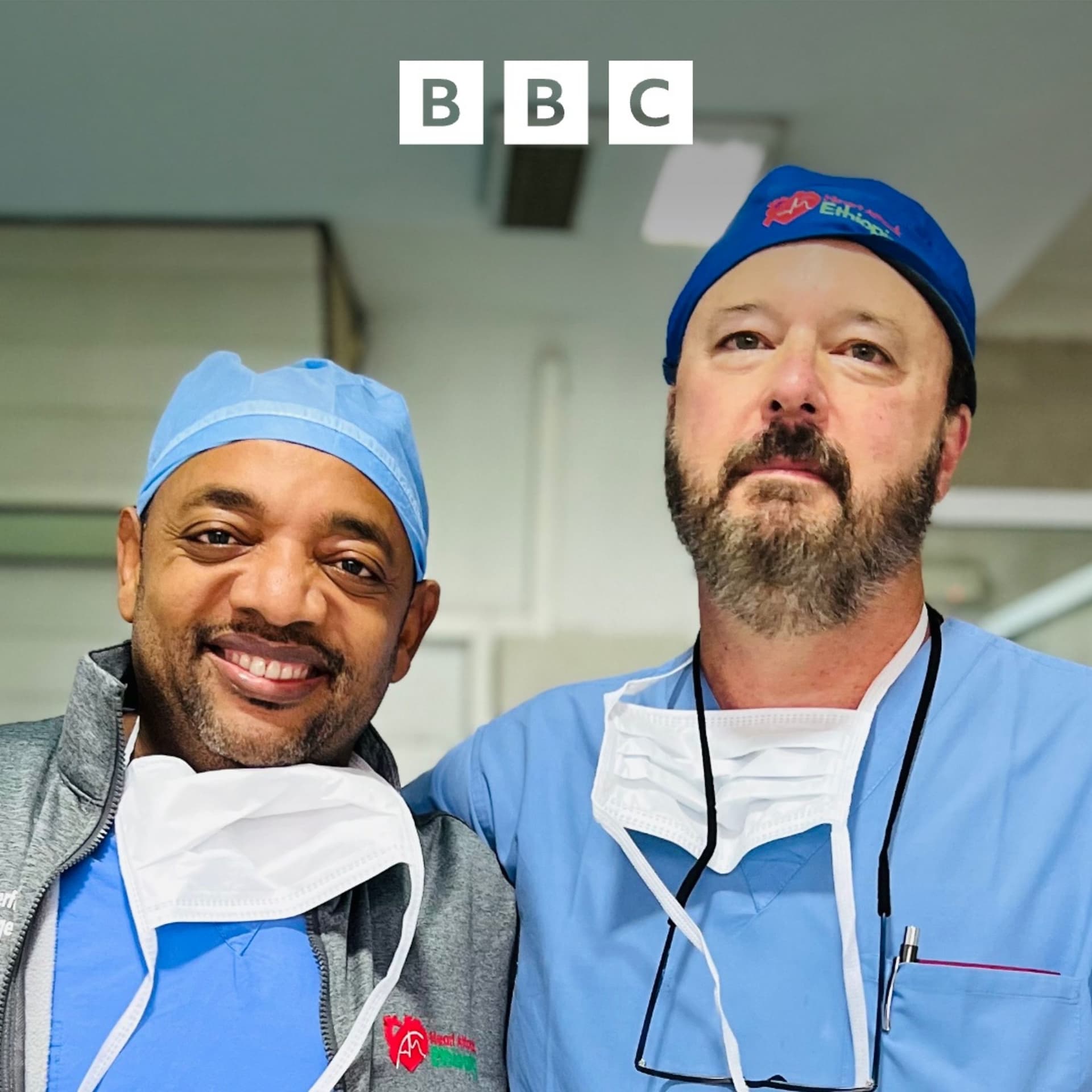
- Twenty-five years later, Mesfin and Jim reunited while volunteering for a charity in Ethiopia.
- Together, they performed hundreds of life-saving operations through the organization Heart Attack Ethiopia.
- Key Quotes:
- Mesfin expressed, "I owe them my life... I’m beyond thankful."
- Jim reflected on the deep bond formed, stating, "It’s a dream come true to work alongside someone who was once my patient."
- A Blind Musician's Amplifier
- Anthony Ferraro's Experience:
- A Paralympic athlete and musician who is blind received a specially designed amplifier with braille controls.
- This innovation allows him to adjust his guitar's sound independently, a significant leap towards accessibility.
- Impact of the Amplifier:
- Anthony described the moment he held the amp with braille as "freedom," emphasizing the importance of inclusive design in music equipment.
- He noted, "It's incredible to have that freedom and joy in accessibility."
- AI Chatbot for Farmers in Malawi
- Introduction of Ulaanjizi AI:
- A new AI chatbot assists farmers in rural Malawi by providing agricultural advice in both English and Chichewa.
- It helps users identify pests and offers guidance on crop protection.
- Significance:
- The initiative, developed by Opportunity International, is particularly beneficial for women farmers, who represent a significant portion of agricultural workers in Malawi.
- This technology aims to empower local farmers by improving access to essential information.
- Cows and Tool Use
- Veronica the Cow:
- A pet cow named Veronica in Austria has gained attention for using a broom to scratch herself, demonstrating complex problem-solving skills.
- Cognitive biologist Antonia Osuna Mascaro explained that this behavior indicates higher cognitive abilities in cattle.
- Broader Implications:
- This behavior suggests that cows may possess intelligence that has been previously underestimated, contributing to a broader understanding of animal cognition.
- Breaking Stereotypes in Truck Driving
- Catherine Smead's Story:
- At 55, Catherine became one of the few women in the UK licensed to drive heavy lorries, aiming to inspire other women.
- She described driving as a way to "smash societal expectations" and empower herself.
- A Young Photographer's Passion
- Aisha McCamely's Journey:
- Aisha, at just 11 years old, began working with her father in the wedding photography business.
- Her enthusiasm and talent led to viral posts showcasing her work, highlighting the joy of pursuing one's passion from a young age.
Conclusion This episode of the Happy Pod showcases remarkable stories of resilience, innovation, and inspiration from around the globe. From healing through medicine to breakthroughs in accessibility and empowerment in unexpected fields, the narratives serve as a testament to human spirit and ingenuity.
Contact and Additional Information
- Contact for Feedback: globalpodcast@bbc.co.uk
- Listen to More Episodes: Available on BBC platforms and popular podcast services.
Written by AI. May contain mistakes. Listen to the episode to check what was said.
Chapters
Tap a time to open that second in VOIntroduction to the Episode
0:05 to 0:42
Discussion about flawed journalism and a significant historical event.
“If journalism is the first draft of history, what happens if that draft is flawed?”
Mesfin's Journey: From Patient to Practitioner
0:48 to 2:19
Story of Mesfin's heart surgeries and his journey to become a cardiac perfusionist.
“how an Ethiopian man who needed two heart operations as a child ended up working with the American surgeon who'd saved him.”
Reunion and Collaboration in Ethiopia
2:19 to 7:59
Mesfin reunites with Dr. Jim and their collaborative efforts to save lives.
“Mesvindola, who grew up in a small village, became very sick by the age of 11.”
The Impact of Accessible Music Equipment
7:59 to 12:45
A musician shares his joy about receiving a Braille amplifier, enhancing his music experience.
“It's such an amazing privilege that we have to be together and to serve together.”
Intelligence in Animal Behavior
12:45 to 14:03
Discussing new findings on tool use in cows, challenging previous assumptions about animal intelligence.
“Next, researchers say they found evidence of deliberate tool use in only the second ever species of animal.”
Animal Tool Use: Insights and Examples
14:03 to 16:39
Explore the cognitive abilities of animals and their use of tools.
“the handle end of the stick she was using it in a really delicate way of poking and pushing and And this is really interesting because it's a multi-purpose tool.”
AI Chatbot Revolutionizing Farming in Malawi
17:44 to 22:20
Learn how an AI chatbot is helping farmers in Malawi tackle agricultural challenges.
“In Malawi, in Southern Africa, around 80 % of the population rely on agriculture for their livelihoods.”
Inspiring Women in Truck Driving
22:21 to 27:25
Meet Catherine Smead, who inspires women by driving heavy trucks in a male-dominated field.
“The Ulangizi AI app ending that report by Jacob Evans.”
Young Photographer's Journey
27:29 to 28:00
Follow 11-year-old Aisha as she steps into her father's photography business.
“Now, if you've joined your family business at a young age or took on an unusual job later in life, like Catherine, we'd love to hear from you.”
Uncovering a Mystery: The 1999 Russian Apartment Bombings
28:10 to 28:44
Exploring the unaddressed aspects of a significant historical event.
“If journalism is the first draft of history, what happens if that draft is flawed?”
Transcript
Automatic transcript. May contain errors.0:00This BBC podcast is supported by ads outside the UK. If journalism is the first draft of history, what happens if that draft is flawed? In 1999, four Russian apartment buildings were bombed, hundreds killed. But even now, we still don't know for sure who did it. It's a mystery that sparked chilling theories. I'm Helena Merriman, and in a new BBC series, I'm talking to the reporters who first covered this story. What did they miss the first time? The History Bureau, Putin and the apartment bombs. Listen on BBC.com or wherever you get your podcasts. This is the Happy Pod from the BBC World Service.
0:47Hello, I'm Ankur Desai and in this edition, how an Ethiopian man who needed two heart operations as a child ended up working with the American surgeon who'd saved him. It's a dream come true life. It's such an amazing privilege to serve together. I applaud Mesfin for going back home and paying back. I'm very proud of him, what he's done. Also, I think I could cry all over again. I have goosebumps and butterflies, and it's just to see, it's history made. When I opened it and touched the braille, it was just freedom. A Paralympic athlete and guitarist who's blind talks of his joy at being sent a specially designed amplifier.
1:29Later on, how a new AI chatbot is helping farmers in rural areas of Malawi. And do stick with me on this one. Why a cow is using a broom to scratch its back and why it's exciting scientists. The surprising thing was she was using it as a multipurpose tool. And the other example that we know of in nature comes from the chimpanzees of Congo. And the girl who joined her dad's wedding photography business at the age of just nine. It's an amazing feeling if your daughter actually wants to come with you to work and then does such an amazing job at the age of nine. I love taking photos. You just see, like, the world through a different lens.
2:14We start with an inspiring full circle story from Ethiopia. Mesvindola, who grew up in a small village, became very sick by the age of 11. Local doctors couldn't help, so he travelled to the capital of Addis Adaba and asked a charity. There, he met an American doctor, Rick Hodes, who diagnosed Mesfin and arranged surgery in the US, as it wasn't available in Ethiopia. He then flew to Atlanta at the age of 15 to be operated on by the heart surgeon Jim Cowton. Now, Mesfin went home, but complications meant he had to return to the US for a second operation and then remain there. He grew up to become a cardiac profusionist, operating the life support machines during surgical procedures, just like the ones he'd had as a child.
3:01Now, 25 years after they first met, Mesfin and Jim found themselves performing operations in Ethiopia together through a charity called Heart Attack Ethiopia. The Happy Pod's Holly Gibbs has been speaking to them. I thought I was going to die. And I do remember speaking to Dr. Rick Holtz. He didn't accept that, and they were able to bring me back, and Jim Couton, Dr. Jim Couton, he was able to save me for a second time. As I got to know Messman, and he was a very determined, charming child, he was easy to like. And after the second operation, we had to put in a mechanical valve, and sometimes the mechanical valves can make clicking sounds.
3:46And he goes, well, you know, what's going to happen? The kids are going to hear that, and I'm going to have to explain it. What can I do about that? So we got Mesfin a watch. You know, I just said, wear this watch and tell the kids that what they're hearing is your watch. And Mesfin, back to you. How grateful are you to Jim and other doctors who helped save you? I'm beyond thankful. I owe them my, literally my life. It's unbelievable the life I'm living and to be, you know, a husband, to have a wonderful two young boys. Just having this career is a huge meaning. It's because of, you know, Dr. Rick Holtz, Dr.
4:26Jim Cowden. Jim, how does it feel hearing that, that you had that much of an impact? Well, I mean, I'm retired now, but I was a cardiac surgeon in practice for 36 and a half years. And during that time, I operated on over 11 ,000 patients doing heart surgery. You know, about midway into my career, I kind of realized that I think I was put on this earth to do heart surgery and to help people. That kind of adds some humility to it, I think. I feel grateful for having met Mesvin. I'm grateful that he got through two operations. And I was even more grateful when I saw him during our first mission trip.
5:08We are meeting at the airport, and there's Mesvin, and I hadn't seen him probably in 25 years. and to know that he was going to be my perfusionist was very special to me. Mesfin, what was it about your experience that made you want to pay it back? I realised that, you know, shadowing a cardiac perfusionist, this is exactly what I wanted to do because I have been into that operating table and I know what it's like to be a patient, the fear, all the flashback. I decided at that moment to be a cardiac perfusionist. and be able to help others. And how did it come about you both working together in Ethiopia?
5:51What brought us full circle was the heart attack Ethiopia. They contacted me. I did not know that Dr. Jim Kautner was coming to this mission trip, but we both was a bit surprised. And when we saw each other, this is like, you know, an incredible life circle moment. We bonded, rebonded so quickly, and we were able to pick up where we left off, meaning I was his patient. And then now we are going to save another life. We completed four series of missions with over 400 patients' life saved. We are trying to build a local system, training surgeons, perfusionists, nurses, and overall cardiac teams.
6:45Jim, you must be proud of Mesvin. I think that's what makes his story so unique and so special. I applaud Mesvin for taking time out of his busy life and career and going back home and paying back. I'm very proud of him, what he's done. He claims me as his fourth father. So that's an honour in and by itself. My final question is, how does it feel to help other people together? You know, I think just having Mesfin there has made it special. He's been a good friend. It's a dream come true life. Just working along with a surgeon who operated on me once. And now we're operating together. Helping others is such a wonderful meaning.
7:38You know, we're giving somebody's child or hope. And what strikes me sometimes when I see patients and tell them I had an open heart surgery just like theirs, that itself gives them a peace that they have a hope. It's such an amazing privilege that we have to be together and to serve together. I am just so beyond thankful. Love hearing about that relationship. Mesfin Dala alongside Jim Cowton speaking to the Happy Pod's Holly Gibbs. Now to the US and a musician who got an amazing surprise after ordering a new amplifier for his guitar. Oh my gosh, I feel braille. There's braille on an amp. I think this is the first amp in the world to ever do this.
8:28reverb dwell fact that this is on braille do you know how many times i have to ask a friend hey what is this control what's it at this is the most amazing amp i've ever touched and i can't wait to play this i think we're all dialed in let's try it out here's my clean signal now i see with some pedals
8:52that's a tiktok video from anthony ferraro a blind paralympic athlete and content creator from New Jersey, unboxing the amp that had been sent to him by a firm in the UK. Now, he'd ordered a regular piece of equipment from Victory Amps, but instead they chose to make what's thought to be the first ever amp with Braille on the buttons and dials. Anthony spoke to my colleague Claire MacDonald about that moment he first took it out of the box. I think I could cry all over again. I have goosebumps and butterflies and it's just to see it's history made. I think it should be in the museum, that amplifier.
9:29You've loved music all your life and you've been blind all your life. When did you think, you know, this is what I need. I need to sort of feel a little bit more included in this world. Tell us how it how it came about. You know, I've been in the market of trying a new amplifier and I reached out to Victory and I told them, you know, who I was and what I was interested in. And they started right away working on a project that was kept a secret from me. And when I received the amplifier, I had no idea what to expect. I've been pushing for accessibility, you know, on my platforms. I try and bring awareness to it in a positive way where things lack, where things are great.
10:09And I wish I could take credit for this, but it takes companies like Victory to really create true change in the world. And when I received this, when I opened it and touched the Braille, it was just freedom. The freedom to be able to control my amp and dial in my sound and do it all alone was just incredible. So, Anthony, up to this point, I mean, your hearing must be incredible. Have you always had to rely on somebody else if you want some kind of nuance to help you with amplification and modification and all of that? Short answer, yes. And sometimes I would just have to memorize the layout of the controls and I would quickly forget.
10:47And I would never be able to tell which, if you're using a clock method, I would never be able to tell if the control was at noon or two o 'clock or whatever it is. So to be able to have that freedom on my own, and not only is there Braille on the amp, but I can't stress this enough, the Braille is perfect. And it's just incredible to feel every time I pull the cover off that amp, my heart sings. I'm reading this quote from you. You said music was one of the only things that made me feel like I wasn't blind. This is your access into a world that you can share, that you can excel at. What difference will this make to you now?
11:26Oh, well, reading that quote, it also goes to say that music is truly the only time I don't feel blind. I'm fully in the music and singing and that song, whatever it is. But when I have to go and adjust my equipment and quickly realize, you know, that I can't do everything dialed in perfectly by myself. It's a, you know, wake up call. Hey, you're blind. But when I'm able to in the middle of a jam session go, oh, I need a little more bass or a little more treble or a little more gain. I'm able to just turn around, put my fingers on the amp and dial in what I want is I can't express it enough. It's freedom.
12:02It's just, it's joy, it's accessibility. And I think that Victory has made a huge example of what companies can do. It's not that we're asking for every company to make their products Braille, every one, you know, every single product. It's, can we please have the option to write to you and you make this accessible in a way that I can use it? And Victories, they decided to make this the cost on them and to do it for no extra cost for a blind musician. And on top of that, to donate portions to a blind UK charity is just a dream come true. I have not cried that much happy tears in a long time, probably since my daughter was born.
12:44It's just amazing. Anthony Ferraro there. Next, researchers say they found evidence of deliberate tool use in only the second ever species of animal. And it's probably not one you'd expect. As you may have heard on our Global News podcast, Veronica, who uses a broom held in her mouth to scratch her back in a variety of different ways, is a cow. The behaviour of this farmer's pet in a mountain village in Austria suggests cattle are significantly more intelligent than most of us assume. Paul Henley spoke to Antonia Osuna Mascaro, a cognitive biologist at the University of Vienna's School of Veterinary Medicine, who's been studying her.
13:21The interesting thing about this is that we provide this broom thinking that the broom is the perfect tool to test if Veronica was sensitive to the functional properties of it because it has a functional end and a non-functional end. But the surprising thing was that Veronica was using both ends of the tool. She was using it as a multipurpose tool. So she was using the broom end to scratch those body areas in which her skin is thick. but she was using the handle end of the tool to scratch those body areas where her skin is sensitive and she was using different techniques to do so so when she was using the broom she was using the same technique that any of us will use when cleaning the apartment but when she was using the handle end of the stick she was using it in a really delicate way of poking and pushing and And this is really interesting because it's a multi-purpose tool.
14:20And the other example that we know of in nature comes from the chimpanzees of Congo. Really? So there are lots of animals that use tools, aren't there? Fish, crows, an octopus, but they don't multi-purpose use them. They don't use them for different tasks. Is that right? When we talk about tool use, we are really, really restrictive. We talk only about those cases in which an animal is using an object to extend its own body and to achieve a goal. So to make something easier or to reach something that was impossible otherwise. So many of those examples that are useful in the literature and in social media are not really to use under this strict definition.
15:04I suppose Veronica's unusual because she's a pet and normally cows on a farm don't get handed a broom to scratch themselves with. And she is older than other cows. She's had time to learn new tricks. It doesn't necessarily mean she's more intelligent than other cows. When we received the video, the first thing that I did was to go immediately to the internet. And I found other videos in social media about cows and bulls using branches to scratch themselves. The interesting thing is that in some of those, the animals that are scratching themselves are Brahman bulls. And Brahman bulls are coming from Asia, while Veronica is a different kind of cow.
15:42And both limiches have been separated for half of a million years. So this is telling us that this capability was probably already there in those aurochs, those bulls that we were hunting and drawing on the walls of caves. So what we think is that this is a potential capability that lays really deep within the nature of these animals. And only when they have the opportunity to interact with objects is when they can really express themselves. So is it saying something profound about bovine intelligence? This is telling us that we have been ignoring the cognitive abilities of these animals. There are 1.5 billion cows and bulls in the world.
16:26We have been in close contact with them for 10 ,000 years at least, and we know much more about the Tullius capabilities of really exotic animals that live in remote islands. Antonia Osuna Mascaro.
16:44Still to come on this podcast. If you want to feel empowered, drive a big truck. If you want to smash societal expectations and stereotypes, drive a really big truck. The woman hoping her midlife career change will inspire others.
17:06If journalism is the first draft of history, what happens if that draft is flawed? In 1999, four Russian apartment buildings were bombed, hundreds killed. But even now, we still don't know for sure who did it. It's a mystery that sparked chilling theories. I'm Helena Merriman, and in a new BBC series, I'm talking to the reporters who first covered this story. What did they miss the first time? The History Bureau, Putin and the apartment bombs. Listen on BBC.com or wherever you get your podcasts.
17:44In Malawi, in Southern Africa, around 80 % of the population rely on agriculture for their livelihoods. They face multiple challenges from climate change to invasive species and natural disasters. And accessing information that could help them respond can be difficult in rural areas. But now a new chatbot is using artificial intelligence to help farmers in English and the country's other main language, Chichewa. Our reporter, Jacob Evans, has the story. Hello. How can I assist you with your farming today? I'm currently on WhatsApp and I've been given the number to this new AI chatbot. Ulaanjeezy AI.
18:22So to see how it works, I thought I'd get it loaded up here and I've been sent some photos from some farmers in Malawi of a bug. Now I have no idea what it is, neither do they. It's almost certainly invasive and it's damaging their crops. So what I'm going to do is upload the photo, ask the AI chatbot what I'm looking at, what damage can it cause and how do I get rid of it? It looks like there's a grasshopper on your plants. Grasshoppers can cause damage by eating the leaves. Here are some steps you can take. What's really useful is there's text and a voice note. You can also send it a voice note, which is important in places where lots of people can't read or write.
18:59It also has a suggested prompt for follow-ups and little thumbs up or down reactions for you to say if the answer was useful. You're welcome. Ulan Jizi was developed by a non-profit organisation called Opportunity International, which uses a network of around 800 farming support agents in Malawi. These are local people who have access to WhatsApp and travel around rural areas as intermediaries between the smallholders and agricultural organisations, like Anna Chimalazeni. I spoke to her and Bahati Zimba from Opportunity International, who helped translate.
19:34Okay, so Anna is explaining to say she works with 150 farmers and sometimes it's more. So she says The farmers come to me or whenever I'm visiting, inspecting their crops, that's when they do ask the questions. When they see the questions and I'm not there, they walk to my house and then I respond to the questions through Ulangiz AI because it's on WhatsApp. So most of the time farmers ask about crops and animal husbandry. Ulangiz acts like a guide for us farmers. The initiative has proven especially popular among women. Almost 80 % of smallholder farmers are female. Most of the village savings and loan groups that Anna works with are women.
20:16Sometimes only two men out of ten women. Anna has been with Opportunity International for a while and helped develop the product alongside the organisation's head of agricultural finance, Tim Strong. It was actually Anna herself who sat down as one of our first agents in front of what was a fledgling web interface called Chachapiti. We were hit by what was known as Cyclone Freddy, but on top of that was an extended rainy period where nearly 90 % of the country's soy production was hit by a disease, a fungal disease called soy blight. When Anna sat down in front of Chachapiti, her very first question was, what could I do to protect my harvest from soy blight?
20:56That was kind of the big aha moment where Anna, when asked if she could have had access to something like Chachapiti, said this could have saved my harvest. Since then, the team have worked to build Ulaanjizi AI to a point where it's been endorsed by the government of Malawi and uses official advice and insight in its answers. Richard Chongo is Opportunity International's in-country director. 180 ,000 small farmers that are in very hard-to-reach areas, in rural areas, in villages, getting the benefit of generative AI. We are pushing the benefit of technology into the areas where people thought that this technology could not reach out to.
21:33Ulaanjizi has faced challenges since its inception.
22:03that we would seek. Now these teething issues are out the way, it's a model that is being trialled elsewhere. The team have already started working in Ghana and Kenya, and early trials are underway in the DRC, Rwanda and Madagascar. If you have more questions in the future, feel free to reach out. Goodbye and take care. The Ulangizi AI app ending that report by Jacob Evans. Now with the new year, many of us make resolutions for big changes in our lives, perhaps pursuing the job we've always wanted. Catherine Smead recently became one of the very few women in the UK licensed to drive the heaviest lorries or trucks, fulfilling a childhood ambition at the age of 55.
22:44She got her license a few months ago and hopes to inspire more women to work in a job that's still dominated by men. I found that a solution to my flagging self-esteem and self-confidence in middle age was to get an HGV license. If you want to feel empowered, drive a big truck. If you want to smash societal expectations and stereotypes, drive a really big truck. It's long hours, it's hard work, but driving a big truck is really good fun. There are three other women drivers at my haulage company that I work for. It would be great to see more women in the job. If I could inspire even one person, if one little girl sees me in my truck and thinks, yeah, I could do that, yeah, that would be good.
23:37I've done various jobs in my life. I wanted to show my daughters that you can even, even at the age where a lot of people are looking at winding down, you can still do new things, learn new things, learn new skills, push yourself way beyond your limits and do things that scare you absolutely witless. Finally, it's not uncommon for children to go into the same profession as one of their parents when they grow up. But one young girl in Australia joined her father's photography business at the age of just nine and is now helping to capture the most special day of many people's lives. Frankie McCamely takes up the story.
24:14I'm a photo taker. I've kind of grown up with the camera. I'm doing photo takers. I'm Aisha. I'm 11 years old and I love to do photography and make videos. And my name's Jerome and I'm the father of Aisha. And I also like doing photography and video. For years, Jerome has been working as a wedding photographer in Melbourne, Australia, capturing those special moments as the day unfolds. Today, I stand before you again, looking into your eyes, promising you just as I did all those years ago. And since she remembers, Aisha has been asking to come along. The answer was always, no, you're not old enough yet.
25:02Maybe when you're older, maybe when you're 12. But her luck soon changed. This opportunity came. Luckily, the bride was a photographer and she just asked for a photo from behind as she's coming in and then a photo from behind as she was leaving the church. And the safe shot is always inside the church for when the bride comes in and outside the church when the bride and groom exit. So I thought little Aisha could just, you know, could be there to do it. Yeah, and I was about nine then. And what was that like, turning up to a wedding and having a camera in your hands? It was so exciting. Like, it was the craziest thing I'd ever done.
25:38And I was counting down the days. I was a little bit nervous because I really wanted to do it perfectly, but I was so excited. Not only were the shots brilliant, but Jerome's social media post showing Aisha taking photos at the wedding went viral. I just loved watching Aisha because she was really hungry for the moment. She wasn't just standing just like she was intentional. Like it's an amazing feeling if your daughter shows an interest in what you do to start with and actually wants to come with you to work and then does such an amazing job at the age of nine. Like it was pretty special. Since then, Aisha has done the odd ceremony with her dad.
26:18She's also directed a leaving video for her school. Aisha came home from school one day and said, my principal's retiring. I've spoken to my assistant principal and we're creating a surprise video for him. You're going to shoot it. I'm going to direct it. It has to be Netflix standard. So you have to bring in all the lights. I want all the lights. So we literally took over his office. We had lights from outside coming in. we went for and these tiny little prep kids came in. And most of them were trembling when they came in. They were terrified of these big lights, but it was a really good video.
Read the full transcript
26:52The pair have another wedding booked in April. Jerome, though, is trying to keep them to a minimum because, let's face it, Aisha does have school to go to, but she says this is just the beginning. What is in store for you? What do you want to go on and do? I love doing photography and videos and I love acting, so it could be something to do with that. Or I also want to be a teacher. I love taking photos. I feel like you just see the world through a different lens. 11-year-old Aisha ending that report by Frankie McCamely. Now, if you've joined your family business at a young age or took on an unusual job later in life, like Catherine, we'd love to hear from you.
27:36The address, as ever, is globalpodcast at bbc.co.uk.
27:44And that's all from us for now, but you can now watch some of our videos and interviews on YouTube. Just search for The Happy Pod. This edition was mixed by Stephen Bailey and the producers were Tamsin Selby, Holly Gibbs and Rachel Bulkley. The editor is Karen Martin and I'm Ankur Desai. Until next time, goodbye.
28:10If journalism is the first draft of history, what happens if that draft is flawed? In 1999, four Russian apartment buildings were bombed, hundreds killed. But even now, we still don't know for sure who did it. It's a mystery that sparked chilling theories. I'm Helena Merriman, and in a new BBC series, I'm talking to the reporters who first covered this story. What did they miss the first time? The History Bureau, Putin and the apartment bombs. Listen on BBC.com or wherever you get your podcasts.
From the publisher
Mesfin Dollar, who grew up in rural Ethiopia, had to travel to the US for two heart surgeries as a teenager. Twenty-five years later, by chance, he was reunited with the surgeon who saved his life -- when they both volunteered for a charity mission to his home country. Mesfin and Dr Jim Kauten went on to work together, performing hundreds of life-saving operations.
Also: a Paralympic athlete and musician who's blind talks of his joy at being sent a specially designed amplifier. It's thought to be the first to include braille on the controls, giving Anthony Ferraro the freedom to adjust the sound of his guitar himself.
How farmers in rural Malawi are getting help and advice from Articial Intelligence through a new chatbot.
Why a cow in Austria has found fame for using a broom to scratch her back -- suggesting cattle are far more intelligent than we think.
Plus a woman who's entered the male-dominated world of lorry driving in her fifties - and a girl who joined her father's photography business at the age of nine.
Our weekly collection of inspiring, uplifting and happy news from around the world.