
In short
Global News Podcast - Episode Summary: "Trump launches Board of Peace"
Episode Overview In this episode of the Global News Podcast, host Anka Desai discusses significant global events, including Donald Trump’s inauguration of the Board of Peace, a controversial body aimed at addressing issues in the Middle East and beyond. The episode also covers other notable news stories, including territorial integrity disputes involving Denmark, landslides in New Zealand, wildlife concerns in Pakistan, and recent Oscar nominations.
Key Topics Discussed
- Donald Trump’s Board of Peace
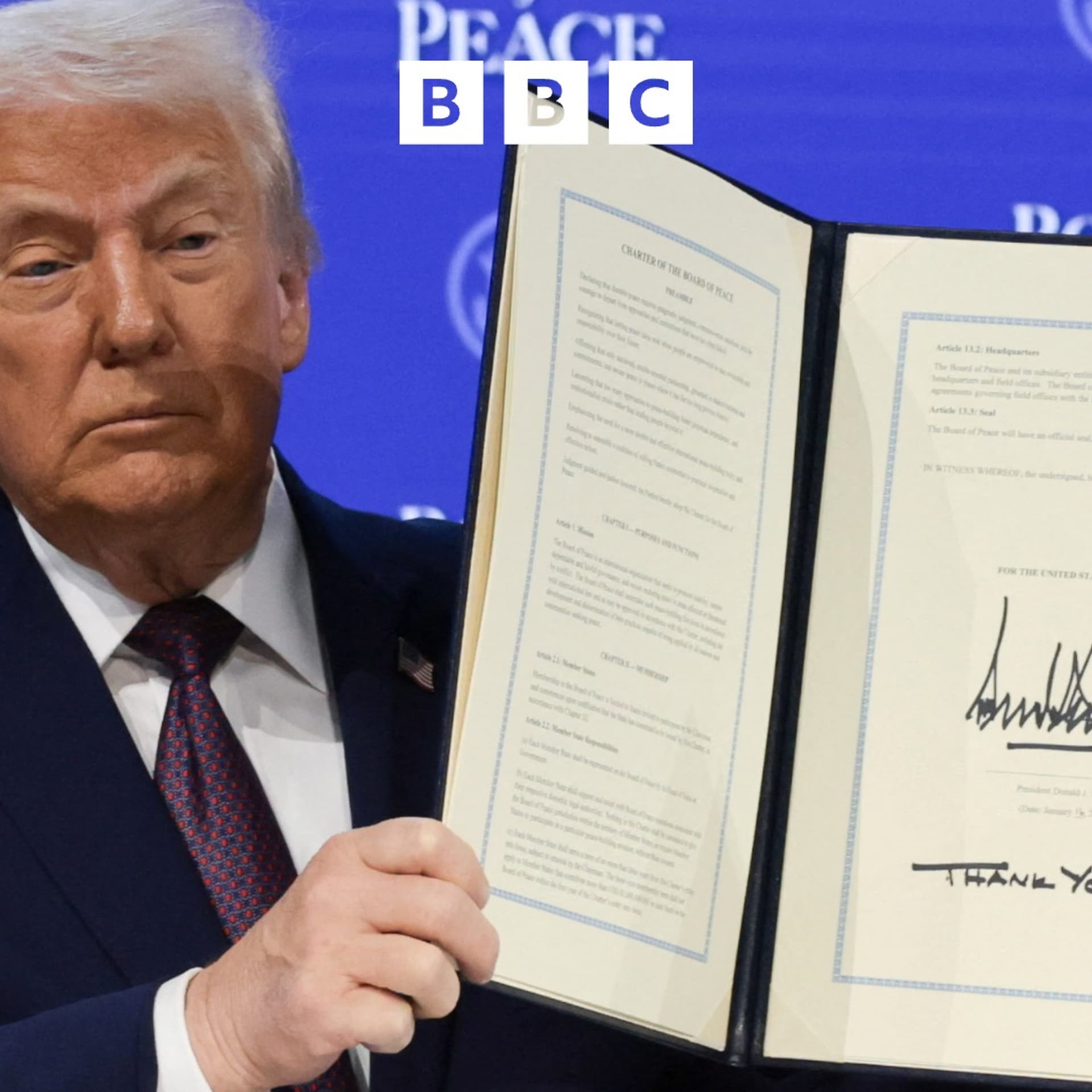
- Ceremony Details: Trump held a signing ceremony in Davos, asserting the Board’s potential to create a "glorious and everlasting peace" for the Middle East. Nearly twenty dignitaries signed the agreement; however, absence of major European powers and Palestinian leadership raised eyebrows.
- Function and Structure:
- The Board is initially focused on Gaza's reconstruction following a U.S.-brokered ceasefire.
- There is a proposed $1 billion membership fee, with participating nations including Qatar, Turkey, Egypt, and Israel.
- Critics, including former UN officials, argue it could undermine the United Nations' role in global peacekeeping.
- Expert Opinions:
- Martin Griffiths (former UN Undersecretary) expressed skepticism about the Board's effectiveness, particularly regarding the complexities of the Gaza situation.
- Frank Gardner (BBC Security Correspondent) voiced concerns about the Board's authority and the challenges of moving beyond initial phases of peace initiatives.
- Denmark and Greenland Negotiations
- Following Trump's comments about potentially acquiring Greenland, Danish Prime Minister Meta Fredriksen insisted on the respect of Denmark's territorial integrity.
- An emergency EU summit was called to discuss the implications of Trump’s statements, reflecting the tensions between the U.S. and European allies.
- Natural Disasters in New Zealand
- Heavy rains led to landslides in New Zealand's North Island, resulting in casualties and several missing individuals, including children.
- Prime Minister Christopher Luxon labeled the incident as a significant tragedy amid the peak tourist season.
- Wildlife Concerns in Pakistan
- Wildlife rangers seized eleven illegally kept lions after one attacked a girl in Lahore.
- The prevalence of illegal pet ownership highlights ongoing issues regarding animal rights and wildlife management in Pakistan.
- Oscar Nominations Announcement
- The film *Sinners* made headlines by receiving a record-breaking 16 Oscar nominations.
- Other notable films, including *Hamnet* and *One Battle After Another*, also garnered multiple nominations, sparking discussions on the Academy's recognition process.
Key Takeaways
- Global Diplomacy Shifts: Trump's approach to international relations, particularly through the Board of Peace, emphasizes a departure from traditional diplomacy, raising questions about the future of multilateral organizations like the UN.
- Environmental and Humanitarian Challenges: The New Zealand landslide and the illegal wildlife trade in Pakistan showcase ongoing environmental issues and their socio-political ramifications.
- Cinematic Achievements: The Oscar nominations reveal trends in the film industry, illustrating a competitive landscape where both critical acclaim and social themes intersect.
Conclusion This episode of the Global News Podcast encapsulates a range of urgent international issues, reflecting both the complexities of global governance and the pressing realities of humanitarian crises. The podcast encourages listeners to stay informed about the rapidly changing landscape of global affairs.
For further discussions, listeners can connect with the podcast via email at [globalpodcast@bbc.co.uk](mailto:globalpodcast@bbc.co.uk) or on X at BBC World Service using the hashtag #GlobalNewsPod.
Producer: Alice Adderley Editor: Karen Martin Host: Anka Desai
Written by AI. May contain mistakes. Listen to the episode to check what was said.
Chapters
Tap a time to open that second in VOThe Flawed Draft of History
0:05 to 0:42
Explores how flawed journalism can impact historical narratives.
“If journalism is the first draft of history, what happens if that draft is flawed?”
Trump's Board of Peace Launch
0:46 to 1:12
Donald Trump introduces his Board of Peace and its implications.
“I'm Anka Desai and on Thursday the 22nd of January, these are our main stories.”
Denmark's Territorial Integrity
1:12 to 1:26
Discussion on Denmark’s response to Trump's comments on Greenland.
“I was very honoured when they asked me to do it.”
Wildlife Rangers Seize Illegal Lions
1:26 to 1:42
Report on wildlife rangers in Pakistan seizing illegal lions.
“after one of the animals escaped and attacked a girl.”
Tragedy in New Zealand
1:42 to 2:16
Coverage of a landslide in New Zealand resulting in missing individuals.
“I heard this huge tree crack and all this dirt come off behind me and then I look behind me and there's a huge landslide coming down.”
Insights from the World Economic Forum
2:16 to 2:28
Highlighting diplomacy at the World Economic Forum in Davos.
“ceremony for the charter of his Board of Peace, a body that was initially formed to oversee the rebuilding of Gaza following the U.S.-brokered ceasefire last October.”
Unveiling the Board of Peace Details
2:28 to 2:47
Details about the Board of Peace's formation and goals.
“president says that he sees the body as going beyond Gaza to address global challenges.”
Criticism of the Board of Peace
2:47 to 3:39
Critics express concerns about the Board of Peace replacing the UN.
“This board has the chance to be one of the most consequential bodies ever created.”
Martin Griffiths on the Board of Peace
3:39 to 4:26
Insights from Martin Griffiths regarding the challenges ahead.
“Martin Griffiths is the former Undersecretary General of Humanitarian Affairs and Emergency Relief Coordinator for the UN.”
Trump's Peace Plan Progress
4:26 to 5:24
Exploring Trump's achievements in peace negotiations.
“Russia's news agency TASS reports that President Putin is ready to send$1 billion of Russian assets frozen in the US to Trump's Board of Peace.”
Show all 24 chapters
Concerns on Authority and Functions of the Board
5:24 to 6:43
Discussion on the authority of the Board of Peace without key players.
“And I'm not certain that this great big diplomatic razzmatazz is going to achieve that because you need people who really understand the situation on the ground and can understand the other side's view.”
Greenland's Response to Trump's Proposal
6:43 to 10:48
Examining Greenland's reaction to Trump's comments on territory.
“The good thing is that you have got some very important Middle East nations involved.”
Ukraine War Negotiations
10:48 to 11:16
Discussion on the recent meetings aimed at resolving the Ukraine war.
“Search for BBC News, click on the logo, then choose podcasts and then click on the Global News podcast.”
The Role of American Diplomacy
11:16 to 13:32
Exploring the role of American diplomacy in the Ukraine conflict.
“Right now we are working actively with partners on security guarantees and I'm grateful for that.”
Landslide Disaster in New Zealand
13:32 to 14:03
Report on the landslide incident in New Zealand and its aftermath.
“Searches have continued through the night for several people, including a child who are missing after a landslide at a camping ground at one of the country's most popular tourist destinations near Mount Manganui.”
Tragic Landslide in New Zealand
14:03 to 15:36
Learn about the landslide in New Zealand that affected a popular campsite during peak tourist season.
“The landslide took out tents, caravans and a toilet block, with people still unaccounted for.”
Trump's Impact on International Diplomacy
16:44 to 21:50
Analyze how Trump's actions have disrupted traditional international relations.
“It's been an interesting few days for what diplomats like to call the rules-based international order, the architecture for managing global conflict that was established after the Second World War.”
Kidnapping Crisis in Nigeria
21:56 to 24:32
Hear about the recent wave of kidnappings affecting communities in Nigeria.
“Security fears continue to rise in Nigeria after authorities confirmed the kidnapping of a group of worshippers in Kaduna State, although the police had initially denied that any attack took place.”
Illegal Wildlife Trade in Pakistan
24:34 to 27:33
Investigate the ongoing issue of illegal wildlife trade and its implications in Pakistan.
“Pet lines have long been a problem in parts of Pakistan, with wildlife officials cracking down on breeding farms after a woman and two children were attacked last July in Lahore.”
Oscar Nominations Break Records
27:35 to 28:01
Explore the surprise and significance behind this year's Oscar nominations.
“And history has been made ahead of this year's Academy Awards.”
Oscar Nominations and Excitement
28:01 to 28:48
Explore the excitement and anticipation surrounding Oscar nominations.
“It's set in the Mississippi Delta during the era of Jim Crow laws and follows two brothers who come up against supernatural forces.”
Discussion of Snubs and Surprises
28:49 to 29:54
Delve into notable snubs and surprises in the Oscar nominations.
“Oscar nominations day is like Christmas morning for movie fans.”
Anticipation for Upcoming Awards
29:55 to 30:44
Learn about the ongoing anticipation leading up to the Oscars.
“I like the fact, we did mention earlier on, that the stories that always get the most click at the end is who's been snubbed and who's going to be angry.”
Highlighting Leading Performances
30:45 to 31:22
Discuss standout performances and rising stars for the Oscars.
“25 years after her nomination for Almost Famous, Kate Hudson is back with Song Sung Blue.”
Transcript
Automatic transcript. May contain errors.0:00This BBC podcast is supported by ads outside the UK. If journalism is the first draft of history, what happens if that draft is flawed? In 1999, four Russian apartment buildings were bombed, hundreds killed. But even now, we still don't know for sure who did it. It's a mystery that sparked chilling theories. I'm Helena Merriman, and in a new BBC series, I'm talking to the reporters who first covered this story. What did they miss the first time? The History Bureau, Putin and the apartment bombs. Listen on BBC.com or wherever you get your podcasts. This is the Global News Podcast from the BBC World Service.
0:46I'm Anka Desai and on Thursday the 22nd of January, these are our main stories. Donald Trump has presided over a signing ceremony for his Board of Peace, which he says will usher in glorious and everlasting peace for the Middle East and the wider world. But critics say it's designed to replace some of the UN's functions. This board has the chance to be one of the most consequential bodies ever created, and it's my enormous honour to serve as its chairman. I was very honoured when they asked me to do it. Denmark's Prime Minister has insisted her country's territorial integrity must be respected, a day after President Trump said a possible deal on Greenland will achieve everything he wants.
1:25Wildlife rangers in Pakistan have seized 11 lines illegally kept in Lahore after one of the animals escaped and attacked a girl. Also in this podcast, several people, including children, are missing after a landslide engulfed a campsite on the North Island of New Zealand. I heard this huge tree crack and all this dirt come off behind me and then I look behind me and there's a huge landslide coming down. I'm still shaking from it now. It's like the scariest thing I've ever experienced in my life. And we look ahead to the runners and riders for this year's Academy Awards as the nominations come out and one film makes Oscars history.
2:02Some of the most powerful leaders in the world are continuing to spend these winter days in the Swiss Alps. This is certainly no apres ski holiday, but rather another day of diplomacy at the World Economic Forum in Davos. President Trump began today's agenda by hosting a signing ceremony for the charter of his Board of Peace, a body that was initially formed to oversee the rebuilding of Gaza following the U.S.-brokered ceasefire last October. But the U.S. president says that he sees the body as going beyond Gaza to address global challenges. Speaking on a stage full of leaders, including the Hungarian president Viktor Orban and Argentina's Javier Millet, although notably no Palestinian leadership or major European powers were present.
2:46Today we're announcing more details regarding the Board of Peace, so important. This board has the chance to be one of the most consequential bodies ever created. And it's my enormous honor to serve as its chairman. I was very honored when they asked me to do it. And every country, just about every country wants to be a part of it. The room has also shown a new Gaza slideshow presented by Trump advisor and son-in-law Jared Kushner. It showed futuristic seaside high-rise buildings on the current Gaza Strip. The board also has a$1 billion price tag for a permanent membership although it's not clear where this money will go.
3:25So far, Qatar, Turkey and Egypt are among countries that have announced they would join the board. Israel has also publicly confirmed its participation. Many critics say this body is going to replace the United Nations. Martin Griffiths is the former Undersecretary General of Humanitarian Affairs and Emergency Relief Coordinator for the UN. He has big reservations about the Board of Peace. We must all welcome the activism of Mr Trump on wars. I mean, that is an energy which we have lacked in the past. It's a good thing. Gaza is the first outing. Gaza is the first test. I'm not sure it's going to work.
4:03I don't think Gaza is an easy one anyway. And I think the test of this grand new scheme, which is a grand new scheme, is going to be whether it moves to phase two properly in Gaza. The signs are not good. The UK Foreign Secretary Yvette Cooper told the BBC that the country wouldn't be a signatory today, citing concerns about the involvement of Russian President Vladimir Putin. Russia's news agency TASS reports that President Putin is ready to send$1 billion of Russian assets frozen in the US to Trump's Board of Peace. Earlier I spoke to our security correspondent Frank Gardner. I asked him what stood out to him from President Trump's speech.
4:42This is very much his day. You know, this is a lot of this is about Donald Trump and his vision of the world and his incredible self-belief as a not just a dealmaker, but a peacemaker. You know, he, of course, says that he has solved eight wars around the world, a figure that is disputed. I think Martin Griffith's concerns are very well founded. To give Donald Trump his credit, he was able to get through, push through phase one of his 20 point peace plan for the Middle East, for Gaza primarily. And that worked. It stopped the war. He got a ceasefire in place. He got the Israeli hostages out and large numbers of Palestinian prisoners released.
5:24Phase two is going to be a lot harder. That's the really tricky bit. And I'm not certain that this great big diplomatic razzmatazz is going to achieve that because you need people who really understand the situation on the ground and can understand the other side's view. That is something that's been one of the reasons why the Gaza issue is so intractable, is that so many moderate Israelis, I've spent a bit of time there since the October the 7th, 2023, Hamas-led raid into Israel, and so many previously moderate Israelis who were prepared to live side by side with a Palestinian state are no longer prepared to because they just are still so traumatized by what happened in that raid.
6:08and for Ghazans who have suffered more than two years of being pummeled from the air and artillery and bulldozed and are still living in appalling conditions. The proof for them in this great big razzmatazz board of peace is, is it actually going to make their lives any better? Are their conditions going to improve? Is there going to be any light at the end of a tunnel towards building a peaceful Palestinian state that can live side by side with Israel and not threaten Israel? And frankly, we've only got 30 seconds, but what sort of authority does it have if many European countries and no Palestinians are on it?
6:42And what are the functions of this board? Well, there is a sub board on that that is the Gaza Executive Board, and they will be looking at trying to push through some of the aims of the Trump peace plan, such as getting a stabilization force in there, disarming Hamas, rebuilding Gaza. The good thing is that you have got some very important Middle East nations involved. You've got Turkey, Egypt, Saudi Arabia, Qatar and Bahrain, all involved, all on the border piece. And that's a good thing. Our security correspondent Frank Gardner. EU leaders are expected to hold an emergency summit in Brussels to discuss Donald Trump's framework of a future deal over Greenland.
7:21The US president announced the proposal after talks with the head of NATO, Mark Rutter, although details remain unclear. In a statement, the Danish Prime Minister Meta Fredriksen said her country wished to engage in a constructive dialogue with allies on Arctic security, as long as it respects the kingdom's territorial integrity. In Greenland, these people spoke of their caution about President Trump's announcement. I'm very thrilled to hear that, first of all, because he has been saying a lot of stuff about taking Greenland with Forrest, like he'll do it the hard way, which is so scary to hear.
7:57And I'm just thrilled that he has now announced that, but I'm also keeping my hopes down. For me, it doesn't feel like everything is over just because a statement like that is out. So I still feel like everything can happen. Our Europe correspondent Nick Beak is following developments from Brussels. I think the big concern, Anka, is that a lot of the Europeans don't have that detail and they'll be really keen to find out when they have this emergency meeting in Brussels tonight. I mean, certainly President Trump's position has changed in a heartbeat because at this speech yesterday in Davos, he was saying he absolutely had to own Greenland.
8:38Nothing less would satisfy him and that was a non-negotiable. But now he's saying that a deal has been reached or the framework of a deal has been hammered out after he had a chat with Mark Rutter, the NATO boss. The Danes are saying that as far as they're aware, nothing to do with their sovereignty has been put up for negotiation. Of course, that is the position of the wider Europeans. And this is how we got in this crisis in the first place. The thought that Donald Trump was going to put tariffs on the European countries that were most vocally supporting Greenland. just for standing up for their territorial integrity.
9:15There are so many key players there as well. What's the reaction been? You mentioned Denmark. There needs to be, I guess, a response from Greenland at some stage and obviously other European leaders too. Yeah, that's right. And I think they coordinate their response. A lot of the heat and the tension has been taken out of this because we got from Donald Trump yesterday that double climb down, if you want to put it like that, or certainly a change of position twice, where he said he wouldn't use military action and he wouldn't apply these tariffs on these eight European countries from the 1st of February.
9:48But in terms of the reaction from the Europeans, they haven't said a huge amount yet. They've kept their powder dry. I mean, we got a pretty understated reaction from the Danes yesterday, the foreign minister saying that the day had ended in a much better way than it had started. And I think, yeah, you know, that's certainly an understatement because there was real concern about what might come next. But, you know, this has not been solved by any means because there are these counter tariffs that the Europeans had lined up ready to go or certainly ready to be discussed at the top level. And as a sort of casualty of all of this or certainly a complication, there was a trade deal that was hammered out between the EU and the US last summer.
10:30and the sort of ratification of that, the signing off of that by the European Parliament has been put on hold as a result of this crisis that blew up this week between the US and the EU. Nick Beak reporting. And for more depth on some of our stories like that one, check out our YouTube channel. Search for BBC News, click on the logo, then choose podcasts and then click on the Global News podcast. There's a new story available every weekday. Now, staying in Davos with negotiations about Greenland ongoing and President Trump officially inaugurating his Board of Peace, attention is also on Ukraine and efforts to end the war there.
11:08Donald Trump held a meeting with Volodymyr Zelensky on the sidelines of the Davos meeting. The Ukrainian president described the meeting as positive and said documents aimed at ending the war are nearly ready. Right now we are working actively with partners on security guarantees and I'm grateful for that. But those are for after the war ends. Once the ceasefire begins, there will be contigions and joint patrols and partner flags on Ukrainian soil. And again, everyone is very positive, but, always but. but the backstop of President Trump is needed. The other half of the American team will be in Moscow for talks with Vladimir Putin.
11:56Here's a U.S. envoy, Steve Witkoff. I think we've made a lot of progress. I think in the beginning of this process there was a little bit of confusion. I was going to Moscow quite a bit, but I think it was important that we go there because we're at the end now and I actually am optimistic. To the Ukrainian people here, you have an amazing negotiating team. We spent a lot of time together. I don't know how much, but it could be 100 hours together. And I think we've got it down to one issue. And we have discussed iterations of that issue. And that means it's solvable. Earlier, I spoke to our BBC Russia editor, Steve Rosenberg.
12:36Interesting to hear Steve Witkoff's optimism there. He also said that the negotiations are now down to one outstanding issue. Without clarifying what that issue is, The Kremlin said it wouldn't like to comment this morning at this stage, but appreciates the peacemaking efforts of Donald Trump and his team. And the Russians always say they don't go in for megaphone diplomacy. So they're not saying much at all, but it'll be interesting to see whether the talks that are planned for tonight move or bring peace any closer. In terms of finding a peace deal, obviously we'll need a lot of players at the table as well.
13:13Could this be something that progresses quickly, swiftly in the coming days and weeks? Well, there have been so many moments over the last year where we've thought peace is very close and it hasn't happened. So I think we have to wait and see whether Vladimir Putin is offered the kind of deal that he believes he can agree to. Our BBC Russia editor, Steve Rosenberg. In New Zealand, the Prime Minister, Christopher Luxon, says that the country is heavy with grief and has called off engagements on Friday to visit the east coast after heavy rain has caused landslides on the north coast of the North Island.
13:48Searches have continued through the night for several people, including a child who are missing after a landslide at a camping ground at one of the country's most popular tourist destinations near Mount Manganui. Two people have also died after heavy rains at nearby Papamoa, which is also on the Bay of Plenty on the North Island. Katie Watson has sent this report. A tourist hotspot turned into tragedy. The landslide took out tents, caravans and a toilet block, with people still unaccounted for. It's peak summer holidays in New Zealand, the busiest time of the year. The campsite, right at the heart of Mount Mungunui volcano, its guests were enjoying the hot pools next door.
14:27I heard this huge tree crack and all this dirt come off behind me, and then I looked behind me and there's this huge landslide coming down. and I'm still shaking from it now. It's like the scariest thing I've ever experienced in my life. Authorities say this is still a rescue effort. One eyewitness told a local paper they heard people shouting for help initially. Then it went silent. At least one young girl is still missing. There has been a significant landslip at the base of the mount. This is an active and evolving incident and information may change as assessments continue. Our priority is life safety, followed by scene stabilisation and risk assessment.
15:09Urban search and rescue teams are on scene to provide specialist search, rescue and technical assessment capability. The weather on the eastern coast of the North Island in recent days has caused havoc. Some parts of the region saw as much rain in 12 hours as they would normally in a month. Thousands of residents are still without power. Authorities being tested in their response, with one minister comparing the damage to a war zone. Katie Watson reporting. Still to come on this podcast, the nominations for this year's Oscars have been announced.
15:47I've been all over this world. I've seen men die in ways I didn't even know was possible. The Film Sinners has set a new Oscars record with 16 nominations. We've got all the other headlines coming up.
16:12If journalism is the first draft of history, what happens if that draft is flawed? In 1999, four Russian apartment buildings were bombed, hundreds killed. But even now, we still don't know for sure who did it. It's a mystery that sparked chilling theories. I'm Helena Merriman, and in a new BBC series, I'm talking to the reporters who first covered this story. What did they miss the first time? The History Bureau, Putin and the apartment bombs. Listen on BBC.com or wherever you get your podcasts.
16:51It's been an interesting few days for what diplomats like to call the rules-based international order, the architecture for managing global conflict that was established after the Second World War. Now, despite many a creak and groan, it has survived largely intact until now. Both President Trump's Board of Peace and his threats to NATO allies have left players and observers wondering what remains of the traditional way of doing things. David Charter is assistant editor of The Times and joined a conversation from Washington, D.C., alongside Gillian Tett from King's College, Cambridge, and is also a columnist with The Financial Times.
17:28She's in Davos. Johnny Diamond asked them how Mr Trump had changed things. I saw his art of the deal, actually, and what we've known since the mid-1980s when that book came out, building up Donald Trump as a great business thinker. where he basically was explicit about how he would use what he called truthful euphemisms, brackets, which the author of the book said really was a cover for lying, and would exaggerate and would frankly, he didn't use the word bully, but he set out how he would use every weapon in his arsenal to create a situation where his opponent would compromise when they didn't want to.
18:14And he would arrive at what his original demand was, because he'd made such exaggerated and almost crazed demands in the first place. This is what he's brought to international diplomacy. And of course, it's a wrecking ball for the way that international politics and diplomacy is normally run. It's not done like this in public, like the way Trump does it. And it's incredibly disruptive. Gillian, does it have a real world impact? I mean, David calls it incredibly disruptive. Does it change the system? Well, it certainly is changing the system quite profoundly. And what's become clear in Davos this week are three things.
18:50Firstly, as you just heard, the old rules-based order that we've become familiar with in the last few decades is, if not totally smashed apart, then definitely fraying. Mark Carney, the Canadian premier, said we're living through an era of rupture. And that's an understatement, I think. Secondly, within that new framework, Donald Trump and America are seeking to be absolutely dominant. And indeed, they are behaving like bullies. Some of the patterns are almost more like domestic abuse in terms of all the ranting and angry threats. And the fact that the person who's the victim of that is, you know, grateful that they don't get hit.
19:27I mean, that's been the mood for a lot of European leaders this week. You know, people are happy that Trump is actually not going to invade Greenland with the military force. And then thirdly, within this extraordinary new world, President Trump is indeed using tactics in a very aggressive way to uphold his strategy. And that is unlikely to disappear anytime soon. And it's making it very hard for companies and investors and governments to actually evaluate risks or the path forward. David, Europeans, I think, sense a deep antipathy to the way they do things. I think it was the Treasury Secretary, Scott Besson, who mocked the propensity of Europeans to form working groups, that sort of committee-based progress.
20:10Do you sense an attempt by the Americans simply to smash through that system of decision-making? I do. I sense a concerted effort to undermine the European Union, which is really, together with China, is the only economic power able to stand up to Trump. And we saw that, I think, this week. The impact of his sabre-rattling is bellicose threats on US markets, but it was also the European Union's threat to match tit-for-tat his tariff game that I think helped Trump see the light and do the deal. Yeah, I do think that they want to undermine the European Union, deeply ironic given America's role in setting up the European Union in the first place.
20:55Gillian, do you think the Europeans and others will simply have to change their ways? Well, I'd say two things. Firstly, I think David understates what's happened in Davos this week, because the Americans are not just critical of Europe, they are absolutely scathing. And they almost seem to enjoy provoking it and prodding it for their amusement. So there is a sense of extreme scathing attitude towards Europe. But secondly, the fundamental problem right now is that America is one single entity that revolves around President Trump. And in governance structure, it's very unified. I mean, you can see the symbols if you walk along the promenade right now with the 250-year anniversary of American symbols, which everyone revolves around.
21:38Europe, very fragmented. You know, it's very hard to find any common symbols that Europeans can revolve around. And the governance structure is incredibly convoluted and requires committees all the time. Gillian Tett from King's College, Cambridge. and we also heard from David Charter of the Times. Security fears continue to rise in Nigeria after authorities confirmed the kidnapping of a group of worshippers in Kaduna State, although the police had initially denied that any attack took place. Residents say that 177 worshippers were abducted from three churches, but that 11 later escaped. This is the latest incident in a wave of kidnappings that have increased across the country.
22:19The BBC's Medina Maishanu is in Kaduna and has been meeting some of the people affected. I visited the Kuruminwali community where the people were taken and the community there is still in a state of shock and hopelessness. They also alleged that some authorities have been trying to silence them from granting interviews or speaking to people about what had happened there. I also faced some issues trying to access the community after a politician stopped me and threatened me but I later insisted on access. And the governor of Goduna State, Ubasani, also visited the village on Wednesday while I was there.
22:55He came, he spoke to the people, and he tried to calm them down, and he assured them that he's doing everything in his power to get the abducted people back. But so far, no demands have been made, and there's really nothing that anyone has heard from the abductors, and no one knows who they are as of now. I spoke to many people in Kurminwali, many families, One of the most compelling stories that I heard, there was one of a father who managed to escape with his two-year-old daughter in his hand.
23:29My two wives and all my other children are still with the abductors. I only escaped with my two-year-old daughter. My daughter is in a terrible situation. She's always crying. If my family is not with me, then my life is worthless. and free of any joy. It's not an easy thing to lose your family, and you know they aren't dead, but they're in a dire situation. So his story was quite sad because while we were doing the interview with him, he broke down because his two-year-old daughter is devastated. She doesn't even eat food, and this is just one of the sad stories. I interviewed many people like him that were in a state of hopelessness.
24:13There was a woman I spoke to. Her husband was taken, all her children were taken, all her siblings were taken. So many people are very devastated in that town. But it's just coming at a time where there's a lot of tension going on, a lot of mistrust between the people and the government. Medina Meishanu reporting. Pet lines have long been a problem in parts of Pakistan, with wildlife officials cracking down on breeding farms after a woman and two children were attacked last July in Lahore. The BBC went to meet some of the team at the time. People breed lions and then sell the cubs to others, so these breeding farms are the root of the problem.
24:55But now it's happened again. An 11-year-old girl suffered head and leg injuries after a lion escaped from her house and attacked her. Investigators found 11 lions being kept illegally and three cubs. Our global affairs correspondent, Ambaras Netirajan, told me more. People complained about this young girl who was injured by a lioness. And then police launched a search operation and that led them to a factory where there was an embroidery work was going on the ground floor. And then when they went upstairs on the first floor, they found all these cages above, these 11 lions with the three of them cubs.
25:32So police now they have arrested two people for illegally keeping these big cats. And now they've moved all these animals to the Lahore Safari Park. And this also shows a big problem in a very normal place like an embroidery work factory where you have these very dangerous animals right in very close to the city of Lahore. And that's why the authorities are saying, you know, even though they had launched various operations, as you heard earlier as well, but still the problem persists where these kind of animals in different places of Pakistan causing real worry for wildlife authorities. And as you mentioned as well, there's been an illegal industry and a crackdown over this as well.
Read the full transcript
26:15The problem doesn't seem to be going away anytime soon. Why is that? Well, people, many people in Pakistan feel that having a big cat, you know, you've seen a lot of Instagram videos on social media, other social media where people holding, you know, chain with a lion or a tiger or a cheetah. So it is a status symbol for many rich Pakistanis, I would say. And it is also these animals are in demand. So all these illegal farms, they are producing these animals. But people are worried about the conditions. You know, these are wild animals. They need long, bigger spaces to roam around. So many of them might be having disease or genetic condition, not able to move around.
26:57And they are literally maybe suffering, in fact, being caged throughout their life in a small area. And also, even though there is a license, you can buy a license and keep these animals still. The welfare of these animals, it's a big question. And many animal rights activists have been urging Pakistan authorities to go really strong about it. You know, last year alone, more than 34 lions were seized from different areas. And people are estimating the numbers of lions and tigers and cheetahs could be in hundreds of different places. And that is why people are urging authorities to be more active and more vigilant about these illegal pet animals.
27:33Ambarasan Etirajan reporting. And history has been made ahead of this year's Academy Awards.
27:42I've been all over this world. I've seen men die in ways I didn't even know was possible. The vampire drama Sinners has become the first film ever to earn 16 Oscars nominations, beating the long-standing record of 14, held collectively by All About Eve, Titanic and La La Land. It's set in the Mississippi Delta during the era of Jim Crow laws and follows two brothers who come up against supernatural forces. Other films that have done well are Hamnet, One Battle After Another and Marty Supreme. Hamnet has been nominated eight times, with its star Jesse Buckley shortlisted for Best Actress. Laurie Borg, Hamnet's executive producer, told us how he was feeling shortly after getting the news.
28:28Truthfully delighted. I think when we made this little film, we never thought, I honestly never thought we'd get what we've got today. So it's been, it's rather been a marvellous five minutes. The entertainment journalist Sandra Manetti spoke to Lewis Vaughan-Jones about the shocks, the campaigning and, of course, the snubs. Oscar nominations day is like Christmas morning for movie fans. It's a mix of anticipation, delight and disappointment. Now, here in Los Angeles for six months now, people have been campaigning for these Oscars with the fervor of a presidential campaign. You know, I was the other day at the Frankenstein Museum.
29:10Yes, the movie has its own museum now. We've been at countless of Q &As, events, parties. It's all led up to this. It's very exciting. Great show. I'm loving it. So what do you think we can learn from the nominations? That record, of course, for Sinners. Anything else standing out for you? Yes, there's so much. I'm focusing on the snubs. Adam Sandler has nine Golden Raspberry Awards. Is he ever going to get an Oscar nomination? This was his chance with Jay Kelly. There's been a huge campaign for him. It didn't work out. Sean Penn came in. He was smoking at the Golden Globes. Will he be smoking at the Oscars?
29:52Who's going to tell Sean Penn to put his cigarette out? So much anticipation ahead. I like the fact, we did mention earlier on, that the stories that always get the most click at the end is who's been snubbed and who's going to be angry. So I'm glad you were straight in there with that. What about the fact, we haven't really been talking about one battle after another, but it's been a huge juggernaut coming in here. It really has. And Paul Thomas Anderson, the writer, director, producer, has 11 Oscar nominations in the past, no wins. But I think the Oscars on March 15th is going to be his coronation, much like it was last year with Sean Baker for Nora.
30:31horror. Yes, Sinners definitely has the most nominations. I expect one battle after another to get the most trophies. Will it? You know, so much debate ahead. We'll see. Even more fervent campaigning to come. Okay. And lastly, then, just talk us through actors, actresses, leading role, supporting role. What stuck out for you? 25 years after her nomination for Almost Famous, Kate Hudson is back with Song Sung Blue. Great to see her in the mix. I'm particularly delighted to see Ethan Hawke, who for me gave the best acting performance of the year in Blue Moon in there. He's the outsider. Can he become the front runner?
31:12There's so much love for him in Hollywood. He's got to take out Chalamet and DiCaprio. Tall order. Go for it, Ethan. That was the entertainment journalist Sandra Minetti speaking to Lewis Vaughan-Jones. And there's more coverage on the BBC News website. And that's all from us for now, but there will be a new edition of the Global News Podcast later. If you want to comment on this episode or the topics covered in it, you can send us an email. The address is globalpodcast at bbc.co.uk. And you can also find us on X at BBC World Service. You can use the hashtag Global News Pod. This edition was mixed by Philip Bull and the producer was Alice Adderley.
31:48The editor is Karen Martin and I'm Ankur Desai. Until next time, goodbye.
32:00If journalism is the first draft of history, what happens if that draft is flawed? In 1999, four Russian apartment buildings were bombed, hundreds killed. But even now, we still don't know for sure who did it. It's a mystery that sparked chilling theories. I'm Helena Merriman, and in a new BBC series, I'm talking to the reporters who first covered this story. What did they miss the first time? The History Bureau, Putin and the apartment bombs. Listen on BBC.com or wherever you get your podcasts.
From the publisher
Donald Trump has presided over a signing ceremony inaugurating his Board of Peace. Speaking in Davos, he expressed his belief that it'll help forge what he called a "glorious and 'everlasting" peace for the Middle East and the wider world. Nearly twenty other dignitaries have signed the agreement. Mr Trump said the board would work in conjunction with the United Nations. Critics say it is designed to replace some of the UN's functions. Also: Denmark's prime minister has insisted her country's territorial integrity must be respected, a day after President Trump said a possible deal on Greenland will achieve everything he wants. Two people have died and several are feared buried after landslides in New Zealand's North Island. Wildlife rangers in Pakistan have seized eleven lions illegally kept in Lahore after one of the animals escaped and attacked a girl. And the nominations for this year's Oscars are out - with the vampire horror 'Sinners' up for a record sixteen different awards.
The Global News Podcast brings you the breaking news you need to hear, as it happens. Listen for the latest headlines and current affairs from around the world. Politics, economics, climate, business, technology, health – we cover it all with expert analysis and insight. Get the news that matters, delivered twice a day on weekdays and daily at weekends, plus special bonus episodes reacting to urgent breaking stories. Follow or subscribe now and never miss a moment. Get in touch: globalpodcast@bbc.co.uk