
In short
The episode centers on Donald Trump signing a Memorandum of Understanding with Tehran to reopen the Strait of Hormuz and end the US-Iran conflict after about four months of on-off fighting, including a US blockade and Iran’s “virtual barricade.” Iran confirms the deal and says it will impose tariffs/fees on ships after 60 days. The agreement also includes nuclear terms: Iran will dilute enriched uranium in return for large-scale economic relief, with disputes over details like a reconstruction fund and whether any fees will be levied. Guest/featured people: Thomas Morgan (BBC US correspondent in Washington) discusses US questions; Kashi Arjoneidi (BBC Persian service) interviews/relays Iranian parliament speaker Mohammad Bagher Qalibaf’s claims that Iran “won” and that Lebanon was included; Lucy Williamson (BBC) covers Israeli concerns about the ceasefire affecting Israel-Hezbollah operations.
Notable examples
Hormuz carrying about 20% of the world’s oil and liquefied gas; Israel’s continued strikes despite the ceasefire; AI-assisted separation of Nigerian conjoined twins Mercy and Goodness; Ukrainian drone attacks causing fuel shortages in Crimea.
Written by AI. May contain mistakes. Listen to the episode to check what was said.
Chapters
Tap a time to open that second in VOTrump Signs Agreement with Iran
0:43 to 1:41
Discussion on Donald Trump's memorandum with Iran to end hostilities.
“Donald Trump has signed the Memorandum of Understanding with Tehran to reopen the Strait of Hormuz and end the conflict between the two countries.”
Details of the Memorandum
1:41 to 4:00
Examination of the terms and implications of the memorandum signed with Iran.
“we now have seen the moment to relieve the tension and end the war?”
US Perspective on the Agreement
4:00 to 5:05
Insight from US correspondent on the political ramifications of the deal.
“Will that concern the president at the moment?”
Iran's Reaction to the Deal
5:05 to 7:42
Exploration of Iran's perspective and claims regarding the agreement.
“So how is this deal being viewed by Tehran?”
Israel's Concerns About the Ceasefire
7:42 to 10:12
Analysis of Israel's position and worries following the ceasefire agreement.
“Well, it was Israel's Prime Minister, Benjamin Netanyahu, who helped convince Donald Trump to go to war with Iran in the first place.”
Xenophobic Protests in South Africa
10:12 to 14:00
Report on rising anti-migrant sentiments and protests in South Africa.
“The US and Iran will now begin negotiations over Iran's nuclear programme.”
Rising Tensions Among Migrants
14:00 to 14:28
Exploring the impact of looming deadlines on migrants amidst violence.
“As the 30th June deadline looms, for many migrants in the country, it feels like a fresh wave of violence could be coming.”
Community Perspectives on Beliefs
14:33 to 14:53
Two post-pits reveal community thoughts on spirituality and reverence.
“Two post-pits tell me about the whole community, how they were thinking, how they were revering the heavens.”
Wayfair Store Announcement
15:48 to 16:30
Introducing the Wayfair store and its unique in-store offerings.
“Make sure to use our URL so they know we sent you.”
World Cup Podcast Introduction
16:30 to 17:03
Highlighting the More Than The Score podcast for the World Cup.
“The biggest men's football World Cup in history is here.”
Show all 21 chapters
Japan's Pacifist Shift
17:03 to 17:41
Discussing Japan's evolving defense policies and military stance.
“Since the end of the Second World War, Japan has been known for its pacifist stance.”
Strengthening Military Capabilities
17:41 to 19:35
Japan's need to enhance military capabilities amid regional tensions.
“Article 9 of its constitution specifically outlaws war as a means to settle international disputes.”
New Defense Export Policies
19:35 to 20:40
Changes in Japan's defense export policies and implications.
“Minister Koizumi had said that defence-related spending in this fiscal year through next March 2027 would total 10.6 billion yen.”
Public Opinion on Militarization
20:40 to 21:08
Exploring the divided public opinion on Japan's militarization.
“And briefly, Kurumi, what does the public make of this?”
AI in Surgical Separations
21:08 to 23:01
Utilizing AI technology in the complex separation of conjoined twins.
“Three-year-old twins, Mercy and Goodness, are at home and able to watch each other as they play together.”
Recovery Journey of Separated Twins
23:01 to 24:03
Mercy and Goodness's recovery after their separation surgery.
“brain surface exposed on the surgical table and the potential for causing injury to the brain is there and we've had that with our previous cases.”
Joy After a Complex Surgery
24:03 to 24:31
Reflections on the happiness of the separated twins and their family.
“but the family are living a life that once seemed impossible.”
Fuel Shortages in Russia
24:31 to 25:24
Examining the fuel shortages in Russia due to the ongoing war with Ukraine.
“Russian drivers are feeling the effects of a shortage of fuel for their vehicles as a result of the war with Ukraine.”
Impact of Ukrainian Drone Strikes
25:24 to 28:04
Discussing the consequences of drone strikes on Russian logistics.
“That has resulted in severe fuel shortages, reports that people need to get a QR code from the government app Max in order to be able to buy fuel with long waiting lines.”
Impact of War on Russia's Economy
28:04 to 28:42
Discover how the war is affecting Russia's oil exports and economy.
“I mean, it's quite stark because Russia is one of the largest oil producers and the world is now reportedly planning on importing gasoline this summer.”
Archaeological Discovery Near Stonehenge
28:42 to 30:28
Learn about the earlier version of Stonehenge and its significance.
“The 93 Standing Stones at Stonehenge, the Neolithic site in southern England, draw in thousands of tourists and a fair few pagans from around the world.”
Transcript
Automatic transcript. May contain errors.0:00This BBC podcast is supported by ads outside the UK.
0:30Visit the Wayfair store today at Edens Plaza in Wilmette. Wayfair, every style, every home. This is the Global News Podcast from the BBC World Service. I'm Nick Miles and in the early hours of Thursday the 18th of June, these are our main stories. Donald Trump has signed the Memorandum of Understanding with Tehran to reopen the Strait of Hormuz and end the conflict between the two countries. Iran has confirmed the signing, but says it will start imposing tariffs on ships passing through the strait after 60 days. Also in this podcast. At certain points, you have their entire brain surface exposed.
1:10The optimal way of doing the surgery is you do the separation whilst causing no trauma to the brains. And this technique essentially allows us to do that. How AI helped the survival chances of two sisters who were born joined at the head.
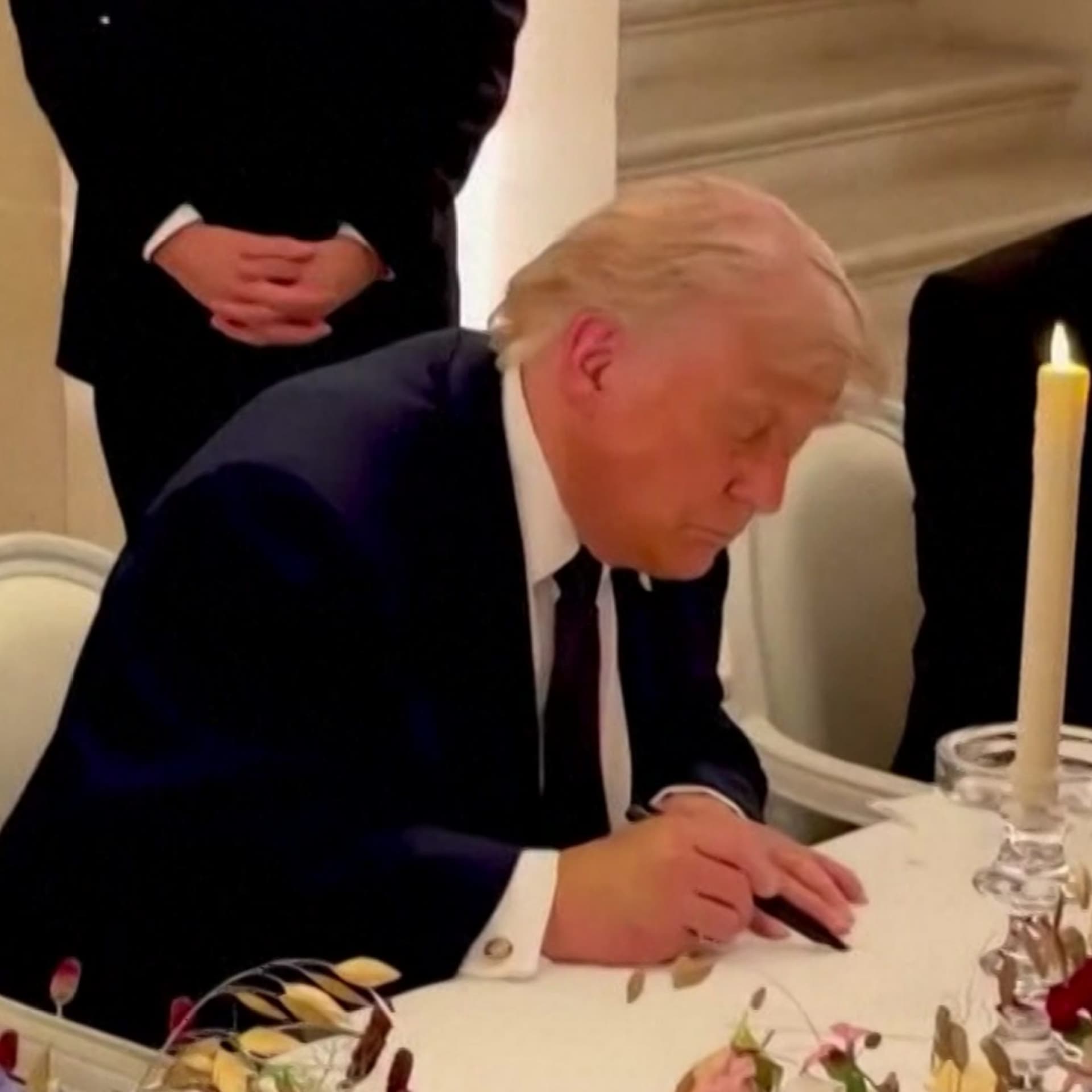
1:29After nearly four months of on-off conflict, a US blockade of Iranian ports and Tehran's virtual barricade across the Strait of Hormuz, everybody is feeling the economic pain. Could we now have seen the moment to relieve the tension and end the war? Well, on Wednesday, at a candlelit dinner in the Palace of Versailles outside Paris, Donald Trump signed a memorandum of understanding to extend their ceasefire. The same document was endorsed by the Iranian president in Tehran. In it, Iran agrees to dilute its enriched uranium in return for large-scale economic relief. So what more is the US president looking to get out of this agreement with Iran?
2:11It's a question I put to our US correspondent Thomas Morgan, who's in Washington. Donald Trump has said from the start, really, that one of the reasons that he entered into this conflict over 100 days ago was to make sure that Iran wasn't able to build any nuclear weapons. And he is confident that has come out from this deal. I mean, it has been said in this memorandum, it is written there, so we understand that that won't happen. But I think there are many question marks still with some of what's been written down in this text. I think the two main issues that some Democrats and some actually Republicans have also questioned about this memorandum of understanding surrounds the future of the Strait of Hormuz and also potential money that could be given to Iran for a reconstruction fund.
3:00Now, Donald Trump has vehemently denied the fact that the US would give towards a reconstruction fund, but written in this text, we've been told in a briefing by US officials is exactly that. If Iran adheres to what's in the agreement, the US would give them that sum of money to help reconstruct the country. And when it comes to the Strait of Amoz, yes, everything is reopened now as it once was before this conflict. However, after this 60 days of negotiation, and where they'll discuss in more detail what happens to some of the uranium that Iran has. The situation around the Strait of Amuse is still up for debate, i.e.
3:44the Iranians are saying they will impose a toll on ships using the straits. And that is something that has never happened before. And that is something that nobody across the world will want, certainly not many of the Americans that have been coming out criticising this deal. And you mentioned criticism from some of Donald Trump's close allies. Will that concern the president at the moment? Well, I think for him, he was under pressure really to get this deal done in some form. This was a conflict that was resoundedly across the US found unfavourable by so much of the public and even more so at a time when inflation is rising at its fastest rate for three years and also then obviously gas, oil, petrol, diesel prices skyrocketing because of the strait being closed, the key conduit for 20 % of the world's oil and liquefied gas.
4:37So he was under public pressure back here, although he has never kind of really shown that really. But I think he was growing increasingly frustrating over the last week with conflicts between Israel and Hezbollah and South Lebanon and tit-for-tat between his US blockade and Iran really. So he really needed to get it And he will look at this as a victory, even though he is being questioned by some from his own party back at home. Thomas Morgan. So how is this deal being viewed by Tehran? Kashair Johnady is from our Persian service and he's based in the US. Well, Mohamed Bogher Khalibov, the Iranian parliament speaker and chief negotiator, went on state TV Wednesday night to defend the agreement.
5:21and he claimed that Iran was the victor here and the United States and Israel had lost the war. He said that Iran managed to have Lebanon being included in the Memorandum of Understanding, which he considered a great achievement for Iran. And he also said that if the Americans refrain from their commitments, then Iran's ready to get involved in another war if the Americans want to fight. And a lot, of course, could change during the negotiations. this initial 60-day period, which has already started. But what are Iran's red lines on this? What's it prepared to give up? Well, these 60 days are going to be a very difficult period for both sides.
6:02Let's not forget the original nuclear deal during Obama was negotiated over 20 months. And Iran is still insisting on its red lines, including Iran somehow managed to get this commitment from the Americans that the highly enriched uranium Iran holds will be diluted on Iranian soil and destroyed on Iranian soil. The Americans were insisting that that should be shipped out of Iran. But some other obstacles remain regarding Iran's nuclear program. And that is Iran's insisting that it wants to do enrichment. The United States is against any level of enrichment in Iran. This was something that has to be negotiated.
6:45Then there is the question of Iran's missiles, Iran's proxies, but more importantly, the question of the future of the Strait of Hormuz. President Trump is insisting that Hormuz will be open to all maritime traffic without paying any kind of fees or any kind of levies. But Iran, the Iranian parliament speaker, Qalibov, today said that the initial 60 days where the negotiations are taking place, no fees will be collected from the passing ships. but then Iran and Oman will find a formulation with the help of the other Persian Gulf states to impose levies on ships that pass through the Strait of Hormuz because Iran and Oman, as the coastal nations, have to invest in the security of naval transportation throughout the Strait of Hormuz.
7:40Kashi Arjoneidi. Well, it was Israel's Prime Minister, Benjamin Netanyahu, who helped convince Donald Trump to go to war with Iran in the first place. But there's been no reaction from him since the deal was signed between Washington and Tehran. Part of the agreement calls for an end to military operations on all fronts, including in Lebanon, and that is causing concern amongst many Israelis. From Jerusalem, here's Lucy Williamson. Israel's conflict with Hezbollah in Lebanon could test the US ceasefire with Iran and the US-Israeli alliance. Donald Trump agreed to end this conflict and to respect Lebanon's territorial integrity but Israeli strikes and Israeli occupation continued with five Israeli soldiers injured in Hezbollah drone attacks.
8:30Donald Trump has frequently insulted and humiliated Netanyahu saying he does what he's told but Israelis from the far right to the liberal left say on this he shouldn't. I think that Netanyahu should do exactly what he wants to do and not be harassed by Donald Trump. We would like to protect our country from other terror activities. Netanyahu has no choice. He is not able to give Trump everything he wants because we have to stay living here. We have to survive. Israel's UN ambassador, a close ally of Netanyahu, has described the ceasefire deal as very bad for Israel. And both Netanyahu's political rivals and allies are piling on the pressure, calling on him to defy Donald Trump and continue fighting Hezbollah.
9:27We must destroy Hezbollah army capacity before anyone tells us that there is a ceasefire. We will have to protect ourselves. They still attacked us. They still build capacity to attack us. And that's something we cannot live quietly with. Benjamin Netanyahu is still insisting that the war with Iran was a success, boosting Israeli power and weakening Iran, even as his critics list the ways Iran has emerged stronger from this conflict, and both his political rivals and his allies point to the rift in the American alliance that was touted as stronger than ever. just months ago. Israel's Prime Minister has staked his political future on this war.
10:12The US and Iran will now begin negotiations over Iran's nuclear programme. Netanyahu will want to influence those discussions. With his hotline to Washington gone cold, he'll be looking for a way to do it. Lucy Williamson, as the continent's biggest economy, South Africa has always attracted people from abroad looking for work. But as the country faces rising unemployment, anti-minority, migrant feelings are on the rise. Protest groups have set a deadline of the end of this month for illegal migrants to leave. As Namsa Maseko reports now from Johannesburg, that threat has raised fears that Africans from other countries may once again become the target of xenophobic violence.
10:56Migrants are once again in the spotlight in South Africa. A chilling deadline has emerged from ongoing protests who want irregular migrants out of the country by the end of June. They must go back to their countries. Jacinta Ngobese Zuma is the leader of the March and March movement. And the thing that makes it like this, for them to keep playing the victim card, is because everyone wants to treat them like victims. The minute they come in here, they come with babies on their backs, and then everyone forgets that South Africans have their own babies that it needs to take care of. They have children, they must take care of those children in their own countries.
11:29What would happen next is unclear. But in preparation for the ominous June 30th deadline, Ghana, Malawi, Zimbabwe, Nigeria and Mozambique have cumulatively repatriated around 2 ,000 of their citizens. But many African nationals who are still in the country feel the clock is ticking.
11:52We're given papers. I have my own document that recognizes my refugee status in South Africa. I have my card and my document, but all of us are still being chased away. The children are afraid. We are asking for help. There is no respect. When you pass by here, you're insulted. The children are insulted, even at school. The ongoing protests have been largely peaceful. But violence, especially around informal settlements, simmers. At the end of May, the government of Mozambique said five of its citizens died in xenophobic violence in the Western Cape. South Africa's international relations minister, Ronald Lamula, disputed that number.
12:39He said police are investigating the deaths of two Mozambicans and a South African teenager. For many South Africans, the anger is at boiling point. They feel unheard in a country with unemployment at 32 percent and increasing economic inequality. For some, the anger can boil over into what appears to be blind xenophobia. Where are you from? Biasu. Biasu. So what are you doing here? Because we've been calling for you guys to leave the country. In a video which has been widely shared on social media, protest leader Ngosikonanda Bandaba, popularly known as Pagilum Tagati, who has more than one million online followers, approaches a Congolese man standing by the roadside.
13:27Just listen to us. We are saying this peacefully. Please go to your country. 30 June is the deadline, but it's not like you must leave on the 30th of June. Leave now, because the 30th of June, I can't control people of South Africa. Under pressure to act, President Cyril Ramaphosa has announced a new strategy to manage migration. We're going to increase the penalties, including imprisonment, for employers who continue employing undocumented foreign nationals whom they exploit. We are taking further measures to secure our borders and we are continuing the crackdown on officials who sell documents, facilitate unlawful entry.
14:10As the 30th June deadline looms, for many migrants in the country, it feels like a fresh wave of violence could be coming. Unless the root problems are tackled, the temptation to blame the neighbour is likely to return. Nomsa Maseko reporting. Still to come in this podcast. Two post-pits tell me about the whole community, how they were thinking, how they were revering the heavens. Archaeologists believe they've discovered a much older version of Stonehenge.
14:53everyone's heard about built as a loyalty program that lets you earn points on rent wherever you live and they just leveled up even more as of 2026 homeowners can now earn up to 1.25x points on their mortgage payments this is thanks to built's three new credit cards the palladium card obsidian card and blue card all three turn your housing payments rent or mortgage into flexible rewards. So you can choose the car that fits your lifestyle without missing out on points and exclusive benefits. Build points can be redeemed at top airlines and hotels, Amazon.com purchases, future rent payments, and more.
15:29Build points have also been ranked by top publications as the industry's most valuable point currency. Your housing payment is already your biggest expense. Make it your most rewarding. Find the car that fits your lifestyle and apply today at joinbuilt.com slash podcasts. That's J-O-I-N-B-I-L-T dot com slash podcasts. Make sure to use our URL so they know we sent you. Turns and limitations apply. Subject to approval and eligibility. Built cars are issued by Column N.A., member FDIC, pursuant to license for Mastercar International Incorporated. Hey, Chicagoland, the Wayfair store is in your neighborhood at Edens Plaza and Wilmette.
16:06Finally, you can feel the fabric, sit on the sectionals, and even open the refrigerators. Plus, our in-store designers will help you bring it all together with free one-on-one design support for any project on any budget. Yep, we said free. Oh, and did we mention the cafe? So what are you waiting for? Come see all that's in store. Visit the Wayfair store today at Edens Plaza and Wilmette. Wayfair, every style, every home. The biggest men's football World Cup in history is here. 48 teams and a record 104 games being played across the United States, Canada and Mexico.
16:46And the More Than The Score podcast is bringing you more than just the latest results, stats and fixtures. We're taking a closer look at the new teams competing, the Cups standout stars and the fans who are shaping the tournament. More Than The Score from the BBC World Service. Listen now wherever you get your BBC podcasts.
17:40Since the end of the Second World War, Japan has been known for its pacifist stance. Article 9 of its constitution specifically outlaws war as a means to settle international disputes. But in recent years, there has been a shift as the country says it needs to adapt to increasing tensions in the region, including with China. The country's defence minister, Shinjiro Koizmi, says that strengthening the country's military capabilities is critical to prevent war. He's been speaking to our Japan correspondent, Kurumi Mori, in Tokyo. I sat down with Defence Minister Koizmi at his office hours ago in Tokyo, and he stressed to me several times over the interview just how critical, how important it is for Japan to ramp up its defense capabilities to prevent conflict and not provoke it.
18:30So this is not Japan trying to enter anything. It is, he says, to defend itself, especially given the security environment that has changed dramatically in the past 80 years, since the end of the Second World War. The ministry issues an annual white paper, and it still calls China its greatest strategic challenge. I just want to point out that up until a few years ago, it was North Korea. So I asked him whether he was concerned about a possible military conflict with China. Japan must first strengthen its own defense capabilities, reinforce its alliance with the United States, and expand collaboration with like-minded countries.
19:15Building multi-layered deterrence is critical to ensure that no new war breaks out in this region. A lot of countries are increasing their spending on defence, and Japan's been doing likewise, hasn't it? Absolutely, yeah. Japan has a goal of upping their defence spending to now 2 % of its GDP. Minister Koizumi had said that defence-related spending in this fiscal year through next March 2027 would total 10.6 billion yen. And that basically means it's approaching that 2 % target more in line with other Western countries. But the newer bit I think we should be paying attention to actually is the April change that Prime Minister Sanai Takaichi announced about the change in policy of governing defense exports, basically eliminating restrictions on sales of lethal weapons and other defense equipment to Japan's closest security partners that it has agreements with.
20:13The defence minister spoke to me about the recent changes in this decades-old ban. We can now transfer defence equipment overseas. Australia has selected Japanese warships. Discussions are underway with the Philippines for used destroyers from Japan's maritime self-defence force. We are in deep talks with Indonesia, and New Zealand has also showed interest in acquiring Japanese destroyers. lawyers. And briefly, Kurumi, what does the public make of this? Is it split on whether or not it should be more militarised? Yeah, you know, Article 9 is a key, key point that everybody is talking about, because on one hand, you have a lot of people who saw the bad effects of the war and want to keep the identity of the pacifist constitution.
20:59On the other hand, other people are seeing reasons about the changing environment and the necessity for upping defence. Kurumi Mori. Three-year-old twins, Mercy and Goodness, are at home and able to watch each other as they play together. But that wasn't always possible because the girls from Nigeria were born conjoined at the head. They were separated after a long surgical procedure with the help of AI technology that blends the physical world with interactive 3D graphics. The BBC's Ruby Gleeson spent time with the surgeon who carried out the high-risk operation to separate the twins in Abu Dhabi.
21:41Originally from Nigeria, twin girls Mercy and Goodness were born conjoined by the head, a rare and life-threatening condition. For the first year and a half of their lives, they'd never seen each other face to face. But that all changed when they were separated last January with the help of cutting-edge AI, led by paediatric neurosurgeon Professor Awees Jelani from Great Ormond Street Hospital. I spent time with him as he prepared for the final stage of the operation. Mercy and goodness is what we classify as a total vertical craniopagus, which essentially means they are longitudinal, the head's a joint, top on, and their feet are away from each other.
22:21So it's quite a complex way of being conjoint. So what you then do is you do the separation of the brain and the blood vessels, then you try and expand the skin, and once you feel you have enough expansion, then you do the separation. So, where does the AI come in? The technology that we have now, the augmented reality, mixed reality technology, it really takes it to the next level where you don't have to do a lot of that 3D processing in your head. It is done for you and you can have those 3D images either suspended in space or superimposed onto the children that you're operating. It just makes your understanding of the whole anatomy and the problem so much more accurate.
23:00it. When you're doing the separation of conjoined twins, at certain points you have their entire brain surface exposed on the surgical table and the potential for causing injury to the brain is there and we've had that with our previous cases. The optimal way of doing the surgery is you do the separation whilst causing no trauma to the brains and this technique essentially allows us to do that. From the start we've called goodness twin one and mercy twin two, correct? Months of planning, every move choreographed. And then at last, it happens. Mercy and goodness after 19 months of life together, finally separated.
23:54I'm so, so happy. Six months on and the girls are on a long road to recovery. It's not been without complications, but the family are living a life that once seemed impossible.
24:20working by themselves. You can see how happy they are, can't you? Very happy. Very, very happy. The way they are looking at you, they're really happy. Ruby Gleeson reporting. Russian drivers are feeling the effects of a shortage of fuel for their vehicles as a result of the war with Ukraine. Drone attacks on both refineries and tankers have reduced availability. Kiev also appears to be disrupting Russian supplies in Crimea, a Ukrainian region annexed by Moscow 12 years ago. Stephanie Baker of Bloomberg is the author of Punishing Putin Inside the Global Economic War to Bring Down Russia. She told Sean Lay how bad the shortages are in Crimea.
25:02I think it is bad. The recent strikes are increasingly focused on the broader logistics network in Crimea rather than just military assets. So the Ukrainian drone campaign has struck multiple roads, bridges, depots, and fuel tankers and trucks moving through that land corridor between Russia and Crimea. That has resulted in severe fuel shortages, reports that people need to get a QR code from the government app Max in order to be able to buy fuel with long waiting lines. So it's having an impact as well as really turning away the Russian tourists who go there regularly in the summer. And when you say that the focus is on the land link between Crimea and Russia, does this mean that now some tanker drivers kind of don't want to do the job or don't want to risk driving fuel up and down that link?
25:58Well, I think traffic on those routes has dropped. And I think the strategy is to make those routes unsafe, not just for military supplies, but fuel supplies and cut off Crimea. And it's a deliberate strategy to isolate the peninsula. And it's something that Kirill Budanov, Ukraine's head of military intelligence, told me in an interview a couple years ago that they saw that they had an asymmetric advantage by attacking that land corridor. And I think now they've been able to do it more systematically because of the growth of Ukrainian drone production and capabilities. And it is having an impact and forcing Dmitry Peskov, the Kremlin spokesman to try to dismiss the reports of fuel shortages.
26:40He's blamed it on panic buying. But, you know, the reports on social media are very real. And the vulnerability of Crimea, is that really geographical as much as anything else? Or has Russia, in a sense, neglected to protect a part of Ukraine, which it annexed more than a decade ago now? It's mostly down to the geography and the fact that it doesn't have oil production or refining capacity itself. So it's quite easy to isolate the peninsula. Of course, there have been fuel shortages reported across Russia and other regions. Russia has imposed a gasoline export ban through the summer because of those shortages.
27:17And that's really stems from Ukrainian drone strikes on Russian refineries across the country. Crimea carries a symbolic value and a military strategic value for Russia. They use it as a staging ground and a military supply route for other Russian-occupied regions in Ukraine. So I think they view that as important to undermine Russia's campaign elsewhere in eastern Ukraine. Some of the international pressure on Russia over its oil exports has eased a little as a result of the Iranian war as countries in Europe and the United States, for example, want to keep oil exports flowing. But domestic supply for Russians themselves, if that's starting to become a weakness, how vulnerable does that make the kind of war effort in Russia?
28:05I mean, it's quite stark because Russia is one of the largest oil producers and the world is now reportedly planning on importing gasoline this summer. So I think it really does bring home the costs of this war to the Russian people, that this is causing a huge amount of disruption and hitting their economy, that they should not be having to block gasoline exports because of the shortages and the problems that they're experiencing at refineries. So, you know, I think it's definitely having an impact and potentially undermining Putin's ability to sustain the war. Stephanie Baker. The 93 Standing Stones at Stonehenge, the Neolithic site in southern England, draw in thousands of tourists and a fair few pagans from around the world.
Read the full transcript
28:53But what came before the ancient megaliths were dragged into place? Well, archaeologists believe that they've discovered an earlier version of Stonehenge about five kilometres away from the famous site. Here's our science editor, Rebecca Murrell. Stonehenge was built to mark the movements of the sun. The huge stones were placed precisely to line up with the sunrise on the summer solstice and sunset on the winter solstice. The discovery in the nearby village of Balford was a much more simple construction. All that's left of it are two pits in the ground, about 120 metres apart, which archaeologists believe held large wooden posts.
29:31The holes were discovered about 10 years ago, but a new analysis examining how the posts were positioned with a reconstruction of the ancient landscape sky and horizon reveals that they accurately lined up with the sun on the solstices. Phil Harding from Wessex Archaeology discovered the holes. Two post pits tell me more about the people 5 ,000 years ago. This tells me about the whole community. This tells me about how they were thinking, how they were behaving, how they were revering the heavens and how important and all that was. It tells them so much more about Neolithic society. It's not something you can hold in your hand, but it really is a find.
30:15Artifacts found near the pits, including pottery, flint tools and animal bone, suggest prehistoric people gathered at the site in the same way as they later did at Stonehenge. Rebecca Morrell. And that's all from us for now. If you want to get in touch, you can email us at globalpodcast at bbc.co.uk. You can also find us on X at BBC World Service. Use the hashtag Global News Pod. And don't forget our sister podcast, The Global Story, which goes in depth and beyond the headlines on one big story. This edition of the Global News Podcast was mixed by Johnny Baker and produced by Stephen Jensen and Wendy Urquhart.
30:54The editor is Karen Martin. I'm Nick Miles. And until next time, goodbye.
31:28Transcription by CastingWords check out The Global Story on BBC.com or wherever you get your podcasts.
From the publisher
The US and Iranian presidents have signed a memorandum of understanding which could be a first step to ending the war between the two countries. It includes an end to fighting on all fronts, the reopening of the Strait of Hormuz and the lifting of the US blockade of Iranian ports. Also: Japan’s Defence Minister, Shinjiro Koizumi, tells the BBC that strengthening the country’s military capabilities is critical to preventing war in the region; archaeologists in Britain believe they've found a precursor to Stonehenge just five kilometres from the prehistoric monument; how AI helped the survival chances of two sisters who'd been born conjoined at the head; and Teddie Beverley, the last surviving member of the famous British singing trio, the Beverley Sisters, has died at the age of 99.
The Global News Podcast brings you the breaking news you need to hear, as it happens. Listen for the latest headlines and current affairs from around the world. Politics, economics, climate, business, technology, health – we cover it all with expert analysis and insight. Get the news that matters, delivered twice a day on weekdays and daily at weekends, plus special bonus episodes reacting to urgent breaking stories. Follow or subscribe now and never miss a moment. Get in touch: globalpodcast@bbc.co.uk Photo: US President Donald Trump signs the US Iran deal in Versailles, France, alongside the President of France Emmanuel Macron Credit: White House Television Service/EVN