
In short
Global News Podcast covers: (1) Nepal flash-flood rescue—two hydropower workers pulled alive from a tunnel nine days after floods killed 1,300+; a third body found; 40 others feared trapped. (2) UK politics—two Reform Party officials resign after undercover footage suggests schemes to get around election laws on foreign donations. (3) Psychiatry—New Zealand authorizes clinicians to prescribe MDMA for PTSD in controlled settings with psychotherapy. (4) Germany auto industry—Volkswagen to cut 50,000 more jobs by decade end (100,000 total planned), possibly closing German plants. (5) Spain’s Ceuta—sexual assault reports rise after July migrant influx; 23 cases recorded, prosecutor says more. (6) Africa—BBC investigation into “genital theft” rumors causing mob killings; Tanzania mechanic Boniface Amgala describes attack. (7) Scotland wildlife—RSPB says injured sea eagle chick “Kinky” survives three years after parents skipped a breeding season to nurse him.
Guests/backgrounds
No traditional guests; reporting by BBC correspondents: Stephen McDonnell (Beijing), Rob Watson (UK politics), Paul Moss (global affairs/psychiatry), Klesia Sala (Italy politics), Alexander Demling (Der Spiegel auto), Rob Young (interviewer), Sherehan Al-Akras (Ceuta), Alfred Lastic (genital theft), Dr. Susanna Ascaso (Ceuta clinician), Elias Mondobo (Tanzania district commissioner), Michael Silavwe (border businessman), Dave Sexton and Victoria Gill (RSPB/sea eagle).
Key claims/examples
Nepal rescue used “call down the tunnel”; Tibet side shifted to water/food testing, shelters, disinfecting, hotlines, and matching belongings. Reform scandal: video shows talk of registering a donor and routing foreign money via intermediaries. MDMA: described as historically used in psychotherapy; parallels to LSD/ketamine debates. Volkswagen: crisis driven by China competition and shrinking profits; job cuts voluntary under guarantees until 2030; possible shift of factories toward defense. Ceuta: victims report assaults in forest/shelter; prosecutor warns underreporting. Genital theft: medical exams found no evidence; verified videos show attacks across multiple countries; Amgala’s friend killed. Sea eagle: Kinky’s crooked wing healed enough to fly; parents’ extended care described as unprecedented.
Written by AI. May contain mistakes. Listen to the episode to check what was said.
Chapters
Tap a time to open that second in VORescue Operation in Nepal
1:19 to 3:08
Discussion about the dramatic rescue of two workers from a tunnel in Nepal after flash floods.
“Rescuers in Nepal pulled two people alive from a tunnel nine days after the devastating flash floods.”
Monitoring the Situation in Tibet
3:09 to 6:46
An update on the rescue efforts and the situation in Tibet following the disaster.
“In Tibet, which is tightly controlled by China, the official death toll remains low at just over 20, with around 500 missing.”
Political Scandals in the UK
6:48 to 9:58
Investigation into the Reform Party's financial scandals and its implications.
“The past couple of years here in Britain have seen the populist anti-immigration reform party become a major political force.”
MDMA Prescribed for PTSD in New Zealand
10:03 to 12:54
New Zealand's authorization for psychiatrists to prescribe MDMA for PTSD treatment.
“New Zealand has become only the second country after Australia to authorise psychiatrist to prescribe MDMA, the active ingredient that's found in the party drug ecstasy.”
Political Stability in Italy
12:55 to 14:00
Exploring the political stability under Giorgia Meloni's government in Italy.
“But Giorgia Meloni's government has become the longest serving in Italy since it became a republic after the Second World War.”
Discussion on Moroccan Border Logistics
14:00 to 14:35
Learn about the challenges involved in transporting goods to Morocco.
“They have to take and get it to the border again, to Morocco.”
Crisis in the German Car Industry
15:10 to 19:24
Explore the challenges faced by Germany's car industry and potential job cuts.
“Germany's once-mighty car industry is in crisis, in part because of growing competition from China and its cheap electric vehicles.”
Migrants in Ceuta and Sexual Assaults
19:24 to 22:45
A report on the influx of migrants in Ceuta and the associated risks they face.
“The Spanish territory of Ceuta in North Africa saw a massive influx of migrants in July.”
Misinformation and Genital Theft Panic
22:45 to 27:08
An investigation into the false claims of genital theft and its deadly consequences.
“A BBC investigation has found that more than 80 people have been killed in a number of African countries following false claims of what's being termed genital theft.”
The Remarkable Recovery of Kinky the Sea Eagle
27:08 to 28:03
The inspiring story of a sea eagle's recovery after a storm.
“has been spotted flying in the skies off the west coast of Scotland.”
Show all 11 chapters
The Journey of Kinky the Sea Eagle
28:03 to 28:55
Learn about Kinky, the injured sea eagle, and his remarkable recovery.
“Then, in an unprecedented display of extended sea eagle parenting, the bird's parents skipped a year's breeding season to tend for their year-old injured offspring while his wing healed.”
Transcript
Automatic transcript. May contain errors.0:00This BBC podcast is supported by ads outside the UK.
0:30and more options to their lineup can shop at machinefinder.com. Booyah! For curb appeal that lasts, shop Labor Day Extra Big Deals at Lowe's. For a limited time, get 50 % off all Holland pavers. Plus, save$110 on the Ego Power Plus 56-volt 2.5-amp-hour blower-trimmer combo kit. Now just$249. Labour Day deals are on now at Lowe's. In-store and online. Valid through 9-7. While supplies last, selection varies by location. Holland Pavers' offer excludes Alaska and Hawaii. This is the Global News Podcast from the BBC World Service. I'm Janat Jalil and at 15 hours GMT on Friday the 4th of September, these are our main stories.
1:19Rescuers in Nepal pulled two people alive from a tunnel nine days after the devastating flash floods. Two officials from the British Anti-Immigration Party reform stand down after undercover journalists film them talking about foreign donations. The German carmaker Volkswagen is cutting tens of thousands of jobs. Also in this podcast, the story of the badly injured sea eagle chick nursed back to health by his devoted parents. For an eagle to get an injury and a broken wing, that's it normally, but he is a true survivor. And now here he is, three years on, and he's still with us.
2:03We start our podcast in Nepal.
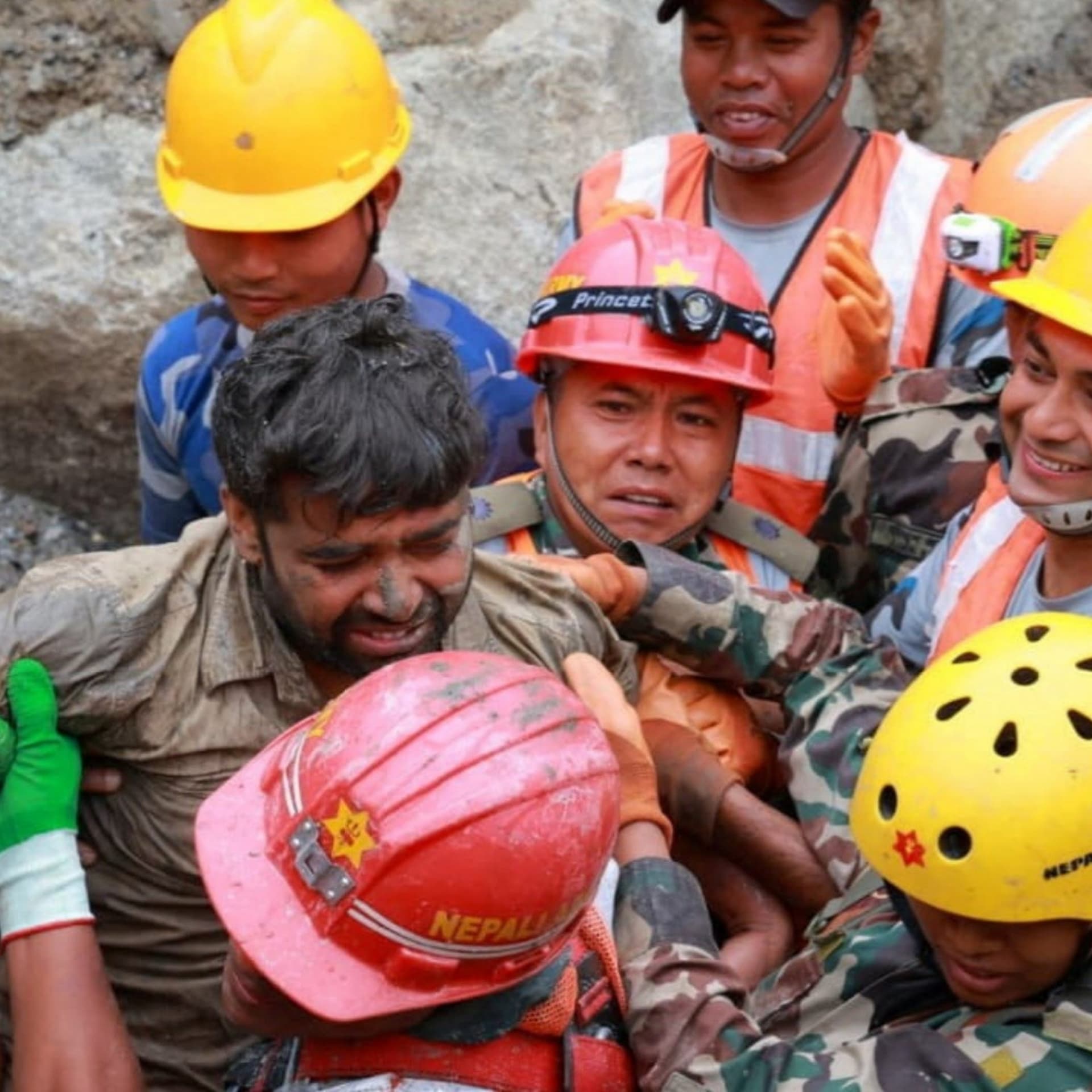
2:09That was the dramatic moment. Two workers were rescued from a hydropower tunnel in this Himalayan nation nine days after devastating flash floods that have killed more than 1 ,300 people. The two men were lifted out of a muddy hole, with one of them on a stretcher putting his hands together as if in prayer. The wife of one of those rescued, Kabir Maharajan, said it was a miracle. He didn't recognise me. He only said things like, what happened to me? And where am I? and didn't say anything else. He's currently in intensive care. He asked for water, so I gave him some. Now he has recognised me and nodded his head.
2:49He has an injury to his leg and hasn't been able to speak that much. His body has turned yellow because he wasn't getting enough oxygen. However, rescuers later found the body of a third person in the same tunnel. Around 40 other people are believed to be trapped there, and Nepali officials say they are hopeful of finding more of them alive. Across Nepal, thousands remain missing. In Tibet, which is tightly controlled by China, the official death toll remains low at just over 20, with around 500 missing. Our Beijing correspondent Stephen McDonnell is monitoring developments and he told me more about the rescue in Nepal.
3:27Imagine what a shot in the arm this is for rescue teams on the Nepal side of the border were into day 10 of this emergency. I don't think many people expected that there would be any more survivors, but obviously they did, especially in these tunnels. And then to have pulled these two workers out alive, I mean, you know, I think it would give them all energy to charge on and keep going and actually look for others because officials are saying that maybe there are as many as 40 workers in that particular part of the hydropower network, but they seem to be hopeful that they can find others later today.
4:10I mean, remarkably, to reach those workers who've come out today, they've been pumping air in and cameras, but it was just the old-fashioned call down the tunnel. Is anyone in there? And they hear these two voices come back. Yes, we are. And the Nepalese army then not only reached these two trap workers, but got them out alive. I mean, just absolutely incredible. And how about remote areas of Nepal, Stephen? Are rescuers now able to reach there? And what's the situation in Tibet where information is much harder to get? Certainly on the Tibet side of the border, the rescue does seem to have changed into an effort much more to deal with the living.
4:53So all of the information we're getting now from the People's Liberation Army is that they're testing water and food that the survivors are eating. They're putting up shelters, they're disinfecting areas. They're also looking after the psychological wellbeing of people who might have lost loved ones. Something else they've done is to pull together, I think around 800 different items of people's personal belongings. Now, they're thinking that these belongings can be attached to the missing and on the Tibet side of the border that's nearly 550 people so items like torn bits of police uniforms children's toys personal belongings like bracelets and the like and then they're attempting to match those with individuals and I guess in the long run it's the pretty grim task of determining who is or isn't coming back and then to be able to say to those who are grieving already yes indeed your family members are not coming back they've also added I should add set up these two hotlines for people to call who have missing loved ones one in English and one in Chinese and so that's for people who specifically think that they are missing somebody in the Tibetan part of China and I think 800 calls around by noon on Wednesday.
6:28And at least I think half of those are from people overseas. So it shows how many amongst that nearly 550 missing, how many foreigners are missing. So that's all pretty terrible. But at least those systems have been set up to try and help people deal with this crisis. Stephen McDonnell. The past couple of years here in Britain have seen the populist anti-immigration reform party become a major political force. Its leader, Nigel Farage, is often compared to Donald Trump, and he's been talked about as a future British Prime Minister. But this year has seen reform embroiled in financial scandals.
7:08The party has repeatedly denied any wrongdoing. But now two senior officials have stepped down after undercover journalists secretly filmed members of the party apparently suggesting ways of getting around the law to secure a large foreign donation. Here's a clip from the video made by Verbatim Investigations and broadcast by Channel 4 News. In it, you hear Mr Farage thanking two men, one of them posing as an American and the other as his British-based son. The mechanism now for this next phase is, we've had some discussion with Dan, with James, all above board. I'm going to be the, it'll be me, so I'll be the registered donor and so I think there'll be some conversations you know, necessarily, you know, lawyers, back office and so on but then Dad will send the money to me and then as soon as that's done, all of those conversations are had then the money's available.
8:04Our political correspondent Rob Watson told me more about the undercover investigation. It's about 30 minutes long of television which is utterly excruciating if you're Nigel Farage or a senior member of the Reform Party, because what it shows in pretty sort of graphic detail is an attempt by what it looks like an attempt by two senior Reform officials, one of them very close to Nigel Farage, essentially to get round Britain's election laws which prevent political parties from getting money from abroad. I mean, it's as simple as that. And added to that is the sort of sense of there being lots of meetings in places which are very expensive, very posh in London and beyond.
8:50In other words, somewhat undermining the idea of reform as this sort of party of the people and a party that's sort of different to the others. And Rob, the timing of this couldn't be worse for reform because they're holding an annual conference and you're there right now trying to relaunch the party after a series of recent scandals. That's absolutely spot on. until fairly recently they were leading in the opinion polls. That is no longer the case. They've lost their momentum. And this conference was supposed to be all about restoring that and presenting reform as the sort of populist right party that deal with the issues that people of Britain care about, such as immigration and cost of living.
9:29But this scandal goes back to what really seems to have been hitting reform in the polling, and that is concerns over its finances, the finances of its leader, Nigel Farage, the finances of the party more generally and concerns really about whether it wouldn't be a rather divisive force in British politics and that sort of bigger philosophical question about whether an insurgent populist style of party could actually govern the country. So this was the absolute last thing they needed as that conference kicks off. Rob Watson. New Zealand has become only the second country after Australia to authorise psychiatrist to prescribe MDMA, the active ingredient that's found in the party drug ecstasy.
10:14It will only be administered in a controlled clinical setting to patients with post-traumatic stress disorder. Our global affairs reporter, Paul Moss, told me more. Well, this is, as you suggested, the drug that's known as part of ecstasy, which makes people dance all night at rave parties. But yes, it does seem to have clinical uses. people don't realize that in fact long before it was used by people at parties back in 1911 it was developed and used in psychotherapy because the idea is that the feeling of well-being it induces allows people to think about perhaps traumatic things that have happened which they might otherwise be blocking out so in a sense while New Zealand might think it's ahead of the curve there's going back to the original purpose of MDMA as you suggested particularly going to use on people with post-traumatic stress disorder in a clinical setting.
11:04And whilst they're under the influence of MDMA, they'll be given psychotherapy with the idea it might be more effective than otherwise. Now, to some people, this might sound like quite a radical approach compared to traditional methods, is it? Well, Australia's actually been doing this, New Zealand's neighbour, for the last three years. But using MDMA in a clinical setting is really part of a growing belief among a lot of psychiatrists that drugs which are considered mainly for recreational, often illegal purposes, do have a clinical use. And again, there is history here. Back in the 1950s, LSD was given in very small doses to people who were suffering from alcoholism and depression and had some effects.
11:43Now, I should emphasize this is always done in a clinical setting. No one is suggesting that if you're feeling a bit depressed, just take an ecstasy tablet and you'll be fine. but there is a growing belief that this and also ketamine can be used to help people in a way that otherwise psychotherapy doesn't work. Yes I think the actor Cary Grant took LSD in that setting. Very well remembered. And magic mushrooms have also been used in those settings but is there opposition to any of this? There is yes. I mean first of all there is a big debate about whether these drugs really are efficacious but then you do tend to get drugs about any medicine used in psychiatric circumstances causing debate.
12:21I mean, think about the rouse over Prozac and related antidepressants still going on. Is it effective? Does it have bad side effects? Similar debates are going on about these other psychedelic drugs. There is also political opposition, I should say. I mean, most countries do have strict laws against possession of things like LSD and ecstasy. And there are a lot of politicians, they're very opposed to anything which might seem to be indulging or sort of favouring these drugs. So I think it's safe to say that like all debates in psychiatry, this one is set to run. Paul Moss. It's not an outcome that many would have predicted, especially for an Italian leader whose party has neo-fascist roots.
12:59But Giorgia Meloni's government has become the longest serving in Italy since it became a republic after the Second World War. She's the country's first female prime minister. Klesia Sala reports. Giorgia Meloni has been in office for nearly four years and the head of a coalition led by her hard right Brothers of Italy party. She's led a period of unprecedented political stability for Italy, a country that has seen 68 governments in 80 years. Her strong opinions were initially met with an ease in some quarters internationally, but she soon built strong relations with the European Commission chief Ursula von der Leyen.
13:35Within Italy, her supporters say she's boosted employment and implemented stricter fiscal discipline, but critics claim that her government has survived by neglecting vital structural reforms. Still to come in this podcast, with thousands of migrants still in the Spanish territory of Ceuta, we hear how reports of sexual assault are rising there. They are sleeping at the mountains and the beach and doing everything they want without any law. They have to take and get it to the border again, to Morocco.
14:35We'll be right back. John Deere certified pre-owned equipment and more options to their lineup can shop at machinefinder.com. Booyah!
15:07This is the Global News Podcast. Germany's once-mighty car industry is in crisis, in part because of growing competition from China and its cheap electric vehicles. Volkswagen is still the biggest carmaker in Europe, but the company is to cut a further 50 ,000 jobs by the end of this decade. That would bring the total number of planned layoffs to 100 ,000 and could see the closure of plants in Germany. Alexander Demlin is the auto correspondent for the German magazine Der Spiegel. Rob Young asked him how big a crisis this is for Volkswagen and the German car industry as a whole. So the crisis is pretty big.
15:47The German car makers are basically, they were the most globalised companies and now with China competing with them, they have a very big China business that's shrinking now because of the competition, because of the tariffs from Donald Trump. They are in trouble. They are still profitable, but profits are decreasing. And so they need to cut workers just to bring down cost. And how will they cut these workers? Will people be allowed to retire, maybe retire early? Or are huge numbers of people in towns where the biggest employer is likely to be car making just going to be thrown out of the labour force?
16:27No, it will be voluntary. So they have a job guarantee until 2030 and they just need to find workers that are willing to go. But still, 50 ,000 is a pretty big number and they will look for retirees and people who are willing to look for another job. And this will still be a big strain on these cities because you don't have productive employment anymore. You have a lot of retirees. And there are the companies that supply components and services to the likes of Volkswagen as well, which will also be hit if Volkswagen is planning to make a million fewer cars a year. What is the plan for Germany's industrial base?
17:12Germany has been the economic engine of Europe for decades. Car making lay at the heart of that. But China now poses a really big challenge to it. Yeah, so I mean that the plan for Volkswagen short term is moving production to Eastern and Southern Europe, where they have plants that are just producing more cheaply than in Germany. And I think the EU's plan is to force Chinese car makers to come to Europe to produce here. But for Germany, that is pretty dire because the Chinese, they don't want to pay German wages and deal with German unions as well. So we're looking at shrinking German industry for years if nothing else happens.
17:54And do political parties have a plan then to retrain Germans to be able to get work, to set up companies, for example, in a world where China dominates global car making in the way that Germany did in the previous century? Yeah, so, I mean, politicians are working on, for example, transforming some of these factories to defense factories. Germany is investing a lot of money into this army because of the Russian threat. And so some old car factories could become defense factories. It's just the question if all of that works. I mean, the car plans are pretty big and for a tank plant, for example, you don't need that much workers.
18:38So either we have to do it through the invisible hand of the market and just people looking for other employment, or you have to invest much more into defence. And is this something that Germans are talking about, about the need to change the very nature of the country's economy, the way that people earn a living? I think we're not there yet because Germany is coming from a long stretch of prosperity, where globalization and the success of the car industry and other industries just lifted all boats. And Germans are struggling now with this moment. But I think that the change is inevitable. And the sooner people accept that the other industries need to step up, the better.
19:23Alexander Demling of Der Spiegel. The Spanish territory of Ceuta in North Africa saw a massive influx of migrants in July. In just a couple of days, around 70 ,000 people, most of them young men, breached the security fence separating it from Morocco or simply swam across. Although most have since returned, several thousand still remain. There have been large protests across Spain over the government's handling of the crisis, with some accusing it of abandoning Ceuta. Now the authorities in the Spanish territory say 23 cases of sexual assault have been recorded there since the mass influx of migrants.
20:05But Ceuta's chief prosecutor says the real figure could be much higher. Sherehan Al-Akras reports. In a shelter in Ceuta, women and children sit under covers trying to shield from the hot sun. There are some of the thousands who crossed into Ceuta at the end of July. Most of them told the BBC that they left their homes in search of work in Europe. But for some, reaching Souta took a darker turn. Sarah, not her real name, was sexually assaulted while sleeping in the forest. We've changed her name to protect her identity. A married man was next to me and touched me in inappropriate places. I tried to defend myself in that situation, moved away and made sure not to go near him again.
20:48I didn't want any trouble, as there were drones overhead and soldiers nearby. I was afraid that if I tried to flee the area, the soldiers would arrest me. I was caught in a difficult dilemma. I was forced to stay there until morning and I managed to escape. There are concerns that the number of sexual assaults in the city could be higher. SOTA's chief prosecutor says many victims have not filed a report, either out of fear or because of their current status in SOTA. Hello. Hello. Thank you for your time. Dr. Susanna Ascaso has treated several victims. The youngest, she says, was just 10 years old.
21:24It's surprising for us. We are not used to that thing. It's horrible. Beyond the emergency room, Dr. Escaso is concerned, like many others in Ceuta, about how the small Spanish enclave will cope with those migrants who remain. They are sleeping at the mountains and the beach and doing everything they want without any law, under any law. So I think they have to take care of them and get it to the border again, to Morocco. Others, like Sabah, have stepped into hell. She's opened her home to feed migrants. We met her as she prepared food.
22:02We want to help, but the conditions are dire. You see girls going through rape, sleeping in the forest. Any one of them could be my daughter, my granddaughter, or a member of my own family. It's thought that there could be more than 5 ,000 migrants still in Sauta. Around 1 ,500 of them are unaccompanied minors. Many are being housed in shelters, but some are still sleeping outside. In recent days, there's been growing tensions between migrants and locals, and the government is under growing pressure to resolve the crisis. But for now, the migrants left in the city are waiting to find out what happens next.
22:44Sherihan Al-Akras reporting. A BBC investigation has found that more than 80 people have been killed in a number of African countries following false claims of what's being termed genital theft. These false rumours which are being spread on social media allege that a simple tap on the shoulder by a stranger can cause a man's genitals to shrink or disappear. Despite repeated assurances from doctors that there is no medical basis for these claims, there have been repeated mob attacks which have left entire communities gripped by fear. One survivor is Boniface Amgala, a mechanic from southern Tanzania.
23:21Alfred Lastic went to meet him. Boniface still bears the scars of the day. He nearly died in April this year. The father of four says he had gone to a restaurant for lunch with a friend when a crowd suddenly surrounded them. The crowd dragged him outside and began beating him. after someone accused him of stealing another man's genitals. Within minutes, the accusation had turned into a brutal mob attack. They were beating my friend over there, and I was being beaten here. We were in the ditches, and they were also throwing stones. It is until I lost consciousness. As for my friend, they took him away to a different location and killed him there.
24:12Boniface regained consciousness in hospital two days later. Months on, he still suffers constant headaches and sometimes walks with a limb. If I walk for even an hour, I struggle and I still have to be on medication. And now, my life has come to a standstill. I have closed my business. I am not working and I have no support. My children offer their sympathies, and the two have always been crying. Bonifaz says he has no idea who made the original accusations, but by then, fear had already taken hold. Behind me is the Tanzania-Zambia border, one of the region's busiest trade crossings. So earlier this year, the area became the centre of widespread panic after rumours of so-called genital theft, which spread through communities on both sides of the border and on social media.
25:12Michael Silavwe, a businessman at the border of Tanzania and Zambia, witnessed one of the incidents. I started hearing about genital theft through TikTok and they took it easy. In the evening, I saw people running. I then had to look what was going on outside my shop. Upon following, I learned that a man had been caught and accused of stealing male genitals. Then I found some people beating the man. Several people were arrested and some were sentenced to prison in connection with other mob attacks linked to the genital theft rumors. Boniface says he has not pursued his own case as his priority for now is to recover fully from the injuries he suffered.
25:59Medical examinations found no evidence that anyone's genitals had disappeared. The BBC verified videos from several countries showing people being attacked after similar accusations. The rumours had spread from the Democratic Republic of Congo to Zambia, Tanzania, Mozambique, Malawi and Kenya. As police tried to restore order, those claiming their genitals had disappeared were taken to hospital, but the violence continued. Elias Mondobo is Tanzania's Momba District Commissioner, Uchambuzi. An analysis and investigation suggested that the incident was rooted in superstitious beliefs, which is linked to criminal acts.
26:46Essentially, individuals conspired to commit a crime and incite public panicker for their own benefits. For Boniface, the impact of that day stays with him. His injuries may heal, but the scars left by misinformation could remain for the rest of his life. That report was by Alfred Lastic. A sea eagle that was badly injured as a chick when a severe storm blew his nest out of a tree has been spotted flying in the skies off the west coast of Scotland. The eagle, known as Kinky because of his crooked wing, was not expected to survive. But in a display of extended parental care never seen before in sea eagles, his parents sacrificed their entire next breeding season to nurse him back to health.
27:35Dave Sexton from the bird charity, the RSPB, says Kinky's survival is simply miraculous. When we first saw Kinky, you know, now three years ago, he was dragging his wing along the shoreline and we thought that's it. For an eagle to get an injury and a broken wing, that's it normally. But he is a true survivor. see him again now on Mull has just upturned everything I ever thought about white-tailed eagles that they have been able to look after this chick long after it should have fledged and long gone but they kept going they looked after him and now here he is three years on and he's still with us our science correspondent Victoria Gill has more kinky the sea eagle as he's affectionately known has become something of a local celebrity on the Isle of Mull his wing was broken when he and his nest fell from a tree during a storm back in 2023.
28:27Then, in an unprecedented display of extended sea eagle parenting, the bird's parents skipped a year's breeding season to tend for their year-old injured offspring while his wing healed. Now, with a marked bump in the limb that gives Kinky his distinctive crooked silhouette, he appears to be thriving. This latest sighting reveals Kinky survived the winter alone, but the next phase of his life, experts say, could be dangerous as he attempts to establish his own territory as an adult. Victoria Gill. And that's all from us for now. If you want to get in touch, you can email us at globalpodcast at bbc.co.uk.
Read the full transcript
29:05You can also now watch our episodes in full. Just search for the Global News Podcast on YouTube. This edition was mixed by Ricardo McCarthy and the producers were Arian Kochi and Oliver Burlough. The editor is Karen Martin. I'm Jeanette Jalil. Until next time, goodbye.
29:29Get more with BBC Podcasts, wherever you listen. Be the first to listen to your favourite shows like Evil Genius, Good Bad Billionaire and You're Dead to Me with a subscription to BBC Podcasts Premium on Apple Podcasts. You can also enjoy a range of our podcasts ad-free with an Amazon Music subscription.
From the publisher
Rescue crews in Nepal have freed two workers from a blocked hydropower tunnel, nine days after they were trapped by debris from flash floods that devastated an area on the border with Tibet. Shortly after the two survivors were lifted out of the tunnel, the body of a third person was found. About forty people are still thought to be inside the tunnel. Across Nepal thousands remain missing and in Tibet, tightly controlled by China, the official death toll remains low at 20 with around 500 missing. Also, New Zealand becomes the second country, after Australia, to treat trauma patients with the active ingredient used in ecstasy. Britain's anti-immigration party faces another funding scandal. VW cuts a further 50,000 jobs, and the Scottish eagle called Kinky, because of a crooked wing, flies high against the odds.
The Global News Podcast brings you the breaking news you need to hear, as it happens. Listen for the latest headlines and current affairs from around the world. Politics, economics, climate, business, technology, health – we cover it all with expert analysis and insight. Get the news that matters, delivered twice a day on weekdays and daily at weekends, plus special bonus episodes reacting to urgent breaking stories. Follow or subscribe now and never miss a moment. Get in touch: globalpodcast@bbc.co.uk Photo: A man is carried by members of a search and rescue team after they rescued alive two people who had been trapped inside a tunnel in Nepal. Credit: Nepal Army/Handout via REUTERS.



