In short
This BBC Global News Podcast covers four main stories. In the UK, Defence Secretary John Healey resigns, claiming Labour Prime Minister Keir Starmer and the Treasury failed to fund a defence plan, risking reduced readiness and greater danger to personnel and the country. Background: a strategic defence review said Britain must spend more after decades of underinvestment, including on drones and unmanned vehicles. In the Middle East, Iran says its US ceasefire is “practically meaningless” after US strikes; analysts say negotiations continue alongside escalating military pressure, with Lebanon/Israel a key sticking point. In the Canary Islands, Pope Francis meets migrants and urges legal, safe migration pathways; Spain’s government is offering undocumented residents legalization. In Mexico, behind-the-scenes coverage of World Cup kickoff at renovated Azteca Stadium, amid anti-tournament protests.
Guests
Rob Watson (UK correspondent), Sebastian Usher (Middle East analyst), Tim Franks (interviewer), Sarah Rainsford (Canary Islands correspondent), Will Grant (Mexico correspondent), Katie Watson (Australia correspondent), Dr Claudio Feliciani (University of Tokyo), Lea Korsgaard (Danish butterfly author).
Written by AI. May contain mistakes. Listen to the episode to check what was said.
Chapters
Tap a time to open that second in VOUK Defence Secretary Resignation
1:33 to 2:25
Discussion on the resignation of the UK's Defence Secretary and its implications.
“The UK's Defence Secretary resigns saying a plan put forward by Keir Starmer could make the country less safe.”
Political Crisis Explained
2:25 to 3:23
Rob Watson provides insight into the significance of Healy's resignation.
“But the Prime Minister and the Treasury had failed to provide the money the nation needs to defend itself.”
Current State of UK Defence
3:23 to 5:49
Exploration of the state of Britain's military capabilities and funding issues.
“I mean, to accuse the Prime Minister of essentially putting the country's troops and security at risk is about as serious a charge as it gets.”
Iran-US Ceasefire Status
5:49 to 7:39
Discussion on the current state of the ceasefire between Iran and the US.
“and Iran says its ceasefire with the US is now practically meaningless.”
Negotiations and Military Tensions
7:39 to 8:29
Analyzing the dual strategy of negotiation and military strikes in US-Iran relations.
“But at the same time, people and not just President Trump, who's been saying we're terribly close to a deal.”
Pope's Visit to the Canary Islands
8:29 to 12:39
Coverage of the Pope's visit focused on migration and humanitarian issues.
“for playing this game of brinkmanship now.”
World Cup Kickoff in Mexico
12:39 to 14:03
Preview of the World Cup opening match and associated protests.
“with the co-host Mexico taking on South Africa in the opening game at the Azteca Stadium.”
Inside the Renovated Azteca Stadium
14:03 to 16:45
Explore the major renovations and history of the iconic Azteca Stadium.
“The iconic Azteca stadium has undergone a major renovation over the past two years, with the Mexican bank having acquired the naming rights with a loan of around$100 million.”
Upcoming World Cup Coverage
16:45 to 17:04
Learn about more coverage on the World Cup and its controversies.
“And we have more on the World Cup and the controversies that have surrounded it on our YouTube channel.”
Inquiry into Unsolved Cases in Australia
19:05 to 22:08
Discussing a new inquiry into unsolved murders and disappearances in Australia.
“A new inquiry is underway in Australia, focusing on unsolved murder cases and disappearances over the past six decades.”
Show all 12 chapters
Turning Left: A Fascinating Study
22:08 to 23:27
Explore the intriguing findings of a study on the direction people walk.
“Now ask yourself, when you're heading for a walk around a park, a museum or even an empty room, would you start by walking in a clockwise direction or anti-clockwise?”
Lea Korsgaard's Butterfly Quest
23:27 to 27:17
Follow journalist Lea Korsgaard's journey to spot all butterfly species in Denmark.
“And sometimes it comes from an unlikely place.”
Transcript
Automatic transcript. May contain errors.0:00This BBC podcast is supported by ads outside the UK.
0:30The new tropical butterfly refresher from Starbucks. Guava and passion fruit flavors with mango pineapple flavored pearls. Yeah, that feels like summer before you even taste it. Funny how one small stop becomes the best part of the day. Start your summer rhythm with Starbucks. Try the new tropical butterfly refresher from Starbucks. Hey, it's Ryan Seacrest for Jewel Osco. Ready to save? It's time for Cyber Deals. Kick off summer with fresh savings that brighten the season. You don't want to miss these exclusive week-long digital offers on your favorite products that are only available when you shop online.
1:08Save on eligible items from Gatorade, Oreo, Frito-Lay, and Doug. Only available now through June 16th on pickup or delivery orders only. Restrictions apply. See the website for full terms and conditions. This is the Global News Podcast from the BBC World Service. I'm Charlotte Gallagher and at 15 hours GMT on Thursday the 11th of June these are our main stories. The UK's Defence Secretary resigns saying a plan put forward by Keir Starmer could make the country less safe. Iran says the ceasefire with the US is now practically meaningless. Is there any hope for an imminent peace deal? Also in this podcast we take you behind the scenes as the World Cup is about to kick off.
1:57It is resplendent. It is amazing. It looks completely ready. The pitch is pristine. The seats are incredible.
2:11We begin in Britain, where the man in charge of the country's defence has announced his sudden resignation from the government. In a letter to the Prime Minister, John Healy said he was proud of what the Labour government had achieved in the past two years in terms of defence commitments. But the Prime Minister and the Treasury had failed to provide the money the nation needs to defend itself. Our UK political correspondent, Rob Watson, told me why John Healy is resigning now. We're expecting the government to announce what it is prepared to spend on defence in the coming days and he clearly thinks it's not enough.
2:45And I should say, Charlotte, I mean, this is a profound, yet another profound political crisis for Britain and for its Prime Minister. and I've seen a lot of resignation letters in my time, Charlotte, but this one is one of the most damning I think I've seen. And I'm just going to read you a bit of the final paragraph from John Healy to the Prime Minister. He says, you know what defence needs. You made the argument for this powerfully in your speech at the Munich Security Conference in February. He says, without a defence and investment plan that meets the moment in this way, I am being forced to make decisions that would reduce the readiness of our forces and increased the risk to personnel on operations and could make the country less safe.
3:25End of letter. I mean, to accuse the Prime Minister of essentially putting the country's troops and security at risk is about as serious a charge as it gets. I mean, we've talked a lot in the past about Keir Starmer having bad days. But as you said, surely this has got to be one of his worst. Absolutely. I mean, he's been reeling from the blows that the governing Labour Party suffered at the hands of voters at local elections back in May and in elections to the Scottish and Welsh parliaments. And, of course, his reputation has taken a massive hit over the fallout from appointing Peter Mandelson, friend of Geoffrey Epstein, as British ambassador to Washington.
4:05But this is about the defence of the realm, and I think most people would accept that, you know, if the government has one profound responsibility, it is to the security of its troops and the security of nations. And so for John Healy, who I should sort of fill in a bit of background here, he's a sort of Labour loyalist. He has been the spokesman for Labour on defence for six years. He's been at Keir Starmer's side, even when Labour were in opposition talking about defence. So for him to stick the knife in like this is profoundly wounding. And what sort of state is defence like in Britain at the moment?
4:41Well, this is why this is such a big issue. And to sort of zoom out a bit, last year, the government published something called a strategic defence review, looking at what is Britain's role in the world in terms of defence and security. And it had basically said it should have the ambition, Britain, to be a leading member of NATO and to play a profound role in Europe's security. But the review noted that Britain's capabilities had been massively run down, that there was a totally parlous army, navy, air force because of decades of underinvestment after the Cold War. And was basically saying you're going to have to spend a lot of money if Britain wants to be a big player, money on drones, on unmanned vehicles.
5:24and that it is a very serious enterprise. And quite clearly what has happened is that John Healy, the defence secretary, now gone, has basically said, look here, you know, you promised, you recognised what a challenge this was, how much money was going to be spent. But we can see now that the money isn't going to be there, or at least not the money that Mr Healy and the defence industry and the armed forces would have liked. Rob Watson. To the war in the Middle East now. and Iran says its ceasefire with the US is now practically meaningless. Following a second night of airstrikes, the US military's Central Command released a video of its assault on Iranian targets.
6:09The sound of Tomahawk cruise missiles being launched. Iran retaliated by firing missiles at what it said were US military targets across nearby Arab countries. President Trump has posted on social media that he was ordering his military later today to hit Iran again very hard. The BBC's Middle East analyst Sebastian Usher in Jerusalem gave his assessment of the state of the ceasefire to Tim Franks. I think it's a ceasefire just in terms that there are still limits on how far either side is going in the way they're hitting each other. There are certain things which are off limits at the moment, so it's not an all-out conflict.
6:48And what we've been hearing from various U.S. officials about this is that the Washington President Trump is still trying to keep two separate tracks going. One still about negotiations, potentially, you know, a deal perhaps. But at the same time, now moving back to the military pressure. U.S. Defense Secretary Pete Hegseff said essentially this is almost negotiating with bombs now. And going on what President Trump has just issued, I mean, it gives that sense of the strategy is going up a dial each day at the moment. So we've had two days of strikes. Now he's saying that it will be in capitals very hard tonight.
7:30So, you know, one would expect that it will be bigger, but it still won't, as far as President Trump is concerned, be a declaration that the war is back on. But at the same time, people and not just President Trump, who's been saying we're terribly close to a deal. You know, there are apparently well briefed people who are saying the Qataris have managed to broker some sort of deal. The text is there and all the rest of it. What do you make of those comments? I mean, we have we have been hearing that now, of course, Tim, for a long time. I mean, the Qataris have said that before. The Pakistanis have said that.
8:06I mean, those are the two main mediators. and there were, from all reports we've had, there were long negotiations that went on in Tehran between mediators and Iranians on all of that. But, you know, the main sticking points are still there and the Lebanon war, the Israeli war in Lebanon, we've seen in the past week has become one of those main sticking points and that certainly isn't stopping. So I don't think there's a huge amount of hope. It's just how much appetite both sides have for playing this game of brinkmanship now. Sebastian Usher speaking to Tim Franks. Pope Leo is in the Canary Islands today.
8:38where he's meeting migrants who survived the dangerous Atlantic crossing to reach Spanish territory. And he's been paying tribute to those who never made it. Last year, around 1 ,200 people died or went missing on the route, which is one of the deadliest journeys into Europe. The Pope has urged countries to create legal and safe pathways for migration and warned that history would condemn leaders who yield to indifference and allow migrants to suffer. It is not enough to manage arrivals, distribute statistics, reinforce borders or lament deaths after they've occurred. Every boat that arrives brings a question along with the migrants.
9:22What kind of world have we built if so many brothers and sisters must risk death to seek life? Our correspondent Sarah Rainsford spoke to us from the Canary Islands. He arrived this morning to Gran Canaria, and he's going to be spending a day here and a day in Tenerife. And his whole focus, really, while he's here is on migration. So the Canary Islands are a really important point on the migration path, particularly from West Africa to Europe. This is the southernmost tip of Europe. It's Spanish territory. And it's somewhere that thousands and thousands of people who have made an extremely dangerous journey across the Atlantic have tried to reach.
10:04And so the Pope essentially has come here to meet some of those migrants, some of the people who have survived the crossing and have ended up here in Spain, in the Canary Islands, but also to remember the people who lost their lives trying. It is really difficult. We've spoken personally to young men who've made the crossing. One man told me, he's 19 years old, he told me it took him seven days to get to the Canary Islands. He said it was terrifying. He talked about running out of water, running out of food, and then ultimately the boat itself running out of fuel. So basically being stranded after he finally saw the shores of one of the Canary Islands and the boat then had to be rescued.
10:47So extremely difficult. And the Pope wants to put those human stories back at the heart of the conversation, essentially. about migration. And what were those migrants that you spoke to hoping that the Pope's visit would do for them? One of them told me, his name is Bakari, he told me he wanted the Pope to understand his pain. That's what he was looking for. Remember that I guess the vast majority of the people that we've met and many of the people crossing are not Catholics, they're not Christians, they're often Muslim. So for them, this is not a church leader, but they know it's a person who is of extreme importance to many in the world.
11:24And they see him as a moral authority in that sense. And they wanted him and they were happy for him to be here, to be recognising them, as he puts it, as the Pope has put it today, as individuals, as not just numbers, as he said. How politically controversial is this part of the visit? Because I know people were surprised earlier in the visit when the leader of the right-wing Vox Party gave the Pope a standing ovation. And obviously the Pope, as you said, is very pro-humane migration. There are obviously huge differences of opinion on migration and how to handle it across Europe, but also in Spain itself.
12:00The socialist government, though, has started a process which is controversial here in the country, but is unique, I guess, in Europe, because they are now offering people who are undocumented here in the country to legalize their status, to get all the documents that they need to be able to reside here legally and to work. And that could mean up to a million people become formally residents in Spain. Now, lots of people see that as a humanitarian gesture. That's certainly how the government is presenting it. But yes, far-right parties and the Conservative PP as well are very critical of that, saying it will be an extra pool, an extra attraction for migrants.
12:36Sarah Rainsford reporting. After a long build-up, the World Cup is finally kicking off in Mexico City, with the co-host Mexico taking on South Africa in the opening game at the Azteca Stadium. The stadium is one of the most iconic in world football and has been through a massive multi-million dollar renovation over the past two years to get it ready. Our Mexico correspondent, Will Grant, was given a look behind the scenes.
13:06Perhaps the biggest challenge facing fans with tickets to the opening match will be simply getting there. Mexico City's traffic is notoriously bad and in the current climate of anti-World Cup protests, Some are worried they might not get in.
13:23Outside the Azteca Stadium, a group demonstrating over the disappearance of more than 130 ,000 people in Mexico's drug war played a game of street football under a bridge. They'd spray-painted the words Mexico, world champions in disappearances on the road, while others painted over World Cup billboards, calling for a boycott of the tournament.
13:47The idea is to continue with these protests throughout the World Cup, said one of the organisers, Mar Guerrero, for maximum visibility while the eyes of the world are on this stadium. Once inside the stadium, though, the focus turns to football. So there we have it, into the stadium. The iconic Azteca stadium has undergone a major renovation over the past two years, with the Mexican bank having acquired the naming rights with a loan of around$100 million. I was taken on a tour with the Azteca's director, Félix Aguirre, who led us into the belly of the stadium. What we are seeing here and what we are going to walk around is a player's path.
14:29He explained that the player's tunnel is adorned with a mural by Mexican artist José Noé Suaro, capturing some of the Azteca's most historic footballing moments. On the other side, a glass-fronted hospitality area, so fans who can afford it can watch the players as they move between the pitch and the changing rooms. So inside the Mexico changing room, it is all branded with the Mexican flag and FIFA World Cup 2026. It feels quite a privilege to be here with just, quite frankly, hours to go until the team come in. FIFA don't have anything considered away or home changing rooms. There are basically two that are identical.
15:11But of course, this one is Mexico's. It is beautifully done, actually. leather seats in each place and within a matter of hours the players will be in here getting themselves ready for in some of their cases the biggest match of their lives wow amazing
15:31well just walked up the steps out into the stadium and it is breathtaking genuinely one of the finest stadiums in the americas no doubt about it one of the finest stadiums in the world this of course was the site of the Ano de Dios, the hand of God, in that incredible goal that Maradona scored against England shortly thereafter. Inside Butcher leaves him for dead. Outside Fennec leaves him for dead and puts the ball away. And that is why Maradona's the greatest player in the world. He buried the English defence. The stadium's director, Felix Aguirre, said with hours to go until kick-off, his overriding sensation is one of pride.
16:10It's the pride of being a very small part of a very big team that will deliver one of the biggest spectacles in the history of the world. It is resplendent. It is amazing. It looks completely ready. The pitch is pristine. The seats are incredible. The positioning, the layout so that everybody gets a decent view seems really well designed. And all that's left now, of course, is 22 players, 80-odd thousand fans and a ball. That was Will Grant reporting. And we have more on the World Cup and the controversies that have surrounded it on our YouTube channel. Search for BBC News on YouTube and you'll find the Global News Podcast in the podcast section.
16:58There's a news story available every weekday. Still to come in this podcast. What started out as an exercise in discovery really turned out to become a reckoning with all these big, big questions that you can't help but ask yourself. We hear about one woman's mission to spot every butterfly species in Denmark and what she discovered along the way.
17:3310 hours on my feet, traffic, noise, everybody needing something from me. My head is spinning. I just need the world to stop for one second. But then I get home, shoes off, phone out, and I open Modo Casino. Hundreds of slots, classic table games. It's my instant reset. The variety I want in the quiet I need. Modo Casino is a social casino. We're prohibited. No purchase necessary. Visit Modo.us for more details. Download the Moto Casino app today. Must be 21+. Moto Casino. America's social casino. Hey, it's Ryan Seacrest for Jewel Osco. For you, save days are here now through June 23rd. Find hot deals throughout the store and earn four times a point.
18:12Look for in-store tags to earn on eligible items from General Mills, Pillsbury, Snickers, Oreo, Tillamook, Ziploc, Gold Peak, and Heinz. Then clip the offer in the app for automatic event-long savings. Stack up those rewards to save even more. Enjoy savings on top of savings when you shop in-store or online for easy pickup or delivery. Restrictions apply. See the website for full terms and conditions. I'm Kai Wright. I'm Carter Sherman. Welcome to Stateside with Kai and Carter. We're a new show from The Guardian. We're talking to big thinkers and the best journalists, just trying to understand the world through smart conversation and honest reporting.
18:45We don't have billionaires telling us what to say. Stateside with Kai and Carter will come out three times a week, Monday, Wednesday, and Friday, starting May 13th. Subscribe on YouTube or wherever you get your podcasts.
19:05This is the Global News Podcast. A new inquiry is underway in Australia, focusing on unsolved murder cases and disappearances over the past six decades. One of the most high-profile cases is that of three-year-old Cheryl Grimmer, who went missing on Fairy Meadow Beach in New South Wales. Her brother Ricky Nash has been pushing for answers ever since and took part in a BBC documentary about the case. For more than 50 years, our family have lived with the consequences of failures. Failures that denied our little sister Cheryl the dignity that she deserved and denied us the truth we should have been given in 1971.
19:50Today is not just about grief, it's about accountability. Our Australia correspondent Katie Watson has been following the inquiry. The disappearance of Cheryl Grimmer is just one of dozens of cases being looked at. It was a parliamentary inquiry that was brought about with the support of New South Wales MP Jeremy Buckingham, who's been really, really supportive of the family of Cheryl Grimmer and has been backing their case. so we heard from Ricky Nash earlier in the day he spoke about the impact talked about the fact that Cheryl was not a case file she was a bubbly little girl that if the police had done their job the family would have known the truth years ago and that was an accusation that was echoed by several other families at the inquiry but yeah this is quite a wide-ranging inquiry looking at you know long-term missing and and unsolved murders in New South Wales.
20:47And they're also going to be looking at potential failings by the police as well? Yeah, so that's something that certainly the three families that were speaking today on the first day of the hearings, you know, they all brought that out that if they wouldn't be sitting in that room, if it wasn't for the failings of the police, there were two other families as well as the family of Cheryl Grimmer. There was the twin brother of Kay Doherty, who was 15 when she disappeared. He talked about the fact that his parents had died with broken hearts, as well as another woman, Karen Rowland, who died. She was five months pregnant when she disappeared.
21:25So yeah, they all share this view that they were failed by police. They didn't look at their cases in enough depth and that's why they were there. And there's a particular notorious serial killer that some families are asking to be further investigated. Yeah, so the two cases I just mentioned, Kay Doherty and Karen Rowland, They are just some of the probably more than dozen cases that are also being considered for their links to one of Australia's most notorious serial killers, Ivan Milat. Now, he murdered at least seven backpackers, including two British women between 1989 and 1992. But there is evidence that he may have killed more people.
22:02And several of those cases are being discussed in this inquiry, which will continue for the next few months. That was Katie Watson. Now ask yourself, when you're heading for a walk around a park, a museum or even an empty room, would you start by walking in a clockwise direction or anti-clockwise? Well, an international study says it's extremely likely you would naturally choose to turn left and walk anti-clockwise. Researchers in Spain noticed the trend during an earlier study linked to social distancing during the COVID pandemic. They thought it might be something to do with the habits of people in Europe.
22:37But the experiment was then repeated in Japan with the same results. So why does this happen? Here's Dr Claudio Feliciani from the University of Tokyo. We don't know why, but we know that is very fundamental. So we had experiments in Japan, we had experiments in Spain. We tried to get people that are left-handed, people that are right-handed. So we tried many different conditions and every time if you took like a population, 65 % of them, they will move to the left direction. So people in general, they have a tendency to move to the left direction, which is like innate. So they're born in that way.
23:14This was also the case with children, with kids that are like five years old. They also turn to the left side. So we didn't know why, but we know that it's found, that can be found everywhere in people from young to old and depending on the country. Finally, publishers are always looking for the next bestseller. And sometimes it comes from an unlikely place. In Denmark last year, that book was about butterflies. The butterfly season by the Danish journalist and author Lea Korsgaard became a number one hit and has now been published in English. It follows Lea's attempt to spot all 64 species of butterfly found in Denmark over the course of a single summer.
23:52My colleague Tim Franks asked her how she first came up with the idea. I couldn't tell why when the idea started simmering in the back of my head. It just kept popping up a voice within me saying, you should go see all the Danish butterfly species within a single year, even though you don't know nothing about butterflies. So it became a quest to find out what is it that is calling. The book makes the point that butterflies had meant something to you beforehand, that butterflies had sort of appeared at important moments in your life. I think that I'm on sort of an intuitive level, understood that the butterfly has told humans a very specific story throughout time, a story about transformation, the hope for rebirth, the hope for light to conquer darkness, right?
Read the full transcript
24:43That's really the story of the butterfly. That's sort of the cultural history of the butterfly throughout times. My mom feels a specific relationship to a butterfly. She feels that her mom comes back whenever she sees a small tortoise shell. It's almost like a human mythology around butterflies. The thing about a hunt for 64 species of butterflies, you're looking for something very concrete, aren't you? Yeah, it was very specific, tangible. But what started out as like an exercise in discovery really turned out to become a reckoning with all these big, big questions that you can't help but ask yourself when you're in a meadow or in a deep forest.
25:26Yes, you might sort of strike out into a lovely flowery meadow and think, well, I'll probably see some butterflies here. But you must have had more of a plan. Not to begin with. Well, I did make a list and had some kind of order and structure. But I very soon found out that if you go to, for instance, the northern part of Denmark, North Jutland, to see North Jutlandic butterflies, they will not appear just because you are there. You have to be way more specific and disciplined than that. But once I learned that and I learned it from just excellent experts that I had to call and ask them for sound advice, then the project really evolved into these like phenomenal experiences of, whoa, this is all right here in my own country.
26:12Did you have to learn how to learn? Yeah, I'm a fast walker. So I really had to learn to walk extremely slowly like a cat. I'm not going to say exactly how many species you did end up being able to see, but there was one that you decided not to see, I think, in the end. Why was that? Yeah, in the very end, on my way home from another journey to the northern part of the country, I could just, I thought, make it and see the gristle skipper. The gristle skipper. Gristle skipper, yeah. But then I decided, nah, I shouldn't. I don't want to see it. I don't want this adventure or scavenger hunt to end.
26:50I just want to let it be unseen by me until maybe I am 100 years old. Also because in the end, this was not about me getting check marks on all my pieces. It was in the end a project about understanding what we're part of and also understanding that it is in a sense wholly what we're part of. And so the crystal skippers should stay a mystery for me. That was the Danish journalist and author Lea Korsgaard. And that's all from us for now. If you want to get in touch, you can email us at globalpodcast at bbc.co.uk. You can also find us on X at BBC World Service. Use the hashtag Global News Pod. And don't forget our sister podcast, The Global Story.
27:36This edition of the Global News Podcast was mixed by Abby Wiltshire and the producers were Carla Conte and Stephen Jensen. The editor is Karen Martin. I'm Charlotte Gallagher. Until next time, goodbye.
28:12Subscribe on YouTube or wherever you get your podcasts.
From the publisher
Britain's defence secretary, John Healey, has resigned, accusing Prime Minister Keir Starmer of failing to commit the resources needed to protect the nation from rising threats. Mr Healey said a long-delayed investment plan fell well short of what was required to bring defence spending to 3% of GDP by 2030 - a NATO target. He highlighted Mr Starmer's recent warning that Russia could attack the alliance as soon as that year.
Also: Iran says its ceasefire with the US is now practically meaningless after a second night of airstrikes. Pope Leo is visiting the Canary Islands and meeting migrants who survived the Atlantic crossing to reach Spanish territory. With the World Cup about to kick off in Mexico City, we get a look behind the scenes at the Azteca Stadium. Australia begins a huge inquiry into unsolved murders and disappearances. New research reveals that people have a natural tendency to veer to the left when walking. And we hear about one woman’s mission to spot every butterfly species in Denmark - and what she discovered along the way.
The Global News Podcast brings you the breaking news you need to hear, as it happens. Listen for the latest headlines and current affairs from around the world. Politics, economics, climate, business, technology, health – we cover it all with expert analysis and insight. Get the news that matters, delivered twice a day on weekdays and daily at weekends, plus special bonus episodes reacting to urgent breaking stories. Follow or subscribe now and never miss a moment.
Get in touch: globalpodcast@bbc.co.uk
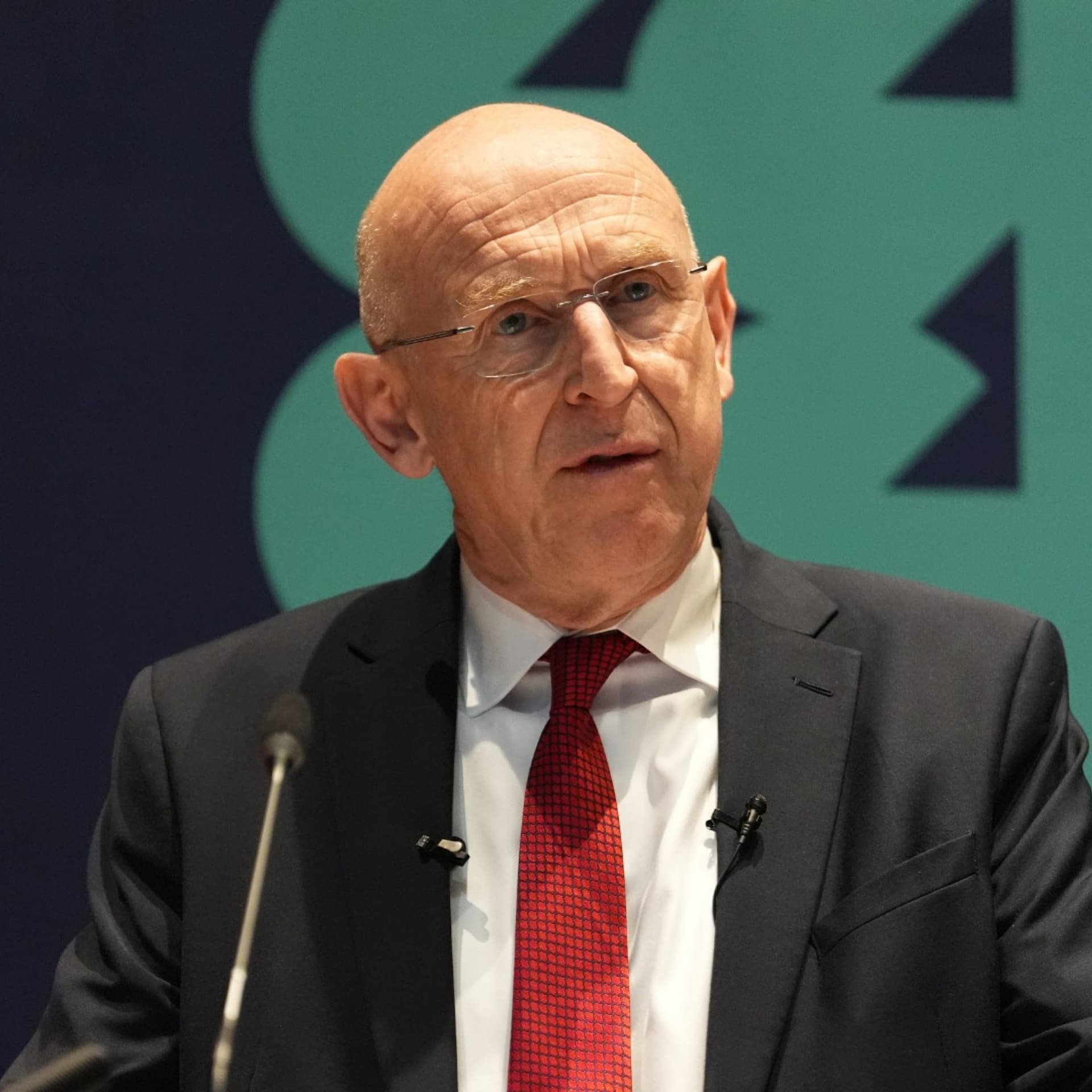
Photo: John Healey, who has resigned as Britain's defence secretary, delivering a speech at an event in May
Credit: PA